Buddhism has captivated many millions of people around the world, its vitality and adaptability enabling it to transform the civilizations of India, Southeast Asia, Tibet, China, Korea, and Japan, and also become a lively component in the cultures of Europe, Australia, and the Americas. But have you ever wondered how a religion that doesn't even have a god could have accomplished this?
Now you have the opportunity to have your questions answered, as this series of 24 lectures by an award-winning teacher traces the history, principles, and evolution of a theology that is both familiar and foreign.
You'll learn the astonishing story of Siddhartha Gautama - who was to become the Buddha, or "enlightened one" - the Indian prince who abandoned wife, son, and a privileged life to seek the meaning of life and death, and whose "awakening" and subsequent teachings have since impacted the world as few others have.
And you'll learn what happened after his death, as his followers began to share his teachings about the "Four Noble Truths" and the "Path" to Enlightenment. You'll see how Buddhist beliefs underwent significant and even radical change, with different varieties of Buddhism having to take shape as those beliefs spread across India, Central Asia, China, Japan, and virtually every corner of the Western world, such as becoming more respectful of one's duties to family and ancestors in China or becoming reconciled with local deities in Japan.
Short, interesting, concise lecture. I've always been curious about Buddhism. Not as in, I wanted to become a Buddhist, but just...what's it about? Also, not gonna lie, it kind of swizzled around in my brain, getting mixed up with parts of Hinduism. And I've hit the halfway mark of my life and decided I should probably be able to distinguish two such major religions. Is Buddhism a religion? I had been under the impression that it was more a philosophy, but then again, what's the real difference between that? If you adhere to a set of morality rules that someone else came up with, I'm at a loss to differentiate on a cellular level between the two. I guess it's whether or not you toss a God/gods in the mix.
I have to say, though, after reading about several of these biggies, they're all pretty much the same. And maybe this sounds silly, but I've come to the conclusion that all of this stuff is for people who need someone else to give them a moral compass, thereby taking the weight off of having to decide what's right for themselves. There's just no need for any of it, otherwise. It's just one giant game of adult pretend where different factions spend way too much precious time debating the various intricacies of nonsense rules. Just be nice and butt out of everyone else's business. How fucking hard is that?
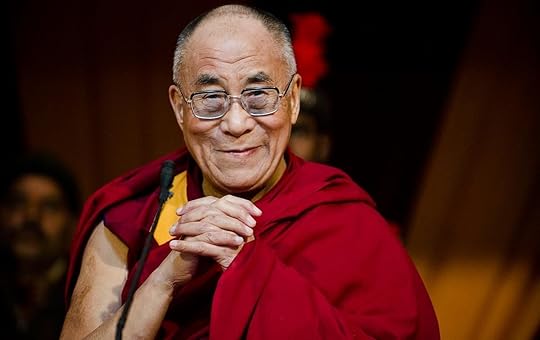
Ok, as far as this course goes, I thought this was a really good introduction to Buddhism. You can tell that Eckel really buys into all of it by the way he phrases some things (I think he actually believes the current Dalai Lama is a reincarnation of all the others), so he has this joy about the way he speaks of Buddhism. That was kind of different for me when it comes to religious lectures, as most of the professors I've listened to don't seem to put much stock in the supernatural elements of what they are teaching. Or if they do, it doesn't come across in the lectures. But he did a really good job explaining the history and how it has morphed and changed over the centuries into what we see today.
I would say that this course has been a pleasure. For two reasons. 1. The auther kept the content varied and fun. 2. buddhism is already rather interesting. I'm not sure what buddhism is. Is it a school of philosophy? Is it a religion? Is it a set of cultural traditions? I'm not sure. It is fluid like no religion or school of taught. Also it has been used as a religion, but it mostly have been a set of experienced knowledges, without any emphasis on the result. I love that about it. Structure: 4/5 Flow:3/5 Style: 3/5 Content: 4/5
More lectures I listen to while I'm driving: This series was twenty-four lectures and very thorough and engaging, covering the spread of Buddhism from India into Tibet, China, Korea, Japan, southeast Asia and Sri Lanka. I was impressed by the influence of Buddhism, growing out of Hinduism and interacting with Confucianism, Taoism and Shintoism. No corner of Asia is untouched, unless it be some corner of Siberia.
In the detailed descriptions of Buddhist schools, I was interested to note a dozen or more parallels to the history of western philosophy. For example, one school asserted no positions, but adopted the method of assuming opponents' positions and showing the absurdities which resulted. This approach parallels Socrates' style, and the logical method of reductio ad absurdam. The many parallels were fascinating and led me to believe that some movements of thought are perennial and transcend individual cultures.
Buddhism was a fairly middle of the road course from the folks over at The Great Courses. I have gone through a few dozen of them over the years, and they can be hit-or-miss; generally speaking.
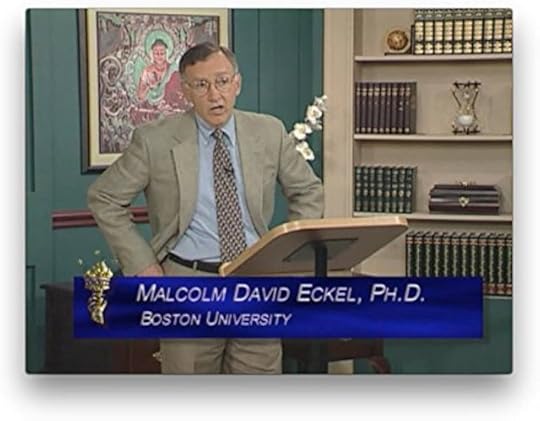
Course professor Malcolm David Eckel was a Professor of Religion and Director of the Institute for Philosophy and Religion at Boston University. He received a B.A. from Harvard, a B.A. and M.A. from Oxford, and a Ph.D. in the Study of Religion from Harvard. His scholarly interests include the history of Buddhist philosophy in India and Tibet, the relationship between Buddhism and other Indian religions, the expansion and adaptation of Buddhism in Asia and the West, Buddhist narrative traditions and their relationship to Buddhist ethics, and the connection between philosophical theory and religious practice.
Malcolm David Eckel: Eckel covers a fairly wide swath of Buddhist-related subject material here. He begins by giving the reader a brief overview of the religion before moving into a history of how it spread.
Unfortunately, there was something about his overall delivery of the course that just did not resonate with me. I found a lot of his lectures to be heavily bordering on dry and tedious. He drowns the listener in a sea of foriegn words that he stumbles over pronouncing. I'm not sure why such an emphasis was placed on pronouncing these foreign language words, as I would bet that the average listener will not retain this info.
The formatting of the course is fairly typical for offerings from The Great Courses. This one is 24 lectrures; each roughly 30mins long.
The lectures are: 1 What is Buddhism? 2 India at the Time of the Buddha 3 The Doctrine of Reincarnation 4 The Story of the Buddha 5 All Is Suffering 6 The Path to Nirvana 7 The Buddhist Monastic Community 8 Buddhist Art and Architecture 9 Theravada Buddhism in Southeast Asia 10 Mahayana Buddhism and the Bodhisattva Ideal 11 Celestial Buddhas and Bodhisattvas 12 Emptiness 13 Buddhist Philosophy 14 Buddhist Tantra 15 The Theory and Practice of the Mandala 16 The “First Diffusion of the Dharma” in Tibet 17 The Schools of Tibetan Buddhism 18 The Dalai Lama 19 The Origins of Chinese Buddhism 20 The Classical Period of Chinese Buddhism 21 The Origins of Japanese Buddhism 22 Honen, Shinran and Nichiren 23 Zen 24 Buddhism in America
********************
Although there was a lot of material covered here in great detail, I did not appreciate to overall delivery of this course. I found the presentation dry and often boring. 2.5 stars, rounded up to 3.
An excellent overview of the history of Buddhism, from its beginnings in India (with a thorough grounding in earlier Indian religious thought) through its development in other parts of Asia. Pays particular attention to how Buddhism grew and changed in Tibet and Japan (countries whose traditions have had the biggest presence in the U.S.), as well as China and to a lesser extent, Southeast Asia. More than just a history, the lectures include insights into many core concepts of Buddhism, including no-self, emptiness, and competing ideas about enlightenment.
A great overview of the fourth most practiced religion, I learned a lot and had many of my Western preconceptions reshaped. Sometimes the professor meandered through illustrative stories and I wouldn’t liked to have had a more clearly mapped out lecture on the doctrines of the different Buddhist sects. But overall I did get a general feel for Buddhism. It’s a good starting point for more learning.
The two biggest points I came a way with was that: 1) the concepts of nirvana and reincarnation isn’t as positively viewed in Buddhism as it is in the Western mind. 2) Buddhism is extremely diverse and the Pure land and Zen Buddhism is more what we get tastes of in the West. Tibetan Mahayana Buddhism is very different and in my opinion much darker and scarier than what I expected Buddhism to be. The third major sect, Theravada Buddhism, (practiced strongly in South Easy Asia) was the least clear to me except for the fact that it’s considered (by its own self at least) to be the most orthodox practice.
01. What is Buddhism? 02. India at the Time of the Buddha 03. The Doctrine of Reincarnation 04. The Story of the Buddha 05. All Is Suffering 06. The Path to Nirvana 07. The Buddhist Monastic Community 08. Buddhist Art and Architecture 09. Theravada Buddhism in Southeast Asia 10. Mahayana Buddhism and the Bodhisattva Ideal 11. Celestial Buddhas and Bodhisattvas 12. Emptiness 13. Buddhist Philosophy 14. Buddhist Tantra 15. The Theory and Practice of the Mandala 16. The “First Diffusion of the Dharma” in Tibet 17. The Schools of Tibetan Buddhism 18. The Dalai Lama 19. The Origins of Chinese Buddhism 20. The Classical Period of Chinese Buddhism 21. The Origins of Japanese Buddhism 22. Honen, Shinran and Nichiren 23. Zen 24. Buddhism in America
Malcolm David Eckel has a great voice which is always a plus for an audiobook. Despite his digressions, he provides an accessible introduction to Buddhism. I find Buddhism the most interesting of the major religions, if it can be classified as one of these. I add this qualifier because traditional Buddhism does not have a god. This a point that is touched on, along with more broadly what defines religion generally. At its core, Buddhism is the following of the teachings and moral principles (the Dharma) of the Buddha. The Buddha, Siddhartha Gautama, was born in India around the 6th century BCE and taught the ultimate objective of being released from suffering, reaching nirvana (literally "to extinguish" or "blow out"). Extinguishing suffering allows one to escape the cycle of rebirth.
The chapter on 'all is suffering' helped add some insight to the vague anti-materialist notions I associated with Buddhism previously. Traditional sources denote three forms of suffering; suffering from physical / mental pain, suffering from change (all good things come to an end), and suffering from conditioned states. The first two are perhaps more obvious than the third point. The example used to explain conditioned states is owning a nice car and thinking there is something in your sense of self that will be enhanced by attachment to the car. In traditional Buddhism, nirvana is only achieved with the understanding that there is no self. This is due to the state of perpetual change of human personality and reality meaning no permanent identity exists from one moment to the next. The cause of suffering is not the change itself, but the human desire to hold on to things and prevent them from changing. To overcome suffering and reach nirvana one must live a life in line with the moral conduct, concentration and wisdom taught.
The two main branches of Buddhism are explored, Theravada Buddhism and Mahayana Buddhism. The former is followed in South East Asia, while the latter is dominant in China, Tibet, Japan, and Korea. These are both interesting and have some divergent ideas. The final chapters are on Buddhism in China, Tibet and Japan which examine country specific developments such as the mixing with Confuscianism, the movements led by the Dalai Lama and the establishment of Zen Buddhism. However, there is a disproportionate amount of time spent on Mahayana Buddhism relative to Theravada Buddhism (six chapters vs one). Hence, the content is a bit unbalanced.
I would recommend this as a basic introduction to Buddhism, although it is by no means an exhaustive resource.
The Great Courses are always so well designed and produced. I listened to the 12-lecture/6-hour course but I plan to listen to the 12-hour course as well to take a second pass at the material. This was a very brief overview and I didn't have the guidebook so it was hard to keep everything straight.
Though it was brief, I think the professor did a great job of showing how Buddhism started and evolved through different times and cultures. It's such a large, diverse religion and philosophy that I think the task of reducing it to just 6 hours must have been daunting.
I feel more compassion for people who are attempting to learn and enter a new religion. It's easy enough when you have grown up in a culture that is predominantly saturated in your family's religion. But learning a different religion means learning an entirely new system of thinking and being in the world, which affects the very core perception of the self. It's hard! So it doesn't surprise me that I got a little lost when I was listening to these lectures.
This is a comparative religions course, so at points the prof contrasts Buddhism with Christianity, Daoism, Shintoism, and other schools of Buddhism to bring out the highlight of what is unique or innovative. This is quite effective for me, and these examples are what I retained the most from the course, along with the parables and anecdotes.
I had a very different idea about Buddhism before this. It opened my eyes to the variety of Buddhism all around the world. It also eliminated some more fantastic notions about the religion I had had. In the end, I was a little disappointed because the religion eventually evolved in directions I disliked. Image worshiping, superstition and all those things that make up so many other religions abound in many of those different flavors of Buddhism. It was an educational course for me.
I've had lots of education about world religions, and tons regarding Buddhism. Finally, with this series, I found a point where I could connect at a personal level. I'm in a state of gratitude for this one.
As someone who has listened to a wide variety of faith-based Great Courses so far [1], one aspect that I have noticed is a consistent difficulty is the way that many instructors assume that the people listening to these courses are those who are members of or sympathizers with the religious traditions involved. While this may be true of many people who take such course, it is generally not the case for me because there are as far as I know no sympathetic mentions of, much less explorations of, my own faith tradition in this collection of audiobooks. This book in particular suffers from assuming the listener is familiar with or interested with Buddhism because it does not give a portrayal that is sympathetic to Buddhism at all for someone who comes to it from a biblical worldview. Enough is discussed in enough detail that someone who does have a biblical worldview is going to be even more unsympathetic of Buddhism than they would before, and admittedly I did not come to this course particularly sympathetic to the Buddhist worldview, especially given the way that Buddhist meditation is a common element of treatments that are encouraged for PTSD and related issues.
After introducing what Buddhism is in the first lecture, the professor of this course spends a considerable amount of time discussing the context of India at the time of the Buddha and the importance of the reprehensible doctrine of reincarnation within Indian religion and the defective cosmology of an infinite past with an infinite amount of lives for souls wandering in the misery of death and rebirth. After this the author gives an overly credulous discussion of the story of the Buddha, not only his life, but also some truly ridiculous stories about supposed previous lives. After this there are discussions of the passing and temporary nature of life and the supposed absence of anything permanent like identity, the immensely long and difficult path to Nirvana, an ideal of nothingness and annihilation, as well as discussions of the Buddhist monastic community and their idolatrous art and architecture. It is at this part that the course gets even stranger than it was--and it was already pretty disturbingly strange--in talking about the main schisms of Buddhism with Theravada Buddhism in Southeast Asia and Mahayana Boddhism and the truly bizarre ideal of the bodhisattva. The next lecture discusses various imaginary celestial Buddhas and bodhisattvas that are invoked in ways that seem to be a horrible parody of Roman Catholic sainthood. The lectures close with a view of emptiness that appear to contradict what the original Buddha himself said, demonstrative of the wide diversity of contradictory belief systems within Buddhism.
As the professor expresses it, Buddhism differs from biblical religion in a lot of fundamental ways for faiths which are often viewed as being close. For one, the doctrine of karmic debt is a horrifying way of blaming the victim/survivor of life's tragedies for some supposed debt from past lives that have to be repaid through present or future suffering. The lack of a permanent identity contrasts negatively with the biblical truth of people being created in the image and likeness of God with the opportunity to enjoy eternal life, as permanent an identity as one could have. At its best, the supposed wisdom of the professor and the worldview he is promoting here merely approaches the cynical and despairing paradoxes of Solomon in Ecclesiastes in thinking that under the sun all is vanity and futility, which is the same sort of view that Buddhism possesses, with the additional handicap that it does not view of a life above the sun but rather views things only from under the sun, in a world that is supposed to be without beginning and without end, nothing but turtles all the way down. That such a pathetic and ridiculous worldview could command the assent of hundreds of millions of people only demonstrates the depths of superstition and idolatry and folly that humanity can fall into.
I must admit that going into this particular course I did not know a lot about the specific subject matter of the aspects of Buddhism that the professor was teaching, although it turned out that I knew more than I had expected, whether that was about the author's fondness for Tibet [1] or the importance of Buddhism to Japanese culture, or even the role of Buddhism in spreading the occult to the United States, something the instructor seems strangely proud of. One of the upsides of listening to or reading something where the person presenting the material thinks that they are writing to an insider audience of fellow believers or sympathizers is that they are more honest and more outspoken than they would be if they felt that people were being critical or negative. In this case the instructor's honesty and enthusiasm demonstrates his fondness for syncretism and his love of fake deep religious thinking and his general interest in the influence of Buddhism on contemporary world culture, without thinking whether that is a good thing or not. Most of the people listening to these lectures, I would think, would at least be likely to agree with him.
The contents of this particular series of 12 lectures in six hours of presentation are varied. The professor spends a lecture each on Buddhist philosophy and tantra in particular, which he tends to soft-pedal the sexual nature of and focus on the way that it gives power through experience. After that the professor discusses the theory and practice of the mandala and the way that it appears in ideas like that of the various chakras. Three lectures follow on different aspects of Buddhism in Tibet: the first efforts at conversion during the short-lived Tibetan Empire, the various schools of Tibetan Buddhism, and the Dalai Lama. Two more lectures follow on the origins and classical period of Chinese Buddhism with its blend with Taoism and Confucianism. After this comes three lectures of Japanese Buddhism, with the origins of its blend with native Shinto religion, a discussion of Honen, Shinran, and Nichiren Buddhism, and a separate lecture on the familiar Zen Buddhism, before the instructor ends with an intriguing and odd look at Buddhism in America. Whatever can be said about the instructor's view of the protean nature of Buddhism and its tendency to change even as it seeks to change the cultures it is in, the instructor at least appears pretty honest even if not completely so.
One area where I have some significant disagreement with the instructor is the nature of the appeal of Buddhism. The author tends to think that the view that everyone suffers and that Buddhism offers some kind of illusory escape from suffering is the main reason for Buddhism's appeal in all of its many and varied forms. In my mind, though, there are a few things that make Buddhism appealing. For one, Buddhist philosophers have always grafted Buddhism onto local traditions and sought to blend certain elements of Buddhism with what was already present in the host society. For another, Buddhism appears to be most interested, at least in its Western incarnations, with trying to appeal to people who want to avoid taking responsibility for the state of their life. Buddhist beliefs in endless reincarnation offer a chance for people to try to blame the suffering of their lives on some kind of karmic debt that they have to pay off, or alternatively for them to justify how well off they are relative to the rest of the world by appealing to the more noble state of their own souls relative to that of others who are less well off. This seems to me a rather artful but shabby dodge of the real nature of things.
An excellent overview of the different forms of Buddhism and how/why they came to be in a historical context from 500BC to the modern day. Once a new form is introduced, it is compared and contrasted to previously introduced forms, helping the learner to compound his or her knowledge.
Compex areas such as Buddhist Philosophy and Emptiness are not allowed enough time meaning the learner can gain only a partial understanding at best.
Dr. Eckel did a fantastic job of exploring the history of Buddhism throughout the centuries. One thing I really admired is that he was equally enthusiastic about each Buddhist sect. Whether he was speaking of Indian, Chinese, Thai, Sri Lankan, or Japanese Buddhism, Dr. Eckel demonstrated true objectivity and impartiality, and gave each branch a proper representstion.
I am new to studying Buddhism so I can't verify the accuracy or precision of Dr. Eckel's lectures, but I think they're very comprehensive and encompass all the changes of Buddhism throughout time. His guidebook also contains some great additional reading references for further study.
Another aspect I liked is that Dr. Eckel uses an adequate amount of readings/excerpts/quotes from various texts and prominent figures without it being overwhelming. Some courses go a little too heavy on the readings and it can be difficult to digest if one is not yet acquainted with such material. Dr. Eckel exercised - I would say - perfect moderation.
One thing this course is not is an experiential teaching. It is purely academic, so it teaches you about the history of Buddhism in its formation, teachings, practices, and rituals without demonstrating the experience of it, although experiences are often described.
So I would highly recommend this lecture series for anyone looking to learn about the history and basic beliefs of Buddhism from a historical/academic perspective.
When I read a book on Buddhism or a spiritual growth topic, I ask myself again: am I not someone who wants to be better and become the best person he could be in his life? And when I turn to another book, my renewed energy to meditate and work on the spiritual part of my life passes.
It's sad.
The good thing is that the book "Buddhism" by Malcolm David Eckel, rather a course on Buddhism from "The Great Courses" motivated me again.
Why has Buddhism endured for 2,500 years and remains an interesting path for many in Asia and the rest of the world?
A religion without God, where a man reaches the state of enlightenment and awakens. If I followed any religion, it would be this one, because it seems to me a very enlightening concept about the possibilities of the human being.
However Buddhism has had a great evolution, Mahayana Buddhism is completely different from the initial concept. I have practiced a bit of Tibetan Buddhism with a friend and also very different from what I expected.
Zen Buddhism is very interesting to me, but I definitely can't sit around that long.
I will practice this religion in my own way, it is my commitment.
Excellent book that will solve many of your doubts about Buddhism.
I enjoyed this dive into the history, religion, and philosophy of Buddhism. Dr. Eckel keeps it somewhat light, which is appreciated, as the main theme of the religion seems to be that the world is on fire. This is not a practical guide in any way- you will not learn how to meditate or get any closer to Buddhahood by the end of the lecture, but you will know a whole lot more about Buddhism in all its incarnations by the time your finished. Dr. Eckel is definitely deeply knowledgable and passionate about Buddhism and kept the subject matter fresh throughout the series, but I got the sense that he is much more excited about, say, touching the shoes of the 5th incarnation of the Dalai Lama then getting an actual experience of not having a self. Nevertheless, if your like me and came to this lecture as a meditator seeking to understand more about the religious, political, cultural and historical context of Buddhism, this is a good place to start.
This course was thorough in presentation of the history, but there were times that I felt the author leaned too heavily on the historical growth of Buddhism to different cultures and forms than in the explication of Buddhist theory. Which is fine, but I wanted more theory.
That may very well be a function of the lack of specificity in Buddhism itself, and not a weakness in the presentation. In fact, the author on several occasions mentioned that it is notoriously hard to determine what Buddhism "is" or "believes," etc.
That said, I don't remember nearly a single of the many names of various influential Buddhist monks that the author took pains to mention and catalog in the history; the ideas are much more important, at least to me.
More focused on the history of Buddhism and how it developed differently in different countries than the actual philosophy of the religion, which was more what I was looking for. There's one lecture on Emptiness that I really liked and kept me grounded after a long day at work, but a lot of the history lectures I found rather dry. Eckel presents the information well, but I've been listening to the Zen Studies podcast every now and again recently and I found that to be more up my alley.
Perhaps it is the nature of Buddhism, but it seemed like the lecturer was talking around Buddhism more than talking about Buddhism. I guess there is a limit to what one can say about emptiness and No Self. I think he should have added a bonus lecture that was completely blank.
A clear, accessible and knowledgeable description of the history and concepts of Buddhism around the world. I feel I can place the various branches of Buddhism I'd heard of in better context now. This was an audiobook, and Eckel is a pleasant and entertaining lecturer.