Jump to ratings and reviews
Rate this book

The Lady and the Unicorn

Rate this book
Three sisters battle poverty and prejudice in 1930s India in this heart-wrenching tale from a New York Times–bestselling novelist.

Life is difficult for the three Lemarchant sisters in the latter years of the British Raj. Born of two cultures and rejected by both—the “half-caste” daughters of an Englishman and an Indian mother—twins Belle and Rosa and their younger sibling, Blanche, live with their widowed father and “Auntie” in an apartment in a crumbling mansion in Calcutta.
 
Having grown to young womanhood in poverty—the result of their father’s indolence and society’s intolerance—tough-minded Belle is determined to improve her lot in life, even if it means compromising her principles and her pride. Her beautiful twin, Rosa, however, dreams of a different, grander escape and foolishly puts her faith in love.
 
For Blanche, the entire world is the decaying estate the Lemarchants share with other Anglo-Indian outcasts. Rejected by her own siblings due to the darkness of her skin, the lonely little girl wanders the halls and grounds, enjoying the fantasy of a phantom pet while communing with ghosts only the purest of souls can see.
 
An extraordinary novel rich in color and heartbreaking human drama, The Lady and the Unicorn is the poignant tale of one family’s struggle to make a future in a society blinded by prejudice and divided by caste. A powerful story of coming-of-age and coming to terms, it is a masterful fiction from one of the preeminent British authors of the twentieth century.
 
This ebook features an illustrated biography of the author including rare images from the Rumer Godden Literary Estate.
 

224 pages, Kindle Edition

First published January 1, 1937

Loading...
Loading...

About the author

Rumer Godden

174 books581 followers
Margaret Rumer Godden was an English author of more than 60 fiction and non-fiction books. Nine of her works have been made into films, most notably Black Narcissus in 1947 and The River in 1951.
A few of her works were co-written with her elder sister, novelist Jon Godden, including Two Under the Indian Sun, a memoir of the Goddens' childhood in a region of India now part of Bangladesh.

Ratings & Reviews

What do you think?
Rate this book

Friends & Following

Create a free account to discover what your friends think of this book!

Community Reviews

5 stars
47 (18%)
4 stars
72 (28%)
3 stars
99 (39%)
2 stars
28 (11%)
1 star
3 (1%)
Displaying 1 - 30 of 35 reviews
Profile Image for Sara.
Author 1 book1,036 followers
June 5, 2025
The Lady and the Unicorn is one of Rumer Godden’s India novels. The main characters are three sisters of half-caste descent–not English, not Indian, and not accepted by either community. The Lamarchant girls live in abject poverty with their worthless, lazy father and their sadly incompetent auntie.

The twins Rosa and Belle are unalike in personality and drive, and while loving each other, spend much of their time bickering. Belle means to escape this place and her fate at all costs. Rosa accepts who she is, until she meets and falls for an Englishman, who has recently come to India and is enchanted by her very differences. The third sister, Blanche, is dark skinned and clearly doomed to be the butt of all the mockery and bias that goes with that. Even within her family, she receives cutting comments and is spoken about as if she were a pariah. She is perhaps the most interesting character for me, she is so obtuse at times and at others she seems to me the wisest person in the room.

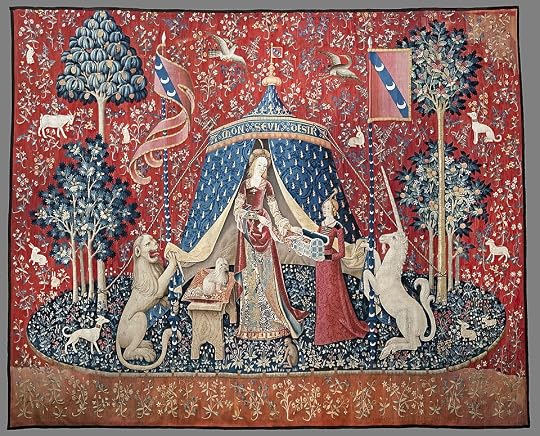
There is a mystery regarding the house in which the girls live. It is tied somehow to the famous tapestries “the lady and the unicorn”, which are housed in a French museum and there is the possibility of a hidden treasure. There is a ghost, which seems right, and believable, in this bewitched environment. But, this thread of the story seems the weakest to me, somehow never satisfactorily concluded.

The Lady and the Unicorn Tapestry


What Godden does superbly (an almost trademark skill of hers) is to develop a crumbling house into a central character. I could see the house itself, both its squalor and its prior majesty, looming large in the picture of who the Lemarchants used to be and who they have become. There is a very cruel sense of unalterable fate that hovers around them and makes you feel any turn of good luck was truly destroyed with the past or the encroaching Jasmine.

Clearly, I appreciate Godden’s style and her ability to pull me into scenarios that might seem ridiculous or fantastic in another’s hands. This is not one of her best books, but it was well worth the reading. I have been spoiled by the intricate and rewarding A Fugue in Time and China Court: The Hours of a Country House, but still very happy to have read this one. Had I read it first, without anything to compare it to, it might have impressed me more.
Profile Image for Kirsty.
2,813 reviews197 followers
August 13, 2023
Rumer Godden’s The Lady and The Unicorn, which was first published in 1937, is the 630th entry upon the Virago Modern Classics list. As with The River and The Villa Fiorita, both republished by Virago at the same time, The Lady and The Unicorn includes a well-crafted and rather fascinating introduction penned by Anita Desai.

After setting out the author’s childhood, lived largely in India, Desai goes on to write about the influences which drove Godden to write over sixty acclaimed works of fiction, for both children and adults. Desai states that Godden ‘cannot be said to have been ignorant, or unmindful, of her society and its role in India. In no other book is this made as clear’ as it is in this one, a novel written ‘in the early, unhappy days of her first marriage’. Desai then goes on to write that ‘the contact with her students [at the dance school which Godden opened in Calcutta], their families and her staff taught her a great deal about the unhappy situation of a community looked down upon both by the English and by Indians as “half-castes”'. The Lady and The Unicorn faced controversy upon its publication, with many English reviewers believing her ‘unfairly critical of English society’, and others viewing ‘her depiction of Eurasians’ as cruel. Her publisher, Peter Davies, however, deemed the novel ‘a little masterpiece’.

The Lemarchant family are Godden’s focus here; ‘neither Indian nor English, they are accepted by no-one’. They live in the small annex of a fading ‘memory-haunted’ mansion in Calcutta. The widowed father of the family is helped only by ‘auntie’ and a servant of sorts named Boy, an arrangement which causes misery for all: ‘There were so many ways that father did not care to earn money that the girls had to be taken at school for charity and the rent was always owing… No matter how badly he [father] behaved they [auntie and Boy] treated him as the honourable head of the house, and auntie complained that the children did not respect him as they ought’. The way in which the family unit is perceived within the community is negative, and often veers upon the harsh: ‘The Lemarchants are not a nice family at all, they cannot even pay their rent’ is the idea which prevails.

The three daughters of the Lemarchant family could not be more different; twins Belle and Rosa are often at odds with one another, and the youngest, Blanche, is treated no better than an outcast. Blanche is described as ‘the family shame, for she was dark. Suddenly, after Belle and Rosa, had come this other baby like a little crow after twin doves. Auntie said she was like their mother, and they hated to think of their mother who was dead and had been dark like Blanche. Belle could not bear her, and even Rosa was ashamed to be her sister’. Of the twins, Godden writes that Rosa, constantly overshadowed by her twin sister, ‘could never be quite truthful, she had always to distort, to embroider, to exaggerate, and if she were frightened, she lied’. The family in its entirety ‘were sure that Belle was not good, and yet at home she gave hardly any trouble; it was just that she was quite implacable, quite determined and almost fearless… Belle did exactly as she chose. When she was crossed she was more than unkind, she was shocking’. The divisions within the family therefore echo those which prevail in society.

The sense of place is deftly built, particularly with regard to the house in which the Lemarchants live: ‘There was not a corner of the house that Blanche did not know and cherish, all of them loved it as if it were their own; that was peculiar to the Lemarchants, for the house did not like its tenants, it seemed to have some strange resentment’. Of their surroundings, of which the girls know no different, Belle sneers the following, exemplifying her discontent: ‘We know a handful of people in Calcutta and most of them are nobodies too. What is Calcutta? It is not the world’. There is not much by way of plot here, really, but the whole has been beautifully written, and the non-newsworthy aspects of the girls’ lives have been set out with such feeling and emotion.

The Lady and The Unicorn is a captivating novel, which captures adolescence, and the many problems which it throws up, beautifully. Part love story and part coming-of-age novel, Godden is shrewd throughout at showing how powerful society can be, and how those within it often rally together to shun those ‘outsiders’ who have made it their home.
Profile Image for Beth Bonini.
1,432 reviews332 followers
March 8, 2021
'I shan't live here very long.' Belle stretched her arms and yawned. "And get this in your head, Rosa; it doesn't matter what we do because we have nothing to lose. If you are wise you'll do anything to get you on, anything for money, anything to get you away from here. If you don't help yourself no one will help you. I tell you this, and you know it's true. We come from nowhere . . .
'Father says that we are an old family.'
'And auntie says we have bad blood. Perhaps they're both right. We shall never know, and still we are nothing and nobodies.'
'You say that because we're Anglo-Indians," said Rosa bitterly.


Belle and Rosa are twins, the oldest daughters of the Lemarchant family. Belle, the elder by 20 minutes, is beautiful and bold. She has 'honey-coloured lashes', skin like 'rich cream' and and hair like 'flame silk' or the 'colour of sacred marigolds'. Rosa is attractive, too, but dark-haired, quieter, slimmer and less self-assured. The head of the Lemarchant family is their father, who was once handsome and proud, but has now gone to seed. He tinkers ineffectually with mending projects and rarely has the money to pay the rent. The girls have been raised by their Auntie after their mother's early death. Auntie was married at 16 to a European man called Kempf and abandoned by the age of 20. There is a younger sister, too; Blanche, who is the 'family shame' because her skin is so dark.

The Lemarchant family lives in an annexe of an old 18 century house that has been eroded to the very bones of its former grandeur. It is neglected and decaying, but still possesses a romantic beauty. It also houses secrets and ghosts. The DeSouza family - also Anglo-Indian - own the house, and the children of that family are friends with the Lemarchants, despite the embarrassment of their poverty. Rosa has a rather innocent 'childhood sweetheart' type romance with the oldest DeSouza son, Robert, but neither of them has the financial resources to consider marriage.

The house plays a huge role in the novel; in some senses it is more important that the actual characters, but it does also mirror both the past and the future for the Lemarchant sisters. There are hints of a French lineage: the house has been constructed in the 'Provencal style', 'yellow plastered with blue painted shutters scrolled iron balconies. The house is set in the backstreets of old Calcutta, an area associated with the poor Anglo-Indian community.

At the very beginning of the novel, Belle and Rosa are asked to leave their Catholic school. Only 17, they are not children, but not quite adults either. There is a huge question mark over their future and they have little to offer the world but their beauty - but even that is tainted in the caste system in which they live. Nevertheless, Belle is determined to leverage her own beauty even if it means she is exploited in the process. As a means to this end, she takes Rosa with her to a party hosted by an English businessman named William Harman. Harman's cousin Stephen Bright is visiting from England, and on his very first evening in Calcutta he meets Rosa. William is interested in Belle, but he makes no bones about the fact that she and her sister are 'B' girls. These beautiful Anglo-Indian girls are seen as 'alluring and dangerous', but especially in the case of Rosa - who is both innocent and honourable - the reader is not fooled about who is dangerous to whom.

I found it hard to enter the world of this novel at first, but when I reread the first 50 pages I truly appreciated how the author builds up the detailed atmosphere of her story. Godden is a wonderfully atmospheric storyteller, and just as Stephen is fascinated by the old house and all of its secrets, so does the reader get seduced and sucked in. Stephen leads an excavation of the house, and his discoveries also yield information about the Lemarchant family's past. The novel's title refers to the 'La Dame a la Licorne' medieval tapestries which also play a role in the storyline. The motifs of the unicorn (associated with virginity) and sexual desire (à mon seul désir) also come into play in the relationship between Rosa and Stephen.

It's a strange, rather sad book, but I found it really evocative. Although the culture is entirely different, it reminded me of the faded South plays of Tennessee Williams. So many of the characters are still yearning for the lost riches of the past, but only the few who can grasp the realities of the present have any real future.
Profile Image for Darryl Friesen.
199 reviews61 followers
August 3, 2026
A very thought-provoking book that I finished in two sittings! Rumer Godden is a writer of beautiful, lyrical prose that rolls off the page. This deals so poignantly with themes of memory and time, identity, class, prejudice, belonging, and family, among many others. Rosa is such a complex heroine—I loved how unpredictable she was: at times proud, at times vulnerable, at times ever so maddening, and then completely charming and winsome. Stephen asks it best: “What matters more: what we are, or who we are.” The Lemarchant family are so consumed by the legacy of their family’s past and how they will shape the family’s future that they cease to be able to live in the present.

I’ve now read Godden’s first two novels, “Chinese Puzzle” and this one. Next stop: a buddy read of her third novel, “Black Narcissus” with some friends. What a writer! I can’t wait to get to her post-conversion works.
Profile Image for Stephanie.
141 reviews71 followers
October 7, 2007
This is Rumer Godden's first novel. It's the story of a young Eurasian girl who is exploited by a British man. Predictibly, disaster ensues. What isn't predictible is Godden's ability to tell this tale from the perspective of the victim. As a young woman growing up during the Raj, Godden saw many similar romances unfold, and was always sickened by them. This book is her response to that trend.

I don't know what happened to Rumer between this and her next book, but it was a quantum literary leap. I found this novel to be a bit stilted and disjointed...it's the only book of hers I don't thoroughly love. Still, you can see the glimmering of what lay ahead for this talented writer.
Profile Image for Susan Chapek.
413 reviews29 followers
September 3, 2022
Rumer Godden is a favorite author, yet I didn't recognize her voice in this book. In the end I think the different voice suits the characters. They're striking and magnetic, and some of them surprised me by growing on me until I felt quite fond of them by the end. And there's an amazing sense of the place.
An incident happens quite near the end that seems obviously to have been borrowed, altered somewhat, and reworked into Godden's later (and more famous) novel In This House of Brede. It's quite a memorable incident in the later book. In this story, I might not have noticed its full significance if I hadn't already read In This House of Brede.
Profile Image for Daniela Sorgente.
408 reviews46 followers
July 4, 2025
As often in Rumer Godden's books (but also sometimes in her sister Jon's books) a subtle atmosphere of uneasiness reigns in the narrative; the characters are people who, for one reason or another, are not at ease in their lives. I also thought that the discovery of the history of the house, for example, in a book by Elizabeth Goudge, The Herb of Grace, became a reason for joy, sharing and connection between past and future. Here, however, the discovery of the house's past seems like a curse, leads to destruction, offers more occasions to feel out of place and it is instead a missed opportunity to place oneself in society and in the flow of history. A rather bitter book, all in all.
Profile Image for Lori Hatch.
70 reviews
February 22, 2026
A little bit magical, a little bit melancholic. Excellent writing as far as setting and atmosphere and characters, but the story didn’t quite live up to its potential.
Profile Image for Pascale.
1,435 reviews67 followers
June 26, 2015
Another delicate yet powerful story by Rumor Godden. This one focuses on 3 Eurasian sisters, Belle, Rosa and Blanche, who from birth are destined not to find their place in life because of the stigma attached to half-castes, as well as the genteel poverty due to their father's shiftlessness. Hard-nosed Belle determines early on to make her own way, irrespective of her feelings or those of others. She lets herself be raped by a businessman in return for a nominal job she intends to use as a springboard to greater things. The last we see of her, she is hoping for a future in motion pictures. Her twin Rosa, on the other hand, falls head over heels for a blond Englishman recently sent to India by his father. Stephen hasn't had time to become cynical about Eurasian girls, and is appalled by the crassness with which his cousin and other guys treat them. His interest in Rosa is enhanced by the fact that she lives in a historical building whose significance he is the first to perceive. For him, his romance with Rosa and his romance with her house, adorned with motives taken from the famous Cluny tapestries are a marvelous introduction to exotic India. In the first flush of his self-righteous denunciation of male practices with local girls, he even promises to marry Rosa if she agrees to sleep with him. Inevitably, of course, things don't turn out that way. Rosa's lack of education irks Stephen too much for him to make good on his commitment. Rosa is too fine a person to use what weapons she has at her disposal to shame him or get money out of him, and at the end of the book she has pressured her old and loyal beau, Robert, to marry her and look after Stephen's child. The third daughter, Blanche, who is still a child, loves animals, and develops a relationship with a ghost dog based on a carving in the house. Yet her pet goldfish dies, and when she finds the hidden diamonds in the mysterious sundial unearthed by Stephen in the garden, she has no idea what they are and throws them in the rubbish. The derelict mansion is eventually pulled down by promoters who have bought it at a vast price from the miserly landlord, without Stephen having been able to sight the ghosts that the purer souls in the story, Rosa, Blanche and Bob, have seen many times. I liked the fact that the supernatural element of the story is very well integrated in a realistic depiction of the circumstances of women of mixed race. From the start Stephen's desertion is inevitable, and to a small extent, justified, since Rosa has so little in common with him, but the beauty of the book lies in the details.
Profile Image for Maura.
859 reviews
March 24, 2018
This story is quite short, really more of a novella, and as many of Godden's India novels so, it shines a floodlight on the problem that Eurasians girls presented in 20th century India. A little too good for the Indian social world, and not quite good enough for the ruling British, they struggled to find a place for themselves. Their attempts to better their lot in life did not always end well.

Rosa and Belle are two such girls, twins although they are quite different. Tough, practical Belle faces her fate with grim determination to get what she wants. Rosa is dreamier and more romantic. The backdrop of the story is the crumbling old house where they have lived; its past bleeds through into the lives of the present-day residents. Godden blends the mystical with the every-day, which seems entirely plausible in her version of India.
Profile Image for Trina.
906 reviews18 followers
August 8, 2019
I really like Rumer Godden’s novels, especially the ones set in India, where Godden lived in her youth. This one is the story of a group of Anglo-Indians who are renting a few rooms of a decaying old mansion in a formerly elegant quarter of Calcutta, along with a number of other not-fully-Indian tenants. Various things happen to the people, but the house is the center of the story. Its mysterious history, its decaying architectural details, and its garden and iron gates are all evocative of other lives, but no one is capable of making sense of that past or saving the house—they are far too focused on the hardships of their own lives. Like many people, landscapes and buildings, the great house gives way to the new.
Profile Image for Lesley.
Author 17 books34 followers
October 15, 2015
This falls into that category of books where I can see that the work has its merits, but I didn't actually enjoy it much. The trajectory of the plot is somewhat predictable if one's read others of Godden's novels for adults. Also it has the essentialism that appears in Godden's other India-set books, though in 1937 that was - perhaps - slightly more excusable.
Profile Image for Joanna.
6 reviews
July 24, 2026
The first time I’ve seen and heard of the lives of Anglo-Indians outside of the stories of mum and dad. Actually very accurate to theirs and my grandparents’ time in India, so I am all in favour of Godden’s critiques of where and how Anglo-Indians fit into both Indian and British society. Feels nice to see my racial identity in pop culture ☺️☺️
Profile Image for Elisabeth Ball.
34 reviews
February 28, 2026
If you want to get sucked into a tragic romance and the search for long lost family secrets that all comes crashing down and then never find out what happens, this is the book for you
Profile Image for Lora.
1,082 reviews13 followers
July 3, 2022
Not one of my favorites by Godden. That descriptiveness I love was still there but turned a bit grey and squalid. She's focusing on the poor and downtrodden in this book, the trap of European and Indian cultures clashing. But it's also just a sad tale of people making bad choices.
There's a mysterious ghostly element as well, and hints of other possibilities and yet all of it runs out of room on the last page and just fizzles for me.
The characters are well drawn, the romance isn't romance so much as just lust, and the settings are tightly drawn. I felt for these people. But I also felt that they were puppets of despair.
Godden usually writes to illuminate these things. But sometimes it slips into despair and pathos.
I usually avoid these kinds of books. I ended up scanning most of it because I wanted to find out what happened.
Profile Image for Meredith.
436 reviews
April 30, 2015
Argh supremely frustrating - probably exactly what the writer wanted. No closure, no real answers
Profile Image for Lucy Gray.
167 reviews
February 19, 2017
This book was a wonderful surprise and some of the issues facing the characters are timeless. Made India come alive to me.
Profile Image for Andrew.
45 reviews1 follower
January 20, 2025
I am honored to be first and so far only normal male reviewer of this book on Goodreads. I'd say it's pretty good. The morals of the story are (a) don't marry outside your social class and (b) ghosts are real but they can't hurt you. I picked up this book in the Virago edition in pristine condition at a local thrift store under the mistaken and unexamined impression that it was a "fantasy novel" (a fake category btw) and under the influence of some half-forgotten memory of having seen the author's name somewhere in a context that sparked my curiosity enough to remember the name but not enough to put a book on a list anywhere (I googled her later and it turns out she was gorgeous btw).

Two brief notes on the prose and craft. One: I found it mildly annoying, like grass in a sock, that at the sentence level this book has that old British trick of using what we here in American call comma splices (something to which I am very sensitive, having, like a real American, grown up on the grind of our Mennonite-authored homeschool curriculum grammar books (see Beginning Wisely : English 3 and others in the same series)), while at the same maintaining a liberal and tasteful use of the semicolon. Why?! Why do this? There must be some arcane standard of usage that everyone in the Oxbridge orbit was aware of a century ago, some technical standard that has passed unremarked into the mists of history while leaving behind these strange and to our eyes inadmissible sentences. And two: the narrative develops quickly, smoothly, linearly, scene by scene: this is helped immensely by how the narrator simply jumps whenever and wherever she needs to jump. Transitioning scenes, perspectives, etc., are all handled with sharp cleaver-like efficiency.
Profile Image for Martin.
545 reviews33 followers
April 14, 2022
It was good but I'm not sure who I would recommend it to. There's some young woman romance, but there's also a bit of a ghost story about the former inhabitants of the house from the height of empire. There's also late empire dinginess and worry about where the Anglo-Indians will end up when colonization ends. It would make a great movie, maybe a BBC film. When there is so much discourse on ethnicity and passing and colorism, it helps to see it in a visual art form. Certainly there is a lot of atmosphere and difference between the house and garden in the day versus the night. It's a book of modest ambitions as it's one of Godden's first novels, and I feel it is successful in its attempt to portray a society where there are many rules around caste and heritage, leaving young women to have to figure things out for themselves and without safety nets. I believe that at the time of publication, Anglo-Indians found the book callous or cruel, while white Britons took offense at any criticism of the class system or empire. In retrospect, I think Godden is fairly clear-eyed about what was going on in Calcutta at the time and was pretty good at reading the writing on the wall. She can write about hopes and dreams and still eschew the sentiment of her heroines.
484 reviews18 followers
January 12, 2020
Wonderful novel set in India. The Le Marchant family live in an old and crumbling house, are very poor, and are scorned for being mixed race - Indian and English. They don't belong as Indians, and have never been to England, but they identify as English. The three sisters escape in different ways: Belle becomes a mercenary party girl; Rose is naive and falls for a newly arrived young British man, and Blanche, who is shunned for being darker skinned, is the sensitive, otherwordly one. Together, they uncover the mystery of the ghostly visits, the hidden tapestries and the sundial, and the new family story that emerges unlocks their lives and points them to a new path.
Profile Image for Debbie Shoulders.
1,527 reviews9 followers
July 30, 2022
This was a difficult story to get into. A family down on their luck ekes out an existence through a trust from their dead mother. Rosa attempts to better herself but the house they live in seems mysterious and draws the attention of Stephen. Not much more happens and the significance of what does is lost on me.
Profile Image for Mark Thompson.
442 reviews
August 31, 2024
Enjoyable story about British in India, about the 1930s. Kind of a novel of manners, with many turns of phrase, social customs, and ideas from the early 20th century. Enjoyed the characters the most, as to their personalities and habits so well drawn. I will seek out other of her books, the most famous being Black Narcissus.
Profile Image for April Lynn.
5 reviews
March 26, 2026
Godden’s second novel may not be as famous as her other stories set in India, but it’s an excellent read. Her interesting characters and relationships, her signature superb descriptive passages, her careful plotting, and an atypical supernatural element underscore the fraught cultural conflicts inherent to the British Raj in India.
Profile Image for Jan Miller.
102 reviews1 follower
August 25, 2019
I have been meaning to read her books but chose this one because it has references to the Lady and the Unicorn tapestries. Anita Desai had an interesting introduction to Goddens life. I enjoyed the story and will seek out her others now.
1,813 reviews1 follower
July 13, 2021
I didn’t enjoy this book as much as I have enjoyed her books in the past. Perhaps this is because it’s her second book, so she’s not so proficient at storytelling, perhaps it’s because of my sympathy for the Eurasian girls, who have little to look forward to, so I disliked what happened to them.
18 reviews1 follower
December 28, 2022
Definitely not my favorite Godden book. She improved a lot after this. But I can still see the beginnings of her distinct style and the themes that re-emerge in her later works.
182 reviews
April 24, 2026
A story of bi-racial girls in India between WW1 and 2. They are living in poverty and become victims of English men and their taste for the exotic. Sad and shameful.
Displaying 1 - 30 of 35 reviews