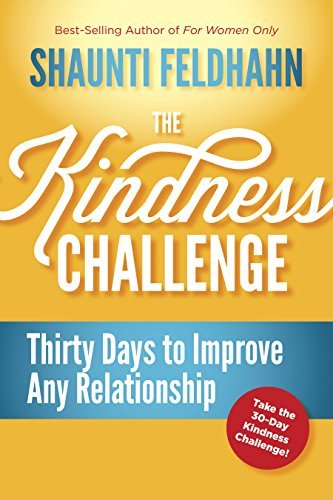
This book challenges you to pick one person in your life that you want to have a better relationship with. Focusing on kindness towards that person for 30 days should lead to the healing of the relationship, the building of bridges, and/or you having a more positive attitude towards that person.
While this isn't a marriage book, there is a lot of talk about husband/wife relationships. The Kindness Challenge, however, can be applied to anyone in your life.
At my church, I gave a sermon that was built around the principles taught in this book. In order to organize my thoughts, I wrote up some notes about the types of things I may want to talk about. Here are those notes:
OUTLINE:
-Romans 2:
Therefore you have no excuse, O man, every one of you who judges. For in passing judgment on another you condemn yourself, because you, the judge, practice the very same things. 2 We know that the judgment of God rightly falls on those who practice such things. 3 Do you suppose, O man—you who judge those who practice such things and yet do them yourself—that you will escape the judgment of God? 4 Or do you presume on the riches of his kindness and forbearance and patience, not knowing that God's kindness is meant to lead you to repentance? 5 But because of your hard and impenitent heart you are storing up wrath for yourself on the day of wrath when God's righteous judgment will be revealed.
-Our kindness can also lead people to God.
-Matthew 5:
16 In the same way, let your light shine before others, so that they may see your good works and give glory to your Father who is in heaven.
Kindness is made up of 3 distinct elements: thought, word, and action
-The three key aspects of kindness: avoiding negativity, finding and praising the positive, and performing kind actions that matter to someone else.
1. Avoid Negativity
2. Praise the Positive
3. Acts of Generosity
AVOID NEGATIVITY:
Here’s the big idea for what that means: Don’t say anything negative to the person for 30 days and don’t say anything negative about the person for 30 days.
You may have to point something out that isn’t going well, but the idea is to be constructive instead of attacking. It’s about how you say it, along with what you are saying.
With that being said, other than the more serious situations, there is a lot we could probably overlook and not be negative about in our relationships.
The first half of avoiding negativity is obvious…it is easy to see how things would get better in a relationship if you avoid saying negative things.
The second half, though, about also avoiding talking bad about the person behind their back can be a little harder to understand how that would tangibly better your relationship with them. I mean, they don’t know what you’re saying about them, so it isn’t making them feel bad, right? The problem with that is that your thought-life impacts how you act.
In the past I’ve been guilty of thinking that it is good to complain to someone if you feel wronged by them because then you aren’t holding it in and letting it get worse. Another thing people may do is complain about the person to someone else to help them blow off steam so that they don’t snap on the person.
The weird thing, though, is that studies have shown that if you tell someone that you’re irritated with them, or you tell someone else you’re irritated, it actually just makes you more irritated.
The more you bring it up or dwell on it, rather than just letting some offense go, the worse it is for you. What you think is what you will say.
If we allow ourselves to think unkind thoughts, they will eventually make their way out of our mouths.
Luke 6:
43 “For no good tree bears bad fruit, nor again does a bad tree bear good fruit, 44 for each tree is known by its own fruit. For figs are not gathered from thornbushes, nor are grapes picked from a bramble bush. 45 The good person out of the good treasure of his heart produces good, and the evil person out of his evil treasure produces evil, for out of the abundance of the heart his mouth speaks.
PRACTICE PRAISE:
Every day, find one positive thing to say about this person. Just like in Step 1, this can be to your person, or you can say something good about them to someone else.
Part of this process is changing your own mindset about your person so that you can have a better relationship with them, so talking nice about them to someone else counts. But, of course, saying as many positive things directly to the person as you can will be best.
It is important that what you choose to praise is sincere. Don’t make up things just so that you can check this step off the list.
-It may take some practice, but over time you will find things to praise about the person you are having relationship problems with.
-The kinder you are, the more you want to be kind. The opposite of that is also true.
-Honor what they do rather than focus on what they don’t.
This step can be intimidating, so to get you thinking about what an authentic praise would sound like, here are some examples given in the Kindness Challenge book.
–Page 98 has a list of authentic praises that can be spoken or written to your person:
-Good job this week
-Thank you for doing that
-I’m grateful for your (willingness, thoughtfulness, etc)
-Your investment of (time, skill, resources, prayer, etc.) will make a huge difference
-He told me what you did. I really appreciate that
-They loved your presentation
-You are so (efficient, productive, good at your job, etc.)
-Well done
-This team would not be the same without you
-You’re a good man
-You’re a wonderful woman
-You’re a great mom or you’re a great dad
-I love your heart to help others
-You make me so happy
-You’re a great friend
-I really like spending time with you
-They told me how much they (respect, like, appreciate, etc.) you
ACTS OF GENEROSITY:
Alright, last step. Every day, do a small act of generosity for your person. This one is going to seem like the hardest one at first because it is going to be noticeable if, out of nowhere, you start doing a kind action for someone on a daily basis.
-Performing small acts of service for someone else – doing extra chores around the house, helping your friend move, bringing over a meal, - you want this to be something that the person notices, so that they know someone cares about them
-overcoming our tendency to be selfish
-Asking people questions about themselves. “I REALLY ENJOYED OUR CONVERSATION – THEY SAY EVEN THOUGH I BARELY TALKED.”
-How was your weekend? What did you do on your vacation? What’s new with your family?
-try not to be too busy for your person – I’ve heard it said that no person should seem like an interruption in your day.
-Being thoughtful – one way you can be thoughtful is by understanding how your person best receives love from others – this is called The Love Languages
-make a point to be patient in situations when you would typically lose your patience
-I don’t know if this would work for me and my person, but for some people leaving a note or a card with a nice message could be a kind act for them
-give or share something precious to you – this could be an item that you give away, or it could be giving your time away for someone
-be present, if you are doing this for a spouse, you could come home early to spend time with him or her instead of staying late in the office
-don’t respond in the same bad way they are treating you - -If I had responded in kind (as I unfortunately have done at other times!), it would have eaten me up. -The Golden Rule: Do to others as you would like them to do to you. – Or, treat someone who is not kind to you in the kind and generous way you wish they were treating you.
-don’t give them the impression that you’d rather be doing something else than talking to them
-assume the best
-When we were talking about practicing praise, I said that the praise has to be sincere and authentic. When doing acts of generosity, these things have to be unconditional. You can’t do these things expecting the person to do something kind back for you. We can’t even expect back appreciation. We are just being kind because God wants us to be, not to get credit for it.
2 Timothy 2:
24 And the Lord's servant[e] must not be quarrelsome but kind to everyone, able to teach, patiently enduring evil, 25 correcting his opponents with gentleness. God may perhaps grant them repentance leading to a knowledge of the truth, 26 and they may come to their senses and escape from the snare of the devil, after being captured by him to do his will.
-it might help others find God, or it might not, but you have to be kind always, even if they still remain unkind
-Obedience precedes emotion. What is God asking of you? Do it. Even if you don’t feel it. Because then you will feel it later.
-It is possible that nothing is going to change in the relationship you want to fix unless you take the first step. That isn’t fair to you, but it is possible that you need to be the one to act first.
-Kindness has to start somewhere before it can spread. Change starts with you.
1 John 4:
19 We love because he first loved us. 20 If anyone says, “I love God,” and hates his brother, he is a liar; for he who does not love his brother whom he has seen cannot love God whom he has not seen. 21 And this commandment we have from him: whoever loves God must also love his brother.
-as we work towards be consistent in our kindness, we will become aware of how often we aren’t actually very kind.
-The fuel is loving Jesus first and loving other for his sake
-the kindness has to be constant
CONCLUSION:
-There has been research done on these three areas of kindness – Avoid negativity, practice praise, and acts of kindness – and the research has shown that a daily effort in applying these 3 things makes a measurable difference in the outcome of relationships.
The 30-Day Kindness Challenge – is designed to build a sustainable desire for and habit in each
-Being kind like this is not something that comes naturally. This series is on the Fruits of the Spirit, and we call them that because the Holy Spirit empowers us to act a certain way that isn’t natural. Once you become a Christian, you are given the power to act differently. With that in mind, let’s read from Luke, chapter 6:
32 “If you love those who love you, what benefit is that to you? For even sinners love those who love them. 33 And if you do good to those who do good to you, what benefit is that to you? For even sinners do the same. 34 And if you lend to those from whom you expect to receive, what credit is that to you? Even sinners lend to sinners, to get back the same amount. 35 But love your enemies, and do good, and lend, expecting nothing in return, and your reward will be great, and you will be sons of the Most High, for he is kind to the ungrateful and the evil. 36 Be merciful, even as your Father is merciful.
-As implied by what we have discussed thus far, what you say and do actually shapes what you feel. In other words, when you act kind, respectful, loving, and positive, you begin to want to be kind, respectful, loving, and positive, which is one of the key reasons the Kindness Challenge works so well to improve difficult relationships.
Doing this challenge can be tough, so there is also a prayer aspect to this whole thing. When we pray for change in our hearts, and open ourselves up to what God wants from our lives, that’s when you start seeing the Fruits of the Spirit in action.
-Now I want you to imagine something with me. We’ve talked about how our kindness could point people towards God, so what if we all took this Kindness Challenge. What if we all chose one person to be kind to for 30 days. What would that do for our family, or our community, or our workplace...and especially for God’s Kingdom?
EXTRA KINDNESS NOTES:
-Whether we thrive depends far more on how we choose to treat others than on how we ourselves are treated.
-The path to our happy place starts with one choice: whether or not to be kind. Especially when we really don’t want to be.
-There are two types of kindness; -Targeted kindness – specific to one individual with whom you want a better relationship -Broad kindness – this will impact the many people you encounter and ultimately, if done in mass, this can impact the culture at large.
-A common denominator in whether people enjoy life is whether they are giving and experiencing kindness (which, for many people, is simply the outward face of unconditional love).
-If you choose relationships over results, you get better results in the long run.
-Combating unkindness with unkindness defeats the purpose! Worse, anything done out of frustration, hurt, or anger is likely to achieve only defensiveness and a worse relationship.
-God’s kindness reaches into our hearts and leads us to feel bad for what we’ve done wrong, and even more than that, God’s kindness also drives us to make a true change in our lives. We love God because he first loved us. That verse, where it talks about God loving us first is followed up by a challenge for how we should act.
-It has to be a habit. Otherwise it doesn’t happen.
-Positivity + Praise + Acts of Generosity = Kindness Challenge
-Kindness Blindness – we can often be unkind without realizing it – this is something I have struggled with
-Whether or not you dive into a difficult situation isn’t the issue: what makes you either kind or unkind is how you express it. Remember the goals: improving the relationship and bringing about heart change.
-One of the beautiful things about kindness is that it changes your heart toward the other person so that you want to keep being kind.
-“Be kind, for everyone you meet is fighting a great battle.” - Philo of Alexandria
-There are examples of negative actions to avoid on Page 73 and 76 that might be helpful to read out loud, then on Page 75 there is a list of benefits to nixing negativity.
-Page 79 talks about what to do when you have tendencies towards pointing out the negative.