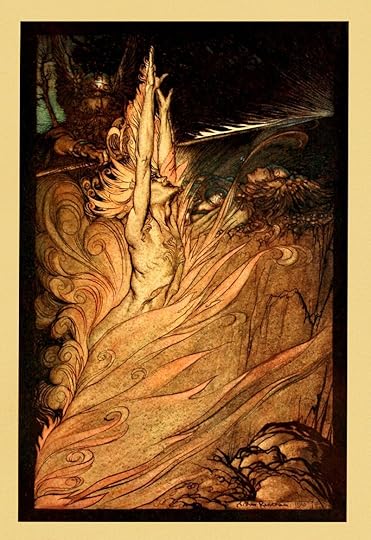
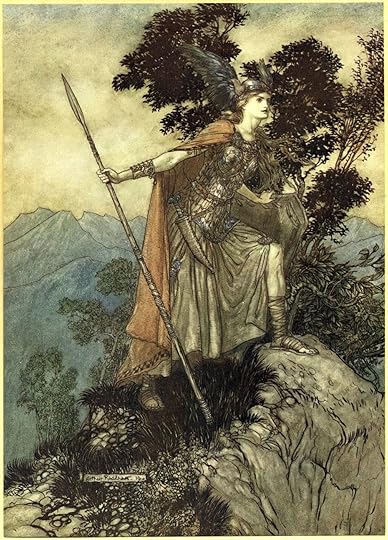
This book forms part of our 'Pook Press' imprint, celebrating the golden age of illustration in classic literary works. The Rhinegold and the Valkyrie' was written by the German composer Richard Wagner (1813-1883). The works are based loosely on characters from the Norse sagas, and are here translated into English by Margaret Armour. The chief components include 'The Rhinegold' - the prelude, 'The Valkyrie' - the first day of the trilogy, 'Siegfried' - the second day of the trilogy, and 'The Twilight of the Gods' - the third day of the trilogy. The text is accompanied by a series of dazzling colour illustrations by Arthur Rackham (1867-1939). One of the most celebrated painters of the British Golden Age of Illustration, his artistry still delights both young and old over a century later. The text is presented in its original translation, alongside Rackham's beautiful images which only serve to refine Wagner's masterful story-telling.
Germanic legends often based romantic operas of especially known composer Richard Wagner, who worked Tannhäuser (1845) and the tetralogy Der Ring des Nibelungen (1853-1876).
From 1872, Richard Wagner lived at Bayreuth to 1883 and designed the opera house, used chiefly for performances of his works.
Wilhelm Richard Wagner conducted, directed theater, and authored essays, primarily for his later called "music dramas." Unlike most other greats, Wagner wrote the scenario and libretto.
Actually have had this book for months but didn't get around to reading it until watching a Das Rheingold performance on DVD staged at The Met Opera in the 2010 to 2012 cycle. But I digress. While Tolkien's Ring trilogy & The Hobbit stands as outstanding high fantasy works in their own right, it does owe quite a bit to Wagner's Ring tetralogy, which in turn owes much to the Prose Edda & Nordic/Teutonic myths. This was discovered much later by me & wasn't apparent out of my ignorance of Wagner until a year or so when coming across old VCDs of the 1976 Bayreuth festival performances. The central tenet of both works revolves around a corrupting ring of power, usually procured by means of theft and murder of its previous owner, and destined to be returned to its place of origin. The broken sword that must be reforged, the Nothung, appears in the Middle Earth as Anduril. And who can dispute the similarity between Wagner's Fafner & Tolkien's Smaug? And did Alberich inform Gollum's characterization? This isn't a knock on Tolkien but rather to admire how much of Wagner's influence upon the Ring trilogy yet at the same time, it did emerge as a distinct & outstanding work as much as Wagner's tetralogy. #Goodreads
I always wondered about those people standing on the stage with spears and strange helmets, what was it all about? I love Opera but have never seen any of Wagner. His reputation is still sullied by his anti Semitic beliefs and his adoption and appropriation by the Nazi's.
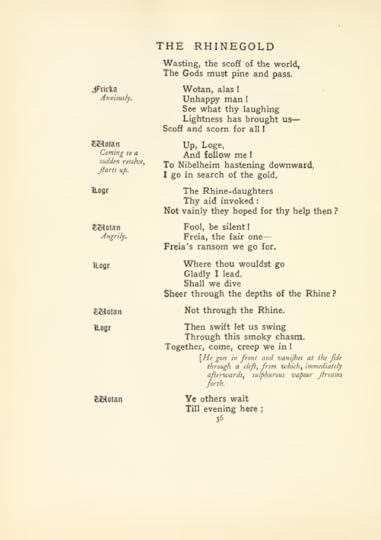
The dialogue and scene notes, supported by the illustrations, plunge you into the world of the Rhine maidens, giants, dwarves, Wotan and the Valkyrie.
The illustrations combined by Wagner's scene notes help you to recreate the Opera in your mind.
Once I have completed the cycle I shall watch the Opera.
I learned about this 2 volume poem from a biography about c.s. lewis. apparently he fell in love both with the poem and the artwork. the artwork is indeed beautiful. to one who is familiar iwth the story of the gods the poem is not bad. to the uniitiated it is a cross between illiad and shakespere. its a tough read reguardless but the words flow nicely when read quickly. i read this book for the prompt read a book that intimitates you. (read with Allison 2024)
Read this in preparation to see the opera, which was very helpful! I’d like to read and see the next three, but it’s not scheduled to perform and my reading list is quite full. It was so interesting to see traces of The Lord of the Rings story.
Rackham’s illustrations were the initial reason I started this book, and they did not disappoint. But I was also wonderfully surprised by the beautiful text and the power of the poetic translations.
Wonderful illustrations by my favourite old-school illustrator, Arthur Rackham, for the libretti from my one of my top favourite Wagner operas. The illustration for "The ride of the Valkyries" is stunning!
Some days ago I read the graphic novel The Ring of the Nibelung, illustrated by P. Craig Russell, and did a review on this site. In ecstasy after such a wonderful piece of art, I read the comments and found one which said that for a cosmic experience one should read that graphic novel while listening to the operas.
See, I've been a fan of the Ring of the Nibelung's opera tetralogy for quite some time, and I developed a tradition where in every vacation I watch the whole Ring cycle again. This creation of the German compositor Richard Wagner left such a mark on me, that in every vacation I search for a different production or interpretation that I never watched. I gladly enjoy my vacation, and in the evening, after dinner, I go to the living room, sit back and relax in the dark of the night with a marvelous, wonderful opera.
About Arthur Rackham's Ring books, I remembered that their appeal was that they had the full libretto of the 4 operas, translated to Old English to give them a legendary feeling, and that they had those beautiful illustrations that this man from the Golden Age of Illustration made. I never truly gave the downloaded books too much attention and they sat on my computer files for months without being accessed (after watching a Ring cycle I let my mind rest from the Wagnerian overwhelming force, until the following vacation when I watch the Ring cycle again). Until now. "Well, time to dig my computer to find where I put the downloaded books!" I said, and I found them without much trouble.
So I went to Youtube to find the recordings with Georg Solti as the orchestra conductor, which are widely held as the best recordings of the Ring cycle that have been ever made, here is the link for Solti's Rheingold, and here you can listen to Solti's Die Walküre. Truth to be told, I never listened them fully. I've been watching filmings of the operas instead of just the recordings, but I remembered watching random videos with music from Solti's prelude from Rheingold and Wotan's farewell from Die Walküre. I found them outstanding, it was only a matter of time that one day I would take my time to listen to his recordings.
And now, after just finishing Die Walküre, here is my piece of advice, Good Reads fellow: do it. You won't likely get such a wonderful experience as this. Listening to the captivating and powerful Ring's music, while reading the libretto translated to English, and looking at the beautiful illustrations by Arthur Rackham, is one of those experiences that makes you feel glad that you are alive.
The Ring story is a timeless one, a story of love, desire, happiness, sorrow, power, honor, clash, struggle, anger, resentment, envy, greed, death and legacy. People can come from different cultures and appreciate it nonetheless, because it tells us of universal themes. The Ring seems to be endless in that matter: people are continually developing new interpretations about it, new Ring opera productions, modelled after the Regietheater concept, have been making new sets and character costumes to emphasize a narrative that tackles issues such as capitalism, industrialism, the Cold War, enviromentalism, feminism, among others.
What I'm glad is that not only opera directors are finding ways to enjoy the Ring in a way that nobody tried before. Common people in the comments section of a book review website can also shed light on a new way to enjoy the Ring's wonderful magic.
Off I go, tomorrow I will start with the second book, Siegfried & The Twilight of the Gods which covers the remaining operas in the cycle. Until next time.