From one of the most celebrated travel writers at work today—a vibrantly observant, witty, utterly captivating account of a lifetime’s worth of travel between the Tropics of Cancer and Capricorn.
Part memoir, part travelogue, all passionate appreciation, Tales from the Torrid Zone begins in Iririki, Alexander Frater’s birthplace. On this tiny island in the South Seas republic of Vanuatu, his grandfather, a Presbyterian missionary from Scotland, converted the inhabitants, his father ran the hospital and his mother built its first schoolhouse in their front garden. And it was on Iririki where, on the eve of his sixth birthday, Frater fell victim to “ le coup de bamboo . . . a mild form of tropical madness for which, luckily, there is no cure,” and which has compelled him, again and again, to return to the “seeding, breeding, buzzing, barking, fluttering, squawking, germinating, growing ” deep tropics.
His travels take him to nearly all of the eighty-eight countries encompassed by this remarkable, steamy swath of the world. He delves deeply into the history and politics of each nation he visits, and into the lives of the inhabitants, and of the flora and fauna. He is, at once, tourist, explorer and adventurer, as fascinated with—and fascinating about—the quotidian as he is with the extraordinary. But certainly, he does not lack for the dining with the Queen of Tonga in a leper colony; making his way across tropical Africa—and two civil wars—in a forty-four-year-old flying boat; delivering a new church bell to a remote Oceanian island.
From Fiji to Laos, Mexico to Peru, Senegal to Uganda, Taiwan to Indonesia, Frater gives us a richly described, wonderfully anecdotal, endlessly surprising picture of this diverse, feverish, languorously beautiful world—as much a state of mind as it is a geographical phenomenon.
Alexander Frater has contributed to various UK publications--Miles Kington called him "the funniest man who wrote for Punch since the war"--and been a contracted New Yorker writer; as chief travel correspondent of the London Observer he won an unprecedented number of British Press Travel Awards. Two of his books, Beyond the Blue Horizon and Chasing the Monsoon, have been been into major BBC television films. One, the Last Aftican Flying Bat (based on the former), took the Bafta award for best single documentary, while a programme for BBC Radio 4 (about his South Seas birthplace) was named overall winner of the Travelex Travel Writers' Awards. He lives in London, though, whenever time and money allow, is likely to be found skulking deep in the hot, wet tropics.
Sometimes I imagine a mildly narcotic vapour drifts across the Torrid Zone. Evanescent as laughing gas, created by decaying vegetable matter, it's borne along by the trade winds and causes a kind of stupefaction in its victims.
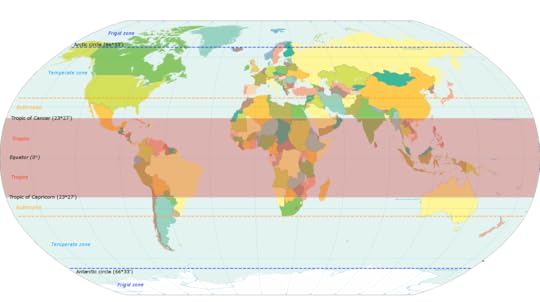
Alexander Frater recounts his journeys across the Torrid Zone which is defined as a total of 169 countries and various territories across the globe. Per the map, these are the areas near the equator between the Tropic of Cancer and the Tropic of Capricorn.
Born to missionaries in Vanuatu, the author has a love/hate relationship with his "zone" but tackles a project to visit as many of the Torrid Zone locations as possible. So we get a travelogue that is combined with a memoir and some history. The journeys swing between paragraphs, so that one can be in different geographic areas within one page. While such structure was disconcerting at first, I adapted as Frater writes some fetching remembrances.
For instance, swimming in the tropics is like plunging into warm bouillon. The Irrawaddy River in Myanmar engages anyone who sails on her in a running battle of wits. It's armchair travel, of course, but given the current world situation, it suited me just fine.
when you're hot, you're hot, when you're not, you're not
If you've ever hung out in bars or pubs, you'll recognize the type---full of stories, knows everyone and their cousin too, seems too raffishly quaint to be true. And probably is. If there's such a thing as a chain smoker, there's also a chain raconteur. Frater starts another story before finishing the first; like one of those Chinese boxes inside boxes all made from one piece of ivory, his tales lie in the belly of another. I have to say his writing is not unpleasant. It may keep your interest, but I developed a serious case of doubt. I like to know if I'm reading fact or fiction, but I couldn't quite find the line here. I know very little about Vanuatu, a Pacific island nation where Frater's family lived in colonial days. I couldn't judge the truth of what he said. But when I did know something about the subject, the book played very lightly with the facts, to be kind.
Muhammad changed his tune---30 years after he'd died ! When the Chinese arrived in Japan, there was no Shogun and no Zen Buddhism. Bartolome de las Casas was entirely different from what we read here. The story of Ishii, the last of his California tribe, is attributed to Levi-Strauss. The `rial' was never a Brazilian currency. Portugal never controlled half the world, though it did a good job on a series of forts and ports from Lisbon to Timor. Did any Brazilian governor ever flatten a million square miles of forest ? He writes of a Malagasy king with a very long name deposed by the French---but they deposed a queen! Did the Seychelles have a team at the 1924 Olympics ? Were there ever leopards in Zanzibar ? And dude ! I'm only scratching the surface here.
All right, TALES FROM THE TORRID ZONE may be entertaining. We can quote the author who says he's writing "a series of vignettes, fastidiously, almost lovingly choreographed" (p.95) Maybe they actually happened too. You can read 26 pages about the epic voyage of Ferdinand Quiros, there's a good section about a boat trip down the Irrawady in Burma, and a trip by flying boat across Africa to Mozambique at the time of its civil war. The foreigners he meets (wow ! you actually do meet some besides the Anglo-American chappies) all have similar accents in English. They all drop their articles. That's a laugh. At last I felt that this book had been bunged together and the author was relying on charm to see him through. If you read it, you'll judge whether that is enough.
When the book arrived in the mail months ago, I skimmed through it, thinking "hmmm ... looks like it might be kinda dull" and put it aside. I was wrong. There was potential for a real dragged out story, had Frater confined himself to Vanuatu (the South Seas nation where he was born and raised - his father and grandfather were missionaries there). However, he does fully succeed in tying-in his experiences in other Torrid locations (Africa, Burma, etc.) along the way such that the parts make the intended whole. When this book is good it's fascinating, and when it's not quite up there, it's at least interesting. Highly recommended.
I must admit that despite being a big fan of travel writing I had never heard of Alexander Frater. When my husband bought his book, Tales from the Torrid Zone, 2nd hand for me I didn’t know what to expect but feeling like a change after reading about the Arab world, I decided to try it. The Tropics are fascinating and it seems that Frater is perfectly placed to write about them because he was born in Iririki, Vanuatu and spent his journalistic life travelling to and writing about the tropics.
Frater obviously did a lot of research and reading of history and sprinkles the text with facts and vignettes. However, I don’t really enjoy his writing style because of his strange lack of punctuation but I persisted anyway because there are occasional vignettes that make it worthwhile. As Sara Wheeler from the Guardian said:
At 388 pages, the book could have done with rather more artful editing. Inconsequential details about scary plane rides or the company that provided the wine at an awards dinner should have got the red pencil treatment, as should the episode when our man almost gets bitten by a dog, but doesn’t. The prose style is breezy and chatty, but Frater could have worked harder at weeding out the clichés.
It was of course thrilling to read about his experiences in the countries that I have visited or want to visit or have friends from those places. Frater makes some sweeping generalizations about the reasons for most tropical nations being unable to move forward economically, socially and politically that are amusing to read but could be quite offensive to some readers.
By far the best redeeming feature of this sometimes tedious rambling account writing, by an older and somewhat fuddy duddy gent, is the section on rivers. Here, finally, Frater almost manages to build a narrative thread. His journeys down the Irrawaddy and up the Amazon were good to read. I have been in the far western Amazonian jungle and to Rio, Brazil but never actually seen the Amazon River. Similarly, I have dreamt of visiting Burma, especially now that the request not to travel has been lifted, I’ve attended talks by authors who’ve spent a lot of time there, I’ve bought the Lonely Planet Guide and planned a trip but never made it there … yet! His interaction with the Burmese princess was fascinating and reminded me of the royalty that I know, including an Uzbek prince, and the Cambodian princess that my husband worked with. If ordinary people find it hard to start again in a new culture, imagine how hard it is for ex-royalty!
The other interesting section was his trip to Yemen where he encounters a wedding party. The men of the grooms family stood on a cliff top on one side of the valley, slowly dancing and shooting their Kalashnikovs, while on the other side, the women of the brides family climbed onto precipices, dressed in heals and fancy clothes, and sang to the men on the other side, who paid them no attention.
Much of the book is set in Polynesia and while I haven’t been there I am not that interested either and Frater failed to generate much interest either. He is exceedingly well connected and I enjoyed reading some of his interactions with Chiefs and the arbitrary way that they would connect and then just as quickly disconnect from Frater. I would have preferred if he spent more time writing about the rest of the tropics but perhaps there is less written about Polynesia and obviously it’s dear to his heart because that’s where he’s from.
Perhaps readers who are much older than me or who grew up it spent a lot of time on Pacific Islands will enjoy this book but otherwise Frater’s book is unlikely to appeal.
This is a mix of travel narrative and memoir. Frater was born in the south Pacific into a family of missionaries and physicians. He has spent a lot of time in the tropics, working as a writer and on documentary films. As he narrates, an event will elicit memories from other places and he lapses into anecdotes from there. His wiritng style is very lush, with complex sentence structure. This makes it hard to speed read, but I suppose gives a sense of the tropics, which Frater stresses is sloooow. Although not my favorite, I did enjoy this unusal narrative, and it does give a strong sense of place. Feb 27 2020. I reread the book forgetting I had read it earlier. THis is at least the 3rd time this has occurred while trying to review a "new" book. I guess my memory is sliding fast. Here is the later review: Frater’s gather and grandfather were Presbyterian missionaries or physicians in the New Hebrides and he was born there. He spent a lot of his life as a writer and correspondent in the tropics. This book is centered on his return visits to what is now called Vanuatu. He describes the terrain, the weather, the people and the influence of tourism on the place. This is intermingled with reminiscences and tales of his ancestors and other tropic adventures. Together the stories of now and then, him and they, make interesting reading. Frater meets a number of locals and as he visits with, and interviews them we get a sense of the lives in these regions. In addition to Melanesia, Frater tells interesting short stories about numerous other tropical areas he has visited, particularly in Africa but also in Indochina. He writes well, with a crisp pace and incorporates a lot of tongue in cheek humor. My overall take away is that life in most tropical “paradises” is in fact, miserable. The heat and humidity is debilitating, the bugs and disease rampant, and the concomitant lethargy just plain boring. Give me 40 degrees latitude anytime.
Alexander Frater was born in Vanuatu and lived there and on other tropical islands until he left to study in Australia. His childhood memories of the places and people are told with fond nostalgia, although most of the book is concerned with visits and travels he made later in life to many tropical countries, making the book a mixture of travel literature and memoir. There are plenty of facts, about the climate, geology, history, individuals, tropical medicine, living conditions, etc. of the places he visits, but this is not a dry book. The author has a love for this part of the world which gives his writing a warmth.
Stunning prose and good tales abound in Tales from the Torrid Zone. I had hoped to read more about Taiwan.
I've read many travel memoirs, especially tales through the Tropics. Frater's book focuses on his life and travels between the Tropics of Cancer and Capricorn. I found my 'home away from home' amongst its pages and could relate to many of his early tales based on my own travels. (Before the tourism industry and travel hordes descended on southeast Asia.)
Frater has captured a beautiful world in his pages. I loved the first part of his book, but once he hit the chapter on Quiros, I found my attention wandering away.
Perhaps a bit too long? I've read many travel tales and I love Pico Iyer and Paul Theroux, but I felt this book could've been edited a bit better. It jumps around a lot. Anyone who knows the tropics knows you can do so easily these days, but in a book, I felt like he should've just stayed in one place for a bit before jumping into his next story.
My secondhand battered copy has clearly been here in Taiwan's torrid zone for decades and it smells of the tropics.
I give this book a strictly average score because of one oft-repeated and very irritating structural huge flaw that runs throughout the very long narrative.
The author will be going along, relating some historical happenstance in some remote part of the world, then jump across the ocean to tell you some detail of a trip he once took years and several time zones away, then relay some little-known unrelated anecdote about an eccentric person he met somewhere out there...all within the space of a single page.
The result is that his book seems as if it were designed by slapping odd sticky notes to a board and forcing it all to hang together by tacky glue instead of interrelatedness. The reader is frequently disoriented as a result of all this trampoline jumping around in the torrid zone.
Sure, he covers a lot of hothouse ground but it's a disoriented journey to say the least and little of it stays with the reader once the last page is accomplished.
People who travel a lot, or dream about being able to, will enjoy this book. The only bone I have to pick with it is the way the author will be describing an event or place and get reminded of another event or place and go off on a tangent to tell about that and then suddenly you are back in the original story, without clear demarcation between the two. Eventually I just gave in to it and let it swirl me around, a most pleasurable experience.
Most of the stories were interesting and brought me back to my life in Thailand, and travels through many countries in the tropics. I was warned beforehand about the jumping around and the Quiros part so I was prepared, yet still found those two things to be slightly annoying and the skipping from topic to topic to be distracting. Reading this book makes me curious to read Paul Theroux. I hope he's more interesting to read. The prose was beautiful in parts but dated.
This entire review has been hidden because of spoilers.
A series of essays about many places in the tropics visited by the author, who grew up in the South Seas, has lived his adult life in the UK but is always happy for the excuse to return to the tropics. There were some interesting pieces, but it seemed something of a grab bag and the author didn't shed a lot of light on the places he visited.
Assorted anecdotes on his tropical adventures, some more interesting than others. Stories jump around in time and place with little coherence making reading it a discombobulated experience.
A celebrated author and travel writer whose colleagues include Bruce Chatwin and Paul Theroux, Frater has a large list of publications under his belt in both magazine and novel form. This book is a collection of stories which is equal parts narrative, non-fiction, and memoir. Frater grew up in the tropics and lived there for the duration of his childhood, until he left as a young adult for further education. He has subsequently traveled the world over many decades and has amassed innumerable stories, tales, and memories, some of which are retold here. As the title suggests, this book focuses on those countries which exist in the "Torrid Zone" and begins with some of Frater's early memories while a child. While the novel as a whole is quite interesting, with a plethora of assorted tales (of countries both known and unknown) and a varied cast of characters that have come in and out of Frater's life, I found its stream of consciousness tone quite challenging to read. Discussions of events in Fiji would lead to a few paragraphs telling a tale from Brazil several decades earlier which would then digress to random thoughts from a visit to east Africa. While the sheer diversity of cultures and tales are fascinating and Frater has a light, humorous voice that easily conveys history and anecdotes, this is at times disjointed and confusing. I finished it feeling I would need to reread it again to simply keep track of it all. In the backdrop of the entire novel is the story of how Frater promised to pay for and provide a new church bell to the congregation of the village where he grew up. Portions of that storyline are intertwined randomly and does attempt to provide a scaffolding to the novel as a whole. However, if Frater had perhaps focused individual chapters on a given country or area instead of the wanton randomness that appears to permeate this work, the reader might have been provided with a more structured memoir.
Wonderful book, poetic and reminiscent. Has the dreamy quality of the tropical subjects of its pages. Small remembrances interspersed with a gossamer thread of narrative that brings the author back over and over to the original torrid place that started his fever for equatorial zones--Vanuatu.
Grandson of a Scottish Presbyterian minister who was the first Frater to travel into the deep tropics, and son to parents that set up both hospitals and schools there, Alexander retraces his family's roots in the region. Surprisingly to the author, the locals still remember his missionary grandfather with great fondness and gratitude, though the still running church is in need of a new bell.
So begins the adventure of procuring one from the very old and historical White Chapel Bell Foundry that made the famous Liberty Bell amongst others (Westminster, Canterbury, etc.) and getting it to an island in the middle of the South Seas.
I adore travel literature, but Frater's books really stand out to me for their humor, love of the absurd, and droll insights. If you are a fan of Gerald Durrell, Redmond O'Hanlon, David Quammen or Eric Hansen, this is right up your alley.
It's a slow, sensual, leisurely, tropical meander through most of the hot, sultry places the planet has to offer. Bat curry, reflecting lakes, magic mushroom omelettes--what more could you want from a travel memoir?
Thoroughly entertaining and chock full of tidbits and factoids, thick enough to keep one busy for at least a full week... Narrative revolves around Frater's desire to bring a mission bell to the island where he was born, and the church his grandfather founded (on Iririki). In between his journey to England and back to the prestigious bell makers of Whitechapel, he throws in history and episodes from adventures over the years in equatorial lands, with all their incongruities and idiosyncrasies. Comparable to the book Pacific, however, with more attention to local color than just the historical narrative.
A fine book, if a bit uneven. Frater does have a good eye for the details that you wouldn't catch as a simple traveler, and writes very lyrically at times (and very funny at times). The thing is, some of the locations (war-torn Mozambique, some of the Southern Pacific isles) and stories (for example, the Quiros travels) are way more interesting than others, and especially in the middle it becomes a bit of a muddle. But, he closes with a good set of chapters around one central theme (wood, for example) and a personal story that brings it all back...
A very good read! The author, a journalist who grew up in Vanuatu, has a knack for story-telling, and for the irony of life. He good-naturedly contrasts ancient ways and modern day life, and tells of travels in Africa and the S. Pacific with wistful observations of lost opportunities and unrealized potential in the places he travels through. Enjoyable throughout, it will make you laugh and wonder with appreciation of the little-known remote tropical corners of this wide world we live in.
Frater is Scottish, a Presbyterian missionary's son who grew up on the island of Iririki in The South Seas. This book documents his travels to countries that lie within the equatorial zone. Not as compelling as a review that I read led me to believe, but has it's interesting moments. Frater is a travel correspondent with The Observer.
A lesser cousin to Frater's excellent Chasing the Monsoon, Tales From the Torrid Zone is choppy and uneven, mucking up an in-depth travel essay about Oceana, where Frater grew up, with myriad asides about other tropical locations Frater has visited during his tenure as chief travel correspondent for The Observer.
2009- Not as great as I was expecting. The author covers too much territory and assumes the reader has in-depth knowledge of geography of some obscure places. I really wanted to like this book and I did learn a great deal about Vanuatu, but I felt the narrative skipped around too much, sometimes jumping from place to place within a single page. I prefer Colin Thubron.
After having been disappointed by Frater's book about monsoons, I was happily astonished by the writing in this particular book. However, I may have disapproved of Frater's lifestyle and inevitable criticism of his father's and grandfather's faith in Christ and ministering as missionaries in an island country, yet I could overlook Frater's ridicule...well, almost.
It reads like it was written by a magazine writer - like it is a whole series of unconnected articles. It could be that I just don't see the connection and when it finally hits me I will fall out of my chair wearing an expression of utter, mind-blowing comprehension, but I don't think so.
Interesting nuggets buried in a meandering and disconnected narrative. Fraser is all over the place in time and space, and doesn't stop to orient the reader very often. The South Pacific is fascinating, but this treatment didn't work for me.
Interesting book, but a bit disjointed at times. Some of the stories spread out over two or more chapters, while other chapters were little more than collections of anecdotes that somehow related to the chapter's main subject.
I really have to disagree with the goodreads review of this; is it not vibrantly observed, not terribly witty. This is the kind of book I absolutely love to read and I have no desire to discover where else he wants to take me.
We'll be spending much of the next few years mucking about in the tropics, otherwise known as the torrid zone, the area between the tropics of Cancer and Capricorn. This book provides an interesting overview of this region as well as some quirky stories about things we might expect to come across.
Still reading but couldn't put it down last night. I must also suffer from mal de jaune. I've been to many of the same places in the "Torrid Zone" and have always been happy in these areas....
Frater's writing style can be rather irksome. Primarily this is a tale of Vanuatu, but it's interspersed with interesting anecdotes about tropical places all around the world.
Very interesting...takes you right into the tropics and all it's quirks, from differing angles. Rivers & boat rides, heat & humidity, crazies and er, bells!