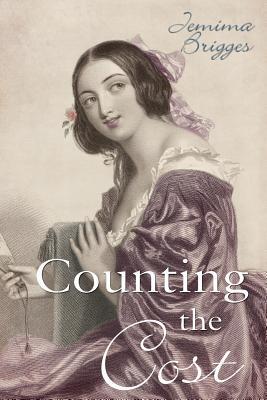
A woman's life in Pre-Regency Shropshire (1794 - 1808).
Maria knows to her cost that a woman alone must do what she can to survive.
Ten years ago, with her life in ruins, she determined to restore her good name and reputation - even if it took subterfuge.
Now she is Miss Dinchope, housekeeper, the epitome of primness and virtue. Her past is forgotten, but she has learned that the respectable faces around her hide dark secrets, every bit as threatening as her own...
Somehow, Maria must protect the vulnerable young servant entrusted to her care. But how can she teach Nell to avoid the pitfalls she encountered? And will her help be enough?
A heart warming story, which gives a rare insight into the lives of women to whom kindness, honesty and friendship mean more than money and social class. It is the second part of an interlinking series that is filled with love, loss, life and laughs.
Having read and enjoyed “Brothers at Arms”, the first book in the Linmore series, I couldn’t wait to start the next one. The second book, “Counting the Cost” takes place at much the same time as the first book, but the story is cleverly told from a differing angle which I found intriguing. The books are set in rural Shropshire in the late 18th century, when times were harsh and many struggled to survive. As historical fiction is my favourite genre, these books are right up my street. The characters are well-developed and there will be few readers who fail to fall in love with Nell, a foundling child. I am delighted to find there are several more books in this series and I have already downloaded the next book which I am looking forward to.
Counting the Cost: Linmore – The Early Years, by Jemima Brigges.
I really enjoyed the first book in the series, Brothers at Arms, and so couldn’t wait to read the second instalment, Counting the Cost. I wasn’t disappointed.
The story follows Maria, a young unmarried woman who had become pregnant due to the unwanted attentions of her employer. After which, she was promptly dismissed. With her reputation in tatters, Maria is desperate to get away. On the road she meets and befriends an old gypsy woman who allows her to live with her until the baby is born.
The story alternates between Maria’s life to that of a young girl, a foundling child, abandoned on the steps of a church. The storytelling is cleverly done with descriptive passages faithfully depicting the customs, etiquette, and dress codes of late 18th century England. A time when England was struggling to evolve. Set against the rich, upper class, versus the poor people who were uneducated, exploited, and subservient.
A passionate story, written with tenderness and feeling, tugged at my heartstrings. Strong characters and an engrossing plot complete this compelling, immersive read. I loved this book. Highly recommended.
I recently reviewed a novel that focused on the class system in late Victorian England where the protagonists were essentially all males. This novel looks at the class system around Napoleonic times, and particularly as it applied to the lower classes, through the eyes of female protagonists. Jemima Brigges paints a depressing picture, but she paints it well. By the time they were approaching 10 years old, and assuming they were in the lower classes, girls were pressed into service. They worked exhausting hours, and were in constant danger of being raped, and if they were, it was seemingly their fault. The story follows Maria, who became pregnant through rape, had a daughter, but because she then had a three week fever, the daughter was left at a church as a foundling. The story also follows the daughter, Nell. Nell is brought up with a woman who is seemingly always pregnant, but, due to malnutrition, the children seldom survive, and a drunken father. She is then put into service at the local rectory, under the eyes of a parson who is a drunken sadistic paedophile, and his sadistic sister. Maria has adopted the identity of Miss Dinchope, and she is housekeeper there, and is of slightly higher status than most, other than the parson and his sister. These latter two are equally somewhat subservient to the local squire. Not a lot happens in the story, but the sequence of relatively trivial events of "women's interests" is so well written that the story maintained my interest throughout. The story ends in one sense, but leaves many questions, so my guess is there will be a sequel. Top class writing.
Those who enjoyed Jemima Brigges' debut novel, Brothers at Arms, will find plenty to relish in her second novel, Counting the Cost. The story follows the misfortunes of Maria, an unmarried young girl who has become pregnant in an era of moral servitude. Critically ill following the birth, she believes her child has died, so seeks to restore her good name and reputation. At the same time, a baby found in a church a few miles away is adopted by a family of paupers. Some years later, Maria, having achieved a position of authority is drawn to help a pauper child, employed as a house maid, to seek a better life. The narrative is propelled along swiftly and remains powerful and engrossing. The characters are well developed and brought to life in a realistic and memorable way. By expanding upon the story started in Brothers at Arms, Ms Brigges' burgeoning saga not only promises a rich and rewarding story, but also delivers a very human story set against the backdrop of the social hierarchies of Georgian England.
I came across Counting the Cost in the Kindle marketplace and read through the synopsis and was sitting on the fence as to whether I would actually buy it or not. I'm not a huge fan of historical stories, but this one intrigued me. I started reading it and found got so engrossed right from the very first page I had to keep reading. The writing itself is beautiful, and seems to perfectly set the tone and scene for the historical age the story is set in (1794 – 1808). We are immediately drawn into Maria's plight and story. As a protagonist she is perfectly likeable and we immediately feel sorry for her. I loved the theme of the story and I love the way that feminism is drawn into a story set in these times. This is not an era where you would instantly think of a woman standing alone and able to be successful, so this is another reason we love Maria. I especially loved the quote “...I’d rather die than be the mistress of any man...” I would look out for more by this author in the future.
Authentic historical drama In her note at the beginning of the book, the author writes, “In ..seventeen hundred and ninety four, the common man had few rights and women had none other than those their menfolk deigned to bestow on them”. This sets the tone for the novel as it opens with the young protagonist Maria, about to commit suicide because she has been raped and is pregnant by her employer. As was always the case, she has been sent away from her job as a result of this as she is considered to be to blame. We really do see the woes of society if you were a woman; Maria manages to forge a new life by lying about her age and beauty, her adopted mother is worn down and dies as a result of constant childbearing; the young servants at the Rectory are abused by their employer and his sadistic sister. It is all very authentic and made me feel very glad to live now and not then.
This is a heart-warming story of a woman’s tenacity in coming back from the brink of ruin. The heroine, Maria, has been impregnated by her employer and dismissed from her position. The book opens with her being saved from the brink of suicide. She re-invents herself and slowly builds herself a better future. The novel is very authentic – especially in its depiction of the lot of the average woman at this time. It was a male dominated society, women were mere chattels and judged very harshly if they were unmarried and pregnant, even if this was as a result of rape. Maria finds herself working for a repulsive parson and his mad sister, and is continually having to see to it that this loathsome pair are not able to use the young servant girls as their playthings.
Counting the Cost is an excellent novel by Jemima Briggs. Her historical research into the time period of the late 18th century and early 19th is well done. The heroine is confronted by many obstacles, but manages to overcome them through her courage and determination. At the same time, she must lead a lonely life in order to make certain she can keep control of her tenuous position as housekeeper in a rather immoral household. The lifestyles of the poor are well depicted, and our heroine knows that with any slip-up, she could be cast out without references. It is a gripping story, and I recommend it to history lovers and anyone who just enjoys an intriguing story. Celia Martin
Impressive - I was quite blown away by this book. I can honestly say that I’m not sure what I enjoyed the most, the way the author depicts female characters like Maria, with a certain mysterious and even ominous history, or the story the author embroils the reader in. Whatever, this is high class writing with a good story line and very convincing characters. I look forward to more from the author.
Counting the Cost written by Jemima Brigges is a wonderfully thought out novel. It is set in the 1800's and it is obvious that the author knows a lot about that era, or did a lot of research. The main character, Maria, is rescued in the beginning of the story and helped by two gypsy women to deliver her child. The story ends up being split between two characters, Maria and Nell. This novel is wonderfully detailed and well written. There are stories of hardship as well as happy moments. The era was a tough one for the poorer folks. The story is well thought out and flows very smoothly. I enjoyed reading about what the characters had to do in order to survive, it was like reading about accounts from the past, as the author really knew a lot about the way life was in the 1800's. I was a little disappointed at the ending as the author didn't go into much detail as to what came of Nell, but the novel is definitely left open for a sequel to explain the next adventures of Maria and Nell. This novel is for a more mature audience as it does go into some sexual content and some of the experiences of the characters are for a mature audience, especially when concerning the household that Maria ends up working for as Miss Dinchope. I thoroughly enjoyed this novel and look forward to reading more from the author, Jemima Brigges. I highly recommend this novel.
A story of losing hope and faith then finding a new path
Maria was a housekeeper for a wealthy family where she found herself being raped by one of the young men of the family. Keeping the secret to herself she discovers she is pregnant and finds herself banished from the home and broke and alone. While standing on a river bank preparing to die, she is saved by a gypsy. Follow Maria on her journey through life looking for salvation and determination to make her life and name respected again. The characters are very real and larger than life easy to relate to. The story is complex and addicting. You will find yourself routing for Maria and turning the pages to see what happens to her next. A great read with some suspense and twists to the story. Would definitely recommend this one for the avid reader who loves a good story.
What an Interesting and enlightening story written from the point of view of a woman during a time when they had no rights. The author does a wonderful job of providing great details and really making the characters likeable and easy to understand. The author does a fantastic job with the time period and making you really feel that you are within the 1700s going through daily life of a servant. I found that there were times when I wanted to cry with the characters and there were times when I wanted to jump in a defend them from the world around them. This is a great period piece that really brings the hardships of women to light and opens a much greater understanding of how far we have progressed. This was a difficult story to put down once it was started and you really want to finish reading it.