

What do you think?

Cautionary Tales
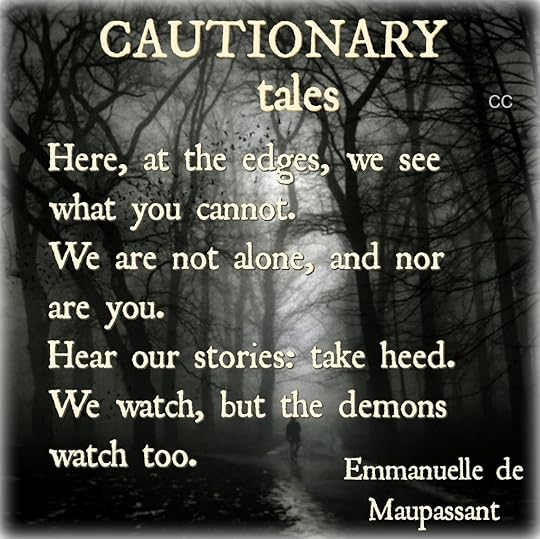
We are the shiver on your uneasy flesh, the creep of the unknown on your skin.
Tread carefully, for the dark things best left behind in the forest may seep under your door and sup with you.
The lover at your window or in your bed may have the scent of your death already on their breath.
Whispered to you from the edges, from the haunted mouths of those who see more than you or I, here are twelve tales of lust and rivalry, of envy and deceit, and of secrets gouged from the darkest depths of the human heart.
Is the shadow on the wall, really yours, after all?
Darkly delicious imaginings for the adult connoisseur of bedtime stories.
Tread carefully, for the dark things best left behind in the forest may seep under your door and sup with you.
The lover at your window or in your bed may have the scent of your death already on their breath.
Whispered to you from the edges, from the haunted mouths of those who see more than you or I, here are twelve tales of lust and rivalry, of envy and deceit, and of secrets gouged from the darkest depths of the human heart.
Is the shadow on the wall, really yours, after all?
Darkly delicious imaginings for the adult connoisseur of bedtime stories.
139 pages, ebook
Published December 29, 2016
About the author
Emmanuelle de Maupassant
71 books1,291 followersEmmanuelle lives in a medieval tower house in the Highlands, with her husband and Ernie McFloof (connoisseur of bacon treats and squeaky toys).
She writes historical romance filled with adventure, suspense, and red-hot passion.
Visit her website - www.emmanuelledemaupassant.com - to find a FREE story to download, and to sign up for her newsletter (monthly gossip, giveaways and goodies).
***
Emmanuelle lebt mit ihrem Mann (Hersteller von Tee und Obstkuchen) und ihrer Schnüffelnase, Ernie, auch bekannt als ihr liebstes Fellknäuel und Liebhaber von quietschenden Spielzeugen und Schinken.
Liebst du liebesromane und Hörbücher?
Von Emmanuelle de Maupassant über ihre neuesten Veröffentlichungen zu hören - und gelegentlich über andere von Emmanuelle empfohlene Bücher
... geben sie ihre E-Mail-Adresse ein, um sich anzumelden
=> https://view.flodesk.com/pages/5fb932...
***
Emmanuelle de Maupassant vive con il marito e ama i suoi fagottini pelosi a quattro zampe (che sono dei grandi intenditori di giocattoli da mordere e snack al bacon).
Iscriviti alla newsletter di Emmanuelle per ricevere direttamente nella tua casella di posta notizie in anteprima sulle nuove uscite, ricevere degli omaggi, e per dare un’occhiata dietro le quinte.
=> https://view.flodesk.com/pages/5fb92e...
***
Emmanuelle de Maupassant vive con su esposo y ama las mascotas peludas de la variedad de cuatro patas (expertos en juguetes ruidosos y golosinas de tocino).
Regístrate en el boletín de Emmanuelle, para ver los nuevos lanzamientos, obsequios y las historias detrás de escena, entregados directamente a tu bandeja de entrada.
=> https://view.flodesk.com/pages/5fb91b...
***
L'auteure publie (des romances historiques) sous trois noms de plume : Annabelle Quinn, Anna Quinn et Emmanuelle de Maupassant.
Elle vit avec son mari et a un sérieux penchant pour les terriers à poils longs (amateurs de jouets qui font pouêt-pouêt et de gourmandises au bacon).
=> https://emmanuelledemaupassant.com/vo...
She writes historical romance filled with adventure, suspense, and red-hot passion.
Visit her website - www.emmanuelledemaupassant.com - to find a FREE story to download, and to sign up for her newsletter (monthly gossip, giveaways and goodies).
***
Emmanuelle lebt mit ihrem Mann (Hersteller von Tee und Obstkuchen) und ihrer Schnüffelnase, Ernie, auch bekannt als ihr liebstes Fellknäuel und Liebhaber von quietschenden Spielzeugen und Schinken.
Liebst du liebesromane und Hörbücher?
Von Emmanuelle de Maupassant über ihre neuesten Veröffentlichungen zu hören - und gelegentlich über andere von Emmanuelle empfohlene Bücher
... geben sie ihre E-Mail-Adresse ein, um sich anzumelden
=> https://view.flodesk.com/pages/5fb932...
***
Emmanuelle de Maupassant vive con il marito e ama i suoi fagottini pelosi a quattro zampe (che sono dei grandi intenditori di giocattoli da mordere e snack al bacon).
Iscriviti alla newsletter di Emmanuelle per ricevere direttamente nella tua casella di posta notizie in anteprima sulle nuove uscite, ricevere degli omaggi, e per dare un’occhiata dietro le quinte.
=> https://view.flodesk.com/pages/5fb92e...
***
Emmanuelle de Maupassant vive con su esposo y ama las mascotas peludas de la variedad de cuatro patas (expertos en juguetes ruidosos y golosinas de tocino).
Regístrate en el boletín de Emmanuelle, para ver los nuevos lanzamientos, obsequios y las historias detrás de escena, entregados directamente a tu bandeja de entrada.
=> https://view.flodesk.com/pages/5fb91b...
***
L'auteure publie (des romances historiques) sous trois noms de plume : Annabelle Quinn, Anna Quinn et Emmanuelle de Maupassant.
Elle vit avec son mari et a un sérieux penchant pour les terriers à poils longs (amateurs de jouets qui font pouêt-pouêt et de gourmandises au bacon).
=> https://emmanuelledemaupassant.com/vo...
Ratings & Reviews
Friends & Following
Create a free account to discover what your friends think of this book!
Community Reviews
Displaying 1 - 30 of 53 reviews

March 6, 2016
4.25 Stars
This is an anthology consisting of twelve tales primarily about greed, lust, deceit, jealousy and death rooted in Eastern European and Russian superstitions. Each tale is told from the point of view of the evil onlooker, whether it be some sort of demon or spirit. When certain acts are committed, these creatures are invited to play into the human realm to maintain a sense of morality.
From the beginning, the tone is cloaked in malevolence and foreboding. While the foreword reads as an ominous yet provocative ode, the verses are woven into the topic of each tale; thereby, creating a cohesive and underlying theme of trickery throughout the book.
Besides being familiar with tales such as the Brothers Grimm, I haven’t read anything like The Cautionary Tales. The writing is truly lyrical – at times eerily so, but the imagery and emotion are evocative and quite tangible in that we all have our own weaknesses. In reading other work by this author, she continues to captivate me with her bewitching prose and I look forward to enjoying more by Emmanuelle de Maupassant.
This is an anthology consisting of twelve tales primarily about greed, lust, deceit, jealousy and death rooted in Eastern European and Russian superstitions. Each tale is told from the point of view of the evil onlooker, whether it be some sort of demon or spirit. When certain acts are committed, these creatures are invited to play into the human realm to maintain a sense of morality.
From the beginning, the tone is cloaked in malevolence and foreboding. While the foreword reads as an ominous yet provocative ode, the verses are woven into the topic of each tale; thereby, creating a cohesive and underlying theme of trickery throughout the book.
Besides being familiar with tales such as the Brothers Grimm, I haven’t read anything like The Cautionary Tales. The writing is truly lyrical – at times eerily so, but the imagery and emotion are evocative and quite tangible in that we all have our own weaknesses. In reading other work by this author, she continues to captivate me with her bewitching prose and I look forward to enjoying more by Emmanuelle de Maupassant.

August 18, 2016
* * * * I give Cautionary Tales 4 stars! I was given a copy of this book in exchange for my honest review.
Not for the faint of heart or the easily offended. Luckily, I don’t belong in either of those groups. I got such a kick out of Cautionary Tales and I believe anyone with a dark and somewhat raunchy sense of humor will, too.
What I Liked:
• I hope the author didn’t intend me to take the work too seriously. The concept of demons and the souls of the departed peeking at us through windows, awaiting our inevitable mistakes, was told with such a lilting twist that I laughed aloud as often as I cringed. Don’t expect horror. It’s more like dark comedy.
• The author is not lacking for confidence and it makes the book. The stories are told without apology; whether we’re watching a widower coupling with his neighbor before his wife’s body is cold or a demon coupling with a roomful of unsuspecting, horny maidens. The tales are straightforward, erotic in a fierce and at times unsettling way, and unafraid to delve into the depths of human vice.
• The author has some serious storytelling skills and can get a lot done in a short span of time. The tales are short and told in the folk tale tradition. I found them to be like potato chips; just one more, and another, until the bag was empty and the book was done.
What I Didn’t Like:
• I found the opening poem – portions of which are carried throughout as they relate to each tale – long and a bit heavy handed.
• There are definitely some heavy topics touched on in these tales. While it is the nature of folk tales to be light in spite of the serious lessons they teach, and while I understand that these tales are not meant to have real “morals” for life outside the book, my feminist sensibilities were tweaked here and there. Women are often seen punished somehow for their sexuality. However, as I stated before, the book is not for the sensitive or the impressionable. It’s for adults with a dark sense of humor. So, I feel the author’s only obligation is to entertain; which she does.
Would I Recommend This and to Whom:
For mature audiences who don’t take fiction too seriously. Dark and raunchy sense of humor required.
Favorite Quotes:
• “And we, from within the sigh of the trees, and the soft moss underfoot, and the calling of night birds, watched him as he watched, gazing where he should not.”
• “We who are beyond the mortal world see many things from the edges; we hear the subtle shifts of rhythm in the beat of a blackening heart.”
Not for the faint of heart or the easily offended. Luckily, I don’t belong in either of those groups. I got such a kick out of Cautionary Tales and I believe anyone with a dark and somewhat raunchy sense of humor will, too.
What I Liked:
• I hope the author didn’t intend me to take the work too seriously. The concept of demons and the souls of the departed peeking at us through windows, awaiting our inevitable mistakes, was told with such a lilting twist that I laughed aloud as often as I cringed. Don’t expect horror. It’s more like dark comedy.
• The author is not lacking for confidence and it makes the book. The stories are told without apology; whether we’re watching a widower coupling with his neighbor before his wife’s body is cold or a demon coupling with a roomful of unsuspecting, horny maidens. The tales are straightforward, erotic in a fierce and at times unsettling way, and unafraid to delve into the depths of human vice.
• The author has some serious storytelling skills and can get a lot done in a short span of time. The tales are short and told in the folk tale tradition. I found them to be like potato chips; just one more, and another, until the bag was empty and the book was done.
What I Didn’t Like:
• I found the opening poem – portions of which are carried throughout as they relate to each tale – long and a bit heavy handed.
• There are definitely some heavy topics touched on in these tales. While it is the nature of folk tales to be light in spite of the serious lessons they teach, and while I understand that these tales are not meant to have real “morals” for life outside the book, my feminist sensibilities were tweaked here and there. Women are often seen punished somehow for their sexuality. However, as I stated before, the book is not for the sensitive or the impressionable. It’s for adults with a dark sense of humor. So, I feel the author’s only obligation is to entertain; which she does.
Would I Recommend This and to Whom:
For mature audiences who don’t take fiction too seriously. Dark and raunchy sense of humor required.
Favorite Quotes:
• “And we, from within the sigh of the trees, and the soft moss underfoot, and the calling of night birds, watched him as he watched, gazing where he should not.”
• “We who are beyond the mortal world see many things from the edges; we hear the subtle shifts of rhythm in the beat of a blackening heart.”

March 20, 2016
Folk tales are universal, of course, and wherever they come from - whatever period - they feed us a helping of those things which most occupy and tease the restless human imagination: take your pick of the seven deadly sins. The eternal game of wits between devils and angels never seems to get old no matter how old the stories themselves become. At most, they're simply reinvented from culture to culture and generation to generation. But the stories in Cautionary Tales aren't centuries old folk tales. Emmanuelle de Maupassant merely seduces you into believing they are.
Her writing has poise and elegance by the truckload, and with Cautionary Tales, she strikes a tone that drives the stories as if they were contemporary renderings of tales out of some antique oral tradition. Taking a surprisingly fresh approach, she has superimposed scenarios of her own invention over East European traditions and superstitions. She has created a new and original mythology of demons and village maidens that feels immediately familiar, but sets them loose in narratives that are fresh and engaging.
As a writer firmly rooted in the deeper regions of erotic tradition, the sensual nature of these stories is palpable, even at its more terse and implicit moments. These tales follow no formula but their own, just as any well-told story should. Cautionary Tales is a beautifully ambitious undertaking, and Emmanuelle de Maupassant's entire concept and execution are a refreshing surprise in the kind of story collection that only comes along once in a very great while.
Her writing has poise and elegance by the truckload, and with Cautionary Tales, she strikes a tone that drives the stories as if they were contemporary renderings of tales out of some antique oral tradition. Taking a surprisingly fresh approach, she has superimposed scenarios of her own invention over East European traditions and superstitions. She has created a new and original mythology of demons and village maidens that feels immediately familiar, but sets them loose in narratives that are fresh and engaging.
As a writer firmly rooted in the deeper regions of erotic tradition, the sensual nature of these stories is palpable, even at its more terse and implicit moments. These tales follow no formula but their own, just as any well-told story should. Cautionary Tales is a beautifully ambitious undertaking, and Emmanuelle de Maupassant's entire concept and execution are a refreshing surprise in the kind of story collection that only comes along once in a very great while.
March 25, 2016
Occasionally, I like to close my eyes and jump into the unknown. I expect to be disappointed more often than not, and I am fine with that, appreciating their author's effort and dedication, if not the content.
However, there are those rare times, those once-in-a-moment occasions when you dive in and find the water refreshing, crystal clear and full of life.
Cautionary Tales: Voices from the Edges is such a book, although perhaps my analogy collapses with the clarity aspect, as this is a dark tome, full of twisted demons and, in some instances, even more twisted humans.
These pseudo folk-tales (for they are wholly original, not a retelling of any classics I have heard of) have attitude, morals and a slightly bawdy undertone; not in a Victorian seaside postcard way, but in a very real and human way. One could read into these many elements of 'the human condition'; the hypocrisy and debauchery that we all conceal within, but in truth, I believe that these Slavic folk-tales were written as a series damn good yarns, meant to tease and titillate rather than arouse, to intrigue and entertain rather than to stimulate.
This is not a book to read cover-to-cover, but rather to dip into and absorb. A quick (Cautionary) tale of adultery, death or promiscuity snatched from this book before bedtime is unlikely to give you nightmares, but remember - a shape-shifting, salivating changeling may just be peering through your bedroom window as you read Ms de Maupassant's excellent contribution to the genre.
However, there are those rare times, those once-in-a-moment occasions when you dive in and find the water refreshing, crystal clear and full of life.
Cautionary Tales: Voices from the Edges is such a book, although perhaps my analogy collapses with the clarity aspect, as this is a dark tome, full of twisted demons and, in some instances, even more twisted humans.
These pseudo folk-tales (for they are wholly original, not a retelling of any classics I have heard of) have attitude, morals and a slightly bawdy undertone; not in a Victorian seaside postcard way, but in a very real and human way. One could read into these many elements of 'the human condition'; the hypocrisy and debauchery that we all conceal within, but in truth, I believe that these Slavic folk-tales were written as a series damn good yarns, meant to tease and titillate rather than arouse, to intrigue and entertain rather than to stimulate.
This is not a book to read cover-to-cover, but rather to dip into and absorb. A quick (Cautionary) tale of adultery, death or promiscuity snatched from this book before bedtime is unlikely to give you nightmares, but remember - a shape-shifting, salivating changeling may just be peering through your bedroom window as you read Ms de Maupassant's excellent contribution to the genre.

March 4, 2016
I had the chance to review an ARC of Cautionary Tales, and what a treat it was.
You know when you read a classic/watch an old movie/visit some stately home, and are left with that mixture of pleasure from the experience, and regret because they don't write books/make movies/build places like those any more? Well, there is still hope. For books, at least.
This is an old-fashioned book, in the best of ways. Really, really old fashioned...think The Decameron, or the Brothers Grimm before they got dumbed down for public consumption. Old, old tales told by the fire, while the candles die down and the shadows dance on the rafters, and the audience huddles down, spellbound.
Because Emmanuelle de Maupassant truly weaves a spell with each story. She starts the usual way: "once upon a time there were two sisters..." and off she goes. She gets the voice so right, so fairytale-like, you just follow along, enchanted by the sense of place, the rich folklore of the stories. When things start to go wrong (they are cautionary tales, after all) you cannot look away: you witness the monsters and ghosts and envious sisters and jealous husbands, and you shudder with fear and secret thrills. The voices, the secret eyes and ears of the spirits from the prologue, appear, here and there, as a Greek chorus, smirking at the follies of mere mortals, throwing a knowing look in your direction, Reader, making sure you are still there, covering your eyes but still watching through your fingers.
You know when you read a classic/watch an old movie/visit some stately home, and are left with that mixture of pleasure from the experience, and regret because they don't write books/make movies/build places like those any more? Well, there is still hope. For books, at least.
This is an old-fashioned book, in the best of ways. Really, really old fashioned...think The Decameron, or the Brothers Grimm before they got dumbed down for public consumption. Old, old tales told by the fire, while the candles die down and the shadows dance on the rafters, and the audience huddles down, spellbound.
Because Emmanuelle de Maupassant truly weaves a spell with each story. She starts the usual way: "once upon a time there were two sisters..." and off she goes. She gets the voice so right, so fairytale-like, you just follow along, enchanted by the sense of place, the rich folklore of the stories. When things start to go wrong (they are cautionary tales, after all) you cannot look away: you witness the monsters and ghosts and envious sisters and jealous husbands, and you shudder with fear and secret thrills. The voices, the secret eyes and ears of the spirits from the prologue, appear, here and there, as a Greek chorus, smirking at the follies of mere mortals, throwing a knowing look in your direction, Reader, making sure you are still there, covering your eyes but still watching through your fingers.

March 4, 2016
Emmanuelle de Maupassant is one of my favourite writers. I was first hooked within an hour of reading The Gentleman's Club and my appetite for her writing has since become unquenchable.
So onto her latest offering, Cautionary Tales: Voices from the Edges. The concept of using nature's voice offering commentary adds an interesting dimension to each of the stories which were inspired by the work of Homer, Chaucer, Boccaccio, Angela Carter and Fay Weldon.
Each tale is, as anyone who may have read Ms Maupassants work, beautifully crafted, evocatively constructed and sensually delivered. I didn't so much read it, I absorbed it. Her work is like the richest of tiramisu, it has to be savoured. It's a work that should be read in the middle of winter, seated close to a roaring fire, book in one hand and a glass of something in the other.
An evocative proposition would be to pass the book around a group of friends and each would read a tale to the group. The end result would be a guaranteed, lust-fuelled romp in front of the same hearth.
Emmanuelle paints such vivid images and her characters became so real I felt them. I love the fact that they were not all perfect in form, but she portrayed them with such clarity and compassion that I envied the deviants who had their wicked way with them.
I bought a copy of Cautionary Tales to sit alongside The Gentleman's Club. Two wonderfully crafted pieces of erotica from the pen of an author I hold in the highest regard.
So onto her latest offering, Cautionary Tales: Voices from the Edges. The concept of using nature's voice offering commentary adds an interesting dimension to each of the stories which were inspired by the work of Homer, Chaucer, Boccaccio, Angela Carter and Fay Weldon.
Each tale is, as anyone who may have read Ms Maupassants work, beautifully crafted, evocatively constructed and sensually delivered. I didn't so much read it, I absorbed it. Her work is like the richest of tiramisu, it has to be savoured. It's a work that should be read in the middle of winter, seated close to a roaring fire, book in one hand and a glass of something in the other.
An evocative proposition would be to pass the book around a group of friends and each would read a tale to the group. The end result would be a guaranteed, lust-fuelled romp in front of the same hearth.
Emmanuelle paints such vivid images and her characters became so real I felt them. I love the fact that they were not all perfect in form, but she portrayed them with such clarity and compassion that I envied the deviants who had their wicked way with them.
I bought a copy of Cautionary Tales to sit alongside The Gentleman's Club. Two wonderfully crafted pieces of erotica from the pen of an author I hold in the highest regard.
March 3, 2016
I have a little envy at the reader that has yet to read this delightful book for they have such a treat in store. I would like to read it for the first time again anew and savour each story over.
This is something special; the intro sets the tone for the stories that are to follow. Each carefully chosen word leaves a haunting aftertaste. The forward, a story in itself possesses a haunting quality that chanted and followed me for days… At the edges… in the dark…
It’s as if Emmanuelle’s creation is alive with a heartbeat running through it. It is quite extraordinary. I’ve never read anything like it. It’s fun, creepy, bawdy and richly dark, using Slavonic demons to tell delicious Fairy tales for adults and the writing is superb. I love how the forward, cleverly interlaced throughout the well-titled chapters becomes part of the book.
My biggest complaint was that it was all finished too quickly. There are phrases in the forward that stay in your mind and torment you long after the final chapter is finished.
I am not easy to please but this book charmed me and I do not doubt that once it finds its readership it will take on a life of its own but don’t read my words read Emmanuelle’s.
This is something special; the intro sets the tone for the stories that are to follow. Each carefully chosen word leaves a haunting aftertaste. The forward, a story in itself possesses a haunting quality that chanted and followed me for days… At the edges… in the dark…
It’s as if Emmanuelle’s creation is alive with a heartbeat running through it. It is quite extraordinary. I’ve never read anything like it. It’s fun, creepy, bawdy and richly dark, using Slavonic demons to tell delicious Fairy tales for adults and the writing is superb. I love how the forward, cleverly interlaced throughout the well-titled chapters becomes part of the book.
My biggest complaint was that it was all finished too quickly. There are phrases in the forward that stay in your mind and torment you long after the final chapter is finished.
I am not easy to please but this book charmed me and I do not doubt that once it finds its readership it will take on a life of its own but don’t read my words read Emmanuelle’s.

March 14, 2016
"Hear our stories, learn from our errors.
We too, were once flesh and blood.
Take heed: remember the old ways."
Emmanuelle de Maupassant is an enchantress with words. I already knew this from reading The Gentlemen's Club. Reading her stories lulls the reader to other times, other places where the unnatural becomes natural, where ghouls and ghosts watch your every move and will exact punishment or retribution when deserved. The characters come to life on the page with no wasted words.
I felt that I was sitting at a fireside hearing these cautionary tales told by a respected elder. Although fiction, my disbelief was suspended. While reading I was tempted to look over my shoulder, question every sound and inspect every shadow. This book is a masterpiece of storytelling, I recommend it to all adults who don't mind being scared out of their wits.
I was offered an ARC on the understanding that I would review it honestly.
We too, were once flesh and blood.
Take heed: remember the old ways."
Emmanuelle de Maupassant is an enchantress with words. I already knew this from reading The Gentlemen's Club. Reading her stories lulls the reader to other times, other places where the unnatural becomes natural, where ghouls and ghosts watch your every move and will exact punishment or retribution when deserved. The characters come to life on the page with no wasted words.
I felt that I was sitting at a fireside hearing these cautionary tales told by a respected elder. Although fiction, my disbelief was suspended. While reading I was tempted to look over my shoulder, question every sound and inspect every shadow. This book is a masterpiece of storytelling, I recommend it to all adults who don't mind being scared out of their wits.
I was offered an ARC on the understanding that I would review it honestly.

June 20, 2021
ADULT Russian Fractured Fairy👹 Tales
These are not your childhood Grimm fairy tales. The tales are filled with demons👹, soul suckers👺, and evil witches.
As with any fairy tale, a greedy person who deals with a demon👹 is lost already. Humans always lose the battle with evil entities. The moral of the story, don't mess with a demon👹 who appears to you in any form, or makes promises too good to be true. The price is one You cannot pay, and temptation is everywhere.
ARC Provided by Booksprout 🌱
This ebook was $2.99 on Amazon at the time of this review.
Opinions expressed here are entirely my own.
This book is more of a novella. There are ADULT scenes and some pretty gory stuff here. Definitely not for anyone under 16. You won't be reading these to your children at 🌙bedtime!
These are not your childhood Grimm fairy tales. The tales are filled with demons👹, soul suckers👺, and evil witches.
As with any fairy tale, a greedy person who deals with a demon👹 is lost already. Humans always lose the battle with evil entities. The moral of the story, don't mess with a demon👹 who appears to you in any form, or makes promises too good to be true. The price is one You cannot pay, and temptation is everywhere.
ARC Provided by Booksprout 🌱
This ebook was $2.99 on Amazon at the time of this review.
Opinions expressed here are entirely my own.
This book is more of a novella. There are ADULT scenes and some pretty gory stuff here. Definitely not for anyone under 16. You won't be reading these to your children at 🌙bedtime!

July 30, 2021
Twelve tales inspired by Eastern European and Russian superstitions and folklore; darkly delicious imaginings.
These tales are short but not sweet, they are indeed cautionary. They were also entertaining, dark, sometimes funny but all were very well written & I loved that I could dip into them when I had a bit of spare time. Chapeau to the author for crafting such strong characters in short stories. Definitely a collection that’s a keeper
My honest review is for a special copy I voluntarily read
These tales are short but not sweet, they are indeed cautionary. They were also entertaining, dark, sometimes funny but all were very well written & I loved that I could dip into them when I had a bit of spare time. Chapeau to the author for crafting such strong characters in short stories. Definitely a collection that’s a keeper
My honest review is for a special copy I voluntarily read

July 20, 2021
Oh my gosh, 'Cautionary Tales" by Emmanuelle de Maupassant is not only a delight to read but brought me back to my childhood when Aesop's Fables was one of my favorite books. Tales concerning murder, faithlessness, indolence, deceit, envy, miserliness, and so much more are in this book. Each tale is the story of some misdeed with the consequences being doled out by whatever being is in charge of the act. I absolutely loved it!

May 19, 2017
Cautionary Tales - a collection of delightfully wicked tales. They are told by the demos themselves as they watch and partake in the human world. I enjoyed each one, but my favorite was Against Miserliness. I think it best we never go to bed with a string tied around our toe.

June 1, 2017
Uncaged Book Reviews:
I really like this author’s style of writing as it’s quite dark and witty. This is a new author to me that has a few books out already. I hope I have the pleasure of reading more of her books. Reviewed by Jennifer
More at UncagedBooks.com
I really like this author’s style of writing as it’s quite dark and witty. This is a new author to me that has a few books out already. I hope I have the pleasure of reading more of her books. Reviewed by Jennifer
More at UncagedBooks.com

March 2, 2016
This extraordinary collection of short tales is, at once, a celebration of the simple beauty of language, a colorful and sometimes terrifying glimpse into the grimly fatalistic heart of Slavic folk culture, and a highly satisfying work of sensually charged entertainment. These twelve stories range pleasingly in mood and atmosphere from the mysterious and macabre—reminiscent of Angela Carter’s treatments of traditional folk and fairy tales—to the broadly humorous, bawdy romps in the spirit of Boccacio, populated with loutish peasants, dirty old men, promiscuous milkmaids, and horny demons in varying degrees of malevolence, ghouls, ghosts, vampires, elemental sprites, and throngs of things that go bump in the magical night.
Yet, as the collection's title suggests, no story here is without an overt moral component, an appropriate comeuppance for bad behavior, just desserts for greed, lechery, and deceit, unfaithfulness, cruelty, murder—the whole catalog of sins, mortal and venial. The tales are narrated with the occasional poetic aside by the souls of the dead, collectively observing the realm of the living, commenting on human folly, sometimes with sadness, more often with a sort of wearily superior resignation as if to say ‘we see it all so clearly, yet the living make the same foolish mistakes again and again, and we, poor spirits, not wholly beyond care, can only watch, having forever lost the ability to intervene.’
Emmanuelle de Maupassant’s language is elegant and direct, never simplistic or condescendingly obvious in spite of occasionally meandering towards preciousness, at times a little too dainty—at least to my taste. The style is consistent—very important!—concise and to the point without venturing off on tangents. Throughout, I was happily reminded of those wonderful—and wonderfully old-fashioned—fairy tale collections from the earlier years of the last century (are there any readers here old enough to remember the original Childcraft series?) genuine literature that never patronized or talked down to its intended audience, never insulted the reader’s intelligence or dumbed down its content to accommodate the attenuated attention spans of addle-brained TV addicts.
The author has done a great deal of research into Slavic folkways, customs and cuisine, and clearly loves the material she is working with—an affection that shines through on every page.
Recommended.
Yet, as the collection's title suggests, no story here is without an overt moral component, an appropriate comeuppance for bad behavior, just desserts for greed, lechery, and deceit, unfaithfulness, cruelty, murder—the whole catalog of sins, mortal and venial. The tales are narrated with the occasional poetic aside by the souls of the dead, collectively observing the realm of the living, commenting on human folly, sometimes with sadness, more often with a sort of wearily superior resignation as if to say ‘we see it all so clearly, yet the living make the same foolish mistakes again and again, and we, poor spirits, not wholly beyond care, can only watch, having forever lost the ability to intervene.’
Emmanuelle de Maupassant’s language is elegant and direct, never simplistic or condescendingly obvious in spite of occasionally meandering towards preciousness, at times a little too dainty—at least to my taste. The style is consistent—very important!—concise and to the point without venturing off on tangents. Throughout, I was happily reminded of those wonderful—and wonderfully old-fashioned—fairy tale collections from the earlier years of the last century (are there any readers here old enough to remember the original Childcraft series?) genuine literature that never patronized or talked down to its intended audience, never insulted the reader’s intelligence or dumbed down its content to accommodate the attenuated attention spans of addle-brained TV addicts.
The author has done a great deal of research into Slavic folkways, customs and cuisine, and clearly loves the material she is working with—an affection that shines through on every page.
Recommended.

March 2, 2016
When I first began reading this collection, I felt at home. The stories take a narrative form and elements from the Slavic tradition, whence come many of our most treasured fairy tales. The characters were earthy, and simply delineated. Though they were not imbued with complex desires or deeply layered motives, they served their purpose eloquently--to caution against the panoply of human folly and action within a cultural context.
De Maupassant artfully draws the marrow from the bones of this narrative form in all its chilling, seductive majesty, liberally spicing her stories with language and metaphysical forms common amongst the cultural tales that inspired her. I found myself thoroughly engaged, and enjoyed each story, with its main characters, its demons and monsters, sketches of simple, close-knit communities, in which the repercussions of socially impolitic behavior could be dire.
My childhood is littered with memories of folktales. Commonly misnamed as fairy tales by our society, these stories were not the sanitary, Disney-fied narratives so many of us have come to think of as representative of the genre. Rather, they were dark, blood-soaked, and frankly terrifying. I'm sure you're wondering why any parent would allow their child to read such things. The truth is that these tales were crafted for children, as well as adults. They were ways for the young to explore the consequences of behaviors that went against the prevailing social mores--greed, betrayal, infidelity, impiety, impurities of a wide array. But they also offered children a view of how they might go their own way, so long as their hearts remained pure and steadfast.
I particularly enjoyed the spirits and non-human characters, because they were not directly imbued with any sense of justice or mission of redress. They simply acted as their natures dictated, drawn by the perfume of vice and wickedness to their victims. These stories were earthy, salted with a luscious eroticism, but particularly circumspect in its presentation. They permitted me to laugh, to draw in my breath in startlement, and served as medium for meditation on how we, as humans, have utilized Story for the purposes of social equilibrium in other ways.
De Maupassant artfully draws the marrow from the bones of this narrative form in all its chilling, seductive majesty, liberally spicing her stories with language and metaphysical forms common amongst the cultural tales that inspired her. I found myself thoroughly engaged, and enjoyed each story, with its main characters, its demons and monsters, sketches of simple, close-knit communities, in which the repercussions of socially impolitic behavior could be dire.
My childhood is littered with memories of folktales. Commonly misnamed as fairy tales by our society, these stories were not the sanitary, Disney-fied narratives so many of us have come to think of as representative of the genre. Rather, they were dark, blood-soaked, and frankly terrifying. I'm sure you're wondering why any parent would allow their child to read such things. The truth is that these tales were crafted for children, as well as adults. They were ways for the young to explore the consequences of behaviors that went against the prevailing social mores--greed, betrayal, infidelity, impiety, impurities of a wide array. But they also offered children a view of how they might go their own way, so long as their hearts remained pure and steadfast.
I particularly enjoyed the spirits and non-human characters, because they were not directly imbued with any sense of justice or mission of redress. They simply acted as their natures dictated, drawn by the perfume of vice and wickedness to their victims. These stories were earthy, salted with a luscious eroticism, but particularly circumspect in its presentation. They permitted me to laugh, to draw in my breath in startlement, and served as medium for meditation on how we, as humans, have utilized Story for the purposes of social equilibrium in other ways.

July 5, 2017
This book is a collection of short stories, all written by the same author. The stories are all based on local folklore with each one concentrating upon a different spirit or creature. The beginning of each new story comprises of a paragraph explaining the creature in detail before then entering the story. I thought this a bit strange at first but it’s brilliant. Without the explanation (unless you already know of the creature) the story itself wouldn’t make as much sense as you wouldn’t know its’ character.
The stories are mostly quite gruesome; much like folklore stories are but there is also hilarity and a bit of a “tongue-in-cheek” attitude to them. I grew up with stories of local ghosts and demons; most of which led to several people meeting a grisly end. This book evoked the same level of wonderment and eeriness that the tales from my grandparents did.
At the first reading the tales in this book are all separate and could have been collected from inspiration throughout European folklore. The author is very clever though and has subtly woven the stories together which I found delightful.
I won this book in a competition and I am totally impartial in my review. It’s not the sort of book I would normally buy and that’s a shame as this was definitely my kind of book and has taught me to be more open in my choosing of books.
The stories are mostly quite gruesome; much like folklore stories are but there is also hilarity and a bit of a “tongue-in-cheek” attitude to them. I grew up with stories of local ghosts and demons; most of which led to several people meeting a grisly end. This book evoked the same level of wonderment and eeriness that the tales from my grandparents did.
At the first reading the tales in this book are all separate and could have been collected from inspiration throughout European folklore. The author is very clever though and has subtly woven the stories together which I found delightful.
I won this book in a competition and I am totally impartial in my review. It’s not the sort of book I would normally buy and that’s a shame as this was definitely my kind of book and has taught me to be more open in my choosing of books.

February 29, 2016
*Book source ~ A review copy was provided in exchange for an honest review.
This is an anthology of stories based on superstitions and folklore. I was familiar with none of them and found them to be quite interesting. And they are most definitely not Disneyed-up. They contain sex and horror and are not for the faint-hearted. Well-written and creative, they will both titillate and horrify usually in the same story. If you enjoy having the creepy and the scary make the hairs on your body stand on end then by all means read this at night. However, if you prefer not to jump at unexpected noises and have your heart beat out of your chest then it might be best to read this in the day. Bright sunlight recommended.
Each of the titles gives the main point being addressed in the tale. Ewwww, is my main reaction to all of these but they are so wonderfully written that I can’t take off points for grossing me out. Very few of these have a happily ever after, so be warned.
Foreword: Voices From the Edges ~ Written in poem form. Poetry is not my thing.
Against Murder
Against Faithlessness
Against Indolence
Against Deceit
Against Envy
Against Miserliness ~ This one is my favorite.
Against Blind Rivalry ~ This is my 2nd favorite.
Against Prolonging the Torment of Grief ~ This is my least favorite.
Against Greed and Ingratitude
Against Lechery
Against Trickery in Love
Against Caution
This is an anthology of stories based on superstitions and folklore. I was familiar with none of them and found them to be quite interesting. And they are most definitely not Disneyed-up. They contain sex and horror and are not for the faint-hearted. Well-written and creative, they will both titillate and horrify usually in the same story. If you enjoy having the creepy and the scary make the hairs on your body stand on end then by all means read this at night. However, if you prefer not to jump at unexpected noises and have your heart beat out of your chest then it might be best to read this in the day. Bright sunlight recommended.
Each of the titles gives the main point being addressed in the tale. Ewwww, is my main reaction to all of these but they are so wonderfully written that I can’t take off points for grossing me out. Very few of these have a happily ever after, so be warned.
Foreword: Voices From the Edges ~ Written in poem form. Poetry is not my thing.
Against Murder
Against Faithlessness
Against Indolence
Against Deceit
Against Envy
Against Miserliness ~ This one is my favorite.
Against Blind Rivalry ~ This is my 2nd favorite.
Against Prolonging the Torment of Grief ~ This is my least favorite.
Against Greed and Ingratitude
Against Lechery
Against Trickery in Love
Against Caution
March 3, 2016
I devoured this book - just as avidly as sneaky demons devour their human toys in this darkly delicious collection of original fairy tales. These stories, inspired by Slavic folklore, are much more than cautionary tales (although they do make up a thorough list of what-not-to-do's). With the eyes of restless spirits we watch people being overtaken by their baser natures - and getting their just comeuppance. Sexual frissons and horrified tremors take turns throughout, making me shiver in all my favorite ways.
These are old-school fairy tales, not the Disnesy-fied fluff we feed to children. Sex, danger, violence, and human nature all contribute to their depth. The writing is superb; I felt transported to an older, more sophisticated, more eloquent state of mind. If you love the taste of beautiful words, your palate will be more than satisfied. And also your curiosity will be whetted by these glimpses into Eastern European culture and superstition of long ago.
Just don't forget the old ways...
These are old-school fairy tales, not the Disnesy-fied fluff we feed to children. Sex, danger, violence, and human nature all contribute to their depth. The writing is superb; I felt transported to an older, more sophisticated, more eloquent state of mind. If you love the taste of beautiful words, your palate will be more than satisfied. And also your curiosity will be whetted by these glimpses into Eastern European culture and superstition of long ago.
Just don't forget the old ways...

March 25, 2016
I was lucky enough to catch a very early draft of Ms de Maupassant’s “Tales”. It is a delightful collection of gruesome ghouls and saucy spectres doing what they do best.
The sexual undertones are masterfully entwined within the tale, and the body of each short story is so beautifully written that you will forget these are newly written tales and not adaptations of centuries-old Eastern European lore, such is their construction. This is a skill particular to the author, who seems able to manipulate language to create a genuinely ‘old’ flavour – ‘The Gentlemen’s Club‘, which I reviewed a while back, being another such fine example.
This occasionally saucy and often dark page-turner will make you both smile and grimace – often during the same sentence.
The sexual undertones are masterfully entwined within the tale, and the body of each short story is so beautifully written that you will forget these are newly written tales and not adaptations of centuries-old Eastern European lore, such is their construction. This is a skill particular to the author, who seems able to manipulate language to create a genuinely ‘old’ flavour – ‘The Gentlemen’s Club‘, which I reviewed a while back, being another such fine example.
This occasionally saucy and often dark page-turner will make you both smile and grimace – often during the same sentence.
March 2, 2016
It was a pleasure to read a book which contains Literature (with a capital L) that is at once beautifully and intelligently written. Fairytales that are not written for children, based to some extent on Eastern European tales, this is a darkly comic and delightful read. The erotic element is fairly mild, but the book provides good, adult fun with a charming bawdiness that is too rare in our currently rather prurient times. If you are looking simply for 'stroke fiction', this may not be the book for you, but if you enjoy reading beautifully written, carefully crafted and well-researched literature, I strongly recommend it.
March 11, 2016
Do you like creepy stories? How about if we add a dab of humour too. perhaps a little smattering of morals?
Emmanuelle De Maupassant's collection of eastern European tales will give you all that and more. if your a little nervous maybe you'll not read it before bedtime, if your the sort of person that switches on the light when you hear a strange noise in the night, or maybe pulls the covers up a little higher then this book might not be good for you either.
A little something unusual, nicely written with some extra's that are just as creepy, but fear not dear reader, these are only stories after all,.....aren't they?
Emmanuelle De Maupassant's collection of eastern European tales will give you all that and more. if your a little nervous maybe you'll not read it before bedtime, if your the sort of person that switches on the light when you hear a strange noise in the night, or maybe pulls the covers up a little higher then this book might not be good for you either.
A little something unusual, nicely written with some extra's that are just as creepy, but fear not dear reader, these are only stories after all,.....aren't they?

March 13, 2017
When I was 12 or so, a copy of The Complete Fairy Tales of the Brothers Grimm found its way into my dad and step-mom’s house. This was not the Disney version.
In these fairy tales, the little mermaid was spurned by the prince and turned to seafoam. Cinderella’s wicked stepmother and sisters were given red-hot iron shoes, and forced to dance until they died. And, in at least one story, children were slaughtered and baked into a pie.
Needless to say, I loved the book.
And I’ve never found anything quite like those stories, with their dream-like settings, brutal, capricious justice, and graphic violence.
Until I picked up de Maupassant’s Cautionary Tales.
Narrated by the restless spirits of the dead, these are dark, serious fairy tales. Each story is a warning – against greed, deceit, and even caution – yet they all feel fresh and surprising.
I loved Cautionary Tales even more than the Brothers Grimm collection, because the good Brothers, whether through careful editing or just 19th century German sensibilities, totally ignored human sexuality. De Maupassant, however, embraces sexuality in all its forms, from human to demonic, from the dangerous seduction to the poignant pain of lost love.
Over the course of these short, stand-alone tales, de Maupassant weaves a beautiful world, drawing on Slavic traditions and incorporating her deep knowledge of the culture. These stories transport you to the kitchens, bathhouses, and terrifyingly deep, dark forests of folklore…and the real world seems that much more nuanced and interesting when you return.
Now if you’re excuse me, I’m off the search the forests for a certain flower. Or at least a well-endowed demon…
In these fairy tales, the little mermaid was spurned by the prince and turned to seafoam. Cinderella’s wicked stepmother and sisters were given red-hot iron shoes, and forced to dance until they died. And, in at least one story, children were slaughtered and baked into a pie.
Needless to say, I loved the book.
And I’ve never found anything quite like those stories, with their dream-like settings, brutal, capricious justice, and graphic violence.
Until I picked up de Maupassant’s Cautionary Tales.
Narrated by the restless spirits of the dead, these are dark, serious fairy tales. Each story is a warning – against greed, deceit, and even caution – yet they all feel fresh and surprising.
I loved Cautionary Tales even more than the Brothers Grimm collection, because the good Brothers, whether through careful editing or just 19th century German sensibilities, totally ignored human sexuality. De Maupassant, however, embraces sexuality in all its forms, from human to demonic, from the dangerous seduction to the poignant pain of lost love.
Over the course of these short, stand-alone tales, de Maupassant weaves a beautiful world, drawing on Slavic traditions and incorporating her deep knowledge of the culture. These stories transport you to the kitchens, bathhouses, and terrifyingly deep, dark forests of folklore…and the real world seems that much more nuanced and interesting when you return.
Now if you’re excuse me, I’m off the search the forests for a certain flower. Or at least a well-endowed demon…

July 29, 2021
Strangely chilling
This is a collection of odd paranormal tales in an Eastern European folklore tradition. The best way I can describe them, and the book as a whole, is: other-worldly. Each story of demonic predation, poetic justice, and punishment for wrongdoing is prefaced and punctuated by a Greek chorus of disembodied voices - the unresting dead? the spirits of other victims? a jury of lesser demons? The vague and obscured source of this mournful, baleful recurrent chant is chilling. It is both portent of coming evil, and a warning to the reader who may be similarly tempted. This is the kind of anthology where you bookmark certain tales, which will later be read by flashlight or campfire light to an audience made receptive by night and shadows and the sighing wind. It is a dark and disturbing treasure, indeed. Read it - but be warned. (This is a voluntary ARC review.)
This is a collection of odd paranormal tales in an Eastern European folklore tradition. The best way I can describe them, and the book as a whole, is: other-worldly. Each story of demonic predation, poetic justice, and punishment for wrongdoing is prefaced and punctuated by a Greek chorus of disembodied voices - the unresting dead? the spirits of other victims? a jury of lesser demons? The vague and obscured source of this mournful, baleful recurrent chant is chilling. It is both portent of coming evil, and a warning to the reader who may be similarly tempted. This is the kind of anthology where you bookmark certain tales, which will later be read by flashlight or campfire light to an audience made receptive by night and shadows and the sighing wind. It is a dark and disturbing treasure, indeed. Read it - but be warned. (This is a voluntary ARC review.)

June 8, 2021
Spine-tingling and bone-chilling stories of mishap and misfortune brought about by a myriad of bad choices. We are only as good as the choices we make or so we are told. This collection of compelling fables will leave you with careful pause, abundant wisdom, and a new found awareness.
What a wild walk into the stories of old filled with all manner of cruelty, neglect, and selfishness. I hope some glean some fear or at the very least wisdom from the grim demise of unfortunate individuals.
If creepy stories are your thing, you are sure to enjoy each of these skin crawling adventures. Don't wait to dive in and savor each grim fated fairy tale.
What a wild walk into the stories of old filled with all manner of cruelty, neglect, and selfishness. I hope some glean some fear or at the very least wisdom from the grim demise of unfortunate individuals.
If creepy stories are your thing, you are sure to enjoy each of these skin crawling adventures. Don't wait to dive in and savor each grim fated fairy tale.

June 20, 2021
I loved them all. A touch scary, a bit frightening, these tales are a refreshing bundle of tales accommodated with a Slavonic sauce. I have studied Russian many years ago and I loved the glossary of Russian/Slavonic words for each tale.
They are an amazing satire of mankind in all possible situations from murder and greed to simple and no so simple foibles and weaknesses.
And those delightful little rimes interspersed here and there in the tales.
Not something to read to your children, but do you feel the little “frisson” or “apprehension” – what will the next tale bring?
No? Time to grab them then…
They are an amazing satire of mankind in all possible situations from murder and greed to simple and no so simple foibles and weaknesses.
And those delightful little rimes interspersed here and there in the tales.
Not something to read to your children, but do you feel the little “frisson” or “apprehension” – what will the next tale bring?
No? Time to grab them then…

June 2, 2021
Kindle Copy for Review
I received a free copy of this book via Booksprout and am voluntarily leaving a review.
Contains twelve tales inspired by Eastern European and Russian superstitions and folklore; darkly delicious imaginings.
Things that will make you skin crawl and make you jump at the unexpected. It will startle you and unnerve you as spirits haunt you.
The eeriness of trees that know more than you will know and the lover who already has the scent of your death in the breath.
A haunting set of stories that will make you night dreay.
I received a free copy of this book via Booksprout and am voluntarily leaving a review.
Contains twelve tales inspired by Eastern European and Russian superstitions and folklore; darkly delicious imaginings.
Things that will make you skin crawl and make you jump at the unexpected. It will startle you and unnerve you as spirits haunt you.
The eeriness of trees that know more than you will know and the lover who already has the scent of your death in the breath.
A haunting set of stories that will make you night dreay.

July 14, 2021
I liked the storytelling. It's quite different because it's from a second person's point of view. The personal is part of a different realm, not dead and most certainly not alive, but just somewhere in between.
This contains various stories of lust and karma. Some of the scenes were graphic and some were not. I liked that there's a balance maintained and not all demons are after the pure ones. Sometimes, they're also after the evil ones.
Most of the morals of the stories lean toward the golden rule and being careful of what you wish for, as well as a crime never goes unpunished.
This contains various stories of lust and karma. Some of the scenes were graphic and some were not. I liked that there's a balance maintained and not all demons are after the pure ones. Sometimes, they're also after the evil ones.
Most of the morals of the stories lean toward the golden rule and being careful of what you wish for, as well as a crime never goes unpunished.
July 15, 2021
I really enjoyed this book. It was such a change from Emmanuelle’s normal genre. It was good to read the different Russian folklores. And Emmanuelle still managed to include all her ‘risqué’ writing.
I would have given more stars, but I felt towards the end, the stories were too repetitive.
However, the book is still very worthwhile reading, due to the fact it is 12 different stories, and therefore you don’t have to read them all if you don’t want to.
I received a free copy of this book via Booksprout and am voluntarily leaving a review.
I would have given more stars, but I felt towards the end, the stories were too repetitive.
However, the book is still very worthwhile reading, due to the fact it is 12 different stories, and therefore you don’t have to read them all if you don’t want to.
I received a free copy of this book via Booksprout and am voluntarily leaving a review.

July 14, 2021
Emmanuelle has done it again. I love her books and this collection of dark, sensual and at times really funny ‘fairy stories/fables/cautionary tales’ does not disappoint. Not a book for those easily offended or of a nervous disposition but for those who like this genre jump in and enjoy. Emmanuelle really wrings the last ounce of sensual darkness from these tales.
I received a free copy of this book via Booksprout and am voluntarily leaving a review.
I received a free copy of this book via Booksprout and am voluntarily leaving a review.
Displaying 1 - 30 of 53 reviews