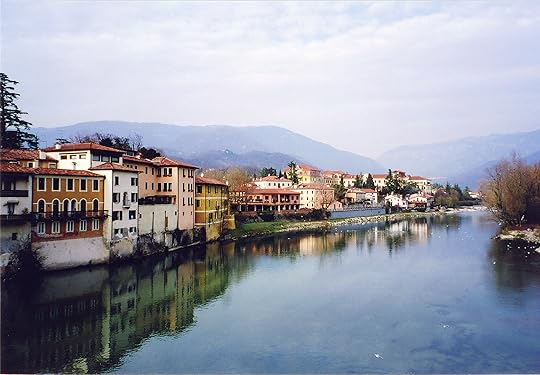
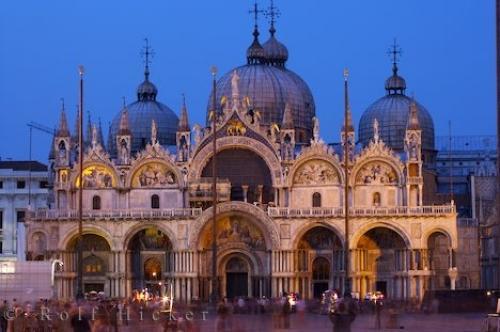
Venice. A woman walks the pathways and streets beside the canals, wrapped in a grey cloak. Her face is hidden from the gaze of two curious onlookers. But as she passes by two old peasant women catch of a glimpse of her features. One of them averts her eyes and crosses herself. teh other makes a sign to ward off the evil eye.
No man, woman or child will speak to the once-proud heiress to one of the city's oldest fortunes. Isolda Mazzini-Forsca is an outcast, imprisoned within the walls of her own splendid palazzo, with only an old servant woman who refuses to leave. Acquitted in law but condemned by popular opinion of a dreadful crime, she has not ventured out for a year. But the people of Venice have neither forgotten nor forgiven.
Indeed there is one among them who believes tha tthe woman in grey has still not been punished enough. Someone vengeful enough to want her to die; someone powerful enough to ensure that it happens, and secretive enough not to be caught when it does. As Isolda Mazzini-Forsca paces the darkened streets of Venice, death stalks at her heels.
The Woman in Grey is the most exciting, sinister and subtle novel that Carola Salisbury has yet written, a sophisticated mystery interwoven with a passionate love story.
Butterworth trained as an artist at Camberwell College of Art and worked briefly as a tutor in drawing at Nottingham College of Art. After briefly working as a salesman, he joined the Amalgamated Press (later renamed Fleetway Publications) after submitting samples of artwork to them. Although these were turned down, he tried again, submitting a script for a sea-going adventure strip. This was accepted and Butterworth was hired as a scriptwriter, at first working primarily Western strips featuring Billy the Kid and Buffalo Bill. His interest in history (particularly naval history) led him to pen many historical comic strips for Comet and Sun, including the Napoleonic era adventures of Max Bravo, the Happy Hussar and World War II air-ace Battler Britton.
Aside from his writing, Butterworth was a gifted editor and created a number of new papers for the firm including Playhour Pictures (soon after abbreviated to Playhour), Valentine and the teenage girls' magazine Honey.
In 1965 he became one of the main script writers for Ranger where he penned the sprawling science-fantasy The Rise and Fall of the Trigan Empire which remains one of the most popular boys' adventure strips published in the UK to this day.
Butterworth left Fleetway Publications and turned freelance. His first novel, The Soundless Scream, appeared in 1967 followed over the next few years by a number of well-received crime novels which appeared under his full name, which has led to some confusion between his work and that of Science fiction writer and Savoy Books publisher Michael Butterworth. Butterworth also turned his hand to Gothic romance novels under the pen-name Carola Salisbury and Sarah Kemp.
The Woman in Grey is a dark and delightful gothic romantic mystery. I just love Salisbury’s style and phrasing. It’s flouncy and flamboyant. Reading one of his books is like slipping into a lovely frock. Yes I said frock didn’t I. I never say frock. See what happens? And once you don that lovely frock you can float down the Brenta river with your trusty gondolier from Venice to your lovely waterfront villa shrouded in Rhododendron while pondering the mysterious Romeo and Juliet -like love story/mystery.
This was different than what I expected from Salisbury in terms of plot line. We move through different time periods as the earlier murder is recapped and ensuing trial relived. The story is of a lovely but lonely woman who is the daughter of nobility in Venice and is falsely accused of a horrendous murder of her fiancé. As the evidence is circumstantial, she is not convicted but every inhabitant of Venice condemns her to a life of being persecuted and shunned. The story evolves as the strong heroine refuses to bow to her tormentors and strives to clear her name – of course with the help of an exquisitely characterized debonair American man. One mysterious happening after another deepens the plot and anyone who dares to expose the culprit behind the scenes is disposed of. This is a little bit like Holt, with Bond-esque like villians. And add in some Italian mafiosos for good measure. I can just picture the heroine running through the cobbled streets at night with some cloaked figure in pursuit.
As these gothics from this era tend to go, the drama is over the top and one must suspend disbelief to enjoy the ride. But it’s just so much fun. It almost reads like a travelogue with the sights and scenes of Venice in the late 1800s coming alive.
This was an enjoyable read, but not definitely the best Salisbury can offer. While I liked the basic story line (heroine shunned by everyone after being accused of murder) and all the subsequent creepiness and mysteries that come with any Salisbury novel, the middle part of this fell a bit flat and dragged on too long. which really cut back on the romantic element, let alone I didn't pick up much on the chemistry between them and it was all pulled together too fast at the end. Still, whopping surprise on the evil doer and dramatic ending.
Carola Salisbury's writing is unique. Her style is unmistakable. She, though, is really a he (Mike Butterworth, writing under a pseudonym). This is an excellent gothic romance story, for those who like such things.