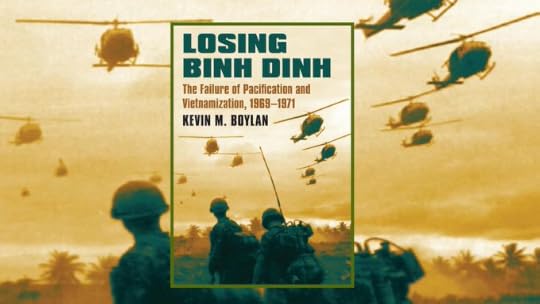
Americans have fought two prolonged battles over Vietnam—one in southeast Asia and one, ongoing even now, at home—over whether the war was unnecessary, unjust, and unwinnable. Revisionist historians who reject this view have formulated many contra-factual scenarios for how the war might have been won, but also put forward one historically testable hypothesis—namely that the war actually was won after the 1968 Tet Offensive, only to be thrown away later through a failure of political will. It is this “Lost Victory” hypothesis that Kevin M. Boylan takes up in Losing Binh Dinh, aiming to determine once and for all whether the historical record supports such a claim.
Proponents of the “Lost Victory” thesis contend that by 1972, President Richard Nixon's policy of “Vietnamization” had effectively eliminated South Vietnamese insurgents, “pacified” the countryside, and prepared the South Vietnamese to defend their own territory with only logistical and financial support from Americans. Rejecting the top-down approach favored by Revisionists, Boylan examines the facts on the ground in Binh Dinh, a strategically vital province that was the second most populous in South Vietnam, controlled key transportation routes, and contained one of the nation's few major seaports as well as the huge US Air Force base at Phu Cat. Taking an in-depth look at operations that were conducted in the province, Boylan is able to uncover the fundamental flaw in the dual objectives of “Vietnamization” and “Pacification”—namely, that they were mutually exclusive. The inefficiency and corruption of the South Vietnamese government and armed forces was so crippling that progress in pacification occurred only when Americans took the lead—which, in turn, left the South Vietnamese even more dependent on US support.
I admire the work of revisionist historians. I strongly believe that the past is always subject to reinterpretation and that it should be revisited by each generation of historians. However, I do not appreciate historians who engage in revisionism for the sake of it. Alas, Kevin M. Boylan, for whose work I had high expectations, turned out to be one such historian. In his book, he aims to prove the so-called "Lost Victory" theory, according to which the war was actually won by the Americans after the Tet Offensive of 1968. This hypothesis stipulates that prior to 1968 the war effort was going well for the American-South Vietnamese alliance. However, this was simply not the case.
Until 1968, when, in the aftermath of the Tet attacks and the international furor they provoked, President Lyndon B. Johnson delivered his Withdrawal Speech that was followed by the decision to stop the American aerial strikes on North Vietnam, the primary contribution of the Americans to the war was air power. What General Westmoreland claimed that the bombing of North Vietnam had accomplished and what it had actually accomplished were two drastically different thing. Westmoreland's optimism was enviable, but contrary to the reassuring reports that he sent to the President, the situation in Vietnam was anything but sunny. The MACV commander and his subordinates calculated success in Communist casualties, which had indeed increased since the Americans escalated the bombing. However, progress in war is measured not in terms of how many more losses the enemy has suffered than we did, but in terms of how close to our goal we are.
The Americans were as far from their goal in 1968 as they could be. First, the more the American military intensified the bombings, the more the resolve of the Communists strengthened, although hundreds of civilians died every day. This was a lesson from the Second World War that had remained unlearned. Hiroshima and Nagasaki was not what broke the will of the Japanese. Prior to the atomic bombs, they had already sacrificed many times as many people as during the two atomic raids. For the Vietnamese, their tradition of patriotism and history of repelling foreign invaders were what the code of Bushido was for the Japanese. They were prepared to fight and die because they knew that it would get better only after it got worse. Second, the Communist fighters, who lived in the jungles, had only two percent mortality caused by the American bombing because the thick canopy hid them well.
The only way that victory could possibly be achieved was to bomb North Vietnam back to the Stone Age, as General Curtis LeMay had proposed. The American government was concerned about drawing China or the Soviet Union into the conflict, though. Furthermore, what good would it have done to bomb back to the Stone Age a country that, in modern industrial terms, was not far removed from it? In North Vietnam there was no important infrastructure to bomb. As one pilot put it, the American pilots were risking their lives daily to destroy a wooden bridge that could be rebuild in a couple of hours. The Vietnam conflict was a conflict without targets.
The fact that Secetary of Defense Robert S. McNamara, who was the staunchest advocate of aerial strikes in 1965, began questioning the ability of America to win the war as early as 1966 – and became convinced that it could not win it not long after – is telling a lot. McNamara's brain worked like a computer, and he recognized that the numbers were not adding up. The Americans were killing and dying in bigger numbers, yet for nothing.
I also disagree with Boylan's claim that Binh Dinh was the only poor area of South Vietnam and that this is the reason for its being the Communist heartland of the South. In reality, the entirety of the South Vietnamese countryside wallowed in abject poverty. There was not a fate worse than being a Vietnamese peasant. Whatever resources there had been were exhausted by the French colonialists and the Japanese occupiers. This is why, as evident from the stories of South Vietnam's resistance fighters, the NLF had members from everywhere. The living standard improved during the Diem regime, but this improvement was short-lived, as Ngo Dinh Diem was dispatched to the netherworld by his own generals with the silent approval of his own ally.
In general, neither in 1968 nor afterwards were America and South Vietnam winning the war. The preparations to get out that begun after the Tet Offensive were the best move that American policy-makers had made in years. The human cost of the war was getting intolerably high. The North Vietnamese attack on Hue during Tet, in which more Americans lost their lives than in the whole conflict up to that moment, may not have been a military loss in the strict sense of the word, but it was definitely a warning that the war would not be won by America and that it was time to get out.
LOSING BINH DINH was a disappointment for me. Boylan's arguments are not convincing, and there are too many facts that one can cite to prove his theory wrong. This book is misleading. I do not recommend it.
Scoring more break-ups in the 30 years since 1994 than Number one songs on the Bilboard Hot 100, the Florida hatched post-grunge band CREED happily lives in infamy, collecting royalty checks from their only chart topper. Nonetheless enjoying a large fan base and successful album sales, CREED is most remembered (by the average audiophile) for the year 2000 hit ballad "With Arms wide open". Often mythologized and overblown and with less success than CREED, the Chieu Hoi Program during the Vietnam War, aka the Phoenix Program, was also known as the 'Open Arms Amnesty Program', looking to underscore pacification and Vietnamization efforts in South Vietnam by encouraging the desertion, defection, arrest, and elimination of enemy personnel. Examining the microcosm of one of South Vietnam's provinces during the height of the Vietnam War, LOSING BINH DINH seeks to test the Revisionist hypothesis that the Vietnam War was, in effect, winnable.
Just like the former-military armchair strategists for GWOT that came pouring out of the woodworks after the war "was over", Revisionists for the Vietnam War argue that the war was winnable, a lost victory, or a victory lost. Historical analysis, however, can neither prove nor disprove whether something that did not happen could have. As such, LOSING BINH DINH goes back to the period before the Paris Peace Accords to determine whether pacification and Vietnamization succeeded, the Revisionists's claim, by arguing for and setting out South Vietnamese shortcomings with reasoning and statistics as they were the chief obstacles to achieving those objectives in Binh Dinh in specific and Vietnam in general. Strategically situated on top of two major transportation routes intersecting in the Central Highlands, Binh Dinh, one of South Vietnam's 44 provinces, was pegged as "the Communist heartland" south of the DMZ. Home to almost a million civilians, Binh Dinh witnessed more allied and communist military activity than all but a handful of other provinces. Like Apalachia in the United States, poverty, geographic isolation, and internal compartmentalization bred a strong distrust of outsiders that made the local inhabitants innately suspicious of the government in Saigon, amplifying VC efforts, seen as liberators from the hated French, and their own Phoenix and defector program that much more successful.
Riding shotgun to the USMC's Combined Action Program in Quang Nam, the 173rd Airborne Brigade's Operation Washington Green in Binh Dinh was one of the few examples of successful pacification and Vietnamization during the Vietnam War. Shifting from tried and true, customary (WW2/Korea) and conventional tactics to small unit tactics to provide security for a terrorized populace. Insurgency is fundamentally a contest for popular support argues LOSING BINH DINH, forcing pacification to also address the underlying social, economic, and political grievances that fuel guerillas in the first place. Operation Washington Green, despite serious efforts by the 173rd, could not break the South Vietnamese dependency on America, and was too ambitious, in fact impeding real pacification. Interestingly enough, the 'story arc' to Operation Washington Green and its aftermath is strikingly similar to events in Iraq during and after the 2007 'troop surge', countermanding that famous promise of #43, saying that Iraq would not be another Vietnam. By that token, LOSING BINH DINH asserts that the secure environment essential for the success of pacification and thus for achieving the overall US objective, creating "a free, independent and viable nation which is not hostile to the United States" ultimately failed.
Basically a Harvard Business Case (HBC), LOSING BINH DINH makes the Vietnam War look like the waffling marketing efforts of Burger King under the revolving door guidance of multiple CEOs, trying to save their jobs and/or justify their golden parachutes in trying to steal market share from McDonald's and shore up revenues and stock price. Going much deeper, LOSING BINH DINH offers a lengthy discourse on the warring nature of people of Vietnam, the naming of Binh Dinh province ("pacified"), French Colonialism, the power vacuum created in the region after Japanese surrender after being nuked at Hiroshima & Nagasaki, cultural differences between Americans & Vietnamese, mixed civilian's feelings towards US troops that were often complex and contradictory, and the creation of the Vietminh to support the argument of inadequate pacification and eventual outcome of the Vietnam War. Doubling down that the Phoenix Program failed for tactical US exuberance, lack of data aggregation, and population control, LOSING BINH DINH also heaps it on the other side, echoing what seemingly was a popular question back in the day; why don't our Vietnamese (ARVN/GVN) fight like their Vietnamese (NVA/VC)? In addition to the corruption within, taxation, bribery, bureaucratic inertia, theft, and abuse of the rural population, LOSING BINH DINH argues that there was something fundamentally wrong with the ARVN that went far beyond quantifiable shortcomings fixable by American money, training, equipment, supplies, and air support. They lacked the will to fight. Well researched and documented, LOSING BINH DINH unholsters interesting concepts the likes of oil spot technique, static penny packets, rice-denial duty, shake and bake NCOs, and West Point protective association. Waxing axiomatic that 'intelligence agencies the world over are notoriously reluctant to share info', and that he who defends everything, defends nothing, LOSING BINH DINH is fundamentally a PhD thesis of how America lost the Vietnam War or how all her efforts treaded water, including Vietnamization, Americanization, grass roots politics, the corrupt regime, the Viet Minh influence, and the Strategic Hamlet Program--All structured or explained on hand of one province in the Central Highlands, with evidence and reasonable argument aplenty detailing the who, what, where, why, when, and how.
Boylan has written a valuable and detailed work of scholarship. He writes superbly, blending statistics with colorful anecdotes. Under his deliberate scholarship, the Revisionist case for US victory collapses more completely than the Republic of Vietnam.