Jump to ratings and reviews
Rate this book

Jerusalem The Emanation Of The Giant Albion

Rate this book
This scarce antiquarian book is a facsimile reprint of the original. Due to its age, it may contain imperfections such as marks, notations, marginalia and flawed pages. Because we believe this work is culturally important, we have made it available as part of our commitment for protecting, preserving, and promoting the world's literature in affordable, high quality, modern editions that are true to the original work.

72 pages, Paperback

First published January 1, 1808

38 people are currently reading
794 people want to read

About the author

William Blake

1,230 books3,204 followers
William Blake was an English poet, painter, and printmaker. Largely unrecognised during his lifetime, Blake's work is today considered seminal and significant in the history of both poetry and the visual arts.

Blake's prophetic poetry has been said to form "what is in proportion to its merits the least read body of poetry in the language". His visual artistry has led one modern critic to proclaim him "far and away the greatest artist Britain has ever produced." Although he only once travelled any further than a day's walk outside London over the course of his life, his creative vision engendered a diverse and symbolically rich corpus, which embraced 'imagination' as "the body of God", or "Human existence itself".

Once considered mad for his idiosyncratic views, Blake is highly regarded today for his expressiveness and creativity, and the philosophical and mystical currents that underlie his work. His work has been characterized as part of the Romantic movement, or even "Pre-Romantic", for its largely having appeared in the 18th century. Reverent of the Bible but hostile to the established Church, Blake was influenced by the ideals and ambitions of the French and American revolutions, as well as by such thinkers as Emanuel Swedenborg.

Despite these known influences, the originality and singularity of Blake's work make it difficult to classify. One 19th century scholar characterised Blake as a "glorious luminary", "a man not forestalled by predecessors, nor to be classed with contemporaries, nor to be replaced by known or readily surmisable successors."

Ratings & Reviews

What do you think?
Rate this book

Friends & Following

Create a free account to discover what your friends think of this book!

Community Reviews

5 stars
136 (49%)
4 stars
64 (23%)
3 stars
56 (20%)
2 stars
13 (4%)
1 star
7 (2%)
Displaying 1 - 30 of 31 reviews
Profile Image for Paul.
2,794 reviews20 followers
May 18, 2025
I just noticed I originally rated this 3 stars when I finished it this morning and gave it the whole ‘RTC’ treatment. Blame my nonfunctional eyes and post-stroke fingers for that error! Sheeesh…

OK, this is Blake’s self-proclaimed masterpiece and it is definitely a work of poetic fantasy on a truly epic scale. The illustrations are beautiful. The verse is powerful and almost transcendent.

Yes, it is confusing, with its multi-gendered characters who are also places who are also gods who are also abstract concepts, but if you give it the attention it needs it does hold together… just about.

I honestly don’t think Blake was entirely present in this world, living as much (if not more) in a world of his own creation. This is probably true of many great creators, though. In their case, the usually pejorative term ‘they’re not all there’ is probably literally true.

Whatever you may think of this work and this man, it’s undeniable that it gave us one of our best hymns; one that even I, a lifelong atheist and non-patriot, finds stirring:

And did those feet in ancient time
Walk upon England's mountains green
And was the holy lamb of God
On England's pleasant pastures seen
And did the countenance divine
Shine forth upon our clouded hills
And was Jerusalem builded here
Among those dark Satanic mills
Bring me my bow of burning gold
Bring me my arrows of desire
Bring me my spears o'clouds unfold
Bring me my chariot of fire
I will not cease from mental fight
Nor shall my sword sleep in my hand
'Til we have built Jerusalem
In England's green and pleasant land…

Profile Image for Joe Kraus.
Author 13 books132 followers
March 31, 2019
Okay, I am not about to “review” William Blake. Reading his work is an experience, and you’re in the mood to “get it” or not. You don’t, in the 21st century, evaluate it.

Still it is fair, I think, to try to evaluate this edition of his work.

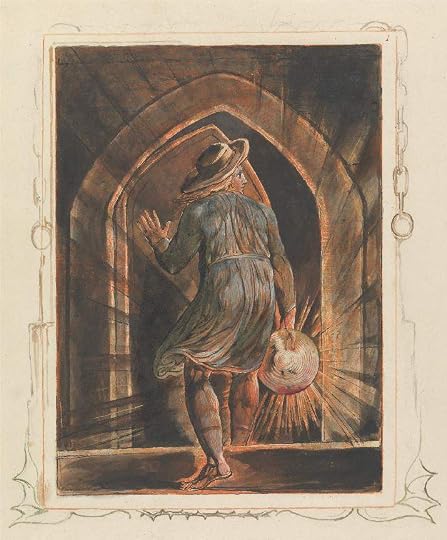
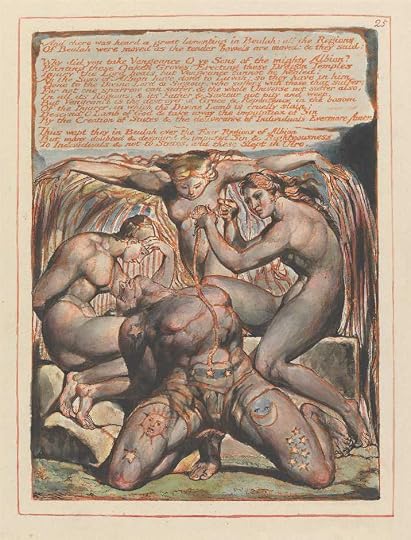
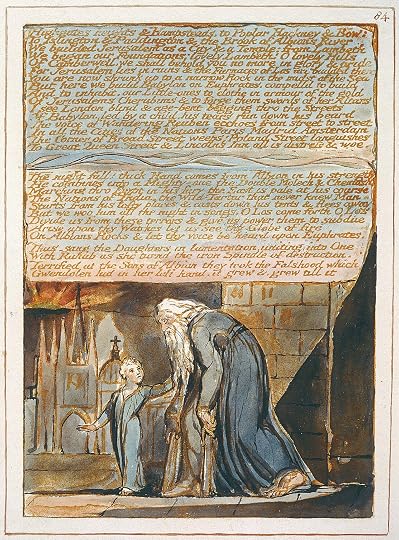
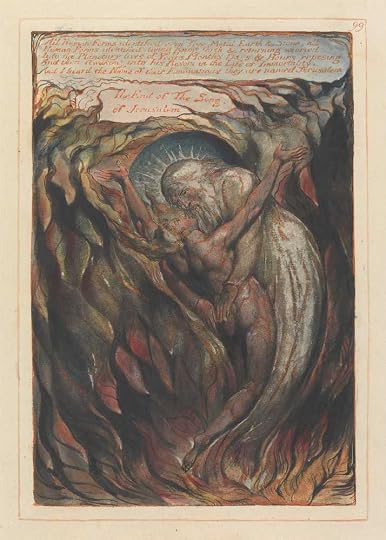
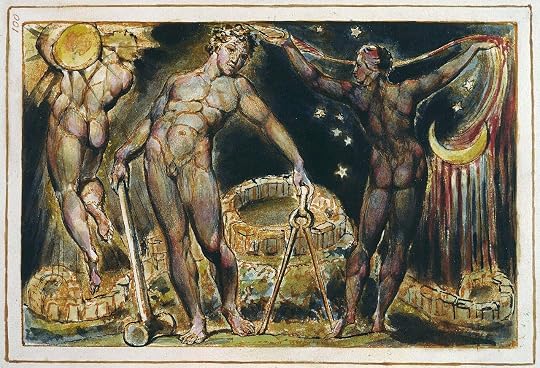
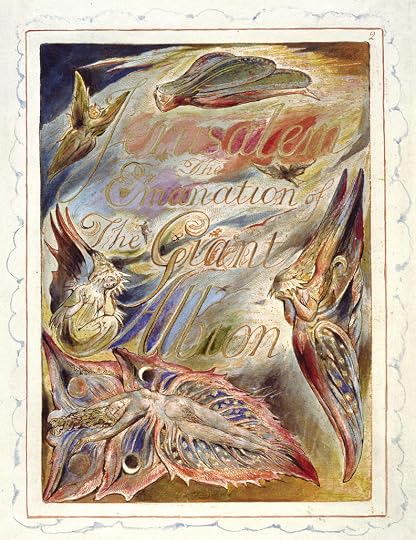
When I was reading Alan Moore’s remarkable novel Jerusalem a few weeks ago, I wanted to get a sense of Blake’s Jerusalem. I pulled my trusty Penguin Collected Blake off the shelf and started reading, but then I realized I was missing a big part of the experience. Moore may have written a novel entirely in text, but it’s one that turns on the visual fine art he describes. And, of course, Moore has spent most of his career in graphic novels. So, I wanted to see the illustrations Blake prepared for his own work.

That turned out to be tougher than I expected. I assumed there’d be an easily accessible on-line edition, but I couldn’t find one – nor could the college reference librarian I consulted. (There are some great digitized editions on-line at the New York Public Library, but not for Jerusalem.)

Instead, we found this edition from Princeton University Press and, expensive as it is, we ordered it for the library.

It’s a beautiful book, and it’s possible to see all 100 plates of the poem back-to-back. Still…

I believe the originals are a good bit larger than the reproduction. And, at least in my imagination, they’re brighter than the pastels of this. Plus, as a result of the sizing, it’s hard to read the words of the text. Sure they’re typed out at the end of this, but I had that in my Penguin.

So, while this may be the best edition available, it still leaves a lot to be desired. Somehow, it seems, this masterwork of English literature remains inaccessible.

All that said, there are better places to start reading Blake. This one is late-stage stuff. It’s hard to make sense of it since its mythology is already developed. I mean who exactly are Los and Albion, and what do they have to with the dismemberment of Jerusalem – who is himself simultaneously a character, a symbol, and a city as well as a representation of 18th Century London?

And the language and tone is right out of the Book of Revelations with bizarre pronouncements and everything functioning at a mythological, symbolic level more than a literal one.

There are some great lines, of course. This is Blake after all. A couple I love are, “[The sons of Albion are] by Abstraction opposed to the Visions of Imagination,” and “As God is love: every kindness to another is a little Death.”

I don’t pretend to understand it, and I missed being able to see the large and bright illustrations I imagine Blake must have wanted to accompany them, but there is nevertheless occasional magic in the glimpse we get.
Profile Image for Marc Lamot.
3,465 reviews1,982 followers
Read
May 19, 2025
I guess I'm not the only one having trouble with this book. It clearly belongs to Blake’s mature period (1804), but this makes it considerably more hermetic than his other work, which is already very difficult to access. What is striking is the epic character of this longer book, with a complete doctrine of salvation and his own vision of the universe in the background. Formally there is the very pathetic style, with constant exclamations and almost continuous verbal fireworks, often with an endless list of geographical and mythical names, lots of metaphors and symbolism. Blake revisits a number of themes from his early work; thus Urizen (the enforcer of order and reason) and Los emerge again. Even more than before, Albion, the mythical giant of Great Britain, is present, and on a superficial reading this seems like a patriotic writing (cf. the much-quoted lines “And did those feet in ancient time/Walk upon England's mountains green”). Nothing could be further from the truth, as John Higgs (Blake versus the World) taught me. The fervent praise of Christianity (not that of the churches, of course) and the outbursts against the Enlightened deists are other ingredients. So there's a lot of meat on the bone. Best to read with extensive, expert commentary.
Profile Image for Randy Wilson.
494 reviews9 followers
July 29, 2024
My husband bought me an exquisite copy of this monumental Blake poem, the most powerful yet inscrutable of his works. I spent several months slowly reading and examining each of the one hundred plates. There is such a glorious tension between the art work, so rich and deep, bursting with energy, sometimes gruesome, often transcendently beautiful on the one hand and the prose which has a different kind of power and imagination despite being almost incoherent. That the poetry tells a personally resonant story to Blake can’t be doubted but he doesn’t care that his reader is ill-equipped to interpret his meaning.

The tension between the visual and written works accesses deeply primal chords of resonance within me. I am not put off by my lack of understanding but instead pulled into its mesmerizing mystery. I feel as I read and react to his vision I am pulled towards a glowing orb found in a mythic underworld. This to me is the epitome of a mystical experience. If I had to convey to someone in words how moved and altered I am by this work, I would fail. I would only hope that my visible excitement would communicate to someone why this work is so meaningful.
Profile Image for Mark.
70 reviews3 followers
October 4, 2017
It may be that I'm just dense, but I found much of this extremely difficult. I had to re-read a LOT, and even then some passages were just too specific to the time and place.
However, it was worth it, and, as Blake paints his picture of the universe and the placement of human imagination and society within it, I found myself weeping at points. The passion with which Blake's near-insane message of universal oneness is drawn out gives some of the most beautiful metaphors and descriptions of his that I've read yet.

Additionally, the scope feels so vast that he seems to write about subjects that wouldn't be discussed seriously until a century after his death.
I read this at the same time as a book on Einstein's theories, and I couldn't help but feel that Blake predicted the curvature of spacetime (even going so far as to say Newton doesn't go far enough, and that Euclidean geometry has too narrow a scope; hell, even the "minute particulars" he refers to could be compared to spacetime geodesics!)

So my advice is this: Read it, even if it seems overwhelming. Point of fact, it IS overwhelming. After all, how could anything with a scope as grand as this be anything but? However, you are bound to see your worldview painted somewhere in this poem, and instructions for connecting that worldview to the worldviews of others. It may not make sense right away, but you're bound to walk away with something to think about.
Profile Image for Mel.
3,519 reviews213 followers
January 4, 2013
I found a lovely folio size copy of Blake's Jerusalem from 1906 in the 2nd hand bookshop on Charring Cross road. It was beautiful type and paper and something I'd been meaning to read for awhile. I'd read Marriage of Heaven and Hell and the Songs of innocence and experience years ago. Despite having read the introduction the poems made Very Little Sense. I think I will have to buy myself an illustrated version and see if that helps. But even without much sense it was still beautiful and there were lovely lines that really jumped out at me. I think I will have to buy the illustrated version and see if that helps it make more sense. But even though I was confussed I still really liked it and enjoyed the themes, which I think were industrialisation, god, mis-interpretation of Christianity and some trouble between the sexes. But I could be wrong on that.
Profile Image for John Yelverton.
4,435 reviews38 followers
November 24, 2017
This is a pretty compelling poem about attempting to spread the word of God throughout all of England, and making it a new Jerusalem.
Profile Image for w gall.
453 reviews8 followers
October 2, 2022
Jerusalem by William Blake was for me impossible to follow but nevertheless it kept my interest. William Blake meant something by it, and Blake scholars and careful readers probably have a loose grasp of what that might be, Mystical characters in almost continual strife, pursuing happiness and eternal life, and the repugnance of moral laws as opposed to the forgiveness of others' sins, leading to the goal, Jerusalem- these seem to me to be the major themes. Does this amount to a loose grasp of Blake's purpose on my part? If he is asserting that the Old Testament and the New Testament are opposed, I disagree with him, though I can see how someone could conclude that. That he has a good grasp of the Holy Scriptures is clear, and prophets are mentioned among the characters, so I would not say that his adherence to his own form of Marcion antinomianism can be proved conclusively from the book. In any case, four stars it is, even though I could not follow. I credit this to Blake's marvelous facility with the English language.
Profile Image for Dan.
23 reviews2 followers
October 29, 2021
I listened to this on librivox, read by Nick Duncan, and (no joke) Nick absolutely kept me present through almost the entire thing. I drifted on occasion but his reading was outstanding and seemed to do this difficult text its absolute due. I would've struggled reading it and might not have finished.

I need to read the guide to the writings of Blake that I have before I listen a second time, though. I'm hoping that will clear up some of the most difficult passages and reveal the 'something' that always seemed to be holding back. My understanding seemed to crest and trough at various times. I'd be feeling like things were becoming clearer and I could almost see Blake's intent but then the image would be lost in obscurity (I'm really curious to know what an 'hermaphroditic winepress' is an allusion to).

I look forward a second go. Rest assured I'll listen to Nick again!
Profile Image for Tait Jensen.
117 reviews4 followers
November 30, 2017
This is a poem of incomparable complexity and opacity, but among the finest of Blake's prophetic works. In this beautiful edition, the intellectual challenge of interpreting both word and image is mitigated by scholarly commentary and editorial insertions; nevertheless, there remains plenty of room for the reader to ponder and ruminate on Blake's dazzling verse, undoubtedly yielding a multiplicity of interpretations.
Profile Image for Andrew.
105 reviews11 followers
April 11, 2018
I am not a poetry buff. I enjoy it, and I appreciate it, but it is not my passion.

With that being said, this was a rough one for me. I like Blake a lot, but I struggled getting through this. it was odd, though: even though I found it difficult to follow and hard to keep reading, it kept me coming back.

If you think you'd like reading something that's a cross between the old testament and Revelation, written in King James, then you would probably really like this book.
Profile Image for Adam Shenouda.
23 reviews
June 8, 2025
one of blake’s best works (i say this about all his works) im kicking myself for not having read this while working on my thesis but oh well there’s always my masters. i’m gonna need to reread it once i get my hands on s. foster damon’s dictionary..
1,642 reviews19 followers
April 20, 2020
Yet another installment of Blake's universe- plus showing influence of German contemporaries
Profile Image for Mark Ferrara.
Author 9 books2 followers
June 25, 2020
Blake at his most magnificent (and inscrutable)! A beautiful reproduction of the plates with transcriptions.
Profile Image for Jeff.
45 reviews2 followers
August 31, 2021
I think I give this 4 stars...This definitely needs a few more readings
Profile Image for Melissa.
77 reviews1 follower
August 24, 2023
I just wanna know what drugs he took before writing this.
1 review
March 19, 2024
Amazing

The story of life, God. True bible as dictated by spirit itself. Please read again and again with an open mind. Highly recommend.
Profile Image for Wiley June.
204 reviews1 follower
May 5, 2025
interesting. perhaps 3 stars but is a little too Silmarillion coded
Profile Image for Jared.
391 reviews1 follower
Read
September 7, 2025
Be vigilant!! Tri-gendered chariots surround us all!
Profile Image for Tommy Milutin.
4 reviews1 follower
November 12, 2023
After reading Blake's "Book of Job" I determined to delve deeper into some of his other works. "Jerusalem" (free online as a part of Poetry's comprehensive archives) is a poem that is progressive in its admittance of England's total lack of proximity to or embodiment of "those feet in ancient time"—additionally, Blake's homeland is described as "clouded," characterized by "Satanic Mills" where the divine purity and grace of the face of Christ had never before advanced its gaze. Or, rather, where it had never before been reciprocated in its attentions. The work is one of action and revolt, both radical and enthused, in hopes of creating a society/nation in the image of Blake's savior. "Mental Fight" is compared to instruments of war through the symbols of bow, arrows, chariot and sword—suggesting that revolution may manifest in intellectual epiphany, not solely in the material taking-up of arms. England's "green and pleasant land," as described in the last line, is one that is illusory. Blake calls for intention in the fostering of truth and for a vigilance in de-constructing what industry and law have ignored.
Profile Image for Mel.
3,519 reviews213 followers
October 22, 2011
I found a lovely folio size copy of Blake's Jerusalem from 1906 in the 2nd hand bookshop on Charring Cross road. It was beautiful type and paper and something I'd been meaning to read for awhile. I'd read Marriage of Heaven and Hell and the Songs of innocence and experience years ago. Despite having read the introduction the poems made Very Little Sense. I think I will have to buy myself an illustrated version and see if that helps. But even without much sense it was still beautiful and there were lovely lines that really jumped out at me. I think I will have to buy the illustrated version and see if that helps it make more sense. But even though I was confussed I still really liked it and enjoyed the themes, which I think were industrialisation, god, mis-interpretation of Christianity and some trouble between the sexes. But I could be wrong on that.
Profile Image for Preetam Chatterjee.
6,833 reviews366 followers
February 10, 2024
Blake’s final epic poem is his colossal equivalent of Milton’s History of England. Incorporating his innumerable former mythologies into a self-consistent myth, it tells the story of the Fall of Albion. Jerusalem is more intricate in its personages and actions than any of Blake’s other works, in part because it is an intellectual metaphor in the Dantean sense of pursuing several different levels or types of meaning simultaneously. It includes historical-geographical, religious-sexual, political, psychological, and visionary meaning and references.
Profile Image for James.
69 reviews6 followers
November 30, 2008
Like all editions in this series, this edition provides a beautiful full color representation of one copy of the work represented in this volume (with some smaller reproductions of other copies in an appendix). Blake's work is accompanied by useful commentary and annotations.
Profile Image for Myhte .
521 reviews52 followers
January 3, 2023
Reader! of books! lover of heaven,
And of that God from whom all books are given,
Even from the depths of Hell his voice I hear,
Within the unfathomed caverns of my Ear.
Therefore I print; nor vain my types shall be:
Heaven, Earth and Hell, henceforth shall live in harmony.
Displaying 1 - 30 of 31 reviews

Can't find what you're looking for?

Get help and learn more about the design.