Widely regarded as one of the greatest landscape painters in the history of art, Turner's influence on the development of Impressionism has been well documented. What has been less explored is the way his influence spread beyond Europe, providing a foundational model for American artists challenged with tackling the vast panoramas of the New World. Landscape painting was seen as the art form most closely allied to the identity of the newly independent nation which encompassed an unparalleled diversity of landscape scenery. Turner's revolutionary depictions of light, colour and atmospherics in the landscape coupled with his understanding of the sublime in nature made him among the most acclaimed and keenly studied European artists in the New World. Accompanying the largest ever touring exhibition of Turner's works in the USA, J.M.W. Turner will explore the artist's legacy and the importance of his ideas for succeeding generations of painters on both sides of the Atlantic. Written by lea
His genius was so personal, so entirely the outgrowth of inspiration, that he stands alone, a Titan, impossible to imitate and difficult to follow … Turner formed no school of landscape art, and his painting belongs to the world rather than to any country. 4 1/2 stars
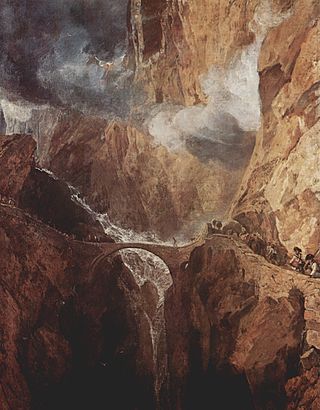
The Pass of St. Gotthard (c.1803-4)
There is no painter of the first half of the 19th century whose paintings I admire and love more than those of J.M.W. Turner. The first time I ever saw a painting by him, I'm certain that I was halted in my tracks as if by a blinding light - as certain as I can be of something that is lost in the mists of memory. And of course "light" (though hardly of the blinding sort) and "mists" are so apposite when describing the stunning beauty of Turner's paintings.
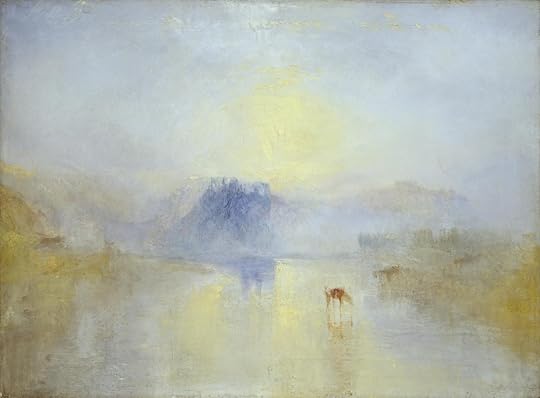
The first two paintings included here have been selected to illustrate light and mist from two widely separated periods of Turner’s life.
The first (above) was painted by Turner in his late twenties. The second (below) dates to around forty years later.
Norham Castle, Sunrise (c.1845)
The book J.M.W. Turner
This book is the guide to the magnificent exhibition of Turner's paintings that visited three venues in the U.S. in 2007-08. First stop was the National Gallery of Art in Washington D.C., between Oct. 1 and Jan. 6; after that it opened at the Dallas Museum of Art on Feb. 10, and at New York's Metropolitan Museum of Art on June 24.
The quote above is from Catherine Gasquoine Hartley’s 1905 book Pictures in the Tate Gallery. It is taken from Stephen Deuchar’s Forward to the book here reviewed - Deuchar being at the time (2007) Director of Tate Britain, as the Tate is now known. Turner’s paintings form one of the most admired foundations of the Tate, admired by art lovers from countries and cultures all over the world.
Physical stuff and format
My book is a very heavy, well made paperback, a typical exhibition guide. It can also be found as a hardcover, but that format discouraged me because of the extra cost. It’s large (11 3/4 x 9 3/4 inches), about 3/4” thick, very high quality paper, color figures and plates throughout.
Those large pages can hold a LOT of words. Text appears in two columns, and on a page that is devoted to just text, there might be about 700 words, more in some cases if a need was felt to crowd a couple hundred more words into the page’s discussion. The print size seems to vary slightly, so as to cover a roughly similar space on pages that contain different quantities of text. The visual aspect of the text pages is quite elegant actually.
There are 165 “main entries” in the book. Each of these consists of one page (or two facing pages), usually showing a single item from the exhibit. The major items will have the painting on one page, and the descriptive essay on the facing page (the "A format", see below). Other formats have the picture and a shorter description on a single page, or in a few cases two or even three items pictured on the same page, with text again on the facing page. All the information about each work is contained in a standard block, small print: the medium, size of the work, a list of all (? maybe not all, maybe just major) works in the Bibliography which discuss the work (with page numbers), and the official “home” of the painting (what museum, what private collection).
The first painting shown in this review (St. Gotthard) is shown in an unusual format: it and a related painting occupy the lower halves of two facing pages, with a single descriptive piece for both of them on the top parts of the pages. Each painting has its own “main entry”, which both appear at the top of the left hand page. The other three paintings I’ve shown are all presented in the standard A format.
Outline
Following three (!) Forwards, there’s a nine-page appreciation - part biography, part history - by Ian Warrell titled “J.M.W. Turner and the Pursuit of Fame”.
Then comes the main show, the 200+ page Catalogue, in three sections: PART ONE: ’the first genius of the day’, PART TWO: ’the great magician of his art’ and PART THREE: ’tinted steam’. Scattered throughout the Catalogue are ten one-page essays, each written by one or more of eight different people. These address different periods of the artist’s life, different challenges he faced, and the background history of the times.
Following the Catalogue is an interesting 16 page essay titled Turner in America. Turner never visited Britain’s former colony, but from about the 1830’s on there was considerable interest in his work in America, and this Turner was aware of. The essay examines many facets of this interest and how it was satisfied, and then traces the influence that Turner had on several American artists, including Frederick Edwin Church, Thomas Moran (known as “the American Turner”), George Innes, Whistler (who actually disliked Turner’s art), Albert Pinkham Rider, and much later, Mark Rothko. There is also information on early exhibitions of Turner, the paintings he did that eventually found their way to America in museums or private collections, and the place that Turner occupied in American art history publications of the early twentieth century.
Finally, a collection of useful flotsam: notes, an eight page chronology of Turner’s life and contemporary events, maps of “Turner’s London” and his travels in Britain and Europe, a HUGE bibliography (five triple-columned pages), and an index containing, among other useful things, all the names of the paintings found in the Catalogue.
The missing half star
One inexplicable problem I found with the book is the location of the “Figures”. The figures illustrate (many in color but all rather small) works which I assume were not in the exhibition. They are sometimes referenced in the text of a “main entry.” But there’s no easy way to find, for example, Figure 38. True, they are in the book in ascending order (there are 56 in all); and there’s even a list of all the “Figure illustrations” near the back, giving all the detailed info for each of them that the main entries get. How easy it would have been to give a page number where the Figure could be found. But no. No page number. Just hunt for Figure 38 by flipping pages … eventually you’ll find it on page 192.
The other problem with this fine book is availabilty and cost. As far as I know guide books for art exhibits are never reprinted. Once the exhibition is over, the unsold copies (assuming there are any) simply disappear into the hands of people associated with the endeavor, or (eventually) book dealers.
You can find both used and new, and both paperback and hardcover editions of this book, in Amazon’s third party seller directory. But they are all expensive, $50 and up (to $200 and more). So don’t think of these as “remainders”. At this time there are almost 50 in these various categories, all at those prices.
On the other hand, had you bought a copy at the exhibition in 2007-8, they wouldn’t have been cheap either … but certainly not over maybe $75 for the hardcover edition, and half that for the paperback.
There is now a Turner exhibition book called J. M. W. Turner: Painting Set Free. This book was published on the occasion of an exhibition on view at the Tate Britain, London, from September 15, 2014, through January 18, 2015; at the J. Paul Getty Museum from February 24 through May 24, 2015; and at the de Young Museum in San Francisco from June 20 through September 20, 2015. I haven't seen it, but it looks good on Amazon, and is considerably more available than the one reviewed- both by number and price.
The Exhibition
This was the most comprehensive Turner exhibit ever staged in the U.S., with 140 works: 85 from the Tate, the rest from dozens of U.S. and British museums and private collections.
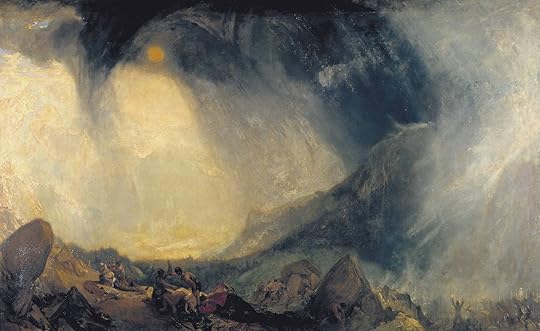
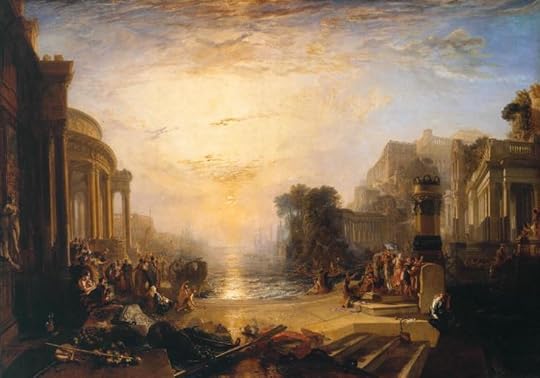
Two notable paintings, shown below, had never before visited America.
Snow Storm: Hannibal and his Army Crossing the Alps (exh. RA [Royal Academy] 1812)
The Decline of the Carthaginian Empire (exh. RA 1817)
Of course my wife and I went. It was an incredible finale to a three month period which started with my only visit to Europe - a life-altering (even at my age) ten days in Italy at the beginning of September.
I recently saw a remark by someone wiser than I, to the effect that Turner, through his wondrous depiction of light, had in a significant way anticipated the impressionists. Whether this judgment would be accepted by an art historian I know not, but that doesn't matter. It seemed meaningful to me.
This is a wonderful catalog of the remarkable American exhibition of Britain's greatest artist and one of the world's greatest artists of the 19th century. It is an unprecedented collection for American viewing and a huge resource of Turner oils and watercolors. The catalog prose is a little dull but the great art shines through in all its glory and variety.