Economics expert Stewart Cowley distils the complexities of modern-day money and our relationship with it, explaining how you can use economics to your advantage and that understanding economics can improve your life.
Along the way you will discover how the statistics that govern our world are based on guesswork, why stock markets are like a wandering drunken man, what you need to live like a millionaire, and why cooking has made man the dominant species on the planet.
Where is all the money? How does a country go bust? Should I get paid in Bitcoin? Wherever you go, whatever you do, however you live your life, money plays a role. Getting it, keeping it, and making more out of it has been one of man’s major preoccupations for the past five thousand years. From buying a sandwich to earning a wage, going on holiday to playing the lottery, how money and economics governs our world is fascinating. And it’s just about to get more curious; the arrival of modern banking, crowd funding, investments at the touch of a smartphone, and virtual currencies means, for many of us, it is even more complex.
Stewart^^Cowley has been working in financial markets since 1987. He is one of a handful of people to have ever held a triple-A rating by Standard & Poor’s and was awarded the prestigious Gold Medal for long-term investment performance by FE Trustnet. He has also been one of the UK’s most visible fund managers, having written for the New Statesman, the Sunday Telegraph and Citywire. He has made frequent appearances on BBC TV and radio and Sky News. His previous books, Man vs Money and Man vs Big Data, have both been bestsellers.
This book has all the attributes of an 'economics made simple' primer - big typeface, thick pages, and wonderful naive drawings by Joe Lyward.... and I understood nearly all of the words.
BUT - but, but but .... I didn't understand much of the economics.
I am someone who has been dabbling around with this subject for about five or six months now, and my ignorance is still appalling. I don't know whether it is my small ageing brain, a lifetime spent with no interest in money whatsoever, or just the general difficulty of the subject - but I am finding it hard to find toe holes on the rockface. My real bête noir is quantitative easing, but there are loads of other things which get me flustered too.
Whilst the author seems more than qualified to write this book, it hasn't been well edited. I found odd comparisons using a mix of pounds sterling and US dollars, and in another instance a mistake between the facts given and an accompanying diagram. These hiccups do not instil confidence.
Herewith the main chapters of this book, and my response to them.
A brief history of economics Short, good and I completely understood it.
Compound interest Knew about this already, and its importance was clearly explained.
Bonds A big learning project for me, especially with my dreadful grasp of numbers. I will read and re-read my notes on this quite a lot more. I had no idea how big the bond market was in most western societies (much bigger than regular bank lending or stocks and shares.) Herewith my copious revision notes, mostly taken straight from the book.
Banks Understood this fairly well, though could have done with some more elaboration.
The markets Pure gobbledegook to me, but then I suspect that is the nature of markets. Not an easy subject to write about.
Bitcoin Surprisingly easy to understand the general process, even though I couldn't grasp the mechanics of how it works. It is more like a commodity than a form of money. You might decide to stash bitcoins instead of gold for instance, though the market is hugely more volatile. Like gold it is 'mined, although in this instance the mining is done on a computer, and only a finite number of bitcoins is ever going to be produced.
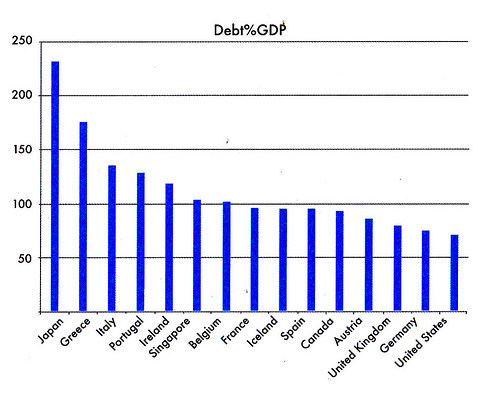
Government finances (eg countries going bust) A very interesting chapter indeed. Whilst levels of national debt can sound scary, it is actually our ability to pay off the interest on our debt which is every bit as relevant. There may be countries with far less debt than the US, but whose ability to pay off the interest rates on their debt is far worse, and they will be in a lot more trouble. Herewith some countries who have reneged on their debts since the 1980s. Argentina Mexico Nigeria Russia Vietnam.
And herewith a chart of the Debt to GDP ratio of various countries. A good level of GDP means you are likely to be able to pay off the interest rate on your debt. Japan stands out not only for having the highest level debt to GDP, but for the fact most of its debt is owed to Japanese people, (presumably via bonds), so it's kind of a home debt, and some would argue, for this reason less serious.
Millionaires Oh yawn, the most boring chapter in the book. Who cares about boring old millionaires, or billionaires.... Pfffffft.
Quantitative Easing Oh sob, sob, sob, yet again, in spite of all the reading I have done on this topic, I barely understood a word. Honestly, I could weep.
Derivatives More investing gobbledegook. For me it sounds like wild betting on the different directions that various markets will take in the future. But I may well have got that wrong, as I didn't understand this chapter. What I did understand is that derivatives are massive. If we roughly compare the different levels of finances......
Bitcoin.................................................................(No figure given, but small compared to the rest.)
So, there we are. Derivatives are a very, very big chunk of world finances.
I am not giving this book any stars. I think that for someone with just a bit better grip on economics than me, it could be an excellent read. Economics is a complex subject, and I thought the book was well laid out. It takes the reader on a journey in such a way that things slot together sensibly, and I think that is an achievement. I also learnt several new things - especially about bonds and national debt - so all in all it was time well spent. Another positive is that the book was published in 2016, so it's right up to date.
It's hard to review this book. Some parts was eye-opening, some was boring, and some was highly obscure you would need an investment dictionary to get through (the derivatives chapter). But overall it was good, it's not "okay" or even great. It just delivers.
EDIT: I give it a two star. The writing style sometimes can be boring.
Even though the book has 220 pages, the size of the font and the number of empty pages makes it an easy read. I finished it in about 2-3 hours, with some breaks. It's a very, very basic introduction to economics and finance ("money") that despite using some terminology that a normal person wouldn't use, it explains it in a way that anyone could understand. Of course, it's not gonna be the equivalent of an Econ 101 course, but for what it's trying to be, it has definitely succeded. I had a lot of fun with it.
I liked the ideas presented in the book & would recommend it anyway who is interested in understanding about money. Just be aware that the topics covered here would require a lot of supplemental reading to truly grasp.
Easy to read and understand for someone with very limited knowledge of economics like me. It helped me to gain confidence again to keep working on my business ideas.
Mình đọc bản Tiếng Việt của quyền này "Tiền quả thật phiền". Với người không chuyên về kinh tế thì mình cảm thấy hiểu được 60% quyển sách. Từ những danh mục mà quyển sách đưa ra, mình có cái nhìn tổng quát về những sản phẩm tài chính.
I finished reading this book (on Oct 14, 2020) I like this book but the parts in this books are not explained in greater depth. Like the explanations about derivatives and gini index were really new to me so I had to search on Google and YouTube. But other than that, the parts about stocks and bonds, I already knew them so it's not a problem. The lesson about GDP was fun. I learn many things from this book even though the examples are kinda hard for me sometimes, coz it's kinda complicated math (to me) but overall sometimes the author uses simple math like he uses muffins to explain about GDP. It's only 200 pages so it's really good for you who wants to have a crash course about fundamentals of money or more like basic economic lessons. I'd give this book 3.8 out of 5
A simple book to understand the concepts of the economy , market and financial instruments . The book tries to remove the boredom of the subject but some areas need more explanation . A relaxing read to get a hang of the world of finance which at times seems complicated to the common man.
Overall interesting read. Bought this on a whim at the airport years ago, so by that context pretty insightful. Some of the later chapters are quite dry (derivatives), but all in all well written and informative.
Very quick read as well given use of charts, page breaks, etc.