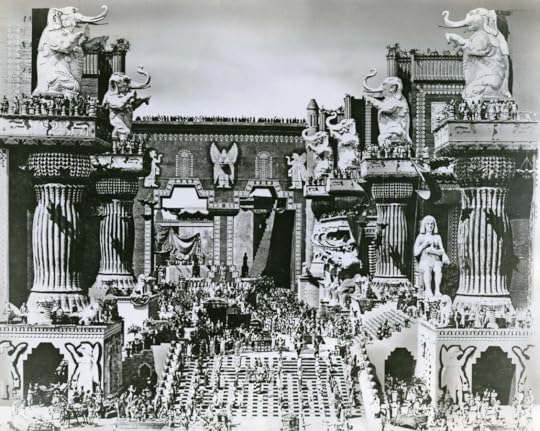
The Silent Movie era is long past us, having begun in the nineteenth-century and ended in the late 1920s, although some countries still made silents into the 1930s. Many people have never seen a Silent Movie or only seen one or two on television. But if you have ever seen a fully restored movie from that era on the big screen, then you know how magnificent a time it was for cinema. This book provides a very clear introduction to the silents, with one section devoted to the best of the films and the other section devoted to the great stars of that time.
Before Silent Movies, the stage was the king, whether it was a serious production or vaudeville. But when the silents came around, suddenly an affordable source of entertainment was made available for everyone, especially the working class. Starting with just one-reel (ten minutes) presentations, filmgoers were astounded by what they saw. A train rolled into a station and people gasped! An actor in a cowboy costume pointed his gun at the camera and people gasped! A spaceship landed on a cheese moon and people gasped! Suddenly, there was a new world of fantasy and realism that could be provided and as movies became more popular, the Silent Movie became longer and more elaborate.
The most famous architect of this revolution was D.W. Griffith, considered the greatest of the Silent Movie directors. With silents having extended into two-reels (twenty minutes), Griffith went even further and filmed the first feature-length silent. While two-reelers were still the most popular between 1913-1919, the longer pictures were now creating stars of greater magnitude, such as Mary Pickford and Douglas Fairbanks. Charles Chaplin, the greatest of all Silent Movie stars, also graduated to longer movies and this is when the most magnificent silent cinema was created. The 1920s would prove to be the zenith of filmmaking for some time, because even after sound came along, movies were stilted until technology in the 1930s allowed studios the chance to emulate the best silents in epic presentations. The selection of silents in this book show the evolution of cinema.
The Silents Grow (1903-1919)
THE GREAT TRAIN ROBBERY Made in 1903, this was a revolution for film. At 9 minutes long, it provided the step from nickelodeons to movie houses and was also the first Western to be filmed. There were shootouts and real trains in action, which put audiences in a tizzy!
INTOLERANCE This is really the first epic, a stunning bit of moviemaking which must be seen on a big screen to be appreciated. It was a colossal spectacle from D.W. Griffith and made Lillian Gish a huge star. And the sets! If this was done today, it would all be CGI special effects.
The Age Of The Great Silents (1920-1929)
THE IRON HORSE There are so many terrific pictures from the 1920s, but this epic Western from John Ford paved the way for his great Westerns from the future talkies. Again, best to see it on the big screen as Ford came into his own with this super-Western.
THE GOLD RUSH Charlie Chaplin was the most famous person in the world by the time this movie was released in 1925, thanks to his short films. This feature was nine reels long, which made it the longest comedy to date. The scene of him trying to eat his boots remains a classic.
THE PHANTOM OF THE OPERA The horror movie would reach its zenith with the talkies, but here it is the outstanding performance of Lon Chaney Sr. which makes this Silent Movie a continued masterpiece. Chaney did his own makeup and terrified audiences around the world.
THE BLACK PIRATE Douglas Fairbanks had become the top male box-office attraction in the 1910s because of his appeal playing the All-American boy-next-door. But in the 1920s, he was the co-owner of United Artists and he expanded the horizons of movies by becoming the most famous swashbuckler of the screen. This 1926 production would go on to influence most pirate movies of the talkies. Again, see it on the big screen if you can.
WINGS Wow. In my opinion, this is the greatest of the Hollywood Silent Movies. It’s a historical interpretation of World War I dogfighting, with Gary Cooper becoming a star from just a few minutes on the screen. The actors had to learn how to fly in order to make the scenes as realistic as possible. It was the first movie to win the Academy Award and it has stood the test of time.
The book then details the various stars of the Silent era, and I didn’t know most of them. This is because:
1. The Silent Movie stars really lived life on the edge. Many died of drug and alcohol addictions as their stardom waned. They also spent money like wildfire, renting opulent mansions instead of purchasing land.
2. The arrival of talkies. Some stars fit in perfectly thanks to their voices (John Barrymore, Ronald Colman, Laurel & Hardy) while most saw their careers upended overnight.
3. The 1937 Fox Vault Fire. This destroyed many of the original negatives of the Silent Movie era. Theda Bari, for example, starred in forty Silents, but only six survive. Even after the fire, the studios weren’t too concerned, as they no longer cared about the old movies and would either let them deteriorate or re-used them for other purposes. It wasn’t until the arrival of television that preservation efforts were made as profits could now be made from old content.
4. Once talkies came along, the speed of movie theatre projection changed. Silent Movies suddenly looked very antiquated as the old speeds had to be increased. In fact, the original audiences for the Silents viewed movies in much the way we do, with the proper projection.
Joe Franklin was the author of this book and was apparently well-known on the East Coast for his radio and television shows focusing on nostalgia. His love for the cinematic medium comes across very strongly which made the book a pleasure to read. Just a note that he makes it clear from the beginning that he wrote the book to focus on American/Hollywood Silent Movies and that the great foreign Silents are not covered. And those are indeed magnificent.
CLASSICS OF THE SILENT SCREEN is extremely difficult for me to properly rate and review because of nostalgic bias. When I bought this book in 1971 “with over 400 rare photographs” (for the staggering amount of $3.95), it was in its fifth edition. It had originally been released in 1959. The writer, Joe Franklin, had a television show called “Memory Lane” on which he apparently showed silent films and interviewed silent film stars. (There is a picture in the book of him interviewing Buster Keaton.) In the Foreword, he expresses his thanks to his Research Assistant, William K. Everson!
Within the book, he discusses “50 Great Films” in Part One and “75 Great Stars” in Part Two. The writing doesn’t go into too much depth and is quite conversational. Even a person who has studied a great deal about silent films is likely to find a title or a name of lesser familiarity. So, CLASSICS OF THE SILENT SCREEN is an excellent starting point for the person who wants a good overview and a list to explore further.
So, why my hesitation?
* The writer is decidedly opinionated. If you have studied film history with much depth at all, you will likely find yourself in disagreement with some of his assertions. For instance, he is a huge admirer of THE BIRTH OF A NATION. There’s certainly nothing unusual about that. But, he also makes positive comments about the highly controversial Klan sequences, expressing the historical accuracy and suggesting that the Klan during the Civil War aftermath was highly patriotic. To put it mildly, I found that very troubling.
* Although he uses “Classic” in his two Parts, his listings often contain many “Famous” names and titles rather than in reference to high quality. As an example, he includes the serial “The Perils of Pauline” which he even acknowledges contained many gaffs, highly exaggerated storylines, and over-the-top acting. Yes, “The Perils of Pauline” was very Famous ... but, Classic?
* I often had the sense that the writer’s comments were coming more from long ago memories rather than close familiarity. When I do my film reviews on Letterboxd, I always watch the film right before writing because my tastes change and memory can play tricks. He admits in his comments about one film that he hadn’t seen it! There were also others that had not been available for viewing for decades. (Thankfully, some of those have been found and restored!)
* Occasionally, he provided details that were inaccurate (though widely circulated) such as Lon Chaney wearing a 70-pound rubber hump in “The Hunchback of Notre Dame.” He also does not mention the on-set directing fracas in “The Phantom of the Opera” (entirely crediting the direction to the listed Director), nor does he mention the extensive editing done to the original to repackage it as a sound film. It made me wonder what other assertions were questionable.
Still, if taken with a grain of salt, CLASSICS OF THE SILENT SCREEN has many wonderful stories, and there are details of performers who have long been forgotten, but were quite popular in their day. And the large collection of photographs is exceptional, many of which I’ve never seen printed elsewhere. Those alone made this well worth the read.
Wonderful book covering the silent era's 50 greatest films and 75 greatest actors. My edition was published in 1959, so many of the people who made these films were still alive, which gives the book a unique, more intimate reflection by Franklin, who clearly loves, appreciates and understands silent film. I only wish a newer edition would come along, one that shows the availability of these films in various formats. Still, this is a great book for people like me who enjoy silent films and want to learn more about them.
Film has always fascinated me, and Lon Chaney got me interested in silents. The author shows some bias against talkie redo of the films (I'm thinking Phantom of the Opera, but I think he gets that one right). It's a fascinating read through, but really it's real worth is in its pictures. This book was my first real introduction to Lon Chaney's work. I'll always wonder what his take on Dracula might have been had he had lived.
Some wonderful comments, and some beautiful photos. I was moved by some of the descriptions of my favourite stars; poetic, insightful, and succinct. Franklin does them justice.