"The malaise continues. Today, I begin a rigorous programme of exercise to cleanse body and soul."
Aisling Selkirk is a young woman beset by unexplained blackouts, pseudo-seizures that have baffled both the doctors and her family. Sent to recuperate in the Suffolk countryside with ageing relatives, she seeks solace in the work of William Blake and writing her journal, filling its pages with her visions of Feodor, a fiery East Londoner haunted by his family’s history back in Russia.
But her blackouts persist as she discovers a Tudor priest hole and papers from its disturbed former inhabitant Soon after she meets the enigmatic Chase, and is drawn to an unfamiliar town where the rule of Our Friend is absolute and those deemed unfit and undesirable disappear into The Quiet…
Blurring the lines between dream, fiction and reality, Pseudotooth boldly tackles issues of trauma, social difference and our conflicting desires for purity and acceptance, asking questions about those who society shuns, and why.
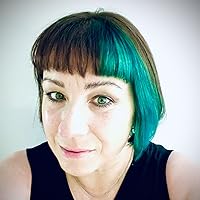
Art, history, folklore, and bad medicine. I wrote Pseudotooth, Beauty Secrets of The Martyrs and The Mighty Healer. I have Marfan syndrome, but my symmetry is still fearful.
And the long…
Born in Gibraltar in 1986, I grew up following my Navy family around the world. Always on the move, dealing with the effects of my connective tissue disorder, Marfan syndrome, I found friendly territory in fantasy, history, and Fortean oddities.
In 2007, I graduated from Cambridge’s Anglia Ruskin University with a First Class BA in Literature and Creative Writing. I went on to earn a Distinction Masters in Literature with special focus on Dante Gabriel Rossetti’s The House of Life.
My short stories and poems have been variously published. My story Cremating Imelda was nominated for the Pushcart Prize, and in 2012 I published my first chapbook, Contraindications. My ‘delightfully weird’ novella, Beauty Secrets of The Martyrs, was released in 2015, and in October 2016 Pen & Sword will publish my first non-fiction book, The Mighty Healer: Thomas Holloway’s Patent Medicine Empire, a biography of my Victorian cousin who made his fortune with questionable remedies. Unsung Stories published my novel Pseudotooth in March 2017.
Pseudotooth is a tale of one teenager’s life living with pseudoseizures, blackouts and strange vivid dreams. It explores the reasons why these episodes occur, and how dreams and problems in the past can cause issues, mentally, in everyday life.
The book opens with seventeen year old Aisling and her mum Beverley, sat in the doctors office whilst he talks about the numerous tests that Aisling has undergone to see if they can find a reason for these episodes. Unfortunately, none came back with any answers. The doctor makes a judgement call, in that the reason could be stress and orders Aisling to take some time out to relax, and maybe a change of scenery would help.
Beverley decides that the best course of action would be to send her daughter off to stay with her elderly aunt Edythe at her home, ‘The Rectory’, where she can get the relaxation she needs. Edythe is a strict woman, but kind too. Also living there is Edythe’s brother. It is he who reveals secrets about the homes past. This though causes Aisling dreams to intensify as she starts incorporating these stories into her dreams, and now they involve her waking life too, when the boy she often dreams about makes an appearance in her daily life, and a young man that she met at the home starts appearing in her dreams.
Pseudotooth I would categorise as a YA book, being that it mainly features young characters. Verity has a writing style that makes the words flow naturally and carries you along without realising how many pages, or how long you have been reading for.
Aisling is a great character, though quite mixed up. I think most people would be put in her situation, suffering from mental trauma, that causes her to have frightening seizures. Her mum Beverley is one self-centred woman, and I really couldn’t take to her. She seemed more important with her life, and reputation, than the issues her daughter was facing.
The plot is unusual, and that’s what hooked me to it, though I don’t feel that the cover of the book does it any favours, and may turn some people off from reading this wonderful story.
Overall the story had plenty of depth to it, interesting characters that you can get involved with, and a plot that will have you racing along, eager to follow Aisling’s story. You’ll be surprised when you realise that this book was written by a debut novelist.
Loved this genre-smashing dark portal fantasy about...uh, eugenics, abuse, and the social construction of disability? Yes, but it's significantly more fun than that makes it sound, with otherworldly whimsy that feels somewhere between Mervyn Peake, Diana Wynne Jones, and Jeff Vandermeer back when he was writing the Ambergris books. This is a smart novel that wears its intelligence and depth lightly.
PSEUDOTOOTH makes some unconventional narrative and pacing choices that I expect will aggravate some readers, but that, to me, only added to its charm and appeal. For one thing, it takes its sweet time building up to the "portal" part of "portal fantasy": protagonist Aisling only finds herself in the other world a solid third of the way into the book. Until then, the story is more slow-burn, mildly surreal Gothic horror than anything, as Aisling suffers frequent seizures and hallucinations while locked away in her tyrannical great-aunt's house, finds bizarre notes left behind by a previous unwell tenant, and writes unsettling scraps of apparent fiction about Feodor, a pyromaniac teenage boy sex worker in early 1990s East London. But slow-burn, mildly surreal Gothic horror is great! I really enjoyed this part of the book, and I enjoyed it just as much when it switched into "magically transported to another world" mode. Like the beginning of THE WIZARD OF OZ, the first third of PSEUDOTOOTH provides a thorough introduction to Aisling's character and to the real world roots of the book's overarching themes.
*Unlike* THE WIZARD OF OZ...well, I like to avoid major plot spoilers in these things, but I will say PSEUDOTOOTH deftly side-steps and/or criticizes several common portal fantasy plot points. The other-world section of the novel mostly plays out as a noirish mystery story with a side of (interestingly handled, surprisingly queer) multi-pronged interpersonal relationship drama. Since I vastly prefer sad stories about untangling the hidden connections between people and learning how everyone is fucked up, corrupt, and traumatized (but you can forgive and love some of them anyway) to stories about action-packed battles against the forces of evil or what-have-you, this was right up my alley.
Holloway's prose is playful, sprightly, erudite, and good at conveying a lot with a little. Her characters sparkle, and even those who don't have much at all to do in the story are imbued with personality and presence. The only nit I have to pick whatsoever is that she very occasionally-- most notably towards the climax/end of the novel-- gives them expository monologues that seem far more motivated by the author's need to convey certain information to the audience than by what it is plausible that person would say in that moment.
I liked the first half well enough, but at the end I had lost interest completely. I wouldn't say that it fell apart or didn't explain anything, as some other reviewers thinks, but at the same time I see where they are coming from. It was all so promising, with all it's darkness and mystery, but leave you somewhat unsatisfied. I just lost interest in this one, and had to fight to get through it.
As the title suggests, reality is a tricky matter in Verity Holloway’s darkly compelling debut novel. When is a tooth not a tooth? When does it become something else? What if it was something else all along? Most disturbing of all is the question of whether it occupies conflicting realities simultaneously. We don’t normally associate teeth with this kind of abstraction. They are visceral things, hangovers from our animal past, particularly the carnivorous bits. In this story, though, one of them forms a kind of anchor for the protagonist, Aisling Selkrik, as she negotiates contradictory realms that blend into a weird narrative that is all the more unsettling for its grittiness. Aisling is sent to the country to recuperate from an unknown illness characterised by ‘pseudo-seizures’, the catch-all title for an inexplicable, possibly psychological malaise. Here again we sense the osmotic relationship between reality and fantasy: Aisling is clearly suffering with something, it’s just that medical science has no explanation for what it is. The seizures are depicted as being both real and very unpleasant; indeed, one of the novel’s many strengths is how it portrays the sheer exhausting toll illness takes on the people living with it and those who love them. There is another unpleasant level to the opening situation: Aisling’s mother Beverley wants rid of her inconvenient daughter to spend time with an ex-boyfriend; worse still, one who sexually abused Aisling when Beverley was with him last time. Aisling stays with Edythe, an aunt of her mother’s. I really wanted Edythe to soften at one point and prove that perhaps her Spartan, antiseptic regime might be motivated by something other than disgust, but no. At one point, Aisling travels in time, encounters Edythe as a child and finds that Edythe is just as vile then. Under constant stress within and without, the sensitive, clever and wholly sympathetic Aisling has only her precious book of Blake poems to provide succour. Blake is an interesting choice; not just for his life, which seems to have been lived on more than one plane of existence, but for the work itself with its odd, hauntingly disjointed half-rhymes and visions of God or the angels depicted with crisply etched, anatomically accurate lines. ‘Pseudotooth’ feels like it has similar ambitions. On one level, the book is a portal fantasy in which the heroine travels to another world. However, there is a constant question underlying the story of whether she has truly gone ‘elsewhere’ or whether she has succumbed to her illness and is lying comatose in Edythe’s chilly house. Also, the other world is no pastoral idyll informed by medieval Northern European folklore with richly coloured heraldry and a panoply of favoured supernatural beings. This other world is an Orwellian nightmare that is only a slight remove from our own realm, although given recent political events it’s a remove that gets less by the day. Dead towns with the feel of post-Blitz London spiral towards a centre ruled by ‘Our Friend’, the mysterious overlord who with the best intentions has reduced the land to a state of cold, muddy terror. The true identity of Our Friend and his link to Aisling and the Pseudotooth is one of the great twists of the novel as it braids all of the influences of Aisling’s life into a single narrative. One such strand concerns Feodor, whose story comes to Aisling as she writes her journal. Feodor is a young pyromaniac, possibly a psychopath, although given his awful upbringing and the way he is treated by his peers it is hard to say for certain. Feodor reaches out of the world of Our Friend to Aisling; they even touch at one early point. Feodor’s story then begins to enter the main narrative as he becomes a separate narrator in the novel proper. The loss of mothers is a link between Aisling and Feodor; Aisling’s has abandoned her to recommence a romance with an abuser; Feodor’s mother is dead and to get away from the toxic relationship the young man has with his father in a blighted inner city flat he visits the financially generous paedophiles next door, one of whom may or may not be Aisling’s long lost father. Meanwhile, Feodor’s father may have let a woman die back in their native Russia, a woman who is probably the mother of Our Friend. Whether these threads are a true reflection of events or the workings of a deteriorating mind desperate to find patterns in the inexplicable does not matter; what’s more important is how much we care about what happens. For example, when Aisling transitions fully into the other world via the priest hole in Edythe’s house that also stores the ultra-repressed ramblings of a step-brother whose philosophy sounds a lot like Our Friend’s, she starts to get better. Given the horrible experience of her life so far, this improvement is as much a relief for the reader as it is for Aisling, because the author doesn’t skimp on how debilitated her protagonist is. Aisling finds herself on the run from Our Friend’s minions accompanied by the comely Chase, a young blond man whose worldly cunning seems at odds with his innocence. We want Aisling and Chase to be together, especially when they house with enigmatic matriarch Tor and plaintively lonely boy genius Georgie. But when Aisling and Chase stumble across the adult Feodor in a wrecked chapel in the woods, will he be a help to them or a terrible hindrance? For all the abstraction suggested in this summary, the novel is rooted in a sense of lived experience. From the overarching, elemental images of fire and water to the size and weight of the tooth as it accrues mass and grisly residue, there is a constant tension between a very English rawness and the esoteric vulnerability of the protagonist. Unique, clever and with a kind of patient compulsion, the novel has a distinctive voice that finds beauty in despair.
This novel is very much worth reading for its inventive worldbuilding and the strange music of its prose, and I will definitely keep an eye out for Holloway's next project, since her mind is clearly a very interesting place. I also very much liked how, even 80-90% of the way in, I still wasn't entirely sure what was going on: I knew enough not to be frustrated, but, at the same time, enough was left unexplained that I was on constant alert for crumbs of information, which also meant that I was never bored, and always intrigued.
All the same, I'm giving a rating of three stars instead of four because I think it all falls apart at the end. I'm not the sort of reader who likes everything to be nicely tied up, and that the protagonists get a relatively happy ever-after, but what happens at the end still felt rushed, under-explained, and unearned. I also wasn't a fan of the soap opera-like revelations that occur at the novel's moment of peak drama. Then again, as ever, I may have missed something, so don't let that discourage you from giving this one a go.
The writing style is the thing that completely stood out to me. It was confusing, and I suppose that's intentional considering the book blurs the line between dream and reality. Almost throughout the book, I was extremely confused though there were parts where I do understand. The confusing writing style actually kept me on the edge of the seat, frantically searching for clues and rereading the chapter.
The book did tackle the mentioned topics written in the summery; however, I was expecting more (?) I can't explain, but it definitenly can be expanded more especially the topics regarding the 'conflicting desires for purity and acceptance', and 'asking questions about those who society shuns, and why'. Another thing I disliked is that they did the whole revealation in one conversation scene, and how it wasn't explained how Tor killed David. Because of those the ending felt rushed.
This entire review has been hidden because of spoilers.
Beginning with the investigation into Aisling’s pseudo-seizures, the picture painted is heavy and cloying. Beverley, a mother who has never fulfilled her duty of care to keep her safe, drops Aisling at great aunt Edythe’s in Suffolk while she goes to live with an ex in a loft conversion in Hackney. Edythe is Victorian in manner and expectations leaving Aisling isolated after being shunned by the mainstream. Great uncle Robert gives some kind of normality to life although there’s something he’s not saying … Aisling has been told as therapy to journal and in a trance, she writes about Feodora. A boy with Russian heritage who experiences depravity on many levels.
As soon as we step through to the the dystopian parallel world I knew I was going to love it! Myths come alive with settings and characters. Life with Tor is surreal. Even though there is darkness attached to Tor, I loved the opposites of life with Edythe and life within Tor’s home. A Saturnine heaviness with both of them (duty, responsibilities, expectations) with the illusion of opposites. It wasn’t so hard to imagine that a place like this exists. A despotic ruler. Life crumbling down all around. Fear.
I thought the characterisations were excellent. The appearance of Aisling belies the strength that lies beneath. She surrenders herself totally to the experiences and situations she finds herself in. We could learn from her!
I never worked out how the characters connected until it was there in front of me. Fabulous how it ties everything together. Very creative.
Pseudotooth captivated me. Yes it is surreal. Yes it is mythical. Tie that in with childhood trauma and abandonment and a world that needs healing and you have a complexity of emotions.
Don’t let the cover or the title put you off. Both are symbolic and of course have meaning but you probably wouldn’t choose this book to read from a Kindle/bookshelf. You would be missing out on so much if this is a genre for you!
Pseudotooth tells the story of Aisling Selkirk, a lonely teenager afflicted with unexplainable blackouts called pseudo-seizures. After she’s shipped off to her great-aunt’s remote estate to recover, Aisling’s reality begins to slip as she uncovers dark secrets within the house and her own mind.
Through dark, dreamlike prose, Holloway explores the stigma of mental and chronic illness, social difference, and the lasting effects of trauma. Pseudotooth had a really strong beginning, then lost me with pacing somewhere around the halfway mark. I appreciate how deeply strange and unique this story is, but I admittedly had a hard time following the separate perspectives and the worldbuilding. That said, this was overall a really fresh take on portal fantasy.
Pseudotooth had me from its first sentence. It’s one of those books that, in a few words, tells you a lot about the novel to follow: “And of course, the weather turned Dickensian.” This reference to Dickens prepares us for a story filled with characters who’ve lost or been rejected by parents. And boy will I get to that later. The novel that follows is gorgeously written.
The real literary influence here isn’t Dickens, but William Blake, who’s quoted throughout the novel; Blake is a fitting choice, given the main character’s name is Aisling, a reference to an Irish form of poetry known as “vision poetry”. In the wake of a traumatic experience with her mother’s latest boyfriend, Aisling has been suffering from pseudoseizures, alongside blackouts and hallucinations. The book repeatedly makes the point of letting us know that she is only a few months from legal adulthood, which stands in stark contrast to the fact she is treated as an inconvenient child; as an alternative to an institution, her mother sends her into the countryside and the care of her aunt. There, Aisling spends her time writing fiction in her journal about Feodor, the delinquent son of a Russian immigrant, and exploring her aunt’s old vicarage.
The other world this novel sets itself in reveals itself slowly; it’s not so much magical as ghostly or, perhaps appropriately for a novel so preoccupied with Blake, visionary. There’s a gradual bleeding over of the other world instead of a crossing into it. It starts with apparitions: Aisling sees a man doing handstands in the garden, then another man walking around the house. When Aisling eventually wakes up in a deserted house, she assumes she’s broken with reality altogether. Aisling is taken in by an ad-hoc family of outcasts (enter stand-in parent figure), and meets Feodor in the flesh. Outside the perimeter of this idealistic house in which she convalesces, is a placed ruled by “Our Friend”.
What’s refreshing about Pseudotooth is that Aisling isn’t a “chosen one”. Don’t get me wrong, I adore, adore this trope; heck, I even wrote a book with it. But it was a nice change to see a character who didn’t get swept up in revolution or “Big Events”. This is a default template, so much so, that we sometimes forget that it’s not an essential characteristic of fantasy. In fact, not only does Holloway avoid the trope with Aisling, she subverts it with Feodor. After learning about the esteemed place Our Friend managed to obtain, Feodor thought he could be a hero; instead, he caused a disaster. He warns Aisling off following his steps by saying: “Look, I know what it’s like to think you’re the molten centre of the universe, but there’s a history here, and people moulded by it.” And right here is what I adore about Pseudotooth: the other world does not revolve around Aisling. It is more than a backdrop for her story, but rather a distinct entity unto itself with a history and characters whose lives have gone on and will continue to do so whether or not she is there. Although the status quo shifts in this world when she arrives, Aisling isn’t an instigator, but rather a witness. Her story isn’t about changing the world, but about understanding her own life.
Now for the tricky stuff. Given the subjects it deals with, Pseudotooth is in constant danger of becoming one of those stories valorising mental illness, connecting it to creativity or suggesting it actually enables some sort of unique and valuable insight. As someone with Bipolar Disorder, this, unsurprisingly, starts to grate after awhile. I’ll admit, there are times when I think my illness has provided me with a unique insight, but at what cost? I remember reading a lot of books and watching TV shows (here’s looking at you, Thirteen Reasons Why) that romanticised mental illness, while I was simultaneously watching it wreck havoc on my own life. There’s no beautiful shot of a single tear streaming down your face when you’re going through that shit; it’s messy and destructive. Ultimately, though, Pseudotooth comes down on the right side of the line, even if it teeters precariously around the time Aisling flushes her meds. Please, please do not do this, even if your doctor is as incompetent as Aisling’s. Find a new doctor.
Now, let’s get to that pesky parental issue. Aside from having an absentee father (ah, that classic mythological beast), Aisling has got a nasty piece of work for a mother. A self absorbed, childlike woman, Beverley can’t wait to be rid of her daughter to go spend time with the aforementioned new boyfriend, Malcolm. I understand having a child with a mental illness must be incomparably difficult and heartbreaking. But Beverley seems less concerned with Aisling than how her illness is a “burden” on her own life. Having had Aisling at the age of seventeen, she has never truly been able to live out her “glory days”, and that’s something keenly felt by Beverley. But Beverley’s absentee parenting is not the crime she’s truly on trial for. No, that would be dismissing her daughter’s rape, committed by Malcolm, and accusing Aisling of making it up because she doesn’t want to share her mother with anyone else. This sick rationalisation of the situation by Beverley so that she can continue living as she wishes is unfortunately not uncommon both in artistic representations of rape and real life. In fact, as is the case with Aisling, it is this failing on a trusted one’s behalf that intensifies the trauma. Judith Herman’s Trauma and Recovery is actually an excellent read for anyone who wants to know more about the subject. Small aside: Herman is an American psychiatrist and the professor of clinical psychiatry at Harvard Medical School. She has been extremely influential on the treatment and recovery process of trauma and is an all around powerhouse of a woman. Her book is incredibly insightful. Aside over.
Alright, so far so good. Why the three stars then? While the concept of the novel had me hooked, as did the first half of it, I honestly felt mind numbingly bored by the end. Even while being aware of the merits of the novel, I found that I was dissatisfied with where is led itself, and wish I could take a crack at the original idea myself, just so I’d have a more gratifying ending. It was a severe Game of Thrones Season 8 moment when I finished reading. However, I do understand that, in not giving us closure, Holloway is making a poignant comment about mental health; it’s never over. We learn to cope and manage, but seldom if ever do we “recover” as one might from a broken leg. Yet, as this blog is all about personal taste rather than awarding stars based on the intelligence of the craft (sorry Verity), I’m afraid I’ll have to deduct two stars! That being said, I think I should also say that my rating system will be a bit harsh. A three is still a good score! It was a good read, but it didn’t blow my socks off. Socks firmly on by the end of the book. Sure, they slipped down a bit halfway through the book, but they slithered their way back up too.
A book review feels incomplete without some kind of thematic summation, so I’ll say that Pseudotooth is less about mental or psychosomatic illnesses than it is about how people define and categorise the people who have them. Aisling’s mother thinks she is weak or faking it, Aisling’s aunt thinks she’s morally deficient, Aisling’s uncle thinks she needs to be protected from the world, while Our Friend thinks the world needs to be protected from Aisling. But Aisling’s story is about coming to understand she doesn’t have to accept anyone’s definitions. Her pseudoseizures aren’t part of her identity; the may affect her but they don’t define her.
Verity Holloway's debut novel, Pseudotooth, is an excellent literary speculative fiction novel. It's one of the best novels of its kind, because it's a beautifully written and thought-provoking novel with plenty of style and substance.
I'm glad I had an opportunity to read Pseudotooth, because it's the kind of speculative fiction that deeply fascinates me. I enjoyed reading this novel, because the author successfully blurs the lines between dream and reality, taking the story into exciting directions with her riveting approach to difficult themes.
Pseudotooth is an interesting novel, because it can be classified as a kind of a blend of adult fiction and young adult fiction with a touch of slipstream fiction and magical realism. Although young adult readers may enjoy this novel, I personally recommend it to adult readers due to its challenging themes.
When I began to read Pseudotooth, I was amazed at the quality of the prose and the depth of the story. It was a bit difficult for me to believe that this novel is the work of a debut novelist, because the story flowed effortlessly, the characterisation was excellent and the author dared to explore challenging themes. Normally, there are at least a few tiny flaws in debut novels, but there are no flaws in this novel, because everything feels polished.
Here's a bit of information about the story:
At the beginning, Aisling Selkirk and her mother, Beverley, are at the doctor's office discussing Aisling's scans, because she has had pseudo-seizures. The scans reveal nothing out of the ordinary and the doctor says that there's nothing physically wrong with her... Beverley drives Aisling to the Suffolk countryside so that she can recuperate there and spend time with her great-aunt Edyth at the old vicarage. Edyth's brother, Robert, is also at the vicarage. Aisling seeks solace in William Blake's poetry and writes her journal... Aisling channels violent dreams and visions about a young man called Feodor, whose detailed history can be found in her diary. Feodor is a Londoner who is haunted by his family's history... When Aisling discovers a Tudor priest hole, meets Chase and hears about what has happened at the vicarage, the lines between dreams and reality begin to blur...
This is all I'll write about this finely-crafted story, because I don't want to reveal too many details about it. The less you know about the story, the more you'll enjoy it.
The characterisation is exceptionally good, because the author writes engagingly about Aisling who has been raised by her mother, Beverley. Aisling doesn't have a father, because Eliot left Beverley in the care of his aunt, Edythe, and then disappeared from their lives. Both Aisling and her mother, Beverley, are well-created characters. Feodor and Chase are also interesting characters, and so is Edyth, because she's a strict woman who isn't intentionally cruel.
I found the Verity Holloway's way of exploring acceptance, mental illness and recuperation genuinely intriguing. She is strikingly honest and realistic when she writes about them. I'm sure that Aisling's condition will cause an emotional response in the readers, because the author describes how Aisling feels about her condition and her life (Aisling desperately wants to get well, she has to take pills and she's often nauseous).
One of the things that I like about this novel is that there's a wonderful balance between realistic elements and fantastical elements. It's almost uncanny how vividly the author writes about these elements and how easily she combines them, because everything feels compelling and the fascinatingly bleak, strange and dream-like atmosphere makes the story all the more immersive. She explores what is real and what is not in her own unique way.
I loved the author's writing style and beautiful prose. I found the prose gorgeous, because the sentences are well-structured and the descriptions are evocative. The author conjures up powerful images with her sentences and evokes a sense of strangeness that will enthrall readers.
I think that readers who have are familiar with the stories written by Nina Allan and Christopher Barzak will find this novel especially intriguing, because there's something in it that is reminiscent of their stories. I have a strong feeling that the complex and unusual story will charm many readers.
I sincerely hope that Verity Holloway will continue to write more novels, because she has a beautiful literary voice and she doesn't hesitate to write about difficult themes. Based on this novel, I can say that she's an assured and confident author who writes fluent and nuanced prose. She's definitely an author to watch.
Verity Holloway's Pseudotooth is a deeply compelling and beautifully written novel that readers of literary speculative fiction can't afford to miss, because Aisling's story beckons to be read and re-read. It's something different and evocative, so don't hesitate to read it.
A darkly charming book that blended themes of mental/physical illness, nightmare fantasy, and getting eaten by your own story, while evoking the sparkle of books like Howl's Moving Castle and The Secret Garden.
Aisling is a young woman who suffers from ''pseudo seizures,'' but as her doctor is quick to tell her and her mother, though they may not be able to pinpoint the physical cause and origin of the seizures, the effect on Aisling are very much real. Having a tidy hole where responsibility or caring would be (later, we learn it's even worse, ), Aisling's mother dumps her off at her aunt's drafty old house, to put her out of sight. Here, Aisling spends the days reading the diary of a disturbed previous dweller obsessed with social cleansing and ridding society of weaklings and ''degenerates.'' She also spends time penning her own story of a Eastern European mad lad who at least has a more easy-to-pinpoint REASON (his foreignness) barring his entry from the society around him. Aisling then discovers a strange Howl-esque dude in her aunt's backyard, who leads her to a place where she soon finds these fragments of written words (the ravings of the previous tenant, and her own first person diary of her fictional delinquent) having real-life consequences. Unless she really has lost her mind. Not knowing is the best part!
I really loved so many elements of this book, and thought the author had a real knack for evoking certain emotions and sensations (particularly unpleasant ones), in a deft and cutting way. The commentary on our social groups, and who is kept in and who is kept out (the foreigner, the mentally ill, the deviant, the unwell), was also well done and I enjoyed that Aisling remains, to the end, more of an observer in all of this than an active agent--certainly, she becomes no savior. I did think that the third half of the book especially suffered somewhat from going off the rails and (for my taste) becoming too scattered, with too much going on. I caught myself skimming some times. That is likely a me-thing though. I tend to find long descriptions of action and runnings around dull. So don't let that deter anyone! --some truly excellent prose, images, characters and nightmare fantasy.
I whipped through this book in two days and while the beginning was fantastic I feel like it ran out of steam. I enjoyed the reality warping nature of the book but it really was underexplained at times, I also feel like it it became oddly predictable and yet nonsensical towards the end, making it feel pretty confused and anticlimactic. The Feodor chapters and his character as a while was a drag, I dreaded those everytime they came up. This book felt far more interesting before Aisling travels to the fantasy world, I liked it better when it bounced between realities the characters were much more compelling. Once she gets to the dystopia it just fizzles out and becomes increasingly lackluster
Mostly because it’s so unlike my usual reading, I did struggle to follow Aisling’s journey the further she ventured from her home. But Verity Holloway’s writing is strong enough to carry along a realist like me and ensure I enjoyed the ride. Full review: Three novels about people whose brains work differently http://annegoodwin.weebly.com/1/post/...
A wonderful, more adult take on a portal fantasy, deftly handling issues of mental illness, trauma, the status of the outsider and the damage we do to those we consider different.
Verity Holloway is an excellent writer, adept at creating dreamlike worlds while unflinchingly looking at the issues people face and the things that keep them from happiness.
Pseudotooth is well written. It's easy to fall into and just go where Holloway takes you. I gave it only 3 stars, though, because The story ramps up and then plateaus until the ending, which basically leaves the reader with very little. A bit disappointing.
Pseudotooth, by Verity Holloway, is one of the most unusual books that I have read in a while. It explores the effects of trauma and the crossover between dreams and reality. It asks the reader to consider what they would define as real when ‘pseudo’ events have an impact on everyday life.
The protagonist is seventeen year old Aisling who has been raised by her mother, Beverley, after her father left his pregnant, teenage girlfriend in the care of his maiden aunt, Edythe, and disappeared forever from their lives. They have had little to do with any family members since Aisling was a young child. Beverley, a secretary, is concerned about how she and her daughter are perceived and is struggling to deal with the health issues Aisling is currently facing.
For the past couple of years Aisling has suffered blackouts and seizures. She has submitted to a plethora of tests and spent time in psychiatric care but still no cause can be found. When a doctor suggests her condition may be psychosomatic Beverley loses patience. She cannot cope with the way her daughter looks – emaciated with messy hair, grubby clothes and no apparent desire to improve her life or appearance – and after so long trying to find a solution wishes to move on with her own life. Beverley’s boyfriend has asked her to move in with him. When the doctor suggests that Aisling may benefit from a change of scenery Beverley arranges for her to go and stay with Edythe at the old rectory where the now elderly lady has lived all her life.
Aisling wishes to please her mother and desperately wants to get well. She is frightened by the effects of her illness, exhausted from her inability to sleep restfully, drained by constant nausea that prevents her from holding down food. She packs little for her stay in rural Suffolk – the diary where she writes down her dreams as her doctor suggested, and a volume of poetry by William Blake whose dark words bring her comfort.
Edythe treats her great niece with contempt. She values cleanliness and order as on a par with godliness, the personal problems she believes Aisling has allowed to fester as something that can be sorted with strict rules and determination. Edythe’s brother, Robert, is also being cared for at the rectory. He is kind to Aisling but the secrets he shares with her about the old building’s past start merging with her dreams.
Aisling’s dreams have for some time featured a young man named Feodor. Her diary recounts in detail his often violent history. When a shadowy version of him appears to her whilst awake, around the time she discovers a priest hole in the rectory cellar, her world’s collide. Another young man, Chase, who she met briefly in the rectory garden, emerges as a dream time friend. She becomes a part of his world, a post apocalyptic existence where those deemed unfit and undesirable are made to disappear.
The trauma that triggered Aisling’s illness is touched upon but she has dissociated events, tried and failed to wash the stain of them away. Although she is aware that the world she is currently inhabiting is a dream she is unsure how to return to waking life in the rectory, or even if this is something she wishes to achieve given the happiness she has discovered here. In confronting the dangers faced by Feodor and Chase she learns more of terrible events that took place in the rectory, which Edythe cannot allow to be talked of for fear they besmirch her memories of her revered father. It becomes clear that Aisling’s demons have also been suppressed.
Although vividly portrayed and well written it took me some time to engage with the plot. Many of the early sections of the book are bleak, Aisling’s situation painful to contemplate. By halfway through the pace had picked up and I raced through the final third eager to know what came next. The adventure is fantastical, but then dreams are subject to a different concept of reality, whether dreamt awake or asleep.
This is an unusual fantasy adventure grounded in the dark realities of mental illness and escapist imagination. It is a sometimes challenging but ultimately worthwhile read.
My copy of this book was provided gratis by the publisher, Unsung Stories.
This was well written and flowed very smoothly, but I’m still not quite sure what actually happened at the end. The whole book is intriguing and engaging, and is a mystery of multiple levels not all of which are fully resolved by the end.
This book is set both in the real world and in an alternative, dystopian world, but both settings had a feeling of unreality to them. In part this was because I could not work out what time period the sections in the real world were supposed to take place in, at times it felt archaic and then it felt modern. This had the effect of making the real world story at times feel less real and stable than the alternative reality that the main character slipped into. But, the fact that Aisling, the main viewpoint character, is metally unwell and suffering from delusions means that this sense of unreality contributes to the story rather than detracts from it, we are seeing through her eyes and she admits she is not a reliable narrator.
I would recommend this book, so long as you are happy to try something a bit different, not if you expect a traditional narrative or plot structure.
In the tale of Pseudotooth we find Aisling Selkirk,a young girl stuck in that strange period of our lives where we all endure the transition from adolescence to adulthood. It's something we've all been through, being deeply unsure of what it is we're supposed to do with our lives and just what is laying in wait around the corner.
But Aisling is what you would call - extremely farsighted - and can see beyond the sphere that everyone sees. As a result she suffers mental trauma which presents itself in the physical manifestations of strange blackouts and seizures which no doctor can explain. Beverly, her mother soon tires of her daughter's condition being deeply embarrassed that her daughter is a social pariah and hampering her own efforts with fitting in. After a brief stint in a psychiatric ward which has done nothing to sort out her condition, Aisling is sent to deep rural Suffolk to stay in a grand old house with her great aunt Edythe. Aisling's mother mother hopes that a bit of peace and quiet will soon have Aisling back to normal. It sounds so peaceful and idyllic but it doesn't take long for her formidable Aunt to find her secret journal with her clandestine visions of Feodor...
Events spiral quickly in the house, first there are unwanted visitors and then Aisling stumbles across an ancient Tudor priest hole down in the cellar which sends her world upside down. She meets a dashing young man named Chase who takes her away from everything she knows and hates.
At first the story feels very cramped and claustrophobic giving you an insight into Aisling's unique perspective. As I read the first part I felt it was taking too long to get going, but with hindsight I see that it was necessary so that we could feel and see what Aisling feels. It is a great adventure story and very unique to anything I have ever read. I hate it when you can easily predict what's going to happen next in a story but there is none of that in Pseudotooth.
This is a tale about outcasts and misfits, each character is an outcast either through choice or destiny. There's not one character in here you could call normal which makes for a captivating tale. Even Beverly the mother goes through strange rituals such as relentless dieting in order to fit in and Aunt Edythe is a woman trapped i within her own strict rules. Pseudotooth reminds me of the saying, "We're mad in our own little ways," and examines the fight and struggles people will put themselves through to feel accepted within society.
I have to admit this is a very strange book, but I really enjoyed it. I would describe this as being speculative fiction that errs on the side of literary fiction. I'm not embarrassed to admit that I usually don't go in for high brow literary fiction. For me it's all about delving into a great story that grips you instantly taking you off on a great adventure, but this book did just that as well as exploring many themes such as loneliness, acceptance, revenge and finding peace. There is a very strong dreamlike style of writing which really adds depth to the tale. I really liked this book and would definitely recommend it to others. This is a brilliant debut and I'd love to see more books from Verity Holloway.
Verity Holloway's Pseudotooth is a dizzyingly imaginative novel in which a teenage girl, Aisling Selkirk, suffers from a mysterious mental illness and is sent to 'convalesce' in the country while her mother goes to London to rekindle her relationship with a former boyfriend. Aisling means vision or dream, and Alexander Selkirk was was the seafaring adventurer who inspired Defoe to write Robinson Crusoe, so it's only fitting that Aisling has a desperate yearning to travel and is prone to strange episodes in which she seems to be losing her grip on reality.
At the beginning of Pseudotooth I wondered if it was a young adult novel, but I soon realised that it is in fact a much more adult take on the genre than I was expecting. The fantasy elements - hauntings, time-slip, portals between worlds, dystopia - are beautifully executed but there's an underlying darkness, even a grittiness, to this book. There are hints that Aisling's symptoms could be caused by a past trauma, and the story of Feodor, a young teenager from the East End who seems to inhabit Aisling's subconscious, is bleakly squalid and disturbing. What's Feodor's link with Aisling? Where does the strangely-dressed Chase, who turns cartwheels on the lawn after dark, come from? And who is behind the pre-war journals in Aisling's room that outline the author's theories on how to handle the the 'defective classes'?
You will certainly want to ask questions of this book that won't be answered, and it's left to the reader to decide for themselves what's real and what isn't, and where imagination ends and madness begins. Some would call this book fantasy, some slipstream, some speculative fiction and some would say it was magical realism, but it really doesn't matter how you choose to categorise it: it's enough to know that Pseudotooth is a cleverly constructed, atmospheric and gripping read. It's packed with all sorts of ideas, images and allusions to art, history, literature and psychology that somehow come together with remarkable coherence, and its scope is ambitious, with multiple interlinked plot strands and a vividly-drawn cast of characters shaped in part by their respective pasts. Pseudotooth is one of the most original and immersive novels I've read in a long time.
Fantastic novel, with shades of Alasdair Gray's Lanark and Iain Banks's The Bridge. Thoroughly enjoyed this from start to finish - a talent to look out for.