

What do you think?
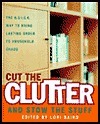
Cut the Clutter and Stow the Stuff: The Q. U. I. C. K. Way to Bring Lasting Order to Household Chaos
1,237 terrific clutter-cutting tips-- plus hundreds of insider secrets from America's clutter-control experts! Is clutter taking over your life? It's time to take some Q.U.I.C.K. action, cut the clutter, and stow the stuff once and for all! Cut the Clutter and Stow the Stuff will help you tame the clutter monster using the revolutionary Q.U.I.C.K. clutter-control system. You're just five fast steps from a clutter-free home! See inside to: * Discover your unique clutter style-- and how to make it work for you, not against you, in the fight with clutter. Take the clutter quiz on page 8. Once you know your clutter style, you'll finally understand why you feel compelled to collect every style of Spode teacup produced since 1856...or stash a year's worth of newspapers under the bed...or keep your 45-year-old son's high school football jerseys "just in case." And you'll find effective strategies to turn those tendencies to your advantage! * Rediscover your rooms-- and your furniture (when was the last time you saw the top of your dining room table?!)-- with the simple steps in the Unload chapter on page 43. There really is a house under there! * Find storage space you never knew you had, even in cramped quarters like the bathroom and laundry room. It's there-- once you know where to look for it. * Clear out the kids' rooms without starting a war. These ingenious tactics are so effective, your kids may even pitch in! * Make all those piles of paper disappear like magic. Right now, your paper piles are probably multiplying faster than hot dogs at a ball game. But you'll find how to get them out and keep them out (even at the office!) starting on page 316.
372 pages, Paperback
First published August 1, 2002
Ratings & Reviews
Friends & Following
Create a free account to discover what your friends think of this book!
Community Reviews
Displaying 1 - 26 of 26 reviews

March 3, 2009
After I finished this book, my first thought was..I just read 340 pages on clutter!!??? LOL. I didn't think this book was very useful, because much of it pertained to rooms I don't even have since I live in a small apartment and I also don't have alcoves or entrys to convert to other things either. Plus, many of their suggestions seem to encourage clutter. Clean Sweep has it right...you can only keep the amount of stuff that will comfortably fit into your current home. Everything else should go!! This book encourages you to just find new spots for things, which doesn't solve the problem.

January 18, 2009
This book is mainly about stowing the stuff. After a quiz about one's clutter character (funny and insightful), there's a small section on decluttering, but most of the book is broken down into chapters for getting as much crap as possible into each room. If you want some creative storage solutions, try this book. If you REALLY want help decluttering, pick up Scaling Down.

January 29, 2015
It promised a revolutionary new system. I should have known better.

May 21, 2019
I have a confession to make; I have way too many books. I have books on practically every surface in my room along with several bookcases. So I saw this book at the library with the hope that it would aid me in my crusade on clutter. Cut the Clutter and Stow the Stuff is a book that has collected advice on how to reduce the amount of clutter you have. It was edited by Lori Baird, a woman who straight out in the introduction tells us that she is really terrible at organization. The basis of all the advice is an acronym that spells out the word QUICK. QUICK stands for Quantify, Unload, Isolate, Contain, and Keep it up.
The book differentiates itself from other books on clutter management by talking about different types of people and how they store their stuff. There are four major divisions, Accumulators, Collectors, Concealers, and Tossers. It gives you a quiz that reminds me of those online quizzes where there are only four choices. So it asks you questions and has you score your own personality. It talks about how to deal with different personalities as well. Say an Accumulator marries a Tosser. How do you decide what to do without irritating one another? The book has suggestions for that and more.
Once the book establishes the acronym and tells you how to manage your significant others and family members, the book talks about the house room by room. So it has advice for cleaning the living room and the bedroom and so on. Each little chapter has a piece of advice on doing something. Say you have company coming over and you haven’t been able to clean since Christmas or something. It even talks about shortcuts and other things you can do in order to make it look good.
The main thing in this book is that cleaning your space and making something clutter-free is not done in a single day. It is a continuous process. As such, the book has suggestions that enable you to make these actions into habits. It also talks about how to avoid getting stuff altogether. Now there are some turn-offs to the book, but it is still quite informative. The main thing that I am somewhat against are the silly jokes, but it isn’t that big of a deal. The book more than makes up for it in being interesting and helpful. However, this book is slightly out of date with computer information. While it is certainly true that pictures take up space, people have cloud services now and hard drives are much larger than in 2002. Plus, Floppy Drives are obsolete nowadays.
Anyway, the book was great. As I mentioned, it was interesting and informative. The only real problems I had with it were with the humor and the fact that the book is slightly out of date.
The book differentiates itself from other books on clutter management by talking about different types of people and how they store their stuff. There are four major divisions, Accumulators, Collectors, Concealers, and Tossers. It gives you a quiz that reminds me of those online quizzes where there are only four choices. So it asks you questions and has you score your own personality. It talks about how to deal with different personalities as well. Say an Accumulator marries a Tosser. How do you decide what to do without irritating one another? The book has suggestions for that and more.
Once the book establishes the acronym and tells you how to manage your significant others and family members, the book talks about the house room by room. So it has advice for cleaning the living room and the bedroom and so on. Each little chapter has a piece of advice on doing something. Say you have company coming over and you haven’t been able to clean since Christmas or something. It even talks about shortcuts and other things you can do in order to make it look good.
The main thing in this book is that cleaning your space and making something clutter-free is not done in a single day. It is a continuous process. As such, the book has suggestions that enable you to make these actions into habits. It also talks about how to avoid getting stuff altogether. Now there are some turn-offs to the book, but it is still quite informative. The main thing that I am somewhat against are the silly jokes, but it isn’t that big of a deal. The book more than makes up for it in being interesting and helpful. However, this book is slightly out of date with computer information. While it is certainly true that pictures take up space, people have cloud services now and hard drives are much larger than in 2002. Plus, Floppy Drives are obsolete nowadays.
Anyway, the book was great. As I mentioned, it was interesting and informative. The only real problems I had with it were with the humor and the fact that the book is slightly out of date.

May 3, 2022
Review originally published February 2004
Spring isn't quite around the corner, but close enough to start thinking about spring cleaning and re-organizing those closets or other storage areas. It seems that many of us are in the midst of cabin fever, so what better way to cure the winter doldrums by staying busy and thinking of ways to de-clutter your home?
Cut the Clutter and Stow the Stuff by Lori Baird offers many hints and tips for dealing with the situation.
There are three parts to this book. In Part I, there is a "Clutter Type" quiz to determine what your clutter style is. Part II discusses "The Q.U.I.C.K. System," which stands for Quantify your clutter, Unload, Isolate, Contain, and Keep it up. Part III goes into more detail with "Q.U.I.C.K. Strategies for Every Room in the House."
The kitchen is the center of family activity and a focal point for family clutter. Home Focus is a company that offers a variety of space-saving kitchen supplies, such as tiered shelving that can help organize spices, tea boxes or tins, decorative jam and jelly jars, or any other items you use frequently and want to keep close at hand. You can visit its Web site at www.homefocuscatalog.com.
For more advice on space-saving tips, may I suggest you check this book out.
Find this book and other titles within our catalog.
Spring isn't quite around the corner, but close enough to start thinking about spring cleaning and re-organizing those closets or other storage areas. It seems that many of us are in the midst of cabin fever, so what better way to cure the winter doldrums by staying busy and thinking of ways to de-clutter your home?
Cut the Clutter and Stow the Stuff by Lori Baird offers many hints and tips for dealing with the situation.
There are three parts to this book. In Part I, there is a "Clutter Type" quiz to determine what your clutter style is. Part II discusses "The Q.U.I.C.K. System," which stands for Quantify your clutter, Unload, Isolate, Contain, and Keep it up. Part III goes into more detail with "Q.U.I.C.K. Strategies for Every Room in the House."
The kitchen is the center of family activity and a focal point for family clutter. Home Focus is a company that offers a variety of space-saving kitchen supplies, such as tiered shelving that can help organize spices, tea boxes or tins, decorative jam and jelly jars, or any other items you use frequently and want to keep close at hand. You can visit its Web site at www.homefocuscatalog.com.
For more advice on space-saving tips, may I suggest you check this book out.
Find this book and other titles within our catalog.

July 5, 2019
Good hints and techniques for every room of your house. The computer info was a bit outdated in the 2002 edition. I am definitely an Accumulator but I am learning and enjoying my soon to be clutter free home.

May 3, 2019
Pretty funny, great advice too.
March 8, 2022
A good read about decluttering and keeping your house under control from all the stuff that keeps cluttering it up.
October 22, 2024
A bit outdated, but still some good ideas.
January 24, 2025
Tips from top names in the professional organizing biz and how to get rid of clutter, organize what’s left and stay streamlined and efficient.

January 26, 2010
This book as really inspired me to get started on decluttering and organizing my home. It's well written and has great ideas, a clear method, and injects humor without being judgmental.
I have three small complaints: the language got repetitive, I read this straight through and got a bit tired of hearing the same things as we moved from room to room. I feel like this isn't a type of book to be read from cover to cover.
It's a little outdated, "CDs are the newest big thing in data storage". Right.
Several of their suggestions are not for people who are trying to cut down on their carbon footprint or live a 'green' lifestyle. It's easy to pick out which suggestions these are and avoid them however (Such as encouraging disposables over things you keep).
Overall, awesome. I'm glad that google books has this book so I can reference it as I start applying the ideas in my home! (And so I can return it to the library!)
I have three small complaints: the language got repetitive, I read this straight through and got a bit tired of hearing the same things as we moved from room to room. I feel like this isn't a type of book to be read from cover to cover.
It's a little outdated, "CDs are the newest big thing in data storage". Right.
Several of their suggestions are not for people who are trying to cut down on their carbon footprint or live a 'green' lifestyle. It's easy to pick out which suggestions these are and avoid them however (Such as encouraging disposables over things you keep).
Overall, awesome. I'm glad that google books has this book so I can reference it as I start applying the ideas in my home! (And so I can return it to the library!)

May 25, 2011
This book is a great reference for home organization, and it includes a bunch of tips and tricks to unclutter any space in your home. She gives superficial treatment to the root causes of clutter, grouping people into a few types of people and making generalizations about each type and how they interact with each other. This is a great book for the post-cleaning and maintenance phase of the decluttering process.

October 8, 2012
A few ideas and for a beginner a lot of them, but for me nothing really new here. been there done that. There were also many ideas to convert stuff which if I had all that storage listed to convert to, I would not need this book. some of it rather silly psychological drip. Get it at the library and you can glean a few things. To pay for the book might be silly also. It would be clutter on the shelf.

November 23, 2010
I agree with other reviewers that this book got repetitive as it went on. Also, I could have used more pictures and visual suggestions. Without photos or diagrams, 300 pages on clutter gets kind of boring. But I really liked some of her suggestions, such as storing AAA-recommended items in your car and organizing your vast book collection by the Dewey Decimal System.
August 17, 2016
I really liked the first chapter of the book, which includes a bit of the psychology behind the different 'clutter personalities', and the quiz to determine your own 'clutter type' was really helpful. The next few chapters describing the overall strategy were useful, but then I just skimmed the last few chapters as they went room by room and got repetitive.

March 4, 2013
I found nothing new in terms of ideas I have not seen before but perhaps this book did reinforc the concept of being more strict with my choices of what gets to stay in this house versus being tossed or donated. Personally I would rather just watch Home and Garden or the Live Well Networks.

January 21, 2008
I love this book. I just dusted it off my book shelf and started reading it. Good stuff.

January 28, 2008
If anyone were to read a book on organizing, I would recommend "Organizing from the Inside Out" by Julie Morgenstern. It is much more "organized" and helpful... one of my favorite books!

July 31, 2008
I didn't read the whole book. It was more of the same.
Did Not Finish
June 4, 2011Eh. I was hoping this would give more specific, instructive steps to purging the crap in my house and keeping things tidy instead of just telling me to do it. Not very helpful.

July 28, 2011
A wonderful book for the organizationally challenged. This book merely confirmed my propensity for order (OCD ... whatever) as I'd already been practicing most of the suggestions.

July 14, 2012
So I see that I read this and gave it 2 stars. I must not have found it very helpful, yet I kept it.

February 7, 2013
Good book for tackling a great deal of "things." Chapters on computers and photography are getting dated. Got great tips even the second time through.


March 14, 2014
A little dated but still with a lot of smart tips!

April 18, 2015
just more clutter. could have been a magazine article with better editing.
Displaying 1 - 26 of 26 reviews