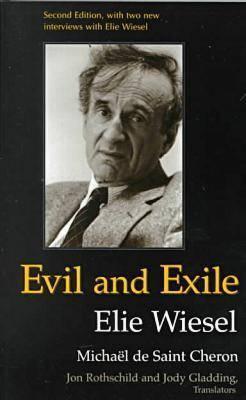
A six-day series of interviews between Nobel Peace Prize Laureate Elie Wiesel and French journalist Michaël de Saint Cheron, Evil and Exile probes some of the most crucial and pressing issues facing humankind today. Having survived the unspeakable evil of the Holocaust, Wiesel remained silent for ten years before dedicating his life to the memory of this tragedy, witnessing tirelessly to remind an often indifferent world of its potential for self-destruction. Wiesel offers wise counsel in this volume concerning evil and suffering, life and death, chance and circumstance. Moreover, the dialogue evokes candid and often surprising responses by Wiesel on the Palestinian problem, Judeo-Christian relations, recent changes in the Soviet Union as well as insights into writers such as Kafka, Malraux, Mauriac, and Unamuno.
Eliezer "Elie" Wiesel was a Romanian-born American writer, professor, political activist, Nobel laureate, and Holocaust survivor. He authored 57 books, written mostly in French and English, including Night, a work based on his experiences as a Jewish prisoner in the Auschwitz and Buchenwald concentration camps. In his political activities Wiesel became a regular speaker on the subject of the Holocaust and remained a strong defender of human rights during his lifetime. He also advocated for many other causes like the state of Israel and against Hamas and victims of oppression including Soviet and Ethiopian Jews, the apartheid in South Africa, the Bosnian genocide, Sudan, the Kurds and the Armenian genocide, Argentina's Desaparecidos or Nicaragua's Miskito people. He was a professor of the humanities at Boston University, which created the Elie Wiesel Center for Jewish Studies in his honor. He was involved with Jewish causes and human rights causes and helped establish the United States Holocaust Memorial Museum in Washington, D.C. Wiesel was awarded various prestigious awards including the Nobel Peace Prize in 1986. He was a founding board member of the New York Human Rights Foundation and remained active in it throughout his life.
This is a conversation between Wiesel and author and journalist Philippe de Saint-Cheron. The format is fascinating and the two men's reflections on the Palestinian question, the Holocaust, finding meaning in the aftermath of evil, and other weighty topics is riveting.
My rating is not for Wiesel, but more towards the interviewer who I found to be rather banal at times and single minded. The book to me seems more geared to the study of Judaism, and as I am not Jewish, I found it trying and at times rather annoying. Ultimately, I found the book disappointing.