

What do you think?
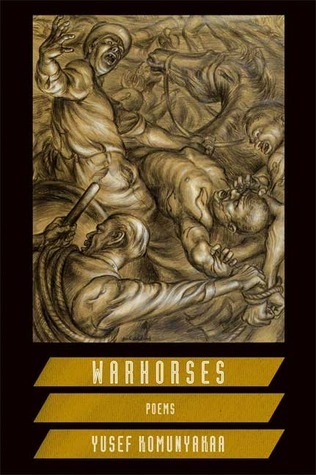
Warhorses
This powerful new collection of Yusef Komunyakaa's poetry delves into an age of war and conflict, both global and internal, racial and sexual. "Sweetheart, was I talking war in my sleep / again?" he asks, and the question is hardly "Sometimes I hold you like Achilles' / shield," and indeed all relationships, in this telling, are sites of violence and battle. His line is longer and looser than in Taboo and Talking Dirty to the Gods , and in long poems like "The Autobiography of My Alter Ego" he sounds almost breathless, an exhausted, desperate prophet. Warhorses is the stunning work of a Pulitzer Prize–winning poet who never ceases to challenge and delight his readers.
96 pages, Hardcover
First published September 30, 2008
About the author
Yusef Komunyakaa
96 books213 followersYusef Komunyakaa (born April 29, 1947) is an American poet who teaches at New York University and is a member of the Fellowship of Southern Writers. Komunyakaa is a recipient of the 1994 Kingsley Tufts Poetry Award, for Neon Vernacular and the 1994 Pulitzer Prize for Poetry. He also received the Ruth Lilly Poetry Prize. Komunyakaa received the 2007 Louisiana Writer Award for his enduring contribution to the poetry world.
His subject matter ranges from the black general experience through rural Southern life before the Civil Rights time period and his experience as a soldier during the Vietnam War.
(from Wikipedia)
His subject matter ranges from the black general experience through rural Southern life before the Civil Rights time period and his experience as a soldier during the Vietnam War.
(from Wikipedia)
Ratings & Reviews
Friends & Following
Create a free account to discover what your friends think of this book!
Community Reviews
Displaying 1 - 23 of 23 reviews

March 8, 2017
War-broken & torn down
to nothing
but stripped muscles
& tendons, to dreams of the past
she was now at ease
If you've read my Goodreads posts you know that I am a big fan of Komunyakaa's elucidation of war through verse. I've tried to distill the heights to which his arrangement of words have taken me during much-need reading escapes:
My hope is to make my way, slowly, through his twelve (or more?) books.
This one I found deliciously allusive and elusive, the kind of potency I enjoy with my poetry. And yet I couldn't help notice how esoteric it was at times, how the erudition sometimes masked the soul and grit that often characterizes Komunyakaa's works. And perhaps later, in the last section, it was also the form that startled me. In any case, it's about personal preference. What I admired here is what I often do with this poet: the mixture of the global and deeply personal, the music of love and psychology, the capture of torment and glee. The makeup of this collection is like a lemon-drop martini, with just the right blend of sweet, sour, and smooth burn. Now if I'll only have the chance to hear him read his poetry some day...
One of my favorites:
Tonight, the old hard work of love
Tonight, the old hard work of love
has given up. I can't unbutton promises
or sing secrets into your left ear
tuned to quivering plucked strings.
No, please. I can't face the reflection
of metal on your skin & in your eyes,
can't risk weaving new breath into war fog.
The anger of the trees is rooted in the soil.
Let me drink in your newly found river
of sighs, your way with incantations.
Let me see if I can't string this guitar
& take down your effigy of moonlight
from the cross, the dogwood in bloom
printed on memory's see-through cloth.
to nothing
but stripped muscles
& tendons, to dreams of the past
she was now at ease
If you've read my Goodreads posts you know that I am a big fan of Komunyakaa's elucidation of war through verse. I've tried to distill the heights to which his arrangement of words have taken me during much-need reading escapes:
Dien Cai Dau review => https://www.goodreads.com/review/show... )
and
Neon Vernacular: New and Selected Poems review =>(https://www.goodreads.com/review/show...)
My hope is to make my way, slowly, through his twelve (or more?) books.
This one I found deliciously allusive and elusive, the kind of potency I enjoy with my poetry. And yet I couldn't help notice how esoteric it was at times, how the erudition sometimes masked the soul and grit that often characterizes Komunyakaa's works. And perhaps later, in the last section, it was also the form that startled me. In any case, it's about personal preference. What I admired here is what I often do with this poet: the mixture of the global and deeply personal, the music of love and psychology, the capture of torment and glee. The makeup of this collection is like a lemon-drop martini, with just the right blend of sweet, sour, and smooth burn. Now if I'll only have the chance to hear him read his poetry some day...
One of my favorites:
Tonight, the old hard work of love
Tonight, the old hard work of love
has given up. I can't unbutton promises
or sing secrets into your left ear
tuned to quivering plucked strings.
No, please. I can't face the reflection
of metal on your skin & in your eyes,
can't risk weaving new breath into war fog.
The anger of the trees is rooted in the soil.
Let me drink in your newly found river
of sighs, your way with incantations.
Let me see if I can't string this guitar
& take down your effigy of moonlight
from the cross, the dogwood in bloom
printed on memory's see-through cloth.

March 20, 2019
I can't imagine Komunyakaa writing a dull book -- his interests are just too wide ranging, too passionate. Here are a few words I wrote about this one:
Yusef Komunyakaa won the Pulitzer Prize in 1994 for Neon Vernacular, a collection of “new and selected poems” that included the work that had established his reputation as a master of several themes. Perhaps he was best known for his book of Vietnam poems, Dien Cai Dau (I’m told the phrase means “crazy” and was used by some Vietnamese to identify American GIs in that war). The poems in that collection were spare and direct, often reflecting Komunyakaa’s experience as a soldier, moving into metaphor or even surrealist associations when the reality the soldier experienced became overwhelming. It remains the best book of poems about the American experience of the Vietnam War.
Before that, Komunyakaa had written about his childhood in the Jim Crow South as well as poems that were both about jazz and used jazz techniques. That American form and its method of allowing wild riffs off an established line offer a useful way of understanding the kinds of imaginative jumps that have characterized American poetry for the last few decades, and Komunyakaa uses jazz as well as anybody.
A lesser writer would have been content with these large historical themes and a method that garnered national awards. But Komunyakaa, who reads at the U-M Museum of Art on Monday, October 25, has a more restless intelligence and an imagination that never seems to be satisfied. A decade ago he published Talking Dirty to the Gods, a collection of poems all in a very rigid form that allowed him to use history, classical references, observation of nature, and personal experience in a way that suggested an almost prophetic vision of the individual in history.
That vision has continued and expanded in later work. Komunyakaa has assumed the prophetic mantle of a Whitman or a Ginsberg, but his tone is more personal, more fragile. In Warhorses, his most recent collection, he balances his experience of colonial war against the wars our country has been fighting during the last decade. In “Clouds” he describes a moment of turbulence in an airplane about to land. The woman next to him is frightened, and he notices the cover of the magazine she is reading, one that shows a picture of contemporary soldiers:
I see my face among their boyish poses
reflected in the airplane window,
& then I hear bloody tom-toms
in a deep valley, as my mind
runs along with an ancestor’s,
three steps into a moonless interior
before he’s captured & sold
for swatches of bright cloth
& a few glass beads. A spear dance
awakens the daydreamer’s blue hour.
What tribal scrimmage centuries ago
brought me here to this moment
where Georgia O’Keeffe’s clouds
are flat-white against an ocean, before
the plane touches down at LaGuardia
this morning? The boy soldiers
huddle around someone shot
on the ground, the raised dust
coloring their faces, clothes,
& memory the pigment of dust.
The personal becomes a vision of history which becomes a picture of the contemporary moment which moves back to the personal. It seems so easy when done with Komunyakaa’s masterful touch.
https://annarborobserver.com/articles...
Yusef Komunyakaa won the Pulitzer Prize in 1994 for Neon Vernacular, a collection of “new and selected poems” that included the work that had established his reputation as a master of several themes. Perhaps he was best known for his book of Vietnam poems, Dien Cai Dau (I’m told the phrase means “crazy” and was used by some Vietnamese to identify American GIs in that war). The poems in that collection were spare and direct, often reflecting Komunyakaa’s experience as a soldier, moving into metaphor or even surrealist associations when the reality the soldier experienced became overwhelming. It remains the best book of poems about the American experience of the Vietnam War.
Before that, Komunyakaa had written about his childhood in the Jim Crow South as well as poems that were both about jazz and used jazz techniques. That American form and its method of allowing wild riffs off an established line offer a useful way of understanding the kinds of imaginative jumps that have characterized American poetry for the last few decades, and Komunyakaa uses jazz as well as anybody.
A lesser writer would have been content with these large historical themes and a method that garnered national awards. But Komunyakaa, who reads at the U-M Museum of Art on Monday, October 25, has a more restless intelligence and an imagination that never seems to be satisfied. A decade ago he published Talking Dirty to the Gods, a collection of poems all in a very rigid form that allowed him to use history, classical references, observation of nature, and personal experience in a way that suggested an almost prophetic vision of the individual in history.
That vision has continued and expanded in later work. Komunyakaa has assumed the prophetic mantle of a Whitman or a Ginsberg, but his tone is more personal, more fragile. In Warhorses, his most recent collection, he balances his experience of colonial war against the wars our country has been fighting during the last decade. In “Clouds” he describes a moment of turbulence in an airplane about to land. The woman next to him is frightened, and he notices the cover of the magazine she is reading, one that shows a picture of contemporary soldiers:
I see my face among their boyish poses
reflected in the airplane window,
& then I hear bloody tom-toms
in a deep valley, as my mind
runs along with an ancestor’s,
three steps into a moonless interior
before he’s captured & sold
for swatches of bright cloth
& a few glass beads. A spear dance
awakens the daydreamer’s blue hour.
What tribal scrimmage centuries ago
brought me here to this moment
where Georgia O’Keeffe’s clouds
are flat-white against an ocean, before
the plane touches down at LaGuardia
this morning? The boy soldiers
huddle around someone shot
on the ground, the raised dust
coloring their faces, clothes,
& memory the pigment of dust.
The personal becomes a vision of history which becomes a picture of the contemporary moment which moves back to the personal. It seems so easy when done with Komunyakaa’s masterful touch.
https://annarborobserver.com/articles...
May 23, 2016
This is a difficult book. It isn't difficult in the way of Eliot, or Pound, or any of those poets whose work is oblique and twisted and confusing, no, it is just hard to keep reading as Komunyakaa lays out the horrors of war in poem after poem, culminating in a forty page long poem of war and the experience of war and the effects of having killed, even if you were "just following orders" as so many soldiers are, when the "Alter Ego" of that final poems says "Forgive / my father's larcenous tongue. / Forgive my mother's intoxicated / lullaby. Forgive my sixth sense. / Forgive my heart & penis, / but don't forgive my hands." This book seeks to drown the reader in the destruction that is war (drawing very heavily on the American violence in Vietnam, where Komunyakaa did serve in the military) because a this sort of prolonged submersion is the closest that it can get to expressing the thing itself. The poems of Warhorses do not flinch, do not shy away, do take snapshots of what has been done:
Komunyakaa blends raw emotion and meticulous craft into a set of poems that dazzle with their brilliance and elegance as much as pummel with emotion. The long "Autobiography of my Alter Ego" is perhaps the best poem in the book, but the opening sequence "Love in the Time of War" contains some remarkable sections and "The Panorama", "Guernica", and "Grenade" are also fanntastic. Warhorses is well worth the wringer that it puts you through.
Someone's beating a prisoner.These poems are harsh, are tired, are angry, are horrified, are raw, but they are also measured and constructed and smooth: "Here, the old masters of Shok & Awe / huddle in the war room, talking iron, / fire & sand, alloy & nomenclature." Komunyakaa weaves his invective and his cautions and his regrets flawlessly into a cascade of silken language, the color the only visible reminder of the blood spilled and the bile used and the sheer feeling wrung out into yellow and indigo dyes. But what colors he gives! When the poem opens, "Tribe. Clan. Valley & riverbank. Country. Continent. Interstellar / aborigines. Squad. Platoon. Company. Battalion. Regiment. Hive / & swarm. Colony. Legend. Laws." the drumbeat pulse of the words mirrors the terror and the marching and when the speaker of the same poem asks "was I talking war in my sleep again?" there is no comfort that this was a nightmare, because this nightmare had to have been made of living remembrances. The dust-blue tones of "The Crying Hill" well up with "Seth & Horus, both dead now for years. / They were kings, three laughing boys, / daring the small animals to speak." and the red destruction of "Grenade" is captured in a fluid prose poem that claims, "Flesh & earth fall into the eyes and mouths of the men. A dream trapped in midair."
Someone's counting red leaves
falling outside a clouded window
in a secret country. Someone
holds back a river, but the next rabbit jab
makes him piss on the stone floor.
The interrogator orders the man
to dig his grave with a teaspoon.
Komunyakaa blends raw emotion and meticulous craft into a set of poems that dazzle with their brilliance and elegance as much as pummel with emotion. The long "Autobiography of my Alter Ego" is perhaps the best poem in the book, but the opening sequence "Love in the Time of War" contains some remarkable sections and "The Panorama", "Guernica", and "Grenade" are also fanntastic. Warhorses is well worth the wringer that it puts you through.

January 19, 2009
Pulitzer Prize-winning poet, Yusef Komunyakaa, does not disappoint. This riveting and emotional collection of poems dealing with the horror and destruction of war is incredibly moving. The images Mr. Komunyakaa describes plunge the reader into the midst of the conflict. Backpedaling in terror, I found myself wanting to set this book aside, but I could not. Like a soldier, I had to see the battle to its fateful conclusion.
I especially liked the ending segment, Autobiography Of My Alter Ego. This section read very much like a soldier’s diary, organizing the writer’s reflections of his home life with the bloody stench of war. Anyone who has ever gone into battle will easily envision himself or herself in this collection. The tragic destruction of human life painstakingly rendered in Warhorses will remain in the reader’s mind long after the final page has been turned.
Ann B. Keller
I especially liked the ending segment, Autobiography Of My Alter Ego. This section read very much like a soldier’s diary, organizing the writer’s reflections of his home life with the bloody stench of war. Anyone who has ever gone into battle will easily envision himself or herself in this collection. The tragic destruction of human life painstakingly rendered in Warhorses will remain in the reader’s mind long after the final page has been turned.
Ann B. Keller

April 28, 2010
Poems in three sections: Love in the Time of War, Heavy Metal, and Autobiography of My Alter Ego, Warhorses looks at the myth and reality of war, mixing literature and history, politics and race, personal experience and current events, to present a searing testimony that matches lure to horror with a sobering effectiveness.
The first section appears to be a suite of unrhymed sonnets, with each poem featuring multiple pairings (“fire & sand, alloy & nomenclature,” “praises & curses,” “slave & warrior,” “prayers & regrets,” “anger & avarice,” “sweat & fingerprints,” and “boots & helmets” to site just a few) in its swirling descriptions of war’s bloody business. In these poems the myth and the lethality of war are featured, its connection to sex and love, to rape and grief. The second section mixes the topical (“Surge”—“Always more,” it begins) and the technological (“The Helmet,” “The Catapult,” “Grenade,” and “Heavy Metal Soliloquy”). The volume ends with Autobiography of My Alter Ego, reintroducing race as a theme. The narrator is a Vietnam vet, who like his father is “a cover artist.” “Oh, so you don’t know / what a cover artist is? / Well, let’s say he was / someone like Pat Boone, Elvis”. The poem tells of his growing up, his love for the woman who took care of him, his war experiences, and his post-war wanderings. A cover artist, he sees himself as John Howard Griffin, a white man who passed as black to experience racism, and who sees war, declared and otherwise, as a conflict against color (“why is our enemy / always dark-skinned? / always surrendering an arm / & a leg for a tooth, / a child for an eye?”) It links Abu Ghraib to American prisons. It ends with a plea for forgiveness that is comprehensive but contains a single exception. Forgive “the brightly colored viper,” it begins, and “the stormy century of crows” and it concludes: “Forgive my mother’s intoxicated / lullaby. Forgive my sixth sense. // Forgive my heart & penis, / but don’t forgive my hands.” Komunyaka knits shock and awe with Gilgamesh, the jawbone of an ass with planes flying into the Twin Towers and does so with balance and the horrible grace of the unblinking judgment that refuses to set aside compassion or culpability.
A beautiful, somber meditation on warfare that will be read and re-read.
The first section appears to be a suite of unrhymed sonnets, with each poem featuring multiple pairings (“fire & sand, alloy & nomenclature,” “praises & curses,” “slave & warrior,” “prayers & regrets,” “anger & avarice,” “sweat & fingerprints,” and “boots & helmets” to site just a few) in its swirling descriptions of war’s bloody business. In these poems the myth and the lethality of war are featured, its connection to sex and love, to rape and grief. The second section mixes the topical (“Surge”—“Always more,” it begins) and the technological (“The Helmet,” “The Catapult,” “Grenade,” and “Heavy Metal Soliloquy”). The volume ends with Autobiography of My Alter Ego, reintroducing race as a theme. The narrator is a Vietnam vet, who like his father is “a cover artist.” “Oh, so you don’t know / what a cover artist is? / Well, let’s say he was / someone like Pat Boone, Elvis”. The poem tells of his growing up, his love for the woman who took care of him, his war experiences, and his post-war wanderings. A cover artist, he sees himself as John Howard Griffin, a white man who passed as black to experience racism, and who sees war, declared and otherwise, as a conflict against color (“why is our enemy / always dark-skinned? / always surrendering an arm / & a leg for a tooth, / a child for an eye?”) It links Abu Ghraib to American prisons. It ends with a plea for forgiveness that is comprehensive but contains a single exception. Forgive “the brightly colored viper,” it begins, and “the stormy century of crows” and it concludes: “Forgive my mother’s intoxicated / lullaby. Forgive my sixth sense. // Forgive my heart & penis, / but don’t forgive my hands.” Komunyaka knits shock and awe with Gilgamesh, the jawbone of an ass with planes flying into the Twin Towers and does so with balance and the horrible grace of the unblinking judgment that refuses to set aside compassion or culpability.
A beautiful, somber meditation on warfare that will be read and re-read.

December 16, 2008
“Warhorses” is an appropriate name for this book—there’s a war on nearly every page: Vietnam, Iraq, Afghanistan, the Sudan, Troy, etc. Man’s inhumanity against man is Komunyakaa’s subject, and at times, the stock words meant to call forth emotion fall a little flat: blood, bodies, cries, we’ve heard all these before. But I kept changing my mind about this book—after a poem like “Warhorses” that felt flat and unemotional, “Guernica” would hit: “Although it was only a replica woven on a wall/ at the UN, before the statesmen could speak// of war, they draped a blue cloth over the piece,/ so cameras weren’t distracted by the dead child/ in her mother’s embrace. The severed hand// grips a broken sword. The woman falling// through the floor of a burning house is still/ falling. The horse screams a human voice.// The dumbstruck bull pines for the matador…”
“Grenade” and “The Towers,” in particular, held me spellbound. “Grenade,” a prose poem, narrates a soldier throwing himself on a grenade to save others, “turn[ing] flesh into dust.” “The Towers,” on the facing page, constructs itself into two columns on the page, and the explanation of the Sept. 11 to a dead son is heartbreaking (cf. Komunyakaa’s personal tragedy in 04).
Komunyakaa alludes to a few other war poems—Randall Jarrell’s “Death of the Ball-Turret Gunner” at the end of “Heavy Metal Soliloquy,” for example—but the focus is on a singular mind trying to process what’s happened.
When I read individual sections of the long sequence which finishes the book (“Autobiography of My Alter Ego”), I was unimpressed, but read as a sequence, the poems establish the voice of a man who has been through war (Vietnam) and thus can tell us something about our current wars. “Here’s another thing about war,” he tells us: “any man who can plead/ through a hunk of brass/ this way, could never kill / another man. You can’t / talk to God & kill a man / in the same breath. No / way.”
“Grenade” and “The Towers,” in particular, held me spellbound. “Grenade,” a prose poem, narrates a soldier throwing himself on a grenade to save others, “turn[ing] flesh into dust.” “The Towers,” on the facing page, constructs itself into two columns on the page, and the explanation of the Sept. 11 to a dead son is heartbreaking (cf. Komunyakaa’s personal tragedy in 04).
Komunyakaa alludes to a few other war poems—Randall Jarrell’s “Death of the Ball-Turret Gunner” at the end of “Heavy Metal Soliloquy,” for example—but the focus is on a singular mind trying to process what’s happened.
When I read individual sections of the long sequence which finishes the book (“Autobiography of My Alter Ego”), I was unimpressed, but read as a sequence, the poems establish the voice of a man who has been through war (Vietnam) and thus can tell us something about our current wars. “Here’s another thing about war,” he tells us: “any man who can plead/ through a hunk of brass/ this way, could never kill / another man. You can’t / talk to God & kill a man / in the same breath. No / way.”
August 29, 2020
Unfortunately, I couldn't get over the subject matter and diction of war to really appreciate the verse here. Masculine. However, his epic poem, "Autobiography of my Alter Ego" is quite riveting, associative, sound-driven, and clean. It follows a whole history of an invented (?) speaker; reminds us what's meant by a "suspension of disbelief." I'm now a great fan of YK.

May 11, 2023
The final line of the book is maybe the most intense thing I've ever read.

May 25, 2009
I had previously read a collection of previous Komunyakaa poems (Pleasure Dome) without knowing anything about the poet. Because of that, and the name, I read his work as if he were a contemporary African poet writing in English. With this new collection, I decided to do a bit of searching, and found his biography--including the fact that he was born (James Willie Brown Jr.) in Louisiana, served in Viet Nam, and later recovered the name of his ancestors (great grandparents who stowed away on a ship from Trinidad). The back story, especially the Viet Nam experience, added a great deal to my reading of these poems, a central theme in which is the horrors of war and the scars it leaves. The poems span across the outlines of recent wars (Viet Nam, Iraq) to more mythological warscapes. My favorite part is the "alter ego" poem at the end, which weaves a multiplicity of identities, including jazz artists: "Do you know this tune,/ do you know who's playing/ tenor? Listen. Listen."

March 23, 2015
Personal yet encompassing, Komunyakaa speaks of love, war, music, racism, and the intersections between. Some endings are hopeful, some are desolate. Komunyakaa is shifting, complicated, striking, and sure to make you uncomfortable.
"Warhorses" is mostly calm, elegant, and composed. Well-timed, sharp bursts of anger and profanity occasionally burst forth from what seems like nowhere. The book is paced excellently to wring the most out of the reader. I really meant to read this over a longer period of time, but I just couldn't stop.
Poetry I'm happy to revisit again and again, Komunyakaa is amazing, and one of my favorite poets.
"Warhorses" is mostly calm, elegant, and composed. Well-timed, sharp bursts of anger and profanity occasionally burst forth from what seems like nowhere. The book is paced excellently to wring the most out of the reader. I really meant to read this over a longer period of time, but I just couldn't stop.
Poetry I'm happy to revisit again and again, Komunyakaa is amazing, and one of my favorite poets.

March 25, 2010
Magnificent anti-war poems. The first section covers the history of warfare from medieval times to the present. The title poem whose concept is self-evident is marvelous. Another winner is "Surge". The last section titled "Autobiography of My Alter-Ego" covers the poets life and is masterly. Komunyakaa is a Pulitzer Prize winner, deservedly so.
November 13, 2008
Bought this book after attending his poetry reading (along with Jorie Graham). Very pleasantly surprised, as I've never read his poetry in depth before, and the imagery and syntax here just blend together seamlessly.

June 4, 2015
This is poetry at its absolute finest.
Equal parts personal, historical, political, topical, and beautiful, I highly recommend this book to anyone who thinks poetry is boring or uninteresting or confusing. This is where it's at!
Equal parts personal, historical, political, topical, and beautiful, I highly recommend this book to anyone who thinks poetry is boring or uninteresting or confusing. This is where it's at!

November 5, 2008
Brilliant, hard, power.
March 14, 2009
This is Yusef's latest and one of his most sure. The last chapter is more revealing than usual. Not to be missed.

November 23, 2010
This may be better than Neon Vernacular: New and Selected Poems.

January 10, 2012
I don't think anyone writes more clearly about the human damage of war.
June 8, 2012
Best sequences I've read in a long time.

March 24, 2015
I fall in love with Yusef Komunyakaa's poetry more and more with each poem.

June 23, 2015
His alter ego auto biography takes up most of the collection which fell dead for me. but these poems stand out.
The section "Love in the time of War" is excellent.
The section "Love in the time of War" is excellent.
July 5, 2015
Awesome. Some of the best poetry on war I've ever read.

December 1, 2022
This is the second volume of Komunyakaa's poetry I have read, and I am awed again by his visceral and raw portrayal of life, war, and love. A truly brilliant poetic voice.
Displaying 1 - 23 of 23 reviews