

What do you think?

The Vision (2015)
La visión, vol. 2: Poco mejor que una bestia
Goodreads Choice Award
Nominee for Readers' Favorite Graphic Novels & Comics (2017)Contiene The Vision v2, 7-12 USA
La conclusión de la más aclamada obra Marvel de los últimos tiempos. Hace algún tiempo, un robot creó una familia, y las cosas fueron bien por un tiempo. Luego llegaron las muertes, las mentiras, las traiciones, las batallas ganadas y las perdidas.
La conclusión de la más aclamada obra Marvel de los últimos tiempos. Hace algún tiempo, un robot creó una familia, y las cosas fueron bien por un tiempo. Luego llegaron las muertes, las mentiras, las traiciones, las batallas ganadas y las perdidas.
144 pages, Paperback
First published November 30, 2016
Ratings & Reviews
Friends & Following
Create a free account to discover what your friends think of this book!
Community Reviews
Displaying 1 - 30 of 773 reviews

February 10, 2018
The conclusion to Vision's gothicish family horror story turned out to be far more readable and complex than I originally thought it would be. <--and I suppose it's not really gothic or horror-y, but it still felt that way to me.

There's this slow build-up to something you just know will be terrifying and sad, and it all unfolds within the confines of a picturesque suburbia. And let's face it, nothing is creepier than the 'burbs.

I thought all the characters were wonderfully layered, which just added that extra bit of oomph to everything that happened to each of them. I really do think Tom King did a fabulous job of making Vision and his family normal and other at the same time. It was very well done and broke my heart completely at the end.
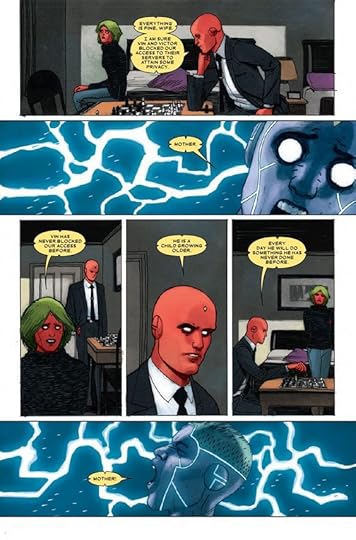
There aren't a lot of Vision-centric comics out there, so it's not as though readers have much to choose from when it comes to this character. But this was a good story. Really.
Unless you're looking for something light and fluffy, you might want to check this out.
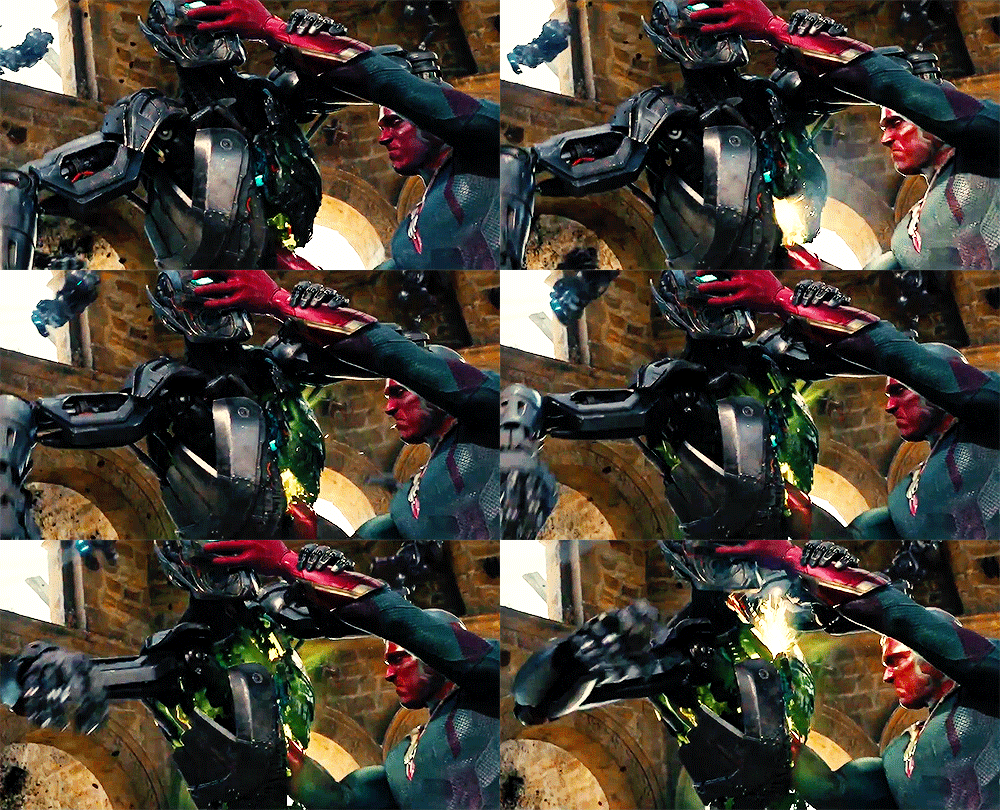
There's this slow build-up to something you just know will be terrifying and sad, and it all unfolds within the confines of a picturesque suburbia. And let's face it, nothing is creepier than the 'burbs.
I thought all the characters were wonderfully layered, which just added that extra bit of oomph to everything that happened to each of them. I really do think Tom King did a fabulous job of making Vision and his family normal and other at the same time. It was very well done and broke my heart completely at the end.
There aren't a lot of Vision-centric comics out there, so it's not as though readers have much to choose from when it comes to this character. But this was a good story. Really.
Unless you're looking for something light and fluffy, you might want to check this out.

December 17, 2016
As The Vision's perfect family continues to unravel, Victor Mancha comes to town to spend some time with them. However, he has ulterior motives...
Tom King's run on The Vision comes to an end. We finally find out who the source of Vivian's brain patterns were, the source of some odd behavior on the part of the Vision over the course of the series, and whether or not The Vision is an ass-kicking machine that can take on the entire Avengers roster.
Vin's Shakespeare obsession foreshadows quite a few tragedies in the series. By the end, everything is in wreckage and the lives of The Vision and his perfect family are irrevocably changed.
The art team did a fantastic job on this volume, particularly Michael Walsh, Gabriel Hernandez Walta, and Jordie Bellaire, the tone perfectly matching the off-kilter, sinister, yet sometimes sweet feel of the series.
Too bad the series only went twelve issues. I could read about The Vision and his strange family for years to come. Four out of five stars.
Tom King's run on The Vision comes to an end. We finally find out who the source of Vivian's brain patterns were, the source of some odd behavior on the part of the Vision over the course of the series, and whether or not The Vision is an ass-kicking machine that can take on the entire Avengers roster.
Vin's Shakespeare obsession foreshadows quite a few tragedies in the series. By the end, everything is in wreckage and the lives of The Vision and his perfect family are irrevocably changed.
The art team did a fantastic job on this volume, particularly Michael Walsh, Gabriel Hernandez Walta, and Jordie Bellaire, the tone perfectly matching the off-kilter, sinister, yet sometimes sweet feel of the series.
Too bad the series only went twelve issues. I could read about The Vision and his strange family for years to come. Four out of five stars.

June 21, 2020
Part two of the 12 issue tour de force of existential insight and look at the human, the super human and the robot conditions. Taking re-imagination of core Marvel characters to a never before seen level! Without a doubt this will be noted as a seminal piece of work by Tom King & Gabriel Hernandez Walta in the future! 9 out of 12.
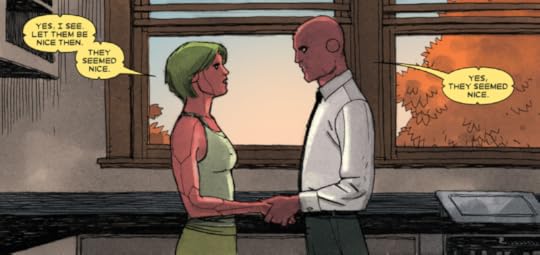
2016 read
2016 read

January 3, 2017
Portia: When he is best he is a little worse than a man, and when he is worst he is little better than a beast.
--Merchant of Venice
Wow, this volume, this series, ended after 12 issues and 2 volumes, alas. And this Tom King, whose Sheriff of Babylon and The Vision I have read in the same two week time period. King is a fine storyteller, by my lights, and especially a fine writer of tight dialogue. And in this series, he creates his own perspective about a Marvel superhero comic and that world.
A little background from the preface to the book: "Vision is a synthezoid, an android composed of synthetic bool and organs. He was created by Ultron to destroy the Avengers, but instead he turned on his 'father' and has been a member of the super-hero team ever since." Vision wants to be human, and so he creates a family for himself and moves into the suburbs. This is funny and odd and maybe slightly touching in the first volume, this desire to be ordinary, to be human.
But in the second volume, Little Better Than a Beast, we see how the exploration of what it means to be human has limitations, at times. As the cover reveals: Here Lies Vision: May God Have Mercy on His Soul.
We begin with some background King provides into the original love relationship between Vision and Scarlet Witch. Flashback to a post-coital bed where Vision tells her a joke. This joke seems like a throwaway initially, but resonates throughout the finale, which thanks to son Vin's passion for Shakespeare, achieves tragic proportions and passionately poetic reflection. Doubt that, from Marvel? Check this out! An epic tragic sequence follows a funny set up in a restaurant where they order food, but order it not cooked, since they can't eat it, of course, but they pay for it, anyway.
I won't tell you all that happens, but trust me, if you like the ways Alan Moore raises the literary bar of comics to tragic proportions, King here has similar aspirations. It begins with Uncle Victor's arrival, and everything goes to hell. At one point there is a discussion about whether God and the soul actually exist, and the Vision and his wife doubt it, but in the ending conversation between them, even the agnostics among us will begin to doubt their doubts. Moving and powerful and quirkily funny reflection on the human condition through a sci-fi superhero tale. We see the high and low possibilities of what it might mean to be human in the losses, the love, and the grieving. One of the best of 2016, which I read in 2017.
--Merchant of Venice
Wow, this volume, this series, ended after 12 issues and 2 volumes, alas. And this Tom King, whose Sheriff of Babylon and The Vision I have read in the same two week time period. King is a fine storyteller, by my lights, and especially a fine writer of tight dialogue. And in this series, he creates his own perspective about a Marvel superhero comic and that world.
A little background from the preface to the book: "Vision is a synthezoid, an android composed of synthetic bool and organs. He was created by Ultron to destroy the Avengers, but instead he turned on his 'father' and has been a member of the super-hero team ever since." Vision wants to be human, and so he creates a family for himself and moves into the suburbs. This is funny and odd and maybe slightly touching in the first volume, this desire to be ordinary, to be human.
But in the second volume, Little Better Than a Beast, we see how the exploration of what it means to be human has limitations, at times. As the cover reveals: Here Lies Vision: May God Have Mercy on His Soul.
We begin with some background King provides into the original love relationship between Vision and Scarlet Witch. Flashback to a post-coital bed where Vision tells her a joke. This joke seems like a throwaway initially, but resonates throughout the finale, which thanks to son Vin's passion for Shakespeare, achieves tragic proportions and passionately poetic reflection. Doubt that, from Marvel? Check this out! An epic tragic sequence follows a funny set up in a restaurant where they order food, but order it not cooked, since they can't eat it, of course, but they pay for it, anyway.
I won't tell you all that happens, but trust me, if you like the ways Alan Moore raises the literary bar of comics to tragic proportions, King here has similar aspirations. It begins with Uncle Victor's arrival, and everything goes to hell. At one point there is a discussion about whether God and the soul actually exist, and the Vision and his wife doubt it, but in the ending conversation between them, even the agnostics among us will begin to doubt their doubts. Moving and powerful and quirkily funny reflection on the human condition through a sci-fi superhero tale. We see the high and low possibilities of what it might mean to be human in the losses, the love, and the grieving. One of the best of 2016, which I read in 2017.

January 5, 2020
This is amazing in the way that it weaves together the weird history of Vision along with this new story of family and existence to come up with something completely original and heartbreaking.

February 13, 2017
Vision’s brother Victor visits but brings complications with him, forcing Vision to make some hard choices about his family.
The Vision is one of those books that occasionally crops up like Saga that everyone goes gay for but totally baffles me as to its appeal. The second and final book in this series is a slight improvement over the first but it’s still only mediocre at best.
I couldn’t get past how contrived the events of the first book were. Virginia does things that shouldn’t have been escalated in the way they were - the drama felt completely forced. This trend continues in the second book with Victor doing something terrible for seemingly no reason, which gives us the conflict and the story in the process.
Not only that but this title is almost humorously self-important and dark with its ridiculous deaths and Shakespearean quotes. I mean, Victor on some kind of robot heroin - are you kidding me!? It just takes itself so damn seriously that it makes it hard for me to read with a straight face.
That said, the ending was surprisingly moving and I liked the way Tom King left things for Vision - I hope Marvel keep it that way for him for a while rather than have it self-contained to just this book. And I loved Mike Del Mundo’s covers which are easily the best art this series has to offer.
Tom King’s writing isn’t bad, it’s just the story has a number of flaws I couldn’t accept. Gabriel Hernandez Walta and Michael Walsh’s art isn’t terrible either, it’s simply not that amazing. Everything’s pretty much acceptable which is why I wonder what everyone else is losing their shit over - it’s an ok title, but a masterpiece? Come on.
The Vision, Volume 2: Little Better Than a Beast is a marginally better book than the first and ends the series well though a lot of the lead-up to it is silly and melodramatic. Obviously if you’re a fan of the first book, you’ll love the second, but for readers yet to take the plunge, I’d say to beware the hype and not expect too much from this title.
The Vision is one of those books that occasionally crops up like Saga that everyone goes gay for but totally baffles me as to its appeal. The second and final book in this series is a slight improvement over the first but it’s still only mediocre at best.
I couldn’t get past how contrived the events of the first book were. Virginia does things that shouldn’t have been escalated in the way they were - the drama felt completely forced. This trend continues in the second book with Victor doing something terrible for seemingly no reason, which gives us the conflict and the story in the process.
Not only that but this title is almost humorously self-important and dark with its ridiculous deaths and Shakespearean quotes. I mean, Victor on some kind of robot heroin - are you kidding me!? It just takes itself so damn seriously that it makes it hard for me to read with a straight face.
That said, the ending was surprisingly moving and I liked the way Tom King left things for Vision - I hope Marvel keep it that way for him for a while rather than have it self-contained to just this book. And I loved Mike Del Mundo’s covers which are easily the best art this series has to offer.
Tom King’s writing isn’t bad, it’s just the story has a number of flaws I couldn’t accept. Gabriel Hernandez Walta and Michael Walsh’s art isn’t terrible either, it’s simply not that amazing. Everything’s pretty much acceptable which is why I wonder what everyone else is losing their shit over - it’s an ok title, but a masterpiece? Come on.
The Vision, Volume 2: Little Better Than a Beast is a marginally better book than the first and ends the series well though a lot of the lead-up to it is silly and melodramatic. Obviously if you’re a fan of the first book, you’ll love the second, but for readers yet to take the plunge, I’d say to beware the hype and not expect too much from this title.

January 14, 2020
This makes me excited for the new Wanda Vision show on Disney plus. I hear some of the story plots will come from this little run.
Vision lives with his family, who were programed to have all the normal problems families have. They love each other very much. The problem comes when Visions son is killed by his uncle, also a robot. The story gets very good and you wonder if the Avengers would be able to take down Vision if they had too. I'm sure they would find a way.
I love the twist at the end. It's totally awesome. It really is a great run. Wanda is also in this story and I thought maybe she could slow him down, but no. Also, Wanda and Vision aren't together, which is sad.
Also, there is some violence toward animals in here as a fair warning to those sensitive to that.
Vision lives with his family, who were programed to have all the normal problems families have. They love each other very much. The problem comes when Visions son is killed by his uncle, also a robot. The story gets very good and you wonder if the Avengers would be able to take down Vision if they had too. I'm sure they would find a way.
I love the twist at the end. It's totally awesome. It really is a great run. Wanda is also in this story and I thought maybe she could slow him down, but no. Also, Wanda and Vision aren't together, which is sad.
Also, there is some violence toward animals in here as a fair warning to those sensitive to that.

March 3, 2021
Note to self: do NOT read this series when you’re feeling even remotely depressed, anxious, or otherwise less than delighted by life, because it is DARK. Instead, eat cookies, pet puppies, and tap dance across a rainbow, ideally without falling through and smashing into the ground at terminal velocity because OUCH. Trust me—you’ll thank me. I mean you. Whatever.
That said, Tom King is so good at this kind of heavy, psychological, introspective take on superheroes. I think I liked Mister Miracle just a tick more than this, but Vision is excellent—great storytelling, great art, and thought-provoking themes.
That said, Tom King is so good at this kind of heavy, psychological, introspective take on superheroes. I think I liked Mister Miracle just a tick more than this, but Vision is excellent—great storytelling, great art, and thought-provoking themes.

December 25, 2016

"KILLER" book, but VERY dark.
Volume 2, and the end of King's short run on the groundbreaking Vision, expands on the Vision pathos and his past. We see Vision with the Scarlet Witch, whose personality and memories became Vivian, much to her distress. And the introduction of Vision's brother, Ultron's son, Victor Mancha, an android with a dark purpose, is the catalyst to send the Vision Family spiraling further out of control.
Tom King oddly reminds me of Cormac McCarthy, but he tries much harder and to greater effect. The minimal, stylistically repetitive dialog. The sparse settings. The pregnant pauses. It's dramatic, bleak, and incredibly written. But inevitably depressing...as...fuck.
I'll be honest, I want more from the artwork. Jordie Bellaire's colors are fantastic, highly tonal and painterly. But Michael Walsh's illustrations in Issue #7 are sloppy, and while Gabriel Hernandez Walta illustrates really well the rest of the way, especially facial expressions, I wish the style was more bold and minimal to complement the writing tone. Think Alex + Ada. And I get the style. It's sketchy cartoony, fine, even great sometimes. Just not amazing. And also what a TERRIBLE cover. Seriously. Of all the issue covers, the editors chose the least interesting and most subdued. That's just poor marketing.
Stark and bleak and tragic, sprinkled with a pinch of hope at the very end, and solidly illustrated if sometimes underwhelming. If you enjoyed Volume 1 then Little Better Than a Beast won't disappoint. 3.5 stars rounded up.

March 1, 2017
The only thing from Tom King that has impressed me until his run on Batman. The stand alone issue flashing back on Vision's relationship with the Scarlet Witch may be the best single Marvel comic I've read in the last few years. The rest of the book is pretty dour, missing the dark humor of the first book. Things continue to escalate to the point where Vision is fated to destroy the Avengers which culminates in a nice twist. It's a shame King's Grayson run hasn't been nearly as good as this series.

January 26, 2017
Although he is predominately writing for DC including his current run of Batman, Tom King made a stop at Marvel where he has now made one of the best runs for the publisher in recent memory, albeit twelve issues. Continuing on with what happened in the last volume, everyone’s favourite “synthezoid” is trying to maintain the safety of his artificial family, despite the Avengers’ fear of him razing the world.
From its beginning, the series has acknowledged the Vision’s history (with the occasional mention of him saving the world thirty-seven times) as the story is built on the character’s dream which is to be human and what’s more human than to be a loving husband and father. Now obviously, if you have been following this character since his 1968 inception, you’ll be aware of his conflicted romantic relationship with Wanda Maximoff aka the Scarlet Witch. Taking a break from the main plot, #7 focuses on their romance as the issue opens with a splash page featuring the two in bed gazing awkwardly into space, and thus revealing a domesticised history with more lows than highs and how it will lead to the Vision to build his own family from his own image.
Despite the pleasant welcome of Vision’s brother Victor Mancha, who steps in as the loving uncle who is there to comfort the conflicted family, no one comes out clean and the descent into darkness becomes even more so. Although Marvel has had its share of dark storylines (largely from Daredevil and The Punisher), Tom King is stepping into Alan Moore territory as despite more appearances of superheroes in the later issues, there are no panels feature any super-heroism as the Vision and even his family unintentionally can come across as villainous.
Although I don’t have a problem with Gabriel Hernandez Walta’s art which fits nicely into the suburban horror, but when the book leans more towards superhero action, the art isn’t quite as effective, but there is enough intimacy between the artificial characters that this is where Walta’s talent lies. As for Michael Walsh, who drew issue #7, his art is sketchy compared to Walta’s but manages to craft some impressive iconography, notably the Vision making out with the Scarlet Witch behind a tree, whilst the Avengers are battling their enemies in the street.
It may not be as strong as the first volume, but this latter half of Tom King and Gabriel Hernandez Walta’s Vision run concludes a dark and twisted story of the repercussions of artificial intelligence becoming more human than human.
From its beginning, the series has acknowledged the Vision’s history (with the occasional mention of him saving the world thirty-seven times) as the story is built on the character’s dream which is to be human and what’s more human than to be a loving husband and father. Now obviously, if you have been following this character since his 1968 inception, you’ll be aware of his conflicted romantic relationship with Wanda Maximoff aka the Scarlet Witch. Taking a break from the main plot, #7 focuses on their romance as the issue opens with a splash page featuring the two in bed gazing awkwardly into space, and thus revealing a domesticised history with more lows than highs and how it will lead to the Vision to build his own family from his own image.
Despite the pleasant welcome of Vision’s brother Victor Mancha, who steps in as the loving uncle who is there to comfort the conflicted family, no one comes out clean and the descent into darkness becomes even more so. Although Marvel has had its share of dark storylines (largely from Daredevil and The Punisher), Tom King is stepping into Alan Moore territory as despite more appearances of superheroes in the later issues, there are no panels feature any super-heroism as the Vision and even his family unintentionally can come across as villainous.
Although I don’t have a problem with Gabriel Hernandez Walta’s art which fits nicely into the suburban horror, but when the book leans more towards superhero action, the art isn’t quite as effective, but there is enough intimacy between the artificial characters that this is where Walta’s talent lies. As for Michael Walsh, who drew issue #7, his art is sketchy compared to Walta’s but manages to craft some impressive iconography, notably the Vision making out with the Scarlet Witch behind a tree, whilst the Avengers are battling their enemies in the street.
It may not be as strong as the first volume, but this latter half of Tom King and Gabriel Hernandez Walta’s Vision run concludes a dark and twisted story of the repercussions of artificial intelligence becoming more human than human.

October 18, 2019
This twelve issue run of The Vision has got to be one of the smartest, most vicious, absolutely brilliant runs in comic history.
Think I'm joking? Read it. Come back to me.
Comics rarely make me cry. A few have. Some are really awesome in other ways.
This one is pure tragedy masquerading as vicious comedy, irony, and satire that neatly sidesteps the very idea of satire because the Vision and his family are SO FAR OUTSIDE, looking in, that they actually become everything that we are.
People. Getting by. Making mistakes. Seeking justice. Receiving tragedy.
Do you think the many, many quotes from Merchant of Venice is a fluke? This comic does more than ravage us. It transforms us. I mentioned I cried? It was terrible sobs. Reminds me of the time I read Saga... but this might be slightly sharper. I'm bleeding.
Think I'm joking? Read it. Come back to me.
Comics rarely make me cry. A few have. Some are really awesome in other ways.
This one is pure tragedy masquerading as vicious comedy, irony, and satire that neatly sidesteps the very idea of satire because the Vision and his family are SO FAR OUTSIDE, looking in, that they actually become everything that we are.
People. Getting by. Making mistakes. Seeking justice. Receiving tragedy.
Do you think the many, many quotes from Merchant of Venice is a fluke? This comic does more than ravage us. It transforms us. I mentioned I cried? It was terrible sobs. Reminds me of the time I read Saga... but this might be slightly sharper. I'm bleeding.
December 28, 2016
2026 Review - Bumped it up to a 5/5. I didn't love the little twist at the very end but everything else was perfect. Dark, depressing, sad, filled with dread, some hope. All of it worked and just summed up why King got so big so quick. When he's on the right project, he KILLS it.
2016 Review - I wanted to love this as much as the first. I didn't. However, saying that, it's still filled with a ton of great moments.
Let's start with the fantastic issue about Scarlet and Vision. Might be one of my favorite issues of the entire run. Heartbreaking, sad, and TRUE. Relationships can be bumpy as fuck, and watching a reflection of that with V is soooo sad. I also love the issue when the Avengers come into play. The way Vision acts and does things just goes to show you how important and valuable his contribution to the team is. Truly scary.
The whole volume is very depressing though. It ends well, but leaves you empty. Where's the first volume I felt balanced it better, giving some light humor, and almost hitchcock type theme, this was downright fucking sad. Reflecting our lives out readers in the process is smart but sure as hell hard to read though and smile...
Either way this series is very much worth reading. I recommend this for EVERYONE who wants a damn well done story. As a whole the series is 9 outta 10.
2016 Review - I wanted to love this as much as the first. I didn't. However, saying that, it's still filled with a ton of great moments.
Let's start with the fantastic issue about Scarlet and Vision. Might be one of my favorite issues of the entire run. Heartbreaking, sad, and TRUE. Relationships can be bumpy as fuck, and watching a reflection of that with V is soooo sad. I also love the issue when the Avengers come into play. The way Vision acts and does things just goes to show you how important and valuable his contribution to the team is. Truly scary.
The whole volume is very depressing though. It ends well, but leaves you empty. Where's the first volume I felt balanced it better, giving some light humor, and almost hitchcock type theme, this was downright fucking sad. Reflecting our lives out readers in the process is smart but sure as hell hard to read though and smile...
Either way this series is very much worth reading. I recommend this for EVERYONE who wants a damn well done story. As a whole the series is 9 outta 10.

February 4, 2022
Just too sad in the end. Tom King was certainly doing something different with the Vision, but I wish there was more of a happy ending. Not just because I am corny when it comes to the superhero genre, but because of the mixed messaging. I get that tragedy can be smart storytelling (if not overused these days), but the way everybody dies seems to confirm the view of the bigoted neighbors who were against living among the androids. I dunno, maybe the lesson is that the whole American suburban family unit thing is a big lie...
I would've liked to see this series go on longer than 12 issues, and poor Vision get to enjoy this silly secret identity status quo for a while. At least his girl Viv is still an ongoing character at Marvel, right?
I would've liked to see this series go on longer than 12 issues, and poor Vision get to enjoy this silly secret identity status quo for a while. At least his girl Viv is still an ongoing character at Marvel, right?

January 11, 2019
". . . where nothing can possibly go worng!" -- tagline for the original Westworld film
But things continue to go awfully 'worng' in the conclusion Little Better Than a Beast. Vision's family situation spirals out of control (wife Virginia - "That is . . . good. Good. Good. Good. G-G-G . . ." Oh boy) as they try to keep a lid on their secrets and maintain the facade of an 'average' family from the 'burbs. A timely substance abuse allegory was even briefly dropped in and did not seem heavy-handed or out of place. Daughter Viv (who thankfully returns in the Champions series) probably has the best scenes, including a heartbreaking moment where she prays for her brother - unexpected, but kind of powerful - and also a dramatic dinner-table confrontation with her mother.
But things continue to go awfully 'worng' in the conclusion Little Better Than a Beast. Vision's family situation spirals out of control (wife Virginia - "That is . . . good. Good. Good. Good. G-G-G . . ." Oh boy) as they try to keep a lid on their secrets and maintain the facade of an 'average' family from the 'burbs. A timely substance abuse allegory was even briefly dropped in and did not seem heavy-handed or out of place. Daughter Viv (who thankfully returns in the Champions series) probably has the best scenes, including a heartbreaking moment where she prays for her brother - unexpected, but kind of powerful - and also a dramatic dinner-table confrontation with her mother.

October 26, 2016
I don't have much to say, except that this is the best Marvel comic since Fraction's Hawkeye, and one of the best comics of the year. And definitely Tom King's best work to date. Absolutely brilliant stuff.

February 12, 2017
A worthy, if not entirely satisfactory, conclusion to The Vision maxi-series. I really, really enjoyed the first volume's moody, dread-filled, dark take on the Marvel Universe's favourite synthezoid. It felt like an independent-publisher take on a classic Marvel character. However, as I feared in my review of the first volume, the imminent entrance of the rest of the spandex- and armour-clad super-folk does put a bit of a damper on the second half of this series.
I think that all faults laid at the feet of this volume can be traced to the problem of the shared universe.
It's sort of like how you have to suspend disbelief when Spidey is in the toughest slug-fest of his life. Why doesn't Thor jump in to thrash Doctor Octopus? Best to quiet those thoughts and pretend like everybody is off fighting the Shi'ar. Alternatively, it is sometimes pleasant to imagine that the characters can exist off on their own during solo adventures, and they link up when convenient. Here, The Vision suffers only in small quantities. The central conflict revolves around the family unit introduced in the first volume and the fallout from their, surprisingly murderous, actions.
The other big hindrance is the copious continuity that was laid before me in issues 7 and 8. The Vision and Scarlet Witch's complex relationship requires the kind of understanding known only to the most elite of comic nerds. Luckily, I knew all of this and was pleased with the issue. The downside: I was hoping to give this to a few friends who enjoy comics, but can't be bothered with the heavy-duty continuity. The other bit is the introduction of Victor Mancha. His introduction makes sense given the whole concept of family, but I can almost imagine my buddies putting the book down and being like, "Are you serious? Ultron had another kid?"
I'd like to note that I love the Marvel Universe, all it's idiosyncrasies, difficulties, highs, and lows. I'd also like to note that a love of the form does not exempt it from criticism.
But, even with those complaints, this is still one of the tightest series from Marvel in recent memory. I mean "tightest" in both the fist-bumping-bros and structural sense. All of the consequences in this book can be clearly traced back to actions in the first volume. In that sense, I can see why many reviewers have drawn comparisons with consequentialist television show Breaking Bad. Of course, this isn't that show, but it is as close as I can imagine the Marvel Universe getting.
The Vision should be essential reading for all Marvel comic readers. It is a mature, dark story that is able to play to the uniqueness of the Marvel interconnected universe and only rarely suffers for it. If nothing else, I hope this prompts Marvel to engage more writers in maxi-series. Wouldn't it be interesting if every year a new writer came on to the scene to drop their particular **AHEM** vision on to a preexisting character? Though it might not work for every character, I think it would introduce a freshness to the Marvel universe much like this series. Think Fraction & Aja's Hawkeye, Hickman's Avengers, and now King & Walta's The Vision. These are comics worth noting: they are doing different things.
I think that all faults laid at the feet of this volume can be traced to the problem of the shared universe.
It's sort of like how you have to suspend disbelief when Spidey is in the toughest slug-fest of his life. Why doesn't Thor jump in to thrash Doctor Octopus? Best to quiet those thoughts and pretend like everybody is off fighting the Shi'ar. Alternatively, it is sometimes pleasant to imagine that the characters can exist off on their own during solo adventures, and they link up when convenient. Here, The Vision suffers only in small quantities. The central conflict revolves around the family unit introduced in the first volume and the fallout from their, surprisingly murderous, actions.
The other big hindrance is the copious continuity that was laid before me in issues 7 and 8. The Vision and Scarlet Witch's complex relationship requires the kind of understanding known only to the most elite of comic nerds. Luckily, I knew all of this and was pleased with the issue. The downside: I was hoping to give this to a few friends who enjoy comics, but can't be bothered with the heavy-duty continuity. The other bit is the introduction of Victor Mancha. His introduction makes sense given the whole concept of family, but I can almost imagine my buddies putting the book down and being like, "Are you serious? Ultron had another kid?"
I'd like to note that I love the Marvel Universe, all it's idiosyncrasies, difficulties, highs, and lows. I'd also like to note that a love of the form does not exempt it from criticism.
But, even with those complaints, this is still one of the tightest series from Marvel in recent memory. I mean "tightest" in both the fist-bumping-bros and structural sense. All of the consequences in this book can be clearly traced back to actions in the first volume. In that sense, I can see why many reviewers have drawn comparisons with consequentialist television show Breaking Bad. Of course, this isn't that show, but it is as close as I can imagine the Marvel Universe getting.
The Vision should be essential reading for all Marvel comic readers. It is a mature, dark story that is able to play to the uniqueness of the Marvel interconnected universe and only rarely suffers for it. If nothing else, I hope this prompts Marvel to engage more writers in maxi-series. Wouldn't it be interesting if every year a new writer came on to the scene to drop their particular **AHEM** vision on to a preexisting character? Though it might not work for every character, I think it would introduce a freshness to the Marvel universe much like this series. Think Fraction & Aja's Hawkeye, Hickman's Avengers, and now King & Walta's The Vision. These are comics worth noting: they are doing different things.

February 7, 2017
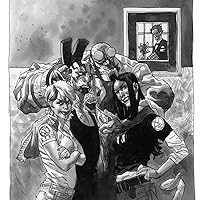
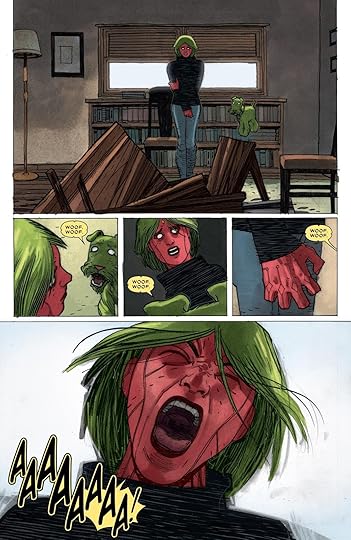
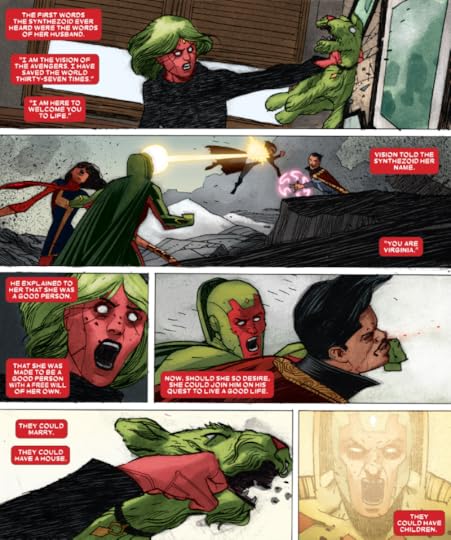
Such a good book... more pathos than really a superhero story... the story of Vision and his new robot family veers towards an inevitable confrontation between Vision determined to protect his new family no matter what the cost and Worlds mightiest heroes, whom Vision used to call friends and allies... concludes one of the best superhero comics of the last few years
February 7, 2017
4 1/2 stars
This entire review has been hidden because of spoilers.

January 14, 2017
A suitably strange, eerie, and sad end to a surprisingly good series.

October 16, 2020
REVIEW: The Vision Vol. 2: Little Better Than a Beast
This volume actually gives us a quick crash course of Wanda and Vision's love story, which I’m excited to explore more of in the show. But once again, Vision and his family are the best part of this run. I feel as if I'm a part of their family now. (Little Tony Vision.)
The art takes a big step forward, or maybe it’s just the beautiful one-pagers, which I’m always a sucker for. Plus, we get some Avengers action, which is as amazing as it sounds. (I wonder if we’ll get Avenger cameos in WandaVision?)
There’s also a moment in this book that blew my mind. I was both shocked and sad as my jaw hit the ground. (My jaw’s okay now though.) It’s major spoilers, so I won’t even mention it, but it changed the entire dynamic of the book. I just love seeing the Visions deal with human problems.
On the downside, I couldn’t help but feel slightly underwhelmed. It was still great, and I still enjoyed it, but the reviews I’ve seen had me thinking this was going to be insanely awesome, and I just didn’t feel that way.
The pacing was up and down for me, the ending left some things unresolved, and the story became somewhat predictable. Vision has extended family show up out of absolutely nowhere, so you know something is up.
But it’s the ending that was so bittersweet. I liked it, but it also leaves WAY too much unresolved. What happened with Vision and the Avengers? What about Vision’s “normal” suburban life? Shouldn’t there be consequences for what he’s done? There’s also a lame reveal with Virginia, which I didn't buy it for a second.
Overall, this 12-issue run by Tom King was fantastic and somehow makes the B-list hero of Vision badass. Despite some pacing issues and a bittersweet ending, this was a compelling story with surprising twists and turns along the way.
Score: 8 out of 10
Overall: Great
Thanks for reading! 😄
This volume actually gives us a quick crash course of Wanda and Vision's love story, which I’m excited to explore more of in the show. But once again, Vision and his family are the best part of this run. I feel as if I'm a part of their family now. (Little Tony Vision.)
The art takes a big step forward, or maybe it’s just the beautiful one-pagers, which I’m always a sucker for. Plus, we get some Avengers action, which is as amazing as it sounds. (I wonder if we’ll get Avenger cameos in WandaVision?)
There’s also a moment in this book that blew my mind. I was both shocked and sad as my jaw hit the ground. (My jaw’s okay now though.) It’s major spoilers, so I won’t even mention it, but it changed the entire dynamic of the book. I just love seeing the Visions deal with human problems.
On the downside, I couldn’t help but feel slightly underwhelmed. It was still great, and I still enjoyed it, but the reviews I’ve seen had me thinking this was going to be insanely awesome, and I just didn’t feel that way.
The pacing was up and down for me, the ending left some things unresolved, and the story became somewhat predictable. Vision has extended family show up out of absolutely nowhere, so you know something is up.
But it’s the ending that was so bittersweet. I liked it, but it also leaves WAY too much unresolved. What happened with Vision and the Avengers? What about Vision’s “normal” suburban life? Shouldn’t there be consequences for what he’s done? There’s also a lame reveal with Virginia, which I didn't buy it for a second.
Overall, this 12-issue run by Tom King was fantastic and somehow makes the B-list hero of Vision badass. Despite some pacing issues and a bittersweet ending, this was a compelling story with surprising twists and turns along the way.
Score: 8 out of 10
Overall: Great
Thanks for reading! 😄

October 26, 2016
"In sooth, I know not why I am so sad..." - First line of The Merchant of Venice.
"It all just goes through me!" - Viv Vision
I have been wanting to review this graphic novel (and I mean this volume and The Vision, Volume 1: Little Worse Than A Man) in its totality for months now. My top 3 if not top read of 2016. I said in in my review of the first volume that Tom King's The Vision was on its way to becoming one of the greatest graphic novels of all time and now I will say that, in my opinion, it is. This "much more than a superhero-comic" is just good storytelling. This book looks at how man makes and un-makes himself and those around him. The best review I can give the series is to simply re-post my letter to the book's creative team (which Marvel reprinted in Vision (2015-2016) #12):
"Mr. Tom King,
Well it has been just about 30 years, but finally someone has created a graphic novel that can be objectively argued as the greatest. The way that Alan Moore and David Gibbons used superheroes to instead do an examination on the state of civil society in the 1980s, you and Gabriel Hernandez Walta have used a family of android/quasi-cyborgs to commentate on the 2010s. You took the tumultuous history of a Marvel B-list/a-list "light" character and instead made it an examination of the ways we try to conform to society while actively having society become alienated from us. Vision's goal was always going to fail because he was giving himself harder and harder benchmarks to achieve what it took to be a man in a society that still cannot recognize common humanity in biological humans because of what they looked like, but yet he misreads and thinks that humanity comes from a superficial principal that he thinks that he is "that close" to achieving. Even when the people closest to him have taken him into and regard him as part of the "human" family, it is not enough and the seeds for disaster are sewn here within Vision's self-doubt of his own worth. He's human enough to want what is commonly perceived to be the rites of manhood, but not enough to be content and pass any contentment on to the rest of his family (probably not a good idea to build a wife based on his then-crazy ex). In a way, even his disastrous situation is proof of another common trait of a man: inheriting the sins of his near-ancestors to at least as far back as Hank Pym and his doomed domestic life.
Vin served to indicate or allude to the audience this story's connection to the Shakespearean tragedies (especially The Merchant of Venice), but this book, I feel, draws a more direct ancestry to Eugene O'Neill's tragic/drama plays. This comic book is a horror comic in the same way that O'Neil's The Iceman Cometh is a dystopian play and that's what makes me love it so much. Vision, in the words of Dr. W.E.B. Du Bois, is aware of a 'veil' that exists between himself (and his family) and the rest of the world. But old Viz does not want to have to have the "curse" of a 'double consciousness' and its implications so he tries to find ways around it, but alas..."
I can't say yet if there will be a better story I will read this year, but this is one that I will not soon be forgetting.
"Portia: One half of me is yours, the other half yours,
Mine own, I would say; but if mine, then yours,
And so all yours." - You guessed it, The Merchant of Venice, again.
"It all just goes through me!" - Viv Vision
I have been wanting to review this graphic novel (and I mean this volume and The Vision, Volume 1: Little Worse Than A Man) in its totality for months now. My top 3 if not top read of 2016. I said in in my review of the first volume that Tom King's The Vision was on its way to becoming one of the greatest graphic novels of all time and now I will say that, in my opinion, it is. This "much more than a superhero-comic" is just good storytelling. This book looks at how man makes and un-makes himself and those around him. The best review I can give the series is to simply re-post my letter to the book's creative team (which Marvel reprinted in Vision (2015-2016) #12):
"Mr. Tom King,
Well it has been just about 30 years, but finally someone has created a graphic novel that can be objectively argued as the greatest. The way that Alan Moore and David Gibbons used superheroes to instead do an examination on the state of civil society in the 1980s, you and Gabriel Hernandez Walta have used a family of android/quasi-cyborgs to commentate on the 2010s. You took the tumultuous history of a Marvel B-list/a-list "light" character and instead made it an examination of the ways we try to conform to society while actively having society become alienated from us. Vision's goal was always going to fail because he was giving himself harder and harder benchmarks to achieve what it took to be a man in a society that still cannot recognize common humanity in biological humans because of what they looked like, but yet he misreads and thinks that humanity comes from a superficial principal that he thinks that he is "that close" to achieving. Even when the people closest to him have taken him into and regard him as part of the "human" family, it is not enough and the seeds for disaster are sewn here within Vision's self-doubt of his own worth. He's human enough to want what is commonly perceived to be the rites of manhood, but not enough to be content and pass any contentment on to the rest of his family (probably not a good idea to build a wife based on his then-crazy ex). In a way, even his disastrous situation is proof of another common trait of a man: inheriting the sins of his near-ancestors to at least as far back as Hank Pym and his doomed domestic life.
Vin served to indicate or allude to the audience this story's connection to the Shakespearean tragedies (especially The Merchant of Venice), but this book, I feel, draws a more direct ancestry to Eugene O'Neill's tragic/drama plays. This comic book is a horror comic in the same way that O'Neil's The Iceman Cometh is a dystopian play and that's what makes me love it so much. Vision, in the words of Dr. W.E.B. Du Bois, is aware of a 'veil' that exists between himself (and his family) and the rest of the world. But old Viz does not want to have to have the "curse" of a 'double consciousness' and its implications so he tries to find ways around it, but alas..."
I can't say yet if there will be a better story I will read this year, but this is one that I will not soon be forgetting.
"Portia: One half of me is yours, the other half yours,
Mine own, I would say; but if mine, then yours,
And so all yours." - You guessed it, The Merchant of Venice, again.

November 28, 2016
[Read as single issues]
Bring tissues. You'll need them.
Vision's journey comes to an end in this volume as everything Agatha Harkness has predicted comes to pass. There is heartbreak, there is joy, and there is even some superheroics in a book that has been notoriously light in them. This is as close to an Image book as Marvel are likely to get, and Tom King absolutely knocks this out of the park with the most bittersweet ending in a long time.
Gabriel Hernandez Walta's artwork and Jordie Bellaire's colours make this even more disturbing, the superheroes standing out in stark contrast to the sleepy suburbia, and that makes the more violent parts of this book even more painful to read.
Vision is a masterpiece. There's nothing else to say.
Bring tissues. You'll need them.
Vision's journey comes to an end in this volume as everything Agatha Harkness has predicted comes to pass. There is heartbreak, there is joy, and there is even some superheroics in a book that has been notoriously light in them. This is as close to an Image book as Marvel are likely to get, and Tom King absolutely knocks this out of the park with the most bittersweet ending in a long time.
Gabriel Hernandez Walta's artwork and Jordie Bellaire's colours make this even more disturbing, the superheroes standing out in stark contrast to the sleepy suburbia, and that makes the more violent parts of this book even more painful to read.
Vision is a masterpiece. There's nothing else to say.
May 7, 2017
To the entire creative team of The Vision,
Thank you for this book.
Every page, every panel, every cover was beautifully rendered. If I could one day produce work this good, I could die a happy artist.
This book made me laugh. This book scared me. This book made me cry. This wonderful story made my heart soar with sheer joy whilst simultaneously casting it to the ground and smashing it into a thousand pieces.
I've been reading comicbooks for almost forty years and this stands out as one of the best I've ever read. Sincerely, thank you for The Vision. It's not a book I'm going to forget.
Thank you for this book.
Every page, every panel, every cover was beautifully rendered. If I could one day produce work this good, I could die a happy artist.
This book made me laugh. This book scared me. This book made me cry. This wonderful story made my heart soar with sheer joy whilst simultaneously casting it to the ground and smashing it into a thousand pieces.
I've been reading comicbooks for almost forty years and this stands out as one of the best I've ever read. Sincerely, thank you for The Vision. It's not a book I'm going to forget.

August 11, 2020
A real descent into madness. Not quite as good as The Vision, Volume 1: Little Worse Than A Man but the emotions of despair and loss of hope were more poignant here. Yes, the themes portrayed were jarringly obvious and slightly overplayed, but they helped to heighten the insanity of it all.

July 2, 2017
La miniserie de La Visión nos relata como el sintozoide decide mudarse a los suburbios para vivir con su propia familia. Poco a poco descubriremos la extrañeza de esa familia, así como los comportamientos erráticos y hasta peligrosos de algunos de sus miembros. Tom King firma un guion brillante, perfecto y redondo que viene adornado por el excelente dibujo de Gabriel Rodriguez Walta y el color de Jordie Bellaire. Una miniserie de las que marcan época, de las que dan vida al género de superhéroes saliendo de los cánones habitualmente establecidos.
Abre este segundo tomo un poderoso flashback que sirve de unión para toda la historia. A partir de ahí vamos uniendo una pieza tras otra hasta llegar a un clímax final apoteósico y muy satisfactorio. Tanto que estoy deseando leer los dos volúmenes seguidos en el futuro para hilar perfectamente cada uno de los detalles. Un relato tanto en el dibujo como en la forma que tira más hacia lo indie que hacía lo comercial superhéroico. Estos 12 números de La Visión son una de esas rara avis que surgen alguna vez en el mundo del cómic, y que recomiendo encarecidamente a todo el mundo.
Abre este segundo tomo un poderoso flashback que sirve de unión para toda la historia. A partir de ahí vamos uniendo una pieza tras otra hasta llegar a un clímax final apoteósico y muy satisfactorio. Tanto que estoy deseando leer los dos volúmenes seguidos en el futuro para hilar perfectamente cada uno de los detalles. Un relato tanto en el dibujo como en la forma que tira más hacia lo indie que hacía lo comercial superhéroico. Estos 12 números de La Visión son una de esas rara avis que surgen alguna vez en el mundo del cómic, y que recomiendo encarecidamente a todo el mundo.

February 12, 2018
The Vision series comes to a close in this second volume, and it brings all the pathos of a Shakespearean tragedy.
Considering my high regard for the first volume Little Worse than a Man, surprisingly it took me a year to pick up and read this second volume. I knew that reading it in one sitting would be best, so the quietly ominous story could have its best effect. The conclusion did not disappoint, yet it did have a different feel than the first. The first volume showed how The Vision, a syntheziod, desperately wanted a family and how his creation upended what others considered human behavior. This concluding volume goes back in time and shows The Vision’s rationale for wanting to create a family, and his motives turn out to be a bit complex.
The volume opens with his past relationship with Scarlet Witch and how their unlikely romance resulted in marriage. The marriage deteriorates as Wanda’s delusion of having twin boys takes over (this plot point has always been confusing to me as Wiccan and Speed are now real Young Avengers) and a seemingly innocuous joke between the two builds and carries through to the end. It seems The Vision’s love for Wanda and her wish for family subverts itself in his later wish for the same thing, and how he creates his new wife Virginia.
When we are in the present day we see twins Vin and Viv (again a connection to The Vision’s first twins) and Vin’s obsession with quoting some of Shakespeare’s work. A quote from The Merchant of Venice brings volumes one and two’s titles into focus, “When he is best he is a little worse than a man, and when he is worst he is little better than a beast” and we know that the story is building towards an unhappy climax.
Themes of destiny and intentions are interwoven throughout the narrative, with many of the Avengers coming off negatively, with many injustices heaped upon the Vision family by them. Decisions certain family members make in the name of love or revenge can be connected to their true humanity vs the shaky moral high ground that others around them take.
The art in both volumes is excellent. When The Vision is with his family the panels are precise and clean, with a more sketchy style used when he is out of the house and interacting with others. I believe this is a subtle nod to The Vision feeling when he is with his new family he is in control and is less clear when he has to deal with the conflicting motivations of people outside his realm of influence.
This two-volume story is outstanding and really subverts the typical superhero narrative. There are many layers to the story and it touches on important themes such as xenophobia, definitions of humanity and love for family. While I feel the first volume was a bit stronger than this second one, the poignant conclusion is a perfect wrap-up, and the team that created it deserves major respect.
This review can also be found on my blog: https://graphicnovelty2.com/2018/02/0...
Considering my high regard for the first volume Little Worse than a Man, surprisingly it took me a year to pick up and read this second volume. I knew that reading it in one sitting would be best, so the quietly ominous story could have its best effect. The conclusion did not disappoint, yet it did have a different feel than the first. The first volume showed how The Vision, a syntheziod, desperately wanted a family and how his creation upended what others considered human behavior. This concluding volume goes back in time and shows The Vision’s rationale for wanting to create a family, and his motives turn out to be a bit complex.
The volume opens with his past relationship with Scarlet Witch and how their unlikely romance resulted in marriage. The marriage deteriorates as Wanda’s delusion of having twin boys takes over (this plot point has always been confusing to me as Wiccan and Speed are now real Young Avengers) and a seemingly innocuous joke between the two builds and carries through to the end. It seems The Vision’s love for Wanda and her wish for family subverts itself in his later wish for the same thing, and how he creates his new wife Virginia.
When we are in the present day we see twins Vin and Viv (again a connection to The Vision’s first twins) and Vin’s obsession with quoting some of Shakespeare’s work. A quote from The Merchant of Venice brings volumes one and two’s titles into focus, “When he is best he is a little worse than a man, and when he is worst he is little better than a beast” and we know that the story is building towards an unhappy climax.
Themes of destiny and intentions are interwoven throughout the narrative, with many of the Avengers coming off negatively, with many injustices heaped upon the Vision family by them. Decisions certain family members make in the name of love or revenge can be connected to their true humanity vs the shaky moral high ground that others around them take.
The art in both volumes is excellent. When The Vision is with his family the panels are precise and clean, with a more sketchy style used when he is out of the house and interacting with others. I believe this is a subtle nod to The Vision feeling when he is with his new family he is in control and is less clear when he has to deal with the conflicting motivations of people outside his realm of influence.
This two-volume story is outstanding and really subverts the typical superhero narrative. There are many layers to the story and it touches on important themes such as xenophobia, definitions of humanity and love for family. While I feel the first volume was a bit stronger than this second one, the poignant conclusion is a perfect wrap-up, and the team that created it deserves major respect.
This review can also be found on my blog: https://graphicnovelty2.com/2018/02/0...
November 26, 2017
I wasn’t expecting to give this such a low score after the first Volume.
It’s obviously well written and the artwork is wonderful. It just didn’t strike a chord with me at all.
I’m happy Marvel have let Tom king experiment and open up the B list characters to more creative writing. I see DC are doing that with Mr Miracle as well.
It’s obviously well written and the artwork is wonderful. It just didn’t strike a chord with me at all.
I’m happy Marvel have let Tom king experiment and open up the B list characters to more creative writing. I see DC are doing that with Mr Miracle as well.

July 19, 2020
A snappy second volume.
This volume moves much quicker than the first. A lot happens and the prophecy the Avengers were trying to stop, might have actually started because of them. Oops! I really liked getting to know the Vision family, Virginia ended up being my favorite even though she kind of blew it in vol 1. I also liked that by looking at the Avengers team you can pinpoint exactly when this story was taking place in the marvel universe. Art stays amazing and honestly this book has me interested in Scarlet Witch and Vision’s history. It stuck to the core of what and who the Vision is and honestly I would read a series with the remaining family members.
This volume moves much quicker than the first. A lot happens and the prophecy the Avengers were trying to stop, might have actually started because of them. Oops! I really liked getting to know the Vision family, Virginia ended up being my favorite even though she kind of blew it in vol 1. I also liked that by looking at the Avengers team you can pinpoint exactly when this story was taking place in the marvel universe. Art stays amazing and honestly this book has me interested in Scarlet Witch and Vision’s history. It stuck to the core of what and who the Vision is and honestly I would read a series with the remaining family members.

October 10, 2018
If nothing else this stunning second part of the series reminds us what it is to be human.
World: The art is fantastic, it's sets a wonderful tone that's grounded and muted and it makes the fantastic much more real and frankly human. The world building is great, we had the very small and contained world of the first six issues where King focused the story on Vision and the family and with this second part the world expands but it makes sense, it's the Visions interacting with the world and the consequences of the first six issues coming home to roost it's stunning.
Story: The pacing is amazing and the journey that this book takes is stunning. I don't want to say anything I am just going to be sharing my thoughts and feelings instead of the plot. One thing though about the writing, it's amazing. I finished this story feeling shaken, sad, human and unsettled. This is not a story just about a robot family trying to be human, it's a human family trying to be human and making choices because of it. It's the best type of drama where it makes readers think about what they would do in their shoes. I don't know when but I stopped thinking about them being non human when stuff started to happen and much like the best of Asimov's robots the end made me cry. It's so good.
Characters: Wow! King's dialog is amazing, his framing of quiet character moments are so good that it hits hard and deep into readers emotions. These characters are real, they are flawed and they are human and with the limited dialog and page count compared to a novel it's absolutely astounding what King has done with the Visions. Each family member is so interesting and their story is so heartbreaking, I'm at a loss for words.
My review is short and it does not do this series any justice. It is one of the best comic book series that I've read this year and I read a lot but wow, this is not just a good comic book this is just purely a good book.
Onward to the next book!
World: The art is fantastic, it's sets a wonderful tone that's grounded and muted and it makes the fantastic much more real and frankly human. The world building is great, we had the very small and contained world of the first six issues where King focused the story on Vision and the family and with this second part the world expands but it makes sense, it's the Visions interacting with the world and the consequences of the first six issues coming home to roost it's stunning.
Story: The pacing is amazing and the journey that this book takes is stunning. I don't want to say anything I am just going to be sharing my thoughts and feelings instead of the plot. One thing though about the writing, it's amazing. I finished this story feeling shaken, sad, human and unsettled. This is not a story just about a robot family trying to be human, it's a human family trying to be human and making choices because of it. It's the best type of drama where it makes readers think about what they would do in their shoes. I don't know when but I stopped thinking about them being non human when stuff started to happen and much like the best of Asimov's robots the end made me cry. It's so good.
Characters: Wow! King's dialog is amazing, his framing of quiet character moments are so good that it hits hard and deep into readers emotions. These characters are real, they are flawed and they are human and with the limited dialog and page count compared to a novel it's absolutely astounding what King has done with the Visions. Each family member is so interesting and their story is so heartbreaking, I'm at a loss for words.
My review is short and it does not do this series any justice. It is one of the best comic book series that I've read this year and I read a lot but wow, this is not just a good comic book this is just purely a good book.
Onward to the next book!
Displaying 1 - 30 of 773 reviews