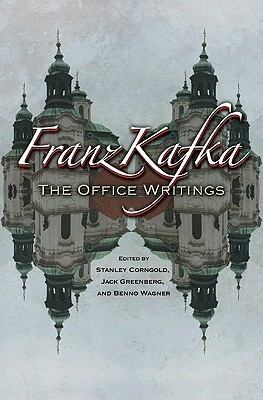
Franz The Office Writings brings together, for the first time in English, Kafka's most interesting professional writings, composed during his years as a high-ranking lawyer with the largest Workmen's Accident Insurance Institute in the Czech Lands of the Austro-Hungarian Empire. Franz Kafka (1883-1924) is commonly recognized as the greatest German prose writer of the twentieth century. It is less well known that he had an established legal career. Kafka's briefs reveal him to be a canny bureaucrat, sharp litigator, and innovative thinker on the social, political, and legal issues of his time. His official preoccupations inspired many of the themes and strategies of the novels and stories he wrote at night. These documents include articles on workmen's compensation and workplace safety; appeals for the founding of a psychiatric hospital for shell-shocked veterans; and letters arguing relentlessly for a salary adequate to his merit. In adjudicating disputes, promo
Franz Kafka was a German-speaking writer from Prague whose work became one of the foundations of modern literature, even though he published only a small part of his writing during his lifetime. Born into a middle-class Jewish family in Prague, then part of the Austro-Hungarian Empire, Kafka grew up amid German, Czech, and Jewish cultural influences that shaped his sense of displacement and linguistic precision. His difficult relationship with his authoritarian father left a lasting mark, fostering feelings of guilt, anxiety, and inadequacy that became central themes in his fiction and personal writings. Kafka studied law at the German University in Prague, earning a doctorate in 1906. He chose law for practical reasons rather than personal inclination, a compromise that troubled him throughout his life. After university, he worked for several insurance institutions, most notably the Workers Accident Insurance Institute for the Kingdom of Bohemia. His duties included assessing industrial accidents and drafting legal reports, work he carried out competently and responsibly. Nevertheless, Kafka regarded his professional life as an obstacle to his true vocation, and most of his writing was done at night or during periods of illness and leave. Kafka began publishing short prose pieces in his early adulthood, later collected in volumes such as Contemplation and A Country Doctor. These works attracted little attention at the time but already displayed the hallmarks of his mature style, including precise language, emotional restraint, and the application of calm logic to deeply unsettling situations. His major novels The Trial, The Castle, and Amerika were left unfinished and unpublished during his lifetime. They depict protagonists trapped within opaque systems of authority, facing accusations, rules, or hierarchies that remain unexplained and unreachable. Themes of alienation, guilt, bureaucracy, law, and punishment run throughout Kafka’s work. His characters often respond to absurd or terrifying circumstances with obedience or resignation, reflecting his own conflicted relationship with authority and obligation. Kafka’s prose avoids overt symbolism, yet his narratives function as powerful metaphors through structure, repetition, and tone. Ordinary environments gradually become nightmarish without losing their internal coherence. Kafka’s personal life was marked by emotional conflict, chronic self-doubt, and recurring illness. He formed intense but troubled romantic relationships, including engagements that he repeatedly broke off, fearing that marriage would interfere with his writing. His extensive correspondence and diaries reveal a relentless self-critic, deeply concerned with morality, spirituality, and the demands of artistic integrity. In his later years, Kafka’s health deteriorated due to tuberculosis, forcing him to withdraw from work and spend long periods in sanatoriums. Despite his illness, he continued writing when possible. He died young, leaving behind a large body of unpublished manuscripts. Before his death, he instructed his close friend Max Brod to destroy all of his remaining work. Brod ignored this request and instead edited and published Kafka’s novels, stories, and diaries, ensuring his posthumous reputation. The publication of Kafka’s work after his death established him as one of the most influential writers of the twentieth century. The term Kafkaesque entered common usage to describe situations marked by oppressive bureaucracy, absurd logic, and existential anxiety. His writing has been interpreted through existential, religious, psychological, and political perspectives, though Kafka himself resisted definitive meanings. His enduring power lies in his ability to articulate modern anxiety with clarity and restraint.
i don't think there's ever been a book so perfectly suited to my particular aesthetic: literature + jargon. The introductions are deeply informative, and Kafka's writing is crisp and dense and fundamentally tied to actual circumstances. the combination is riveting, and also amazing. the issue of how legal language determines the facts of life is dramatized and underscored to such an extent that you can even see a 'chicken and the egg' scenario develop, confusing the intricacies of law and language as a prioris before the lives they are supposed to account for. technical language, whoever the author, has always held poetic evocations for me, so it's no surprise that kafka's language shows how rich this kind of writing can be.
The allure of office memos written by Kafka? I don't know. I think it would be no small comedy to read his requests for a bigger paycheck - also, each and every word would thrum with sweaty-palmed paranoia. Mostly undeserved.
But this is it for the truly hardcore Kafka scholars - unless you find some Post-It notes or laundry lists, Kafka's every written word is out there, you...you vultures.
From Franz Kafka: Bitchy Notes Tacked to the Refrigerator
To Whom It May Concern: You left the coffee pot on over night. The pot is scorched and the coffee itself is an unfriendly hybrid of roadtar and ipecac. I poured the goop down the sink, slowly, but when I saw my reflection in the slow black liquid, I was filled with a deep remorse. Where Hercules triumphs, mankind struggles. Where Hercules struggles, we fail. But when Hercules dies, we shall become immortal. The gods' line of succession favors the zero.
Kafka'nın, işçi kaza sigortası kurumunda icra ettiği günlük işinde karşılaştığı insanların, mekanların ve olayların, onun edebi yazılarına nasıl ismiyle müsemma, 'kafkaesk' olarak tanımlanan kavramı kattığına şahit oluyoruz.
Elbette herkes gibi Kafka'nın da mesleğinden pek hoşnut olduğu söylenemez. Edebi tutkusunu engellediğini düşündüğü mesleği; ofis yazıları, kurum içi yazışmaları ve denetleme gezileri esasında büyük edebi metinlerinin temel kaynağı olmuş. Bu ilginç ve hoş bir nüans.
For what it attempts to do, this book is quite good. Whether what the book is attempting to do is worth pursuing in great detail is another matter, but I hope it is and I will see as I go back to reading some more Kafka.
The point to note here is that Kafka had a day job. It was not just any day job however, but a specialized and relatively high level position as what we would today call an actuary for an Institute concerned with the implementation of mandatory workman’s insurance in the pre-WW1 Austrian Empire. This involves formadible legal, economic, statistical, and political skills in situations of great conflict at a time when the Empire and the entire European world appeared to be going to hell. The question is then whether Kafka’s office writings might shed some light on his mysterious and influential fiction writing which has established a distinct and troubling perspective for viewing the bureaucratic soul killing view of modernity that seems as relevant today as when Kafka wrote.
For anyone who has spent time reading, writing, and generally working through bureaucratic memos, legal briefs, or academic papers, it will not be surprising to learning that this book is not an easy read, or even an easy slog. Still, the world of insurance regulation in pre-WW1 Austria seems primed to provide the conflicts, tensions, and paradoxes that have been associated with Kafka. To start with, there is the contrast between the “real world” of particular situations and cases and the regulatory world of categories and statistical likelihoods. Employers and employees work in the real world while regulation and adjudication occurs in the abstract world of bureaucratic regulations and court cases. Then there is the world of politics versus administration. On the one hand, bureaucracies are meant to be “rational” (goal directed in a variety of ways) while at the top one finds battles over conflicting goals and scarce resources - “rational” perhaps in some sense but not obviously to an observer or someone adversely affected. Then you have the various other boxes to which individuals may be assigned to bureaucratic processes - economic (labor or management) or various ethnic and linguistic categories (German, Czech, Slovak, Jewish, Polish). In a polyglot empire, how does one get everyone involved to even speak the same language? One can even sense the inroads of technological change, as mention is provided of new office equipment or new machines like elevators or automobiles (how does one insure those things?). I have not event mentioned that the Empire is going to be subjected to the trauma of WW1 and eventually disintegrate as the war drew to a close.
If this was all that the book provided, it would be a lot of work to come to the conclusion that the organizational world in which Kafka worked and about which he wrote when he went home was quite complex. OK, but this would be hardly surprising. The editors of the collection do a good job in pointing out how Kafkaesque situations arise in these situations because they are highly contested by parties pursuing different objectives and who see the world in very different ways. Some employers do not want to pay their fair share in insurance premia. Complaints and court cases are contested and the parties involved come up with their own stories to support their positions for a common set of “facts” that support a situation. Distorting the world becomes a part of the game in which words become weapons and in which the consequences of losing are catastrophic. Get caught in the middle of such a multi-party contest and none of the stories at issue will necessarily match “the real world” and the person in the middle will be lost and confused and start looking to Kafka for guidance.
This is all well and good, but do any of these documents relate directly to Kafka’s works? My fear was that the linkages would be indirect at best, but the editors were extremely helpful at pointing the reader to various Kafka short stories and to key elements of his larger works (the Castle, the Trial, America). This is very helpful for following up. That is what I hope to do now - start the third volume of the Stach biography and look harder at The Trial and Amerika.