Time travel is such a familiar fictive concept nowadays that it’s easy to forget how new the idea of a time machine was in 1895, when the then 29-year-old H.G. Wells wrote a short novel titled The Time Machine. And 125 years later, this concise little masterpiece of science fiction has lost none of its power; if anything, it seems more and more prophetic as we all continue forward through the 4th dimension.
The Time Machine is, at its heart, a framed tale. It begins with a conversation among a group of well-educated gentlemen of Victorian England, at the elegant Richmond home of a scientist and inventor who is known simply as “the Time Traveller.” Most of his friends, in a somewhat clumsy characterological development, are likewise referred to in terms of their occupations – “the Editor,” “the Journalist,” “the Medical Man,” “the Provincial Mayor,” “the Psychologist.” At one otherwise ordinary Thursday gathering, the Time Traveller (hereafter T.T.) announces that he has invented a machine that can travel through time; and the following Thursday, a noticeably disheveled and much-the-worse-for-wear T.T. shares with the assembled company, through an extended flashback, the story of his journey through time.
T.T. makes his journeys not back to ancient Egypt or Greece or Rome, or forward to some comprehensible future year like 1984 or 2001, but rather all the way forward to the year 802,701 A.D.! This daring move gives Wells total creative freedom to set forth the far future exactly as he likes; after all, none of us will be around to point fingers and complain that Wells got this or that detail wrong regarding life 800,000 years from now.
And given all that fictive room for free play, Wells makes the most of the opportunity to exercise his extraordinary imagination. Wells may be poking good-natured fun at his own affinity for socialism - or at the average 19th-century Englishman's impressions of socialism - when he records T.T.’s initial response to the world at which he has arrived: “Here and there among the greenery were palace-like buildings, but the house and the cottage, which form such characteristic features of our own English landscape, had disappeared. ‘Communism,’ I said to myself” (p. 29). Well – no, T.T. What’s happening in the year 802,701 A.D., in what was once England, is not communism; it’s something different, and much worse.
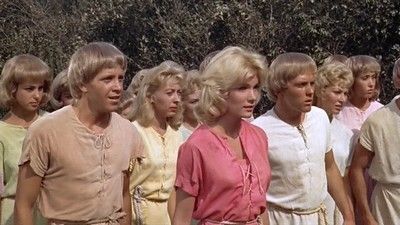
At first, T.T. feels as if he has emerged into an earthly paradise. The beings he meets are recognizably human, albeit of smaller size, and they seem to live a life of ease in which they eat delicious fruits, play together all the day long, and never have to work or worry. The Eloi – for T.T. learns that that is their name – are singularly lacking in curiosity, but they are just as singularly benign, and T.T. soon comes to believe that this is the stage to which humanity has evolved in 800,000 years. When T.T. rescues a drowning Eloi girl named Weena, and she thanks him, child-like, with a garland of flowers, he begins to feel a sort of fatherly affection toward her.
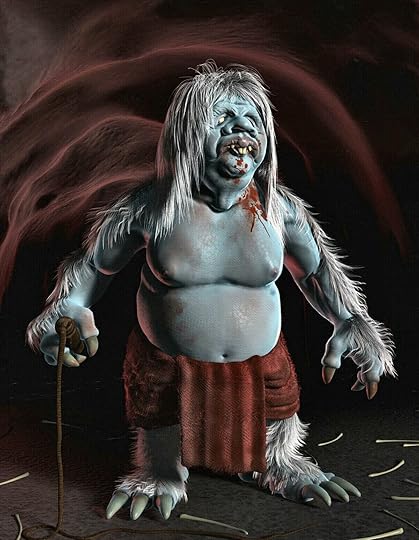
But the Eloi are not the only people in town. T.T. finds that his Time Machine has been removed from where he left it! And in a darkened gallery of a long-ruined building, T.T. encounters a creature that is “dull white, and had strange large greyish-red eyes”, along with “flaxen hair on its head and down its back” (p. 45). This moment represents T.T.’s first encounter with the Morlocks, the other of the two species into which humankind has divided itself over the eons.
The Morlocks live underground, and work great machines in their network of caverns beneath the surface of the earth. At first, T.T. thinks that the Morlocks work for the Eloi; after all, the industrial labourers of his own time do their work hidden from the sun, in settings like factories and coal mines, producing wealth that goes to an aristocracy up on the surface. Yet it turns out that the relationship between the Eloi and the Morlocks is actually quite different.
Situational irony of a particularly grim kind abounds; T.T., reconnoitering the Morlocks’ underground lair, notices “a faint halitus of freshly shed blood” and a “red joint” of meat on a table laid for dinner. The reader senses the significance of these clues long before T.T. does – and a potent metaphor emerges for a 19th-century British society that Wells sees devouring itself through its class divisions.
Wells’s pessimism regarding the prospects for human progress comes through clearly in the passages shortly before T.T.’s return to 1895 – when, as T.T. sits in a golden chair atop a high hill, he engages in bitter recollections: “I grieved to think how brief the dream of the human intellect had been. It had committed suicide” (p. 78). It is against the backdrop of such somber reflections that T.T. makes one last descent into the Morlock abyss in search of his time machine – and then hurtles even further forward into time! You think that traveling to 802,701 A.D. sounds extreme? Try traveling to 30,000,000 A.D., and see where that takes you!
This edition of The Time Machine benefits from the inclusion of Wells’s 1931 preface to a reprint of the novel. While tending to be rather dismissive of The Time Machine as a juvenile effort on the part of a very young writer, Wells nonetheless sounds like a thoroughly contemporary theoretical physicist when he sets forth “the idea that Time is a fourth dimension and that the normal present is a three-dimensional section of a four-dimensional universe” (p. 94).
As mentioned at the beginning of this review, time-travel narratives have become a familiar thing in our, well, time. We are all used to how Terminator movies, Back to the Future movies – even Santa Clause movies – explore the potential paradoxes of time travel. But no one engaged the possibilities of time travel earlier, or better, than H.G. Wells. The Time Machine travels through time by surviving the test of time.