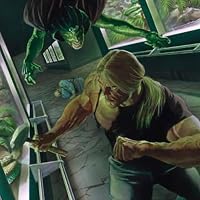
Collects Marvel Premiere (1972) #9-14 & Doctor Strange (1974) #1-9.
Entering the good Doctor Strange's world like a bolt from above, Steve Englehart and Frank Brunner teamed up to take the Master of the Mystic Arts to new heights of cosmic consciousness and other-dimensional adventure-and now you can experience it all in one amazing MARVEL MASTERWORKS edition! From the conclusion of the Shuma-Gorath saga and death of the Ancient One, to Stephen Strange's assumption of the mantle Sorcerer Supreme; from the time-lost "Sise-Neg Genesis" with Baron Mordo, to the classic Silver Dagger epic-these are Marvel comics at their very best! Brunner's art mixes a deliriously lush line with psychedelic stylings, while Englehart's scripting plumbs the depths of Strange's soul to create a strikingly personal epic that's just as challenging today as the first day it hit the racks. All this and a massive Dormammu/Umar attack on Earth!
Steve Englehart went to Wesleyan University in Middletown, Connecticut. After a stint in the Army, he moved to New York and began to write for Marvel Comics. That led to long runs on Captain America, The Hulk, The Avengers, Dr. Strange, and a dozen other titles. Midway through that period he moved to California (where he remains), and met and married his wife Terry.
He was finally hired away from Marvel by DC Comics, to be their lead writer and revamp their core characters (Superman, Batman, Wonder Woman, Flash, and Green Lantern). He did, but he also wrote a solo Batman series (immediately dubbed the "definitive" version) that later became Warner Brothers' first Batman film (the good one).
After that he left comics for a time, traveled in Europe for a year, wrote a novel (The Point Man™), and came back to design video games for Atari (E.T., Garfield). But he still liked comics, so he created Coyote™, which within its first year was rated one of America's ten best series. Other projects he owned (Scorpio Rose™, The Djinn™) were mixed with company series (Green Lantern [with Joe Staton], Silver Surfer, Fantastic Four). Meanwhile, he continued his game design for Activision, Electronic Arts, Sega, and Brøderbund.
And once he and Terry had their two sons, Alex and Eric, he naturally told them stories. Rustle's Christmas Adventure was first devised for them. He went on to add a run of mid-grade books to his bibliography, including the DNAgers™ adventure series, and Countdown to Flight, a biography of the Wright brothers selected by NASA as the basis for their school curriculum on the invention of the airplane.
In 1992 Steve was asked to co-create a comics pantheon called the Ultraverse. One of his contributions, The Night Man, became not only a successful comics series, but also a television show. That led to more Hollywood work, including animated series such as Street Fighter, GI Joe, and Team Atlantis for Disney.
This volume of Dr. Strange has consistently great art throughout. There are artist changes but nobody lets the side down. If I was rating this purely on the artwork it would be a solid 4 stars.
The stories, though, aren’t as great. They’re fine, really, but as is often the case with Dr. Strange stories, particularly from this era, there’s no real human element grounding the stories or making the threats palpable. 3 stars.
Overall, this is a 3.5 star read but I’m rounding down due to the inclusion of not one but two reprint issues in this run. I can only imagine how annoying it must have been to buy a ‘new’ issue of Dr. Strange only to get it home and find that all but two pages of framing material of it was just a reprint of an issue you already owned. I’m glad Marvel doesn’t pull that crap anymore.
In my review of this series' previous volume, I lamented how die-hard collectors sometimes suffer through the low points of a character’s history. I’m happy to report that this volume in turn shows how quickly quality can turn around and faithful fans can be rewarded. The stories collected herein (originally published in 1973-1975) are still highly regarded and represent a milestone for Dr. Strange fans.
Steve Englehart scripts all the stories (although Mike Friedrich is credited as a “co-writer” of one), collaborating with artists Frank Brunner and Gene Colan. Englehart and Brunner provide modern-day introductions, in which both assert that the two were true collaborators, with Brunner assisting Englehart on the plots. Englehart states that his relationship with Gene Colan, who drew the last four issues presented in this volume, was different, as Englehart became the series’ sole plotter once Brunner departed. Frankly, you can see the difference in the stories themselves. The Englehart/Brunner stories are deeper and weightier, tackling lofty themes such as the nature of God and the nature of death…and tackling them well, for that matter. This is definitely not your typical 1970s super hero series, and reading it now, I wonder how contemporary fans reacted. Some, particularly younger and more traditional ones, may have been turned off by the relatively (well…compared to say, AMAZING SPIDER-MAN and the like) more sophisticated fare, but older and more discerning readers might well have been blown away. While reading it, I thought of Neil Gaiman’s late 1980s-mid 1990s SANDMAN series, which also seemed classier than many of the books surrounding it on the stands. That’s not to say that the two series are alike, mind you, but they’re similar in how they stood out, if that makes any sense.
You might legitimately wonder, then, if the Englehart/Colan material is inferior to what came before it. It’s not – at least not to me, although I can see where might feel that way. Personally, I like Colan’s art better than Brunner’s, as he brings a more distinct and atmospheric style. The four Englehart/Colan issues presented here constitute one story, in which Dr. Strange and his girlfriend/discipline Clea face off against Dormammu and Dormammu's evil sister Umar. Although that particular tale might be less philosophical/intellectual than the ones preceding it, it’s still a rollicking good Dr. Strange yarn - one that contains some fun twists and adds greatly to the character’s mythos.
In fact, “big things” happen throughout the volume. Although the stories themselves are over forty years old, they’re new to you if you haven’t read them, and thus, I will avoid spoilers. Suffice it to say that events are important to the main character’s history, and if you’re only familiar with more recent Dr. Strange tales, then you might find yourself occasionally thinking, “Oh…so THAT’S how/when that occurred!” At the time, these were arguably the best Dr. Strange stories since Ditko left the series in 1966, and they would still rank high on an “all-time best” list. Needless to say, I highly recommend the volume.
Steve Englehart’s Doctor Strange run - particularly the issues with Frank Brunner on art - is a major breakthrough for the character. It’s the first time Strange is in the hands of creators who take the occult seriously and also (you strongly suspect) the first time his writers know their way around a psychedelic experience.
This definitely gives the run a unique, incense-heavy, head shop aroma. Stan The Man bombast hasn’t entirely departed but it’s mostly been replaced by smoky 2am ramblings about the nature of magic, creation, death… heavy shit, basically, and the plots have the ambition to match. Strange goes on a wild trip back in time across the history of magic; Strange takes a psychedelic journey into unreality before fighting death itself; Strange must free Mother Earth from her torments; and so on. This is big picture stuff, refreshingly different from the monster of the month rut the comic had been stuck in. Yes, Dormammu and Umar rock up again in the last and weakest story here but even that does some needed work in giving Clea - who’s been around for a decade at this point! - the most basic rudiments of an actual character.
When the ideas click, you get something entirely different from most of 70s Marvel that succeeds on its own vaguely counter-cultural terms. The best example is the time travel story, which is set up as Strange and Baron Mordo racing to stop (or steal from) a new character with designs on becoming God but rapidly goes to wilder places as the character succeeds, gains the power to reboot the universe but also the wisdom to put it all back how it was. Brunner gives the whole thing the loose, fluid quality of a dream and the narration rises to the art’s trippiness.
Much of the time though it doesn’t cohere as well as that. Part of the problem is how influential this run was on comics ranging from Starlin’s Warlock to Moore’s Swamp Thing which were, well, better. Part of the problem is its influence on comics that were worse - if Englehart was the first comics writer to send a superhero inside his own magical/powerful artefact then well done, because it’s still being ripped off in the 2020s. But that doesn’t make me groan less when Strange lands in an Alice In Wonderland riff and chats to a talking caterpillar.
It’s also true that while putting real heads in charge of Strange is a better idea than putting Roy Thomas in charge of him, the genius visual iconography of the guy still comes from the squarest man in comics history. Ditko’s vision is something of a curse on Strange - imitate it and it looks dumb, strip it away and Doctor Strange looks like a generic 70s horror book with a Marvel Super Hero in the middle of it. And a particularly pompous one at that - Strange’s own personality, at this stage, is in bad need of attention.
This is the first time since the Ditko/Lee run where I've felt like I was getting exactly what I wanted. Stteve Englehart and Frank Brunner carefully capture what made Doctor Strange so great in the first place while also feeling like a more fresh take that has had time to evolve and mature. Englehart's prose is poetic, certain times it felt like he was really channeling Stan Lee with some of Strange's incantations, and the general idea of Doctor Strange tackling this mixed reality between life and death felt as grand and epic as the original journey into Eternity's realm that Ditko/Lee did. Brunner's art is mind-boggling at times with incredible layouts and detail. Though Gene Colan takes over pencils in the last few issues, it's not like there's a sudden drop in quality. Colan was one of the best artists between Ditko and Brunner, and in returning to the title has has some incredible moments with the Dark Dimension that make it come to life as more than some evil reality but a lived-in world in and of itself.
Popping open the first issue of this book makes me remember why I love superhero comics in the first place, with so many big ideas and beautiful moments. It's jaw-dropping and well worth the read.
I found the issues in this collection really frustrating, because as I've read through the original Doctor Strange comics, all I wanted was for more issues that focused on Clea. And now these issues start to, revealing her parentage and giving her moments of action that really move the plot, which is great. But they also continue to paint her as much weaker and inexperienced than Dr. Strange, even though it was previously established that she grew up with magic, and it came extremely naturally to her. It just feel like they keep giving Clea moments in the spotlight, only to turn around and remind the reader that she is, and always will be, inferior to Doctor Strange. I recognize I need to take the 70s for what they were, and there were moments I loved in these comics, but it's just really draining.
Although the Steve Englehart stories of this era were decent, they were also a little ‘out there’. He admitted to use of various substances during this writing era and it shows. Doctor Strange was probably the best book for him. The real pleasure in this collection comes from the fantastic art of both Frank Brunner and Gene Colan. Brunner could have been a superstar, but left the field very early, this being amongst his best known and still loved work. Gene Colan, by contrast, had a career spanning decades, and his style was tailor made for Doc. This collection is a nice snapshot of a great era in Doctor Strange’s history.
This is a lot of wild fun, as Steve Englehart really got into the idea of magic, and, with the aid of a Frank Brunner and Gene Colan, did his damndest to get cosmic in the stories. This collection culminates in a story that brings back Dormammu and Umar, reveals Clea's origins, and does some fun things with the Marvel Universe pantheon of godly creatures, as well as improving the relationship between Strange and Clea.
The art is incredible, visually its impressive and creative. However the actual dialog and storylines are bit of a slog to get through. There's not much to ground the characters in any emotional or physical sense.
I do think that with more modern or eloquent writing the concepts and ideas in this volume could2 be incredible and compelling
This entire review has been hidden because of spoilers.
More bizarre adventures in strange dimensions with Dr. Strange. Steve Englehart gives us fun stories, and Frank Brunner wild artwork. But, for me, it's the return of Gene Colan on the art chores that makes this volume special. And the return of Dormammu certainly doesn't hurt! Enjoyable reading.
Fun stuff. Englehart's got a good knack and his own vision for Dr. Strange. Brunner's art is exceptional, a one of the kind run. The final stories by Gene Colan are as good as you'd hope except that none of the ohters equal the one Colan issue inked by Palmer.