Jump to ratings and reviews
Rate this book

Παράξενες ιστορίες από το κινέζικο σπουδαστήριο

Rate this book
Στην έκδοση παρουσιάζονται δώδεκα ιστορίες από τις σχεδόν πεντακόσιες που συνέλεξε και έγραψε ο Κινέζος λόγιος τον 17ο αιώνα, οι οποίες αποτελούν απόσταγμα της μακράς κινεζικής παράδοσης στο υπερφυσικό και στη λογοτεχνία του φανταστικού. Σήμερα το έργο του Που Σονγκλίνγκ χαρακτηρίζεται ως αριστούργημα της παγκόσμιας κληρονομιάς, τόσο για το περιεχόμενο των ιστοριών όσο και για τη ζωντάνια της λιτής γραφής του, τις ανατροπές στην πλοκή, τον έξυπνο λόγο, το χιούμορ, το σασπένς και τη μαγεία που καταφέρνει να μεταδώσει, καθώς και για τα στοιχεία του κινεζικού πολιτισμού που διατρέχουν τις σελίδες του.

144 pages

First published January 1, 1740

873 people are currently reading
8642 people want to read

About the author

Pu Songling

432 books90 followers
Pu Songling (simplified Chinese: 蒲松龄; traditional Chinese: 蒲松齡; pinyin: Pú Sōnglíng; Wade–Giles: P'u Sung-ling, June 5, 1640—February 25, 1715) was a Qing Dynasty Chinese writer, best known as the author of Strange Stories from a Chinese Studio.

Pu was born into a poor landlord-merchant family from Zichuan (淄川, now Zibo, Shandong). At the age of nineteen, he received the gongsheng degree in the civil service examination, but it was not until he was seventy-one that he received the xiucai degree.

He spent most of his life working as a private tutor, and collecting the stories that were later published in Strange Stories from a Chinese Studio. Some critics attribute the Vernacular Chinese novel Xingshi Yinyuan Zhuan to him.

Ratings & Reviews

What do you think?
Rate this book

Friends & Following

Create a free account to discover what your friends think of this book!

Community Reviews

5 stars
953 (37%)
4 stars
908 (36%)
3 stars
519 (20%)
2 stars
103 (4%)
1 star
30 (1%)
Displaying 1 - 30 of 281 reviews
Profile Image for Tim.
491 reviews837 followers
April 13, 2022
"Read these tales properly, and they will make you strong and brave; read them in the wrong way, and they will possess you."
- Feng Zhenluan
Early nineteenth century commentator on the Strange Tales

I honestly don’t know how to begin with reviewing a book like this. Normally with short story collections, I try to do a short review for each tale, but with 104 stories, I’m not going that route this time. Perhaps we’ll go with a little historic background?

These tales were written by Pu Songling sometime in the Qing dynasty (from what I can gather, he probably completed the tales by 1679, but could have been adding extra stories up until the early 1700s) and published by his grandson in 1740. The stories range from silly real life problems from the upper classes, to stories dealing with monsters, ghosts and fox spirits. Throughout this collection there is obvious social criticisms; sometimes these are outright preached as a moral at the end, more often they are more subtle or presented as a joke (Ha! Those silly merchants and their greed, that priest sure showed them, eh?). The only major theme tying all the stories together is that they are indeed strange. Sometimes the strangeness comes from the supernatural side, or it can just be the peculiar habits people pick up, but every single tale serves as an oddity that shows human nature in often surprisingly witty fashions.

If I was to do a one word review, the closest word to capturing the feeling of these tales would be sublime. In this collection you will find stories about fox spirits, ghosts, demons and priests. You will find longer tales of the supernatural and short almost slice of life moments of comedy. There is horror, humor and wonder all in about equal measure and it is stunning.

While I do not know if it is the translation or the style it was written in, but the book is very readable. The stories flow well, and never feel their age other than in some of the opinions he expresses which are very much a part of his time. Some American and European readers may be shocked by the amount of sexuality in this book considering its age, but remember, this is 1600/1700 China, with stories often taking place much earlier, not your usual proper English subject matter of the time. Though as a fun historic note, in the introduction to the Penguin edition I read, the translator discusses earlier translations where they tried to hide the more erotic content, with some examples being a fox spirits coming into bed chambers at night and "drinking tea" or "playing Go" instead.

I can’t say that every story in the collection is perfect. Some are duds, but the good far outweighs the bad, and as a look at history its rather fascinating on that ground alone. Well deserving of a full 5 stars and my highest praise.
Profile Image for Paul Haspel.
726 reviews217 followers
April 9, 2025
The strange thing, for me, about these classic Chinese tales of the weird and the supernatural is how familiar they feel. All people in all cultures round the world wonder about the connections between life and death, about a world beyond our own; and in his book Strange Tales from a Chinese Studio, the 17th-century Chinese writer brings together the familiar and the bizarre in a manner that the modern Western reader is likely to find uniquely compelling.

Pu Songling came from the northern Chinese province of Shandong, and lived from 1640 to 1715 – or, to put it another way, at about the same time that Louis XIV was king of France. He never rose as high as he might have liked in the imperial bureaucracy – evidently, he had trouble passing the exams that were a prerequisite for anyone who wanted to move up in the hierarchy – but he was a diligent collector of tales of the weird and uncanny, and his collection is written in a manner that causes it to be considered one of the finest examples of modern writing in classical as opposed to vernacular Chinese.

Part of the interest of Strange Tales from a Chinese Studio inheres in the way the tales provide insight into the 17th-century Chinese culture of the Qing dynasty. As translator John Minford of the Australian National University explains in a series of detailed and helpful essays and footnotes, this time in Chinese history was characterized by three religious traditions – Confucianism, Taoism, and Buddhism – that influenced, and sometimes clashed with, one another.

Tale #25, “Past Lives,” seems quite Buddhist in the way it emphasizes karmic concepts of how one’s conduct in one’s life dictates the next life that one is born into. This tale describes how one Mr. Liu, a scholar-gentleman who had lived “a somewhat dissolute life” (p. 98), is brought before the King of Hell who determines what a deceased person’s next life should be. Mr. Liu is given the Soup of Oblivion that, like the waters of Lethe in Greek mythology, blots out a person’s memory of their past life, but Mr. Liu pours it out while only pretending to drink it. Therefore, for his two next lives, as a horse and a dog, he goes through the painful and unpleasant experience of having human awareness while living as an animal! Here, I thought of the unhappy situation of the hunter Actaeon from Ovid’s Metamorphoses; transformed into a stag by the goddess Diana, Actaeon experiences, with his human consciousness, the horrors of being chased down and torn to pieces by his own hounds!

Having not properly used his reincarnations as horse or dog to expiate the misdeeds of his human life, Mr. Liu is punished further by the King of Hell, and is then reincarnated as a snake. By the time of this third reincarnation, Mr. Liu has learned his lessons, and knows what he needs to do before he can hope to move forward rather than backward in karmic terms:

He took an oath not to harm a living thing, and to assuage his hunger with a diet of nothing but plants and fruits. A year went by, and many a time he thought of taking his own life, but knew he could not. Nor could he deliberately harm someone else in order to get himself killed. He had already suffered the consequences of these two stratagems. He spent his days longing for a good way to die, but nothing presented itself. (p. 101)

How does the repentant Mr. Liu resolve his karmic dilemma? You’ll have to read the story to find out.

In contrast with the Buddhist emphasis of “Past Lives,” Tale #71, “The Stone Bowl,” has more of a Taoist focus. This story shows how Yin Tu’Nan, a gentleman of Wuchang, befriends a young scholar, Yu, to whom he rents a villa. When Yu, who has demonstrated some mystical abilities of his own, departs, he leaves behind a white stone bowl, and Yin takes it home to keep goldfish in.

A year later, he was surprised to see that the water in the bowl was still as clear as it had been on the very first day. Then, one day, a servant was moving a rock and accidentally broke a piece out of the rim of the bowl. But somehow, despite the break, the water stayed intact within the bowl, and when Yin examined it, it seemed to all intents and purposes whole. He passed his hand along the edge of the break, which felt strangely soft. When he put his hand inside the bowl, water came trickling out along the crack, but when he withdrew his hand, water filled the bowl as before. (p. 308)

The bowl breaks at the next winter solstice, and it is left to a visiting Taoist adept to explain to Yin the reasons for the mysterious powers that the bowl once held. The Taoist explains that “This…was once a water vessel from the Dragon King’s Underwater Palace,” and that “the spirit of the bowl” gave the bowl its mysterious powers. The Taoist asks Yin for a piece of the bowl, explaining that “By pounding such a fragment into a powder…I can make a drug that will give everlasting life” (p. 310). Yin gives the Taoist the requested fragment, and doesn’t even request any of the everlasting-life drug for himself!

The spirit of Taoism also influences Tale #96, “Waiting Room for Death.” In this story, “A gentleman named Li of Shang River County” who is “a devotee of the Tao” has built a small hermitage where Buddhist and Taoist monks will sometimes stop to talk with Li, and to pray. When one old monk, whose philosophical insights have particularly impressed Li, is preparing to leave after a visit of a few days, Li goes to visit, and finds that “The old monk was packing his bag. He had a skinny ass with him in the room, tethered to the lampstand. On closer inspection, it was not a real beast but one of the effigies buried with the dead. Its ears and its tail twitched from time to time, however, and it was quite visibly breathing” (p. 405). This tale, like so many of the others, blurs the lines between the living and the dead, the organic and the inorganic.

Li never gets to make a proper farewell to his monkish friend, but the experience of meeting him seems to have been an important milestone along his spiritual path. Pu Songling concludes this story by writing that a friend of Li’s “had once visited his little hermitage and seen a horizontal scroll hanging in the entrance hall, inscribed: Waiting Room for Death. The wording testified to the unusually deep nature of the man” (p. 407).

I like how, throughout Strange Tales from a Chinese Studio, the bizarre and uncanny is treated as part of normal life. There are no expressions of hyperbolic horror, the way one might see in a Western narrative; rather, the feeling is somewhat like what one experiences in magical-realist literature from Latin America: strange things just happen in the course of an ordinary day.

Tale #49, “The Little Mandarin,” chronicles the experiences of a Hanlin academician, who is dozing in his study when suddenly he sees “a little procession filing through the room. There were horses the size of frogs, men less than finger-high, a retinue of several dozen insignia-bearers, and then a mandarin in a palanquin…who was carried out through the doorway with great pomp.” A member of the mandarin’s retinue speaks briefly with the academician and then leaves, “And the shame of it was that the Academician had been too timid to ask him who they all were” (p. 200). That lack of closure, of a final and conclusive explanation for the appearance of mysterious phenomena, is also quite characteristic of these tales.

If you read this Penguin Classics edition of Strange Tales from a Chinese Studio, then I would strongly encourage you to read the supplementary and explanatory notes that translator Minford includes after the tales. In the notes for Tale #5 (“Talking Pupils”), for instance, Minford notes that this tale is the first one where, in its conclusion, Pu Songling provides concluding commentary, giving himself “the mock-grandiose title ‘Chronicler of the Strange’”, in a manner that “alludes to, and gently spoofs…the great Chinese historian Sima Qian (c. 145 - c. 85 B.C.)”, who was fond of “calling himself the Grand Chronicler or Historian” (p. 502). I appreciated the opportunity to learn more, through Minford’s notes, about the rich cultural and historical background out of which these tales came.

Some of the tales are shocking. Many are humorous. Quite a few are romantic, even erotic. Truly, Pu Songling’s Strange Tales from a Chinese Studio provides for a compelling journey into odd and surprising new worlds.
Profile Image for Rowena.
501 reviews2,771 followers
February 9, 2014
The title, and the fact that this is a Penguin classic, attracted me. I really, really enjoyed this read. The stories were quite short, some only a paragraph in length, and the longest ones being perhaps 4-5 pages. And they were strange indeed, strange is definitely an understatement. They were very candid tales, especially considering they were written almost 400 years ago. Many stories were of a sexual nature which also surprised me because of when the stories were written. A couple of stories were distressing, I must admit.
I’m fascinated by the idea of Chinese ghosts; they actually bleed if injured. And the idea of fox spirits that take on human form and act like succubi.

Profile Image for Alwynne.
940 reviews1,595 followers
January 20, 2021
A selection of pieces from a classic of Chinese literature dating from the 1600s. These are early examples of a literary tradition of accounts of the weird (zhiguai) and the strange (chuanqi), which Pu Songling famously combined in his writing. So here are weird tales of hauntings as in “The Golden Goblet,” mythical creatures such as trolls and the more familiar fox spirits; and strange, often grim and grisly, stories like the fornicating dog subjected to cruel punishment for his affair with a human, the woman who accidentally serves her husband’s dildo to their dinner guests, or graphic accounts of dealing with syphilitic, suppurating sores. Although there are some more charming images of dancing mice, or the bonds between friends. The subject-matter also reflects the author’s stalled career as a civil servant in the way he pokes fun at corrupt officials and unnecessary bureaucracy. The style, at least in translation, is mostly deadpan and fable-like, the narratives are predominantly brief, bringing to mind modern micro or flash fiction. I’m not sure how to sum these up, the closest comparison I could make is probably wildly inappropriate but if anything, they reminded me of aspects of Chaucer's Canterbury Tales or The Decameron., At the same time they’re vastly different from these and not just because of their cultural underpinnings: there’s an air of detachment and dislocation in Pu Songling’s work; there are no overall framing devices or other signposts that suggest ways of navigating the material as a reader, the only unifying elements are the repetition of themes or scenarios.

I’m not sure how much I actually liked these as found them incredibly intriguing, I enjoyed that sense of the unknown as I turned each page totally unable to predict what the next one would contain. The edition I have is from Penguin, John Minford’s translation is smooth and there’s a host of invaluable supporting and contextual material including extensive background notes. This version also features a smattering of striking lithographs from a nineteenth-century Chinese printing. John Minford’s overview highlighted the influence of Pu Songling’s work on existing subgenres dealing with the bizarre and the supernatural, so for me an additional attraction was a chance to develop my understanding of relationships between classical Chinese literature and modern-day writers.
Profile Image for Anh.
363 reviews195 followers
November 1, 2016
thất vọng bàng hoàng đến câm nín luôn :|
review mai bình tĩnh lại sẽ viết vậy :(
------
Nhớ lại cách đây hơn 7 năm, tui từng mê mẩn với loạt phim Liêu trai chí dị chiếu trên tivi lúc 12h trưa, tui dán mắt vô tv mòn mỏi ngày ngày qua ngày khác, coi đi coi lại, coi mê mẩn một phần vì dàn diễn viên đẹp lộng lẫy từ chính tới phụ, từ nam tới nữ...Tui đâm nhập tâm mấy câu chuyện về hồ li, tình yêu giữa người và tiên, hồ li, ma...Với tui lúc đó các tập phim không chỉ thu hút nhờ cốt truyện li kì lôi cuốn mà còn nhờ vào tính nhân văn sâu sắc về cách đối nhân xử thế, tình yêu thương và các thể loại phép thuật, quả báo... -> tui nói dài dòng vậy để biết là đối với tui, bản điện ảnh của Liêu trai chí dị rất rất tuyệt vời :)

Xong hồi đó tui biết phim được dựng lại từ bộ truyện Liêu trai chí dị của Bồ Tùng Linh, mà hồi đó làm gì có nhiều tiền nên tui nhủ lòng sau này nhất định mua về đọc. Rồi Nhã Nam xuất bản cuốn Liêu Trai chí dị này, khổ lớn, dày cộm, bìa rời cầm siu đã tay, tui đâu có ngu mà ko tậu liền về để đọc, nhủ là phim đã hay vậy truyện chak cũng ko vừa. Tui là người thực tế nha, biết phim làm dựa theo cốt truyện của nguyên tác thôi nên phim sẽ được thêm thắt này nọ, thêm mắm dặm muối các tình tiết để gây hấp dẫn và kéo dài mạch phim. Nhưng tui nghĩ cốt truyện thì vẫn được giữ, linh hồn của phim là được xây dựng nên từ linh hồn của truyện, phim 10 thì truyện tệ lắm cũng đc 7...bla...bla...tâm trạng tui khi chuẩn bị đọc cuốn này háo hức vô cùng luôn...

Ấy vậy mà tui bé cái lầm, tui thật là ngây thơ mà...
Mẹ ôi, đọc xong chừng 3, 4 truyện đầu (cũng có truyện đã được dựng thành phim đó chứ). Tâm trạng tui xẹp như cái bong bóng xì luôn :( Tui không biết do cách dịch của Đào Trinh Nhất hay bởi lí do nào khác, mà tui thấy bản dịch không được trau chuốt, có nhiều chỗ cứ gượng gạo và "trần trụi" sao sao á :| Nhưng bản dịch là vấn đề con kiến thôi, nội dung mới là con voi >.<

Xong tui ráng, tui nghĩ mới mấy truyện đầu thôi, chắc tui chưa thấm nhuần được hết ý nghĩa khéo léo ẩn giấu sau từng câu truyện, chưa quen với bản dịch này. Tui ráng tới câu chuyện thứ 15 bắt đầu tui đuối đuối. Bây giờ nói tới cốt truyện. Thi thoảng lắm mới có một câu chuyện có ý nghĩa nhân văn thật sự. Còn lại 95% là các tình tiết kiểu như chỉ mới gặp nhau có mấy phút đã lôi nhau lên giường giao hoan các kiểu (mặc kệ nó là hồ li, là ma, là họ hàng hang hốc xa xôi các kiểu, miễn nó đẹp và dễ dãi là anh quất tất >''< ) làm tui tự hỏi hong lẽ đờn ông hồi xưa ấy gặp con gái nhà người ta là trong đầu chỉ xuất hiện mỗi mục đích là thịt người ta?! Một số chuyện tui thấy tình tiết rất kiên cưỡng, đơn giản đến dễ dãi trong cốt truyện.

Cũng may có một vài câu chuyện có năng lực cứu vớt toàn bộ tác phẩm. Như "Mũi dao Kinh Kha", "Thanh Mai", "Thục Phán", "Vợ dữ hơn cọp", "Báo ứng trước mắt", "Phiên chợ giữa biển". Các câu chuyện này mang một vài ý nghĩa nhân văn nhất định về cách đối nhân xử thế giữa người với người, tình nghĩa vợ chồng con cái son sắt gắn bó, sự hi sinh vì người khác và lời răn đe con người về các quả báo nhẵn tiền. "Ác giả ác báo".
Còn lại các câu chuyện khác làm tui thất vọng toàn tập và khó mà nuốt nổi vì nội dung nhạt nhẽo, gượng ép, sáo rỗng như "Liên Hương", "Bạch Thu Luyện", "Cởi truồng rượt ma", "Một nhà đĩ chồn", "Cô Tân thứ mười bốn", "Hoa Cô Tử", "Liên Tỏa"...ôi thôi kể quài ko hết.

Nói chung là có thể Liêu trai chí dị ko có tệ như tui nói nãy giờ, vì dù sao đi nữa nó vẫn là một kiệt tác của Trung Hoa như phần giới thiệu sau bìa sách: Nhiều người bảo là Liêu Trai là truyện thần quái dị đoan, có lẽ chỉ nghe nói mà chưa đọc qua bao giờ. Hay là có đọc nhưng không ngẫm nghĩ nhận xét...Liêu trai hay cả truyện lẫn văn, không lạ gì nó được truyền tụng xưa nay, coi như một bộ đoản thiên tiểu thuyết đặc sắc nhất của Trung Quốc.
Chẳng riêng ở Á Đông, nhiều nước Âu Mỹ đã có bản dịch từ lâu. Một nhà phê bình không ngần ngại viết rằng:"nhiều chuyện trong Liêu trai có giá trị làm bài học tu thân xử thế, há phải là loại đọc tiêu khiển cho người hiếu kỳ mà thôi.


Nhưng mà với tui, có lẽ sự vỡ mộng đã phóng đại nỗi thất vọng của tui lên tới cực đại luôn. Tui ráng hết 9.5 phần công lực mới đọc hết được cuốn này. Đọc xong thấy hối tiếc vì đã mua và tui bik tui sẽ ko đọc lại cuốn này lần thứ 2 :((( chắc luôn!


Profile Image for Nancy Oakes.
2,018 reviews918 followers
November 26, 2017
According to John Minford (whose translation in the Penguin edition of some of these strange tales is my preferred translation of this book: Strange Tales from a Chinese Studio), what readers are about to experience here are

"longer stories with complex plots, often involving relationships between men, fox-spirits and ghosts, sometimes interweaving the events of several incarnations. Then there are a large number of medium-length tales dealing with a variety of themes: the foibles of spiritual or alchemical pretension, both Buddhist and Taoist; the workings of illusion and enlightenment; and the ways of human vanity and corruption in general. These are interspersed with brief accounts of strange phenomena (earthquakes, hail-storms, mirages), of unusual skills (rare sorts of kungfu, mediumistic skills -- genuine or otherwise) -- strange performances with animals, obsessions with snakes; descriptions of unusual varieties of bird, fish, turtle and alligator, of magical stones, bags and swords; and tantalizing evocations of the transience of life, of strange tenants and abandoned halls." (xiii-xiv),

a perfect description of what's between the two covers.

I did sort of flit between the Penguin and the Tuttle editions while reading this book -- as grateful as I am to Herbert A. Giles for his outstanding scholarship (and for also giving me a great start in trying to understand classical Chinese well over a decade ago), his version of Strange Tales from a Chinese Studio has much less to offer than Minford's. Minford breathes life into the stories he's translated while Giles' version ends to be a bit on the dry side; there are also some big differences in the translations themselves. I found myself going back to the original Chinese more than once to try to sort things between the two English versions and decided I preferred Minford when all is said and done.

I love Chinese classical works and this one with its focus on the strange made me a seriously happy person while reading. It's not a book you can read in one sitting, and it's certainly not one to speed read because there is so much at work here within each story that needs time and thought to try to suss out what's really happening.

I leave you with some excellent advice from nineteenth-century commentator Feng Zhenluan who says the following (as quoted in Minford) about reading Strange Tales From A Chinese Studio which I found helpful:

"Read these tales properly, and they will make you strong and brave; read them in the wrong way and they will possess you. Cling to the details, and they will possess you; grasp the spirit, and you will be strong."

http://www.oddlyweirdfiction.com/2017...
Profile Image for Jesse Field.
843 reviews52 followers
July 30, 2010
This is the kind of book that, when read carefully, can transform the English reader from perfect ignorance of Chinese culture to nerd-like engagement with aesthetics, society, history, mythology, folklore, science, medicine, technology, and the list goes on and on. It's really worth remembering how powerful a single book can be, and if you think about the variety and range of this book, you begin to understand why Chinese writing so often comes in anthologies and collections.

I'll likely return to this book again and again, both for personal benefit and to assign to my students. Just today I re-read the story "Twenty Years a Dream" (Pu Songling's original title was "Locket" 连锁, which is the name of the ghost girl).
Profile Image for foteini_dl.
568 reviews166 followers
November 16, 2022
Άνθρωποι, ζώα και παράξενα πλάσματα ζουν σε έναν κόσμο σαν αυτόν που ξέρουμε αλλά και αυτόν που δεν βλέπουμε. Οι ιστορίες του Που Σονγκλίνγκ είναι πιο πολύ λαϊκά παραμύθια, γεμάτα μαγεία και υπερφυσικά στοιχεία, κάνουν τον πολιτισμό των Κινέζων οικείο (χελόου Αίσωπε) αλλά και άγνωστο.

Αν αφήνει μία αίσθηση αυτή η συλλογή, είναι πως υπάρχουν διαφορετικά μέρη που συνυπάρχουν και συνιστούν ένα σύνολο, που ίσως να μην μπορούμε να το καταλάβουμε απόλυτα.

Υγ.: Άλλη μια προσεγμένη έκδοση από τις εκδόσεις Αιώρα και τι ωραίο εξώφυλλο!
Profile Image for Justin Evans.
1,716 reviews1,133 followers
March 8, 2014
I've been reading a lot of "difficult" books recently, and a few short books that just weren't very good. Amid that pile, Pu's tales were a glorious reminder of why people enjoy telling stories, why people enjoy reading them, and how many different ways something can be interesting.

Short of listing the best stories here, there's not much to review. THere are supernatural tales (ghosts and 'foxes'); there are little anecdotes; there are morality tales; there are anti-morality tales; and most of all there's a kind of joy I just don't get from a lot of contemporary books. I've been recommending this to all of my meat-space friends since I finished reading it. Now I recommend it to my interwebby friends on goodreads: anyone who likes to read will love this book.*

As a special bonus, you'll learn a bit about Imperial era China. As a super-extra-special bonus, the editor/translator includes illustrations from a nineteenth century Chinese edition of the text. They are fabulous.


* caveat: this is a book written by a lonely scholar for other lonely scholars, all of whom are men. There's a lot of lady-love wish-fulfillment. It's unfortunate.
Profile Image for Vu K.
104 reviews103 followers
September 9, 2023
Không biết là lần đọc này là lần thứ mấy. Chỉ nhớ những lần trước thì đọc chăng hay chớ, lúc đọc truyện này lúc lại đọc truyện khác trong tập. Mà là quyển khác, thường thấy Chu Văn giới thiệu, nhưng nay đọc bản này - do Đào Trinh Nhất dịch, thì đoán bản trước kia vẫn đọc là do Tản Đà Nguyễn Khắc Hiếu dịch. Không nhớ là đã đọc từ đâu chí cuối tập do Tản Đà dịch hay chưa. Nhưng trong trí nhớ thì là đó là tập truyện về ma quái, hồ (tức là chồn) và thần tiên, thấy cũng thú vị. Nay lần đầu đọc toàn tập do Đào Trinh Nhất dịch, nhưng như giới thiệu Đào Trinh Nhất mới chọn dịch 50 truyện làm một quyển và dự định sẽ làm tiếp 3 quyển nữa thì hoàn tất, nhưng công việc mới đến đây thì Đào Trinh Nhất đã mất. Mới đây Cao Tự Thanh có dịch lại toàn bộ, có lẽ đọc xong tập này lại tìm đọc bộ do Cao Tự Thanh dịch vậy, cho đầy đủ. Bởi đọc bản dịch này của Đào Trinh Nhất mới rõ thêm về tác giả Bồ Tùng Linh, tức là thuộc kiểu gần như bất đắc chí ở đời, nên không chọn cách học khoa cử, mà thiên về như trong sách nói là cổ văn. Nên những truyện ma quỷ, chồn, thần tiên là gửi gắm những suy nghĩ về tác giả về cuộc sống, chứ không đơn thuần là chuyện hoang đường, thấy thấm thía được nhiều điều. Như khi lớn tuổi mới bắt đầu đọc lại một cách nghiêm túc, cẩn thận Kiều của thi hào Nguyễn Du vậy. Mình sẽ so quyển này với Kiều, hay Dante, Faust tuy thể loại và cách thể hiện, câu chuyện về căn bản là khác nhau.
Viết thêm, đã có và đã đọc bộ toàn truyện của Bồ Tùng Linh do Cao Tự Thanh dịch.
Và hy vọng quyển đang bắt đầu - Mư���i ngày (Decameron) của Boccaccio cũng thuộc loại tương tự.
Profile Image for Anisha Inkspill.
497 reviews59 followers
January 2, 2025
When I got this, I did not know what to expect. This turned out to be a wonderful, enjoyable read. This book is over 600 pages but it didn’t feel like it. This edition also includes lithographs, Pu Songling’s preface and a pronunciation guide.

I enjoyed reading this collection of the shorts of some of Pu Songling’s Strange Tales. I found them enchanting, dark, cynical, funny, full of wit and written with a light hand. They also vary in length and cover the themes of love, moral lesson, sex, family and friendship, and are a mix of supernatural, naturalistic, surreal and the absurd. Many of these were presented as accounts witnessed first-hand, some by Songling’s friends, others as recorded in history.
Profile Image for Eressea.
1,901 reviews91 followers
September 11, 2025
20250911 2nd read
有一搭沒一搭慢慢讀
當作其他書看不下去時的墊檔
看了將近一年又看完一遍啦
這次讀注意到壓卷是王二喜XD
--
20201229 1st read
距離我第一次完整讀完
已經過了十六年
想當年小高一時,把老爸不知道何時買的聊齋註釋本天天帶著
下課吃飯回家都對著簡陋的註釋一篇一篇慢慢啃
中午睡覺拿來當枕頭
同學看到還笑問我有沒有夢見狐仙點化(可惜沒有QQ )

之後又讀了也是老爸買的盜版中華書局史記三家註的列傳(還精裝XD)
更是瞎讀,本文註解都文言文也不知道看懂了多少
就這樣到了高二,搭配更早以前就看完的章回小說四大奇書
雖然都囫圇吞棗,但對國文課來說有如神助
考試根本易如反掌,尤其是考閱讀測驗
有時根本就是讀熟的聊齋、史記或章回某篇
看都不用看就可以直接答題了

多年過去,國高中國文課堂上在意的文法詞性分析
早已都忘了,倒是讀點文言小說還不成問題
但越來越不覺得自己能看懂全部了
散文的文法大體掌握得了,生難字和用典仍然力有未逮
現在未必需要白話翻譯,但喜歡找有今人詳註的版本來讀
中華書局這套雖然是簡體書
但不至於像對岸某些古籍今註那樣通篇馬列唯物
只是封封封封,封建時代仍是少不了的
不過題解者在指稱封建禮教迂腐之時
不免以今非古,且常常表現得比康熙時人更加保守
加上(也許是)河蟹因素,白話翻譯時有超譯或漏譯
好在註釋詳盡,白話我也只有在精神不濟的時候參考一下
整本看下來,還是讓我看懂不少高中時自以為看懂的東西

高中時讀,正好碰上追不成心儀的國中同學
整天羨慕書生們的奇遇,好希望絕世佳人自己投懷送抱
不然就是嚮往癡情的書生終將得償所願
隨著年紀增長,現在再看以前打動我的篇章
只覺得這些書生根本都是變態癡漢啊啊啊
就算有幾個比較正常的人,碰上大美女
仍然滿腦子"欲與狎"Orz
現在固然受不了這些書生
但比起稍稍看過幾篇的閱微草堂筆紀來說
蒲留仙的故事生猛有力,還是好看多了
就是"癡"漢太多,有點受不了而已

話雖如此,下一套還是把紀大學士的書看完好了~
中華書局出一堆清人筆記電子書
何時也出點唐傳奇或宋筆記的詳註啊~
用電子書看好方便都不會重,不想再去找紙本了

BTW
家中聊齋舊藏後來念大學時
在圖書館發現註解一模一樣的簡體版
原來也是盜版啊
盜版中華書局本史記,原版就是繁體直排了
家裡的盜版聊齋真是費功,還轉成繁體
真是不知道該說啥XDD
可惜年代久遠,想不起來盜得是那套書了
Profile Image for Grady.
712 reviews50 followers
August 28, 2012
Pu Songling (1640 - 1715) collected these tales of the supernatural and uncanny and left them to his sons in the form of 110 handwritten, loose-leaf sheets. They have since been published many times, with additions and deletions, and been drawn upon by other authors (and playwrights, and television script-writers) for plots and plot elements. This edition uses Herbert Giles' translation of the late 1800s, complete with his extensive footnotes offering commentary, but updates spellings to reflect the currently-favored Pinyin system. Giles' notes are themselves an artifact now, half illuminating, half hopelessly chauvinist.

The tales are wonderful, involving fox people, dreams, trips back and forth to the afterlife/underworld, just deserts, rewards for long-suffering love or virtue, and inexplicable tragedies. These are not ghost stories in a western, gothic sense; just tales of the fantastic, with the implicit promise that, for better or worse, bizarre events may unfold anywhere, at any time. Most of the stories are not long, but altogether, the collection is dense, and reading a few at a time, it took me over a year to work my way through.
Profile Image for Mizuki.
3,365 reviews1,398 followers
April 24, 2016
It is a book I read as a child, and many of the famous tales from Strange Stories From A Chinese Studio still stay in my mind, always.

Pu Songling created an exquisite, imaginative fantasy world based faithfully and richly on the traditional Chinese myths and folklore. It is a world inhabited by gods, ghosts, demons, magical animals and humans.

In one of the tales, a man fell in love with a beautiful maiden painted on the wall of an ancient temple; in another tale, a man put on a magical robe and shapeshifted into a raven and lived a far happier life than the old life he had as a mortal. There are many, many more for readers to discover.

There are romance, comedies, moral tales as well as thrillers among the Strange Stories. I'd recommend everyone to try this remarkable book.
Profile Image for Larou.
341 reviews57 followers
Read
April 19, 2017
Classical Chinese literature obviously does not consist solely of the Six Great Novels, and I wanted my reading project to also include some shorter (but not necessarily minor) books. Strange Tales from a Chinese Studio was my first attempt at a canonized work which is not a several thousand pages long, and overall I enjoyed it, if not quite as much as the novels, which I strongly suspect is due to more getting lost in translation.

Pu Songling’s work is written in “classical” Chinese as opposed to the “vernacular” of the novels. Not knowing any Chinese at all, I have not the faintest clue what the implies, but according to the translator of the edition I have read, John Minford, the former is highly elliptical and allusive, while the latter is much more straightforward. The tales in this volume often rely heavily on references to other works, and are often oblique in their allusions – a Chinese gentleman reader of the 17th century would probably have caught them easily, but a modern day Western reader is quite lost and has to rely on annotations. John Minford thankfully supplies a generous amount of those (as well as a highly informative introduction), but it still is not quite the same – the whole situation is rather reminiscent of Plum in a Golden Vase – and in fact, Strange Tales shares another trait with that novel, namely that it is very frank about sexuality; the sex is not as explicit, but it occurs rather more often.

When I was starting with this, I was expecting a Chinese version of Sei Shonagon’s The Pillow Book, but what I got instead was a Chinese version of Hebel’s Kalendergeschichten with added supernatural elements (and more sex). Which, as I hasten to add, is not a bad thing at all. The stories in this volume (104 in all, a selection from the original) are all short to very short (I don’t think there is a single one above twenty pages) and vary in nature, from didactic morality tales over ghost stories to reports of strange occurrences like you’d find them in the Miscellaneous section of your newspaper (if it was published in 17th century China, that is). And there is, of course, cannibalism – I guess no piece of Classical Chinese literature would be complete without it. Some tales I found delightful, some left me scratching my head, some were amazing, some plain bizarre, some I got, some left me baffled – in short, this collection is very much like the notorious box of chocolates, you never know what you will get.

Strange Tales from a Chinese Studio is best read one or two tales at a time, so that each piece has space and time to unfold its own peculiar charm. Another trait this collection shares with chocolates is that too many ingested at once will spoil your stomach, and that while they are delicious, they are not particularly nourishing. Only maybe half a dozen stories felt like they’d make any lasting impact, the rest, while a pleasant diversion, also seemed somewhat shallow. Which may be because of the shortness of the tales, but I’m more inclined to blame it on them being translations. John Minford’s translation does appear to be a good one (as far as i can tell not knowing the original), but translations can only do so much; and if a work which depends as much on nuances and wordplay (not to mention the occasional double entendre) as Strange Tales from a Chinese Studio appears to do, then it will unfailingly be bound in its original language and any translation, no matter how good, will only give a blurry, washed-out reproduction of the original’s splendour. Even so, just for the glimpse it grants us, it is well worth reading translations. And who knows, readers might find themselves motivated to actually learn the language of the original…
Profile Image for Laurie.
183 reviews71 followers
April 26, 2017
Sublime. With every story I read I found myself immersed in the rich life and thought of Ming dynasty China. Here we meet fox spirits, Taoist monks versed in the art of alchemy, magic implements, beautiful women possessed by the ghosts of the recently departed and vexed lovers. Unlike ghost stories in the western tradition, these tales are designed to engage, entertain and enlighten the reader; not scare us. Short tales contain get depth of insight into the human condition and psychology. Minford's deft translation of the 104 (of an original 500) tales reads with a clarity and cadence that must surely reflect the beauty of classical Chinese. Illustrations, an outstanding introduction by the translator, glossary, bibliography and extensive background notes on most tales add to fullness of the reading experience.
Profile Image for Nguyễn Minh Hiếu.
286 reviews68 followers
October 5, 2019
Tôi đọc Liêu Trai năm 13 tuổi, một thằng con trai đang độ tuổi phát dục mê mẩn truyện hồ ly, ma nữ trả ân lắm lắm, tiếc là đi ngủ có mở toang cửa cũng chả có em nào mò vào như truyện.
Bồ Tùng Linh kể chuyện ma mị mà chẳng có gì đáng sợ, gần gũi cứ như ma là người, hồ ly cũng là người vậy. Ta sợ ma vì tâm ta có tà, tâm ta chính thì vạn tà bất xâm.
"Thiên địa có chính khí"
Profile Image for Shelley.
158 reviews44 followers
January 19, 2021
A Review… and a Translation

Full disclosure: I read neither the Penguin’s translation nor the entirety of the original. Rather, I sampled the first two volumes (out of twelve) in the original classical Chinese. I will be returning to the rest frequently in the coming years.

The difference between classical and vernacular Chinese is probably the difference between Chaucer’s Middle English and modern English—surmountable with plenty of patience and footnotes, and well worth surmounting. Allusive, imagistic, terse, classical Chinese is the language of the most sublime poetry, and a perfect vehicle for these short, elusive, and imaginative tales.

Here are my favorite stories from the first two volumes (82 stories). English titles are taken from Herbert A. Giles’s translation.

The Fisherman and His Friend / The Snake Man - Two moving portraits of friendship.

The Painted Wall - A lush, erotic dream, best enjoy alongside images of Dunhuang murals.
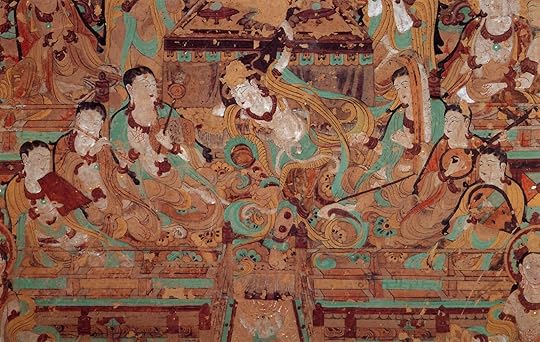
Mogao Cave Mural

Miss Chiao-No - Can a man and a woman be just friends? A thoroughly unconventional and imaginative love story.

Miss Ying-Ning; or, The Laughing Girl - Of flowers and laughter, the most breathtakingly beautiful story of the collection.


I also adore a tiny (119 Chinese characters in total!) tale of loyalty and love, 义鼠, which Giles appeared not to have translated. Here is my feeble attempt at translation:

The Staunch Mouse

Two mice emerged. One was swallowed by a snake. The other’s eyes popped out like peppercorns, full of hatred and fury, but it dared not approach from a distance.

Now full, the snake began slithering back into its hole. As it was halfway in, the mouse darted forth, gnashing at the snake-tail. The angered snake backed out of its hole. The brisk mouse darted off. Thwarted, the snake returned to its hole, but the mouse returned with its gnashing.

When the snake retreated, the mouse advanced; when the snake advanced, the mouse fled.

Finally the snake emerged and spat the dead mouse out onto the ground. The mouse approached to sniff it, squeaked as though mourning, and carried the dead off. Seeing this, my friend composed “The Song of the Staunch Mouse”.
Profile Image for E. G..
1,175 reviews797 followers
January 2, 2015
Acknowledgements
Introduction
Note on the Text, Translation and Illustrations
Note on Names and Pronunciation


--Homunculus
--An Otherworldly Examination
--Living Dead
--Spitting Water
--Talking Pupils
--The Painted Wall
--The Troll
--Biting a Ghost
--Catching a Fox
--The Monster in the Buckwheat
--The Haunted House
--Stealing a Peach
--Growing Pears
--The Taoist Priest of Mount Lao
--The Monk of Changqing
--The Snake-Charmer
--The Wounded Python
--The Fornicating Dog
--The God of Hail
--The Golden Goblet
--Grace and Pine
--A Most Exemplary Monk
--Magical Arts
--Wild Dog
--Past Lives
--Fox in the Bottle
--Wailing Ghosts
--Thumb and Thimble
--Scorched Moth the Taoist
--Friendship Beyond the Grave
--Karmic Debts
--Ritual Cleansing
--The Door God and the Thief
--The Painted Skin
--The Merchant's Son
--A Passion for Snakes
--A Latter-Day Buddha
--Fox Enchantment
--Eating Stones
--The Laughing Girl
--The Magic Sword and the Magic Bag
--The Devoted Mouse
--An Earthquake
--Snake Island
--Generosity
--The Giant Fish
--The Giant Turtle
--Making Animals
--The Little Mandarin
--Dying Together
--The Alligator's Revenge
--Sheep Skin
--Sharp Sword
--Lotus Fragrance
--King of the Nine Mountains
--The Fox of Fenzhou
--Silkworm
--Vocal Virtuosity
--Fox as Prophet
--This Transformation
--Fox Control
--Dragon Dormant
--Cut Sleeve
--The Girl from Nanking
--Twenty Years a Dream
--Mynah Bird
--Lamp Dog
--Doctor Five Hides
--Butterfly
--The Black Beast
--The Stone Bowl
--A Fatal Joke
--Raining Money
--Twin Lanterns
--Ghost Foiled, Fox Put to Rout
--Frog Chorus
--Performing Mice
--The Clay Scholar
--Flowers of Illusion
--Dwarf
--Bird
--Princess Lotus
--The Girl in Green
--Duck Justice
--Big Sneeze
--Steel Shirt
--Fox Trouble
--Lust Punished by Foxes
--Mountain City
--A Cure for Marital Strife
--A Prank
--Adultery and Enlightenment
--Up His Sleeve
--Silver Above Beauty
--The Antique Lute
--Waiting Room for Death
--Rouge
--The Southern Wutong-Spirit
--Sunset
--The Male Concubine
--Coral
--Mutton Fat and Pig Blood
--Dung-Beetle Dumplings
--Stir-Fry

Author's Preface
Glossary
Maps
Finding List
Further Reading
Notes
Profile Image for Bbrown.
910 reviews116 followers
January 28, 2022
This collection of over one hundred stories was a fun, quick read for me, despite the fact that some of the story features get repetitive and few stories stood out from the herd. The introduction explains that the collection consists of two types of tales: one type is actual stories, with beginnings, middles, and endings as well as a themes and often times lessons. The other type are just bizarre occurrences that Pu Songling heard about and recorded. The latter kind provides short breaks between the former kind, and both are amusing, but few individual stories of either type grabbed my attention or impressed me. If someone were to ask me about this book in a few years I would remember it as a collection of stories about fox spirits and ghosts, most of which only seemed interested in seducing humans, but that will probably be about all. One or two tales might stick with me, like the wonderfully bizarre story of a man cursed with blindness whose pupils decide to leave his eyes, or the humorous story of a dandy who pretends to hang himself in order to make a girl laugh, only to actually choke himself to death, but the vast majority of the tales aren't memorable. Despite this, reading the collection was a lot of fun, and I found it much more accessible than most Chinese literature. Thus I rate this collection four stars. If ghost stories or Chinese folklore is your thing then by all means give this one a read.
Profile Image for SeirenAthena.
78 reviews9 followers
December 24, 2021
I'm surprised with the rapidity with which I read this nearly 600 page-long collection of very! strange Chinese tales. I find these to be less compelling as stories and more so fascinating; I was given insight on the often (fiercely) carnal, disturbing (sometimes very much so; beware!), transcendental, even funny, but always unthinkably bizarre and supernatural nature of some of the Chinese folklore (zhiguai). Haha, as an example the final story was of a woman chopping her husband's dildo up and serving it to guests in a fucking stir-fry (although that's not the greatest example of the general theme of most of the tales).

I was in no way expecting works with such explicit content, but it really was interesting--and the allegories, while not necessarily compelling, had somewhat of a surreal and absurd quality that invariably bathed my mind in some fresh mind-boggling fantasy, which I really did find to be fascinating and usually delightful. Each tale had something new and equally bizarre phenomena in store. And in the end, I resulted in knowing more about the livelihood and culture and societal framework of many of China's 'marvel tales'. Very, very cool (I'm a bit lost on how I should rate it, though).

Also: this is the second work of my continental folklore 'journey' (I've read East African and this so far and I've made my way through almost a quarter of an 800 page tome of Italian Folktales).
Profile Image for tara bomp.
520 reviews162 followers
March 20, 2017
Lots of fun stories. The most notable theme is sex with fox spirits although there's a good variety of stuff too, with varying morals and conclusions even when the set-up is pretty similar. There's nothing here that made me think "woah that's amazing" hence the 4 star but I enjoyed reading every single story here - there's a lot of cool ideas and overall there's an amazing and absorbing atmosphere that really takes you into the world of the Chinese studio.

The Penguin edition I was using has very helpful notes and a good glossary that help you understand the setting for each story as well as pointing out allusions to classic Chinese literature - although I'd note it relies notably on 19th century sources and stuff quite a bit, dunno how some of the explanations of concepts stand up to modern scholarship. 1 story adds the commentary which is apparently standard in the full original Chinese editions.
Profile Image for Mel.
3,519 reviews212 followers
November 19, 2014
This book was most excellent. A selection of 20 of Pu Songling’s strange tales rewritten in modern Chinese, the texts were presented in both traditional and simplified characters. The stories featured a lovely mixture of ghosts, fox spirits and trips to the underworld. The book is aimed at “intermediate” Chinese students, (those who have completed the Read Chinese series I and II). I’ve not been studying with the Read Chinese series, but it definitely has the best supplemental reading material of any Chinese language course I’ve seen yet. This book (and the others I read of theirs) was published about 30 years ago but I’ve not been able to find whether they are still producing “easy to read” versions of classic Chinese legends. These stories were great fun and very good practice. I feel like they helped me improve my Chinese. While I was able to sit down and read a story in one go I felt like the structure helped with grammar, sentence structure and character recognition. There are also lovely wood cut illustrations for each story. I managed to find a new copy of this hidden away in the SOAS book shop. If you can find a copy (and are studying Chinese) I’d highly recommend it.
Profile Image for Knigoqdec.
1,181 reviews186 followers
October 11, 2021
Като атмосфера книгата безспорно е доста интересна и откривам неща, които се припокриват с неща от други китайски книги и прочие.
Но разказите са и твърде странни. Не можеш да ги наречеш приказки, нито пък истински притчи или нещо от сорта. Когато авторът се включва с тълкуванията си, често тълкуването звучи страшно нелогично от наша гледна точка. Дали е някакво разминаване в културен план или времеви, не мога да кажа. Може и да е и двете.
Profile Image for Anna Baboura.
693 reviews16 followers
July 27, 2021
Φαντάσματα, θρύλοι και αλεπούδες. Το νησί των λωτοφάγων και το πόδι της Φουμίκο. Παραδόσεις και θρύλοι τόσο διαφορετικοί από τους ευρωπαϊκούς, αλλά τόσο όμοιοι συνάμα.
Θα ήθελα το βιβλίο να ήταν λίγο παραπάνω.
Profile Image for হামিম কামাল.
79 reviews29 followers
Read
June 8, 2022
ফু সুংলিংএর অদ্ভুত উপাখ্যান আমাকে গভীর আনন্দ দিয়েছে।
Displaying 1 - 30 of 281 reviews

Join the discussion

Can't find what you're looking for?

Get help and learn more about the design.