

What do you think?

Scarweather
Mystery crime fiction written in the Golden Age of Murder
'My friend Ellingham has persuaded me to reveal to the public the astounding features of the Reisby case. As a study in criminal aberration it is, he tells me, of particular interest, while in singularity of horror and in perversity of ingenious method it is probably unique.'
1913. John Farringdale, with his cousin Eric Foster, visits the famous archaeologist Tolgen Reisby. At Scarweather―Reisby's lonely house on the windswept northern coast of England―Eric is quickly attracted to Reisby's much younger wife, and matters soon take a dangerous turn. Fifteen years later, the final scene of the drama is enacted.
This unorthodox novel from 1934 is by a gifted crime writer who, wrote Dorothy L. Sayers, 'handles his characters like a "real" novelist and the English language like a "real" writer―merits which are still, unhappily, rarer than they should be in the ranks of the murder specialists.'
'My friend Ellingham has persuaded me to reveal to the public the astounding features of the Reisby case. As a study in criminal aberration it is, he tells me, of particular interest, while in singularity of horror and in perversity of ingenious method it is probably unique.'
1913. John Farringdale, with his cousin Eric Foster, visits the famous archaeologist Tolgen Reisby. At Scarweather―Reisby's lonely house on the windswept northern coast of England―Eric is quickly attracted to Reisby's much younger wife, and matters soon take a dangerous turn. Fifteen years later, the final scene of the drama is enacted.
This unorthodox novel from 1934 is by a gifted crime writer who, wrote Dorothy L. Sayers, 'handles his characters like a "real" novelist and the English language like a "real" writer―merits which are still, unhappily, rarer than they should be in the ranks of the murder specialists.'
272 pages, Paperback
First published January 1, 1934
Ratings & Reviews
Friends & Following
Create a free account to discover what your friends think of this book!
Community Reviews
Displaying 1 - 30 of 81 reviews

February 4, 2017
One can damn a book with faint praise; likewise, it is possible to damn a book by unfairly comparing it to much superior books and raising expectations unreasonably. That I do not wish to do to Scarweather. If you approach Anthony Rolls’ 1934 mystery novel (one of just four that C.E. Vulliamy penned under that pseudonym) thinking that you’re reading one of the era’s wonderful but less-well-know authors — J. Jefferson Farjeon, Margery Allingham, Anthony Berkeley, or, heaven forbid!, Gladys Mitchell — you’re destined to be disappointed.
However, if you go into the novel expecting it to be a run-of-the-mill Golden Age mystery that is too long, too verbose, and too obvious as to both the crime and the perpetrator, then you will enjoy Rolls’ novel for its interesting characters, its window into an England of a century ago and its glimpse into the time’s dismissive opinion of the nascent science of archeology, described as “this make-believe of a science” that relied on “pseudo-this or neo-that, and the whole thing is lost in a senseless medley of jargon.” Clearly, the 1912 Piltdown Hoax gave birth to this novel. Still, I’m not sorry that I read Scarweather; with the right frame of mind, you won’t, either.
However, if you go into the novel expecting it to be a run-of-the-mill Golden Age mystery that is too long, too verbose, and too obvious as to both the crime and the perpetrator, then you will enjoy Rolls’ novel for its interesting characters, its window into an England of a century ago and its glimpse into the time’s dismissive opinion of the nascent science of archeology, described as “this make-believe of a science” that relied on “pseudo-this or neo-that, and the whole thing is lost in a senseless medley of jargon.” Clearly, the 1912 Piltdown Hoax gave birth to this novel. Still, I’m not sorry that I read Scarweather; with the right frame of mind, you won’t, either.

March 18, 2017
Dorothy L. Sayers loved the writing of Anthony Rolls, so I went into this with expectations. And the writing was excellent – I enjoyed the way Rolls (that is, Colwyn Edward Vulliamym using the pen name Anthony Rolls) strung words together. Believable characters, believable dialogue, tension and humor both.
The reason I didn't rate this higher or enjoy this more is that once the characters' roles were sorted out – for the apparent murder victim was not who I expected it to be – I foresaw pretty much everything that was to come. Funnily enough, it's as though Rolls anticipated this: "Does the reader now perceive the shadow of these events? If so, I congratulate him upon possessing a swift and practical imagination." Well, thanks, but ... not so much, really.
Still, the writing was excellent, everything you could ask of a solid Golden Age mystery. "Their boy, Peter Laud Ellingham, was about twelve years old—he was not more offensive than the average boy of twelve." "We spent our time very harmoniously and pleasantly, and in a manner that was decidedly sociable without being too restrained. It has always been my belief that only intelligent people know how to enjoy themselves." The glancing blow at the Great War and the narrator's part in it is kind of wonderful. I felt an actual pang when I realized who the murder victim was; I was worried about what would happen to the star-crossed couple who obviously belonged together. All to the good.
Dorothy Sayers wrote about Rolls, "he handles his characters like a 'real' novelist and the English language like a 'real' writer—merits which are still, unhappily, rarer than they should be in the ranks of the murder specialists". Unhappily, that hasn't changed, so actual good writing still has a worth far above rubies or pearls.
I look forward to tracking down as much as possible by this author, under whatever name I can find him.
The usual disclaimer: I received this book via Netgalley for review.
The reason I didn't rate this higher or enjoy this more is that once the characters' roles were sorted out – for the apparent murder victim was not who I expected it to be – I foresaw pretty much everything that was to come. Funnily enough, it's as though Rolls anticipated this: "Does the reader now perceive the shadow of these events? If so, I congratulate him upon possessing a swift and practical imagination." Well, thanks, but ... not so much, really.
Still, the writing was excellent, everything you could ask of a solid Golden Age mystery. "Their boy, Peter Laud Ellingham, was about twelve years old—he was not more offensive than the average boy of twelve." "We spent our time very harmoniously and pleasantly, and in a manner that was decidedly sociable without being too restrained. It has always been my belief that only intelligent people know how to enjoy themselves." The glancing blow at the Great War and the narrator's part in it is kind of wonderful. I felt an actual pang when I realized who the murder victim was; I was worried about what would happen to the star-crossed couple who obviously belonged together. All to the good.
Dorothy Sayers wrote about Rolls, "he handles his characters like a 'real' novelist and the English language like a 'real' writer—merits which are still, unhappily, rarer than they should be in the ranks of the murder specialists". Unhappily, that hasn't changed, so actual good writing still has a worth far above rubies or pearls.
I look forward to tracking down as much as possible by this author, under whatever name I can find him.
The usual disclaimer: I received this book via Netgalley for review.

January 4, 2019
This review can also be found on my blog

I picked this book up, knowing it was a crime novel. In a crime novel, there is usually…well a crime. A character in that novel obviously doesn’t know what kind of book they’re in. So if they learn that a person disappeared it’s realistic that they will accept ‘He went for a swim and drowned’ as explanation and not suspect foul play. But as a reader that’s still rather frustrating because you know that it isn’t going to end with the solution “It was an accidental drowning and nobody else was involved.”
It’s bearable if the character only needs a bit longer than the reader to discover that fact but Farringdale doesn’t need a bit longer. He needs the whole book and then he only gets it after someone explains it to him. Because he is the first-person narrator of this story but the actual investigator is his friend Frederick Ellingham. He describes himself as ‘the Watson’ and even without that direct shout-out it wouldn’t have been difficult to guess the inspiration for this story. Ellingham is incredibly clever, has a vast knowledge in several fields and leaves Farringdale in the dark about his suspicions because of reasons.
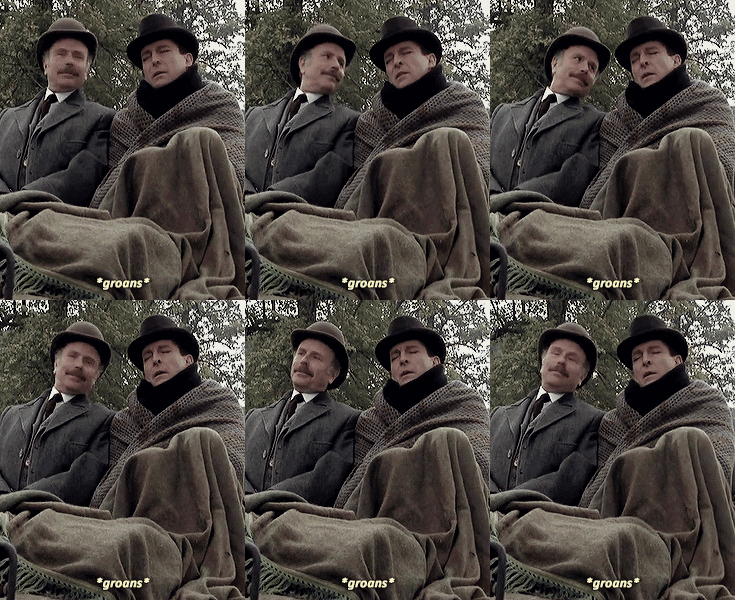
But there are also a fair number of differences. For one: Holmes had charm. And charisma. Ellingham has neither and while Farringdale keeps telling the reader what a great man and friend he is but really I never saw anything of it. He’s condescending and doesn’t seem to trust Farringdale at all. But far more importantly: Holmes frequently makes it clear that he doesn’t think somebody should be lett off just because he’s rich or influential. Ellingham, meanwhile, knows that someone is doing something illegal (not murder but still something serious) and from the way he tells it, it seemed to me that he would have had no problem proving it. Still, he decides not to do it because *drumroll* the man has a reputation and is such an important scientist. (As a side note: he’s an archaeologist, a profession Ellingham mocks throughout the whole book, essentially saying that they only make up stuff as they go along and that there’s no proper scientific reasoning behind their claims).

Farringdale, meanwhile, isn’t exactly a Watson, either since Watson had, you know, some brains. But when I said that he has no idea what’s going on until Ellingham explains it to him at the very end, I wasn’t exaggerating. He watches Ellingham come back repeatedly to the scene of the disappearance, act oddly in a myriad of different ways and witness a series of strange events. Then Ellingham even alludes that there might be something fishy going on but he remains convinced that it was all a tragic accident and a series of incredibly strange coincidences.
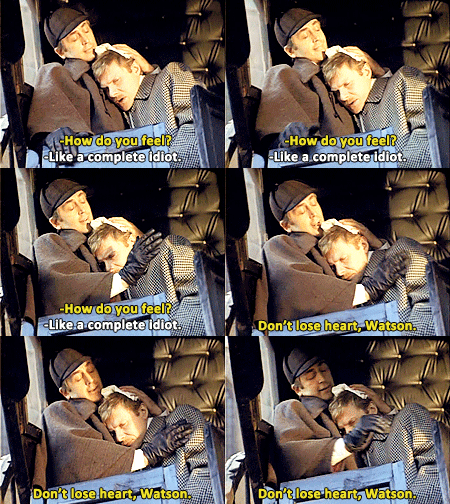
And since he doesn’t think there is anything wrong, he never does any investigating. So what we get is a mystery novel, told from the POV from someone who doesn’t even know that there is a mystery and who keeps talking about things that make you scream “DON’T YOU SEE WHAT’S GOING ON THERE? IT’S SO BLOODY OBVIOUS!” And then, when things are explained to himin words with as few syllables as possible he almost faints from shock while most readers will go “I am shocked that gambling is going on in this house that all my suspicions turned out to be true.
Who would have expected that?”
Now, I don’t claim that I loved every single British Crime Library Classic I read so far but at least in most cases, I can see that others might enjoy them. So far there have been only two where that wasn’t the case: I really can’t see how anybody would find something enjoyable in Scarweather and The Secret of High Eldersham. They’re just plain bad…and the ending of Scarweather also offers an absolutely horrid moral about how reputation is more important than everything else.
I picked this book up, knowing it was a crime novel. In a crime novel, there is usually…well a crime. A character in that novel obviously doesn’t know what kind of book they’re in. So if they learn that a person disappeared it’s realistic that they will accept ‘He went for a swim and drowned’ as explanation and not suspect foul play. But as a reader that’s still rather frustrating because you know that it isn’t going to end with the solution “It was an accidental drowning and nobody else was involved.”
It’s bearable if the character only needs a bit longer than the reader to discover that fact but Farringdale doesn’t need a bit longer. He needs the whole book and then he only gets it after someone explains it to him. Because he is the first-person narrator of this story but the actual investigator is his friend Frederick Ellingham. He describes himself as ‘the Watson’ and even without that direct shout-out it wouldn’t have been difficult to guess the inspiration for this story. Ellingham is incredibly clever, has a vast knowledge in several fields and leaves Farringdale in the dark about his suspicions because of reasons.
But there are also a fair number of differences. For one: Holmes had charm. And charisma. Ellingham has neither and while Farringdale keeps telling the reader what a great man and friend he is but really I never saw anything of it. He’s condescending and doesn’t seem to trust Farringdale at all. But far more importantly: Holmes frequently makes it clear that he doesn’t think somebody should be lett off just because he’s rich or influential. Ellingham, meanwhile, knows that someone is doing something illegal (not murder but still something serious) and from the way he tells it, it seemed to me that he would have had no problem proving it. Still, he decides not to do it because *drumroll* the man has a reputation and is such an important scientist. (As a side note: he’s an archaeologist, a profession Ellingham mocks throughout the whole book, essentially saying that they only make up stuff as they go along and that there’s no proper scientific reasoning behind their claims).
Farringdale, meanwhile, isn’t exactly a Watson, either since Watson had, you know, some brains. But when I said that he has no idea what’s going on until Ellingham explains it to him at the very end, I wasn’t exaggerating. He watches Ellingham come back repeatedly to the scene of the disappearance, act oddly in a myriad of different ways and witness a series of strange events. Then Ellingham even alludes that there might be something fishy going on but he remains convinced that it was all a tragic accident and a series of incredibly strange coincidences.
And since he doesn’t think there is anything wrong, he never does any investigating. So what we get is a mystery novel, told from the POV from someone who doesn’t even know that there is a mystery and who keeps talking about things that make you scream “DON’T YOU SEE WHAT’S GOING ON THERE? IT’S SO BLOODY OBVIOUS!” And then, when things are explained to him
Who would have expected that?”
Now, I don’t claim that I loved every single British Crime Library Classic I read so far but at least in most cases, I can see that others might enjoy them. So far there have been only two where that wasn’t the case: I really can’t see how anybody would find something enjoyable in Scarweather and The Secret of High Eldersham. They’re just plain bad…and the ending of Scarweather also offers an absolutely horrid moral about how reputation is more important than everything else.

February 7, 2019
Despite this type of fiction being a real favourite of mine,I really struggled with this 'golden age' crime novel. The pace was extremely slow, the tone ponderous and the solution couldn't have been more obvious if it had been written at the top of every page in glowing letters. Added to this, one of the characters, an eccentric professor, punctuated nearly every sentence with stupid phrases such as ha-ha-di-tee, tra-la-da-da or similarly annoying sounds. Oh boy, was I glad to finish it and move on!
January 31, 2017
I received an e-ARC of this novel through NetGalley and Poisoned Pen Press. Thank you.
Anthony Rolls is not an author I have read before, but I enjoy reading the British Library's Crime Classics re-issues so I decided to try this one. The novel is quite different because the involvement with the characters takes place over a decade and a half. With a death happening fourteen years before the proof is gathered I found this book to be both fascinating and slow. I was on guard as soon as I read in the introduction by Martin Edwards that the pace was "leisurely". Yes, that it was. Scarweather is an isolated manor house on the coast of northern England, the story begins just months before the outbreak of World War I.
This mystery has archeology as the central theme so if you aren't interested in that subject you might take this as a warning. I know practically nothing about ancient burial sites in Britain or elsewhere so I found myself often wondering if the information was true or had been made up by the author. When so many experts in the same field have totally different opinions of what is fact and what is not it just confuses me more. Plus, I'm sorry to say I was correct very early on as to what was happening regarding the mystery ship and the death had a pretty obvious solution also. Yet in spite of all those things which would seem to be an impediment to enjoyment, I really did like the book. I certainly liked it enough to make it through the middle portions which slowed down from a crawl to a creep.
Read this novel if you want to see a different style of mystery writing done well.
Anthony Rolls is not an author I have read before, but I enjoy reading the British Library's Crime Classics re-issues so I decided to try this one. The novel is quite different because the involvement with the characters takes place over a decade and a half. With a death happening fourteen years before the proof is gathered I found this book to be both fascinating and slow. I was on guard as soon as I read in the introduction by Martin Edwards that the pace was "leisurely". Yes, that it was. Scarweather is an isolated manor house on the coast of northern England, the story begins just months before the outbreak of World War I.
This mystery has archeology as the central theme so if you aren't interested in that subject you might take this as a warning. I know practically nothing about ancient burial sites in Britain or elsewhere so I found myself often wondering if the information was true or had been made up by the author. When so many experts in the same field have totally different opinions of what is fact and what is not it just confuses me more. Plus, I'm sorry to say I was correct very early on as to what was happening regarding the mystery ship and the death had a pretty obvious solution also. Yet in spite of all those things which would seem to be an impediment to enjoyment, I really did like the book. I certainly liked it enough to make it through the middle portions which slowed down from a crawl to a creep.
Read this novel if you want to see a different style of mystery writing done well.

June 18, 2019
I read this as satire. It only works for me as satire. If this was written as a serious mystery, then this book has a lot of issues.

March 16, 2022
Exactly what it says on the tin. In 1913, the young and beautiful Eric Foster takes his best friends - cousin John Farringdale and mentor Frederick Ellingham - with him when he visits the eccentric archaeologist Tolgen Reisby at his home, the titular Scarweather, a house located in an isolated little town in the North of England. Eric becomes infatuated with Resiby's thirty-years-younger wife, Hilda.
In 1914, Eric suddenly disappears while visiting the Professor at Scarweather. Everyone is convinced that it's a tragic accident - everyone except Ellingham. It takes 15 long years to uncover the truth, but they eventually do, uncovering a secret that lies deeper than any archeological dig can find.
This book was a decent-enough read, right up until the end. Farringdale, our narrator, is unfortunately an oblivious idiot. It's blindingly obvious what happened to his poor cousin, and yet he can't believe it, even when the evidence is staring him in the face. Unfortunately, the ending is absolutely maddening: Frankly, I'm glad the original dust jacket spoiled the story, because it saved a lot of people the hassle of reading it!
In 1914, Eric suddenly disappears while visiting the Professor at Scarweather. Everyone is convinced that it's a tragic accident - everyone except Ellingham. It takes 15 long years to uncover the truth, but they eventually do, uncovering a secret that lies deeper than any archeological dig can find.
This book was a decent-enough read, right up until the end. Farringdale, our narrator, is unfortunately an oblivious idiot. It's blindingly obvious what happened to his poor cousin, and yet he can't believe it, even when the evidence is staring him in the face. Unfortunately, the ending is absolutely maddening: Frankly, I'm glad the original dust jacket spoiled the story, because it saved a lot of people the hassle of reading it!

December 19, 2021
I rather enjoyed this, in an inessential way. It's well written, at times even impressively so. Rolls/Vulliamy seems to save his best writing for the passages where he's writing about archaeology and archaeologists (more of this anon), which was my main reason for picking it up in the first place.
I liked the unorthodox timeframe of the unfold, but it's difficult to take it very seriously now: the mystery seems patently transparent and unmysterious, the gifted and perceptive amateur expert seems too uncentral to the narrative to be overly compelling (his quirky or disturbing moments don't particularly resolve, and not in an interesting way), and the peripheral minor characters are sometimes little more than supposedly comic-sounding names.
BUT. I’d previously read Vulliamy’s 1926 book Immortal Man (repr. as Immortality: Funerary Rites and Customs), which I’d found a similarly well-written and often charming work of anthropological archaeology - dated, seemingly derived from Tylor at times, but fascinating in its (sometimes hilarious) engagement with Spiritualism and psychical research. And the interaction of archaeology and folklore is a subject of some interest to me, so I wanted to see if/how this fitted into popular representations of the subjects. In many ways it doesn't, and I could wish Rolls/Vulliamy had spent more time even than he does on his asides about archaeology, but he's waspishly perceptive about the appeal and the limitations of archaeology - and the storm-in-a-teacup self-generated spats between scholars in that field as it professionalised and developed - in a sometimes surprising way. (He seems, at times, almost to discard the viability of archaeology as a separate field of study, which intrigues me, coming from an archaeologist). That stuff bears up in an almost more fascinating way than the perfectly ok '30s mystery.
I liked the unorthodox timeframe of the unfold, but it's difficult to take it very seriously now: the mystery seems patently transparent and unmysterious, the gifted and perceptive amateur expert seems too uncentral to the narrative to be overly compelling (his quirky or disturbing moments don't particularly resolve, and not in an interesting way), and the peripheral minor characters are sometimes little more than supposedly comic-sounding names.
BUT. I’d previously read Vulliamy’s 1926 book Immortal Man (repr. as Immortality: Funerary Rites and Customs), which I’d found a similarly well-written and often charming work of anthropological archaeology - dated, seemingly derived from Tylor at times, but fascinating in its (sometimes hilarious) engagement with Spiritualism and psychical research. And the interaction of archaeology and folklore is a subject of some interest to me, so I wanted to see if/how this fitted into popular representations of the subjects. In many ways it doesn't, and I could wish Rolls/Vulliamy had spent more time even than he does on his asides about archaeology, but he's waspishly perceptive about the appeal and the limitations of archaeology - and the storm-in-a-teacup self-generated spats between scholars in that field as it professionalised and developed - in a sometimes surprising way. (He seems, at times, almost to discard the viability of archaeology as a separate field of study, which intrigues me, coming from an archaeologist). That stuff bears up in an almost more fascinating way than the perfectly ok '30s mystery.

August 12, 2020
In 1913, our narrator John Farrington along with his cousin Eric Foster is invited to visit Scarweather, the home of the famous archaeologist Tolgen Reisby. Reisby has many interesting finds to show the two young men and Foster, who has a budding interest in archaeology, is struck with a bit of hero-worship. But he's struck even harder by love's arrow when he meets Reisby's much younger wife.The two behave with every propriety, but Farrington can't help but worry that his cousin will get himself into trouble. Many visits follow, some of which include Farrington's friend Frederick Ellington, who takes an interest in a ancient burial site known locally as the Devil's Hump. He'd like to see Reisby open an archaeological dig there. Everyone is friendly and everything seems to be going smoothly.
Then Foster makes a visit to Scarweather on his own--in answer to an invitation made by Reisby while his wife is away. The next thing Farrington knows, he's on the receiving end of a telegram telling him that his cousin is missing at sea, presumed drowned. He asks Ellington, who has an investigative nature, to accompany him and the two are greeted with an odd story. Foster apparently expressed himself forcefully on the subject of taking a swim off the coast almost immediately upon arrival (he'd often done so)--but the evening was chilly and Reisby thought he had convinced the young man to wait till the next day. Foster room and bed gave evidence that he had not gone to sleep, but apparently stayed up all night and headed out in Reisby's boat at about three or four in the morning. The boat was found aground with Foster's clothes aboard and no sign of the young man. A search was undertaken by boat owners in the area, but Foster was eventually given up as having drowned. Farrington is a bit disappointed that Ellington doesn't seem as interested as he supposed his friend would be. In fact, Ellington spends a great deal of time taking pictures of the Devil's Hump.
Fifteen years later, after a world war and Farrington's law profession has intruded, he and Ellington return to the Scarweather area. Ellington has told him that he still thinks about the missing Foster and he's quite sure that Reisby has never told everything he knows about that night. They soon learn that two more men have disappeared and a man who had sent Foster a letter before he disappeared has committed suicide. Are these things related? And now that Reisby is finally going to dig at the Devil's Hump Ellington makes an interesting prediction about what might be found there.
I'm a bit on the fence with this one. It's a perfectly fine mystery novel with a fairly standard motive for the initial murder. I enjoyed reading it for the most part. The description of Scarweather and the background of archaeology was interesting. I quite liked the character of Ellington and wouldn't mind seeing more of him. But...our narrator is one of the most dense Watson characters I've met since Nigel Bruce made Sherlock's Watson such a bumbling fool. The motive for the murder is glaringly obvious. The identity of the murderer is glaringly obvious. Exactly what happened to Eric Foster is glaringly obvious. And Farrington gives us these HIBK-like phrases throughout the book: "Little did I know what Ellington meant by..."; "I had no idea that such and such indicated..."; "Had I realized why Ellington asked those questions". For the love of all that's holy, man, did you use up all your brains on reading law?
The other thing that bothers me is the dangling bits at the end. The motive for the murder is all nice and tidy. We definitely know who did it. But as far as the other deaths and presumed deaths go...not really explained properly. Why did Rolls drag in the man who wrote a letter to Foster and then ultimately committed suicide? It didn't have anything to do with the real case and if Rolls was trying to provide a red herring, then it wasn't very effective. If you want to splash false clues around, that's all well and good--but don't make the solution to the mystery so neon-sign-blinking-obvious that nobody will pay the least bit of attention to them (other than being annoyed that they were brought in and not properly explained). And...it would be nice to know if the other two missing, presumed dead men really are dead or not and if they are if our villain did them in. Are they dead? We don't know. If they are, we could come up with a reason why the villain got rid of them, but it'd be preferable that Rolls square that all away in the wrap-up.
So--good marks for setting and characterization and some deductions on the wrap-up. Decent mystery.
First posted on my blog My Reader's Block. Please request permission before reposting portions of review. Thanks.
Then Foster makes a visit to Scarweather on his own--in answer to an invitation made by Reisby while his wife is away. The next thing Farrington knows, he's on the receiving end of a telegram telling him that his cousin is missing at sea, presumed drowned. He asks Ellington, who has an investigative nature, to accompany him and the two are greeted with an odd story. Foster apparently expressed himself forcefully on the subject of taking a swim off the coast almost immediately upon arrival (he'd often done so)--but the evening was chilly and Reisby thought he had convinced the young man to wait till the next day. Foster room and bed gave evidence that he had not gone to sleep, but apparently stayed up all night and headed out in Reisby's boat at about three or four in the morning. The boat was found aground with Foster's clothes aboard and no sign of the young man. A search was undertaken by boat owners in the area, but Foster was eventually given up as having drowned. Farrington is a bit disappointed that Ellington doesn't seem as interested as he supposed his friend would be. In fact, Ellington spends a great deal of time taking pictures of the Devil's Hump.
Fifteen years later, after a world war and Farrington's law profession has intruded, he and Ellington return to the Scarweather area. Ellington has told him that he still thinks about the missing Foster and he's quite sure that Reisby has never told everything he knows about that night. They soon learn that two more men have disappeared and a man who had sent Foster a letter before he disappeared has committed suicide. Are these things related? And now that Reisby is finally going to dig at the Devil's Hump Ellington makes an interesting prediction about what might be found there.
I'm a bit on the fence with this one. It's a perfectly fine mystery novel with a fairly standard motive for the initial murder. I enjoyed reading it for the most part. The description of Scarweather and the background of archaeology was interesting. I quite liked the character of Ellington and wouldn't mind seeing more of him. But...our narrator is one of the most dense Watson characters I've met since Nigel Bruce made Sherlock's Watson such a bumbling fool. The motive for the murder is glaringly obvious. The identity of the murderer is glaringly obvious. Exactly what happened to Eric Foster is glaringly obvious. And Farrington gives us these HIBK-like phrases throughout the book: "Little did I know what Ellington meant by..."; "I had no idea that such and such indicated..."; "Had I realized why Ellington asked those questions". For the love of all that's holy, man, did you use up all your brains on reading law?
The other thing that bothers me is the dangling bits at the end. The motive for the murder is all nice and tidy. We definitely know who did it. But as far as the other deaths and presumed deaths go...not really explained properly. Why did Rolls drag in the man who wrote a letter to Foster and then ultimately committed suicide? It didn't have anything to do with the real case and if Rolls was trying to provide a red herring, then it wasn't very effective. If you want to splash false clues around, that's all well and good--but don't make the solution to the mystery so neon-sign-blinking-obvious that nobody will pay the least bit of attention to them (other than being annoyed that they were brought in and not properly explained). And...it would be nice to know if the other two missing, presumed dead men really are dead or not and if they are if our villain did them in. Are they dead? We don't know. If they are, we could come up with a reason why the villain got rid of them, but it'd be preferable that Rolls square that all away in the wrap-up.
So--good marks for setting and characterization and some deductions on the wrap-up. Decent mystery.
First posted on my blog My Reader's Block. Please request permission before reposting portions of review. Thanks.

January 17, 2025
An interesting story from the British Library Crime Classics. Recommended for those who enjoy this genre.

August 27, 2018
Very different from any of the other British library crime classics i have read so far.
Which is not bad, just not what i expected going into it, so i actually think that if/when i will re-read this book in a year or two i will most likely enjoy this much more because i know to expect something different!
Its a slow rolling crime book, but at the same time it is not slow at all. Which honestly is just very strange while reading it since nothing really feels slow paced, but at the same time it does?
And there is also the fact that this book basically takes place over 15 years... but not really? Most o fit takes place before those, a part of it after 15 years past, but at the same time we do get pieces of what happened in between...
To say this shortly this book id very different from basically anything i ever read so far.
Which is great at some aspects but because of its very unique style it also is quiet hard to prepare for, or to know what to expect and so in some ways this book didn't deliver what i wanted, but i got something completely different out of it than i expected.
So was it a good read or not?
I have no idea!
It was different and quiet strange and not at all what i expected!
If that sounds like something you want to give a try?
Please do!
If you need something more predictable and knowing what you get yourself into?
This might be a hard one for you!
*Thanks to NetGalley.com for providing me with a free e-copy of this book in exchange for a free and honest review!*
Which is not bad, just not what i expected going into it, so i actually think that if/when i will re-read this book in a year or two i will most likely enjoy this much more because i know to expect something different!
Its a slow rolling crime book, but at the same time it is not slow at all. Which honestly is just very strange while reading it since nothing really feels slow paced, but at the same time it does?
And there is also the fact that this book basically takes place over 15 years... but not really? Most o fit takes place before those, a part of it after 15 years past, but at the same time we do get pieces of what happened in between...
To say this shortly this book id very different from basically anything i ever read so far.
Which is great at some aspects but because of its very unique style it also is quiet hard to prepare for, or to know what to expect and so in some ways this book didn't deliver what i wanted, but i got something completely different out of it than i expected.
So was it a good read or not?
I have no idea!
It was different and quiet strange and not at all what i expected!
If that sounds like something you want to give a try?
Please do!
If you need something more predictable and knowing what you get yourself into?
This might be a hard one for you!
*Thanks to NetGalley.com for providing me with a free e-copy of this book in exchange for a free and honest review!*

November 16, 2018
Reviewed for The Bibliophibian.
There is something really sinister and dark about this book. It’s one of those where drug-taking/mental illness really pushes the plot, and it leads to some really gruesome moments. That atmosphere is the best thing about the book, I think: that sense that you don’t quite know what’s going to happen next, because it seems like it could be anything. It’s not very subtle, but it works pretty well.
Of course, I don’t love mysteries which rely on mental illness for their sense of danger and their motives, because the facts are that mentally ill people are more likely to be attacked than to be the attackers, by quite a margin. But it’s a classic trope and this is a classic book, from a less aware time, so while I wouldn’t recommend it if that kind of thing really gets to you, I don’t hold it against it too much in how I enjoyed it.
Mind you, considering I didn’t like the detective that much and found the Watson rather boring, I’m not sure how to rate it. The sense of atmosphere is definitely worth something, though, and it’s not as though I found it a hard read. Until I sat down to think about it, I’d have gone with three stars easily.
There is something really sinister and dark about this book. It’s one of those where drug-taking/mental illness really pushes the plot, and it leads to some really gruesome moments. That atmosphere is the best thing about the book, I think: that sense that you don’t quite know what’s going to happen next, because it seems like it could be anything. It’s not very subtle, but it works pretty well.
Of course, I don’t love mysteries which rely on mental illness for their sense of danger and their motives, because the facts are that mentally ill people are more likely to be attacked than to be the attackers, by quite a margin. But it’s a classic trope and this is a classic book, from a less aware time, so while I wouldn’t recommend it if that kind of thing really gets to you, I don’t hold it against it too much in how I enjoyed it.
Mind you, considering I didn’t like the detective that much and found the Watson rather boring, I’m not sure how to rate it. The sense of atmosphere is definitely worth something, though, and it’s not as though I found it a hard read. Until I sat down to think about it, I’d have gone with three stars easily.

October 11, 2019
I can't say I particularly liked this book. It's a tale whose events are spread well over a decade and it takes its time getting there.
It's part of the British Library Crime Classics line and it's worth noting that it is very much a crime story as opposed to a detective story. There's crime committed among a disparate set of amateur archaeologists but there's not much of a mystery and what detection there is takes place largely behind the scenes.
The book isn't badly written by any means but its pace is leisurely and the narrative voice, bearing in mind the story begins just before the First World War has a slightly stiff Edwardian quality, which I'm guessing was intended by the writer. I think it's the lack of a real sense of mystery that I disliked most. Having said that, I'm not a fan of writing which presents us with a genius amateur sleuth and does so via the use of a narrator who is far from being the sharpest knife in the drawer and who never seems capable of making even the most basic deduction.
It's part of the British Library Crime Classics line and it's worth noting that it is very much a crime story as opposed to a detective story. There's crime committed among a disparate set of amateur archaeologists but there's not much of a mystery and what detection there is takes place largely behind the scenes.
The book isn't badly written by any means but its pace is leisurely and the narrative voice, bearing in mind the story begins just before the First World War has a slightly stiff Edwardian quality, which I'm guessing was intended by the writer. I think it's the lack of a real sense of mystery that I disliked most. Having said that, I'm not a fan of writing which presents us with a genius amateur sleuth and does so via the use of a narrator who is far from being the sharpest knife in the drawer and who never seems capable of making even the most basic deduction.

July 24, 2023
Not my favorite in the series, but a pretty good read. I liked the amateur detective, Frederick Ellingham, and his dogged pursuit of the solution to the crime across the first World War and a 15-year span of time. You sense with Ellingham that, much like Sherlock Holmes, he is always at least two steps ahead of everyone else involved; he has a decent sense of humor as well. The archaeological details were interesting, but the characterizations were the strongest part; apparently, Dorothy Sayers said of the author (who was also an archaeologist) that he "handles his characters like a 'real' novelist." There was even a touch of romance thrown in at the end involving the next generation of characters. Still, I figured out the obvious "whodunit" easily and the motive was fairly mundane. 2.5 stars, rounded up to 3.

August 17, 2018
An unusually crafted pre-war whodunnit. Part whodunnit, part Buchan, part MR James. Good, grisly fun.
The GR blurb:
'John Farringdale, with his cousin Eric Foster, visits the famous archaeologist Tolgen Reisby. At Scarweather - Reisby's lonely house on the windswept northern coast of England - Eric is quickly attracted to Reisby's much younger wife, and matters soon take a dangerous turn. Fifteen years later, the final scene of the drama is enacted. This unorthodox novel from 1934 is by a gifted crime writer who, wrote Dorothy L. Sayers, 'handles his characters like a "real" novelist and the English language like a "real" writer - merits which are still, unhappily, rarer than they should be in the ranks of the murder specialists.'
The GR blurb:
'John Farringdale, with his cousin Eric Foster, visits the famous archaeologist Tolgen Reisby. At Scarweather - Reisby's lonely house on the windswept northern coast of England - Eric is quickly attracted to Reisby's much younger wife, and matters soon take a dangerous turn. Fifteen years later, the final scene of the drama is enacted. This unorthodox novel from 1934 is by a gifted crime writer who, wrote Dorothy L. Sayers, 'handles his characters like a "real" novelist and the English language like a "real" writer - merits which are still, unhappily, rarer than they should be in the ranks of the murder specialists.'

March 18, 2021
I picked this one for the 'weather' in its title, weather being one of the prompts for #marchmysterymadness 2021.
This one started off decently enough and had the requisite London and remote village settings & a quirky cast of characters. However, after the first quarter of the book, where the crime is set up, it became rather boring, with an obvious plot and tedious writing. I thought the author over did the background details until they overwhelmed me with their minutiae. The pacing felt slow, the narrative laboured and the solution was so obvious that I wondered what the point was! The ending was rather unsavoury in my opinion although by that time I didn't care either way!
A disappointing, boring read that was just not my cup of tea.
This one started off decently enough and had the requisite London and remote village settings & a quirky cast of characters. However, after the first quarter of the book, where the crime is set up, it became rather boring, with an obvious plot and tedious writing. I thought the author over did the background details until they overwhelmed me with their minutiae. The pacing felt slow, the narrative laboured and the solution was so obvious that I wondered what the point was! The ending was rather unsavoury in my opinion although by that time I didn't care either way!
A disappointing, boring read that was just not my cup of tea.

August 11, 2022
First published in 1934, 'Scarweather' is s mystery novel set mainly near a fictional north England town against a background setting of archeology digs. The time period takes on a fine appeal as it is stretched over about 15 years from 1913. This makes for some interesting background details, and amazing characterisations, though let down by a condescending attitude to simple primitive northern folk.
September 18, 2017
It's quite tedious and seems apparent early on who did what. I kept reading as I assumed there would be a significant plot twist. Unfortunately, this wasn't the case.
This entire review has been hidden because of spoilers.

January 2, 2021
I love the fact that these old crime stories from the Golden Age are now being reprinted and with such beautiful cover illustrations. It gives them a new lease of life, although admittedly I am often slightly disappointed when I read them. Perhaps there's a reason why they disappeared from view in the first place. However, this is a rather superior example.
Narrated by a man who was partly involved but mostly a spectator to the events, it combines the clubland narrative style of John Buchan with the creeping sense of dread of MR James and I found it a very atmospheric and haunting read, although admittedly it does not offer much in the way of a whodunit puzzle - more a howdunit, if anything.
The premise is that the narrator and his cousin Eric befriend an eminent archaeological professor and his attractive young wife and a series of delightful house-parties at his remote Northern home ensue, with the inevitable murder. The structure is unusual because the action is stretched over several years, the initial events happening in the summer of 1914 and therefore everything being immediately interrupted by the Great War. (However, the book was written in the Thirties so this time period must have been deliberately chosen.)
Those who like a fast pace and lots of dead bodies will be disappointed. This is more about the inevitability and horror of one particular murder and the eventual solving of the mystery. Unravelling it requires patience and an unhurried approach and as a reader, you're not helped by the characters all seeming rather flat, like the characters in a Sherlock Holmes case. On the other hand, the setting itself makes a splendid character - the Professor's house is located close to the sea but in bleak, beautiful, rolling moorland, giving us two atmospheric settings for the price of one. I also enjoyed the narrative style, which was both pacy and tense and quite often drily witty, almost as though EM Forster had taken a hand in the descriptions of the various awkward dinner-parties and unsuccessful picnics.
Overall, I enjoyed this book. It probably helped that I read it by a blazing fire over Christmas, which gave an additional appeal to the descriptions of the bleak, icy moors. I recommend it and might try others by the same author.
Narrated by a man who was partly involved but mostly a spectator to the events, it combines the clubland narrative style of John Buchan with the creeping sense of dread of MR James and I found it a very atmospheric and haunting read, although admittedly it does not offer much in the way of a whodunit puzzle - more a howdunit, if anything.
The premise is that the narrator and his cousin Eric befriend an eminent archaeological professor and his attractive young wife and a series of delightful house-parties at his remote Northern home ensue, with the inevitable murder. The structure is unusual because the action is stretched over several years, the initial events happening in the summer of 1914 and therefore everything being immediately interrupted by the Great War. (However, the book was written in the Thirties so this time period must have been deliberately chosen.)
Those who like a fast pace and lots of dead bodies will be disappointed. This is more about the inevitability and horror of one particular murder and the eventual solving of the mystery. Unravelling it requires patience and an unhurried approach and as a reader, you're not helped by the characters all seeming rather flat, like the characters in a Sherlock Holmes case. On the other hand, the setting itself makes a splendid character - the Professor's house is located close to the sea but in bleak, beautiful, rolling moorland, giving us two atmospheric settings for the price of one. I also enjoyed the narrative style, which was both pacy and tense and quite often drily witty, almost as though EM Forster had taken a hand in the descriptions of the various awkward dinner-parties and unsuccessful picnics.
Overall, I enjoyed this book. It probably helped that I read it by a blazing fire over Christmas, which gave an additional appeal to the descriptions of the bleak, icy moors. I recommend it and might try others by the same author.
September 11, 2019
This is a beautiful book, really well-paced, releasing information at a steady pace, and making you know and love the characters as it developed.
I had just abandoned a modern edgy crime novel before picking this up, and the contrast was notable - the info dumps in the modern ones seemed to serve no purpose, while the sudden explosions of plot action seemed to come out of nowhere.
In comparison, Scarweather is perfectly formed. The characters begin as interpersonal relations and grow into themselves. The story starts out slowly, with some clear possibilities, and tragedy. It breaks off, takes up, and moves on. It all feels like a very natural progression.
And it works. It's an exceptional piece of its age and genre. Do read it!
I had just abandoned a modern edgy crime novel before picking this up, and the contrast was notable - the info dumps in the modern ones seemed to serve no purpose, while the sudden explosions of plot action seemed to come out of nowhere.
In comparison, Scarweather is perfectly formed. The characters begin as interpersonal relations and grow into themselves. The story starts out slowly, with some clear possibilities, and tragedy. It breaks off, takes up, and moves on. It all feels like a very natural progression.
And it works. It's an exceptional piece of its age and genre. Do read it!

September 1, 2017
This story is told by John Farringdale, a self-proclaimed Watson to his friend Ellingham. Farringdale has a true Watsonian denseness. Since Farringdale is writing all of this long after the events the book takes on a certain "had I but known quality" at times. There is a lot of fun poked at archaeologists, who are quite a group of know-it-alls. There is also a (very subtle) tongue in cheek quality to much of the book. There is humor directed at the character's class consciousness, but all the women are rather silly, or very much in the background (with the exception of John's friend who realizes the importance of the dirty custard cup in the legal case he is involved in). The ending is rather drawn out, and certainly justice would seem to be a dish best served cold. There is also a rather cavalier attitude towards the body of their, supposedly, dear friend and to the truth in general. More a curiosity that a good read.
February 8, 2023
This book was such a disappointment, especially after reading so many reviews which commented on the strong and unusual narrative structure.
The story, which spans over 15 years, is narrated by John Farringdale, and is supposedly written down shortly after the final scene. It commences in 1913, when Farringdale, his cousin Eric and their friend Ellingham spend time with renowned archaeologist Tolgen Reisby and his pretty and much-younger wife Hilda at their house, Scarweather, on the bleak northern English coast. Eric falls in love with Hilda, although it is a chaste romance, with no suggestion of an affair. The trio continue their friendship with the Reisbys until a tragedy occurs - at the time, it seems to be a simple accident, but Ellingham and Farringdale both have their suspicions, and fifteen years later, they return to Scarweather in an attempt to uncover the truth.
It sounds like a brilliant concept, but I found I alternated between boredom and irritation as I read, and I think it fails for three reasons.
The first is that we are constantly reminded we are reading a document, so we never get the chance to become truly absorbed in the tale. Some people have compared Farringdale/Ellingham to Watson/Homes, but when Watson is telling a story, he just gets on with it, and we become absorbed into the tale. By contrast, Farringdale is constantly reminding us that we are reading his words. For example, "I am not writing the history of my life, and I need give no further immediate particulars of myself." "It is now essential to give the reader some idea of the place..." "These details can be of no interest to the rader, and I mention them only to explain my situation at the time." I assume that comments like these are sprinkled through the narrative to try to make it more 'realistic', but I found it had the opposite effect - every time I read one, I was reminded that I was reading a novel purporting to be a factual manuscript, and it jerked me right out of the story.
The second problem is the sheer obviousness of the supposed 'horrible mystery'. We are introduced to one strand of crime at a very early stage in the story, and it could not be more obvious if the criminal had been wearing a label saying "I am committing x crime", yet Farringdale doesn't seem to realise what is going on, while Ellingham does, but unaccountably does nothing about it. As for the second crime, throughout the story, the narrator hints at how terrible and shocking it is, and there is a supposed 'big reveal' twenty pages before the end - yet it has been glaringly obvious for at least the last half of the novel!
The third problem I had was the number of loose ends that are never tidied up. A couple of people disappear and at the end, we are told that they 'may or may not' have been murdered - it really doesn't seem to matter (query - is this because they were working class? I can't imagine our detecting duo being so blasé about the disappearance of an aristocrat!). A couple of things that are pointed out as 'suspicious' early in the book end up playing no part in the ultimate solution. Ellingham and Farringdale also suppress the truth about a disappearance to save upsetting people they care about - never mind the feelings of the missing person's next of kin, who will die without knowing the truth. I'd been wavering between marking this a 2 star read or a 3 star one until the last couple of pages, but they definitely knocked it down to 2 stars.
The story, which spans over 15 years, is narrated by John Farringdale, and is supposedly written down shortly after the final scene. It commences in 1913, when Farringdale, his cousin Eric and their friend Ellingham spend time with renowned archaeologist Tolgen Reisby and his pretty and much-younger wife Hilda at their house, Scarweather, on the bleak northern English coast. Eric falls in love with Hilda, although it is a chaste romance, with no suggestion of an affair. The trio continue their friendship with the Reisbys until a tragedy occurs - at the time, it seems to be a simple accident, but Ellingham and Farringdale both have their suspicions, and fifteen years later, they return to Scarweather in an attempt to uncover the truth.
It sounds like a brilliant concept, but I found I alternated between boredom and irritation as I read, and I think it fails for three reasons.
The first is that we are constantly reminded we are reading a document, so we never get the chance to become truly absorbed in the tale. Some people have compared Farringdale/Ellingham to Watson/Homes, but when Watson is telling a story, he just gets on with it, and we become absorbed into the tale. By contrast, Farringdale is constantly reminding us that we are reading his words. For example, "I am not writing the history of my life, and I need give no further immediate particulars of myself." "It is now essential to give the reader some idea of the place..." "These details can be of no interest to the rader, and I mention them only to explain my situation at the time." I assume that comments like these are sprinkled through the narrative to try to make it more 'realistic', but I found it had the opposite effect - every time I read one, I was reminded that I was reading a novel purporting to be a factual manuscript, and it jerked me right out of the story.
The second problem is the sheer obviousness of the supposed 'horrible mystery'. We are introduced to one strand of crime at a very early stage in the story, and it could not be more obvious if the criminal had been wearing a label saying "I am committing x crime", yet Farringdale doesn't seem to realise what is going on, while Ellingham does, but unaccountably does nothing about it. As for the second crime, throughout the story, the narrator hints at how terrible and shocking it is, and there is a supposed 'big reveal' twenty pages before the end - yet it has been glaringly obvious for at least the last half of the novel!
The third problem I had was the number of loose ends that are never tidied up. A couple of people disappear and at the end, we are told that they 'may or may not' have been murdered - it really doesn't seem to matter (query - is this because they were working class? I can't imagine our detecting duo being so blasé about the disappearance of an aristocrat!). A couple of things that are pointed out as 'suspicious' early in the book end up playing no part in the ultimate solution. Ellingham and Farringdale also suppress the truth about a disappearance to save upsetting people they care about - never mind the feelings of the missing person's next of kin, who will die without knowing the truth. I'd been wavering between marking this a 2 star read or a 3 star one until the last couple of pages, but they definitely knocked it down to 2 stars.

February 11, 2017
This book was a little different, in that the mystery ran over quite a few years. I just love the writing style in these older works of fiction. They really had a way with words and how to tell a story.
It certainly does not give you that instant thrill, but makes you work for the story which makes for a very enjoyable story from start to finish. A book that is hard to put down.
It certainly does not give you that instant thrill, but makes you work for the story which makes for a very enjoyable story from start to finish. A book that is hard to put down.

April 10, 2017
A mystery that only a real dummy would not be able to figure out, peopled with a persnickety, priggish narrator, an amateur sleuth that rivals a bit of cardboard for personality, a love interest that consists mainly of nice hair, and one of those "large men" of a certain kind of fiction in which the author keeps telling us is a force of nature, but just seems like a right a**hole. Cut down to its main parts, this should be like 25 pages. I mean, maybe this is a send up of those tropes? Maybe? Anyway, a super hard pass.
I received an ecopy from the publishers and NetGalley in exchange for an honest review.
I received an ecopy from the publishers and NetGalley in exchange for an honest review.
August 1, 2017
Hard to give this one a 'star' rating, since I really enjoyed some aspects of the book while others were just ok, and some were downright irritating. Have to give five stars for the writing, which was amusing and charming. The mystery itself was pretty transparent, and the unraveling of it was definitely leisurely and (self-consciously) methodical. And while I did appreciate the subtlety of both the narrator and the 'detective' characters, the Professor character was just so obnoxious--and the fact that all the other characters didn't realize this but fawned over him instead made him all the more annoying.

June 26, 2017
Normally, I genuinely enjoy these kind of old-school British mysteries, but this one just couldn't seem to capture and hold my attention. Maybe it's that I've been reading too many of this genre lately, or maybe the plodding pace would let my mind fade out after only a few pages. The mystery itself is well structured, and the characters are developed well, it was just the pace itself that killed me.

December 6, 2019
In terms of his mastery of the English language, Anthony Rolls is a superb writer. In terms of his ability to write compelling crime fiction, Scarweather leaves a lot to be desired. The main issue is that the whole thing is so ponderously slow. I ended up having little interest in what was going to happen next, because I knew the answer was going to be "not much, just like the last chapter."

July 18, 2017
This mystery, written in 1934, is a good mix of Miss Marple and Sherlock Holmes. I loved the language but there was very little suspense and the ending was predictable.

May 10, 2017
Digging up the truth...
The story begins in 1913 when our narrator, John Farringdale, is just twenty-one. He and his cousin Eric are more like brothers, so when Eric meets the famous amateur archaeologist Professor Tolgen Reisby, he's keen to introduce him to Farringdale too. Eric has a bit of a hero-worship for Professor Reisby, but he's also well on the way to falling in love with Reisby's much younger wife, Hilda. Farringdale also has a friend who is considerably older than him – Frederick Ellingham, a man of eclectic tastes and knowledge and a wide acquaintanceship across the classes, from seamen to aristocrats. Ellingham knows something of Reisby and hints that there may be darkness hidden beneath his boisterous extrovert exterior! And so when Eric goes missing in what seems like a sailing accident, Ellingham decides to investigate further...
…which takes him roughly a decade and a half to do. Admittedly they all had to stop and go and fight a war in the middle of it all, but frankly those of us with at least one functioning braincell had the whole thing worked out before the war began, so one certainly can't accuse Ellingham of rushing things. Fortunately, there's plenty to enjoy in the book, though, even if the plot is so slight as to be almost non-existent.
As Martin Edwards informs us in his introduction, Rolls was himself an archaeologist and he puts his expert knowledge to good use. He pokes a lot of fun about the world of archaeology – the digging up of a shard of broken pot and extrapolation from that of an entire civilisation, the dismissal of anything that seems a bit peculiar as 'ritual', the arguments between experts over time periods, and the jealousies over access to the best sites and acquisition of the choicest finds. He also has his characters comment on the ghoulishness of the archaeologist's enthusiasm for digging up corpses, with Reisby himself keeping a kind of charnel house of finds in his own study. In fact, even the denouement makes fun of the cavalier fashion in which archaeologists spin theories based on the location of a few bones. (I'm sure it's all very different and much more professional now, even though it all rather reminded me of Tony Robinson rapturising over half a femur or a mangled old bit of bronze in many an episode of Time Team... ;) )
The set-up is a spin on the Holmes/Watson pairing, but I fear Ellingham and Farringdale don't match up to their illustrious predecessors in either detection or characterisation. Reisby himself is a fun character – a giant of a man, loud and jolly with an uproarious laugh, but also opinionated and quick to fury when crossed. I would definitely cast Brian Blessed in the role.
Scarweather is a remote place on the coast of Northern England, and Rolls does a good job with the setting, allowing the wildness of the landscape and sea to play their part in the story. The isolation of the setting also allows him to show the kind of unlikely friendships that blossom when people live close to each other but far from the rest of society. Many of these secondary characters add to the humour of the book, slightly caricatured but still believable and, on the whole, likeable despite their idiosyncrasies.
So, overall, while this isn't the most thrilling or fiendish crime novel in the world, it's still an enjoyable, well-written entertainment. 3½ stars for me, so rounded up.
NB This book was provided for review by the publisher, Poisoned Pen Press.
www.fictionfanblog.wordpress.com
The story begins in 1913 when our narrator, John Farringdale, is just twenty-one. He and his cousin Eric are more like brothers, so when Eric meets the famous amateur archaeologist Professor Tolgen Reisby, he's keen to introduce him to Farringdale too. Eric has a bit of a hero-worship for Professor Reisby, but he's also well on the way to falling in love with Reisby's much younger wife, Hilda. Farringdale also has a friend who is considerably older than him – Frederick Ellingham, a man of eclectic tastes and knowledge and a wide acquaintanceship across the classes, from seamen to aristocrats. Ellingham knows something of Reisby and hints that there may be darkness hidden beneath his boisterous extrovert exterior! And so when Eric goes missing in what seems like a sailing accident, Ellingham decides to investigate further...
…which takes him roughly a decade and a half to do. Admittedly they all had to stop and go and fight a war in the middle of it all, but frankly those of us with at least one functioning braincell had the whole thing worked out before the war began, so one certainly can't accuse Ellingham of rushing things. Fortunately, there's plenty to enjoy in the book, though, even if the plot is so slight as to be almost non-existent.
As Martin Edwards informs us in his introduction, Rolls was himself an archaeologist and he puts his expert knowledge to good use. He pokes a lot of fun about the world of archaeology – the digging up of a shard of broken pot and extrapolation from that of an entire civilisation, the dismissal of anything that seems a bit peculiar as 'ritual', the arguments between experts over time periods, and the jealousies over access to the best sites and acquisition of the choicest finds. He also has his characters comment on the ghoulishness of the archaeologist's enthusiasm for digging up corpses, with Reisby himself keeping a kind of charnel house of finds in his own study. In fact, even the denouement makes fun of the cavalier fashion in which archaeologists spin theories based on the location of a few bones. (I'm sure it's all very different and much more professional now, even though it all rather reminded me of Tony Robinson rapturising over half a femur or a mangled old bit of bronze in many an episode of Time Team... ;) )
On another table were the remains of about a dozen skeletons. One or two of these had a remarkably fresh appearance and were nearly complete; but most of them were in a fragmentary state, and the bones were mottled with a dark stain of manganese – the indication (though by no means invariably present) of considerable antiquity. The skeleton of a young woman, slightly burnt, was particularly attractive.
The set-up is a spin on the Holmes/Watson pairing, but I fear Ellingham and Farringdale don't match up to their illustrious predecessors in either detection or characterisation. Reisby himself is a fun character – a giant of a man, loud and jolly with an uproarious laugh, but also opinionated and quick to fury when crossed. I would definitely cast Brian Blessed in the role.
Scarweather is a remote place on the coast of Northern England, and Rolls does a good job with the setting, allowing the wildness of the landscape and sea to play their part in the story. The isolation of the setting also allows him to show the kind of unlikely friendships that blossom when people live close to each other but far from the rest of society. Many of these secondary characters add to the humour of the book, slightly caricatured but still believable and, on the whole, likeable despite their idiosyncrasies.
So, overall, while this isn't the most thrilling or fiendish crime novel in the world, it's still an enjoyable, well-written entertainment. 3½ stars for me, so rounded up.
NB This book was provided for review by the publisher, Poisoned Pen Press.
www.fictionfanblog.wordpress.com
January 11, 2025
'I have little skill as a narrator', the narrator tells us on page one, and goes on for another 260-odd interminable pages to prove the point. This book is written in a ponderous style with turgid dialogue and characters (mainly posh shouty men) who are as uninteresting as they are unbelievable. The author expends much ink describing these characters, their good and bad points and their personal foibles, in a desperate but failed attempt to make them 'rounded' and 'alive'.
There is no mystery, as the criminal is identified at the start and his activities are signalled with foghorn-loud clues throughout. Only the dim-witted narrator fails to follow them. I was hoping for a clever twist at the end and had thought of some alternative possibilities that might have enlivened the plot but no, the reveal of the 'horror' was what we always knew it would be. Not that there was any chance of criminal conviction because Ellingham the amateur detective had removed the vital clues from the scene of the crime. But of course the criminal did the right thing and committed suicide. Some elements of the story remain unexplained: the business of Ludwig Mackenrode, which the author seems to have forgotten about; and the disappearances of two further characters, also probably murdered - but they were just members of the lower classes, so nobody cares abut them.
In fact the only mystery about this book is why Dorothy L Sayers praised it so fulsomely. But this is not the only time I have come across her heaping praise on authors vastly inferior to herself; she must have been a very generous woman.
The descriptions of archaeological excavations (or the vandalistic hacking up of archaeological sites) are excruciating, but some seriously bad archaeological work was being done at this period, so these episodes may be accurate portrayals of real events. (The only character who appears to have even the slightest archaeological competence is the despised Mr Tuffle.) Ellingham's crushing denunciation of the discipline of archaeology may have been well-founded at the time but fortunately archaeology has moved on a long way from those days. (It is interesting to note that the skeleton could have been radiocarbon dated just twenty years after the events of the book, in which case Ellingham, if still alive, could have been prosecuted as an accessory after the fact.) On the back cover it is stated that CE Vulliamy (the author's real name) was an 'archaeologist of distinction', to which the only possible reply is, 'No, he wasn't.'
In his Introduction Martin Edwards refers to the author's 'sly wit' but I wish he would point out an example because I didn't see it. The book is not without humour but it is rare and heavy-handed; the mayor's speech at the museum is an example (but of course the mayor is a mere tradesman, so his humour is vulgar - the joke is on him). Reisby is supposed to be a 'jovial' humourist who often has his hearers in stitches but this is asserted rather than demonstrated. I did wonder at one point whether the whole book was an elaborate satire on the genre of detective fiction but I believe this hypothesis is untenable. The names of some of the minor characters - Goy, Dudbud, Flummidge - might be funny in another book but here they are just further cause for irritation.
British Library Crime Classics have re-published some real gems but also a handful of stinkers, and this is one of the stinkiest. A single star is awarded for the nice cover.
There is no mystery, as the criminal is identified at the start and his activities are signalled with foghorn-loud clues throughout. Only the dim-witted narrator fails to follow them. I was hoping for a clever twist at the end and had thought of some alternative possibilities that might have enlivened the plot but no, the reveal of the 'horror' was what we always knew it would be. Not that there was any chance of criminal conviction because Ellingham the amateur detective had removed the vital clues from the scene of the crime. But of course the criminal did the right thing and committed suicide. Some elements of the story remain unexplained: the business of Ludwig Mackenrode, which the author seems to have forgotten about; and the disappearances of two further characters, also probably murdered - but they were just members of the lower classes, so nobody cares abut them.
In fact the only mystery about this book is why Dorothy L Sayers praised it so fulsomely. But this is not the only time I have come across her heaping praise on authors vastly inferior to herself; she must have been a very generous woman.
The descriptions of archaeological excavations (or the vandalistic hacking up of archaeological sites) are excruciating, but some seriously bad archaeological work was being done at this period, so these episodes may be accurate portrayals of real events. (The only character who appears to have even the slightest archaeological competence is the despised Mr Tuffle.) Ellingham's crushing denunciation of the discipline of archaeology may have been well-founded at the time but fortunately archaeology has moved on a long way from those days. (It is interesting to note that the skeleton could have been radiocarbon dated just twenty years after the events of the book, in which case Ellingham, if still alive, could have been prosecuted as an accessory after the fact.) On the back cover it is stated that CE Vulliamy (the author's real name) was an 'archaeologist of distinction', to which the only possible reply is, 'No, he wasn't.'
In his Introduction Martin Edwards refers to the author's 'sly wit' but I wish he would point out an example because I didn't see it. The book is not without humour but it is rare and heavy-handed; the mayor's speech at the museum is an example (but of course the mayor is a mere tradesman, so his humour is vulgar - the joke is on him). Reisby is supposed to be a 'jovial' humourist who often has his hearers in stitches but this is asserted rather than demonstrated. I did wonder at one point whether the whole book was an elaborate satire on the genre of detective fiction but I believe this hypothesis is untenable. The names of some of the minor characters - Goy, Dudbud, Flummidge - might be funny in another book but here they are just further cause for irritation.
British Library Crime Classics have re-published some real gems but also a handful of stinkers, and this is one of the stinkiest. A single star is awarded for the nice cover.
Displaying 1 - 30 of 81 reviews