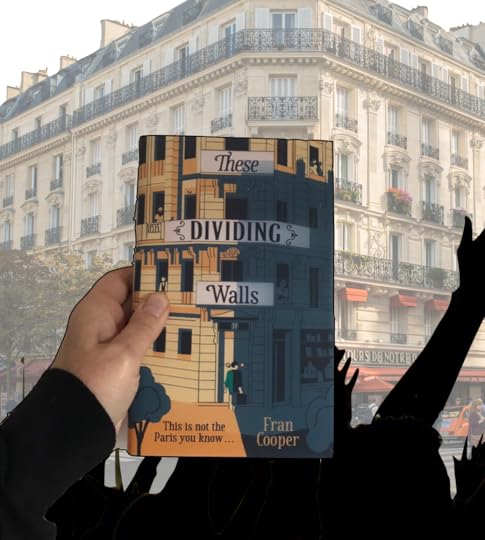
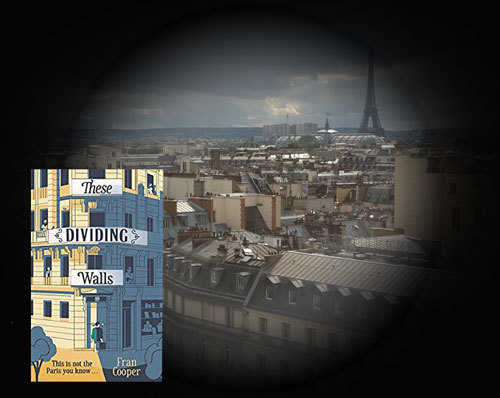
Within its walls, people talk and kiss, laugh and cry; some are glad to sit alone, while others wish they did not. A woman with silver-blonde hair opens her bookshop downstairs, an old man feeds the sparrows on his windowsill, and a young mother wills the morning to hold itself at bay. Though each of their walls touches someone else's, the neighbours they pass in the courtyard remain strangers.
Into this courtyard arrives Edward. Still bearing the sweat of a channel crossing, he takes his place in an attic room to wait out his grief.
But in distant corners of the city, as Paris is pulled taut with summer heat, there are those who meet with a darker purpose. As the feverish metropolis is brought to boiling point, secrets will rise and walls will crumble both within and without Number 37...
Whilst the setting in Paris, France might have you reaching for the book, what is inside is far more beautiful than any city could ever be. Between those creamy, orange covers is a story about life and the residents of the apartment building, Number 37 Rue des Eglantines, that has stood on the street corner for many decades.
Whilst the main character might be the young English Edward Rivers, who has taken up residence in his friend’s apartment as he tries to get away from his present life, the plot features so many more superbly created characters in the shape of the other residents, and one who lives on the street facing the building. Including many with secrets, passions, and a sense of trying to come to terms with their current situations.
Ms. Cooper’s writes so elegantly and heart felt. Every joyous, happy, sad, upsetting moment was vividly felt. The scenery was distinctly described. Don’t expected to be seeing Paris through the eyes of a tourist though, this is back streets Paris, it almost felt like I was stepping back in time.
This isn’t a fast paced book, this is one to be savoured. There are no twists, turns, big plot reveals, just a realistic story that centres itself on looking at society as a whole. This is a book that will make you think about the world we live in and, may even make you have a little bit of empathy for those around you.
These Dividing Wall by Fran Cooper, is a lovely little book set in Paris....more precisely on the Left Bank in a little known quarter of the city. Number thirty-seven sits at the meeting of two streets ...behind its grand turquoise door there is a courtyard and within its walls it’s residents carry on with their lives. Monsieur and Madam Marin are the caretakers. Madam in her bright clothes and high heels, creeping out late at night. Monsieur quietly going about his job, rarely speaking and always dressed in beige! Young Edward is over from England, to stay in his friend’s Emilie apartment. Frederique, aunt of Emilie, has lived in the same apartment all her life. Frederique and Edward become close, as they recognise in each other, that they have had significant loss in their lives. Chantal and Cesar Vincent, married for many years but both hiding secrets from each other. Cesar becoming more anxious about immigrants in Paris and the irrational need of wanting to keep their apartment block ‘Parisian only’. Isabelle Duval, the perpetual curtain twitcher, the one that sees everything that goes on. Bitter, unhappy and on her own. Anais and Paul with their three young children. Anais struggling with motherhood and wilting under the pressure - having little help from her husband. Her body on the verge of breaking! Homeless Josef who watches from the outside.
All set during a stiffling hot summer where ‘ produce wilts on the market stands up and down the city, and people wilt in their homes, too, day and night’
In the courtyard Madam Marin runs a hair dressing salon and in the corner is a tiny book store, crammed with art and history tomes. This book shop is different, most people do not even knows it exists, nobody ever purchases anything and it’s only clientele are dusty old historians with baggy dusty cardigans! Outside number thirty-seven is political unrest, protests, and demonstrations. ‘Tides of anger’ flowing down the streets. A lovely debut novel by this author .... an author I will definitely look out for in the future. I was supposed to be in Paris last month, but we lost our flights when an airline went under ( as well as the travel ban ), so I am having to console myself with reading about Paris rather than being there ☹️🥖🥐
Thanks to Goodreads friend Marianne for bringing this one to my attention and I hope she does not mind me copying her comment that These Dividing Walls is like anAlexander McCall Smith novel set in France. No real story, just lots of separate characters whose lives touch and mingle in the the course of everyday events.
I struggled a little with the background setting of political marches and racial hatred which for me intruded upon an otherwise gentle and interesting study of human lives. Somehow the two aspects of the same city seemed to belong to two different time periods.
Still an enjoyable read especially if you know and love Paris.
There's a lot to like about this book in terms of its warmth, its human interactions and its social conscience, but I couldn't help thinking it tried too hard to be quaint, colourful and consciously Parisian - though this is the Paris of Amélie, a picture-postcard from a nostalgic past, rather than anything recognizably contemporary. The character names are a giveaway: old-fashioned names suggesting the France of the Fifties, rather than the present day. The language? Too many unnecessary verbal reminders that we're in France (as if we needed them); too many "little cabbages." (Fun fact: in French, "mon petit chou" does not translate as "my little cabbage", but refers to the popular pastry, the chou à la crème, so would be the equivalent of something like "cupcake".) I know; they're all minor niggles, but the devil's in the details where research is concerned. Still, worth reading, by all means, though perhaps not by someone who knows Paris well...
I received an uncorrected proof copy in exchange for an honest review.
This book promised more than it could chew. I was disappointed, and agree with a previous reviewer who wrote "it lacks a plot". To me it feels like the author has attempted to write a feelgood-novel mixed with a little preaching on the social inequalities in the world and what they may lead to.
I don't like, or empathise with the characters. They feel too one-dimensional, and their "objectives" are too predictable: obviously the person who "runs away" will realise where his home is and return. The "love story" is evident from the start. The suggestion that a "normal" middle class man would be "radicalised" in less than half a year - or that a serious, violent protester would trust him with extremely secret information after a relatively short period of time does not ring true at all. Or, at least, the book didn't make me believe that it happened.
The writing style is very wordy. Sometimes it feels like the author has spent more time thinking up metaphors than plot, for example, this good bye:
"When she pulls her body away from his it is with a sigh that echoes long after she has retraced her steps down the interminable corridor, a sigh that echoes in his ears like the rush of blood in a seashell, the magnitude of ocean in a hand."
It comes across as pompous and contrived. Maybe it feels like the author has "tried too hard"? I'd be interested in trying another book by her where she spent more time on thinking of "what do I want to say" rather than "how do I say it". (But I cannot guarantee I would finish it!)
The cover is really clever - apart from the fact that the "turquoise door", that is mentioned umpteen times in the book, doesn't exist on the cover. Seems like it would have been an easy thing to fix.
I was disappointed in this book and it might be closer to 2 1/2 stars than 3. The book begins with the description of an apartment building and its residents in Paris. It is tucked away in a corner of the city that is not overwhelmed with tourists. In fact, the parts of the book that described tourists managed to turn me off the idea of visiting the city, ever. The descriptions of mad hoards of people just running from famous site to famous site to take pictures (and not actually see anything) were off putting. Although Paris doesn't need promoting to get tourists there, these descriptions, and the current climate in the age of terrorism, would scare many away.
One criticism of this book is that there are too many characters and many are not adequately developed. Some of the character's actions weren't well explained. Other characters had narrow back stories that are repeated endlessly without more elaboration. The depressed mother of 3 young children, the angry middle aged female vandal who hates immigrants, etc. etc. Things are neatly (perhaps too neatly) tied up in the end. The one compliment I can pay the author is that she kept this novel relatively short.
Anger against immigrants, and Islamophobia, are widespread in contemporary Europe. This novel attempts to deal with these huge issues in a book that starts off as a story about a building and its residents in Paris. What starts as a potentially sweet portrayal steers off into a story of contemporary hatreds. I do think there is a way to create such a portrait but in this novel the themes often fail to merge in a convincing way.
Setting: Paris, France; modern day. In a relatively unvisited area of Paris stands an apartment building at No.37 Rue des Eglantines. The people who live in the apartment building are effectively a microcosm of French society and, during a long hot summer, the residents have to learn to cope with the ups and downs of their own lives and with the seething unrest building in the country. Into the apartment building arrives Edward - trying to cope with the death of his beloved sister, a friend has offered him the chance to stay in her apartment in No.37. On arrival, Edward soon meets his friend's aunt Frederique and, despite the age difference, they find solace in their shared sense of loss: Edward of his sister and Frederique of her young son.... The story is mainly about Edward and Frederique but also features several other interesting characters whose stories I thoroughly enjoyed. Whilst there are no particularly earth-shattering events, the characters and their feelings really came to life for me and I felt considerable empathy for most of them. A quite different read, both for setting and theme, and I simply couldn't rate it at lower than 5 stars - 9.5/10.
These Dividing Walls is the first novel by British author and museum curator, Fran Cooper. Number 37 Rue des Eglantines is not in the fashionable, tourist-frequented part of Paris. It’s far back on the Left Bank, tucked in a warren of quiet streets, a block of apartments with two shops on the ground floor. It’s the place where Englishman Edward Rivers has come to escape. He’s staying in a tiny top floor apartment that belongs to his friend, Emilie. Her aunt Frederique is the first to welcome him and she recognises, almost immediately, the sort of loss from which he is running, having experienced it herself.
Frederique has lived at Number 37 for most of her life. She knows everyone there, but perhaps not as well as she thinks: many of them have something to hide. Chantal and Cesar’s happy marriage might not survive the secret that Cesar has been keeping for months, a secret that sees him taking extreme action. Hairdresser Estella Marin, the flamboyant gardienne of Number 37, seems a mismatch for the very beige Augusto Marin, with her barely discreet affairs, and yet….
On the second floor, Anais Legrange is a young mother of three who is at breaking point, while her hard-working husband, Paul is puzzled at the change in their relationship. Fourth floor resident, Isabelle Duval vents her xenophobic frustrations online, completely unaware that, one floor up, her long-time neighbour Henri Lalande is actually a Muslim.
Homeless Josef is often parked in an alcove across the street from Number 37. He watches carefully and perceives more about the building’s residents than anyone would believe. During a sweltering Paris summer, as racial tensions rise with the mercury, Number 37 have their own dilemma to deal with: Ahmed and Amina Laribi are about to move into the empty third floor apartment.
Cooper’s structure is not unlike McCall Smith’s 44 Scotland Street; she melds that with Katherine Pancol-like French characters in a drama that features loss and grief, pride and prejudice, depression and insecurity, love and loyalty and friendship. As well as the main characters, sometimes the building itself has a role as narrator; certainly, the City of Paris and her denizens are a play a significant part. Cooper’s prose is often beautiful and her characters are easily believable. This is an outstanding debut novel from an author to watch.
I was really, really impressed with this book; despite being a debut is it has such an assured feel to it. From the beginning I was drawn into the stories of the various individuals living at Number 37, storing up the nuggets of information provided by the author about each character. I felt a bit like James Stewart’s character in Hitchcock’s Rear Window, eavesdropping on the residents of the neighbouring apartments.
Number 37 seems to act as a microcosm of society, not just French society. There are secrets, frustrations, unhappy memories, prejudice, loneliness, depression, love and loss. But there are also new beginnings, reconciliations and a coming together in adversity.
The author very cleverly connects the intimate personal stories to the wider political situation in France where tensions over unemployment, immigration and change threaten to boil over in the sweltering heat of a Paris summer. Reading this in the wake of the terror attack in London, the events depicted and the emotions that gave rise to them really resonated.
I absolutely loved this book and I can’t wait to read more from the author who I’m sure has a glittering career ahead of her. Highly recommended.
I received an advance reader copy courtesy of NetGalley and publishers, Hodder & Stoughton, in return for an honest review.
I found this book really interesting but super lacking in plot! This is essentially a character study of people living in an apartment building, and how the political backdrop of France effects them. I did enjoy the writing style the most as it was beautiful and found myself hoping for a happy ending for many of the characters. A full review will be ok my blog on Friday!!!
In a rundown, unfashionable part of Paris, far removed from the romance and grandeur of the City of Love a young Englishman arrives looking for a safe-haven following a family tragedy. As he tries to deal with his own inner confusion he becomes embroiled in the lives of his many neighbours and their worries, their dislikes, their uncertainties represent a sense of wider change and growing agitation in Paris as a whole.
There is so much to enjoy in These Dividing Walls. She writes with impressive assurance and clarity for a debut novel, with perfect narrative control and poise. Her characters are excellently realised, forming a diverse cast of peoples whose lives intersect and collide in their shared building, it's a dynamic that you will probably be familiar with if you have ever lived in a block of flats. These are convincingly ordinary people, living recognisable, largely unremarkable lives but Cooper writes them with real charm and sympathy, and a finely-judged dash of eccentricity so that you come to care for each of them in spite of their flaws and pettiness. They're amusing infuriating, heart-breaking and most importantly they are believable, because this is not just a charming, light-hearted tale about neighbourhood relations, it's also a book of clever contrasts that sheds thoughtful light on the sides of Paris more at home in the headlines than the picture postcards.
"Oh, Edward," one character sighs towards the end, "the myths we make for ourselves," and this theme defines many of the contrasts that Cooper contracts between the real and the imaginary, the simplified ideal and the complex reality. There's subtlety and insight in the way that the grandeur of the Louvre and Monmatre with homelessness, unemployment and the struggle to make ends meet in the dilapidated streets where Edward settles. These daily struggles weigh on her characters and the new Muslim family moving into the building become easy targets for hostility and frustration. These issues are sensitively unpicked as fear and tension rise with a new terror attack at Notre Dame and the violent response of the Far Right. She convincingly demonstrates the all-too-easy drift into extremism for those looking for someone to blame and it rings very true both for those characters who watch on from the periphery in horror or vindication and for those swept up more directly in the flow of hatred. My only reservation with this aspect of the story is that there is so little of the Labiris (the new Muslim residents) whose perspective could have contributed so much.
The way that innocuous personal narratives are woven with violence and terrorism is remarkably true to the way these things really touch most people, shockingly but often peripherally and life goes on in spite of them. Edward struggles with his personal grief and forges new relationships far from home while his neighbours struggle with failing marriages, unorthodox relationships, loneliness and mental illness. And yet despite it all this is not a dark book. It's full of characters I became fond of and is often astute and touching in equal measure. It offers a lot of hope without denying that there is darkness in people. A warm and ultimately uplifting story
I didn’t know what to expect when I found These Dividing Walls. I think I had seen something about it somewhere but decided not to read it. It was obviously contemporary but then discovering the book in my favourite bookshop Lorelei, I took a closer look at the prose and then straight away knew that I couldn’t ignore such beautiful writing (and for a first time novelist - a young English woman writing about the French). Who can resist that? Cooper sets the scene with elegance and a wonderful flow. We begin with the building itself in a backwater of Paris. We then encounter a young English man Edward (trying to escape his own grief) who sees the small apartment he has been leant by a friend for the first time in the light of day. “Four o’clock, and Edward stands outside his new building in a new city, breathing damp summer deep into his lungs.” But it is Frederique who drew me as a reader. She has lived in the apartment block since she was a child: “That is how she thinks of this apartment, her childhood home: a place where feeling is left at the door. So many years seeking expanse, horizon, a space larger than this city, a world beyond the bourgeois formalities cradled within these walls. And then to have life made infinite; to have a son, and lose him and to feel the universe in all its immensity within her bones. To become hollow and yearn again for the slim childhood bed, the flowery walls, the heavy furniture and the grim-faced portraits - everything that had suffocated her before in its intensity turned now into a cushion against pain; scar tissue around her heart.” How wonderful is that? Cooper goes on to acquaint us with the other major players in the apartment block but her touch is not just personal. As we read These Dividing Walls Cooper spreads her net to Paris itself, to an unrest that is pervading the city. There is a divisive meeting of the residents of number 37 at Cesar’s apartment. And the news for some of the residents is not good - a Muslim family is moving into the third floor apartment of Batiment A. Whilst Edward finds his way in this new Paris life, we learn more about the other residents. Soon after the meeting Cesar (who has lost his job but hasn’t told his wife) is drawn into the shady world of a violent dissident group. Anais, the exhausted young mother with three children, becomes more paranoid and the new Muslim family arrive. There is a terrorist attack in Notre Dame and with impressive skill, Cooper evokes not only the events but the effect on each of the residents and the city itself. But it’s not over yet. “But there are also those who stay at home. Those who watch the pictures on the news from inside their airless apartments, those who peer anxiously out from behind their blinds, afraid of or waiting for something to happen in the city streets.” An enjoyable read.
A ship of fools story set in the real Paris, the Paris few visitors experience. A glimpse at a disparate group of people struggling to live in a hot, steamy, dusty and doubtless over-priced apartment building in an unfashionable Parisian suburb, all living mundane, workaday, recognisable lives against a backdrop of rising political tension, the divisions of race and religion, and the ever-present threat of terrorism. Each character has their own demons to battle, their own struggles, and though I found the politics more than little black and white and lacking in nuance, it was an interesting hook to hang a story on, though it has to be said, there’s not much of a plot, and what there is is entirely reactionary. This is very much a character study: a harassed mother, slowly losing her mind; the fiercely leftist bookshop owner with a big secret, her looks fading in middle age, who finds solace in her friendship with an English student seeking respite from his grieving family. There’s a recently redundant banker who resents the young immigrants he blames for taking his job; a young Muslim couple moving into the building, and Isabelle, who simply does not want Muslims around. Dividing Walls is a perfect title for this tale of personalities clashing and melding as the heat of summer builds and tensions rise to a horrific crescendo, before tumbling down the other side of the tale as the characters all react to events in their own way. Some stories are resolved, some are not and are left hanging, like life. I can’t say I was entirely engaged for the whole of it. My attention definitely sagged towards the middle. It picks up pace when The Event occurs, right at the apex of the narrative, when the story grows markedly more interesting, though still somewhat lacking in incident for my taste. The best of this novel is in the writing, which is deliciously metaphorical - lyrical, with incandescent moments which are truly poetic, yet always within the flow of the writing; thrown-away brilliance that never interrupts the flow or is too self-consciously clever. The story lacks impetus. It is often patchy, with a narrative that is not often well stitched together. There are some nicely-sketched characters, but read it for the writing. The glorious writing is far and away the best of it, the reason I recommend everyone should read it and and why I am very much looking forward to reading what Fran Cooper writes next.
Stories about people in apartment buildings are a bit like stories about groups of school mates for me – you invariably have a mixed bunch of characters who are tied together because they have one (physical) thing in a common – a building. I generally quite like these stories, which is why I picked up Fran Cooper’s These Dividing Walls (the very pretty cover also swayed me).
These Dividing Walls is about a particular apartment building in Paris. It’s described beautifully, just as I imagine the quintessential apartment building in Paris to be – a courtyard, heavy wooden doors, flower boxes, winding staircases, a garret room at the top and, the pièce de résistance, a bookshop at the bottom.
There’s a mix of characters, dominated by Frédérique, the book shop owner, and Edward, a visiting Brit, in Paris to grieve the sudden death of his sister.
Thankfully Cooper avoids a stereotypical cast and her descriptions of the apartment block residents are playful and intriguing. However, afforded the opportunity to assemble an unlikely group of characters, Cooper takes it one step further and throws in some unlikely plot twists. When you’re building a story around characters whose lives would not ordinarily cross paths, I think their interactions must be believable. And it’s enough for the plot to be dominated by these interactions. Unfortunately, in These Dividing Walls, the interactions felt contrived, the characters built around pushing a certain (political) agenda and there were too many parallel story-lines that had to be hastily resolved at the end.
There are some lovely passages in this book – an awkward one-night stand described as “…a night where the only bits that bumped were the bits you didn’t want to – a long percussion of teeth and noses” and some sensitive thoughts on grieving – “…everything that had suffocated her before in its intensity turned now a cushion against pain; scar tissue around her heart” but these sat alongside the ‘action’, upsetting the pace.
2/5 Not for me but don’t let that stop you.
I received my copy of These Dividing Walls from the publisher, Hachette Australia, via NetGalley, in exchange for an honest review.
I just really liked this book. As other reviewers have said it isn't exactly plot heavy but it still covers important issues. An old building on a quiet Parisian street is home to a variety of characters with their own stories of how they got where they were.
The ones that stand out the most are Edward, the young Englishman staying in a friend's apartment in the building, while he is trying to heal after the death of his sister. His friend's aunt Frederique recognises that same look in his eyes of someone who has lost a dear family member (she lost her son ten years ago to a fire) They form a friendship over their tragedies and become close.
The other people's stories are important too and a lot of the events are very current to what is happening in the world. The increase of Islamophobia and intolerance to anyone of race or colour are very much in the fore here, but also how people deal with it. Terror attacks, reprisals from white extremists, even the hidden racists. It sounds pretty heavy, and in some places it is, but it is also a celebration of our differences and the need to change perceptions of people. This was a really readable novel about a slice of Parisian life in modern day France. And although the story is set in France it is relatable to any street in any country.
These Dividing Walls is such an important book. I merely bought it as I was rushing through an airport and wanted something with a French flavour. My word, did I get so much more for my money. This book is both well written and well researched. Fran Cooper manages to draw you in to a story that seems to be all about a young man trying to escape a tragic accident in England, but weaves together the stories of so many other authentic characters whose attitudes to the social justice issues of our time make for a novel that will leave you thinking, not just about a beautifully told story, but also about how as a society, we can do better.
Such a cleverly interwoven plot. The interconnections between each of the characters is effortlessly portrayed as we witness the whole spectrum of emotions and complex parallel lives residng under one roof in a seemingly ordinary corner of Paris. A deeply affecting, intelligent read.
I couldn't finish it. It became all about the politics. And I understand how much Paris is dealing with politics now and a terrorist mess because of their policies. Just not my cup of tea to be entertained with.
Novel set in PARIS (a story ver much of our times)
Edward, struggling to come to terms with the untimely death of his sister, is offered the use of a tiny studio apartment in Paris by his university friend, Emilie. It seems an ideal solution, allowing him to escape into the anonymity of a big city and he spends his time crashing out in exhaustion in the tiny bedroom of the apartment, or else meandering around the Parisian bars trying out his schoolboy French.
Number 37, in the Parisian suburbs, represents a microcosm of France and the residents are a very mixed bunch, with their own individual preoccupations and concerns. There is the waiflike Anais, struggling to care for three small children while her husband, Paul, spends all his time at Bible study groups. Monsieur and Madame Marin, residing on the ground floor, lead increasingly separate lives, he attending to the cleaning of the bins while his wife decks herself out in her finery and heads out for a night on the tiles. Upstairs, Cesar and Chantal Vincent look like the perfect couple but Cesar is hiding a shameful secret; he has lost his job in banking, and hasn’t the courage to tell Chantal. Instead, each day, he takes the metro to a remote area of the city and whiles away the time in a café, where he begins to be drawn into dangerous company. Then into this mix a new pair of residents arrive, who happen to be Muslim.
Cooper is very skilful in her creation of these disparate characters – they’re utterly believable and an astute combination of flaws and admirable qualities. But the real achievement in this novel is the way she blends the individual stories with the gradually mounting political unrest in the city for this is a book very much of our time and the reader is acutely aware of the growing sense of foreboding as the far right gains momentum. There are scenes that provide no-holds-barred details of violence but Cooper counterbalances this with some real tenderness and some delightfully humorous descriptions. When Edward is invited to have a cup of tea with Fréderique, Emilie’s aunt, he finds himself seated in a very grand salon and, despite his efforts to be presentable (putting on his least crumpled T-shirt) he feels that he ought, at least, to have worn a proper shirt and muses, “This room has the air of one that expects buttons.”
The Paris described in this slim debut novel is not the one the tourist usually sees but it is, in many ways, a welcome change and offers the reader a glimpse into the true nature of the city in today’s turbulent times. These Dividing Walls certainly makes the reader ponder about the nature of prejudice and the hyper nationalism that seems to abound today. It is not, however, a depressing read as it offers hope for improvement. Edward, alone amongst these characters, manages to break through the dividing walls and make a connection with someone else and, through this, he begins the process of healing.
These Dividing Walls takes the reader on a journey into the lives of the inhabitants of an apartment block in arrondissement Paris, drifting seamlessly from one character’s perspective to another. Meet among others, Edward and Frédérique, both stricken by grief; depressed and emaciated mother of three Anais and her absent husband Paul; Chantal and her lost and disillusioned husband César Vincent; Madame Marin, the gardienne who runs a hairdressing salon in the courtyard and slips out in the night; the hate ridden Isabelle Duval, and Josef, the vagrant who sleeps in the doorway opposite. Through this cast of quirky and troubled characters the various attitudes to be expected in any social mix, from tolerance through prejudice to extremism, are explored.
The writing is exquisite and discursive. The narrative meanders, rich with incidental details and acute observations, Cooper’s strength, her ability to enter into the souls of her characters. Frédérique seeks “a world beyond the bourgeois formalities cradled within these walls…everything that has suffocated her before in its intensity turned now a cushion against pain; scar tissue around her heart.”
The use of the present tense brings an immediacy to the story, focusing the mind of the reader on the characters in close proximity. Through it, Cooper, invites the reader to ponder the inane and banal aspects of prejudice.
These Dividing Walls is a slow read that contains few surprises. The portrayal of terror and reprisal bleeds into the narrative, growing ever larger, vying for centre stage, seeking to oust the much larger and more poignant story of grief. Contemporary fiction is difficult to write, for the risk is always that themes appear stuck on, worked into something already in existence. Cooper manages to achieve a good balance, using the weather – Paris endures a June heat wave – to full and dramatic effect. Ultimately, it is the weather that binds this story and makes it work.
An apartment in Paris filled with people from all corner of the globe – now I’ve lived in such a place and didn’t know my neighbours either – that planted the seed for wanting to see behind the closed doors of this apartment block!
There’s something delicious about peaking behind the curtains (or lack of as is the case in France) and seeing what people get up to. There’s the curious in all of us and this is a fascinating insight into a multicultural French society.
Crime and trouble is known to become worse when the heat of the summer gets worse, and this is no exception. Paris is having problems – there is racial tension on the streets and protests of all descriptions. When a muslim family moved into the building, I felt a prickle of nerves as this was becoming very poignant and relevant to what’s going on in the world today.
There’s not much to be said other than you have to read it and go on the journey with these people to see, experience living in a Paris apartment and a city undergoing turmoil in every sense of the word.
I found the ‘afterword really interesting as this illustrates how life carried on after the riots and turmoil of the summer
Possibly the longest read of my life. I'm going through a bit of a tough time so concentration levels are seriously low but this was HARD. I didn't dislike it, it just didn't grip me. The characters are all fairly interesting although I did struggle to keep up with who was who. Some people have said it lacks plot and while it maybe does to an extent, there is a sense of being in the midst of the real, gritty Paris. I appreciate that. I was torn between 2 and 3 stars, not because it's bad, just because it was slow. 2 stars due to my grumpy mood today!
I read almost the first half of These Dividing Walls. Whilst I found it quite overwritten at its outset, I soon settled into it, and met some rather interesting characters. Those that I found interesting are shadowed by some who are a little dull, and not that well developed either; there were also far too many of them introduced in such a short space of time. I enjoyed the concept of the novel more than its execution.
A beguiling work that started off slowly and gradually grew momentum. I loved it and felt it a book that demanded longer periods of reading rather than just short bursts. The writing is beautiful, the many characters well drawn and the narrative cuts right to the heart of racism in France. If you like Elizabeth Strout, the chances are high that you’ll like this.
An elegant, witty and big-hearted novel. Cooper takes us into the minds of a wide range of characters with astonishing talent and compassion. Definitely recommend.
Number 27, an apartment building in the little backstreets of Paris, houses behind its turquoise door a myriad of characters each with their own story to tell. Madame Frederique Aubry lives alone, running the bookshop on the ground floor. Madame Marin, gardienne of the building and owner of the hairdressers. Cesar Vincent, President of the Residents Association lives with his lovely wife Chantel. Then there is Anais, her husband Paul and their three children. Add into the mix, Edward, escaping from the death of his sister in England and the walls of number 37 begin to creak and groan with bubbling tensions and upheaval. Paris itself teeters on the brink as terrorists attack the Notre Dame and riots break out. Against this backdrop Cooper is wonderfully adept and skillful in relaying the stories of the individual characters before bringing them altogether and hurtling them towards a dramatic conclusion. Coopers writing is fantastic perfectly capturing a true sense of time and place in the heat of a Parisienne summer. It is a novel that says much about the society we live in today, highlighting the threat of terrorism ,and the ignorance of race and religion so vehemently held by those around us. This is a superb debut and I cannot wait to read what Fran Cooper writes next. Thank you Hodder and Stoughton and Netgalley for the opportunity to read and review.
While Paris is my favorite city in the world, it would be amiss to ignore the darker side of the City of Light. This book focuses on how walls, whether the be cultural, physical as in the parts of the city or the separate apartments at number 37, or what isn’t said between people, can cause problems.
My favorite quote from the book is as follows:
“There are those who light candles in churches, mosques, synagogues, temples. In distant corners of the city there are those who meet with a darker purpose, plotting to bring this feverish metropolis to boiling point. All of it under the same blanket of heat and dust, the same dark sky, the same invisible stars drowned out by the sea of electric light.”
We never know the thoughts in the heads of others nor do we know what goes on behind the walls/doors of elsewhere.
This book is a glimpse at the other Paris, the other France. As an avid Francophile and French teacher, I did not learn anything new from this novel. I would still recommend it.