Jump to ratings and reviews
Rate this book

The Milk Lady of Bangalore: An Unexpected Adventure

Rate this book
The elevator door opens. A cow stands inside, angled diagonally to fit. It doesn’t look uncomfortable, merely impatient. “It is for the housewarming ceremony on the third floor,” explains the woman who stands behind the cow, holding it loosely with a rope. She has the sheepish look of a person caught in a strange situation who is trying to act as normal as possible. She introduces herself as Sarala and smiles reassuringly. The door closes. I shake my head and suppress a grin. It is good to be back.

When Shoba Narayan—who has just returned to India with her husband and two daughters after years in the United States—asks whether said cow might bless her apartment next, it is the beginning of a beautiful friendship between our author and Sarala, who also sells fresh milk right across the street from that thoroughly modern apartment building. The two women connect over not only cows but also family, food, and life. When Shoba agrees to buy Sarala a new cow, they set off looking for just the right heifer, and what was at first a simple economic transaction becomes something much deeper, though never without a hint of slapstick.

The Milk Lady of Bangalore immerses us in the culture, customs, myths, religion, sights, and sounds of a city in which the twenty-first century and the ancient past coexist like nowhere else in the world. It’s a true story of bridging divides, of understanding other ways of looking at the world, and of human connections and animal connections, and it’s an irresistible adventure of two strong women and the animals they love.

238 pages, Kindle Edition

First published January 23, 2018

153 people are currently reading
4474 people want to read

About the author

Shoba Narayan

17 books32 followers

Ratings & Reviews

What do you think?
Rate this book

Friends & Following

Create a free account to discover what your friends think of this book!

Community Reviews

5 stars
301 (18%)
4 stars
635 (38%)
3 stars
546 (33%)
2 stars
114 (6%)
1 star
38 (2%)
Displaying 1 - 30 of 277 reviews
Profile Image for Diane S ☔.
4,901 reviews14.6k followers
December 20, 2017
Moving back to India, after twenty years in the states, the first thing Shoba encounters is a woman with a cow, in the elevator of the apartment building in which she and her family are moving. This is her first introduction to Sarala who will soon be her introduction to all things cow.

Who would ever think a book about cows, their urine and dung, their milk and the benefits from drinking it straight from said cow, to be so fascinating? Yet,I was, I loved this story, loved the people in it, and loved reading about the vibrant and colorful country of India. The importance of cows in the Indian culture, and how this came to be. The many uses of cow urine and dung. So much about their culture, their traditions, and the importance of family. So yes, it is about cows, but it encompasses so much more.

Loved the friendly tone, like the writer is talking to you, explaining to you. Not at all snooty, just wanting to learn, understand, and embrace all that she can. Also explains some of the differences between those who hold with the old traditions, and the young people who now want to be modern. Generational gap. So friendship, family, and cows. Loved it!
Profile Image for megs_bookrack.
2,167 reviews14.1k followers
February 23, 2023
I adored this book. As memoirs go - top, top notch - super interesting and engaging!


The Milk Lady of Bangalore took me completely by surprise. I had no idea what this was going to be like and within the first few pages I was hooked.


Narayan, a journalist by trade, writes in such a pleasing way. To me, it flows like you are sitting for coffee with a friend and she is telling you a very detailed story. I couldn't put this one down and ended up reading it in three days.

This is a memoir, one of the best I have EVER read, but it is truly so much more than that.

The basic gist is that Narayan decides, with her husband, to move back to their native-India after living for 20-years in the United States. They both have parents who are getting older and as they have two children, they want them to know their grandparents and experience their culture.

They move into a large apartment building in Bangalore and on move-in day, Narayan, by chance, meets Sarala, the milk lady. This is how it all begins.


This book is a beautiful examination of culture, friendship, life, love, loss and growth. I laughed and I cried. You know you have found a special book when such a wide range of emotions are elicited.

It was interesting to read about Narayan learning about her own culture for a second time. I could absolutely relate with a lot of her feelings, having moved away from the area I grew up in, and being away for many years, going back, you see things with fresh eyes. You can appreciate how much culture varies from area-to-area and that can really bring forth a lot of self-reflection about ones own beliefs, traditions, goals, wants, needs and really where one feels like they belong.

Now, COWS:


In this book you will also learn so much about cows. Magnificent animals; they really are.

This is really part microhistory of cows and their role/significance in Indian culture, particularly through different Hindu beliefs and customs. I absolutely adored that aspect of the book. If you are someone who enjoys microhistory as a subgenre of nonfiction, you will love this.

Also, if you are a foodie, you will probably love this and should definitely read it. There is a lot in here about milk, the different types / properties of milk. I am telling you, fascinating.

Overall, I applaud Shoba Narayan for her efforts with this and I say, thank you, for sharing this part of your life with the world. It was beautiful!

Also, a big thank you to the publisher, Algonquin Books, for providing me with a copy of this to read and review. I truly appreciate the opportunity and apologize that it has taken me so long to get to this! One of my favorite and most unique reads of 2018 so far!
Profile Image for Jenna ❤ ❀  ❤.
893 reviews1,846 followers
October 9, 2018
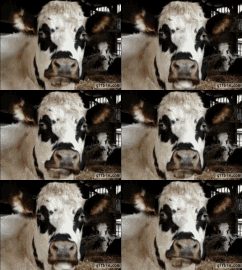
Chew GIF - Cow Cows Chew GIFs

What an absolutely charming memoir! In The Milk Lady of Bangalore, Shoba Narayan tells of moving back to India with her family after 2o years in the United States. She quickly befriends her milk lady Sarala, a generous and deeply superstitious woman who raises cows within the immense city of Bangalore, supporting her family by selling the milk. When Sarala needs another cow, she entices Shoba to help her purchase another.

I learned quite a lot about the richness of Indian culture and so it was most interesting and fun to read. Narayan writes colourfully and whimsically about Indian mythology, infused as it is with everything cow. I didn't want to put this book down and highly recommend it to animal lovers and people wanting to learn more about Indian culture. Within you will learn about Hinduism; Indian mythology, culture, and food; and cows -- their personalities and preferences, the supposed medicinal properties of their urine and dung, their milk, their ability (so it's believed) to assist humans and bestow great fortune upon those who honor them. It is a quick, enjoyable, and delightful read, though with a bit of sadness in a couple of chapters as well. The author dwells more on the positive though, and writes humorously.

The bit about drinking cow urine might be disgusting to most Western readers, so be prepared to perhaps get grossed out. As a vegan, I find it at least as disgusting, if not more (maybe I'm weird!) to drink milk, so don't worry -- it's not THAT bad to read about! I think it's more fascinating to learn about other cultures than to be disturbed by any differences.

If you'd like to know what it would be like to get onto an elevator only to find a cow standing there, waiting to go bless a new home, read this book. If you'd like to know what it's like to go cow shopping, finding the right one to suit your and your family's personalities, read this book. If you'd like to know what cows mean to the majority of Indians, read this book. If you want to know the process of donating a cow in order to get good karma and blessings from the cow (because hey, who couldn't use a little extra good karma?!) read this book. If you just want a fun, interesting, and light read, this is the book for you.
Profile Image for Katy O..
2,997 reviews705 followers
January 21, 2018
Some books enter into my life for the simple purpose of making me a more informed world citizen, and I am all for that. However, THE MILK LADY OF BANGALORE 100% did that, but also did the almost impossible and utterly charmed and entertained me at the same time. Narayan has taken a topic that seems to be incredibly simple (the life of the milk lady across the street from her apartment building), and has woven it into not just a rich look at life in modern India, but also a compassionate and loving tale of one family's life and livelihood, as well as a well-researched and fascinating account of the role of the cow and milk in Indian culture throughout history. And not just that - she wrote all of this in a fast-paced and addictive style, from her unique perspective of being born in India, living in the US for 20 years and then returning to India as an adult with her family.

As a lifelong Wisconsin resident, and a cow-landlord for 6 months out of the year, I thought I knew pretty much what I needed to know about these giant animals. But no. No, I didn't. Narayan has made me desperately want to travel to India ASAP to see for myself the differences between desi cows and imported hybrids. And taste packet milk versus fresh milk sold on the street. I want to see a cow shelter and I want to donate a cow to a Brahmin. This book is one I will truly never forget, and its gift of the cow urine anecdotes will give me something to bring up in awkwardly silent social gatherings for years and years to come.

If you read one nonfiction book in 2018, make it this one. And then PLEASE be in touch so we can talk about that cow urine. Please?

Thanks to Algonquin Books for the complimentary review copy of this title - all opinions are my own.
Profile Image for Ashish Iyer.
873 reviews636 followers
December 24, 2019
It was a fun reading this book. Thanks to one of my goodreads friend aka coconut lover to recommend me this book. I literally had to google each and every Desi cow to know the details and it was really fun. Now at some extend i know the different in various Desi cows breed and even some foreign ones. This book has a beautiful story with cultural and historical facts. This reminds me of my school days when we used to write an essay about cow in Hindi. Ahh... those were the days.

Now, i so want to go to cattle fair in Dindigul, Dakshin Vrindavan in Palakkad and Jallikattu event in Tamil Nadu. Now i know the right values of cows in India and yes, Gau rakshak too. We need some kind of laws to protect such cows. Cow stealing is a very big issue(underrated) in India which we always see from stealer point of views. Its high to hear from farmer's point of views as well.
Thanks to Shoba Narayan for writing such an interesting book.
Profile Image for Andrea.
1,088 reviews29 followers
August 15, 2021
I had a fair idea that I'd enjoy this book, but still I wasn't prepared for just how charming and informative it was.

Milk from a black-colored cow is best because it balances all the three doshas (imbalances) of the body. Milk from a red-colored cow balances vata, the air element that causes arthritis, gas, and bloating. Milk from a white cow is the worst: it causes kapha (mucus). What about milk from patchy black-and-white cows such as the Holsteins? Open to interpretation, I guess. (This, before the prologue, even!)

The author is a journalist who grew up in India, but spent 20 years living in the US before eventually relocating her family to Bangalore (Bengaluru, Karnataka). Moving into a brand-new apartment complex, the lift door opens and she encounters Sarala - the milk lady - with one of her cows no less, for the first time. The cow is being taken to a housewarming ceremony for one of the author's new neighbours. We learn that if the cow was good enough to deposit some dung on the floor of the apartment, it would be considered very auspicious, and seemingly before she has even consciously decided to do so, she seeks out the milk lady to bring the cow to her own apartment next. It turns out that Sarala's family urban dairy enterprise is based in the neighbourhood, with the twice-daily milking taking place just across the road. A kind of friendship develops between the two women over the ensuing years, and as the author becomes involved in the business herself (investor), she shares what she knows and what she learns along the way about cows, about their milk, about their place in Indian culture and Hindu lore. It's surprisingly fascinating!

Aside from the cows, the book also offers insight to a modern Indian slice of life. The author's family is financially comfortable, so a lot of their tension comes from regular family life, and balancing modern freedoms against traditional restrictions and commitments. Sarala's family is quite different, living hand-to-mouth as they do. They have issues with housing, schooling, finding partners for their sons, changing their business focus to improve their livelihood - the worries are neverending. But in the end, they are happy and content.

Highly recommended.
Profile Image for Srivalli (Semi-Hiatus).
Author 23 books736 followers
September 12, 2021
3 Stars

Disclaimer: I picked this up as a memoir for a reading challenge because I prefer lighthearted memoirs.

The author is an NRI, a US returnee in India, and it shows on every page of the book.
It has been written for the US audience, and I’m not sure how much they’d be interested in without feeling overwhelmed and confused.

The Indian readers, on the other hand, would have had many more experiences with cattle (at least many of them would). There’s quite a lot of information overload, a good lot of taken from other sources. Even some of the initial statements seem to be rather carelessly summarized from news portals.

Also, I could do without some of that high-flying attitude implicit in the overall tone. Moreover, the book is quite disjointed. I wasn’t surprised to read in the author’s note that these were first shared as individual installments. The stitching together of various incidents to create a book is quite evident.

That said, Sarala is a wonderful character, or rather person, and her grit, resilience, persistence, and acceptance of life are not uncommon in people whose livelihood depends on cattle rearing.
I lived in the same street where a family had buffalos and cows at home and was into the diary business. The smell of cattle is hard to miss, even on people. But what’s more apparent is their hardworking nature and their determination to lead a dignified life. Yeah, they aren’t perfect by any means. Some of them are aggressive and (over)protective of their cattle. Can’t blame them either. They lose everything if they lose even a cow.

I didn’t even have to imagine Sarala. I’ve seen her every day for almost two and a half decades. We’ve gotten milk from them (though we had another milkman).

We know their pain when they don’t find their cows. They drive through the same roads, enquiring if anyone has seen a certain cow grazing in the open lands. The cows could be stolen, bound, and carried off to the butchers, and they wouldn’t even know until it’s too late at times. Imagine someone stealing your livelihood for their personal gains.

It does make one wonder why cows are left to graze outside on the roads. The answer is simple. Feeding a cow is costly. They eat a lot (to produce milk twice a day), and the milkmen wouldn’t have any money left if they had to feed the cows. They give them as much as they can afford and leave the cows to graze in the open and eat their fill. That’s why running a gaushala (a shelter home for cows) is so darn expensive and needs donations to care for the cows and calves.

Even today, we get milk from our milkmen (or boys, they are young guys), and well, we prefer it over the packeted version. By the way, we get buffalo milk for daily use and cow milk during festivals.
And hey, we used gaumutra in our new home because we couldn’t bring a cow (it wouldn’t fit in the elevator). Just throwing in some ‘shocking facts’ as the author did in the book.

Now you see why I’m not really impressed by the book. I like that it was about Sarala, but that’s about it. The author’s latest book seems to be a lot better than this, so I might pick it up.

*****

Note: A lot of 'educated' people on social media make jokes and call Hindus cow-piss drinkers. They think that the gaumutra jibe signifies their superior intellect. It is not. Instead, it is a sign of Hinduphobia. It is not funny. Neither does it make them cool or woke.
Profile Image for Virginia Myers.
302 reviews29 followers
December 22, 2017
This book was not what I expected. I saw in Book Browse that it was categorized as a "biography/memoir" and I somehow expected something different than what this book turned out to be. I thought it would be more of the typical type of memoir about some part of the author's life with a little informative data about Indian cows. It turned out to mostly about milk and cows interwoven into a little bit of the typical memoir type stuff.

I did enjoy reading the assortment of experiences that the author had as she befriended the lady from whom she bought milk every day and I learned a whole lot about cows and their by-products, e.g. urine and "poop".

By the time I reached the end of the book, however, I was suffering from an overload of information about such things as which type of cow provides the best milk and other previously unknown facts and figures about cows in general and Indian cows in particular.

So now comes the question: Would I recommend this book? It may be sort of a cop-out, but I will put it this way: If you are interested in learning some interesting facts about the life of a cow in India, then I think this is surely the book for you. Or, if you are the type of person who just enjoys reading non-fiction books that can add to your overall knowledge on different subjects, then I think you might want to add this to your list. If, however, you have no reason to want to learn more about customs and mores of the cow culture of India, I am not sure this is the book for you.

I received this book from the publisher in exchange for an honest review as a result of the BookBrowse.com ‘s e First Impression program.
Profile Image for Booknblues.
1,536 reviews8 followers
July 14, 2018
What a true delight it was for me to read The Cows of Bangalore: Adventures with My Milk Lady by Shoba Narayan. It is the story of an American immigrant who returns to her home country of India in middle age with her husband and two daughters. It was an interesting and eye opening view of India, especially its relationship to cattle. Shoba is a well-to-do Indian who makes friends with a local milk lady, who she first meets when moving into her apartment:

Inviting cows to warm houses is a tradition that continues in India. Fitting one into an elevator is a creative take on it. The Hindi word for this is jugaad. Jugaad is makeshift ingenuity; improvisation; recycling, precycling, and upcycling; finding new uses for everyday objects—and for that matter, animals. Indians are masters at jugaad. It is the product of a resource-constrained culture. When you don’t have enough, you figure out how to make do. You tie empty Coke and Sprite bottles around your waist in order to float in the water; you line up tattered shoes as goalposts when you play football; and you figure out how to get an animal to the third floor.

She quickly becomes intrigued with the cows, the milk lady and the idea of buying fresh milk. At first she is apprehensive about drinking fresh milk, but upon research, she feels compelled to try it. Soon it becomes part of her everyday life:

The Indian food chain, even in busy urban cities, still links cows and humans. In my home, for instance, I boil cow’s milk every morning, then let the milk cool a little before scooping out the cream on top and setting the remainder into yogurt. I collect the cream for a week and then churn it to separate the butter from the buttermilk. I divide the butter into two parts: one for sweet cream butter to spread on my children’s toast and the other to boil into ghee or clarified butter. The whole thing is a painstaking process—a nuisance, really—but I do it. As do many of my neighbors. We set yogurt, churn butter and when needed, squeeze a bit of lemon juice into the milk to curdle it into fresh paneer. Doing all this is a daily reminder of all we get from a cow, the giver of good things.

This is really a memoir as it takes place over ten years of her life, but it does mostly inform us about cows and milk, while filling in information about her life and her relationship with her milk lady and her family.

I found it intriguing being the daughter of a dairy farmer. Urban cows is an interesting idea, while we in America have adapted to the idea of urban chickens, I'm not sure we are ready for cows.

Narayan's writing is informative, humorous and entertaining. Even those who find no interest in this topic, may ultimately find the book endearing. I encourage anyone interested to read it. I did however round it down because I felt it may not have universal appeal, but I may end up rounding it up.
Profile Image for Amy Layton.
1,641 reviews80 followers
January 15, 2018
I didn’t expect to love this book so much or learn that much about milk from it. Not to mention, of course, the way India as a whole tends to treat cows, and why, and what they like to do not only with the milk, but urine and feces as well. Talk about versatile functionality!

Written with Narayan’s journalistic expertise, this book truly makes India come to life. Its social groupings, expectations, and lifestyle all converge to create a colorful picture that’s smattered across the board with cows.

And even better, even though this is a memoir-esque journalistic nonfiction book, Narayan provides so many sources and recommended readings to further the reader’s knowledge about cows, milk, and India. I’ll definitely be taking a look at those!

I just think this book is incredible, fun, and informative all in one go. I absolutely love all of the people Narayan interacts with, and I thoroughly enjoyed reading about how to go about purchasing a cow and donating a cow and how that all ties into India’s respect culture. I’ve done nothing in the past week or so except rave about this book to my coworkers at my cafe, and I just hope that anyone I recommend this to (everyone) will find this book as intriguing as I did.

Review cross-listed here!
Profile Image for Nicole Means.
427 reviews18 followers
February 19, 2018
Wow! “The Milk Lady if Bangalore” transported me back to 2010 when I had the pleasure of spending over a week in Bangalore. I only wish this book had been written then because the author provides so much insight into the ubiquitous cow found on the streets of Bangalore. Upon first spotting the cow, the tourist can be found staring with his/her mouth agape, but after several days, the cow is such a “normal” part of Bangalore, that the tourist barely notices. Narayan’s writing is truly exquisite overloading all of the reader’s senses through her vivid style. I recommend this book to anyone who is interested in understanding the role of the cow in Hinduism!
Profile Image for Karen.
Author 3 books12 followers
November 6, 2017
**Note: I received a free ebook copy of The Milk Lady of Bangalore in from NetGalley in exchange for a review.**
**Spoilers ahead.**

Through the theme of milk, author Shoba Narayan unexpectedly brings together aspects of modern India that I've never encountered in other works. And I say this as someone who briefly lived in India and who reads a great amount of Indian literature.

This story spans a number of years after Narayan and her husband, both Indians who lived in the United States for decades, returned to live in India with their children. Narayan found an unexpected -- there's that word again -- world through her connection with her neighborhood milk seller, Sarala. Sarala frequently offered Narayan experiences such as gathering grasses and herbs for her cattle to eat, visiting the cattle markets with her, and exploring the worlds of commercial versus independent milk production. Narayan took her up on these offers. Her book also delves into numerous societal factors that tie in with milk -- often unexpectedly. For example, families find unexpected divides between those who are open to cattle-based alternative medicine and those who are not. Narayan often takes what seem to be tiny details of the story and opens them up into enlightening, engaging stories.

None of this expresses the sheer exuberance of The Milk Lady of Bangalore. What I really loved about this book was its glimpses into many scenes of Indian society that I hadn't seen before -- for example, watching dust tint the sunset as millions of cattle come home to their calves every night at milking time in villages across India. I also loved Narayan's willingness to take up Sarala's offers of any and all experiences available to her.

If you're at all interested in India, take the plunge. The Milk Lady of Bangalore is well worth the read.
Profile Image for Smitha Murthy.
Author 2 books419 followers
July 18, 2019
Ah, Shoba! What a little gem you have written! I love cows. Ok. Ahem. And I love my Bangalore. Despite the mess it is in now. But you have to love what you love despite the mess, don’t you? Otherwise what’s that love? I had been waiting to read ‘The Cows Of Bangalore’ when it released last year and when I finally got the chance (read money), I was overjoyed.

With painstaking research and detail, Shoba has written a beautiful tale of her friendship with Sarala, the cow-woman, if I can call her that, and her cow-adventures as she gets caught up in Sarala’s family. I learnt so much of cows that I am now determined to go to Dindigul myself (Been a while since I have been to my beloved Tamil Nadu) and check out a ‘goshala’ or cow shelter.

This is a book to be savored and shared with other Bangalore-lovers.

PS: I feel saddened that this book has received just 21 reviews on Goodreads. We Bangaloreans, I tell you! Probably, if this book was named ‘The Cows Of Chennai,’ I am sure that there would an entire Twitter feed already dedicated to the #whistlepodu cows and there would be a yellow army wearing ‘Cows Of Chennai’ T-shirts. C’mon Shoba. Change the title. Let's make this amazing book cowpular!
Profile Image for Adrienne Blaine.
340 reviews27 followers
September 13, 2021
DNF at page 82. I think it’s misguided to accept this narrative as a tale of an unexpected friendship that transcends class. I fear this “feel-good” story does more to reinforce harmful ideas about people living in poverty.

When talking about what Shoba Narayan calls “the resilient matter-of-factness of India’s poor,” she says, “People get used to a certain standard of life, a way of being. They adjust to their lot. They learn to be happy within their means.” This is coming from an ivy league educated journalist who is married to the former head of emerging markets in Morgan Stanley. From this viewpoint she also writes about a man who decides not to go to the police after his cow has been run over, by saying that she admires how he “turned his impotence with the police into a choice.”

Narayan acknowledges the “Pandora’s box of guilt” that comes from “being surrounded by people whose means are drastically different than mine,” including the various domestic workers she employs. But she seems to use “the milk lady of Bangalore” as a prop for various forms of self-improvement. She admits, “the truth is that Sarala is not my friend,” because of their transactional interactions, but that she gains a great deal from maintaining a relationship with her.
Profile Image for Jess Johnson.
44 reviews55 followers
January 22, 2018
Not my cup of tea cow urine.

There were parts of this book I found delightful -- particularly the insight into Indian culture both past and present. That said, I found the narrator problematic. It felt like she couldn't decide if she or the milk lady were the protagonist and she ended up keeping both subjects at arm's length. We only really get close to her with which felt really out of place from the rest.

Shoba's interactions with her environment were strange for me. I felt like she had a distance from her subject that at times reminded me of an awkward 'eat pray love' which, if she weren't from India, would seem almost like cultural appropriation to me. That said, I felt towards the end she started to not just observe but live in the culture and it definitely picked up for me so I'm glad I finished. I just wasn't sure the end was worth the first half of the book.
Profile Image for Debbi.
467 reviews120 followers
January 4, 2021
Thanks to my GR friend Jenna for bringing this wonderful book to my attention! As a vegan and an animal lover this was a perfect read for me. It is a window into the cow culture in India but more than that it is memoir about connections. The writing is excellent, it is charming and unpretentious. Although I have read dozens of books about India, this book is unique, it demonstrates that it is often quirky details and traditions that make us who we are.
A couple of years ago it would have been unbelievable that people would bring a cow into their house for good luck. Now, it seems kind of normal. I have three chicken and one of them routinely gets through the cat door and forages for cat treats. I often find her snuggling next to the coffee maker. Good luck? I hope so. For Christmas I received a chicken diaper...who knew.
Profile Image for Beth Ann.
6 reviews
December 11, 2017
This was a delightful read! The cow in the elevator reminded me of baby camels in the back of a pickup I saw in Saudi Arabia. Ms Narayan has one foot in the States and one in India. That coupled with her language skills allow a glimpse into Indian life that one would never get just from visiting. She also generously sprinkles historical and cultural nuggets into the story to make it even more interesting.

This book is about cows but really so much more. It is about family, friendship, religion and our relationship with our animals. We may keep cats and dogs in our homes but the cow also enjoys a place in the daily life in India, even in the city. Our differences may be ironic and funny but at the end of the day we have the same problems of daily life.
Profile Image for Swati.
479 reviews69 followers
July 23, 2019
The Cows of Bangalore? When my friend suggested we read this together, the title made me do an about turn with its specificity. I had read one of Shoba Narayan's books earlier and I had liked her writing then. The Cows of Bangalore didn't disappoint either. Witty and self-deprecatory, Shoba draws a portrait of dairy farmers in a city like Bangalore along with her own adventures in acquiring a cow for purposes that will be clear when you read the book. Well-researched and told in a conversational manner, the book touches multiple aspects of life in India, particularly if you are a Brahmin. Peppered with Indian mythology, references to scientific research, and musings on friendships and life, this is a wonderful book that you can easily finish in a few hours.

My rating is 4.5 stars. I took out half a star only for the slightly sloppy editing, which shows itself in the repetition of certain myths or points of research. Shoba wrote this as a series of articles for a popular newspaper and I feel the book is simply a direct compilation, which might explain the repetitions.

They shouldn't stop you from enjoying the book at all, though.
555 reviews2 followers
December 31, 2017
The price of milk, the price of cows, and the price of friendship, all are suberbly explored in this book. Some basis in fact, I believe, and Ms. Nayaran’s mischievious sense of humor enlivens the narrative. Her research regarding the customs and traditions about cows, languages, and other ‘only in India’ information was a great plus. I thought the first half of the book could have been tightened a bit so a 4.5 rather than a solid 5. Heartily recommend.
Profile Image for Kristen.
117 reviews10 followers
May 5, 2018
When our author, Shoba Narayan, moves home to Bangalore after spending 20 years in the United States, she moves into a nice apartment building with her family and then her life intersects with Sarala (who she meets in an elevator with a cow), the urban dairy farmer who comes to sell fresh milk in her neighborhood. The friendship that unfolds is delightful, absorbing, complicated, hysterical, and loving. It was a gift to be invited into the circle of these women. The friendship begins when Shoba becomes irresistibly drawn to the idea of buying fresh cows milk from a known cow while at the same time being very concerned about pasteurization. She realizes that,
"The reason I want to buy milk from a cow is because I am trying to recapture the simple times of my childhood, particularly after the intricate dance that I have undertaken for the last twenty ears as an immigrant in America."
I find it refreshing and fascinating that the simple ritual of gathering fresh milk, for Shoba, had to do with "complex layers of emotion, romance, nostalgia,...,and loss." It makes me think of things that tie us to a place, especially in an era where people are so mobile.

Midway through the book, Sarala one day does not add the extra couple of teaspoons of milk after it is measured. The extra kosuru is always given to spoon out extra joy. Sarala withholds the joy because she wants to ask Shoba to buy her a new cow.

"What to do, Madam?" Sarala replies. "We are short of cows."
What happens on the remaining adventure of looking for a new cow is absolutely charming. It is where Shoba admits, she has fallen in love with a cow.

Mixed in with the developing friendship and the adventures of the women, are the gems of lessons about the cow industry in India: fresh milk, ghee, packet milk, milk cooperatives, pasteurization plants, cattle fairs, cow shelters (mostly for unwanted bulls), medicine, bartering (super interesting), superstitions, the differences between all of the native breeds, and the multiple roles cows play in the life of India. A reader will never look the same way at a cow after learning so much and "feeling" the importance to the Indian people.

Of course, I can't complete my review without mentioning all the giggles: cows in elevators, cow dung used as a cleanser, and the almost slapstick chapters where Shoba is torn about using the cow urine medicine and also when Shoba's modern cousin throws a fit when the Uncles bring a cow into his nice apartment to have it shit for a good blessing because, "Cow dung is where goddess Lakshmi resides."

Recommended to anyone who loves learning about other cultures and who enjoys being invited inside a friendship.

Profile Image for Robert Yokoyama.
233 reviews10 followers
February 11, 2018
Shoba Narayan describes a part of India that I would love to visit. She is New York educated journalist but was born and raised in India. She moved with her family to Bangalore so she could reconnect to her Indian culture. Bangalore is a place where people of different religious beliefs can peacefully coexist. I never thought a person from a Christian faith and a person from the Hindu faith would ever get married without receiving scorn. I would love to live in Bangalore because of this. I learned that people who live in the southern part of India speak a different language from people who live in the northern part of India. The author mentions about four different languages in this book. I would like to learn how to speak Telugu, Tamil, Sanskrit and Bengali. Learning the distinctions of each language would be fun. I have never seen a cow being milked on the street or any where and it would be interesting to see how it is done. I like the practice of arranged marriage in India. I would move to India to see if this would work for me. I did know about the caste system in India. India is divided into four different castes. There are priests, warriors, merchants and a caste called sweepers. I think sweepers are cleaners, but the definition of the sweeper caste is not explained. I liked learning about this piece of historical information.

Every fact about cows in this book is fascinating in this book. I learned that the urine from cows can be used to make medicine to treat cancers. I learned that smelling the dung from cows can make me smarter. I never thought of cows as animals who have feelings, but it is easy to believe. Cows are like valued members of the family in India because they all have names. They can mourn the passing of family members by staying in one place. I have a hard time sleeping, and I learned that putting saffron and cardamon in milk can help me sleep better. Buying a cow is like buying a car because there are so many things to consider like a tail that wags and strong teeth. These are signs of a happy cow. I learned that a happy cow is one that can easily be milked. Cows eat unusual things in India like cucumbers, watermelon and mango peels along with thirty different kinds of grass. I learned many things about life in Bangalore and about cows reading this book. I really like this book.

Profile Image for Renée | renee.the.reader.
109 reviews24 followers
January 22, 2018
*An advanced reader ebook copy was provided by the publisher via NetGalley in exchange for an honest review*

I loved reading Narayan's unique perspective on Indian culture. Though raised in India, Narayan spent 20 years in the U.S. before moving back with her husband and two children. Thus she can see Indian culture as both an insider and an outsider. I think this provides a great access point for readers like myself who are not Indian or Indian American. She can switch between her experiences as a child in India to the Western influenced perspective from her time in the U.S.

I love the cultural and historical tidbits provided throughout. Narayan seamlessly ties together her everyday interactions alongside the Bhagavad Gita, the Vedas, and Ayurvedic medicine. I never thought I would read about cow excrement and urine let alone their alleged curative powers. Gomutra is the term refers to the usage of cow urine as a remedy for a number of ailments. Despite the odd sound to Western ears, it was fascinating to learn about Gomutra and other alternative remedies and Narayan handles it with both knowledge and a touch of humor. Not only does she provide information about Hindu principles and practices, Narayan introduces the reader to Sarala, her milk lady. Sarala and her family have several cows, which they milk and provide their customers with fresh raw milk. One of the most endearing parts of this book is the friendship that develops between the two women. Sarala teaches Narayan, and thus the reader, a lessons about live and cows.

This booked sparked my interest in learning more about Indian culture and Hinduism. I love when a book makes you want to read even more books. I would highly recommend this fun, informative, and quick read!
Profile Image for Joan.
309 reviews5 followers
June 18, 2018
If you all were expecting a review of this book, sorry but it took me awhile to really process it. I knew cows were sacred in India, but I had no idea it was so profound. The author develops a relationship with a milk lady in India, and I guess since they're not many milk ladies, it's special. This book went through all ways cows effect people and people effect cows I guess. If a cow defacates in a new house, it's considered blessed, drinking the cow urine and cure numerous illnesses, among other things. Gave me a more realistic view of Indian life than some of the other Indian books I've read. Felt more realistic anyway, since the author is a character in the book.
Profile Image for Vaishali.
1,178 reviews314 followers
March 26, 2022
Do skip the audiobook version ; it’s voiced by an Indian who mispronounces all the Indian words (!) and has a voice tone which makes the author seem arrogant. I found the content itself blasé, but will be perhaps more interesting to individuals unfamiliar with life in India.
Profile Image for Matangi.
525 reviews23 followers
June 30, 2022
i really liked this book! it was humorous and interesting and engaging. The author’s perspective came off a little bit sheltered/ privileged/naive and was tone-deaf on class and caste
Profile Image for Sandy.
2,800 reviews71 followers
February 7, 2018
I’m lactose intolerant yet here I am reading a book about cows and milk. Hum? I thought this novel sounded interesting and that is why I asked to read it and interesting is what I got. I found out a great deal about cows but I also got an interesting story about a woman who packed up her family and took them back to India. Both Narayan and her husband were from India and they had family there. Looking out the window of her apartment one morning, she spots a woman milking a cow across the street selling the fresh milk to individuals waiting in line. Apprehensive to the idea, Narayan reaches out to talk to the woman, Sarala, and thus begins a friendship, a journey, an education that she will never forget.

I learned a great deal as Narayan and Sarala build their friendship. Sarala has a deep connection to her cows, a connection that goes back many generations. I guess a lot of what I read makes sense but to stop and think about it, I hadn’t really done that. I learned that what you taste in a cow’s milk, should be what the cow has ate. A good connoisseur should be able to taste the wheat, the grass, the barley, etc. that the cow was grazing on. Now, this pertains only to unpasteurized milk, the milk Narayan is contemplating. While in India, Narayan is learning all about this type of milk as this is what Sarala is selling. Trying to convince Narayan that this milk is superior, Sarala is educating her and is having her taste different cow’s milk. All I could think of while Narayan was concentrating on what each cow ate while she was taste testing was an individual swirling a glass of wine before taking a sip.

Most individuals know there is medical value in milk but what about the cow’s urine? What people do with the cow’s urine had me almost gagging. India does love their cows and they love every part of them. I did appreciate learning this information, as you never know when I might need to know this. Let’s talk about cow dung. It’s used for lighting fires and for fertilizer but there is much more this waste can be used for. There is medical value inside of it and you can also use it for purifying, that’s just a couple of things that Narayan learns as she talks with Sarala.

I thought it was interesting as I read about the struggle between the traditionists and the young folk who are now making their way out into the world. Parents and grandparents want to call upon the traditions that have been in place for over 5,000 years and pass them onto their children, traditions that have worked, while the younger generation are ready to put them behind. It seems every part of the world has this struggle.

I was glad Narayan shared her story with me. I thought this novel was entertaining, educational, and clever. I got an education in cows and life in India.

I received a copy of this novel from NetGalley and Algonquin Books/Algonquin Young Readers in exchange for an honest review.
Profile Image for Aruna.
Author 8 books29 followers
December 18, 2018
When Shoba Narayan returns to India and moves into her new home, the first thing she encounters is a cow in the elevator of her posh apartment complex. This single meeting leads to an unlikely friendship with the milkmaid, Sarala, as the author is first tempted into hiring the cow for rituals, then to buy its milk (as opposed to the pasteurised packet-milk that her neighbours use), and eventually to buy a cow. Narayan's initial scepticism about the goodness of unpasteurised milk, the benefits of cow urine, and the wish-granting capabilities of the holy Hindu cow gradually evolves, through study, experience and the persuasive powers of Sarala, into an abiding love and respect for all things bovine.

The quest to understand more about the animal takes the author from the centre of Silicon City, Bangalore, where cows ruminate in the midst of heavy traffic, to the rural communities that hide in narrow lanes just off highways and where the roadside peanut seller owns a large green mansion and fields and cattle, to the heat and dust and time-honoured traditions of a cattle fair in neighbouring Tamil Nadu. It also leads her deeper into the lives of Sarala's family and gives the reader a fascinating glimpse into the trials and simple joys of a small-time dairy farmer.

The book is well researched and informative, expounding on everything from the role of cow in folklore and Hindu scriptures to the pros and cons of the native breeds. And the characters are truly lovable - the author herself comes across as intelligent and curious, sceptical and generous, while opportunistic, persuasive, hard-working Sarala is an absolute delight. It is to the author's credit that a book about cows in India navigates expertly past all the cliches and stereotypes.

Above all, the Cows of Bangalore is an entertaining and insightful memoir in the tradition of A Year in Provence and The Egg and I, written with much humour and affectionately capturing the paradoxes of India, the peculiarities of Indian life and culture, the enterprise and pragmatism of the working class, and the relationships they share with the people they serve.
Profile Image for V.
118 reviews19 followers
July 28, 2023
Upon returning to India from the US, the author is swayed by nostalgia to buy milk from a popular local vendor. They soon form a close bond, & when the milk seller expresses her dream of owning a new cow, the author agrees to help her financially. This decision sparks a humorous adventure that the book is titled after.
Profile Image for Mary.
271 reviews13 followers
June 17, 2018
Interesting perspective and look at life in India via a journalist raised in India, who spent 20 years in America and then returned.
Displaying 1 - 30 of 277 reviews

Can't find what you're looking for?

Get help and learn more about the design.