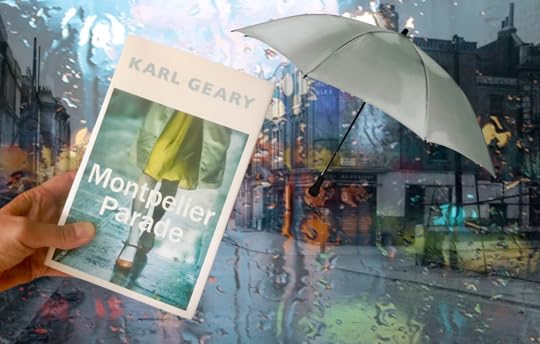
Montpelier Parade is just across town, but to Sonny it might as well be a different world. Working with his father in the garden of one of its handsome homes one Saturday, he sees a back door open and a beautiful woman come down the path toward him. This is Vera, the sort of person who seems destined to remain forever out of his reach.
Hoping to cast off his loneliness and a restless sense of not belonging—at high school, in his part-time job at the butcher shop, and in the increasingly suffocating company of his own working-class family—Sonny drifts into dreams of a different kind of life. A series of intoxicating encounters with Vera lead him to feel he has fallen in love for the first time, but why does her past seem as unknowable as her future?
Unfolding over a bright, rain-soaked Dublin spring, Montpelier Parade is a rich, devastating debut novel about desire, grief, ambition, art, and the choices we must make alone.
Yes, Costa judges, yes! If this novel wasn't nominated for the Costa First Novel Award 2017, I wouldn't even know it existed - now that would be a tragedy, as this is one of those rare heart-wrenchingly sad books that manage to make the reader extremely happy. Karl Geary tells a coming-of-age story (but make no mistake: this is no YA), but maybe even more than that, this is a story about loneliness - the kind that comes with being alone without wanting to, and the kind that persists even in the company of other people.
16-year-old Sonny is the youngest son of a working class family in Dublin. His father works as a handyman and likes to gamble, his mother seems to have given up on herself, and although his parents seem to love Sonny, they are unable to cater to their son's individual needs, to encourage him and to help him find his own path in life. School and his job at the butcher's are no help either. When Sonny falls in love with an older English woman who loves paintings and books, he takes a glimpse into another world, but soon finds out that Vera's loneliness is just of another kind.
Geary's characters are fantastic, even minor ones like Sonny's troubled friend Sharon - every one of them is contradictory and at the same time believable. Also, none of them is what you might call "good" - Sonny is a delinquent, Sharon's social skills are a disaster and Vera sleeps with a minor. But still, the reader feels with all of them, because what drives them to behave as they do is perfectly crafted (which of course doesn't excuse Vera's behavior).
On a formal level, I was shocked how well the second person narrative worked here - usually, I'm not a fan, as it tends to sound artsy in a very forced way, but somehow Geary manages to use it as a means to build intensity. To add another twist, there are some hints that the whole book is Sonny recalling the story to himself, which would mean that the text is a soliloquy - this adds to the overall haunting atmosphere of this novel.
Kudos to the people at Costa for highlighting this debut, it is a very worthwhile read!
Update: 2/18/21: Just as grand a read on a second go-round. I can only hope Geary is hard at work on a follow-up novel. [PS - and he didn't disappoint with the beautiful and heartbreaking 'Juno Loves Legs', my favorite book of 2023, so far.]
My first 5-star novel of 2018, and a book I suspect I may well re-read before the year is over. How this failed to win the Costa First Novel Prize it was nominated for is beyond me, especially since I have heard dreadful things about the book that won (... and now I suppose I will HAVE to read that, just to be even more pissed off! [PS. I DID eventually read [book:Eleanor Oliphant Is Completely Fine|35900387], the Costa winner - and let me say unequivocally - Geary was ROBBED!!] )
If I say the plot is basically 'The Summer of '42' transplanted to Ireland in a dreary rain-soaked fall/winter circa '82, then that is damning it with faint praise, and doesn't do justice to Geary's perfectly rendered setting and characters, and gorgeous prose. Particular kudos for effortlessly pulling off the second person narration, that so many novelists bungle badly.
Others have quibbled that the book seems TOO cinematic (Geary also has careers as an actor and screenwriter), but for me that was a huge plus - I could imagine almost every scene taking place exactly in my imagination, and almost hope they DON'T attempt to film it, so as to compete with Geary's flawless depiction. Would also like to check out the audiobook (something I rarely do), just to hear Geary read it in, I presume, a lovely Irish accent.
If Montpelier Parade had a soundtrack, it might well be The Summer of 1942, and indeed, the key theme is evocative: a young and disenfranchised teenage boy named Sonny and a beautiful older woman named Vera who seems out of his reach.
Life seems pre-destined for Sonny: his father can’t seem to hang onto his wages, his mother is weary and resigned, and his future seems to be headed nowhere, toward a butcher apprenticeship. He suffers from the yoke of low expectations: no one believes in him and he barely believes in himself. And then the quixotic Vera comes along.
Vera places Sonny on “a restless carousel, excitement, dread, excitement.” Although she is, in many ways, a cipher – unknowing and unknowable – she is also Sonny’s fantasy woman and, in ways, his kindred spirit. Neither feels a sense of belonging and each feels unmoored in the gritty world. While Sonny’s demons are right out in the open, Vera’s are held tightly; as readers, we don’t know until the end what drives her.
The book is written in the second person tense, a hard feat to pull off, and a tense that is often used to “twin” the reader with the character. Although there were times that I questioned whether Karl Geary was pulling it off, I felt – for the most part – that he did. The reader is forced into inhabiting Sonny’s life and mind, and seeing the unfolding of the affair through his as-yet-unjaded eyes. As a result, his own vacillating emotions, Vera’s unapproachability, and Sharon – his street-smart yet still tender friend – all come fully alive. In ways, this is a book about unfulfilled potential; readers can almost envision how these trapped characters will squander their chances as life disappoints them, time and time again. The book transported me to 1980s working-class Dublin and, to my mind, was totally convincing.
Sonny is a 16 year old schoolboy, living in working class 1980s Dublin. He works part time at a butchers and partly assisting his gambler father (a self-employed labourer) while keeping his head down at the good local school he attends, where his main ambition is to steal parts to build his own bike. His only real friend a quietly desperate dropout, Sharon and he is otherwise a loner, drinking and watching art films in the local cinema when he has enough money.
Sonny and his father work on a garden wall on a large house in an affluent street (after which the book is named) – and Sonny and the owner Vera (an English woman also on her own, ex an employee at the National Gallery, now seemingly subject to serial suicide attempts) strike an immediate but unlikely rapport before conducting an even more unlikely affair, fuelled on both sides by a loneliness and neediness that have turned into desperation.
The story is written in the second person – and with a retrospective feel, so that the book reads like the reflections of an older Sonny on the early influences in his life – his first love affair, his first encounters with death, the events that lead to him leaving school, his first real interactions with the world of arts (literature and paintings).
There is much to like in the book – much of Geary’s writing is excellent, both his turns of phrase and the way in which he conveys both loneliness and bleak poverty; Sharon and Sonny are strong characters.
However there are also strong flaws – at times the book is too cliched (for example when Sonny tells the school counsellor he wants to be a painter – meaning artist – and she starts talking about house painting apprenticeship) and many of the scenes too portentous. The insider front cover of the book talks about being “cinematic”, and I later found that Geary is an actor and scriptwriter, married to an actor. One can easily see this novel being made into a film – and that almost axiomatically means that it is not great literature.
Imagine a strikingly impressive debut novel, written by an Irish author in the second person, with a keen insight into loneliness and poverty, one that marks out an author for awards across the literary spectrum. That novel is not this novel – but instead Sara Baume’s Spill Simmer Falter Wither
Can you choose the person you fall in love with? Is it foolish to dream of a better life, or should you just make the best of what you've got? These are the questions posed by Karl Geary in his debut novel, a coming-of-age tale set in Ireland of the 1980s.
Sixteen-year-old Sonny Knolls lives in a working class area of Dublin, sharing a bedroom with two older brothers. Money is scarce for the Knolls family and the situation isn't helped by their father's gambling problem. When he's not robbing bicycle parts at school or smoking cigarettes with his friend Sharon, Sonny works in the local butcher's shop. He also helps his Dad with the odd nixer at the weekend and on one such assignment he encounters the lovely Vera. A beautiful older woman, she lives alone in a fancy house on the well-to-do Montpelier Parade. Sonny immediately becomes infatuated with her and levers himself into her life. They emerge as a comfort for one another, but Sonny's disapproving parents and Vera's dark secrets also have roles to play in this improbable relationship.
Karl Geary really captures the misery of 80s Dublin in this story, when unemployment was rife and emigration was often the only answer. Opportunities are limited for Sonny and he feels like he is at a crossroads in his life. On the more obvious route, there is an apprenticeship as a butcher and marriage to Sharon, a girl with the same background and prospects as himself. But Sonny wants more than this. His relationship with Vera offers him a glimpse of another world, a cultured & refined existence where things like art and music are appreciated. He tries his best to educate himself about these matters but ends up being ridiculed for his efforts. The poor kid just can't catch a break.
All of this may sound very depressing and to be honest it is quite a gloomy read. There is a sense of inevitability to the outcome even though there are couple of surprises along the way. Karl Geary deserves praise for his unflinching, authentic portrayal of a difficult period in Irish history, and for his sensitive and poignant depiction of an unlikely love affair.
The cover of my edition of this book, depicting these lovely legs on a cold grey street perfectly encapsulates this novel for me - its all in shades of blues and greys, there are plenty of thighs, its raining almost always and that most melancholy song, Gloomy Sunday is playing in my head the entire time. To me this book is foremost an intense "age-gap romance" novel, minus almost all the romance and secondly its a dark portrayal of the hopelessness of 80s Ireland.
The main character is an 16 year old schoolboy, called Sonny but I think it folly to go into this thinking "coming-of-age" story. Its a very interior, and quietly disturbing book in my opinion. I was trying to think of other books to draw comparisons with and I kept thinking of The Glorious Heresies for the same sense of inevitability and social malaise but this has none of the humour of that book. Its a lonely sort of novel, which I can see one day as a film with slow interior tracking shots and long meaningful pauses on faces in shadow.
This may not be clear yet, as I am busy trying to paint a sense of tone, but I actually really liked this novel. Geary has such a great grasp of his material, both the location, time and characters. To me it seemed more assured than the recently lauded debut novel, Elmet . However, the unbearable pathos very nearly did me in. I closed the cover on this book feeling a little emotionally manipulated.
The story of 16-year-old Dubliner Sonny Knolls' short affair with Vera, a posh and single English lady twenty years his senior, really resonated with me.
Montpelier Parade explores the human need for love, human contact, for the attention that contributes to our self-worth. In the universal sense, the novel shows how the hunger transcends class and time, but what makes the story so compelling is its portrayal of the alchemy in this unlikely affair.
Not until near the novel's end--due to the choice in narration--is the reader given the key to understanding the enigma of the depressive, suicidal Vera, which brings into recall all the little things leading to it.
The unlikely romance in 1980s Dublin is drawn so convincingly. Geary has a knack for keenly setting scenes, in a cadenced rhythm and with great economy. This seems to me a great feat given that the narration is second person which can have a tendency to get carried away with excitement or agitation. I typically avoid second person narration. This is the first novel I can recall reading in which I enjoyed the second person narration and thought it the best and perfect choice, and carried off brilliantly.
Montpelier Parade is Vera's upper scale neighborhood where Sonny becomes acquainted with her while helping his father, a day laborer, with repairs on her townhouse one weekend. In stark contrast, Sonny's homelife is bleak with eight others in his house, including his stay-at-home mom who is irretrievably embittered by his dad with a gambling problem and six scantly employed older brothers whose most significant contributions seem to be to household strife.
Sonny Knolls attends (and often skips class) at an across-town parochial school where he doesn't fit in, and where steals/collects parts off his schoolmates' bicycles and ultimately gets expelled. He has no real friends except a 16-year-old dropout who will do anything to get boys to like her.
His view of the world around him changes dramatically after he begins an affair with Vera who opens new worlds to him in literature, art, talks of travel and sexual and sensual rapture. His jour de ma vie.
Geary sensitively embraces the 20+ year age difference and smartly avoids what must have been a huge temptation to dive into the salacious details. Voyeurism would not have worked here for a couple of reasons. One, the relationship seems completely convincing in the circumstances leading up to its inception and the enigma of Vera is resolved by novel's end. More significantly, Sonny's narration in the second person, which Geary paces flawlessly, shows a teen who is trying to make sense of things as they happen or shortly thereafter, learning as he goes, and naive of this whole different universe of pleasure and culture.
An ultimately doomed affair--sad but transformative and redemptive. Definitely recommended.
The story of Sonny, a working class teen and Vera, a thirty something middle class English women will continue to haunt me. Initially it seemed like it would be another male coming-of-age story, and I was unenthusiastic. A GR friend, however, encouraged me to continue, saying that it would become something more.
Sonny is, inexplicably, a boy with no friends who works after school for a butcher. This is where he meets Vera, one of their few customers, as people begin to do most of their shopping at a nearby supermarket. Vera asks Sonny if he is available to do some works around her house and this begins their relationship. Neither of them have close friends, but other than that there is no reason the reader can see for them to grow close.
Geary describes Dublin of an unnamed era, but a time when Ireland was still poor. The fact that Sonny's family is still waiting for a phone is a hint this is set in the 1970's or 1980's when people I knew waited years for a phone line. This was an era when working class kids left school in their teens and if lucky got an apprenticeship. It is the Ireland of massive outward emigration, and high unemployment. We learn much more about Sonny's world while Vera's remains a secret until almost the end of the book.
This is Geary's first book and this remarkable novel foretells, hopefully, more great writing to come.
1980s Dublin is painted as a grim, depressed city. Sonny is the youngest of several brothers in a family struggling to keep afloat. Although he has gained a place at a grammar school, he is not thriving - singled out as a ‘welfare’ boy, hampered by lack of support and low expectations at home. Things come to a head when he starts cannibalising other students’ bicycles for parts to make one of his own. He is expelled from school and seems to be destined for an unwelcome apprenticeship in a butcher’s shop.
While helping his father work on a house in a wealthy suburb, he is smitten by the sophisticated householder, Vera, and an edgy relationship develops between them. Edgy because each of them offers the other something they need and, although it is obvious that Sonny is attracted by proximity to a better kind of life, it is not immediately apparent what the introspected, reticent Vera could be looking for from Sonny.
This is an emotionally charged story. Sonny’s predicament is heartbreaking. His earnestness in hoping to educate himself and trying to involve himself in Vera’s life struck me particularly. I wondered throughout how things could work out well for him.
The most significant way in which the author creates this feeling of foreboding is his use of the second person and the past tense. As a result, the novel reads as an accusation or as an apology - a really effective technique. It works especially well on Sonny’s relationship with his friend Sharon, a girl from a background like his who is also trying so hard in her prickly, graceless way to better herself. ‘And after she had gone, and the bus rumbled forward, you were left to wish you had mentioned, just once, how she looked nice.’
This story is superbly well written and, at only 230 pages, pared down to its essentials so that its messages hit hard. Karl Geary’s own history shows that there is a possibility of escape for Sonny. I read that he left Ireland for New York at 16 and prospered, through luck and talent, becoming an actor and screenwriter, and now a novelist shortlisted for the Costa First Novel award. Perhaps the cinematic quality of this novel is telling, I’d certainly love to see it as a film.
Een triest en meeslepend verhaal. Knap beschreven eenzaamheid, depressie en liefde. Het boek is compleet anders dan wat ik verwachtte na het lezen van Juno Loves Legs en dat vond ik in eerste instantie jammer aangezien Juno Loves Legs een all time favorite van me is. Bovendien is het in de tweede persoon geschreven en dat vind ik altijd vreselijk irritant. Maar het is zooo mooi! Hartverscheurend, 6 sterren mooi.
Geary, aged only 16, left his native Ireland in the late 1980s for the bright lights, sophistication and opportunity that New York offered. He then went on to become a successful actor and screenwriter but, when it came to penning his first novel, it was to Ireland that he looked for inspiration. Geary gets 1980s Dublin (well, 1980s anywhere in Ireland really) spot on. The incessant rain, the lack of adequate warmth or comfort, the unshifting class divide and the crushing lack of opportunity or hope are unflinchingly laid out for the reader.
Sonny Knolls, the hero, is a 16-year-old schoolboy, who has ambitions to get out of Ireland and to achieve something more than his predicted future as a butcher’s apprentice. Whilst helping his father in the garden of a big house in Montpelier Parade, he meets the owner, Vera, and is immediately smitten. Sonny is a troubled youth, the youngest son of a working-class family in south Co. Dublin, who has gained a place in grammar school but is struggling to cope there, feeling all too keenly the gulf between the predominantly middle-class boys and himself. Sonny is a romantic at heart, wanting to save his mother from her life of drudgery and hopelessness, but realising that it is too late so he spends what money he gets on alcohol and at times punches walls to silence the howling misery inside him. Sharon, his only friend, is a sad, bleached-blonde school dropout, who has learned to use her body to buy affection. Sonny would like to save her too, and rejects her offer of sex, “not wanting to be one of those boys who made her cry” but is unable to prevent her from making a final disastrous choice. Only Vera, with her secrets and unhappiness seems to offer Sonny a final chance to be a saviour. The affair that develops between them is very sensitively handled by Geary and is utterly convincing.
The novel is written in second person, giving us the impression of Sonny talking to himself throughout – a very effective way of conveying Sonny’s loneliness and isolation from everyone around him. Stylistically, the novel is a masterpiece. Geary’s experience as a screenwriter tells – the novel is awash with cinematic detail and vivid incident. In the first chapter, Sonny witnesses a drunk man, Mr Cosgrove, being knocked down outside the butcher’s shop where he is working. Geary focuses our attention on the thin, sealed plastic bag of livers that the butcher plonks down on the counter for Cosgrove and then later, after the accident, draws our attention to the plastic bag that “had been flung a few feet away from him; it was burst, empty.” This visual metaphor powerfully conveys the damage to the man’s body without recourse to more direct description.
There’s not a word wasted in this pared down, perfectly-paced little novel and, considering that this is Geary’s debut novel, there’s bound to be more on the way. Oh goody, goody.
Montpelier Parade by Karl Geary is a beautiful and tender debut novel shortlisted for the Costa First Novel Award 2017.
Montpelier Parade is set in Dublin in the 1980s, between the Georgian terraces of Monkstown and the rough, impoverished housing estate where the adolescent narrator, Sonny Knowles, lives. The 16-year-old boy describes the Dublin of have and have-nots. Sonny is born into a big Catholic family with six older brothers. They live in a tiny house. With not enough money to go around and a father who gambles away most of his small pay check he receives as a builder, they often go hungry.
After school, he sweeps the floor in a local butcher’s shop and occasionally helps his father with small jobs. It is during one of these jobs that he meets Vera, a middle-aged English woman, whose garden wall they are repairing.
Over the weeks, Vera comes to represent a transformation from a boy to a young man, and for her, Sonny becomes a temporary respite from a despair that has engulfed her life. Their complicated friendship leaves Sonny torn between the dream of possibilities that Vera’s world seems to hold and the oppressive existence in the impoverished and limited world he knows.
The second person narrative is unsettling, yet deeply personal. Montpelier Parade is raw and nuanced in equal measures, at times hard to digest, but it captures the harshness and ugliness of Sonny’s life, where to aspire above your means seems impossible.
Karl Geary has immense talent, and as a fan of Roddy Doyle’s The Barrytown Trilogy: The Commitments / The Snapper / The Van, this was right up my alley. I went from laughing about the witty, snappy dialogue to choking on my laughter because it was so awful to hear the heartbreak in the conversations between Sonny and his only friend Sharon, a school dropout he shares smokes and drinks with at night. But what makes this novel a triumph is the utterly realistic back and forth between Sonny’s innocence and Vera’s inescapable sadness. Brilliant and heartbreaking.
This was a sad, coming-of-age novel. Sonny Knolls is the youngest member of a working class, Dublin family. He's in high school and works at a butchers' shop after hours. He's terribly lonely and feels out of place.
He becomes infatuated with a much older, English woman, who's mysterious and very sad. Everything starts falling apart, but Sonny's completely besotted with Vera. Nothing good can come out of such an unseemly relationship, but that's not what Sonny thinks.
Montpelier Parade was interesting and a bit unusual, as it was written in the second person, which I personally found unsettling and it prevented me from fully connecting with the characters.
This will be a polarising novel.
3.5 stars
I've received this novel via NetGalley, in exchange for an honest review. Many thanks to the publishers, Vintage Penguin, for the opportunity to read and review this advanced copy.
I think what I appreciated most about this novel is how well the author conveyed the sense of bleakness & loneliness of the characters. Even when two of them were together, they were still lonely and lacking connection to each other. I struggled a bit with Vera & Sonny's relationship, because it was hard for me to believe in this chain of events. The ending helped bring it back up to 4 stars in my opinion. I think it was an interesting and unusual book.
Well, this is a powerful novel. It reminded me of some other novels which share its main theme of the romantic and sexual initiation of a young boy by an older, beautiful woman. The Lost Country by J. R. Salamanca comes to mind, as does The Discovery of Heaven by Harry Mulisch, though the latter doesn't involve initiation.
As with these kinds of novels, too, Vera is a kind of muse. Sonny is sensitive and at his beginnings but unformed and directionless. Vera is near the end. It's a Dublin which is dark and where it seems to rain all the time, fitting the tones of loneliness and grief.
Still, it's romantic and you cheer for Sonny and Vera. It's all unlikely, though, as you recognize, until the end when Karl Geary makes you believe it. It's tightly controlled and wound full of feeling released to pour into the world in ways you didn't see coming but salute. This is a 1st novel, and Geary's written a dandy.
It took me a while to get used to the second person narrative style in which Geary wrote this book, but I grew to thoroughly appreciate this thematically dark novel. Set in Dublin in what I assume is the 80s, judging by the few cultural references made, I was struck particularly by the baseness of the characters and story being portrayed. From memory, this was an award winner, and it's easy to see why.
Montelier Parade is a coming of age story set in 80's Dublin told in the second person, which I usually find annoyingly precious. But read in Geary's own voice, it takes form as a memory piece, a recollection of loss and discovery that is beautiful and carries a verisimilitude that I feel might lack certain poignancy if read as text. The time was harsh and life not easy for Sonny in those days, but there is a sense that his life led during those days changed him forever. Haunting.
This debut novel is set in Dublin in the 1980’s. It has a very unusual element: the narrative is told entirely in the second person. It’s like the main character is telling the story to himself.
Sonny is a 16 year old youngest son of poor working class parents. He has a lot of older brothers. The dad is a boozer and somewhat abusive. Spends his money on drink and gambling. His mother is constantly trying to make ends meet, put food on the table and has an overall pretty shitty deal.
Sonny is a poor (doesn’t apply himself) student. He works after school part time at a butcher shop and on the weekends helps his dad with the odd jobs he occasionally picks up. One weekend they are repairing a wall in a fashionable neighborhood on Montpelier Parade. The homeowner comes out - a beautiful older lady. So begins the unconventional love affair between Sonny and Vera.
There was a really surprising ending that I certainly didn’t see coming. The author has just published his second book; I’d be interested!
The 52 Book Club Reading Challenge - 2023 Prompt #47 - Set in the city of Dublin
Sonny et Vera, c’est une rencontre inattendue qui va déboucher sur une relation particulière : amour, désir, soutien. Ils vont devenir peu à peu indispensable l’un à l’autre. C’est un roman dont les sujets ont su me toucher, même s’il comporte de nombreuses longueurs.
This is either the story of the sexual awakening of a heterosexual teenager, or the story of the sexual abuse of a teenage boy. You will have to make that decision. There is no doubt that he is willing, but there is a question about whether or not Vera should have taken advantage of his willingness in this way. There is also a question about whether or not any harm is done. Clearly, he cannot get pregnant so there is not the risk of becoming a teenage mother or having to face a termination. Our society has less concern about psychological damage, even when it considers that such damage can be done. And let us be honest, the usual response is that "he's got lead in his pencil" or something similar to that. You may or may not think that any damage has been done.
We are not told Sonny's age. All we know is that he is old enough to consider leaving school to start an apprenticeship, but that he is not old enough to go into a shop to buy a bottle of wine. Vera does that for him. So he may not be underage, but Vera is still considerably older than him, and whether or not she is exploiting him is an open question. Vera has her own issues to consider, and is clearly facing up to her own situation with great difficulty. When you find out her situation, you may or may not consider it to be an explanation of her behaviour. You may or may not consider that it justifies what she does.
Karl Geary is too good a writer to force his moral judgements onto his readers. He lets the issue arise through his characters, through Sonny's mother who wonders why Vera is taking an interest in her son. through Sharon, supposedly Sonny's girlfriend, who decides that he will come to nothing, through Vera herself, who thinks that Sonny will come to hate her. And Sonny is no paragon of virtue. He steals. He fights. He is essentially a working class boy, who sees no future for himself that he can deliver. The key moment here is when he tells the school counsellor that he wants to be a painter and she assumes that he means a decorator, not an artist. And when the word "artist" is raised in the conversation, he abandons all hope of ever becoming one.
This is essentially a sad tale, about the loss of aspiration and the hopelessness of life for so many people. The writing is spare, beautiful, considered. There is no careless choice of words. Each sentence has been carefully constructed with poetic thought. This story is a thing of beauty and a joy forever.
You will have to decide what Geary is trying to tell you. You will have to make your own judgements about both Sonny and Vera. You will have to decide whether this is a book about sexual awakening, sexual abuse or possibly both. This is a book that will make you think, and you will have to decide how to react. You will even have to decide whether or not you should cast the first stone.
Montpelier Parade is a story that has a dreamlike, ethereal quality. Composed with beautiful prose and told in the second person, this is a beautiful novel. A love story with the poverty and hardship suffered by Sonny, the lead character running alongside the wealth and grandeur of the house on Montpelier Parade occupied by Vera.
Sonny comes from a poor family who live in the backstreets of Dublin. When he's not in school, he works in the local butcher, and helps his father with building jobs. Sonny's parents are distant, from each other, and from Sonny. His father works, then spends his money in the bookies or the pub. His mother cooks, cleans and despairs at the lack of money coming into the house.
Sonny is a bright boy, intrigued by the world and gradually discovering his sexuality. His days are spent either at work, sometimes at school, but more often he's to be found smoking and drinking, accompanied by Sharon, a girl from a family just like his.
When Sonny meets Vera, the owner of a house where his father is building a wall, he discovers a world that is so far away from his own. Vera is older, she's English, she's so different to the women in his life. He is entranced, and besotted and desperate to know Vera better.
Vera is an enigmatic, mysterious character, she has secrets, she has a sadness and Sonny is determined to know more about her.
Atmospheric and haunting and really quite beautiful, Montpelier Parade is remarkably moving with characters who are vulnerable yet have hearts that beat so passionately.
Karl Geary has brilliantly captured both the pain and the wonder of first love and coming of age. His words are powerful and inspired. This is a debut novel that enchants and delights the reader. Highly recommended
Die Mutter mit den abgearbeiteten Händen, immer am Kartoffelschälen und Abspülen. Die Schulfreundin, die jetzt ein Flittchen mit zu viel Make-up ist. Das kleine Haus der armen Leute, das große Haus der reichen Leute, in dem es Gedichtbände von T.S. Eliot gibt. Die ganze schäbige Welt voller Figuren mit den allervorhersehbarsten Eigenschaften.
This book left me feeling very sombre. It had a slow steady pace that kept me wanting a positive outcome for all the characters from Sonny and Vera to Sonnys parents and Sharon. A thought provoking read highlighting class differences and how no matter what your background you can still have the same life changing experiences.
I finished this little book with a little whoosh of tears and air. Like when you stub your toe and it takes you 30 seconds to realise it hurts really badly. Sweet and sad.
When I started reading this book I instantly thought that I was going to enjoy it. Whilst initially it felt like it was going to be similar to many books that I have read and enjoyed about teenagers growing up in Ireland there came a point where it changed and became an incredibly tender book about love and loss. So it began with Sonny a teenager in a poor Dublin family with a distant father who spends all his money on the bookies and a mother frustrated by her husband and struggling to put food on the table. Sonny is obviously bright but his circumstances lead him into trouble at school where he is victim of an education system that naturally assumes that he is no good and he plays up to that image. And of course there is a burgeoning interest in sex as he befriends a teenage girl who is like him often out of school but for whom he has conflicting sexual interest. All that sounds like lots of books I'd read before even though really well done with brilliant dialogue and scene setting and if I'd had a book that simply told that story in such a skilful way I would have been happy. However early on Sonny and his dad visit the home of Vera , an older woman on the outskirts of Dublin, where they build a wall. The subsequent story draws the reader in to the relationship that develops between Vera and Sonny, a relationship that ignites the dormant spark in Sonny both intellectually and emotionally. I don't want to say anything more about the plot other than it was one of those books that I had to keep on reading but was sorry to see end as I had enjoyed the read so much and at the end when I put it down I felt physically stunned. I only wish that as with the best characters I couldn't have picture of Sonny's life twenty years later to know that all was well. A book I would really recommend and a joy from beginning to the end.
Sonny Knolls, de hoofdpersoon van dit boek, wordt door de alwetende schrijver aangesproken met je; je deed dit, je dacht dat. In het begin van het boek is dat erg verwarrend, maar het went. Wat niet went is het feit dat bij de dialogen voortdurend gebruik wordt gemaakt van de tegenwoordige tijd, terwijl het hele boek in de verleden tijd staat. 'Stap in,' zegt hij terwijl hij naar de wagen liep. 'Je aanbidt me,' zegt ze, en draaide zich om en keek hoe je keek. Waarom?
Montpelier Parade is a sad story of a teenage boy from a poor family in Dublin. Sonny works at the butcher's shop after school. His family is hoping to get him an apprenticeship there following high school. When one Saturday Sonny goes to help his father do some garden brickwork at a house across town in an upscale neighborhood for a British woman we come to know as Vera, Sonny's life is altered dramatically.
This is a beautifully crafted story written in the second person. Its pace is slow and the prose poetic and sparse. However, much is communicated in others' silences. Important life-changing decisions must be made by Sonny solely on his own account without discussion with others. The story seems to have an old-fashioned feel to it. Sonny's family doesn't have a telephone due to monetary reasons. The lift in the hospital is an older style. Also, the way of life seems to be from an earlier time. Maybe 1970s or 1980s. I loved it.
A book full of emotions. Anger, frustration, madness, love all wrapped up into a very well written book. You may fall in love with the characters or you may be disgusted by their actions. However you feel the book will still make you think about life and the choices one makes. How situations can make you become someone you never anticipated nor thought might exist. It's a beautifully written story that will stay with you even after the last page has been read.