The Photurians - a hivemind of sentient AIs and machines - were awakened by humanity as part of a complex political trap. But they broke free, evolved, and now the human race is almost finished. Once we spanned dozens of star systems; now only four remain, and Earth is being evacuated.But the Photes can infect us, and among the thousands rescued from our home world may be enemy agents. Tiny colonies struggle to house the displaced. Our warships are failing. The end of humanity has come.But on a distant planet shielded from both humanity and the Photurians, one hope may still live. The only person who might be able to intervene. The roboteer. He is trapped in a hell of his own making, and does not know he is needed. And so a desperate rescue mission is begun. But can he be reached in time? Or will he be the last remnant of humanity in the universe?
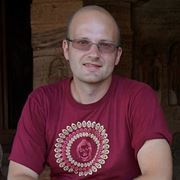
Alexander Lamb splits his time between writing science fiction, software engineering, teaching improvised theater, running business communication skills workshops, and conducting complex systems research.
In his day jobs, Alex has worked on a myriad of unrelated software projects, including mobile applications for biologists and publishers, risk analysis software for banks, large-scale simulation of battlefields for the US Army, hyper-optimized software interfaces for major US corporations, and novel machine-learning applications for Silicon Valley start-ups.
He has also held the position of Research Scholar in the Ecology and Evolutionary Biology Dept. at Princeton University, where he worked on computer simulations of complex systems. His research has spanned the simulation of gossip, the formation of human cultural norms, the arise of wealth inequality in society, new algorithms for general machine intelligence, and the modeling of the Planck-length structure of spacetime. He has several blogs, one focussed on behavior science and improv, the other on algorithmic approaches to physics.
As an improviser, Alex has founded three theater companies and is the inventor of the archetypal improv style, a technique used to bring Joseph Campbell’s theories of narrative structure to unscripted theater. As Britain’s foremost expert on spontaneous plotting, he has created play formats now used and enjoyed across the world from London to San Francisco.
As a trainer, he has worked with CEOs, high school students, international sales professionals, astrophysicists, doctors, world-class athletes, and graduate students. He has twice been a speaker at ASTD International—the largest business training conference in the world.
Along with his novels, he has two pieces of short fiction in print, Ithrulene, a short story in the Polyphony 5 anthology by Wheatland Press. He is a graduate of the Clarion West writers program and a Milford group attendee.
He currently lives in Santa Cruz, California with his wife, Genevieve Graves, (an award-winning astrophysicist turned data scientist), and his three-year-old son, Thorfinn.
Exodus is so far removed in scope from Roboteer it's weird to think they form part of the same trilogy. However, there is one constant throughout and that is Will Kuno-Monet, who is one of the more likeable protagonists of anything I have read recently.
Another forty years have passed since the events of Nemesis and (similarly to the intervening period between Roboteer and Nemesis) a lot has happened during that time, as referenced and implied by the character dialogue as well as the narrative. It's an interesting approach, since there are lots of gaps that the reader has to attempt to fill in. It can be a bit disjointed, but it also serves to add gravitas to the overall story arc by adding history to the author's fictional universe without making use of data dumps.
It is therefore clear that the author has no intention of spoon-feeding readers, and I had a time of it to try and figure out the nature of the Photurians and, probably more to the point, Willworld (or Snakepit). The author's extrapolation of complex information systems to include humans (or, more accurately, post-humans) as part of the equation, is a bit dazzling and I won't pretend that I understood exactly how everything works here, but that didn't make it any less rewarding.
If there is one issue I had with the book it would be some of the character interaction. For a bunch of super beings there is a lot of childishness on display. Not sure whether this is intentional on the author's part, to try and prove a point of sorts, or as a commentary on human social development, but nevertheless.
In conclusion though, if you are partial to big concept, hard science space operas with massive space ships and mind-warping technology and weapons of mass destruction, you should consider giving the Roboteer trilogy a try. I would argue that in this specific entry, those blurb comparisons to Peter F. Hamilton and Alastair Reynolds come into play nicely. Lamb might not be quite on that level yet, but it will definitely be interesting to see what the author comes up with next.
Also worth noting that the trilogy ends with some interesting reveals regarding the nature of the Photes and the Transcendent. I always like when authors take the long view and give my imagination a good old stretching.
I received this from NetGalley and Gollancz in return for a review. It took me a little longer to finish reading it than a book, even one of this size, would, so I’m a little behind the curve here. I got distracted, you see, what with buying my first-ever house. Were it not for that, I would have devoured Exodus in a day or two, because it’s that good. It’s not quite the space opera I’ve been craving since tearing through the latest Linesman novel; I think my freezer burn on posthumanism is still causing some issues. That’s saying something, then, that I enjoyed this as much as I did.
Exodus is the third book in a trilogy. This wasn’t readily apparent to me from the NetGalley or Goodreads descriptions; had it been, I probably wouldn’t have requested it. I don’t think it does an author any favours to start a trilogy at the final book in most cases! This is a rare exception: Alex Lamb’s exposition helps you understand the state of this universe after the first two books, and any regret I feel for having missed these books is more around the fact that if I go back and read them now, I’m going to know how the story ends!
I’m see lots of comparisons in the marketing material to Peter F. Hamilton, and I get that, but Lamb reminds me a little more of Alastair Reynolds and the Revelation Space universe, particularly with the M.O. of the Transcended here. Lamb works hard to balance between writing three-dimensional individual characters and also stuffing our heads to bursting with cool posthuman SF ideas on a trillion-year timescale. That’s very difficult to do, which is why I find myself increasingly disenchanted with posthuman SF—but Exodus pulls it off.
The story is a Hail Mary type of adventure to help humanity against a mortal enemy, the Photurians, or Photes. This species “converts” human individuals, bringing them euphoric “bliss” at the price of individual privacy or sanity. At the beginning of the novel, two of our protagonists are involved in the evacuation of Earth, which has finally fallen to the Photes. One of the few remaining refuges of humanity is its most powerful world, Galatea, in the grip of the New Society, an autocratic regime of young leaders and ruthless military discipline coupled with psychological therapy. The other main characters are “heroes” from the older generation, out of step with this new mode of governing, and many of them mourning the society that has passed them by. This adventure is perfect for them (even if they don’t want to admit it) and will perhaps even reunite them with a long-lost friend, Will Monet, the main character (apparently) of previous books.
To be honest, the characters in this book are not the main draw, in my opinion. They’re all right, and if I had been through this entire ride with them, I’d probably feel much closer to them. Lamb does his best to make me feel the immense burden of Ann’s disconnection from humanity; he tries his best to help me understand how frustrated and powerless Mark feels, how confused and lost Will feels, and how Ira vacillates between feeling obsolete and feeling absolutely essential on this crew. There are some genuine moments of pathos here. Largely, though, the relationships are predictable, the interpersonal conflict is predictable, and the romance is boring and very hetero.
However, like so many books with Big Ideas, the crunchiest nougat of Exodus is the way Lamb sketches out possible futures, technologies, and even conjectures for the organization and structure of life on a universal scale.
Virtual reality plays a major role here, along with the underlying assumption that the human brain can be accessed and hacked like any computer. Identities are fluid, most exemplified in the character of Nada Rien. Lamb digs into the idea of possibly finding a way to use the universe itself as a computational substrate in a way that is much less metaphorical and far more interesting than, say, Dan Simmons’ Hyperion uses. If you really like your posthumanism bleeding-edge-this-is-basically-magic, then this book has that in spades.
I also enjoy Lamb’s depiction of faster-than-light travel. He doesn’t use too much exposition, and what he includes serves to deepen my awareness of this universe rather than my understanding. For example, I don’t know how warp travel works in this universe (aside from using something called “curvon flow”), but I do know that there are different types of warp travel (traditional, ember, and stealth) with varying advantages and disadvantages. I don’t really understand what a “boser” is, or what “warpium” is—but I totally grok their purposes in the story, and while they might actually be unrealistic according to our current understanding of physics, Lamb makes them believable enough within this universe. Yes, any time you start throwing in Transcended species and talking about vacuum states you’re crossing the line towards techno-space-fantasy. But Exodus tries really hard to make you think you’re just touching the line.
Philosophically, Exodus questions the nature of identity. It seems to take it as a given that the human mind, or mind-state, can be copied and uploaded, and even duplicated. Although Exodus doesn’t quite grapple with the existential questions surrounding duplication of consciousness, it does ask us to consider what it would be like to, for example, live in a society solely of differentiated versions of yourself. If you just read that sentence twice and are now asking “what the hell does that mean?” then you’re not alone. Basically, Lamb wants us to confront the uncomfortable notions of what separates society from self, species from individual, and whether or not the human predilection towards individuality over these past millennia is itself a good survival trait.
This is one of the most fascinating uses for science fiction: authors examining aspects of our species and asking what we are prepared to change about our species in order to survive on a universal time-scale. Are we willing to speciate? Are we willing to redefine what we mean by consciousness, by life, by individuality and thought and identity? I don’t know the answers to these questions, myself; some of it I’ll never know, at least not until I get simulated by the overbrain stored in the smart-matter computational matrix of New New Earth several millennia from now. Until then, all I can do is keep reading fascinating SF novels that ask these questions for me!
Exodus is full throttle, rip-roaring space opera, with a side helping of virtual reality and biotech. It strongly brings to mind two classics of the genre. The first is Star Trek's Borg episodes. As is the case with the Borg, the humans here face up to the conquering Photurians - who seek to assimilate whole species into their strange mix of hive mind and individuality. The tech behind the invaders may be at the biological cellular level rather than cyborg, but the effect is equally terrifying. I can't help but feel that this was a conscious influence, given the Borg's catchphrase, as at one point one of Alex Lamb's characters says: 'I mean resistance is worth it. The opposite of futile.'
Then there is E. E. 'Doc' Smith's Lensman series. Though obscure now, in its time, the Lensman series was one of the founding sagas of space opera. Thankfully, Lamb writes a lot better than Smith does - frankly, his style was distinctly clunky - but if you know the classics, it's hard not to see similarities in the vast flotillas of spaceships, devastating futuristic weapons and some of the main characters becoming superhuman thanks to highly advanced alien technology.
Although Exodus, without doubt, fits into the space opera genre, I ought to stress that this is no simplistic shoot-ups in space storyline. Like the second version of the TV show Battlestar Galactica, this book manages to transcend its roots - here with a complex mix of storylines and some remarkable imagination. This is particularly true in the 'Willworld' segments. Lamb really stretches the possibilities of combining virtual reality and biological modification and manages a complex scenario without the reader ever becoming lost in it.
This is a book I enjoyed reading... but didn't really make me want to go back for more. There are a few issues I had with it that were probably more about what I like to read than the book itself. Each chapter is split into around five different points of view, which I've never been fond of in a novel - and for me, at around 600 pages, it's too long - it could have been trimmed 100 pages at least without losing anything, tightening the whole thing up. For various reasons I found it difficult to empathise with many of the characters. But if you like a complex space opera with lots of hi-tech imaginings and a tangled, multi-point-of-view plot, this could well be a delight.
I came across this in my local library and was initially attracted by what I saw was the similarity in style and content to the late, great, Iain M Banks. Only after I started reading did I realise that it was book 3 of a trilogy. However, it stands on its own and is an intriguing story. Lots of action, complex plot lines, and very descriptive writing. It’s told from the perspective of different players and initially, Will, Nada and the remaining individuals occupy very different worlds. It’s a long book, the pace rarely falters, and some of the technology and environment descriptions are quite hard to grasp - but that’s good: describing such a universe so far from our own concepts should be a challenge. I really did enjoy this book and will definitely go back and read the first two volumes of the series.
This takes place 4 decades after the action of the 2nd book. The Photurians are absorbing/changing humanity until only a remnant is left. Ann is helping with an exodus from Earth. Mark was supposed to help, but was deceived. They finally meet up.
Meanwhile, Will, who was dead, has had a version of himself revived and is having a very strange time with a billion other variations of him living on Snakepit.
The Photurians (some of whom have been allowed to remain mostly human to assist in defeating the humans) are having their own internal problems as too many of the want to go into bliss and subsequently become useless. Nada Rein (a self-aware non-integrated Photurian) tries to stop those internal problems and works to capture or defeat humans (especially Ann). She, too, has "that hunger to lie down on a bed of moist fungus to experience bliss, but first she had a colony to crush." The Photurian chapters were very unpleasant.
The surreal ridiculous aspects reminded me of Alice in Wonderland and was sometimes excessive. Also the techno-jargon and the virtual reality became tedious. There were phrases such as this: "integumentary parsnip horse." The swearing was standard 20th century American. In general, the technology may have been futuristic, but the culture was not futuristic.
Issues: Does a more technologically advanced species have the right to impost its will? Are they necessarily superior, except in the sense of "might makes right"? Do we need challenges to survive (if everything is easy and taken care of will we drift into extinction from bliss fatigue)? Can happiness be forced? What is the importance of free-will?
A slam-bang finish to an epic trilogy that began with Roboteer and Nemesis. The story is very much a continuation of Nemesis -- it takes place after those events, but really not much will make sense without the first two books. The beginnings of the character arcs are necessary to appreciate the conclusions.
For all their implanted gadgetry giving them enormous tech and communications abilities, the characters remain very human in motivations and actions. The obstacles they encounter are daunting but they refuse to quit fighting. The scale of those obstacles vary -- from a single ship to a single planet to a mystery region many light-years across -- and yet the worst challenges come from within their own minds.
KUDOS to the author for skillfully placing us inside a mind within a hive mind. It's creepy and unsettling and while it's not quite what you imagine being a termite, or a Borg, is like, it feels entirely too plausible.
A lot of the crazy super-tech still feels like hand-waving, or technobabble, but it does hang together more or less.
I was disappointed in a couple of formerly important characters being used to not full advantage, but in the heat of the moment within the story I reluctantly decided to excuse that.
Alex Lamb continues to amaze with a deep and varied imagination. He succeeds in maintaining a plot filled with many side lights. His imagination is detailed, very, and complete. Characters well thought out and realized. I can just see Alex with a project management spreadsheets keeping track of the plot and the characters as he wrote. But, the constant introduction of new technology is distracting from the plot. And, the exciting new ideas does not hide nor justify that the plot requires new technology to show up just-in-time; characters wake up or reveal some important secret at the very last minute, just as it is needed; and Gods pop in and out (in Rachel's image) to give necessary technology (miraculous). Also, these characters are wonders at understanding and incorporating technology, information, security hacks, in zero-time. There is no learning curve except where Alex wants to walk us through his imagination and philosophy.
The book contains enough information and ideas for a whole series.
Good ending to the trilogy. The story is a bit stretched and laboured, and took me longer to read than expected, but generally I enjoyed it, even more so than the previous (2nd) book. There's some new cool sci-fi ideas, mainly Willsworld as a kind of The Matrix but fighting itself as some kind of psychosis and interesting mechanics. There's some good plot with familiar characters. Overall the world building and the story feels complete with this kind of ending, even if a bit cliché. The Transcended are explained and their evolvement, so are the Photorians, in ways that are not disappointing, and everyone gets to continue on the path that will work for them.
I enjoyed it overall. I haven't read any of the other books... some of it was hard to understand at least initially. It was a solid read. The characters stood out as individuals and I really got to know them well as the story progressed. Everything - all the loose threads (pun intended) tied in together nicely at the end. The conclusion I felt had a lot of thought and meaning put into it which I appreciated. I want to read The Roboteer now that I've finished this - wish I'd read it first.
I received a free copy via Netgalley in exchange for a honest review.
This may have got 4 stars if I had read the previous two books. I found it difficult to follow at the start, but did eventually understand what was happening. Although fairly complex it was enjoyable and actually made me think whilst reading.
Final part of the trilogy. Technology escalates and all the favourite characters are still around. The book introduces the inclusion of alien viewpoints into the story threads. Some of the narrative gets very weird, but sticking with it helps it gradually make sense and I was pleased to see that Alex has a good explanation for what has been happening, nicely tying up all the loose ends.
A great story told well with engaging characters embroiled in some wicked situations. If you enjoy Peter F Hamilton’s work you’ll likely enjoy this too. There’s a lot to get your teeth into. I’d highly recommend this series.
A fine conclusion of the trilogy. Not without some minor flaws, but everything can be forgiven for a good old-fashioned space opera, exquisitely rare these days.
Great conclusion to the trilogy. If anything, the book had so many awesome ideas, it was hard to do them all justice and keep the story a reasonable length. Thumbs up especially to Willworld.
Don't you just hate it when you're half way through a book when you realise it's part of a series and even worse, it's the last in the series!! Why can't the publishers make it obvious for dimwits like me??