Heidi's brother, Donald, is 16 and Autistic. She has always loved playing with him, but now she's 11 and her life is changing. She's embarrassed to have her brother around and doesn't want her friends to know about him. High school boys bully him. When the kids at her school find out about him, she gets bullied too. It's not fair. No one seems to understand. But Heidi needs to understand too. She can't change her brother, but she can change how she feels about him, and she can get people to see why her brother is special.
A perfect children's book for people who enjoyed the bestselling children's novel Wonder by R. J. Palacio or the Newberry Honor Award winning novel Rules by Cynthia Lord. For children 8-13 years old.
D. G. Driver is an optimist at heart, and that's why she likes to write books about young people who strive to make a difference in the world. From her teen environmentalist in The Juniper Sawfeather Trilogy, a young girl teaching her friends autism acceptance and to stop bullying people with special needs in No One Needed to Know, a girl who bravely searches for a friend lost along the shore of a dark lake in Lost on the Water - A Ghost Story, a princess who desires to be more than a pampered prize for a prince in The Royal Deal, to a boy who learns that being genuine and chivalrous are the ways to win a girl's heart in All the Love You Write, Driver hopes to write characters that you'll want to root for.
When she's not writing, she is a teacher in an inclusive child development center in Nashville, and she can often be found strutting the stage in a local musical theater production.
It looks at the main character's issues of growing up and wanting to fit in. To add to this Heidi's brother is autistic and, well different. Her brother draws unwanted attention, and Heidi must try to find a way to feel wanted, and also to support and care for her brother. This is a thought provoking book which raises many issues for young teens, and those living with autistic family members. It is covers so many vital issues I believe that no young teen should miss out on reading it. It is enlightening, empowering and inspiring.
No One Needed to Know, by D. G. Driver, opens when Heidi (who so wishes she’d been named something more fitting, like “Storm”), and her brother, Donald, engage in a make-believe battle on a “boat” set that sits in the midst of their local park. Right off, the reader learns something interesting about Heidi who, in response to Donald’s question about whether he’d stopped the bad guy, tells him, “No.” She can’t explain why her “impulse was always to turn him down,” yet it was. Soon, the reader discovers that Donald is not your “typical” 16-year old. Rather, his learning disability means that Heidi, his younger sister, is already ahead of him in some regards. Her awareness of that fact is growing in her pre-teen years, and with it comes her frustration with his behavior—behavior she cannot fully understand. Seeking to engage in more “grown-up” ventures, new troubles take hold for Heidi, as she discovers that Donald is bullied. But in her attempts to help him, she too becomes a victim of harassment. Fortunately for the both of them, Heidi eventually provides the means for building a bridge toward understanding—for herself and for others.
D.G. Driver offers middle grade readers a lesson in bullying in her award-winning, No One Needed to Know. Having been bullied herself as a girl—because she had a “differently-abled” brother—Driver quickly gets to the heart of the matter. When someone stands out as “different,” often others may not know how to speak, what questions to ask, or even how to act. Driver’s story illustrates for both the young and the not-so-young, that bullying is never acceptable, and that a better understanding will likely bring about better results.
I am 13 years old and I was privileged enough to read and review this book. This book helped me have a better understanding of children and all people with disabilities. I learned how their brains work and process things a little better. While reading this book I learned that being different or having a disability is not a bad thing, it makes you unique. I loved this book! I read it in one night and could not put it down! I recommend this book to everyone
I am a sucker for a strong female character, especially in middle grade and young adult novels, and Heidi is one of the more convincing 11 year old characters that I have read in recent times. She is smart, passionate, caring, athletic, and yet still has the flaws that make her a convincing, well-rounded character. Throughout the story, Heidi has many struggles that readers can relate to as she is grappling to understand life, especially her brother, who isn’t quite like every other 16 year old boy… Consequently, as you read through the scenes of this book, you can feel the love, confusion, and cringe-worthy moments that come along with self- discovery and a preteen’s introduction to the encroaching awareness of other’s opinions. This book also has a graceful way of introducing readers to the variety of developmental delays or disabilities that someone may see when interacting with a population of people with special needs. It is informative as well as entertaining, and could serve as a way to open up conversation about a potentially tough topic. I also appreciate that D.G. Driver also goes a step further to including links to resources that are useful in learning more about Autism in the back of the book. All in all, an enjoyable and authentic read that entertains and informs all in one.
First, two disclaimers. I received this book in return for an honest review. Second, I have a severely mentally disabled sister.
Now, for my review. All children need to read this book to learn about situations children in families with disabled children face each and every day. They also need to learn how to relate to these challenged individuals as feeling persons, not to pity them, but to understand, so they are not afraid. The situations in the book are realistic, the feelings genuine, and the outcome extremely reasonable.
It is a short book and would make a great classroom project. I highly recommend it.
Sometimes a story doesn't need to be written, and this one of those
Let me preface this review by saying that I am autistic, and I first came upon this book when the author followed me on Twitter. A few of her books were listed on her profile, this one among them, and I was immediately intrigued. We always need more autism rep, especially in kidlit, and I also saw that Driver is an early childhood educator so I was hopeful that she would be able to present a nuanced discussion on this topic, because after all, I do recognize sometimes how hard it is to be the sibling of a disabled child and it feels as if your parents are completely ignoring you, or parentifying you. But this book was just... oof. Inspiration porn in a nutshell.
Inspiration porn is basically a story written by (usually, but not always) a non-disabled person, about a disabled character, with an intended audience of non-disabled readers, that paints the disabled character as an "inspiration". Basically, if you read a story about a character who has a disability that you do not share and you finish the book and find yourself saying "Wow, I'm glad I don't have (insert disability here), and I'm so extra glad that none of my children have (insert disability here). Disabled people are so *inspirational*." then you've just consumed a piece of inspiration porn.
*clears throat in autistic*
HEY DRIVER, YOUR ABLEISM IS SHOWING!!!!!
Okay, now that that's out of my system...
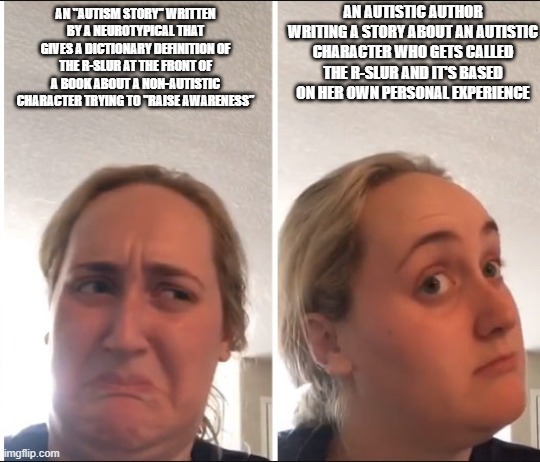
My first thoughts upon seeing this book was: “Oh great, another neurotypical writing an ‘autism story’!” Honestly, I should have seen this coming when the blurb comped this book to Rules by Cynthia Lord (which is another book about a neurotypical sibling whose life is “ruined” by having an autistic sibling, written by a neurotypical.) Books like Rules or No One Needed To Know are what is known colloquially as inspiration porn.
As far as I can tell, DG Driver is not autistic herself. Heck, if she was autistic, she would have written a very different story because she would have realized from her own personal experience how problematic this sort of story is. And while the current cover of this book is a plain blue with two bikes on the front, the old cover that is still visible here on Goodreads (and which still shows as the default cover) is covered in puzzle pieces. For those who don’t know, a large majority of the autistic community (not all of them, you will find some autistic people who don’t mind the puzzle piece) but a significant number of us autistic people (me included) view the puzzle piece as a hate symbol. This is because the puzzle piece was created as a logo for Autism Speaks, which is very widely known among autistic people as a hate group. The puzzle piece was created to signify that there is something “missing” with autistic kids. Autism Speaks also has a long, proven history of eugenics agains the very autistic people they claim to “serve”! I would like to focus this review primarily on the content of this book, so if you are interested in learning more about Autism Speaks, I encourage you to watch this Youtube video by autistic creator Paige Layle about why Autism Speaks is so problematic and why autistic people (aka the people it claims to “help”) vehemently reject it with every fiber of their being.
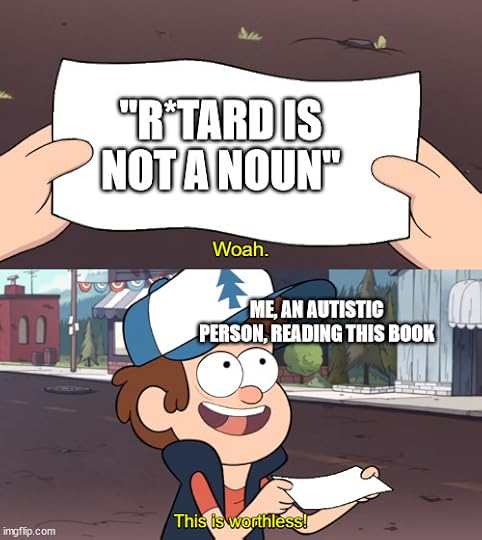
So the very fact that this book cover is full of puzzle pieces raises all of the alarm bells for me. As does the very first opening page, where Driver gives us a bunch of dictionary definitions of the word “r*tard” and then a paragraph-long explanation about Rosa’s Law (which was a law passed by President Obama to change the language in federal documentation from “mental retardation” to “intellectual disability”, due to the word “retard” becoming a slur for people with intellectual disabilities.) In fact, a lot of times you won’t even hear or read people say the full word, they’ll just refer to it as “the r word” or “the r slur.” I’ve found that a large majority of autistic people are familiar with the r slur, either because they have had the r-slur slung at them as an insult or else they have seen other autistic people talking (in online spaces, for example) about the r-slur and how damaging it is. A lot of people, myself included, have had this word slung at them so much that they are triggered by simply seeing it written out, or hearing it said in any context, even if it’s to talk about “fire retardation” which is a common word you see on fire extinguishers, etc.
Again, I’d like to keep this review specifically about the content of this book, so for more information about the history of the r-slur and why it’s so damaging, please watch this Youtube video (8 minutes) by autistic creator Stephanie Bethany about the r-slur and the history behind it.
If Driver had really intended for this book to be written for autistic people, to acknowledge them and say “I see you, I think your stories are worth telling and you deserve to have a place in my story,” then she would not have put five iterations of a damaging slur on the first two pages of her book. Also it’s worth mentioning that since Driver is not autistic or intellectually disabled, she’s never had this word slung at her as an insult. I have seen the r-slur used in another fiction book–Rogue by Lyn Miller-Lachmann, in which the main character, who is autistic, is called the r-slur by a bully at her school. In that case, Miller-Lachmann is autistic herself and is obviously writing from an area of personal experience. I can recognize that Driver is trying to raise awareness of the r-slur but in this case she just went about it all wrong.
Oh, and while we’re on the topic of words, I have to mention another quite ableist term that Driver uses! Several times during the book, Heidi calls her brother “lame” and I found it quite ironic that a book that purports to “raise awareness” of disabilities uses an ableist term like “lame” (which is an insult that compares something to a person who lacks the full use of an arm or leg!)
So this book was written by a non-autistic person, with a target audience of non-autistic people. Sometimes even with a non-autistic person writing it with non-autistic people in mind, they can still provide a good, faithful representation of autism, balancing “educating people about autism” with “the autistic character is a person and more than just a plot device.” See, for example, With the Light: Raising an Autistic Child by Keiko Tobe, which is one of my favorite books of all time. It’s written by a non-autistic author and oftentimes speaks to its neurotypical audience, but the autistic character, Hikaru, is a very genuine representation in that he’s a fully fleshed-out character with thoughts, feelings, motivations, etc. of his own within the story itself. He’s more than just a “plot device”. And to provide contrast, there’s multiple autistic characters, all with different presentations of autism. Hikaru is a non-vocal high support needs autistic boy who likes trains and cartoons, but we also have Miu, a medium-support needs semi-vocal autistic girl who loves to draw, Kubo-kun, a high-support needs autistic man working at Hikaru’s father’s company, and Tomoya-kun, a low-support needs highly vocal autistic boy who interacts with Hikaru and his mother in several extracurricular activities. Multiple autistic characters are presented in the story to give the reader a varied view of what autism is really like. “Good” autism rep will be more than just a checklist of traits that the author inserts onto an otherwise-cardboard cutout of a character to be able to claim “diversity.”
Let’s look at our “autistic” character, David. (and I put “autistic” in quotes because if he is autistic or not is really up for debate–in one early scene he is shown to “have trouble memorizing the combination for the bike lock” but that’s literally so unrealistic because autism makes you have a better memory for numbers, not worse, because a lot of autistic people have a very visual memory and can remember general knowledge and numbers and things very easily) He is sixteen years old, but as his (neurotypical) sister puts it, he’s “sixteen, but he seemed more like nine or ten.” Of course, we can’t have an “autism story” written by a neurotypical without the harmful cliche of “autistic people are literal children trapped in adult bodies.” Infantilization at its finest here, folks! 🙃
Of course, autistic people can seem childish because of their interests. Many of us autistic people have what is known as a “special interest” and oftentimes it is something like Disney, Lego, Star Wars, anime, etc. that is commonly viewed as “childish.” I’m autistic, and my “special interests” are Disney, anime, and Japanese history/language. However, autistic people are not “children trapped in adult bodies” as Driver is seeming to portray here. This is such a damaging trope because we also are adults: we can have jobs, we can enter into romantic relationships, and yes, we can even consent to having sex! His non-autistic sister keeps talking about Donald being “like a child” and yet we don’t ever get to see Donald having a special interest of any sort. In fact, every single one of his autistic triats that we see is a “negative.” How he stims and moves his body, it’s “embarassing” for Heidi. He takes things very literally, which “ruins” Heidi’s game. He comes close to having a meltdown at the park, which again, is “embarassing” for Heidi. His safe food is hamburgers and chocolate shakes from McDonald’s, but Heidi is so embarrassed by being seen with him that she won’t go with him to McDonald’s after he has a meltdown!
So after the scene at the park where we see Donald being such a “burden” on Heidi and all of his bad autistic traits, we get a scene at school where Heidi is “not like other girls” because she likes DODGEBALL and no other girls like dodgeball in sixth grade! But because this review is already going to be very long, I’m going to focus specifically on the autism rep (though as a tomboy-ish girl I do not appreciate this “not like other girls” trope one bit because there is so much more nuance to something like this than Driver portrays!) The one thing I will mention is that she’s embarrassed to invite any of her friends over to her house because of Donald: again, that “embarassment” about having an autistic brother comes into play!
The next chapter we get to see Cathy and Heidi hanging out at Heidi’s house. The entire scene is rife with Heidi being “embarassed” about Donald’s autistic traits. He “doesn’t understand subtlety” but rather than being more direct with him or suggesting something else for him to do or even letting her mother know that she doesn’t want Donald in the living room (because any mother worth her salt would then know to redirect Donald/distract him so that Heidi could hang out with her friend!) she just seethes with resentment at how annoying he is. You know, you have another option, Heidi: take Cathy to your room and hang out there! Heidi also is embarrassed by Donald because he starts trying to talk to Cathy about insects, which I assume is his special interest. Donald also apparently likes to read newspapers and reference books and watch the news, but Heidi inwardly scoffs at him because Donald just makes “it look like he was doing something intelligent.” Then, when Donald gets excited about something on the TV and starts happy-stimming, Heidi tells him to be quiet.
At this point, a reasonable mother would come into the room and take over, maybe suggesting that Heidi and Cathy go out and sit in the garden or in Heidi’s room, but Heidi is given even more of an excuse to resent her brother by needing to be his mother and essentially babysit him during this scene. Also in this scene is another rather unrealistic portrayal of autism, where he “couldn’t remember why he was looking at us.” This is not an autistic trait, and presenting it as such is extremely unrealistic and unfaithful to the book’s original mission of “spreading awareness.”
Then Cathy leaves before the visit is over, and Heidi is again disgusted by the fact that her brother is autistic. It’s worth mentioning that one of Donald’s stims is touching hair, which she says “the whole family was working really hard at getting him to quit.” In With the Light which is the book I mentioned above that has good autism rep, the main character Hikaru is also a teenage boy who likes to touch women’s hair. But in With the Light it’s presented in a more nuanced manner: his mother figures out the function of his behavior (sensory seeking) and manages to replace it with something more appropriate (she knits him a shoulder pad-ish thing that goes on the strap of his bag that he can touch instead of needing to touch women’s hair). Hikaru’s need to touch something soft and hairlike is accommodated and fulfilled in a way that is socially appropriate. Meanwhile, Donald’s needs: need to touch hair, need to follow a routine to go to the park with his sister, are completely ignored and dismissed.
And in the following chapter, it is made very clear that because of Donald, Heidi is no longer allowed to be friends with the other girls at school. Cathy, Heidi’s only friend, is disgusted by Donald and immediately tells another girl, Jackie, about it. Jackie is said to be the biggest gossip in school, and Heidi is immediately ostracized from her class following Cathy’s visit. How amazing that an autistic person who is not being properly accommodated at home is the reason for his sister being bullied at school! Yes, let’s all feel sorry for the NEUROTYPICAL character for being bullied for having an autistic brother rather than the AUTISTIC character who has already been shown to be a victim of bullying in his own right!
We see several scenes of Heidi being bullied at school over the next Monday, before she meets Donald again as she’s biking home. Donald loves biking, so he makes noises as he bikes. But Heidi is disgusted, yet again, by Donald stimming, so she purposely sabotages him being able to put away his bike properly so he’ll get in trouble. Then, when Donald has trouble opening the front door, Heidi refuses to open it for him, and instead leaves him out on the front porch. She inwardly snarks about how he “makes a good servant” when he finally comes inside. (I’m not even going to bother mentioning how unrealistic it is that he immediately forgot about the bikes and didn’t have a meltdown; again, an autistic person would not easily forget about something like that so soon after it happened and might be close to tears!)
Heidi gets invited to go to the movies with a classmate (Kirk) on Saturday, meaning she skips going to the park with Donald in favor of going to the movies. Donald decides to go to the movies, as wel, and she is yet again disgusted by him as she watches him order food and buy his ticket. AND THEN KIRK CALLS HIMSELF THE R-SLUR: “Forgive me, I was being a r*****.”
I know where this book is going. Heidi is going to start some sort of self-righteous campaign about the r-slur: “How dare you call my brother such a horrible name!” in some sort of performative “acceptance” campaign. NEWS FLASH HEIDI: ACCEPTANCE STARTS AT HOME. It’s worth noting that it’s SUPER problematic for Driver, a non-autistic author, to try and make a statement about the r-slur via this book!!!!!!!
In the following scene, Heidi is in the theater with Kirk, and Kirk starts making fun of Donald and how he eats. Then along come Donald’s other bullies, Daryl and Matt, and start calling Donald a “doggy”. And of course, once the manager gets involved, he is also vomit-inducingly ableist, asking Heidi who is “babysitting” her brother and calling her a “little girl” who should “let your brother look out for himself.”
At this point, I had to take a break from reading this book because I felt so sick to my stomach. You know your book isn’t written with autistic people in mind if autistic readers literally have to take breaks from your book. This book should have been one of those times when Driver asked herself “Is this really my story to tell?” and then answered her own question with “No, it’s not.” Some books just aren’t meant to be written.
Anyway, after I had my break, I returned to the book–I'm running out of space in this review, but the entire rest of the book is rife with inspiration porn. It ends with THE NON DISABLED CHARACTERS BEING INSPIRED BY A CLASS OF DISABLED PRESCHOOLERS. DISABLED PRESCHOOLERS JUST BEING THEMSELVES MAKE THE NON DISABLED PROTAGONIST THINK "WOW I AM SUCH A BITCH".
Sometimes you get an idea for a book but it's not your story to tell so it's better to leave it as "an idea". This is one of those books that should have just been left as "an idea" and not found its way into the light of day,
I found this book painful to read. I was hurt for Heidi and all the bad things she had to deal with, especially when her so-called friends started bullying her. And why did they pick on her? Because she had a special needs brother. Of all the stupid reasons! I just wanted to smack the people who were mean to her and Donald. Of course, at some points, that included Heidi. It upset me how mean she often was to her brother, just for being himself...
I was glad when Heidi finally had a name to put to Donald's problems...
I was also glad when Heidi finally started pushing back against her bullies. I felt that having them help out in the special needs classroom was a brilliant idea. Something that all kids should do sometime, regardless of their attitude toward differently-abled kids, but especially for those who pick on them. I did think that Heidi could have handled things a little better in regards to the apologies from her classmates, but she was still dealing with her own issues as well.
I really enjoyed it when Heidi met Russell, and Alex. To have someone in her life who dealt with many of the same issues with his own sibling, would certainly make her life easier to deal with and understand. Not to mention that he had a great attitude about his brother and the other disabled kids he went to school with, including Donald.
The last chapter was absolutely my favorite of the entire book! I loved it!...
This is definitely a book that I recommend for kids with a sibling on the Autism Spectrum, or with any other disability, or who just want to broaden their horizons and learn a bit more about some of the many diverse personalities out there that make up our kalidescope world. A great read especially in April for Autism Awarenesss Month!
D.G. Driver, author of No One Needed To Know, delivers an honest and highly relateable portrayal of a pre-teen girl, Heidi (who is partially biographical) with an older brother who has autism. On one hand, Heidi wants desperately to fit in with her peers and on the other hand, remain true to her family values. It is easy to identify with her as she struggles with her own coming of age at a time when society was much less inclusive for people with autism. On the precipice of “growing up”, we meet Heidi when she is unable to stick up for herself or her brother, but she evolves into a resilient, brave young woman, who comes, not only, to her brother's rescue but also, in turn rescues herself. I highly recommend this book. It is a great heart-felt, eye opening “slice of life” that should be shared at school, in the home and out into the world.
Full Disclosure: The author sent me a copy of this book. All opinions are my own.
This is an excellent book that takes the listener inside the relationship of a "normal" eleven year old girl and her "high functioning autistic" brother. Heidi is growing up and beginning to really notice her brother's uniqueness. When other kids bully Donald and make fun of her, she is torn between her love for Donald and wanting a normal life. This gives the listener a chance to see how others live. A very good listen with life lessons!
The narration was well done. The characters were well portrayed by Allie James.
I was given this free review copy audiobook at my request and have voluntarily left this review.
The author offers an eye-opening first person account of what it's like to live with an autistic family member. In this story, the strong, young protagonist finds herself grappling with frustration and misgivings at her older brother's frailty. Even so, she sees that he's confronted by boys his age who, motivated by shallow insensitivity, would harm him. At that point, as the pace of the action picks up, she finds herself needing to abruptly take up for him. D. G. Driver makes effective use of irony to imply ambivalence and often displays her clever way of turning a phrase.
This is a well written and engaging story. However, I very much disliked one factor in the story...enough that it made me drop this to a 3 star. I won't spoil that twist here, but I will say that I hope it isn't common in differently abled families (I am an educator and have not seen it before BUT the world is a big place). This book handles the topics of bullying, differently abledness, and growing up with a differently abled sibling well and I would recommend picking up this quick read.
It was interesting to read a book about an sixteen year old boy with autism but told from the point of view of his twelve year old sister makes it more intriguing. Hope this book reaches a lot of readers.
I think this was a great insight to what a sibling of an Autistic Child might be going through. Donald is 16 and a fun loving person, but it's the Autism that makes it hard for his sister Heidi. Heidi is ok with Donald as long as none of her friends find out about her brother. Then her best friend comes over and finds out about Donald. Life is not the same for her any more. Everyone make fun of her at school. They leave her out of everything. She must try to make her friends understand about her brother.
Thoughts: I came into NO ONE NEEDED TO KNOW with high expectations, and I am extremely happy to say that my expectations were far exceeded. D.G. Driver has crafted a beautiful, very real story that has touched my heart - and I'm positive will touch others'.
When Driver offered NO ONE NEEDED TO KNOW to me to review, she explained to me that this story was based on her own childhood experiences. That's part of the reason I had such high expectations - I usually expect an author who can relate so easily to their own main character to be able to write a better story because of it. I'm pleased to say that my assumptions were correct - Heidi is a stellar main character. She's relatable, likable, and flawed, but in the type of way that makes the story seem more real, which is exactly the type of thing I like seeing in novels like this. A huge problem I always have with realistic fiction novels is that they have a cliche happy ending, with everything tied up in a neat bow - something that isn't very realistic. What was so memorable and touching about NO ONE NEEDED TO KNOW was, in fact, the ending, part of why I enjoyed this book so much. I would definitely recommend this book to teachers and students alike (as well as literally everyone else on the face of this planet), since it promotes activism and empathy, two characteristics that Heidi strongly displays in this book. The great thing, though, is that Heidi isn't necessarily this way right from the start - as a reader, I loved seeing her evolve from a rather insecure girl who can't really stick up for herself or her autistic brother, to a strong-willed, caring girl who makes for a perfect role model. And although this story was short, Driver got her point across easily with great writing that made the story flow nicely from start to finish. There was never a dull moment, which I loved.
All in all, a fantastic book that I highly recommend to literally everyone, no matter who you are!
Disclosure: I received a free copy of this book in exchange for an honest, unbiased review. All thoughts are my own.
Nice thoughtful book teaching kids about autism. The ending was a little disappointing though. Heidi's bullies learned and changed, but nothing really happened with the high school bullies. Heidi doesn't get picked on anymore, but Donald still does.
This is the first book I’ve read/listened to by this author and I would listen to another. I think this story was well done. It seems to me a very realistic series of events and behavior by these kids. I like the solution Heidi comes up with to try to bring a bit more tolerance and empathy to her classmates.
This is the first book I’ve listened to by this narrator ( Allie James ) and I would listen to another. Her reading is expressive, yet she does not have overly distinct voices for each character. This was not really an issue but noticeable.
There are no explicit sex scenes, excessive violence or swearing.
I was given this free review copy audiobook at my request and voluntarily left this unbiased review.
Please feel free to comment on whether you found my review helpful.
No One Needed to Know by D. G. Driver is a sweet story about bullying and learning to live with autism.
Heidi is a preteen who loves her older brother, who has autism. As a child, she never gave much thought to his behavior, but by the time she got to middle school things started to change. Her brother started getting bullied, and because of his condition, she was bullied herself. Heidi tried to hide from everybody that she had a brother with autism, including her school friends. And this is when the story gets interesting (not giving away spoilers).
No One Needed to Know is a nice book to teach preteen/teens how to deal with and help a loved one with autism. Not only that, but it is also a helpful tool to identify bullying. D. G. Driver depicts a clear picture of the characters and their personalities. The plot keeps a steady pace with no major twists. And what the author recounts is not far from reality. Although the author uses an excellent approach to teach young adult about autism, I thought the plan to deal with bullying was too simplistic. Nonetheless, it is a refreshing reading.
The author gave me this book in exchange for an honest review. The opinions expressed are my own.