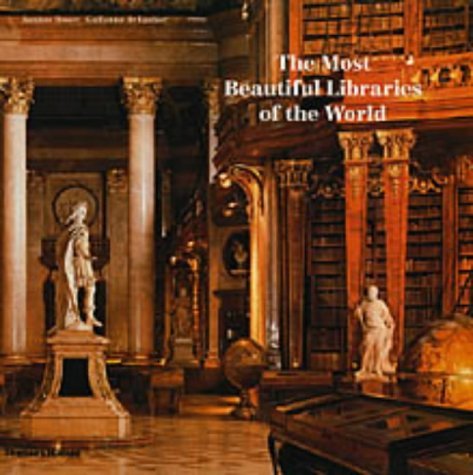
The Most Beautiful Libraries in the World (2003)
This book is about the art and architecture of magnificent edifices, together with the storehouse of human knowledge and culture contained within. It’s a tour of twenty three of the world’s most historic libraries, representing twelve countries. Lest you think this is all a bunch of dull reading about these 23 libraries, I estimated about 174 pages of beautiful color photographs that accompany about 54 pages of text. A true coffee table book that anyone can delight in.
It begins with the National Library of Austria in Vienna. Earlier known as the Hofbibliothek, it’s a masterpiece of Baroque Austrian architecture from the early to mid 1700s. The grand hall alone covers almost 12,000 square feet and is 64 feet high. The collection now includes 6.5 million books.
There’s the Benedictine Abbey Library of Admont, not far from Salzburg in Austria; the Monastic Library of Wiblingen in Ulm, Germany, near the Danube in southwest Germany; the Benedictine Abbey Library of Metten, Germany, east of Munich, is an extreme luxury example of Bavarian Baroque; the Herzogin Anna Amalia Library in Weimar, Germany—the son of Duchess Anna Amalia invited Goethe to reside in Weimar, near the Czech border, until his death—the one million volume collection lost over 50,000 volumes to a devastating fire in September 2004.
Although there are accounts of a library in the old seventh century St. Peter’s Church, it was Nicholas II, a passionate bibliophile elected Pope in March 1447, that gave a real start to the Vatican Library. The fame of this attraction to humanists and scholars reached its peak under Pope Leo X—Giovanni de Medici—who was elected in 1513. Then many manuscripts were lost in the Sack of Rome in 1527 by the army of Emperor Charles V. Afterwards came the Vatican of the Counter-Reformation and its war against heresies. Pope Paul V instituted the Index of Banned Books in 1559 which remained in force until 1966, however the collection continued to grow impressively and, today, holds some 75,000 manuscripts and over 1.1 million printed books.
The Riccardiana Library of Florence is the product of a wealthy Florentine family in the 16th and 17th centuries. The guiding tone for the Mazarine Library in Paris was librarian Gabriel Naude, whose book, Advice for Forming a Library (1627), is a foundation of modern library science. Since 1926 the library of 17th century Cardinal Mazarin has developed an area of specialty in regional and local French history. On the other side of an oak door in the Mazarine Library is the Institute Library, founded after the French Revolution of 1789 after the revolutionaries abolished the royal academies. The Institute took over the functions of the academies and a library was needed for this “parliament of scholars.” Today the Institute Library has 600,000 works, including over 800 current periodicals.
The Senate Library at the edge of the city of Paris began as a palace built by Marie de Medicis, widow of Henry IV and regent of the kingdom, in 1615. The transformation from Palace to Library began in 1800 when the revolutionary Senate of the Consulate required a research tool. The Cabinet des Livres of the Duc D’Aumale in Chantilly, France, demonstrates what can result from one of the greatest bibliophiles of the nineteenth century. In the first plans for his dream chateau, which he intended to build in Chantilly, it was the library that occupied the central space. The Abbey Library of Saint Gall, near Lake Constance in Switzerland, is like a microcosm of the history of European culture. From Irish missionary work in the 7th century to the Benedictine takeover, to the Reformation followed by the great secularization movement, the Abbey has survived it all.
The Bodleian Library of Oxford University struggled in its beginning. From 1320 when the Bishop of Worcester decided to build a hall for a collection of manuscripts to the dark days of 1555 when all works with any reference to Roman Catholicism had to be purged and 1556 when the furniture was sold and the empty hall was transformed into the School of Medicine, the library awaited Thomas Bodley, Protestant and one time ambassador for Queen Elizabeth I. Bodley spent his time and his fortune creating the library. His money and books were accepted in 1598. In 1602 the library contained 1700 printed works. By 1605, there were over 6000 volumes. In 1610, Sir Thomas Bodley received, free of charge, a bound copy of every work published by London printers, marking the beginning of copyright registration in England. By 1849, the library owned 220,000 books and today, with 6.5 million volumes, is the second largest university library in the world, after Moscow.
The Wren Library of Trinity College, Cambridge, was begun in 1676, at a time when Christopher Wren, mathematician turned architect, was busy with London. The 1666 fire that devastated London resulted in Wren being appointed to draw up the plans for the city and construct fifty two churches and St. Paul’s Cathedral while planning and building the Cambridge library. The facades are in a noble and classical style, but the interior really demonstrates the “functionalist” vision of the architect. The great hall has bookcases set perpendicular to the wall, creating eleven alcoves in each side and the entire space tends to be black, white, and dark oak, except for a picture window of stained glass facing south.
The John Rylands Library of Manchester, England, was actually a tribute by his widow to commemorate her husband and became one of the most beautiful private libraries in the United Kingdom with the most remarkable book collection of the early twentieth century. The Trinity College Library in Dublin was founded in 1592 by Queen Elizabeth I to propagate the “good” religion, i.e., Anglican Christianity, in a primarily Catholic country. Its greatest treasure is the illustrated Gospels, the Book of Kells, from around 800 AD. The National Library in Prague is a brilliant testimony to 17th century Baroque at is apogee. Its ceiling frescoes with fake balconies confound the true scale of the hall. The Library of the Royal Monastery of El Escorial, north of Madrid, was founded by Philip II after defeat of the French in 1557, though the entire complex, including the library, was not completed until 1654. Many of the treasures originally in El Escorial were moved to museums and palaces in Madrid but the monastery-palace and library remain one of the most brilliant expressions of Spain’s Golden Age. The National Palace Library in Mafra, thirty one miles north of Lisbon, Portugal, was modeled after the Imperial Library in Vienna but was built when Portugal’s fortunes began to decline. The library still has 40,000 volumes from the 16 to 18th centuries in an otherwise empty complex containing 880 rooms and bedrooms.
The Boston Athenæum was founded in 1807 on Beacon Hill, Boston, by a number of the most important families in Boston with a sculpture gallery on the ground floor, the library on the second floor, and a painting gallery on the third floor. Its collection of paintings and sculptures formed the nucleus of the Boston Museum of Fine Arts, which was originally housed in the Athenæum. Its collection of more than half a million works focuses on the history of Boston and New England, biographies, English and American literature, and the fine arts. It possesses one of the largest collections of American documents on the Confederate states and is the proud owner of George Washington’s library. The Boston Athenæum, a private membership library, is one of the oldest and most impressive examples of American cultural philanthropy.
The Library of Congress in Washington DC had its origins in 1800 when John Adams authorized its operation and books were stored in the U.S. Capitol. In 1814 the Capitol and its books were destroyed by the British. Congress quickly rebuilt the collection, especially including the purchase, in 1815, of Thomas Jefferson’s personal library—the largest in the country—for $23,940. The Thomas Jefferson Building was dedicated in 1897 and in buildings and annexes throughout Washington, the collection now contains more than 17 million books and 95 million maps, manuscripts, photographs, films, and other collections in 460 languages.
At the New York Public Library, Patience and Fortitude are the names of the two pink Tennessee marble lions sculpted by Edward Clark Potter that welcome the visitor. John Jacob Astor, the wealthiest American in 1848, left $400,000 to create a reference library. In 1870, James Lenox, a wealthy merchant and housing developer, founded a library for his own collection. After the passing of Samuel Tilden in 1886, former New York governor and past presidential candidate, the Tilden Trust was charged with the creation of a great public library. Finally, the three merged and a building was commissioned. For the cost of nine million dollars, two million more than the Library of Congress, the cultural monument was built with the first stone laid in 1902 and inauguration day in 1911. The Library contains almost 12 million items and is visited each year by more than ten million readers.
The National Library of Russia began in 1795, when Tsarina Catherine II ordered the construction of a building in St. Petersburg, to house a library that would help form an “enlightened aristocracy”. The library contains more than 32 million volumes, including Voltaire’s personal library of almost 7000 items, and has become one of the five largest libraries in the world.