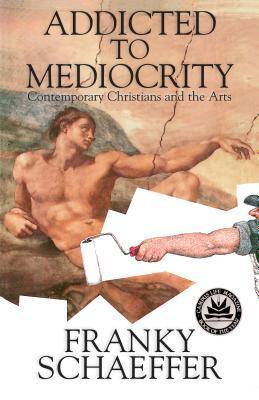
In this provocative book, Franky Schaeffer shows how Christians today have sacrificed the artistic prominence they enjoyed for centuries and settled instead for mediocrity. The evidence for this sad state of affairs abounds. We are flooded with "Christian" doodads, trinkets, t-shirts, bumper stickers, etc., that use God's name as an advertising slogan--"Things Go Better with Jesus"--putting the Creator of the universe on the same level as soda pop! Moreover, Schaeffer writes, "Whenever Christians, and evangelicals in particular, have attempted to 'reach the world' through the media--TV, film, publishing and so on--the thinking public gets the firm idea that, like soup in a bad restaurant, Christians' brains are best left unstirred." But it doesn't have to be this way. Schaeffer shows how Christians who care can begin to reverse the slide toward by demanding excellence in the arts and media, and in all areas of life; by giving our time, talents and money to those things which are worthy of our support and are truly honoring to God; by staying away from the cheap, the shoddy, and the make-a-fast-buck mentality. Schaeffer offers not only an unflinching critique, but specific and practical direction for becoming "unaddicted," and for recovering artistic excellence. The punch, humor and satire of the text is effectively enhanced by nineteen original drawings by Chicago artist Kurt Mitchell.
Frank Schaeffer is a New York Times bestselling author of more than a dozen books. Frank is a survivor of both polio and an evangelical/fundamentalist childhood, an acclaimed writer who overcame severe dyslexia, a home-schooled and self-taught documentary movie director, a feature film director of four low budget Hollywood features Frank has described as “pretty terrible.” He is also an acclaimed author of both fiction and nonfiction and an artist with a loyal following of international collectors who own many of his oil paintings. Frank has been a frequent guest on the Rachel Maddow Show on NBC, has appeared on Oprah, been interviewed by Terri Gross on NPR’s Fresh Air and appeared on the Today Show, BBC News and many other media outlets. He is a much sought after speaker and has lectured at a wide range of venues from Harvard’s Kennedy School to the Hammer Museum/UCLA, Princeton University, Riverside Church Cathedral, DePaul University and the Kansas City Public Library.
I agree with a lot of Franky Schaeffer’s points in this book. Christian movies, by and large, are terrible. Christian novels are often poorly written, riddled with stock characters, and are peppered with forced moral/biblical(?) messages. Etc. etc.
However, I found myself increasingly frustrated by the fact that Mr. Schaeffer wasn’t giving concrete examples. He spoke in broad generalizations and made blanket statements about what Christians should and shouldn’t do. He also talked a lot about Christian art being inferior without giving readers any kind of rubric to judge artistic value. Many people will say that Christian music today is crap… OK, but why is it crap? This is what Mr. Schaeffer didn’t do very well.
In the last half of his book he does offer some helpful answers to certain questions. One of those questions involves where to learn more about the subject, in which he recommends about 10 books. I guess you could say this book Is a treatise that points readers towards deeper territory.
An important little book, rapidly readable. I agree with Sarah Wolfe's review: The topic definitely deserves more robust, less repetitive treatment, and the book needs a rewrite with a broader swath of examples. After all, any book that takes aim at mediocrity in the arts had better be excellent itself! (I'll add that while Kurt Mitchell's penciled cartoons for this book are a great inclusion, their placement within the text often interrupts its flow or undercuts a serious written point with a bit of delightful visual absurdity).
Schaeffer deserves full credit for placing his reputation and career in the line of fire by calling attention to the anti-intellectual, anti-culture tide that overswept American Evangelicalism as Fundamentalism co-opted it during the mid- to late-twentieth century. Like many artists and thinkers of the era, he found himself on the "wrong" side of Evangelical political activism and suffered for it, personally and professionally.
But insightful, prophetic, and helpful as it may be, what's missing from this work is analysis of market forces and the engines of culture. What Schaeffer calls "mediocrity" is I think better understood as what Skye Jethani calls "the Evangelical-Industrial Complex," a highly profitable ecosystem of tastemakers and producers who actively curate "Christian" commercial products, including not only purchasable goods but experiences, celebrities, and even church buildings and programming, for the mass market. This way of doing business actively limits and shapes "Christian" products and messaging to what will sell and simultaneously (but passively) trains and stokes consumer appetites for what is being sold. "Mediocrity" as such is an emergent property arising from these pressures; it shows up in every mass market. The problem is not so much lack of taste or capitulation as it is lack of exposure among Christians to work that is genuinely transcendental.
Forty years on, the situation is starting to change - largely due to the economic opportunity created by the internet. Mass markets are breaking up; niche markets are on the rise. This is true even within Evangelicalism. The change in and of itself is not necessarily positive, but it does create opportunities that were far more difficult, risky, and expensive to exploit in the 70s and 80s. Consider, for example, the work of the Anselm Society, or Terry Glaspey's excellent book 75 Masterpieces Every Christian Should Know. Inertia and vested interests are powerful, but we are on the cusp of things new.
"Today, Christian endeavor in the arts is typified by the contents of your local Christian bookstore-accessories-paraphernalia shop. For the coffee table we have a set of praying hands made out of some sort of pressed muck. Christian posters are ready to adorn your walls with suitable Christian graffiti to sanctify them and make them a justifiable expense. Perhaps a little plastic cube with a mustard seed entombed within to boost your understanding of faith. And as if this were not enough, a toothbrush with a Bible verse stamped on its plastic handle. And a comb with a Christian slogan or two impressed on it. On a flimsy rack are stacked a pile of records. You may choose them at random blindfolded, for most of them will be the same idle rehash of acceptable spiritual slogans, endlessly recycled as pablum for the tone-deaf, television-softened brains of our present day Christians."
pg. 22-23
...Hilarious.
I found this book to be very encouraging in the freedom it gives Christians to pursue their artistic endeavors in their own special way, without being held back by suffocating "Christian" ideologies. It begins with an argument for many of the problems with the way the Evangelical American church has handled the arena of the arts and aesthetics, and then gives an alternative solution for how one could view the arts. All while taking refuge and inspiration from the history of Christian artists going back to the fall of the Roman Empire, heightening in the High Renaissance, and finally through the 19th Century.
I really struggled about what to rate this book. On the one hand, I agree with a portion of the author's premise. Christain "art" is terrible, full stop. OTOH, the author is an arrogant sonuvabitch. I literally gasped and laughed out loud in a crowded theatre at intermission, causing everyone around me to think I was a loony. But then, they already thought that because I was singing along when invited to do so, but I digres...
I'm going to send this book to my mother. That should give us something to talk about. ::wicked grin::
Franky writes in a flamboyant, easy to ready, captivating fashion. Franky describes the job of Christians in much the same fashion as John Comer does in Garden City. We are Gods images on earth and given the job to continue the work of culture building.
If you are looking for an easy read that gives a compelling vision for Christians engaging in the arts, this is it.
He is also eminently quotable.
“It seems at times, in the areas we are discussing [art], that the Christian community, the evangelical establishment, whatever, often exhibit to the world, an IQ about 30 points lower than that of a rather determined jellyfish.”
This is a short book. A good friend (and a brilliant artist) recommended it, so I read listed to the audio version last week. I wasn’t impressed. Granted, I had listened on 2x speed or higher while washing dishes, so I decided to give it another run through and take notes this time. I’m still not thrilled with Shaffer’s approach.
First, he writes as an offended man, full of anger and accusations. I don’t see grace for the church. He never asked whether the church has any good reason for rejecting art or gives them the benefit of the doubt. He only accuses and rejects. I can’t imagine the Jesus writing a book about his bride in this tone.
Second, a good chunk of the book was a tirade against utilitarianism. He refuses to call art useful in any sense. I don’t like people cheapening a brilliant novel to the level of a mere tool any more than the next person—but I struggle with his extreme antiutilitarian position. Are the arts not good for the soul? Are they not good for anything? These are uses, and it’s not obvious to me that these are invalid questions. But Shaffer hates measuring the arts by their effects. He says that “everything cannot be measured in church growth programs or the number of souls saved, as if we were chalking up the sales of second-hand cars on some great blackboard in the sky.” But doesn’t this reject the idea that we know good things by their good fruit.
I had several other gripes, but perhaps the most pervades was his method of argumentation. He builds straw men and often writes in absolutes. He says things like, “there are only two kinds of art: good art and bad art. …There is no such thing as Christian art any more than there are Christian bricks for the house builder.” But bricks have no weight of meaning; they usually do not communicate a message. Art does by definition. Even if I thought he was right, his argument can’t hold water. A novel is so clearly different from a brick.
At the end of the day, I’m disappointed—not so much because this was a unsatisfying read but because it leaves me wondering if anyone has good answers for my questions. For all his ranting, I think Shaffer was right about the abysmal state of a lot of self-proclaimed Christian art. But Shaffer couldn’t satisfy me as to why the men and women I know and love are genuinely unwilling to leave it. And he didn’t at all make me hunger to see solid Christians make good art. He had no way of expressing the need for Christians specifically to create because “Christian” art isn’t even a valid concept in his mind.
I’m sure that God calls some of his people to be artists, and I’m sure this is a good, beautiful thing. But Shaffer hasn’t at all helped me understand this calling or understand why it is good and beautiful.
Almost fantastic, but overlooks some seriously vital insights on the aftermath of the reformation on art history (seemed to write as though reformed thought has remained exactly the same as it was 500 yrs ago, and didn't take reformers' cultural/historical context into account), as well as containing some cringey political blind spots that did not age well. Overall encouraging, though, and still timely
An important message packed into a beautifully short package, however, this only gets 3 stars for a few reasons: 1) important message, but DUH. maybe it's not so obvious to some people, but for me the whole thing was a "no duh" experience. 2) i didn't feel like there were many solutions offered, and those that were put forth were pretty vague.
While I agree with the premise of this book, I personally found it to be an overlong read, despite its already short (127 pages) length. Once you reach agreement with the book's basic propositions, the rest seems somewhat repetitive.
This "judgement " was a wild ride. I thought the author was his dad (Francis Schaeffer) and was very confused about the incredible tonal shift from the previous work I read. A lot of this book felt incredibly harsh, and in a way I appreciated it - like being slapped hard and having to reconcile whether or not it was deserved. It's clear the author is angry, betrayed even, and it's unfortunate to read that he seemingly has spiraled towards atheism (he now says he's a Christian atheist). Despite not agreeing with everything I appreciate having read it and will continue to digest it to see what is worth absorbing and what I feel needs to be rejected. The discussion about how church employees are said to be in "full-time ministry" is a ridiculously belittling and nonsensical phrase to use was one of my favorite parts: all Christians are in full-time ministry. At home, at work, at the grocery store, doing art or hobbies - "Whatever you do, work at it with all your heart, as working for the Lord, not for human masters, since you know that you will receive an inheritance from the Lord as a reward. It is the Lord Christ you are serving." Colossians 3:23-24 His discussion about how culture valuing only "productive " work also cracked some of the crust off my heart, that every single person is an image bearer of God FIRST and ALWAYS, they don't have to do anything to earn that. God created beauty and thought it was good. Not to make money or convert people, but out of love and a desire to give His children good things. We, thusly, should do the same. Not holding back or belittling our gifts or others but encouraging and supporting them. Lots to think about and practice.
His take on the state of "Christian art" is spot on. Most things labeled "Christian" hardly seem to convey the excellency of Christ and definitely don't often convey the excellency that should be expected of art.
However, he basically says the secular vs. the sacred distinction is a false dichotomy. I don't find his argument all too convincing (though he might elaborate further elsewhere).
As well, because the church is also so mediocre (albeit, in the early 1980s that's what he was saying), he thinks that many Christians might be more spiritually benefitted if they simply skipped church (or Sunday school, small group, etc.) altogether and did something else in the world that God has made (canoeing, camping, hiking, painting, etc.). He does contradict himself a few times on this, saying at one point that the church is most certainly an institution given to us by God, but instead of calling for the revitalization of local churches, he calls for avoidance. It's not a very optimistic outlook for how the corporate bodies can be improved (or made to be more in line with Scripture), as much as it is optimistic concerning how an individual Christian can thrive even with the shambles of local churches that we have.
He also believes the creation of good art is basically on par with evangelism, discipleship, etc. I find the logical end of this thought to be wildly inconsiderate of the means necessary for something to truly be gospel proclamation (i.e., actually evangelizing with words) and, thus, that which might lead to one's salvation.
I want to start by saying that Schaeffer is absolutely correct in his assessment of the mediocrity of Christian art, and that not nearly enough has changed in the 40+ years since he wrote this book. Christians should care about the quality of the art they produce and consume just as much as the "message" of said art.
Ironically, Schaeffer's book is not a good example of Christian art. (I wonder, does does the author separate criticism from art?) The prose is heavy and ponderous. It seems that the book is based on a series of lectures that Schaeffer gave and I imagine the content likely worked really well in that form. So, I am left giving a hearty amen to the content of the book but not being particularly pleased with the book itself. This particular Schaeffer is, I think, my least favorite author of the family. (But he can be forgiven for that, given the giant shoes his parents left to fill.)
Schaeffer's diagnosis of the problem of American Christianity's love-affair with the mediocre is still resonant today, as it appears American Christians have largely leaned into the trend Schaeffer identifies. I do sometimes think that Schaeffer's condemnation of the church addicted to mediocrity comes a bit stronger than it ought, though, though by Schaeffer's own admission he was in something of a cage-stage when he wrote this book (and I'm not sure that he would agree with or believe what he has written now given that he seems to have abandoned orthodox faith altogether). That said, his indictment here does ring true.
Una reflexión sobre la creatividad, las artes, la belleza. El autor hace un llamado a la excelencia y calidad en la creación y consumo de arte. Plantea sus ideas sobre porqué el arte cristiano ha llegado a ser tan malo (con algunas excepciones) cuando durante siglos, dominó la cultura. Reflexiona sobre los peligros de la televisión y el activismo en la iglesia; los pequeños “mundos” que hacen los cristianos dentro de la iglesia. Da recomendaciones prácticas para desarrollar la creatividad y aumentar el buen gusto en el arte (también da recomendaciones para padres e hijos).
I would note the author has changed from someone who was apart of christian worldview at writing this book to currently a self-described Christian atheist.
I enjoyed this book. This work is somewhat dated being written in the early 1980’s. But overall I would say the attitudes towards art have changed much so much of the criticism does hold.
A couple good points, a couple somewhat ambiguous contradictory points, and a couple questionable points. Overall I appreciated the process and there definitely are some valuable insights and criticisms of modern artists and conversations about the the religious vs. secular views of the world. Almost four stars, I just could not quite do it. I listened to an audiobook version.
This has some scathing indictments that are 100% true regarding the state of the arts in Christianity. Some great things to think about. But, overall the book is lacking is concrete examples and needed more than just a rudimentary nod to philosophical and aesthetic background.
I read this book as a young teenager in the early 80’s and thought it was revolutionary. The basic thesis is that once upon a time, there was a Christian consensus in the west, and the arts benefitted from this. Artists were free to create works of lasting beauty, and they weren’t pigeonholed into “Christian Media.” Today, however, we’ve lost that consensus, and now what passes for Christian art is so utilitarian, agenda driven, and market tested that it can’t even legitimately be called art. Thus the title: Addicted to Mediocrity.
First published in 1981, the book at the time seemed like a brave stand against poorly produced Christian movies, the Christian music industry, and everything about TV in general, let alone “Christian television.” As a creative kid who loved to write poetry and draw pictures and act onstage, it was liberating to read that creative expression could be an end in itself, and didn’t have to simply be a means to get a message across. A work of art could be “Christian” simply because it was the best expression of an artist created in the image of a creative God.
But in the 40 years since its publication, either the book hasn’t aged well, or I haven’t. Reading it in my late middle age, now the tone just seems so pompous and self-righteous. Everything since the renaissance is awful, all Christian artists have sold out and all Christian consumers have settled. It is strident finger pointing, self-aggrandizing (of the dozen books listed in the “for further reading” chapter, three of them were written by his father), and, ultimately, unfair. There’s no mention of Spielberg in the movies section. Indeed, with the exception of George Lucas and Francis Ford Coppola, all the filmmakers cited (Fellini, Polanski, etc) seem to be mentioned just so the author can point to how sophisticated he is. Like people who insist on calling it cinema. There’s no contemporary musicians referenced. Granted, a lot of “Christian music” really is as bad as Schaeffer says it is. But not all of it. There have been some original, boundary pushing artists in the last forty years, such as Rich Mullins, Charlie Peacock, Lecrae, and Derek Webb (yes, him too, even given where he is now) who happened to be Christians.
I would love to see this subject dealt with again, but maybe more charitably, and certainly less Anglo-centrically. I’d love an essay that considered hip hop for example— a legitimate art form that didn’t even exist in 1981. And a reconsideration of TV in the streaming age, when creative work can find a niche audience without having to test market for such broad appeal.
This one was a chore to get through the second time.
Everyone involved in the Christian music industry or anyone who happens to be a Christian and who is an artist of any nature, and has been frustrated by the utter mediocrity that Church puts forward as art or creativity, should read this book.
Addicted to Mediocrity's main premises revolve around the banality of modern Christian arts which seem to follow man-made values and evidently neglect the inherent purposes of art appreciation and creativity God has blessed us with. The author starts off with pointing our the importance of arts in relation to the nature of God's creation; being created in an image of God, we human are naturally granted with great qualities as he says:
""made in the image of God," it is the area of creativity, the capacity to enjoy beauty, to communicate artistically and through abstract ideas. The area of creativity therefore is no minor footnote to the Christian life, but is an essential." (p.12)
Knowing this truth, we as Christians are supposed to pay more attention to arts and do not let the values of the world and its shallowness hinder us from another great path of glorifying God. The first part of the book is really clear about these points. The author does an excellent job to motivate us audiences to embrace arts as it is again with his way of writing. Highly critical statements are used to effectively portray the ideas. The illustrations are also great to help visualize and emphasize the concepts; for example, when the author talks about how awfully we have ruined the true beauty of arts, putting our creativity to death by conforming to capitalism and ideologies; he puts the illustration of representations of arts; paint brush, musical instrument, a ballet shoe hanged on a gallows. I found them really helpful and really excited to see another illustration await for me on the next page. It is really refreshing and inspiring.
However, the book also contains a lot of flaws as I read on. Though the ideas are well communicated, there is one thing I really want to search for in the book; more biblical supports. There is a small use of the Bible in this book except for Genesis which the author uses to point out the beauty of creation. The other parts are mainly his claims and quotes excerpted from other books; they make me feel kind of uneasy to trust those strong suggestions and challenges without the firm foundation of the Bible despite the fact that I do like those wild ideas, I still expect more evidences and responsibilities in his words. And in many parts he is so judgmental; He goes further to judge modern church practices; well what he claims is true to a certain degree but how can he judge the unseen. He says that attending church activities can be a waste of time as he says:
"It might be a good idea to abandon our frenetic addiction to church activities altogether in favor of more warm and personal human relationships, which are natural and God-given, within the family and in friendships. After all, for a Christian married couple, making love is as spiritual as some church activity. Isaac took Rebekah to his mother's tent, not to some prayer meeting or spiritual emphasis week. God in Scripture has left the church for us as an institution to serve a very real and worthwhile purpose. However, the constant activity-oriented nature of the church today, which is more like some combination health club-golfing society-bowling tournament-Sunday school service-inspirational message-fellowship-Jesus advertising machine-growth program all rolled into one, does not seem to have very much to do with the institution we read about in the New Testament." (P.87)
and he also says:
"There are no valid excuses for accepting this mediocrity. The excuse that "sometimes people are saved" is no excuse at all. People have been saved in concentration camps because God can bring good from evil, but this does not justify the evil. The idea that "the Spirit can work somehow," that God can bring something out of it if we just sort of throw it out there, is unjustifiable from those who claim to know the living God and can see his integrity and dedication to quality in his Word and the world around us. The excuse that "many people see this," and that "somehow it must do some good" and "it's better than nothing" is no excuse." (p.45)
Whoa whoa easy it is true that overspent time attending church activities can harm your life in many areas, yet there exist also people who have time to do them effectively and are blessed by these activities. Though they might look to adhere to mediocrity of the world, it is also evident that God has actually turned some of those into blessings to people as well. It's not that we try to choose for the second best sometimes people just don't know and even if they know and are willing to achieve the real God-given things we might have to understand that at some point our creativity now has a basis on this so called mediocrity as well; we are in this culture and culture is inevitable. Culture is inescapable no matter how hard we try to get the out of it. For example, this book, though, claiming itself to be out of the bubble and independent from mediocrity. In a sense, yes it is true that it purposes unconventional and out of the box way of thinking but it also conforms to mediocrity of capitalism; being published and printed by a publisher and mass produced by a machine and finally shelved in book stores all over the country to be consumed by the audiences. This mediocrity phenomena perhaps is just a double-edge sword as anything that has happened in the face of history; it can do good and huge destruction. The author also seems to praise people from the past in terms of artistic creation more than our existing culture of cliche and the bubble of capitalism; well though they created more authentic artworks and released more creativity than people of this age there are also mistakes of the era as well. The Catholic Church spent loads of money funding artists to create arts while many people in the society were struggle towards poverty. Would you say that the whole thing was entirely good? Absolutely not. The author just picks an aspect on creativity and forgets totally to look at the bigger picture; the reality in the society.
Maybe capitalism is more evil but there are evil everywhere as long as human still exist. We are sinful by nature, right? I do agree with the point that our culture is full of shallow manipulation and ridiculously banal Christian artworks. But, we have also have to be careful to take a look in individual scales. Remember what Jesus said, " Don't judge or you too will be judged" We can't know for sure what in people's heart is and I don't want this new attitude to fix what we have failed to backfire us by veiling our will and love to serve God. This is something that we all should be more careful. I didn't say that we should not fix anything just leave it as it is or whatever but it should be in a softer way and with great understanding both in the context of our culture and society, and ourselves. Furious judgmental criticism which cover all the people in its circle without concerning to their individual motives are impractical and almost equally evil to those twisted practices themselves.
In overall, this book is still a good read despite its flaws if you want to remind yourself of authenticity and the beauty God has put in our lives. If you're interested in arts in relation to God I would like to recommend it to see what the idea is. The book also suggests readings that will expand your view on this particular topic whether Giorgio Vasari's book and others useful resources to exercise your knowledge. I also suggest you to read it critically. Open your Bible along, take notes and don't be quick to believe every single thing being said here.
I'm actually writing something about religion--ME! A little summer 2025 side-project--and good old famous (in some circles) Frank Schaeffer is on my mind! I'm actually reading two of his OTHER, more contemporary books, but this one is rather seminal (in that sphere of "some circles"). It was my mom's. A bit of an eclectic mix of art-lover and theologian, my mom loved this book. It ended up on my own book shelf, as an adult, strategically positioned next to Frank's dad's book, HOW SHALL WE THEN LIVE.
I thought I'd give it a read prior to reading the more contemporary ones.
My impression: I think, for its time, it was kinda radical (for his "circle"). Probably not now. But he did it. He wrote it. Honestly, I didn't disagree with any of it.
I wrote down some quotes:
“The level of teaching in the church today reflects this. Since spirituality is seen as an end in itself, what does it matter if sermons become endless repetition of theological jargon that takes the place of truth? As long as it all sounds spiritual, it accepted. The constant exhortations to ‘pull up our spiritual socks’ and calls to ‘love’ naturally have a hollow ring. They are often only exercises in futile spirituality and remain unapplied to real life in the areas that count” (55).
“As Christians, the overall lifetime body of work will show something of our lives as based in God himself. This does not necessarily mean implicitly the gospel itself, but what we choose as subject matter will be ultimately related to our true beliefs, and not in a narrow sloganeering sense. This is not unique to Christians. Good artists who are non-Christians and have integrity reflect their world views over their lifetime body of works as well. This reflection is not some forced philosophical treatise as an art work, but rather a gradual natural outpouring over the years of one’s personality and one’s beliefs, amongst other things. Beware of those who speak in terms of a right or wrong style, a worldly or an unworldly style” (106).
“An individual is unique; the sum total of a group is nothing” (107).
“Christian rubbish is the most destructive of all. Keep away from it, stop your ears, cover your eyes” (117).
“[D]o not think you can get away with living in a shoddy environment, dedicated to mediocrity, even if the ingredients come marked ‘Christian’” (117)