

What do you think?

Moshi Moshi
In Moshi Moshi, Yoshie's much-loved musician father has died in a suicide pact with an unknown woman. It is only when Yoshie and her mother move to Shimo-kitazawa, a traditional Tokyo neighborhood of narrow streets, quirky shops, and friendly residents that they can finally start to put their painful past behind them. However, despite their attempts to move forward, Yoshie is haunted by nightmares in which her father is looking for the phone he left behind on the day he died, or on which she is trying--unsuccessfully--to call him. Is her dead father trying to communicate a message to her through these dreams?
With the lightness of touch and surreal detachment that are the hallmarks of her writing, Banana Yoshimoto turns a potential tragedy into a poignant coming-of-age ghost story and a life-affirming homage to the healing powers of community, food, and family.
Published in 2010 in Japanese in Tokyo, it has sold over 29,000 copies there so far. In Moshi Moshi, Banana's narrator addresses the poignant question, how do you rebuild your life when your much-loved father loses his life in shocking circumstances?
With the lightness of touch and surreal detachment that are the hallmarks of her writing, Banana Yoshimoto turns a potential tragedy into a poignant coming-of-age ghost story and a life-affirming homage to the healing powers of community, food, and family.
Published in 2010 in Japanese in Tokyo, it has sold over 29,000 copies there so far. In Moshi Moshi, Banana's narrator addresses the poignant question, how do you rebuild your life when your much-loved father loses his life in shocking circumstances?
206 pages, Paperback
First published January 1, 2010
About the author
Banana Yoshimoto
240 books9,693 followersBanana Yoshimoto (よしもと ばなな or 吉本 ばなな) is the pen name of Mahoko Yoshimoto (吉本 真秀子), a Japanese contemporary writer. She writes her name in hiragana. (See also 吉本芭娜娜 (Chinese).)
Along with having a famous father, poet Takaaki Yoshimoto, Banana's sister, Haruno Yoiko, is a well-known cartoonist in Japan. Growing up in a liberal family, she learned the value of independence from a young age.
She graduated from Nihon University's Art College, majoring in Literature. During that time, she took the pseudonym "Banana" after her love of banana flowers, a name she recognizes as both "cute" and "purposefully androgynous."
Despite her success, Yoshimoto remains a down-to-earth and obscure figure. Whenever she appears in public she eschews make-up and dresses simply. She keeps her personal life guarded, and reveals little about her certified Rolfing practitioner, Hiroyoshi Tahata and son (born in 2003). Instead, she talks about her writing. Each day she takes half an hour to write at her computer, and she says, "I tend to feel guilty because I write these stories almost for fun."
Along with having a famous father, poet Takaaki Yoshimoto, Banana's sister, Haruno Yoiko, is a well-known cartoonist in Japan. Growing up in a liberal family, she learned the value of independence from a young age.
She graduated from Nihon University's Art College, majoring in Literature. During that time, she took the pseudonym "Banana" after her love of banana flowers, a name she recognizes as both "cute" and "purposefully androgynous."
Despite her success, Yoshimoto remains a down-to-earth and obscure figure. Whenever she appears in public she eschews make-up and dresses simply. She keeps her personal life guarded, and reveals little about her certified Rolfing practitioner, Hiroyoshi Tahata and son (born in 2003). Instead, she talks about her writing. Each day she takes half an hour to write at her computer, and she says, "I tend to feel guilty because I write these stories almost for fun."
Ratings & Reviews
Friends & Following
Create a free account to discover what your friends think of this book!
Community Reviews
Displaying 1 - 30 of 1,194 reviews

April 21, 2022
I was drawn in by the emotional flow of the storyteller’s voice.
The story explores the complex relationships between a father and mother, friends, their parents’ friends, and work colleagues.
It also touches on memories, shared history, and nostalgic shops known for their delicious food.
If I were to sum up this book in one message, it would be:
“Nothing is permanent in this world. Be enlightened and live in the present.”
The story explores the complex relationships between a father and mother, friends, their parents’ friends, and work colleagues.
It also touches on memories, shared history, and nostalgic shops known for their delicious food.
If I were to sum up this book in one message, it would be:
“Nothing is permanent in this world. Be enlightened and live in the present.”

December 2, 2016
New Banana!!

In case that doesn't make things clear, I love Banana. I've loved her for many, many books, even though the last few I sort of only loved because I love her, not necessarily because they were the best evar. Moshi moshi is a big step up, I think: It's a really masterful work in its own right, regardless of your track record with the author. It still suffers, as all her books seem to, from some awkwardnesses introduced, I'm nearly positive, by her translator, and could have used a rather more vigorous edit, but on the whole, it's a deeply affecting meditation on life, loss, love, redemption, and saying goodbye.
This is the story of Yoshie and her mother putting their lives back together after Yoshie's father has committed suicide under rather dishonorable circumstances. Yoshie, who had previously lived at home her whole life, has moved into a studio in a neighboring small town, right across the street from the bistro where she has gotten a job as a sous chef. As the book opens, about a year after her father's death, her mother has swept into town and asked Yoshie if she can move in, just for a little while, so she can get out of the house that is so oppressively haunted with devastating memories of her late husband.
With some reluctance, Yoshie lets her, and the book proceeds from there, softly, slowly, haltingly, as these two strong, delicate women get to know each other as adults and re-learn how to live life — albeit one that bears very little resemblance to the one they had each assumed they'd be living.
I think I say this in every review, but I secretly believe that Banana is Haruki Murakami's kid sister, or some kind of diminutive female doppelganger sprung from his rib. Their books share so many themes: the spiritual divide between This Side and The Other Side, a deep reverence for food and its ability to both heal and to bring people together, tragically haunted women, strong men who love music, the fine line between solitude and loneliness, dreams and their prestidigitations, an endless love of the Japanese cityscape and countryside.
All of those things are present here, and it adds up to a work that is far more hopeful than despairing — although Yoshie's sudden bouts of memories of her father, and her dreams about his time in the afterlife, were almost shockingly devastating, and left me weeping on the subway more than once. But still it was an overall softly wonderful, sweetly sorrowful book, and I recommend it very much.
In case that doesn't make things clear, I love Banana. I've loved her for many, many books, even though the last few I sort of only loved because I love her, not necessarily because they were the best evar. Moshi moshi is a big step up, I think: It's a really masterful work in its own right, regardless of your track record with the author. It still suffers, as all her books seem to, from some awkwardnesses introduced, I'm nearly positive, by her translator, and could have used a rather more vigorous edit, but on the whole, it's a deeply affecting meditation on life, loss, love, redemption, and saying goodbye.
This is the story of Yoshie and her mother putting their lives back together after Yoshie's father has committed suicide under rather dishonorable circumstances. Yoshie, who had previously lived at home her whole life, has moved into a studio in a neighboring small town, right across the street from the bistro where she has gotten a job as a sous chef. As the book opens, about a year after her father's death, her mother has swept into town and asked Yoshie if she can move in, just for a little while, so she can get out of the house that is so oppressively haunted with devastating memories of her late husband.
With some reluctance, Yoshie lets her, and the book proceeds from there, softly, slowly, haltingly, as these two strong, delicate women get to know each other as adults and re-learn how to live life — albeit one that bears very little resemblance to the one they had each assumed they'd be living.
I think I say this in every review, but I secretly believe that Banana is Haruki Murakami's kid sister, or some kind of diminutive female doppelganger sprung from his rib. Their books share so many themes: the spiritual divide between This Side and The Other Side, a deep reverence for food and its ability to both heal and to bring people together, tragically haunted women, strong men who love music, the fine line between solitude and loneliness, dreams and their prestidigitations, an endless love of the Japanese cityscape and countryside.
All of those things are present here, and it adds up to a work that is far more hopeful than despairing — although Yoshie's sudden bouts of memories of her father, and her dreams about his time in the afterlife, were almost shockingly devastating, and left me weeping on the subway more than once. But still it was an overall softly wonderful, sweetly sorrowful book, and I recommend it very much.

April 6, 2020
It’s been a long time since I’ve read anything by this author and there is something unique about the way she writes.
During the last 20% of the book the main character seems to have a bit of a personality change and it gets a bit more exciting. I think I would have preferred the book if she was like that all the way through instead I found it a little incongruous.
I also got sort of bored with all the food talk. It seems like the characters didn’t stop eating and I didn’t constantly need to know what they ate.
During the last 20% of the book the main character seems to have a bit of a personality change and it gets a bit more exciting. I think I would have preferred the book if she was like that all the way through instead I found it a little incongruous.
I also got sort of bored with all the food talk. It seems like the characters didn’t stop eating and I didn’t constantly need to know what they ate.

December 7, 2018
Moshi Moshi! Say moshi moshi back! SAY IT or you're a ghost
no it's true, ghosts can only say "Moshi" once, which is why Japanese people answer the phone "Moshi moshi". It proves they're not ghosts.

cute ghost
Now you'll understand the title of this book way better, so you're welcome. Because there's a ghost in this book! WoooOOOooOOooo not really, not that kind of ghost, it's more of a Boring Emotional Ghost instead of a Badass Gothic Ghost. Narrator Yoshie's father has been murdered. He fell into an affair with a woman who then drugged him and killed both of them with car gas. How does Yoshie know she drugged him first? Was it definitely murder?
Yoshie moves to Shimokitazawa, a hipster neighborhood of Japan, to refind herself. She gets a job at a cool bistro. Her newly widowed mother follows her and moves right into her tiny apartment, which sounds awful, right? What's worse than your mom moving in with you? Your mom moving in sadly. But it turns out it's not so bad for Yoshie. She connects with her mom finally as an adult, as a fellow human and as a friend.

Cute hipster neighborhood
This is of course a little boring, but so far I was reminded of the mighty subtle Japanese authors of the early 20th century, Kawabata and Tanizaki. They had this understated way of slipping you big emotions, and Banana Yoshimoto, who's a very big deal in Japan, is updating their methods with this extremely modern, bright, almost kawaii (cute) voice.

Cute narrator
The problem is you hit the end and all of this falls apart. All of a sudden Yoshimoto drops the subtlety and explains all the lessons Yoshie's learned. And it goes on and on! She's all, "Was this what it meant to be alive? It felt almost like magic." It's like badly translated manga. It's brutal. Meanwhile on top of starting a cliche factory, plotwise an extremely unsatisfying thing happens: So you're left with a bad taste in your mouth. I mean, we should have known all along. One moshi is badass ghosts; two moshi moshi is cute people saying hi. Hi, whatever.
no it's true, ghosts can only say "Moshi" once, which is why Japanese people answer the phone "Moshi moshi". It proves they're not ghosts.
cute ghost
Now you'll understand the title of this book way better, so you're welcome. Because there's a ghost in this book! WoooOOOooOOooo not really, not that kind of ghost, it's more of a Boring Emotional Ghost instead of a Badass Gothic Ghost. Narrator Yoshie's father has been murdered. He fell into an affair with a woman who then drugged him and killed both of them with car gas. How does Yoshie know she drugged him first? Was it definitely murder?
Yoshie moves to Shimokitazawa, a hipster neighborhood of Japan, to refind herself. She gets a job at a cool bistro. Her newly widowed mother follows her and moves right into her tiny apartment, which sounds awful, right? What's worse than your mom moving in with you? Your mom moving in sadly. But it turns out it's not so bad for Yoshie. She connects with her mom finally as an adult, as a fellow human and as a friend.
Cute hipster neighborhood
This is of course a little boring, but so far I was reminded of the mighty subtle Japanese authors of the early 20th century, Kawabata and Tanizaki. They had this understated way of slipping you big emotions, and Banana Yoshimoto, who's a very big deal in Japan, is updating their methods with this extremely modern, bright, almost kawaii (cute) voice.
Cute narrator
The problem is you hit the end and all of this falls apart. All of a sudden Yoshimoto drops the subtlety and explains all the lessons Yoshie's learned. And it goes on and on! She's all, "Was this what it meant to be alive? It felt almost like magic." It's like badly translated manga. It's brutal. Meanwhile on top of starting a cliche factory, plotwise an extremely unsatisfying thing happens: So you're left with a bad taste in your mouth. I mean, we should have known all along. One moshi is badass ghosts; two moshi moshi is cute people saying hi. Hi, whatever.

June 4, 2024
There is something special about the way Banana Yoshimoto portrays liminal states and spaces, those transitional moments sometimes between life and death. In Moshi Moshi she focuses on how death influences our life and changes us as human beings - how people don’t really move on from grief yet move forward with it and carry it perhaps through their whole life.
Our narrator Yoshie, a young and slightly naïve woman, loses her father and after a while decides to move to Tokyo’s bohemian district Shimokitazawa, full of independent vintage stores, cafés, bookstores and small theatres. Yoshie tries to find a job and live an independent life, when, oh snap, her mother, a fancy housewife or a “Meguro Madame” as the narrator lovingly calls her, asks to move in with her. Although at first it seems like a very bad idea, both women start to get on quite well and grow into their new selves or simply into themselves. Just like the old objects and photographs are left behind in the old flat, it would be wonderful if grief too could stay behind, but grief seems to move in with them and within them.
Yoshimoto’s quiet and introspective novel revolves around the everyday life of these two women coping with grief. The title Moshi Moshi , a telephone greeting like “Hello” although it doesn’t mean “Hello”, refers to Yoshie’s dreaming about her father calling her from the other side or trying to make contact with her just before his death. The last call, the last conversation they never had. Yoshimoto portrays anger, sadness, guilt and other complex feelings through subtle shades of expression and deceivingly simple sentences. And while plotwise there might be new revelations about the death of Yoshie’s father, this novel meanders through the details of people, places, food, sometimes very ordinary, almost banal things. Yoshimoto is a master of interweaving the lyrical with the colloquial. There is so much conversation around food, descriptions of food and how people eat and how they relate to food. The narrator says that she can understand other people’s psychological state just by looking at how they eat. While these scenes and descriptions might sound unimportant, I think they end up being an essential part of the novel.
I’ve been on a strange journey with Banana Yoshimoto’s writing. Her Kitchen and The Lake left me with some mixed feelings, yet reading her short story Mummy found in along with the editor/translator’s notes helped me to appreciate the author’s fine subtlety, and left me wondering whether I missed some important nuances in those two novels. So I’m glad I gave her another chance. For a while I thought it was going to be a five stars read, towards the end there is an episode I found too forced, so out of place and totally cringeworthy. Mixed feelings, here we go again. Even if it also reminds me that it’s the narrator’s choice and probably I shouldn’t judge her by my own standards, that part was very inconsistent.
Although I skimmed through some parts of the English translation, double-checking the meaning of a certain phrase or simply curious about how some parts were translated, I managed to read Moshi Moshi, mostly in Japanese. Maybe it’s just my personal relationship with these two languages (obviously, neither is my native language), I cannot help but notice there is a different feeling to the English translation. While reading this novel in Japanese I had this mental image of a kind of intermittent rain - words and meanings falling down but with intervals and spaces of no rain. When I turned to its English translation this rain was rather continuous with no intervals. Another impression is that a good counterpart in the English language world might be Sally Rooney.
Yoshimoto’s novel turned out to be such an entrancing reading experience. Even though sometimes some scenes and dialogues made me feel rather uncomfortable, it was Moshi Moshi ’s layers of meditative quality that tucked me in.
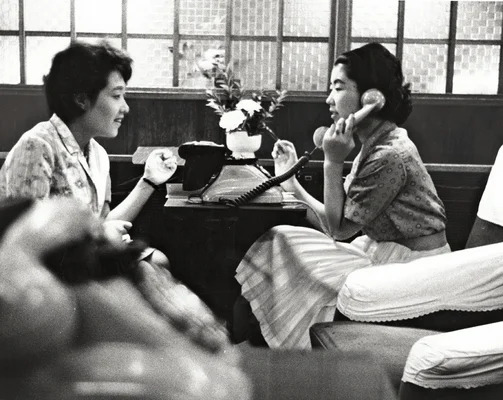
Photo: Tokyo, 1962
3.5/5
Excerpts/quotes:
うすうすわかっていることをだれかがはっきりと言葉にしてくれと、心はこんなに安らくんだ、そう思った。
What a comfort it was, I thought, to hear someone put into words something that you were on the verge of grasping.
この世には、そうやって増やしていく力と同じ分量で、減らしていく力があこともなんとなく知っていた。同じ分量なのに、その力のほうがなぜか大きく感じられてしまうことも。
I knew, vaguely, that just as the world contained forces that nurtured and strengthened and created things, there were also forces that diminished them. And that even though there were equal amounts of both, the latter could sometimes seem more powerful.
もうおそれることはなにもないのだ。
The worst that could happen had already happened.
何か新しいことを始めると、最初は濁っている。だが、やがてそれは清流になり、自然な運動の中で静かに営まれていく。
When we start something new, at first it is very muddy, and clouded. But soon, it becomes a clean stream, whose flow conducts itself quietly, through spontaneous movements.
Our narrator Yoshie, a young and slightly naïve woman, loses her father and after a while decides to move to Tokyo’s bohemian district Shimokitazawa, full of independent vintage stores, cafés, bookstores and small theatres. Yoshie tries to find a job and live an independent life, when, oh snap, her mother, a fancy housewife or a “Meguro Madame” as the narrator lovingly calls her, asks to move in with her. Although at first it seems like a very bad idea, both women start to get on quite well and grow into their new selves or simply into themselves. Just like the old objects and photographs are left behind in the old flat, it would be wonderful if grief too could stay behind, but grief seems to move in with them and within them.
Yoshimoto’s quiet and introspective novel revolves around the everyday life of these two women coping with grief. The title Moshi Moshi , a telephone greeting like “Hello” although it doesn’t mean “Hello”, refers to Yoshie’s dreaming about her father calling her from the other side or trying to make contact with her just before his death. The last call, the last conversation they never had. Yoshimoto portrays anger, sadness, guilt and other complex feelings through subtle shades of expression and deceivingly simple sentences. And while plotwise there might be new revelations about the death of Yoshie’s father, this novel meanders through the details of people, places, food, sometimes very ordinary, almost banal things. Yoshimoto is a master of interweaving the lyrical with the colloquial. There is so much conversation around food, descriptions of food and how people eat and how they relate to food. The narrator says that she can understand other people’s psychological state just by looking at how they eat. While these scenes and descriptions might sound unimportant, I think they end up being an essential part of the novel.
I’ve been on a strange journey with Banana Yoshimoto’s writing. Her Kitchen and The Lake left me with some mixed feelings, yet reading her short story Mummy found in along with the editor/translator’s notes helped me to appreciate the author’s fine subtlety, and left me wondering whether I missed some important nuances in those two novels. So I’m glad I gave her another chance. For a while I thought it was going to be a five stars read, towards the end there is an episode I found too forced, so out of place and totally cringeworthy. Mixed feelings, here we go again. Even if it also reminds me that it’s the narrator’s choice and probably I shouldn’t judge her by my own standards, that part was very inconsistent.
Although I skimmed through some parts of the English translation, double-checking the meaning of a certain phrase or simply curious about how some parts were translated, I managed to read Moshi Moshi, mostly in Japanese. Maybe it’s just my personal relationship with these two languages (obviously, neither is my native language), I cannot help but notice there is a different feeling to the English translation. While reading this novel in Japanese I had this mental image of a kind of intermittent rain - words and meanings falling down but with intervals and spaces of no rain. When I turned to its English translation this rain was rather continuous with no intervals. Another impression is that a good counterpart in the English language world might be Sally Rooney.
Yoshimoto’s novel turned out to be such an entrancing reading experience. Even though sometimes some scenes and dialogues made me feel rather uncomfortable, it was Moshi Moshi ’s layers of meditative quality that tucked me in.
Photo: Tokyo, 1962
3.5/5
Excerpts/quotes:
うすうすわかっていることをだれかがはっきりと言葉にしてくれと、心はこんなに安らくんだ、そう思った。
What a comfort it was, I thought, to hear someone put into words something that you were on the verge of grasping.
この世には、そうやって増やしていく力と同じ分量で、減らしていく力があこともなんとなく知っていた。同じ分量なのに、その力のほうがなぜか大きく感じられてしまうことも。
I knew, vaguely, that just as the world contained forces that nurtured and strengthened and created things, there were also forces that diminished them. And that even though there were equal amounts of both, the latter could sometimes seem more powerful.
もうおそれることはなにもないのだ。
The worst that could happen had already happened.
何か新しいことを始めると、最初は濁っている。だが、やがてそれは清流になり、自然な運動の中で静かに営まれていく。
When we start something new, at first it is very muddy, and clouded. But soon, it becomes a clean stream, whose flow conducts itself quietly, through spontaneous movements.

May 8, 2026
Moshi Moshi: - Banana Yoshimoto
...
"لماذا يجب أن يعني البقاء على قيد الحياة أن يتعافى الجسد، حتى حينَ تعجز الروح عن ذلك؟"
"قلّة من الناس يشقّون طريقهم في الحياة دون أن تمسّهم المشقة."
"كان على كل منا أن يخوض معاركه اخاصّة. لم يكن بوسعنا الاستسلام والموت؛ وما دام علينا أن نحيا، فلا مناص من الاعتماد على ما نحن مصنوعون منه."
"يستغرق التعرف على الناس وقتًا طويلًا، ناهيك عن معرفة ما إذا كنتم تنسجمون مع بعض، لذا فإنني أتساءل حقًا، ماذا يُفترض بك أن تفعل حين يتعاقبون عليك كالباب الدوّار، يأتي واحد اليوم ويرحل غدًا، ولا يتسع لك الوقت حتى لمعرفة من هُم حقًا؟"
في هذه الرواية؛ يُطرح سؤال: كيف تعيد بناء حياتك بعد رحيل والدك المحب في حادث صادم؟
رحلَ والد الراوية/البطلة المحب والزوج المثالي والموسيقي الشغوف في اتفاق انتحار مع امرأة مجهولة. بعدها تنتقل البطلة للعيش في شارع عامر بالحياة في أحد أحياء طوكيو التقليدية بمحاله الكثيرة وجيرانه الودودين وتنضم إليها والدتها سريعًا هاربة من أشباح منزل العائلة، ولكن البطلة تحلم دائمًا بوالدها وهو يبحث عن هاتفه النقال للاتصال بهم أو وهي تحاول الاتصال به، تطاردها هذه الأحلام وتقض مضجعها وراحة أيامها.
رواية بسيطة وسريعة عن محاولات إبنة وأم لتخطي صدمة رحيل الأب والزوج في حادث صادم وغير مفهوم، وسعي للسلوان والتعافي بالتواصل والقوة الشافيّة للناس الطيبين من معارف وعائلة والطعام اللذيذ.
رغم أنني أحب بانانا يوشيموتو، كتابتها رائعة وعفوية وحميمية-شكل من أشكال من السهل الممتنع .. إلا أنه لابدّ من قول هذا؛ في بعض الأحيان توجد في رواياتها أحداث مُحيرة ولا أفهم الداعي لها؛ نوع من العلاقات غير المقبولة مثل تلميح بعلاقة بين أخ وأخت أو خال وابنة أخته-في هذه الرواية حدث هذا.. وفي عمل سابق حدث شيء مشابه وهناك مشهد آخر غير مريح في هذه النوفيلا-نعم هو نوع من العلاقات التي تقرر اشخصيات خوضها في حالات غير مستقرة مثل الحزن الشديد.. لا أريد الاستفاضة أكثر في ذكره، ولهذه الأسباب كنت أنوي تقييم الرواية بأقل من ثلاث نجمات لكن الرواية تضم بعضًا من أجمل الاقتباسات التي قرأتها موخرًا.ا، ولهذا سأكتفي بتقييمها بثلاث نجمات.
...
"لماذا يجب أن يعني البقاء على قيد الحياة أن يتعافى الجسد، حتى حينَ تعجز الروح عن ذلك؟"
"قلّة من الناس يشقّون طريقهم في الحياة دون أن تمسّهم المشقة."
"كان على كل منا أن يخوض معاركه اخاصّة. لم يكن بوسعنا الاستسلام والموت؛ وما دام علينا أن نحيا، فلا مناص من الاعتماد على ما نحن مصنوعون منه."
"يستغرق التعرف على الناس وقتًا طويلًا، ناهيك عن معرفة ما إذا كنتم تنسجمون مع بعض، لذا فإنني أتساءل حقًا، ماذا يُفترض بك أن تفعل حين يتعاقبون عليك كالباب الدوّار، يأتي واحد اليوم ويرحل غدًا، ولا يتسع لك الوقت حتى لمعرفة من هُم حقًا؟"
في هذه الرواية؛ يُطرح سؤال: كيف تعيد بناء حياتك بعد رحيل والدك المحب في حادث صادم؟
رحلَ والد الراوية/البطلة المحب والزوج المثالي والموسيقي الشغوف في اتفاق انتحار مع امرأة مجهولة. بعدها تنتقل البطلة للعيش في شارع عامر بالحياة في أحد أحياء طوكيو التقليدية بمحاله الكثيرة وجيرانه الودودين وتنضم إليها والدتها سريعًا هاربة من أشباح منزل العائلة، ولكن البطلة تحلم دائمًا بوالدها وهو يبحث عن هاتفه النقال للاتصال بهم أو وهي تحاول الاتصال به، تطاردها هذه الأحلام وتقض مضجعها وراحة أيامها.
رواية بسيطة وسريعة عن محاولات إبنة وأم لتخطي صدمة رحيل الأب والزوج في حادث صادم وغير مفهوم، وسعي للسلوان والتعافي بالتواصل والقوة الشافيّة للناس الطيبين من معارف وعائلة والطعام اللذيذ.
رغم أنني أحب بانانا يوشيموتو، كتابتها رائعة وعفوية وحميمية-شكل من أشكال من السهل الممتنع .. إلا أنه لابدّ من قول هذا؛ في بعض الأحيان توجد في رواياتها أحداث مُحيرة ولا أفهم الداعي لها؛ نوع من العلاقات غير المقبولة مثل تلميح بعلاقة بين أخ وأخت أو خال وابنة أخته-في هذه الرواية حدث هذا.. وفي عمل سابق حدث شيء مشابه وهناك مشهد آخر غير مريح في هذه النوفيلا-نعم هو نوع من العلاقات التي تقرر اشخصيات خوضها في حالات غير مستقرة مثل الحزن الشديد.. لا أريد الاستفاضة أكثر في ذكره، ولهذه الأسباب كنت أنوي تقييم الرواية بأقل من ثلاث نجمات لكن الرواية تضم بعضًا من أجمل الاقتباسات التي قرأتها موخرًا.ا، ولهذا سأكتفي بتقييمها بثلاث نجمات.

January 26, 2021
❀ blog ❀ thestorygraph ❀ letterboxd ❀ tumblr ❀ ko-fi ❀
There is something idiosyncratic about Yoshimoto's novels. Every time I read something of hers I feel almost comforted by how familiar it all is. Her narrators sound very much like the same person: they are young women prone to navel-gazing yet attuned to their environment (especially nature or their hometown). Moshi Moshi follows Yoshie after the death of her father, a musician and a bit of a free spirit. The way in which he died (he was involved in a suicide pact with a woman unknown to Yoshie or her mother) weighs on Yoshie. She dreams of the last night she saw him alive, imagining different outcomes that would have prevented him from leaving the house without his phone. Yoshie attempts to turn a new leaf by moving out to Shimokitazawa, a neighborhood in Tokyo, with which she fell in love. Her mother insists on staying with her, and the two women soon form a routine of sorts. One day, Yoshie, who works at a restaurant, meets a young man who knew of her father. In an effort to learn more about her father and 'that woman' Yoshie also reconnects with her father's best friend.
The novel, overall, has a very 'slice of life' feel to it. Yoshimoto captures Yoshie's daily life, the thoughts that pass through her head as she goes about on her day, the lingering grief caused by her father's tragic death, the desire to understand how it could have happened. As much as I enjoyed the atmosphere and writing the romance aspect of this novel left a sour taste in my mouth. There are a few questionable remarks (for instance on sexual assault) that did not really fit with the narrative's one. These kinds of comments were more suited to a dark comedy. The whole romance also gave me some incest-y vibes which I could have done without.
Not Yoshimoto's best but a lot more enjoyable than her worst.
There is something idiosyncratic about Yoshimoto's novels. Every time I read something of hers I feel almost comforted by how familiar it all is. Her narrators sound very much like the same person: they are young women prone to navel-gazing yet attuned to their environment (especially nature or their hometown). Moshi Moshi follows Yoshie after the death of her father, a musician and a bit of a free spirit. The way in which he died (he was involved in a suicide pact with a woman unknown to Yoshie or her mother) weighs on Yoshie. She dreams of the last night she saw him alive, imagining different outcomes that would have prevented him from leaving the house without his phone. Yoshie attempts to turn a new leaf by moving out to Shimokitazawa, a neighborhood in Tokyo, with which she fell in love. Her mother insists on staying with her, and the two women soon form a routine of sorts. One day, Yoshie, who works at a restaurant, meets a young man who knew of her father. In an effort to learn more about her father and 'that woman' Yoshie also reconnects with her father's best friend.
The novel, overall, has a very 'slice of life' feel to it. Yoshimoto captures Yoshie's daily life, the thoughts that pass through her head as she goes about on her day, the lingering grief caused by her father's tragic death, the desire to understand how it could have happened. As much as I enjoyed the atmosphere and writing the romance aspect of this novel left a sour taste in my mouth. There are a few questionable remarks (for instance on sexual assault) that did not really fit with the narrative's one. These kinds of comments were more suited to a dark comedy. The whole romance also gave me some incest-y vibes which I could have done without.
Not Yoshimoto's best but a lot more enjoyable than her worst.

September 14, 2026
How does one rate a book with such beautiful prose but with a slightly predatory ending? I mean how Japanese is that???
Having read the excellent two story collection, Kitchen, I sought out another Banana book. This author has the most unserious name. Gotta love it.
Kitchen is a novel about dealing with loss and finding your identity as a woman. So yeah this is kinda a coming of age book, I say kinda because the main character is already a college graduate with a job. This made me realize that there is no age limit to coming of age, because even her mother found herself here.
Typical to Japanese litfics, Moshi Moshi has an element of magical realism that I just respond very positively to. I could describe it as a sad non scary horror... ok a soft haunting haha. No joke, I was all set on rating this a 5 but that final decision by the MC just disgusted me a Lil.
Having read the excellent two story collection, Kitchen, I sought out another Banana book. This author has the most unserious name. Gotta love it.
Kitchen is a novel about dealing with loss and finding your identity as a woman. So yeah this is kinda a coming of age book, I say kinda because the main character is already a college graduate with a job. This made me realize that there is no age limit to coming of age, because even her mother found herself here.
Typical to Japanese litfics, Moshi Moshi has an element of magical realism that I just respond very positively to. I could describe it as a sad non scary horror... ok a soft haunting haha. No joke, I was all set on rating this a 5 but that final decision by the MC just disgusted me a Lil.

June 15, 2023
I find most Japanese novels are enjoyable reading, especially as in this book where place and descriptions of Tokyo neighbourhoods are so well done, and the food. Yoshi works at a restaurant and seems to be going out to eat all the time and I do love Japanese food.
This book was a study of a woman's grief after his father has died in unusual circumstances. Her mother decides to move in with her in her tiny flat across the street from the restaurant where she works as her dead husband's ghost seems to be inhabiting the space they lived in. A somewhat drawn out study of grief and how one woman deals with it. 3.5 stars.
This book was a study of a woman's grief after his father has died in unusual circumstances. Her mother decides to move in with her in her tiny flat across the street from the restaurant where she works as her dead husband's ghost seems to be inhabiting the space they lived in. A somewhat drawn out study of grief and how one woman deals with it. 3.5 stars.

December 1, 2024
Moshi Moshi is another enthralling novel from critically acclaimed Japanese author, Banana Yoshimoto. I stumbled on this book on the kind recommendation of my dear Goodreads friend and fellow author, Fiza Pathan . Among the questions in an interview that I did with her was one about which book I would choose to read in the near future. Of the three options Fiza gave, I chose Moshi Moshi since I was keen on reading something light.
However, to my (not altogether unpleasant) surprise Moshi Moshi was anything but light. It was a gripping story about love and loss told from the perspective of a thirty-something Japanese woman, who is struggling to find her purpose in life following the tragic death of her father in a murder-suicide. Although the core subject matter of the novel was quite heavy on the surface, Yoshimoto infused several less heavy aspects into the narrative. She enriched the story with vivid descriptions of the preparation and taste of various foods and the emotional vicissitudes of relationships, be they romantic or platonic.
Despite the story's smooth-as-jazz flow, I still was left missing something. Hence the 4 star rating. Somehow Moshi Moshi didn't quite succeed in lingering with me as other books by Yoshimoto have done in the past (e.g., Kitchen and Goodbye Tsugumi). Yet I cannot quite pinpoint where this feeling comes from. The story by no means disappointed me, and I'm very grateful that Fiza put this one on my literary pathway for 2024! Indeed I am eager to read more of Yoshimoto's works that have been translated into English in the not too distant future.
However, to my (not altogether unpleasant) surprise Moshi Moshi was anything but light. It was a gripping story about love and loss told from the perspective of a thirty-something Japanese woman, who is struggling to find her purpose in life following the tragic death of her father in a murder-suicide. Although the core subject matter of the novel was quite heavy on the surface, Yoshimoto infused several less heavy aspects into the narrative. She enriched the story with vivid descriptions of the preparation and taste of various foods and the emotional vicissitudes of relationships, be they romantic or platonic.
Despite the story's smooth-as-jazz flow, I still was left missing something. Hence the 4 star rating. Somehow Moshi Moshi didn't quite succeed in lingering with me as other books by Yoshimoto have done in the past (e.g., Kitchen and Goodbye Tsugumi). Yet I cannot quite pinpoint where this feeling comes from. The story by no means disappointed me, and I'm very grateful that Fiza put this one on my literary pathway for 2024! Indeed I am eager to read more of Yoshimoto's works that have been translated into English in the not too distant future.

December 30, 2016
First off, what an awesome book cover!
This charming novel embarks the reader on a journey of loss, grief, reconnecting, healing, love, hope, youth, family, and everything in between. I enjoyed every bit of it, and many of its quotes are engraved in my mind/heart. If you love Japanese literary novels which linger on the themes mentioned above, and enjoy psychological and emotional insight to the protagonist, then this is definitely the book for you to savor.
I wish to visit Shimotikazawa now. I really felt I was there among the shops and cafés.
This charming novel embarks the reader on a journey of loss, grief, reconnecting, healing, love, hope, youth, family, and everything in between. I enjoyed every bit of it, and many of its quotes are engraved in my mind/heart. If you love Japanese literary novels which linger on the themes mentioned above, and enjoy psychological and emotional insight to the protagonist, then this is definitely the book for you to savor.
I wish to visit Shimotikazawa now. I really felt I was there among the shops and cafés.

February 19, 2024
“But life went on, even at times like this, and it was surprising how easy it was to keep going as though nothing had changed. I found it strange that I could walk down the street and appear normal, just like anyone else. That I could be in complete turmoil inside, and yet my reflection in a shop window could look the same as it ever had.”
🚃🍵🌇
Cozy, melancholy, and hopeful, Moshi Moshi is a dreamy tale that shows the value of moving on after tragedy and living in the moment. The narrative revolves around a twentysomething woman, Yoshie, who is gradually coming to terms with the sudden passing of her father. Centered in a trendy Tokyo neighborhood rich in culture and whimsy, each page exudes a kind of subtle charm.
Moshi Moshi is a lovely, moving portrayal of a bereaved family, showing how they deal with loss and unexpected revelations concerning their loved one, how they move past their grief and resume their regular lives, and how compassionate friends and family support them along the way. It's also an enchanting ode to the cuisine and picturesque sceneries of Shimokitazawa.
Yoshimoto approaches emotionally and existentially challenging subjects—domestic chaos, loneliness, identity crises, and lovesickness—with a wonderfully light touch characteristic of Japanese literature.
Yoshimoto transforms an unfolding tragedy into a heartbreaking coming-of-age ghost story and an empowering tribute to the healing properties of community, cuisine, and family, all with the delicacy of touch and dreamlike detachment that define her work. Yoshimoto's gorgeous imagery—the blooming cherry tree in front of Les Liens cafe, eateries shining late into the night, and the warm camaraderie among restaurant staff members—all capture the essence of Shimokitazawa and symbolize Yochan's steady return to a grounded existence.
A heartfelt depiction of mourning and healing that will linger in your mind like a warm hug.
🚃🍵🌇
Cozy, melancholy, and hopeful, Moshi Moshi is a dreamy tale that shows the value of moving on after tragedy and living in the moment. The narrative revolves around a twentysomething woman, Yoshie, who is gradually coming to terms with the sudden passing of her father. Centered in a trendy Tokyo neighborhood rich in culture and whimsy, each page exudes a kind of subtle charm.
Moshi Moshi is a lovely, moving portrayal of a bereaved family, showing how they deal with loss and unexpected revelations concerning their loved one, how they move past their grief and resume their regular lives, and how compassionate friends and family support them along the way. It's also an enchanting ode to the cuisine and picturesque sceneries of Shimokitazawa.
Yoshimoto approaches emotionally and existentially challenging subjects—domestic chaos, loneliness, identity crises, and lovesickness—with a wonderfully light touch characteristic of Japanese literature.
Yoshimoto transforms an unfolding tragedy into a heartbreaking coming-of-age ghost story and an empowering tribute to the healing properties of community, cuisine, and family, all with the delicacy of touch and dreamlike detachment that define her work. Yoshimoto's gorgeous imagery—the blooming cherry tree in front of Les Liens cafe, eateries shining late into the night, and the warm camaraderie among restaurant staff members—all capture the essence of Shimokitazawa and symbolize Yochan's steady return to a grounded existence.
A heartfelt depiction of mourning and healing that will linger in your mind like a warm hug.

March 16, 2023
4.5 estrellas
Esta es una fan account de Banana Yoshimoto, así que mucha objetividad en esta reseña no hay. Me pareció un libro precioso en el que se explora el duelo (como en muchas otras de sus historias) pero también la relación madre-hija, el autodescubrimiento y el sentimiento de pertenencia a un lugar. El padre de Yo-chan ha muerto en un homicidio-suicidio con su amante. Aunque tanto ella como su madre están dolidas, el proceso de aceptación es completamente distinto para cada una, pues no es lo mismo perder un padre que un esposo y menos en una situación tan truculenta. Subrayé medio libro por las frases y sentimientos llegadores que Banana logra expresar como nadie. Me enamoré del barrio de Shimokitazawa y de las descripciones de sus calles, sus restaurantes, su ambiente. Como fan de lo spooky, la verdad esperaba un poco más de esas llamadas del inframundo y background de la amante siniestra, pero entiendo que ese no era el enfoque del libro. Se me cayó un poco el final con una decisión que toma la protagonista junto con un amigo del papá... Pero fuera de eso, lo amé.
Esta es una fan account de Banana Yoshimoto, así que mucha objetividad en esta reseña no hay. Me pareció un libro precioso en el que se explora el duelo (como en muchas otras de sus historias) pero también la relación madre-hija, el autodescubrimiento y el sentimiento de pertenencia a un lugar. El padre de Yo-chan ha muerto en un homicidio-suicidio con su amante. Aunque tanto ella como su madre están dolidas, el proceso de aceptación es completamente distinto para cada una, pues no es lo mismo perder un padre que un esposo y menos en una situación tan truculenta. Subrayé medio libro por las frases y sentimientos llegadores que Banana logra expresar como nadie. Me enamoré del barrio de Shimokitazawa y de las descripciones de sus calles, sus restaurantes, su ambiente. Como fan de lo spooky, la verdad esperaba un poco más de esas llamadas del inframundo y background de la amante siniestra, pero entiendo que ese no era el enfoque del libro. Se me cayó un poco el final con una decisión que toma la protagonista junto con un amigo del papá... Pero fuera de eso, lo amé.

April 23, 2025
3/4, ik weet het niet zo goed. Ik houd van het kabbelende vertellen van Yoshimoto, haar oog voor de details die het dagelijks leven ontroerend maken, maar ik erger me ook aan het sentiment, de gevoelens die steeds opnieuw meegedeeld worden in lange, herhalende paragrafen — terwijl in die herhaling ook weer het kabbelende en eigene zit. Dus.

April 21, 2015
La Yoshimoto non mi emoziona più come una volta, ma non capisco perché. Probabilmente è dovuto al fatto che, col tempo, ho letto più autori giapponesi e ho più paragoni da fare. Moshi Moshi, per esempio, mi ha ricordato in troppi punti Il ristorante dell'amore ritrovato, specie nella descrizione del cibo come medium per superare un trauma, e ha perso il confronto.
Le due donne del romanzo, madre e figlia, devono superare la morte del rispettivo marito e padre. Le circostanze sono dubbie e la definizione applicata è quella di suicidio, che colpevolizza in qualche modo le protagoniste e le costringe ad avanzare un po' a tentoni per superare questa oppressione dell'essere rimaste vive. Mi sembra che la moglie, tutto sommato, si emancipi prima e meglio.
Le due donne del romanzo, madre e figlia, devono superare la morte del rispettivo marito e padre. Le circostanze sono dubbie e la definizione applicata è quella di suicidio, che colpevolizza in qualche modo le protagoniste e le costringe ad avanzare un po' a tentoni per superare questa oppressione dell'essere rimaste vive. Mi sembra che la moglie, tutto sommato, si emancipi prima e meglio.

April 22, 2025
https://www.humo.be/achter-het-nieuws...
Nadat haar vader samen met zijn geheimzinnige minnares zelfmoord pleegt, gaat Yoshie op haar eentje wonen in een hippe buurt in Tokio. Wanneer haar moeder een jaar later ontredderd en eenzaam bij haar aanklopt, laat ze haar – niet zonder tegenzin – inwonen. Als lot- en huisgenoten ontbolstert hun moeder-dochterverhouding gaandeweg tot een openhartige, gelijkwaardige vriendschapsrelatie. Naast de steun van haar moeder in het rouwproces, vindt Yoshie troost en hoop in de Aziatische keuken, in het sociale buurtweefsel en in een man die zijn licht werpt op de raadselachtige dood van haar vader. Die laatste leeft als geest voort in telefoongesprekken die Yoshie in haar heldere dromen met hem voert.
Banana Yoshimoto wordt niet onterecht vergeleken met haar Japanse schrijfbroeder Haruki Murakami. Beiden spelen met magisch realisme, droomsymboliek en de helende kracht van eten, muziek en de Japanse cultuur. Waar echter bij Murakami het mysterie en de plotwendingen centraal staan, nemen bij Yoshimoto de alledaagse waarnemingen, de dialogen en de intermenselijke verhoudingen de bovenhand.
‘Moshi Moshi’ (oorspronkelijk uit 2010) is een kabbelende en gedetailleerde verkenning van hardnekkige rouw die dankzij persoonlijke veerkracht en nobele onbekenden kan worden omgezet in herboren levensvreugde en verlangens. Los van de ietwat klungelige eindspurt is het een geslaagde roman waarbij de zelfreflectie van de verteller ook de lezer inzichten verleent rond wat het betekent om mens onder mensen te zijn.
Nadat haar vader samen met zijn geheimzinnige minnares zelfmoord pleegt, gaat Yoshie op haar eentje wonen in een hippe buurt in Tokio. Wanneer haar moeder een jaar later ontredderd en eenzaam bij haar aanklopt, laat ze haar – niet zonder tegenzin – inwonen. Als lot- en huisgenoten ontbolstert hun moeder-dochterverhouding gaandeweg tot een openhartige, gelijkwaardige vriendschapsrelatie. Naast de steun van haar moeder in het rouwproces, vindt Yoshie troost en hoop in de Aziatische keuken, in het sociale buurtweefsel en in een man die zijn licht werpt op de raadselachtige dood van haar vader. Die laatste leeft als geest voort in telefoongesprekken die Yoshie in haar heldere dromen met hem voert.
Banana Yoshimoto wordt niet onterecht vergeleken met haar Japanse schrijfbroeder Haruki Murakami. Beiden spelen met magisch realisme, droomsymboliek en de helende kracht van eten, muziek en de Japanse cultuur. Waar echter bij Murakami het mysterie en de plotwendingen centraal staan, nemen bij Yoshimoto de alledaagse waarnemingen, de dialogen en de intermenselijke verhoudingen de bovenhand.
‘Moshi Moshi’ (oorspronkelijk uit 2010) is een kabbelende en gedetailleerde verkenning van hardnekkige rouw die dankzij persoonlijke veerkracht en nobele onbekenden kan worden omgezet in herboren levensvreugde en verlangens. Los van de ietwat klungelige eindspurt is het een geslaagde roman waarbij de zelfreflectie van de verteller ook de lezer inzichten verleent rond wat het betekent om mens onder mensen te zijn.

October 2, 2020
I Love Yoshimoto’s writing, she has a depth of compassion and empathy that I have not found in another writer before, and her writing evokes a range of different emotions in me, and that’s exactly what I want and need when I am reading purely to become more aware of the human spirit. She handles the complex subject of grief from a mature and enlightened sensibility as if she has fully experienced it herself, it seems to be a theme that she keeps returning to in her books as a previous one I read was very similar to this one. I look forward to reading more of this author.

June 28, 2025
Weer een sterke vertaling van Maarten Liebregts, eentje die naadloos aansluit op het al eerder uitgegeven Kitchen, ondanks dat er tussen het schrijven van deze twee werken zeker twintig jaar zit. Yoshimoto heeft zich verder ontwikkeld als auteur, maar is niet van de voor haar kenmerkende thematiek afgedreven: ook Moshi moshi is een gloedvol boek dat op een volwassen maar soms verrassend lichtvoetige manier met zware thema’s als rouw en verlies omgaat.
De leesclub gisteren in Utrecht (shout-out naar Das Mag en De Utrechtse Boekenbar) had gemakkelijk uren door kunnen gaan, zóveel voer voor discussie gaf deze roman. Maar hé, we moeten nog wel iets te bespreken overhouden...
... want na de zomer pakken we uit met een mooie aflevering van Aap Noot Mishima over deze sfeervolle roman. Vertaler Maarten Liebregts is dan ook weer van de partij, dus stay tuned! 🍧
EDIT: Aflevering 15 van de literaire podcast Aap Noot Mishima, over Banana Yoshimoto’s troostrijke roman ‘Moshi moshi’ én met vertaler Maarten Liebregts als gast, staat voor je klaar. We zijn in al je favoriete podcast-apps, Spotify én op YouTube te vinden, en ook op Instagram. Leuk als je luistert!
➜ Spotify
➜ Apple Podcasts
➜ YouTube
De leesclub gisteren in Utrecht (shout-out naar Das Mag en De Utrechtse Boekenbar) had gemakkelijk uren door kunnen gaan, zóveel voer voor discussie gaf deze roman. Maar hé, we moeten nog wel iets te bespreken overhouden...
... want na de zomer pakken we uit met een mooie aflevering van Aap Noot Mishima over deze sfeervolle roman. Vertaler Maarten Liebregts is dan ook weer van de partij, dus stay tuned! 🍧
EDIT: Aflevering 15 van de literaire podcast Aap Noot Mishima, over Banana Yoshimoto’s troostrijke roman ‘Moshi moshi’ én met vertaler Maarten Liebregts als gast, staat voor je klaar. We zijn in al je favoriete podcast-apps, Spotify én op YouTube te vinden, en ook op Instagram. Leuk als je luistert!
➜ Spotify
➜ Apple Podcasts
➜ YouTube

January 27, 2017
I was quite enjoying this story of a young woman and her widowed mother putting themselves back together after their father/husband died in a tragic and rather scandalous way, especially the setting, Shimokitazawa, very near where I live in Tokyo. But I bailed at the 50% mark because of the truly awful writing. I assume the translation is largely to blame here, but the prose was making me sick to my stomach.

June 19, 2017
I am not sure why, but Yoshimoto always reminds me of Murakami, maybe it's the descriptions of Tokyo and food that are so pervasive in the authors' books. Although, I don't think this book is as good as Kitchen, I thoroughly enjoyed it.

August 22, 2018
Is there such thing as a cozy-literary? Because that's exactly what this book is--super cozy. It's a quiet little story about a young woman coping with her father's death by engaging with her community. And it's a great community, packed with cute little bars and charming restaurants. This is probably the perfect novel to read on a rainy day while sitting in your favorite coffee shop.

April 30, 2025
Weemoed en troost, rouw en heerlijk eten, familie en vriendschap, de weg kwijt zijn en een thuis vinden, buiten de sociale orde willen leven en een weg zoeken uit eenzaamheid- het was weer een echte Banana Yoshimoto en ik heb er enorm van genoten

June 15, 2025
‘Er kwamen steeds meer mensen in me op: andere lachende gezichten en gebaren van mensen die ik had leren kennen sinds ik hier was komen wonen en werken. Mensen die mijn moeder en ik in deze wijk hadden leren kennen, hadden waarschijnlijk ook vandaag een doodgewone dag aan elkaar gesponnen.
Dat is de definitie van een wijk.
Al die bezigheden van deze mensen die een paar jaar geleden nog vreemdelingen voor me waren, voelde ik als een soort ademhaling door deze wijk bewegen: in, uit, in, uit. Ik was niet alleen. De wijk werd door hen gevormd, en door mensen die ik niet kende, die er op diezelfde manier in en uit bewogen.’
Dat is de definitie van een wijk.
Al die bezigheden van deze mensen die een paar jaar geleden nog vreemdelingen voor me waren, voelde ik als een soort ademhaling door deze wijk bewegen: in, uit, in, uit. Ik was niet alleen. De wijk werd door hen gevormd, en door mensen die ik niet kende, die er op diezelfde manier in en uit bewogen.’

May 2, 2019
When a daughter loses her father to an accident/suicide, she moves places to find comfort. Shimokitazawa has always fascinated Yocchan and that is where she heads to figure out how to live a life without her father. But whenever she feels that she is close to finding that stare, another layer is added to her life. She meets a few people, who remind her of the horrible truth and to offer advice or comfort. But the answer to all her restlessness and sense of loss lies in acceptance.
'Moshi Moshi' explores the relationship between a father and a daughter. It talks about the golden memories and unspoken words. The journey left midway and how that lead Yochhan to strange realizations and brought her close to healing.
The writing is poignant, and it touches the heart because of its brutal honesty. The pace can be described as leisurely but all these words and descriptions evoke a deeper understanding.
'Moshi Moshi' explores the relationship between a father and a daughter. It talks about the golden memories and unspoken words. The journey left midway and how that lead Yochhan to strange realizations and brought her close to healing.
The writing is poignant, and it touches the heart because of its brutal honesty. The pace can be described as leisurely but all these words and descriptions evoke a deeper understanding.

August 11, 2019
I have wanted to read a Banana Yoshimoto book for a long time since one of my friends recommended it. I got 'Moshi Moshi' as a present from one of my friends and I decided to read it this week. This is my second book for #WITMonth.
In 'Moshi Moshi', the narrator Yoshie starts the story by describing the neighbourhood of Shimokitazawa in Tokyo. She quotes a description of Shimokitazawa, that a character gives in a movie. It goes like this :
"The clutter of streets and buildings, which seem to have been left to spread and grow without any thought – they sometimes appear very beautiful, like a bird eating a flower, or a cat jumping down gracefully from a height. I feel that what might seem at first sight to be carelessness and disorder in fact expresses the purest parts of our unconscious.
"When we start something new, at first it is very muddy, and clouded.
"But soon, it becomes a clear stream, whose flow conducts itself quietly, through spontaneous movements."
Yoshie then describes how she ended up moving there. Her father had died under mysterious circumstances. It looks like he had a suicide pact with an unknown woman who might have been his lover. Yoshie and her mother are shocked and heartbroken. After the funeral is over and things have settled down, Yoshie moves out of her parents' home into a small apartment in Shimokitazawa. She gets a job in a bistro which is opposite her apartment. Michiyo-san runs the bistro and she is an amazing chef. Yoshie admires her and loves working with her. While Yoshie tries to settle down into her new life, one day her mother walks in. Her mother says that she can no longer live in their family home and she wants to stay with Yoshie for a while. After some initial hesitation, Yoshie agrees. And thus starts a new phase in their relationship when the mother and the daughter start treating each other like friends and roommates. And then things start happening. People who knew something about Yoshie's father stop by and start revealing secrets. Yoshie starts having a dream about her father. She feels it might be her father's ghost trying to talk to her. Then a handsome man starts visiting the bistro and tries courting Yoshie.
Is Yoshie able to come out of her grief and get on with her life? What about her mother? How do they handle the secrets that come tumbling out? Is it really her father's ghost which is trying to talk to Yoshie? Does Yoshie respond to the handsome man's courting and is she able to find love in her life? The answers to these are found in the rest of the story.
I am glad I read my first Banana Yoshimoto book. I liked 'Moshi Moshi' very much. It is a beautiful, poignant portrait of a family in mourning, how the family members handle grief and the surprising revelations about their loved one, and how they come out of grief and get back to their normal lives, and how their loved ones and kind strangers help them in their journey. It is also a beautiful love letter to food and to the beautiful place called Shimokitazawa. Michiyo-san, the chef in the bistro was one of my favourite characters in the book – she is such a beautiful person who elevates cooking to an art and creates perfection in the kitchen and delivers it on the plate. There is a four-page afterword at the end of the book in which Banana Yoshimoto shares her thoughts on the book and how some of it might have been inspired by her own father and how some of the old, beautiful, traditional places in Shimokitazawa are closing down now. She also talks about how there is a real-life Michiyo-san (her name is Yoshizawa-san) who ran a bistro in Shimokitazawa and how she is still running a restaurant in Tokyo which is doing very well and how her barley salad still tastes of life. Well, if I ever visit Tokyo, I want to meet Yoshizawa-san and try her barley salad. That afterword made me love the book and Banana Yoshimoto even more.
#SpoilerWarning
I had just one problem with the book. This is a spoiler and so please be forewarned. Without revealing much, I found the way the main character overanalyzes and talks herself out of a relationship with a man who looks perfect for her, and talks herself into a relationship with a man who is unsuitable for her – I found that too forced and somehow tacked in. I felt that it didn't hang in comfortably with the rest of the story.
#EndOfSpoilerWarning
I will leave you with some of my favourite passages from the book.
Context : This is spoken by Yoshie's mother to Yoshie
"The main thing I'm careful of is to really take my time when I'm walking. Go slowly, like I used to when I was a student. Because that's all I've got now. Time.
"You know how the flow of time through a day slows down around late afternoon, and then quickens again after the sun goes down? I finally recovered my ability to sense it, recently, and now I can get in touch with that flow each day.
"I can sense the border between when time dribbles on and stretches, like a warm rice cake, and when it suddenly pulls in tight, and speeds up again. I love being able to do that. I look forward to it every day.
"I'd forgotten about it, you know? Even though when I was a kid, I sensed it no problem, even if I stayed inside all day.
"That's the kind of phase I'm in right now. I want to let myself take in the flow of time again, without having to think or worry about anything."
Context : This is spoken by Yamazaki-san, a family friend, to Yoshie
"My old mother's nearly ninety, but each year in spring she still puts up vegetable preserves – cooks them down into tsukudani with soy sauce, sweet rice wine, and sugar. And each year, when I taste that familiar flavour, we both know it could be the last time she makes the spring tsukudani. But that's just thoughts. When my mother gets a bumper crop of butterbur or prickly ash, she just gets to it, starts cooking, even if it's hard work. She's not thinking about what might happen next year. The great thing about the everyday is that we don't care about next year, as long as the tsukudani turns out good this spring. So I let go, too, and instead of getting maudlin over every mouthful, I just say, Mom, your tsukudani's so good, it's the best, I'm so glad I get to eat it again this year, it makes rice taste so good. And I think there's a case to be made for you finding your appetite for enjoying that kind of happiness."
I loved Banana Yoshimoto's 'Moshi Moshi'. I can't wait to read more of her books. Have you read 'Moshi Moshi'? What do you think about it? Which is your favourite Banana Yoshimoto book?
In 'Moshi Moshi', the narrator Yoshie starts the story by describing the neighbourhood of Shimokitazawa in Tokyo. She quotes a description of Shimokitazawa, that a character gives in a movie. It goes like this :
"The clutter of streets and buildings, which seem to have been left to spread and grow without any thought – they sometimes appear very beautiful, like a bird eating a flower, or a cat jumping down gracefully from a height. I feel that what might seem at first sight to be carelessness and disorder in fact expresses the purest parts of our unconscious.
"When we start something new, at first it is very muddy, and clouded.
"But soon, it becomes a clear stream, whose flow conducts itself quietly, through spontaneous movements."
Yoshie then describes how she ended up moving there. Her father had died under mysterious circumstances. It looks like he had a suicide pact with an unknown woman who might have been his lover. Yoshie and her mother are shocked and heartbroken. After the funeral is over and things have settled down, Yoshie moves out of her parents' home into a small apartment in Shimokitazawa. She gets a job in a bistro which is opposite her apartment. Michiyo-san runs the bistro and she is an amazing chef. Yoshie admires her and loves working with her. While Yoshie tries to settle down into her new life, one day her mother walks in. Her mother says that she can no longer live in their family home and she wants to stay with Yoshie for a while. After some initial hesitation, Yoshie agrees. And thus starts a new phase in their relationship when the mother and the daughter start treating each other like friends and roommates. And then things start happening. People who knew something about Yoshie's father stop by and start revealing secrets. Yoshie starts having a dream about her father. She feels it might be her father's ghost trying to talk to her. Then a handsome man starts visiting the bistro and tries courting Yoshie.
Is Yoshie able to come out of her grief and get on with her life? What about her mother? How do they handle the secrets that come tumbling out? Is it really her father's ghost which is trying to talk to Yoshie? Does Yoshie respond to the handsome man's courting and is she able to find love in her life? The answers to these are found in the rest of the story.
I am glad I read my first Banana Yoshimoto book. I liked 'Moshi Moshi' very much. It is a beautiful, poignant portrait of a family in mourning, how the family members handle grief and the surprising revelations about their loved one, and how they come out of grief and get back to their normal lives, and how their loved ones and kind strangers help them in their journey. It is also a beautiful love letter to food and to the beautiful place called Shimokitazawa. Michiyo-san, the chef in the bistro was one of my favourite characters in the book – she is such a beautiful person who elevates cooking to an art and creates perfection in the kitchen and delivers it on the plate. There is a four-page afterword at the end of the book in which Banana Yoshimoto shares her thoughts on the book and how some of it might have been inspired by her own father and how some of the old, beautiful, traditional places in Shimokitazawa are closing down now. She also talks about how there is a real-life Michiyo-san (her name is Yoshizawa-san) who ran a bistro in Shimokitazawa and how she is still running a restaurant in Tokyo which is doing very well and how her barley salad still tastes of life. Well, if I ever visit Tokyo, I want to meet Yoshizawa-san and try her barley salad. That afterword made me love the book and Banana Yoshimoto even more.
#SpoilerWarning
I had just one problem with the book. This is a spoiler and so please be forewarned. Without revealing much, I found the way the main character overanalyzes and talks herself out of a relationship with a man who looks perfect for her, and talks herself into a relationship with a man who is unsuitable for her – I found that too forced and somehow tacked in. I felt that it didn't hang in comfortably with the rest of the story.
#EndOfSpoilerWarning
I will leave you with some of my favourite passages from the book.
Context : This is spoken by Yoshie's mother to Yoshie
"The main thing I'm careful of is to really take my time when I'm walking. Go slowly, like I used to when I was a student. Because that's all I've got now. Time.
"You know how the flow of time through a day slows down around late afternoon, and then quickens again after the sun goes down? I finally recovered my ability to sense it, recently, and now I can get in touch with that flow each day.
"I can sense the border between when time dribbles on and stretches, like a warm rice cake, and when it suddenly pulls in tight, and speeds up again. I love being able to do that. I look forward to it every day.
"I'd forgotten about it, you know? Even though when I was a kid, I sensed it no problem, even if I stayed inside all day.
"That's the kind of phase I'm in right now. I want to let myself take in the flow of time again, without having to think or worry about anything."
Context : This is spoken by Yamazaki-san, a family friend, to Yoshie
"My old mother's nearly ninety, but each year in spring she still puts up vegetable preserves – cooks them down into tsukudani with soy sauce, sweet rice wine, and sugar. And each year, when I taste that familiar flavour, we both know it could be the last time she makes the spring tsukudani. But that's just thoughts. When my mother gets a bumper crop of butterbur or prickly ash, she just gets to it, starts cooking, even if it's hard work. She's not thinking about what might happen next year. The great thing about the everyday is that we don't care about next year, as long as the tsukudani turns out good this spring. So I let go, too, and instead of getting maudlin over every mouthful, I just say, Mom, your tsukudani's so good, it's the best, I'm so glad I get to eat it again this year, it makes rice taste so good. And I think there's a case to be made for you finding your appetite for enjoying that kind of happiness."
I loved Banana Yoshimoto's 'Moshi Moshi'. I can't wait to read more of her books. Have you read 'Moshi Moshi'? What do you think about it? Which is your favourite Banana Yoshimoto book?

September 29, 2016
Moshi moshi racconta la storia di Yoshie, una ragazza che sta affrontando una dolorosa elaborazione del lutto dopo che suo padre è stato trovato morto suicida in un'automobile accanto ad una donna sconosciuta.
Quella che Banana Yoshimoto propone non è affatto una lettura semplice, seppur narrata con l'estrema delicatezza e l'infinita dolcezza tutta femminile di una giovane ragazza che sta imparando a rinascere assieme a sua madre, anche lei distrutta. Purtroppo leggere un romanzo che tratta di morte, dolore e rinascita spirituale non è del tutto scontato se non lo si affronta con il giusto spirito, anzi, può risultare insidioso. Io, che mi trovo in un periodo di strana tranquillità d'animo e modesta felicità (e speriamo che duri), ho un po' fatto fatica a macinare queste tristissime pagine piene di note infelici, di lacrime e di frustrazione, ma questa non può essere assolutamente una colpa da attribuire all'autrice. Direi che, semplicemente, ci sono momenti buoni per leggere certi tipi di romanzi, e altri in cui non riesci ad entrare in sintonia con il pensiero narrante. Io appartengo in questo caso all'ultima categoria, e mi dispiace.
La storia di Yoshie procede lentamente, sovrapponendo pensieri che spesso si ripetono, tanto da dare al lettore l'impressione che non si vada mai avanti, che si sia sempre fermi sullo stesso punto. Questo, e il fatto che il pensiero non venga suddiviso in capitoli e, il più delle volte, nemmeno in paragrafi, risulta fastidioso all'inizio. Poi però si comincia a capire il motivo: le pagine seguono le emozioni della protagonista, che elabora un poco alla volta, ritorna sui suoi passi, affronta di nuovo lo stesso problema, che sembrava aver risolto, mentre invece non era così. In fondo è questo il procedere della mente umana, a piccolissimi passi un poco per volta, tanto che sembra di restare sempre fermi sullo stesso punto, ma in realtà la strada percorsa è tanta.
Ultima nota, alla fluidità del pensiero di madre e figlia, si affianca un'incantevole descrizione di un quartiere di Tokyo di nome Shimokitazawa, che mi ha parecchio incuriosita.
Quella che Banana Yoshimoto propone non è affatto una lettura semplice, seppur narrata con l'estrema delicatezza e l'infinita dolcezza tutta femminile di una giovane ragazza che sta imparando a rinascere assieme a sua madre, anche lei distrutta. Purtroppo leggere un romanzo che tratta di morte, dolore e rinascita spirituale non è del tutto scontato se non lo si affronta con il giusto spirito, anzi, può risultare insidioso. Io, che mi trovo in un periodo di strana tranquillità d'animo e modesta felicità (e speriamo che duri), ho un po' fatto fatica a macinare queste tristissime pagine piene di note infelici, di lacrime e di frustrazione, ma questa non può essere assolutamente una colpa da attribuire all'autrice. Direi che, semplicemente, ci sono momenti buoni per leggere certi tipi di romanzi, e altri in cui non riesci ad entrare in sintonia con il pensiero narrante. Io appartengo in questo caso all'ultima categoria, e mi dispiace.
La storia di Yoshie procede lentamente, sovrapponendo pensieri che spesso si ripetono, tanto da dare al lettore l'impressione che non si vada mai avanti, che si sia sempre fermi sullo stesso punto. Questo, e il fatto che il pensiero non venga suddiviso in capitoli e, il più delle volte, nemmeno in paragrafi, risulta fastidioso all'inizio. Poi però si comincia a capire il motivo: le pagine seguono le emozioni della protagonista, che elabora un poco alla volta, ritorna sui suoi passi, affronta di nuovo lo stesso problema, che sembrava aver risolto, mentre invece non era così. In fondo è questo il procedere della mente umana, a piccolissimi passi un poco per volta, tanto che sembra di restare sempre fermi sullo stesso punto, ma in realtà la strada percorsa è tanta.
Ultima nota, alla fluidità del pensiero di madre e figlia, si affianca un'incantevole descrizione di un quartiere di Tokyo di nome Shimokitazawa, che mi ha parecchio incuriosita.
August 21, 2021
Would actually be a 3.5/5. Really strange story and not Yoshimoto's best in my opinion, but still a great read. I have noticed something about Asian authors that I haven't about Western authors, and it's how much attention they pay to the space they occupy, to the people around them. I'm not saying it's absent in Western authors, but the sense of individualism sometimes squashes everything else. Especially in prose like Yoshimoto's you find a deep awareness of being just a speck in the universe, a sense of detachment that doesn't stem from apathy; it's one that aligns more with being patient enough to observe the world and let it affect you. Don't know if this makes sense, but I have been thinking about it a lot. Let me know if any of you are aware of something like this that might actually explain why I felt this.
Overall I would say read Kitchen first💕
Overall I would say read Kitchen first💕

October 15, 2025
Een verhaal wat gaat over rouw en hoe je dat samen maar ook alleen doet. Helder geschreven zonder ingewikkelde zinnen of opsmuk, waardoor je de neiging hebt snel door te lezen (ook omdat er geen hoofdstukken zijn) maar waarbij het geschrevene zo vol van betekenis is dat ik het boek toch met regelmaat moest wegleggen om te laten bezinken voordat ik verder kon lezen.
Aanvulling sept 2026: opnieuw 5 sterren voor de sfeer van dit boek en het voorbeeld van hoe gezamenlijk en belichaamd een rouwproces zou kunnen zijn
Aanvulling sept 2026: opnieuw 5 sterren voor de sfeer van dit boek en het voorbeeld van hoe gezamenlijk en belichaamd een rouwproces zou kunnen zijn

June 16, 2024
What an odd little book. This felt like a human drama written by an alien who only knows about earthlings from memes and daytime soap operas.

December 30, 2016
2015 ended and 2016 started with the my "discovery" of the TV series Sherlock and the works of Banana Yoshimoto. Now, here at the end of 2016, the start of 2017, I found myself reading the latest Banana Yoshimoto during the early evening and (re)watching at night the Sherlock run-up-to-the-new-season marathon on PBS. What I see here are bookends. The most tightly locked bookends I've ever experienced in the world of art. Sherlock. Yoshimoto. Sherlimoto.
The novel is melancholy. Lovely. I want to walk the streets of Shimokitazawa after midnight and dart into its vintage clothing shops in the late afternoon and enjoy its selection of noodles and sake in the evening.
The trip-ups of the translation I've forgiven as more the awkward fumblings of, say, an enthusiastic slop-tongued big-pawed puppydog than outright editorial carelessness. I mean, I'm guessing, any mistakes or whatever were worked out from the original in order to communicate the flavor of the original and not because anybody had to catch the last train or get to the sportsbar for the last inning.
Did you know this was written as a serial for a newspaper? In this day and age! So, I guess you could say, what with that, what with its cast of characters, its city-as-character whateverness, its "ghost story" hook etc etc that this novel, here, Moshi Moshi, is pretty darn Dickensian.
I really wish the cat riding a toy train on the dustjacket had been in the novel somewhere. You gotta check out the cat riding a toy train on the dustjacket: it's cute. It will make some Brooklyn girl a great tattoo someday. The toy train cars around 95 percent of the ankle and then the cat there, sitting there, with its paws in its lap and that expression on its face on the first and/or final car. Cute.
The novel is melancholy. Lovely. I want to walk the streets of Shimokitazawa after midnight and dart into its vintage clothing shops in the late afternoon and enjoy its selection of noodles and sake in the evening.
The trip-ups of the translation I've forgiven as more the awkward fumblings of, say, an enthusiastic slop-tongued big-pawed puppydog than outright editorial carelessness. I mean, I'm guessing, any mistakes or whatever were worked out from the original in order to communicate the flavor of the original and not because anybody had to catch the last train or get to the sportsbar for the last inning.
Did you know this was written as a serial for a newspaper? In this day and age! So, I guess you could say, what with that, what with its cast of characters, its city-as-character whateverness, its "ghost story" hook etc etc that this novel, here, Moshi Moshi, is pretty darn Dickensian.
I really wish the cat riding a toy train on the dustjacket had been in the novel somewhere. You gotta check out the cat riding a toy train on the dustjacket: it's cute. It will make some Brooklyn girl a great tattoo someday. The toy train cars around 95 percent of the ankle and then the cat there, sitting there, with its paws in its lap and that expression on its face on the first and/or final car. Cute.
Displaying 1 - 30 of 1,194 reviews