

What do you think?

Canopy
At the edge of a magical wood, a little girl named Canopy grows up with her family. When she is grown her mother makes her venture into the dark forest on her own, where she encounters a loving ogre, sirens, and a man without a face... all while trying to discover herself and grow into a woman.
Interspersed with stories of her relationship with her father, Canopy is a fantastic fable told with Karine Bernadou's amazing cartoon pantomime style.
Interspersed with stories of her relationship with her father, Canopy is a fantastic fable told with Karine Bernadou's amazing cartoon pantomime style.
80 pages, Paperback
First published January 1, 2011
Ratings & Reviews
Friends & Following
Create a free account to discover what your friends think of this book!
Community Reviews
Displaying 1 - 20 of 20 reviews

June 12, 2019
My first encounter with the work of Karine Bernadou, an eighty-page wordless comic that is about a girl growing up to be a woman, focused on her relationships with men. The relationships are seen as a series of related vignettes; most of them feature bad or confusing encounters. From time to time the stories return to her relationship with her father, whom she loved, but men seem to manipulate her, use her, dominate her. Occasionally these relationships are for her interesting and good, but not usually. I like the simple art and the wordlessness of it, making a statement more about men than women, really. Very interesting and provocative work.

August 30, 2021
дивний невеличкий комікс про дівчину, яка дорослішає й опиняється сама у великому світі, де її як не зжерти хочуть, то пограбувати. але поки в неї є сукенка, зроблена з неба, і важкі предмети, за допомогою яких можна відстоювати особистий простір, не так все й погано.

December 23, 2021
Bizarre but also weird (yeah). Metaphoric n allegorical but makes damn sense. It tells so much without a single word.
You can't say it's just daddy issues. As in every family there is mommy issues too. Like how her mother 'abandoned her in the life' that called 'u r an adult now'. So it's not just also mommy issues.
It's adulthood issues, childhood issues, trust issues, living issues, female issues, sex issues, relationship issues...
It's sad. So sad. Not tear-dropper sad but what-the-fuck sad.
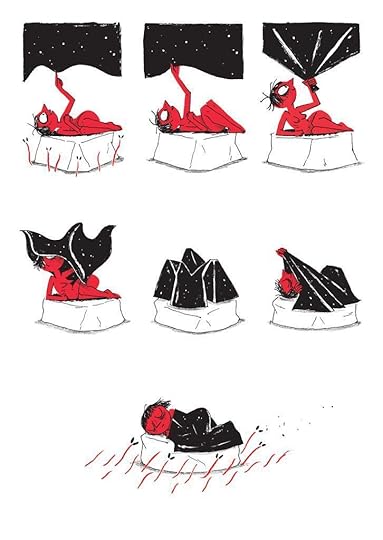
I loved the artwork. Bold, raw. solid. The greatest combination ever black & white and red which is the nicest shade of.

February 23, 2021
Históricas oníricas pero muy alegóricas -y muy claras- con un estilo gráfico impresionante.

March 23, 2023
Bem creepy e bem bom, traço muito lindinho 🤏

February 12, 2017
A engaging and surreal short narrative that is all about the situation and role of women in our culture. I hadn't been familiar with Bernadou's work before this, but now I want to seek out more of her art. This is exactly the kind of comic that Big Planet/Retrofit does best!

April 11, 2019
A story lost in its allegories & symbolisms.

December 12, 2022
I keep rereading a lot this book. It’s very interesting trying to understand the metaphors.

December 11, 2017
Beautiful wordless comics about a naked woman in a magical forest dealing with daddy issues. When people talk about comics as poetry, this is the kind of thing they mean.

May 30, 2018
I really enjoy this the illustration style is pretty solid and this is a wonderful and very relatable history

April 19, 2023
Titulo: Canopy
Autor: Karine Bernadou
Año publicado: 2011
Motivo de lectura: -
Lectura / Relectura: Lectura
Fisico / Electronico: Electronico
Mi edicion: -
Idioma: (No tiene dialogo)
Puntuacion: 3/5
Esta es una novela grafica bastante compleja de reseñar.
Creo que el principal motivo es por sus infinitas capas de posibles interpretaciones y simbologias. Por momentos podria ser una alegoria a la mujer y su rol en la sociedad/cultura. Por momentos todo parece muy surrealista y enteramente relacionado con lo instintivo/basico, con el sentimiento de la primera reaccion.
Una de las cosas que mas me gusto es el nulo dialogo, siempre pienso que se dice mas en el silencio que en las palabras expresadas (sobre todo cuando la persona que recepciona las palabras le da su propio significado, haciendo perder al emisor su verdadera intencion, algo asi como "lo que se pierde en una traduccion").
Tambien siento que esta novela grafica tiene dos protagonista, la mujer que vemos a traves de las paginas, y nosotros mismos. Estoy segura que cada persona le daria una interpretacion distinta a lo leido. Canopy es la protagonista, y nosotros somos la trama a traves de nuestra interpretacion.
Tambien diria que por momentos fue una lectura incomoda, supongo que tendra que ver con la incertidumbre de no saber que le deparaba a la protagonista.
Karine Bernadou trabajo esta novela grafica con solo cuatro colores, y siento que fue una decision muy acertada. Una obra asi no necesita la distraccion que una paleta de muchos colores le hubiera dado.
Autor: Karine Bernadou
Año publicado: 2011
Motivo de lectura: -
Lectura / Relectura: Lectura
Fisico / Electronico: Electronico
Mi edicion: -
Idioma: (No tiene dialogo)
Puntuacion: 3/5
Esta es una novela grafica bastante compleja de reseñar.
Creo que el principal motivo es por sus infinitas capas de posibles interpretaciones y simbologias. Por momentos podria ser una alegoria a la mujer y su rol en la sociedad/cultura. Por momentos todo parece muy surrealista y enteramente relacionado con lo instintivo/basico, con el sentimiento de la primera reaccion.
Una de las cosas que mas me gusto es el nulo dialogo, siempre pienso que se dice mas en el silencio que en las palabras expresadas (sobre todo cuando la persona que recepciona las palabras le da su propio significado, haciendo perder al emisor su verdadera intencion, algo asi como "lo que se pierde en una traduccion").
Tambien siento que esta novela grafica tiene dos protagonista, la mujer que vemos a traves de las paginas, y nosotros mismos. Estoy segura que cada persona le daria una interpretacion distinta a lo leido. Canopy es la protagonista, y nosotros somos la trama a traves de nuestra interpretacion.
Tambien diria que por momentos fue una lectura incomoda, supongo que tendra que ver con la incertidumbre de no saber que le deparaba a la protagonista.
Karine Bernadou trabajo esta novela grafica con solo cuatro colores, y siento que fue una decision muy acertada. Una obra asi no necesita la distraccion que una paleta de muchos colores le hubiera dado.


January 26, 2018
this comic made me feel exceedingly uncomfortable, but in a good way: http://womenwriteaboutcomics.com/2018...

July 14, 2017
An ever-shifting allegory for female maturity, CANOPY rustles the leaves and out drops a naked young person full of naivete and curiously lacking in self-discernment.
The subsequent exhibition of innocence lost, however, is as caustic as one might assume for a book of this fashion: wordless and absent moralistic overtones, and featuring characters that bend toward nihilism and incest. The story of CANOPY belongs in a gallery for modern art, not necessarily in a softcover book.
In any case, the story told here concerns a young woman ushered into the wild after her mother's milk runs dry. The mother shrugs her shoulders, blindfolds her daughter, and takes her by the hand, ultimately leaving her in the middle of a dark, anonymous forest of sharp-beaked blackbirds, sunflowers with stubble, and a random, flute-wielding fellow.
The young woman? She fends for herself, mostly. She eats, sleeps, and fornicates as adults are wont to do. Life goes on. What remains of her weary heart, in-between these episodes of nascent maturity, are raucous memories of violence, tears, and abandonment. The young woman's absentee father features prominently among these memories, and often in dramatically conflicting ways.
Happiness and sadness, it seems, are two sides of the same coin.
CANOPY models the survival of the woman character against an environment indifferent to her independence. The environment does not care if she starves, does not care if she is uncomfortable, and will, at times, test her individuality by stealing her identity right from under her nose. She must fight to regain (and preserve) her identity at every turn, because the surrounding environment, again, is wholly indifferent to her suffering.
Bernadou's art isn't conducive to sequential storytelling. It does, however, tell a story. But with no textual narrative to guide the reader into and through the emotional deliberations (or misconduct) of the nameless woman character, CANOPY swings about blindly, hoping the barren, twiggy forest, with its giant insects and cannibalistic neighbors will strike the right cord with little to no effort.
The subsequent exhibition of innocence lost, however, is as caustic as one might assume for a book of this fashion: wordless and absent moralistic overtones, and featuring characters that bend toward nihilism and incest. The story of CANOPY belongs in a gallery for modern art, not necessarily in a softcover book.
In any case, the story told here concerns a young woman ushered into the wild after her mother's milk runs dry. The mother shrugs her shoulders, blindfolds her daughter, and takes her by the hand, ultimately leaving her in the middle of a dark, anonymous forest of sharp-beaked blackbirds, sunflowers with stubble, and a random, flute-wielding fellow.
The young woman? She fends for herself, mostly. She eats, sleeps, and fornicates as adults are wont to do. Life goes on. What remains of her weary heart, in-between these episodes of nascent maturity, are raucous memories of violence, tears, and abandonment. The young woman's absentee father features prominently among these memories, and often in dramatically conflicting ways.
Happiness and sadness, it seems, are two sides of the same coin.
CANOPY models the survival of the woman character against an environment indifferent to her independence. The environment does not care if she starves, does not care if she is uncomfortable, and will, at times, test her individuality by stealing her identity right from under her nose. She must fight to regain (and preserve) her identity at every turn, because the surrounding environment, again, is wholly indifferent to her suffering.
Bernadou's art isn't conducive to sequential storytelling. It does, however, tell a story. But with no textual narrative to guide the reader into and through the emotional deliberations (or misconduct) of the nameless woman character, CANOPY swings about blindly, hoping the barren, twiggy forest, with its giant insects and cannibalistic neighbors will strike the right cord with little to no effort.

February 28, 2020
A beautiful, little twisted, sometimes violent, yet quite poetic allegorical acid trip about a woman’s various relationships with men/herself. In nude cartoons. I think it’s...brilliant.

July 4, 2021
Stumbled upon this gem at Big Planet Comics in DC. Harrowing but lovely.

August 7, 2022
Sencillo, elegante y de una belleza visual muy bien realizada
April 10, 2023
A obra conseguiu transmitir pra mim o problema de relações parentais que não ficaram bem resolvidas. Fiquei curiosa por mais obras de Karine.

December 14, 2023
"Retrofit 57" ¦ 17×24cm ¦ $15
Weird "Daddy Issues" going on in here.
Weird "Daddy Issues" going on in here.

June 18, 2019
Simple, elegant, poetic. The themes of human attachment, disappointment and resiliency are handled with care, and with subtlety. Beautifully done.
Displaying 1 - 20 of 20 reviews