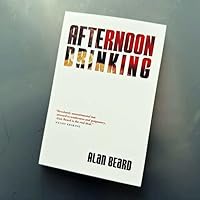
What is it about Tessa Hadley? In the less than two years since I first discovered her, she's become not just a favorite author but my writing mascot, an author (and other writers know what I'm talking about, I hope) I'd like to imagine I could be. I liked this neither more nor less than Married Love—maybe that collection is a little more vivid to me for having been first—and both story collections a bit better than the novels (Everything Will Be All Right and The Past, so far). But everything I've encountered is of such uniformly high quality and so suffused in an essential Tessa Hadley-ness that these distinctions are pretty small. But I digress: What is it about Tessa Hadley?
1. She writes stories about everyday life. And I mean really, aggressively ordinary, picayune swaths of life. For example: in the title story of this collection, a little girl who can't sleep messes up her family's living room (no spoilers, but that's close to all there is). As a fiction writer, I can attest there's often a pressure to make something dramatic happen in one's stories, even literary-realistic ones. Inevitably it's the kind of thing that happens rarely if at all in reality: a car wreck, a gloves-off screaming fight between family members, etc. etc. Hadley resorts to none of these things, and suffers none of the cheesiness and predictability that commonly ensues. The stories here often hinge on something dramatic that doesn't quite happen (again, no spoilers, but "Experience," "Bad Dreams," and "Flight" could all be examples), and Hadley's ability to spin up interest and tension out of situations with no more than an ordinary amount of dramatic charge is impressive; you never feel her straining for a hook. She also ends stories in surprising places, often while you're still waiting for it to happen, whatever it is. For people who've consumed enough narratives that they can feel a climax coming from a mile away, this is refreshing. Her endings can create a breathtaking feeling, like stopping short at the edge of a cliff.
In spite of Hadley's investment in "the everyday," she does offer variety in terms of setting, time, and class. Her stories are set from the 1960s to the present, and once in a while, even farther back; they take place in London and other cities, and the country; a lot of her characters are well-off, but many are working class, and she does them all convincingly. Whatever the particular social/financial situation of a character is, it never feels generic or phoned in. She must be a phenomenal observer in real life because the details she offers nearly always tell, and tell a lot, very specifically. I'll never forget reading the first story of hers I came across, "Dido's Lament," in the New Yorker in 2016. The main character is a young woman in London, of African descent, and reading it, I just assumed that Tessa Hadley was the same. But she's 62! And white. And not from London. And she published her first novel at 46.
Besides admiring Hadley's powers of observation and her ability to convincingly inhabit other lives, I take inspiration from the example she provides, that it's possible, at least if you're kind of a genius, to write great fiction that people connect to without apparently having anything more than an ordinary, middle-aged, white-lady life to draw from.
2. The prose is great. There is a sweet spot between fancy and plain, elaborate and conversational, Jamesian and text message-y, and to my mind, Tessa Hadley hits it perfectly. Reading her, I seldom if ever pause and say "Really?" the way I do sometimes with impressive but purplish prose, but the writing never seems pedestrian, either. It's not full of fifty-cent words, and you can read it fast, but almost every sentence bears slowing down and savoring, too. I think it goes back to her command of detail. The acuity (especially visual) is extraordinary. Again and again, she pulls just the right detail, the right word. It's like coming across someone who looks fantastic, not because their clothes are flashy or trendy, but because they're well-tailored, expertly chosen, flattering, absolutely the right shade. I have a feeling that because of the way they're written, these stories will stand the test of time: they'll look good this season, but also many seasons down the road; they are wonderfully free of tics that scream "2018!" And they have that maddeningly effortless quality that I suppose a lot of New Yorker stories, in particular, have (seven of these ten were first published there), where you imagine the writer just sitting down and tapping the story out verbatim; the prose is that assured & that even.
3. There's a psychology so subtle it almost feels magic. I don't know if Tessa Hadley has ever studied psychology/psychoanalysis or not, but I wouldn't be surprised. Her work reminds me again and again of my (admittedly sketchy) understanding of "the uncanny." There is absolutely, positively no "magic" in the supernatural sense in these stories, yet what powers many, maybe all of them is a sense of cause and effect so hidden and mysterious it is almost supernatural, and it tickles the brain and, in the best cases, tingles the spine, in a similar way to actual magic. There is a fair amount of doubling (events in the past presage similar events in the future, or events in the present recall in strange form events in the past), and cases where x leads to y in a way that's surprising but feels right. It's as if what Hadley does as a writer is to lay bare the magic and mystery that exist in the everyday—to say that the real drama is here, right under our noses, if only we can attune to it. It's a feat I'd be proud to pull off even once, while she clears the hurdle gracefully, again, and again, and again.