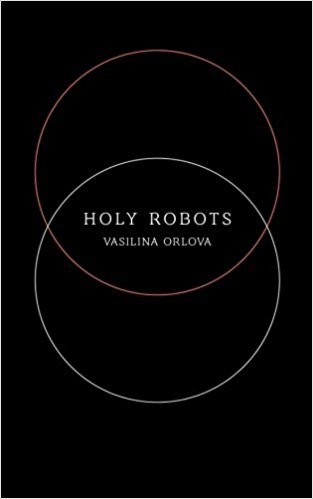
Vasilina Orlova is a philosopher, anthropologist, poet, and emerging psychotherapist. She holds the Russian equivalent of a Ph.D. in philosophy (Kandidat of Philosophical Sciences, Moscow State University, 2013) and a Ph.D. in socio-cultural anthropology from The University of Texas at Austin, where her dissertation explored “affective infrastructures” and mobility in post-Soviet Siberia.
In English, Orlova has published several essays based on her Siberian fieldwork, including "Cheerful Nonchalance" and "Affective Infrastructures of Immobility" in Slavic Review and The Journal of Contemporary Ethnography. Her prose and poetry in English have appeared in journals and anthologies such as The End of Austin, Texas Linguistics Forum, Blue Bonnet Review, Figroot Press, Bloodstone Review, and Visions International. She is the author of three books of poetry in English: Contemporary Bestiary, Holy Robots, and Pale Automaton (the latter is forthcoming, Gutenberg Printing Press Independent Group, Austin).
In Russian, Orlova has published 11 books of autofiction, fiction, and poetry. Her prose and poetry have appeared in prominent Russian literary journals, including Noviy Mir, Druzhba Narodov, Moskva, and Oktyabr. Her work has been recognized with several literary awards in Russia, including the Crystal Rose of Victor Rozov and the Anton Delvig Poetry Prize. She has also published philosophical essays on topics such as free will and the Russian philosopher Vasily Rozanov in Svobodnaya Mysl and Topos.
Orlova’s works in both Russian and English have been translated into Bulgarian, Dutch, French, Spanish, Ukrainian, and more.
Born in 1979 in Dunay in the Russian Far East, Orlova has lived in Moscow, London, and Austin, and is currently based in New York City. She is a member of the American Anthropological Association and the Association for Slavic, East European, and Eurasian Studies.
Books by Vasilina Orlova
In English
Pale Automaton (forthcoming) Holy Robots Contemporary Bestiary
In Russian
Antropologia povsednevnosti (Anthropology of Everydayness, forthcoming) Londonsky dnevnik (London Diary) Mificheskaya geographia (Mythical Geography) Kvartet (Quartet) Russkiy ostrov (Russky Island/Russian Island) Bossikom (Barefoot) Trapesa bogomola (Supper of the Praying Mantis) Pustinya (The Wilderness) V opravdanie vodi (In Defense of Water) Stat’ zhenshchinoi ne pozdneye ponedel’nika (To Become a Woman on Monday) Vchera (Yesterday) Odnova zhivem (We Live Only Once)
In Bulgarian
Shipkata (English Rose). Translated by Sylvia Nikolova and Valentin Kornilev
Orlova's work covers a lot of ground, from musing on our relationships with machines and each other to anthropology to the metaphorical mirrors in our lives. Each poem packs a sweet punch, or perhaps a gibe, but quite often an observation that avoids the rhetoric that takes lesser writers into polemic. Thus, when she takes what appear to be risks, as in the section, "Poems In A Male Voice," they don't read like the chatter of bullies or preachers, but as naturally as any conversation with a revolutionary over coffee or basking in the afterglow or finishing a cigarette after battle.
This is a great collection of what I interpret as futuristic poetry that perfectly expresses all the robotic aspects of love and religion. The poet perfectly uses the metaphor of robots to portray the idea that adoration of any sort can be replaced by an almost mechanic habit instead. After seeing some of the poet’s work before reading this, I was truly impressed by the complexity of language used in a form that’s simple to understand even for those that do not read poetry. Vasilina occasionally uses words from her native language, and often, they cannot be perfectly translated into English, which makes this collection very original. The division of sections is very useful and allows the reader to know right away what topic is going to be explored. This also made it so much easier for the reader to follow the key images in each section. The poems here are very easy to follow, and I would definitely recommend this collection to readers who like to dig a bit deeper into poetry instead of judging it based on what’s on the surface.
I love getting lost in Orlova's scenes, with their strange premises and their clever variations. Every section feels like a book in its own right, so that Holy Robots comes across as bigger than its own slender form. The words are beautiful and often rare - the arrangements are well suited to the pleasure of quiet reflection.