Jump to ratings and reviews
Rate this book

Doorbraak bij Stalingrad

Rate this book
Nadat de Duitse Heinrich Gerlach officier in de Slag om Stalingrad zwaargewond raakt, belandt hij als krijgsgevangene in de witte hel van Siberië. Daar schrijft hij in het diepste geheim aan zijn manuscript over de horreur van Stalingrad, de zinloosheid van de oorlog en de desillusionering van de Duitse soldaat, die overblijft zonder idealen en overtuigingen.

Hij slaagt erin zijn manuscript door meerdere kampen te smokkelen, maar in 1949 wordt zijn ooggetuigenverslag door de Russische inlichtingendienst in beslag genomen. Als Gerlach vrijkomt, probeert hij het verloren manuscript vanuit zijn herinneringen onder hypnose te herschrijven.

Dat resultaat werd een bestseller, maar wordt in diepte en zeggingskracht overtroffen door het nu teruggevonden oorspronkelijke manuscript, dat jaren verborgen is geweest. Voor het eerst wordt het baanbrekende Doorbraak bij Stalingrad gepubliceerd in zijn originele vorm.

543 pages, Paperback

First published March 10, 2016

628 people are currently reading
905 people want to read

About the author

Heinrich Gerlach

9 books8 followers
Heinrich Gerlach was a German soldier in the 14th Panzer Division during the Second World War, who later became a Latin and German teacher. His semi-autobiographical novel, The Forsaken Army, was published in West Germany in 1957. It was rewritten with the help of hypnosis after the original manuscript was seized by the Soviets. In 2012, Carsten Gansel discovered the original manuscript in the State Russian Military Archive. It was then published in Germany in 2016 and its English translation was published in 2017 as Breakout at Stalingrad.

Ratings & Reviews

What do you think?
Rate this book

Friends & Following

Create a free account to discover what your friends think of this book!

Community Reviews

5 stars
450 (47%)
4 stars
337 (35%)
3 stars
112 (11%)
2 stars
33 (3%)
1 star
10 (1%)
Displaying 1 - 30 of 102 reviews
Profile Image for TBV (on hiatus).
307 reviews70 followers
February 5, 2021
“The lieutenant looked wide-eyed at the colonel, who in the meantime had stood up and was slowly pacing up and down the room.
‘No one will want to hear the truth about Stalingrad,’ he went on, ‘but I honestly believe Germany needs to know about it. There must be men over there with the courage to report what really happened. And that oughtn’t to be just a soldier, it needs to be someone who can… well, who can tell the story from a human perspective, if you catch my drift?”

The Author
Heinrich Gerlach (1908-1991) grew up in Königsberg, Germany. After studying at Freiburg he became a teacher before being drafted in the army in 1939. Eventually he became a Lieutenant in the 14th Panzer Division as an Intelligence Officer at Stalingrad. The Stalingrad offensive had started in August 1942; by November of that year the Germans were encircled by the Russians. The Germans persevered with attempts to break through, but by the beginning of February 1943 they were in a sorry state and of the 300,000 soldiers only 91,000 had survived the battles and the Russian winter. Gerlach was one of the survivors who was imprisoned by the Russians. During his captivity he wrote this novel. He had access to a typewriter and paper. Unfortunately his manuscript was confiscated at the Russian border when an acquaintance tried to take the manuscript to Germany for him. Not fazed by this misfortune, Gerlach underwent hypnosis in order to recall what he had written, and in 1957 his recollection of the novel was published as ‘The Forsaken Army’. However, in 2012 Carston Gansell, a professor at Giessen University, discovered the complete original manuscript of Gerlach’s novel in an archive in Moscow. This is the novel.

The Novel
The story focuses on the plight of the German army during the period in which they were surrounded by the Russians until Field Marshall Paulus surrendered on the second of February, 1943. The surrender happened minutes after receiving his promotion to Field Marshall.

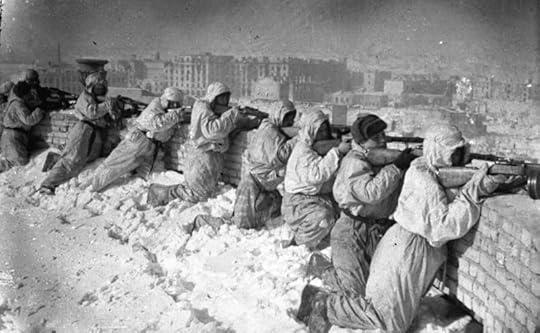
German soldiers in Stalingrad Bundesarchiv Bild 183-B22478, Stalingrad, Luftwaffen-Soldaten in Ruinen.jpg

Russian Defense
Bundesarchiv Bild 183-E0406-0022-001, Russland, Kesselschlacht Stalingrad.jpg


As quoted above, a character in the novel is told to have the courage to report what really happened. But it is the author, Gerlach, who does this unflinchingly. He was there, he experienced it. According to the Afterword, although most characters are fictional, ”Yet at the same time, nothing in this book is ‘fabricated’. All the incidents recounted in the action of the novel actually took place sometime and somewhere, either on the snowbound fields outside Stalingrad or in the ruins of the city itself.”. There is a large cast of characters: some good, some not, some real (General Paulus and various other officers), others fictional. But they are all human with human frailties, and any pretention is stripped away by their circumstances. Over time (these few months were like a lifetime) their hope fades and many change their views about their Führer. As their situation deteriorates, it is almost a case of rather the enemy who surely can’t be as bad as painted by propaganda, than more broken promises by a government which they felt had betrayed them. At least there would be more food in captivity than the tiny rations on which they had tried to survive through the bitterly cold winter.

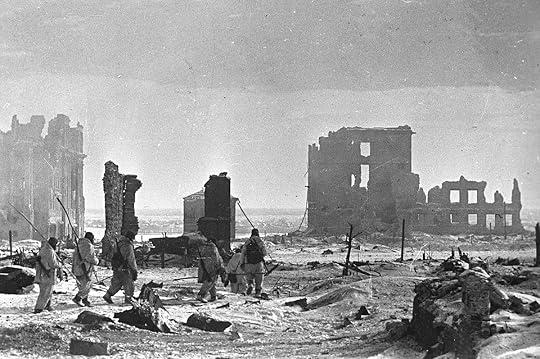
Stalingrad after liberation
RIAN archive 602161 Center of Stalingrad after liberation.jpg

It is historical fiction at its very best. The translation is excellent, and it is well worth reading the various addenda to the novel which include details of how the manuscript was found, as well as biographical information about Heinrich Gerlach who became involved in anti-fascist work in the concentration camp. It also provides details of the writing of the novel, how it was possible to do so and the loss and re-write of the novel based on hypnosis therapy. There was also a subsequent lawsuit filed by the hypnotist.
Profile Image for Andy Weston.
3,199 reviews225 followers
July 27, 2018
Published in Germany in 2016 and in the UK the year after this much acclaimed novel was written in captivity by a junior officer on the staff of the 14th Panzer Division, of the Sixth Army, who was badly wounded and captured at Stalingrad. From November 1942 it tells the story of the last months of the 300,000 strong Army as it was surrounded by the Soviets.
Not only is it tell an astonishing account, based heavily on fact, but the story of the novel itself was initially confiscated by the Soviets before Gerlach’s release, and lost for more than 50 years.
147,200 German bodies were recovered in the days after the battle. 91,000 went into captivity, including 2,500 officers and clerical staff. That figure represents a third of the Sixth army, and half of its officers. Four fifths captives subsequently died, and half the officers.
Hitler said ‘The duty of those who fought at Stalingrad is to be dead.’

At just over 600 pages it’s a very full account, as you may expect from someone writing in captivity. It provides therefore an almost complete picture of the detrioration of life in the camps. Even the descriptions of the lesser incidents are compelling.
The persisting impression of the attitude of the fascist Generals to the devastation on the Eastern Front,
‘Can I do anything for you Field Marshall?’ enquired Schmidt, like a nurse addressing a patient.
‘No, I don’t think so...thank you! Perhaps you might see to it that we’re allowed to keep our cars? And my batman, too, if possible, I’d like to keep hold of him.’

‘I’m not really sure about this Colonel, Sir,’ he said, shaking his head. ‘I don’t know... whatever happened to “fighting to the very end”?’
‘What’s your problem?’ Exclaimed the Colonel, spitting out the stub of his cigarette. ‘Haven’t we done just that? I’d say we have. And today is “the end”.’
Profile Image for Olaf Gütte.
222 reviews76 followers
April 6, 2017
Geprägt durch das selbst erlebte Grauen in der aussichtslosen Schlacht um Stalingrad, schreibt der Autor sehr eindrucksvoll und erschütternd über das Ende der 6. Armee der deutschen Wehrmacht. Jedem der todgeweihten Soldaten und Offiziere wird klar, dass sie hier nicht für die Heimat geopfert und verraten wurden, sondern allein für die Rechthaberei und dem Prestige Hitlers. Von einst 300000 Soldaten werden 209000 Totenopfer eines Wahnsinnigen, 91000 gehen in Gefangenschaft und nur 6000 von ihnen sehen ihre Heimat wieder. Diese Tatsache beweist, welche Notwendigkeit den Autor Heinrich Gerlach zum Schreiben gezwungen hat.
Profile Image for Tomq.
220 reviews17 followers
November 5, 2018
This would get 4 stars as a historical document, 1 star as a novel. I settled on two stars because of the editors' decision to present it as a novel.

Why is this bad as a novel? The single main problem is the moral message: Gerlach visibly had no problems with killing while the Nazis were winning, but he suddenly grows a conscience when he risks dying as the Nazis are losing. Indeed, he seems to be very much an opportunist, since this book (very critical of Hitler) was written after he became a prisoner of the soviets, who knew full well about it. But more on this later. The novel was written in captivity by a direct witness of horrific events, it was that person's first attempt at fiction, and it hasn't had an editor. Unsurprisingly, the quality of writing has suffered greatly. Among other issues, many characters are one-dimensional or desperately bland. There is a strong focus on telling a litany of gruesome anecdotes, at the expense of explaining what is going on or furthering the plot. The prose is shamelessly purple throughout. Etc.

But this is not just a novel. Gerlach wrote "Breakout at Stalingrad" with several aims in mind. He wanted to testify of what he had seen; he wanted to settle the score with Hitler, the Nazis, and the army High Command, that is, to find scapegoats for the defeat of Stalingrad; he wanted to promote peace between the Soviet Union and Germany; and, last but not least, he wanted to save his ass, knowing the soviets were reading over his shoulder.

So, it's a fascinating book. It is most interesting in what it involuntarily reveals: the self-righteous arrogance of nearly every single character; the obsession with loyalty and obedience; the absence of doubt or critical self-reflection, except on the brink of death; the lack of empathy and the inability to deal with emotions other than by suppressing them; all of which simultaneously makes them excellent soldiers, useful tools, and ripe for committing atrocities. Certainly these are important lessons for all of us.

Unfortunately, this text is presented purely as a novel, in a way that encourages the reader to side with Gerlach and his characters, instead of engaging critically with it. Indeed, it is easy to see why the second version (rewritten by Gerlach after his liberation, when the original text had been confiscated by the Soviets) was a huge success in post-war Germany: it's even more complacent towards the Wehrmacht than this one! For instance, Gerlach portrays the 6th army as being increasingly critical of Hitler and the Nazis, but historians think the opposite is true - the majority remained loyal to Hitler and to Nazism, enthuasiastic for the cause even, to the end, and despite the near certainty of their own death.

Overall: an interesting read, which suffers from an irresponsible presentation on the part of the editor and translator. At the very least, I strongly suggest reading the relevant appendices before reading the novel, rather than afterwards; but even that is not enough.

Post-Scriptum: It is hard not to think of Napoleon's Russian campaign, which also saw the near total annihilation of an army of 300,000 men by cold, hunger, and Russian harassment. (With the difference, and that's an important one, that although they were invaders, they were not Nazis.) In Tolstoy's "War and Peace", as the last remnants of Napoléon's army are drawing their last breaths, the Russian Kutuzov gives the following speech to his men:
"(...) Worse off than our poorest beggars. While they were strong we didn’t spare ourselves, but now we may even pity them. They are human beings too. Isn’t it so, lads?
He looked around, and in the direct, respectful, wondering gaze fixed upon him he read sympathy with what he had said.
But Kutuzov resumes speaking, and concludes:

“But after all who asked them here? Serves them right, the bloody bastards!
Profile Image for Noah.
550 reviews74 followers
January 2, 2019
Bereits die Entstehungsgeschichte dieses Romans ist romanwürdig:

Der Autor Heinrich Gerlach war Stabsoffizier im Range eines Oberleutnants der 6. Armee und nahm an der Schlacht von Stalingrad teil, wo er in Kriegsgefangenschaft geriet. Hier schloss er sich bald dem Nationalkommitee Freies Deutschland (der pro-kommunistischen Exilbewegung) an. Da dieses Bewegung im Offizierschorps ziemlich unbeliebt war, gehörte er als mittlere Charge bereits zu den höchstrangigen Offizieren im NFD und wurde mit Propagandauaufgaben betraut, die ihn zu den verschiedenen Offizierslagern der Stalingrad Gefangenen führten. Er nutzte den Kontakt zu den Soldaten, um Stoff für diesen Roman zu sammeln, den er alsbald zu schreiben begann und dessen Manuskript schon vor Kriegsende 1945 fertig war.

Der Autor durfte - wie die meisten Kriegsgefangenen der UdSSR - erst 1950 nach Deutschland zurückkehren. Sein Manuskript wurde indes vom KGB beschlagnahmt. Es entspann sich innerhalb der Propagandaverwaltung der UdSSR eine längere Debatte darüber, ob dieser Roman publiziert werden sollte (weil anti-Nazi) oder unterdrückt werden sollte (weil nicht pro-kommunistisch). Schlussendlich entschied Bucharin persönlich, das der Roman nicht gedruckt werden soll.

Heinrich Gerlach siedelte sich in Niedersachsen an, wurde Lehrer und versuchte sein Romanmanuskript zu rekonstruieren, womit er Jahre verbrachte und wobei er sich sogar - von der Quick finanziert und mit entsprechenden Artikeln begleitet - der Hilfe eines Hypnotiseurs bediente. 1957 veröffentlichte er "Die verratene Armee", einen Roman, der wohl nicht altzuviel mit dem ursprünglichen Manuskript gemein hatte und der ein Riesenhit war.

Wenige Jahre nach dem Tod des Autors wurde das Manuskript in einem Archiv des GPU in Moskau gefunden und nunmehr sorgfältig editiert herausgegeben. Dabei sind - etwas übertrieben lange - 150 Seiten Einleitung, Editionsgeschichte und Vergleich von "Durchbruch bei Stalingrad" mit "Die verratene Armee".

Obgleich dieses Manuskript ohne Zeitabstand zum Krieg geschrieben ist und nie lektoriert wurde, schlägt es in meinen Augen fast alles, was über den zweiten Weltkrieg in Romanform geschrieben wurde. Es hat nicht den rohen, abstrakten Stil der "Trümmerliteratur" und nicht die absurden Charaktere der "Wohlgesinnten" keine Liebesgeschichte und keine Rettungsgeschichte sondern schonungsloser, militärisch präzise eingebetteter sinnloser Kampf und absehbarer Untergang. Gerade die militärische Kenntnis zeichnet den Autor sicherlich vor vielen anderen aus aber die Stärke liegt nicht nur dort, sondern im menschlichen. Heinrich Gerlach steht eher in einer Linie mit den großen, die über den ersten Weltkrieg auf allen Fronten von Remarque über Barbusse und Celine bis zu Alexej Tolstoi geschrieben haben und das ist gut so denn er kann bedenkenlos durchaus im gleichen literarischen Atemzug mit diesen genannt werden.

Vor diesem Hintergrund ein absolut empfehlenswerter Fund!
Profile Image for Homunculus.
145 reviews14 followers
September 12, 2016
Stalingrad war immer eine kleine Wissenslücke bei mir. Ganz früher habe ich mal einen Konsalik über das Thema gelesen, aber das war es auch schon.
Das wirklich interessante an diesem Buch ist seine Geschichte. Erst deshalb bin ich überhaupt darauf gekommen. Der Autor ist Stalingrad Überlebender und hat das Buch während seiner Gefangenschaft geschrieben. Jedoch konnte er das Manuskript nicht hinüberretten, sondern es verschwand in den Tiefen russischer Archive. Aufgrund der langen Gefangenschaft waren weite Teile des Buches aus dem Gedächtnis verschwunden und der Autor versuchte unter Mithilfe von Hypnose diese Teile wieder herzustellen.
Vor kurzem wurde dann das Manuskript im russischen Archiv entdeckt und darauf basiert dann dieses Buch. Diese Geschichte ist im lesenswerten und sehr langen Anhang beschrieben. Sehr spannend.
Ein wirklich aufrüttelnder Anti-Kriegs-Roman über die verratene Armee von einem Zeitzeugen. Ich bin froh, dass ich das Buch entdeckt habe.
Profile Image for Colin Lawrence.
43 reviews
February 4, 2018
Based on the author's experience of the horror that was Stalingrad, this novel reads more like a memoir. The discovery of his original manuscript in Russian archives has brought the reality of the dreadful situation of 300,000 marooned and abandoned troops, Germany's entire Sixth Army, into graphic focus. Hard to believe that only 6000 men made it home after the war. In addition to the novel the book contains the story of how it was written, lost and rediscovered and the story of the author, who died in 1991, and his struggle to be reunited with his wife and children after eleven years; he wasn't released by the Russians until 1950 - and only because he agreed to spy for them, something he managed to avoid. This book isn't for the fainthearted. Reading this book has been a memorable experience.
Profile Image for Antti Kauppinen.
107 reviews1 follower
January 6, 2019
Among many things, this excellent autobiographical novel serves as a warning from the past for those who still believe in 'genius' leaders who get it right by dismissing expert advice. In Stalingrad, Hitler and his bootlicker Göring sacrificed 300 000 of their own rather than acknowledge their own mistakes. Gerlach describes finely how the scales gradually fall from the eyes of German soldiers, some of whom come to realize not only the criminal stupidity of their leaders but also the moral monstrousness of their campaign in the East (while many others, plausibly, die in the cold while still believing in the big lie).
20 reviews2 followers
October 28, 2018
The history and events of Stalingrad have fallen into popular legend, or is it myth, and the sense of what happened to the German Sixth Army in the terrible conditions of a Russian winter are well-documented. However, it is difficult to imagine the reality on the ground.

Gerlach's account creates the picture through the eyes of soldiers on the ground, who descend from the all-conquering, highly confidence Wehrmacht, into a desperate rabble. Established views of honour and duty slowly collapse as the Russians close in, and as death through starvation, cold or injury haunt the central characters. What really comes across is the randomness of death or life-threatening wounds, and as the Russian noose tightens the realisation that senior officers on the ground are as keen to escape using any means possible adds to the despair.

I found the book took some time to pick up the pace, and wondered if the author was looking for us to attach ourselves to individual characters. As the situation rapidly declines one comes to realise that any and every character might die, while Hitler fuels hope from afar and the soldiers still believe that help will arrive. Towards the end as the officers come to realise they have been abandoned, and the shame leads to drastic personal actions and the final descent into a living hell.

There are few books in English that convey the horrors of the Eastern Front, but this, Guy Sajer's "The Forgotten Soldier" and Ralf Rothmann's "To Die in Spring," all capture the view from the bottom up of an everyday infantryman. While we are taught to despise the Germans in WW2, the real lesson of these works is that there are no winners in war, and the 'grunts' on the ground are the ones who pay the real price.
Profile Image for Grant S.
180 reviews1 follower
January 31, 2019
Excellent story about the battle of Stalingrad.
This book really captures the desperation, hunger and fear of the soldiers trapped within the Stalingrad 'cauldron.'
It should do. The author Heinrich Gerlach was a German soldier taken prisoner there.
As much as anything it's a study of the mental disintegration of the men who are trapped. Their plans to 'breakout' and escape, defect to the Russians and surrender, and their contempt for their superiors when the realization hits that they won't be rescued and they've been abandoned by the senior officers of the 6th Army and their leaders and politicians at home.
Reading this book made me feel claustrophobic. I could feel the fear of entrapment and desperation growing. Impending catastrophe. Really well written!
Highly recommended for anyone who enjoys Military History. Years ago I read Anthony Beevor's 'Stalingrad' and enjoyed it, but have to say I probably learnt more from this book! You buy into the struggles of the characters and that makes the story so believable and readable.
Profile Image for John Eliot.
Author 100 books19 followers
April 10, 2018
It was fortunate that I was in the UK for a few days and bought the Sunday Times. This novel was reviewed. £25, sounded very expensive but as an ebook it was a lot cheaper. Simply put reader, if you only read one novel this year then it has to be this one.
I would guess that it was a memoir novel, much in the same way that Solzenitsyn wrote his novels. Very powerful, very graphic.
After this I read a non fiction account of the German/Russian war and the siege of Stalingrad. In this there were many accounts of the atrocities committed by the Germans, execution of schoolchildren for example, amongst many others. Gerlach makes no mention of anything like this. Perhaps he didn't experience this, perhaps his mind just shut of from the dreadful deeds, perhaps he didn't want to admit he took part in them.
176 reviews
December 18, 2018
Seen from the perspective of the Germans bottled up by the Russians in the Cauldron at Stalingrad this is on a par with All Quiet on the Western Front. over the Winter of November 1942 to April 1943 when Field Marshal Paulus surrendered over 200k perished in the awful nightmare that they were constantly told would be relieved within days by a Leader who felt that it was their duty to die. The translation is deftly handled and I would recommend this book
Profile Image for Richard Cubitt.
Author 6 books11 followers
June 30, 2018
Grim. Some genuinely powerful passages; quite easy to read. The breakdown of the civilising aspects of humanity; am reminded of some of J.G. Ballard's fiction. Senseless fascism at its worst. The story of Gerlach and his manuscript as a POW is highly interesting as well.
278 reviews7 followers
March 20, 2022
This is one of the few novels I have read about the German experience of WWII and it was written by a German soldier while being held in captivity by the Soviets after the mass surrender at Stalingrad in 1943. The novel itself recounts events of the three-month period before that in the ‘Cauldron’, as the encircled German Sixth army (of about 300,000 men) fought to keep the Soviet forces at bay, while slowly starving and freezing to death outside Stalingrad. It is the German counterpoint to Grossman’s Life and Fate/Stalingrad in some ways, though without the same breadth and literary heft.
It reads much like a memoir, written in a hard-bitten and economic style, and focuses on the experience of ordinary German soldiers trapped in the Stalingrad cauldron, very few of whom seem to be Nazi supporters – in fact, those who are zealous about the war are treated with contempt by the other troops. It becomes increasingly obvious that Hitler has abandoned them to their fate in the cauldron, with their only life-support being the infrequent and insufficient air drops, despite the Furhrer’s exhortations that they will fight to the very end (rather than withdraw, as would have made more sense).
The book goes into some details of the horrors of war, with such images as frozen corpses being left upturned in snow at the roadside to mark routes, as wooden markers would be stolen for fire wood; in another scene, a field surgeon operating on men in a half-demolished building on the front loses both his hands after a tank shell hits and is then callously left to die, as he is no longer of use. The military command system is seen to be break down as the Russians get closer and the men get hungrier and the casualties mount, and in the end the German commander, General Paulus, is minded to surrender, against orders. This scene in the book is the result of his being told that there was no option by a colonel who had already negotiated a ceasefire as the Russian tanks were only a few hundred metres away. The sense is that virtually all the Germans were happy to surrender, rather than die heroically in battle, as Hitler’s High Command wanted them to do (Goering appears in one scene comparing them to the ‘300 Spartans’ on the radio, at which point a soldier destroys the radio in cold fury). The book is also full of references to how well the Russians treat German prisoners (and even vice versa), which seems to contradict many historical accounts of this most brutal of battles. The colloquial English used by the German troops is also a bit jarring at times (making the soliders sound like tommies), and much of the book could have been cut back as it gets bogged down a lot in the middle.
As the helpful postscript tells us, Gerlach was a teacher who then went to the Eastern Front and was captured at Stalingrad in 1943 and then spent 7 years in a Russian camp, where he wrote the first draft of the book. This was confiscated by the Soviets and he then went into hypnosis back in Germany to try to recover the lost memories and piece it back together (this is described as if it were a psychotherapeutic intervention for trauma). Although it is highly critical of the Nazi regime (who are rightly seen as lunatics and criminals), it presents the German Army and soldiers in a fairly positive light, with little attention paid to the mass atrocities committed by the military in the Eastern campaign.
Profile Image for Charlie.
31 reviews13 followers
February 2, 2021
Breakout at Stalingrad is one captured and injured German Officer's fictionalised account of the last weeks of the battle of Stalingrad, encompassing December 1942 through to the end of January 1943 with the surrender of the German forces who had been enclosed in the 'cauldron' and abandoned by leaders of Germany. While the book is fiction, everything described happened during this period. The author wrote this book while in USSR captivity, but was confiscated and he never saw this work again. He underwent hypnosis to have another book released, but this one was found in 2012, 22 years after Heinrich's death.

The author, Heinrich Gerlach, focuses on a select few officers who start off following orders unquestioningly, but as their situation deteriorates, questions are asked about Hitler and what they are actually fighting for. Heinrich masterly conveys you into the destroyed arena of war, not skimping over any details which are uncomfortable. You feel you are there with them in the freezing, snow and ice filled hellscape following the soldiers as they battle with their conscience after seeing some of the worst that war can bring, against what they have been told by propaganda for the previous 10 years under Nazi leadership. Reading this book, we know the outcome of the battle, we know what the outcome of the war was, we know what USSR forces done to German prisoners of war, and therefore you are also in this moral dilemma with hindsight.

Basically, if you want to read a book from a German perspective of one of the major, and destructive, battles of the Eastern Front, I fully recommend this one. It is not an easy read by any means but I found a rewarding and questioning one.
Author 5 books3 followers
February 22, 2021
Early on I had this as a 4/5 in my head - and over time I decided it was a 3. I think it is a fine book, and makes the well-known story of the disaster at Stalingrad very human indeed. That alone is worthwhile. But readers should be warned. It is a book of its time. There is a relatively large cast of characters, even if he clearly makes Breuer the protagonist. At times every one of them gets deep introspective mind searches. I think many readers will find these have a hideous slowing effect in the narrative - and - broadly speaking are quite repetitive. I think the growing disillusion with Hitler is crystal clear - and seeing this disillusionment grow at different paces in different people with different responses is interesting. It is just not done in an elegant well-crafted way - it takes pages and pages. Obviously when someone finds such a seminal and important work in an archive you have to publish it as it stands, it would be wrong to take an editor’s read men to this. But I think the modern reader should be aware going in that you get a vast amount of soul searching with your Stalingrad narrative
Profile Image for Robert Ronsson.
Author 6 books26 followers
July 2, 2019
Congratulations to the translator Peter Lewis who deserves huge praise for making the English version so readable.

A harrowing account of a pivotal engagement of WW2. So harrowing that at times the horror was overwhelming until, like the soldiers, the reader becomes inured to the carnage. This is a brilliant account of the disintegration: militarily and morally of the German army trapped in the Stalingrad 'cauldron'. We follow specifically a group who initially were in a quieter stretch of the front line to the north-west of Stalingrad which, after the Sixth Army's encirclement, is forced to 'withdraw' westwards to the doomed city where it meets its fate.

My only cavil is that the large cast of characters is difficult to follow. I would have benefited from a pen-picture listing of them in a glossary. It would also helped to have a had a map of the 'cauldron'.
Profile Image for Nicola C.
69 reviews
March 4, 2022
"Stalingrad began as an assault became a defensive action & ended up as a crime !" And so this quote comes from pages 485 & 486 of the hardback 1st edition of Breakout At Stalingrad, having read other history books of Stalingrad and the battle wages their notably Antony Beevors Book Stalingrad the name is synonymous with death & the tragedy of an army encircled and of suffering, this book is a strong anti-war story and caution tale of those in power and corruption and failing to stop those who use that power and of the impotency of higher ranks who failed and kept failing the rank and file soldiers & officers who were surrounded and left to die in Stalingrad in the most miserable and wretched conditions.
I found this book hard to read at times & vividly horrific more than any horror novel.
I haven't read the appendices but I will and will edit this review accordingly.
Hardback 1st edition 551 pages
Profile Image for Hannah Polley.
637 reviews11 followers
July 3, 2020
I think I got the wrong idea when I bought this book. I thought that as it was written by a German solider when he was in a Russian PoW camp, that it would be his experiences in the camp. However, it is a novel he wrote about soliders in Russia, up to the characters being captured by Russians.

It did make me think of how awful and freezing it would have been (I swear the book actually made me feel cold!). But I found it very heavy going and it took me a very long time to read this book.
Profile Image for Matthew McLaughlin.
18 reviews
February 11, 2025
An interesting account of the lead up to and during the encirclement of the Nazi's at Stalingrad.
Written by a German soldier that was actually there the book gives an insight in to the thoughts and mind set of the Nazi army as there fate becomes clear.

Although the huge cast of characters can be confusing and left me unsure of what part of the front and what character the book is focusing on at times
Profile Image for Alicia Huxtable.
1,901 reviews60 followers
November 28, 2020
To be honest, I didn't quite finish this book. At first, I loved all the history and the story but it just dragged on so much that I just couldn't finish it. I got to just over halfway and had to put it away. It's not a book I'll pick up again but would definately recommend to readers who live war stories
24 reviews
January 12, 2021
Harrowing, yet riveting account of the last days of the battle for Stalingrad. German soldiers are surrounded by the Russian Army, facing the horrors of a Russian winter, starvation and abandonment by the Nazi High Command.
Profile Image for Chris Hudson.
42 reviews1 follower
February 4, 2024
I agree with the reviewers description of "masterpiece" from a perspective we don't usually get.
Profile Image for Paul  Kelly.
58 reviews1 follower
January 5, 2020
So many unnecessary adverbs in the text quickly told me this was going to be disappointing. Translation might be blamed, however, if this is the format from the original manuscript unearthed in recent years then that leaves for a poor, page-turner of a book.

The style reminded me of a Sven Hassel paperback with its simple prose of gore, derring-do and descriptions of death, glory and honour.

Almost child like in its telling, I found it hard to believe this was the same novel lauded by reviewers in its new issue. Those appraisals gave me great expectation and have only allowed me to judge this against much better.

Willi Heinrich wrote The Willing Flesh (1955), later to become Cross of Iron, and later still to be filmed in 1977 starring James Coburn and directed by Sam Peckinpah. Lots of similarities in each other and at times I felt that much of the film dialogue matched descriptive elements of Gerlach's effort.

One star for prosaic literature.
Profile Image for Mike.
273 reviews17 followers
March 12, 2020
Every work of literature is a miracle to some extent. But the idea that a German soldier could survive Stalingrad and be able to write such a remarkable first novel is almost incredible. Add to that that Heinrich Gerlach wrote the book in captivity and it was discovered in a Soviet archive and Breakout at Stalingrad becomes a miracle.

There are already war books that are haunting, that are atmospheric, that demonstrate the futility of conflict, but Gerlach has summoned a claustrophobia, a feeling of mounting hopelessness, and the feeling of an army on the edge of disintegration that I have not encountered previously, either in fiction or non-fiction. His depictions of people and events offers a near-nauseous feeling that grips in a way that few can.

With - possibly above - Orwell and Grossman, Breakout at Stalingrad deserves to be regarded as one of the finest war novels; perhaps one of the finest novels of the twentieth century.
Profile Image for Maduck831.
526 reviews1 follower
May 11, 2021
what a find (a thank you to the reddit comment that suggested this one)...although fiction, it is from the german perspective re: stalingrad which i found fascinating (and horrifying)...after reading a lot of western europe/pacific work it was nice to get this perspective (although "nice" may not be the right word re: stalingrad)...story behind the author is fascinating and i think important to read/know about for this book.

Their brains start working again, and to a man they all have just the one thought: We’d already put all of that behind us, our homeland was already beckoning! And now, right at the very last, we’re supposed to die a miserable death for these puffed-up swastika lovers?

Back then, in 1918, when he returned home still feeling the artillery barrage at Saint-Mihiel in his bones, he–like everyone else at the time–had only one thought in his head: Never again. No more war. And now, despite themselves, they’d slipped back into fighting another one.

Beside the vehicle lay the body of the driver, burned to a cinder. Its teeth and glazed eyeballs shone out ghastly white against the shrunken skin of the face. Its black, shrivelled arms were stretched up to heaven. A group of Russian POWs loitered around the scene of the conflagration, holding their mess tins over the guttering flames. One of them had propped his foot on the chest of the dead man. They were chatting and laughing, pleased to have found this little oasis of warmth.

He’d never be able to rid himself of memories of this war. It had got under his skin and become an indissoluble, unforgettable part of his very being.

No, we won’t get out of here; I know it. Even if we’re relieved one day–and I really believe it might happen–we won’t be the same people. We’ll never bring our best side home with us. That’s fallen victim to this war. It’s lying dead and buried under the snowy fields of Stalingrad.

‘Manstein, now, he’s the one who…’ Manstein, nothing but Manstein! None of the troops had ever seen the field marshal in person, and hardly anyone even recognized his photograph. The besieged men of Stalingrad were investing all their heartfelt hopes in a name.

The army needed six hundred tons of supplies every day to live and fight effectively, not the three hundred they’d all so glibly taken to be the bottom line.

The bodies of Sergeant Major Harras and Private Seliger, formerly a mess orderly at divisional HQ, are not found.

But man was put on Earth to raise himself up from the depths of bestiality… (No, they’re not my words, it’s a quotation from Fichte.) “Love They Neighbour as Thy Self”, that’s the secret of humanity. Take a look inside yourself just for once, Dierk, into your heart of hearts. Can’t you feel that I’m right? Sure, the war’s brutalized a lot of things in us. But hidden somewhere deep inside us all is this miraculous treasure. Dig it out, Dierk, so you can become a human being again!’

The crucifix of Stalingrad! In time, the wooden crosses will rot to nothing, and new life will blossom once more on the neglected graves. But the invisible crucifix of Stalingrad will go on looming over space and time, standing for ever as an admonishment and a warning.

‘In years to come, if anyone asks me if I was one of those who came back from Stalingrad, I can say: “Yes, in part! When I went there I weighed a hundred and ninety-three pounds, now I’m only a hundred and thirty. The rest of me stayed there.”’

This cruel play of nature seemed positively to encourage that self-deception, that mystical faith in miracles to which the men abandoned themselves ever more freely the more hopeless and desperate their situation became.

He had to do something! Work, slave away till he dropped from exhaustion, fight, shoot, freeze and fall in battle–it was all the same to him. Just so long as he didn’t have to think any more

They’re expected to lie here with no end in sight, even if that’s being wounded or killed? This just can’t be right! It’s sheer madness! This isn’t war any more; it’s nothing but murder: futile mass murder!

There’s no shouting, no questions, no noise at all. That kind of deathly hush can only come from people who have given up on everything.

But this terrible silence rises up to the heavens like a single painfully pressing question, to which no answer comes: ‘What is the point of these sacrifices, what are they for?’

‘Now just hold your horses a minute!’ Unold interrupted the hubbub. ‘I think you’re labouring under some kind of misapprehension. To put it bluntly: we’ve had it! There aren’t any other tasks any more. We’re under orders to die here, and that’s that! You’re aware that the Corps commander is here with his staff, too. Well, he’s already chosen the foxhole where he’s going to fight till the very last bullet. That’s how things stand!’

‘What do we do?’ the colonel repeated in astonishment. ‘You’re asking me that? You’re a soldier yourself, man! We’ll follow orders, that’s what!’

Stalingrad, the graveyard of the German Army.

And so it was that they kept quiet again when they were expected to understand that this warm bunker hadn’t been prepared for the likes of them, but for the others–those who had the power to decide over life and death–and that they were destined to die. And even if they didn’t understand that, they still said ‘Yes, sir!’ to it, albeit not in as many words. So, slowly and exhaustedly, they shuffled backwards towards the door, casting a last stolen glance at the wonderful pleasures of this room as they went.

We’ve sacrificed the best years of our lives to that criminal shit, and now he’s letting us go to the dogs… Come on, let’s drink! It’s the only thing that makes any sense any more!’

And every thought and every deed that was not aimed at overcoming that ludicrous, destructive spirit that insisted upon the mass slaughter of Stalingrad as some ghastly ritual of a barbarian cult of idolatry would be repudiated. As yet, Breuer only has a faint inkling of all this. And he struggles to fight back this thought and summon up his strength for the fight that still awaits him.

‘The very idea of a general or General Staff officer standing in the trenches with his rifle like Private Dogsbody is quite preposterous!’ he’d said, for instance. ‘We didn’t undergo our training at the military academy to do that sort of thing!’

A few men on the upper floor had saved themselves by climbing out of the windows onto trees. But the flames from below steadily licked up to where they were perched. The men in the trees started screaming, ‘Shoot us, shoot us!’ And the soldiers below opened fire, and one after the other the trapped men plunged into the flames… That had all been undignified, shameless and criminal. ‘Stalingrad began as an assault, became a defensive action, and ended up as a crime!’ he had written in a letter to his wife. The German Wehrmacht, he claimed, ‘had lost face’.

A city was gradually being levelled. It was as if the decay of all man-made objects, a process normally concealed from mortal eyes by the slow passage of the years, was here being made visible by some merciless time-lapse camera.

There’s a babel of slurring, whimpering, gurgling and moaning. One man’s laughing crazily to himself. Another has stood up. Two burning irises, framed in white, blaze at Fröhlich, and a skeleton’s hand reaches out to him.

Colonel Lunitz was pleased with himself. The building was saved and at the same time he’d be able to carry out his orders from High Command. The chiefs of staff could sleep safe in their beds that evening. He’d like to see someone do any better! What happened afterwards was no concern of his. Orders were orders!


Profile Image for Kate.
151 reviews2 followers
July 22, 2019
Not for the faint-hearted and readers need stamina. This novel of over 600 pages describes the horrors of a siege during WWII. It never describes war as glorious but covers its horrors and the beastly things men are able to do to survive. I had to occasionally put it down and pick up something else, when scenes became too horrific for me to continue.
The author based his novel on his personal experiences. One of the characters in the novel, Breuer, is the author's alter ego. The story starts with Breuer observing the wintry landscape around Stalingrad, where Paulus' army is already stuck and slowly being surrounded by the Russian one.
The novel does not describe the complete battle - or rather siege - but the last months. The novel ends with Hitler's horrible remarks: "Die Kämpfer von Stalingrad haben tot zu sein!". Which in turn explains the novel's dedication: "Mortuis et Vivis".
Though there is a new English translation available, I'm very glad I read the German version published in 2016 by Galiani, Berlin. For this edition not only includes the novel which consists of 3 parts and as mentioned above, numbers over 600 pages. This edition also includes an after-word by Carsten Gansel.
Gansel's addition also runs into over 200 pages and tells the story of how this book got written. For this novel was created twice. The first manuscript, written between 1943 - 1945, was lost.
On being finally released from one of the prison camps he was kept in, Gerlach managed to escape to the West in 1950. After unsuccessfully trying hypnosis to try to remember what he had written years earlier, he decided to write the novel again.
Long after his death, the original manuscript was discovered in Russian military archives. Russian archives also shed light on what happened to the author as prisoner of war in Stalin's Russia.
This makes Gansel's account important too. For - among other things - it describes how Stalin, Beria, the KGB and others used prisoners of war not just as forced labour. The few survivors were first used to try end WWII, but when Hitler survived an attempt on his life (Stauffenberg) Stalin changed objectives.
For those interested in WWII, history, even current affairs, this is a must-read - though certainly not an easy read.
Displaying 1 - 30 of 102 reviews

Can't find what you're looking for?

Get help and learn more about the design.