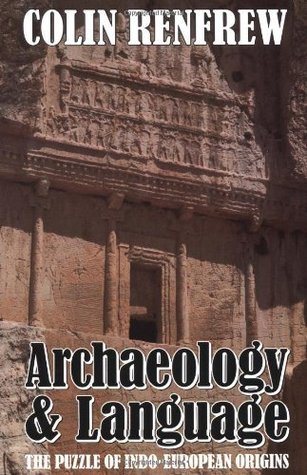
Truth be told, I read Colin Renfrew's 1987 Archaeology & Language (and with very much personal interest I might add) as a university library book around 1994 while studying for my First Comprehensive Exam for the PhD at the University of Waterloo (which tested general linguistics, Western European and in particular German language history and finally both Old High German and Middle High German language and literature) and thus of course also almost fifteen years before I joined Goodreads. And yes, while I do remember the basic tenets and considerations of Colin Renfrew's main theory (namely that he believes the spread of the Indo-European languages into especially Western Europe was not as has been proposed by the majority of scholars through conflict, subjugation and massive fluxes of invasions from patriarchal horse riding and heavily armed pastoralists eager to obtain more land and thereby expand their influence in particular from east to west, but rather through the slow movement north, west and east of basic farming technology from Anatolia, from what is now Turkey, of farmers moving steadily onwards as they kept peacefully expanding their fields), I also do not recollect all that much of the specific details (of Colin Renfrew's presented evidence and proofs) except to say that while I have certainly very much enjoyed Archaeology & Language I do still find the author's main theory (while without a doubt intriguing and interesting) also more than a bit suspect and majorly problematic (full of intellectual holes) in places.
And indeed, for me, the main issues with Colin Renfrew's musings and assertions as he features them in Archaeology & Language are and always will be first and foremost that in my opinion, if one actually does take a look not so much at the archeological evidence the author shows as proof for his theory (of the slow movement from the Anatolian peninsula into Europe of farming supposedly being what caused the gradual but steadily successful spread and influx of PIE) but if one also and primarily then takes a look and considers the basic vocabulary of the extant Indo-European languages of today and the fact that the modern Indo-European languages considered to be the likely most conservative in structure and therefore also probably the closest to what we now propose Proto Indo-European to have been like (namely the Baltic languages, particularly Lithuanian and to an extent Latvian) are NOT located in ancient Anatolia but in the area that has been for many many decades proposed as being the so-called and possible homeland of Proto Indo-European (namely the steppes, plains and forests of what is now the Baltic States) this does make one question how reasonable it is for Colin Renfrew to assume and declare that the origin of the Indo-European languages is the area of present day Turkey (and that of course this would mean that Colin Renfrew would likely take the now extinct Hittite language as being the closest to PIE).
However, and please bear with me, as I am neither an archaeologist nor a trained linguist (although I do indeed and certainly have considerably more knowledge in linguistics than in archaeology simply because as mentioned above, I had to learn basic linguistics and language history during my PhD studies), I also must wonder and have always questioned a bit why the concept of where the homeland of PIE and its original speakers might have been and how it has spread so successfully needs to always seemingly be an either/or scenario, why it could not also have been at the same time a both/and situation, with some spreading of Proto Ind0-Euopean happening via invasion from in particular horse riding migrants and nomadic pastoralists and some equally and also occurring through the more steady and slow spread of farming. For we do know that Indo-European tongues were spoken both on the steppes and grasslands of what are now the Baltic states and Russia and equally in what is now Turkey (and in my opinion, it should at least be entertained that perhaps the conquering spread of the Indo-Europeans and the Indo-European languages might well and also have been a combination of both invasion and a slower and more gradual movement ahead through farming and farmers).
And no, I am most definitely NOT making ANY assertions here that my speculations are in any manner the truth and likely correct, but I do think that perhaps the often in conflict with one another camps of Indo-European origins should perhaps and indeed consider working more closely together a bit and thinking outside of the proverbial box so to speak, that perhaps, Indo-European origin theories need to be more inclusive and more combinatory (for a more combinatory approach would definitely and especially make Colin Renfrew's Archaeology & Language both less problematic and more potentially realistic to and for me personally, and yes, this could also and likely should also be said about those scholars who adhere very strictly to the Indo-European homeland being the grasslands, the forests, steppes and plains of Russia and Lithuania theory).