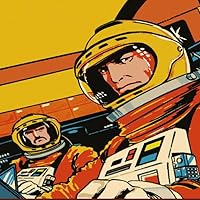
NEW FRONTIERS If you like Heinlein, you'll enjoy POINT ULTIMATE. Welcome to the future where the Enemy rules the world. Resistance is The Enemy maintains control by having released a lethal virus, then forcing everyone to get a monthly antidote injection, lest they die a horrible, painful death without it. Resistance is never entirely futile, and freedom-loving men, women, and children attempt to sneak their way to the secret "Point Ultimate" where they can be free. But the Enemy wants to Where is Point Ultimate? Very Heinlein-esque in feel, it's like finding Heinlein's Have Spacesuit, Will Travel or Farnham's Freehold in an attic if they hadn't been published before, the way people find a "new" Mozart or Beethoven piece in a trunk somewhere. "Jerry Sohl undoubtedly possesses one of the most imaginative minds of our day." —Houston Post Jerry Sohl is the acclaimed writer for Star Trek, The Twilight Zone, The Outer Limits, Alfred Hitchcock Presents, and scores more novels and TV/movie scripts. Read POINT ULTIMATE and save humanity today!
Gerald Allan Sohl Sr. (December 2, 1913 - November 4, 2002) was a scriptwriter for The Twilight Zone (as a ghostwriter for Charles Beaumont), Alfred Hitchcock Presents, The Outer Limits, Star Trek and other shows . He also wrote novels, feature film scripts, and the nonfiction works Underhanded Chess and Underhanded Bridge in 1973.
His 1955 Point Ultimate is a piece of Cold War invasion literature: in 1999, a faraway future history at the time of writing, the US lies under a cruel Soviet occupation, reinforced by a deadly artificial disease which makes conquered Americans dependent on the conquerors for the injections which keep them alive. But a dashing Illinois farm boy breaks out in revolt, killing a degenerate soviet governor and his "Commie" American collaborators. Eventually, he becomes a leading member of a very formidable resistance organization which is capable of breaking at will into the occupiers' security headquarters and springing prisoners out, and which had already established a clandestine space program under the Soviets' noses and established a sizeable colony on Mars.
In the far more low-key The Time Dissolver (1957) Sohl tells the story of a man and a woman who wake up one morning to find that, inexplicably, they had lost all memory of the past eleven years including any memory of how they ever came to meet and become married to each other, and who embark on a quest to find what happened and to trace back these eleven lost years. Aside from the science fiction aspects, the book captures the atmosphere of late 1950s America.
So strap in here as this book review, like many of my retro science fiction reviews will be a fair bit of history lesson. Jerry Sohl is an author whose name I was familiar with. His name was connected to two classics of Star Trek. The only one where he got full script credit was the Corbomite Maneuver, the classic episode that actually was the first Trek to go before cameras. The writer and this novel got on my radar because of his second Star Trek Treatment “Way of the Spores.”
I was able to read the treatment after getting a copy at the UCLA Roddenberry papers archive. The details are famous, the episode started as Sandoval’s Planet, Power play then Way of the Spores. It was eventually credited to Dorothy Fontana as This Side of Paradise. Sohl had done a great job with his first script so he was given several chances to fix it. In the memos that I have read Robbenberry, still concerned about pleasing SF fans, was worried about upsetting Sohl an active SF novelist who was involved in the fan community.
So Trek fans know the episode colony planet with spores that brainwash people. Sohl’s treatment had a love story for Sulu not Spock, an idea Sohl thought ridiculous. Roddenberry had a bigger problem his story editor Steven Calabasas (who admitted he didn’t like SF) had quit. The Gird bird told Fontana if she could crack the script he would hire her to be the story editor.
He was right about two things. Fontana would become a TV legend, and Jerry Sohl would trash everyone involved in re-writing his script. He did this in letters to Science Fiction magazines, and had his credit changed to Nathan Butler. It is funny because one of the things Fontana fixed was Sohl had written the plants with the spores being in a cave, so all anyone had to do was avoid the cave.
So I read about this when I was researching Dorthy Fontana (for an article I hope you’ll be able to read soon) and thought it was interesting as they were talking about him as this very respected author. The thing is as a huge fan of mid-20th century science fiction I had never read the guy. I knew his episodes of the Outer Limits and understood that he ghost wrote some Twilight Zones for a dying Charles Beaumont.
I decided I needed to look up his books and Point Ultimate was the first to stick out to me. Let us start with the fact that the back cover spoils the end, as much as a crapfest can be spoiled. I really hate to say this as I respect the man’s work, between 1952 and 83 he wrote for 11 Tv shows, 6 produced films and published 25 novels. Even though he lived until 2002 his writing career almost mirrored Philip K. Dick’s active years. He also wrote books on playing Chess and Bridge. I respect the guy but I gotta be honest this book sucks.
It is fascinating and we have lots to talk about so bare with me and keep reading. My edition of this book was published in 1959 the same year Castro came into power and Hawaii became state 5-0. It is interesting that Bantam was in that year promoting this novel set in far off 1999 as prophetic, but they did. Jerry Sohl didn’t think we were going to party like it was 1999, he thought we would be living plague ravaged communist dystopia. None the less Bantam put on the cover “1999 - incredible and prophetic - the story of a U.S.A. conquered and Freedom from the Stars.”
When I think of prophetic Science Fiction novels I think of Brunner’s Shockwave Rider, or Stand On Zanzibar. I think of Atwood’s Handmaid’s Tale, John Shirley’s Song called Youth Trilogy. It was bold for Bantam to declare this book prophetic 40 years out, but now that the novel is 68 years we can say anyone short of Marjorie Taylor Greene or Qanon morons would find this book prophetic as it got literally nothing right.
Nothing. Yes, this novel about a communist dystopia is like a Q message board, or a Fox news segment woven into a goofy 50 SF narrative featuring Robot waiters, bartenders , flying cars, and motor vehicles called Turbos because the future.
I point out 1959 because that is when this edition came out but more importantly this novel was written in either 54 or 55 to be published in 1955. The peak years of the red scare were just before this novel was published, there were books, comics and movies like “I Married a Communist,” played on these fears. Science fiction films that played with these tropes in films like Them and Invasion of the Body Snatchers, but the left leaning of SF editors and writers kept this rare in the books. Outside of Heinlein’s Puppet Masters and Jack Finney’s Body Snatchers. I was a little surprised to learn about Point Ultimate. I was curious, and when I found a cheap copy online I thought I needed to read it.
Point Ultimate is the story of Emmet, a small town rebel who accidentally learns he doesn’t need his monthly booster against the plague that socialists use to keep the helpless Americans under the unnamed “enemy” which is a lazy stand in for the soviet union. They people that took over America are implied but not named, honestly I think Sohl was too lazy to write about the soviets, unlike PKD who wanted to write about the Japanese and Germans (even if he got the Japanese wildly wrong at times) at least Phil tried. In this novel the conquerors are just those damned commies or the enemy. It makes me think of the average Fox viewer who hates socialism but can’t explain it.
As a work of 20th century science fiction is on weaker side of examples. The characters are paper thin, the prose lacks invention and the world-building is uneven. The most interesting elements of this novel is the backstory of the dystopia that is often info-dumped with almost zero smoothing into the action. I was never lost in the summer, aware on every page that I was in the hands of a poorly written Science Fiction novel. Worse every time it seemed to be making a point it felt like a dude trying to own the libs.
So the idea is monthly all people in the former America have to submit to a booster against a plague that will drive them to madness. So when Emmet goes off on the run it should start the clock. In a well done narrative Emmett would have been nervous about leaving, unsure if he would be found at all times. “What would happen if he was caught? Maybe one of the slave-labor camps in Utah or Nevada. Maybe they would cut him off from his booster. But they’d have to catch him first.”
Sohl doesn’t develop that paranoid feeling, nor does he take advantage of having the ticking clock toward when he was supposed to appear for the booster. He just has Emmet ask himself that once and moves on. A better narrative would show the reader through events in the story that he was afraid someone would turn him in, or he would multiple times be counting down until his booster date. There is a scene where a farmer who has accepted being a communist pretends to help him but intends to turn him in. That is normal red scare fear, of course the SF aspect to it is the idea of the plague and the booster. Just like Q said these damn boosters are about control, and even if I didn’t agree with the notion I was interested if it mirrored modern conspiracy theory.
This is baked into the way the US fell within the back story. Sohl is able to make it a vague history as the war of 1969 happened before Emmet was born. The world of America pre-1955 is alien to our main character. The history he knows second-hand.
“For thirty years the need for the monthly injections had been the rule of life for everyone in the United States and other occupied countries – for four years longer than he had been alive. It began in 1969 when the enemy H-bombs wiped out Washington D.C., and Chicago. The United States had tried to retaliate in kind, only to make the tragic discovery that the enemy had discovered something that tipped the scales of war in their favor and made the outcome certain: they had somehow devised an impregnable barrier against aircraft and missiles.”
This is one of the very few choices that I thought was smart choice. At every turn this novel failed to engage me, and even if I thought it came off like Red Scare or Q bullshit I was happy and ready to acknowledge a bad point well made. I am not a fan of the message of Starship Troopers but I think it is well done. The Skinner by Neal Asher is one of my favorite SF novels of this century and Neal is a conservative, I don’t have to agree to like something.
Poor DC and Chicago got H-bombed and the Soviets built an anti-missile shield. It is interesting that Sohl, living in the early days of the cold war, assumed that the bombs would launch. A reasonable assumption. The advanced shield system is also an interesting speculative choice. The bombs and the missile shield caused the downfall of America but how had the dystopic communists control ‘merica. Well a plague and booster injections.
“No sooner had the United States capitulated than the enemy made a surprise announcement. Just to make sure their eventual conquest of the United States, they said, they had let loose all over the world a new strain of bacteria.”
The social control aspect of the booster storyline is as thinly developed as anything in the novel. So this regard the Q folks probably will not start book legging this novel or turning Jerry Sohl into some prophet. The strength of the Red Scare political nature of this novel is most pointedly made and on the nose in the form of making socialists and communists into the worst devils that ever lived. This is most notable when a doctor named Smelter talks to Emmet.
“Smelter nodded “and then the bombs fell. No more army. So I went back to Peoria where my Father had a practice and set-up an office. It was a miserable time. Few drugs, hardly any instruments. I could have become a staff member of a commie-run hospital, but I didn’t want anything to do with slaughterhouses. In the commie book nothing is more expendable than life.” I don’t know why communists even have hospitals. Life don’t mean shit to them and worse no one even wants to bring their babies into this commie world.
“Because they were the unlawfully Pregnant. Each one wanted me to perform an abortion. But I still clung to old professional ethics. I’m sorry, I’d say. I can’t do it, no doctor should.” It was 1955 after all, many years before Roe V Wade but again, an interesting moment. This is one of those moments that reminds you that you are reading speculative fiction by a 50s conservative. Two years later PKD would enter into Red scare SF with The Man who Japed a scathing look at communist China. As dumb as I find Point Ultimate I can vibe with Japed. PKD was a better writer but he was also exploring how communism functioned not just saying “Them commies are bad because.
There is also an interesting turn when Gypsies were part of a resistance and travelling the country side in tents. He seemed to be suggesting a certain freedom that these traveling folks outside of mainstream society were able to resist. The only thing in all the social political speculation the Sohl was on to was this… “The rural people are more subjugated than city people. They don’t have half the opportunities of the people in the metropolitan areas. Maybe because it is easier to keep track of them. easily but you rarely see a Tri-D antenna or current model Turbo or flier out in the country.”
Besides having all the funny names of future TV and cars this quote is on to something. It is well know that there is a rural/metropolitan or suburban divide politically in our modern America. Sohl again missed the missed the mark by his own conservative ideas. A fan of this novel or Fox News thinks the woke population of the cities are under control. In the novel still the resistance doesn’t come from the city, so this novel doesn’t understand itself.
Point Ultimate, however, as it is spoiled on both the front and back cover has the resistance coming far beyond the city, but people who made it to Mars. So it is the people on another world who are not revealed until the last three pages who are the great hope against the commies.
I know it is a spoiler but the book sucks and I would never suggest you read it. Plus it is spoiled on the damn cover. It is a stupid ending that comes quickly, too quickly and out of fucking nowhere. Sohl saw us having robot waiters and bartenders in 1999 he was just as wrong about the communist dystopia. Point Ultimate makes a strong case for being the last time I read Sohl but I will give him another case at some point. I am glad I can comment on this book but I was pretty happy to finish it.
Just re-read my copy in 2022 and can say it was quite prescient, as regards forcing boosters on people to keep them in line. Overall, it was quite a good adventure but could have been more in-depth. It seemed too easy for Emmett to suddenly become an action guy in the space of a few pages. And the end of the blurb on the back cover spoiled the ending, even though Mars is only mentioned and not 'shown' in the book.
Jerry Sohl’s ‘Point Ultimate’ was originally written during the Cold War in 1955 - and it is obvious.
The story itself isn’t good. The book follows a man who leaves home under a communist takeover of America in a search for liberation. “The Commies” have taken over the United States, forced vaccinations, “permits” for every civil activity and have opened prison labor camps - how original! If you can get past the other general right wing sentiments of anti abortion, quasi anti vaccination and rugged individualism - the writing is decent.
I was mildly entertained. By no means would I recommend this one. If the book was any longer I think it would be a 1 star read. 3.5/10
It was only after finishing this book that I realised when it had been written, but it makes sense that it wouldn't be a book written today with all it's anti-communist views. Still, it was an interesting read, even if I did want to hit the main character sometimes for being exceptionally dense.