Jump to ratings and reviews
Rate this book

A Rift in the Earth: Art, Memory and the Fight for a Vietnam War Memorial

Rate this book
A Rift in the Earth tells the remarkable story of the ferocious "art war" that raged between 1979 and 1984 over what kind of memorial should be built to honor the men and women who died in the Vietnam War. The story intertwines art, politics, historical memory, patriotism, racism, and a fascinating set of characters, from those who fought in the conflict and those who resisted it to politicians at the highest level. At its center are two enduring figures: a young, Asian-American architecture student at Yale whose abstract design won the international competition but triggered a fierce backlash among powerful figures; and Frederick Hart, an innovative sculptor of humble origins on the cusp of stardom. James Reston, Jr., a veteran who lost a close friend in the war and has written incisively about the conflict's bitter aftermath, explores how the debate reignited passions around Vietnam long after the war's end and raised questions about how best to honor those who fought and sacrificed in an ill-advised war. Richly illustrated with photographs from the era and design entries from the memorial competition, A Rift in the Earth is timed to appear alongside Ken Burns's eagerly anticipated PBS documentary, The Vietnam War.

304 pages, Hardcover

First published September 5, 2017

119 people are currently reading
565 people want to read

About the author

James Reston Jr.

25 books65 followers
James Reston Jr. was an American journalist, documentarian and author of political and historical fiction and non-fiction. He wrote about the Vietnam war, the Jonestown Massacre, civil rights, the impeachment of Richard Nixon, and the September 11 attacks.

Ratings & Reviews

What do you think?
Rate this book

Friends & Following

Create a free account to discover what your friends think of this book!

Community Reviews

5 stars
89 (33%)
4 stars
124 (46%)
3 stars
45 (16%)
2 stars
4 (1%)
1 star
3 (1%)
Displaying 1 - 30 of 59 reviews
Profile Image for Mikey B..
1,136 reviews482 followers
March 23, 2020
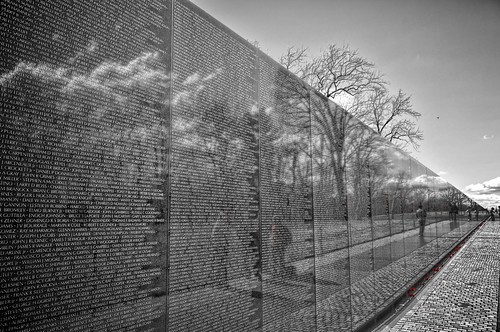
Vietnam Veterans Memorial 2

When Maya Lin submitted her design for the Vietnam Veterans Memorial in 1981 at the age of 21 she had no idea what she was getting into, in fact she probably felt she was a very long-shot to win (there were 1,421 submissions).

Her design had a raw and sublime simplicity that made it win. After winning, Maya and her design entered the world of Washington DC sharks.

Page 110 (my book)

The Boston Globe put the situation succinctly [regarding a Vietnam Memorial]: “Commemorating the war in Vietnam is likely to prove no simpler than fighting it.”


Everyone started wading in – some quite vicious and a few racist (Maya Lin was of Chinese origin). Maya Lin was aptly able to defend herself – she stood toe-to-toe against a ranting Ross Perot who wanted a memorial, but not Maya Lin’s. She did less well against a rather large and verbally abusive Vietnam veteran. He had to be restrained and she was taken away.

There were even sexual connotations in the criticisms; hint: the Memorial was in full view of the Washington Monument.

Maya Lin was resistant to any suggestions to alter her design, which did not endear her to her allies. She was a design person, but knew very little about the engineering aspects, such as drainage, of constructing a large memorial.


Vietnam Veterans Memorial- Washington DC

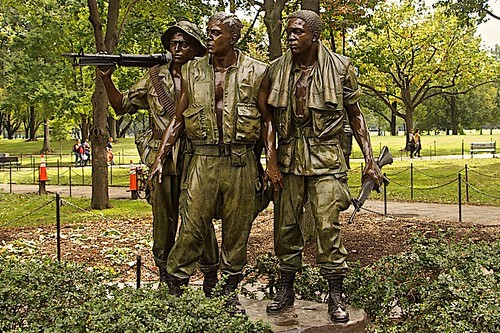
The Three Soldiers by Frederick Hart
unveiled on November 11/ 1984

Another facet of the memorial was a statue that was to be made by the very talented American sculptor Frederick Hart. This too had allies and enemies (one being Maya Lin who kept insisting that the sculpture was not in her original submission). After endless debates about the placement of the statue it was decided to position it nearby so as not to detract from the Memorial Wall. There were also endless debates about the positioning of the United States flag and the wording that accompanied the Memorial (Maya wanted neither). The dark granite rock that was to be used was available in both Canada and Sweden, but these countries were omitted because they had provided sanctuary to draft resistors. India was chosen as the supplier.

This is an extraordinary book on the building of the Vietnam Veterans Memorial to commemorate those who had died in a war that still causes endless controversy in the United States and around the world. In many ways it illustrates the essence of democracy with a diverse variety of contentious opinions.

Just to wade in I have been to the Vietnam Veterans Memorial and find it serene and beautiful. The names overwhelm one (as of May 2018 there are 58,220) .
(There is no mention in the book of the Vietnam Women’s Memorial which was dedicated in 1993).
Profile Image for Joy D.
3,136 reviews330 followers
November 19, 2019
Anyone who has visited the Vietnam Veterans Memorial on the National Mall in Washington D.C. knows first-hand the power of the experience. This book reconstructs the controversy surrounding how it was selected, built, and adjusted in response to criticism. Suffice it to say the backlash against the selection was extremely ugly, including racism, condescension, and politics. In addition, art appreciation naturally varies widely in personal taste and it is often difficult to envision the final product during the design stage. Throw in the many intense opinions about the war, and how and why it was fought, and the stage was set for a flashpoint of discontent.

The author is a Vietnam Veteran, and in the epilogue, he relates the story of his close friend from military training, who died in the Tet offensive. As he looks at the mirrored black granite surface of the wall, he sees his reflection over his friend’s name. It seems like a separate story, but it is a nice way to honor his friend.

The book is well-researched and reported. I very much enjoyed the inclusion of photos of other submissions, poems, literary references, detailed footnotes, and bibliography. If you are interested in public art or curious about how the Vietnam Veterans Memorial came into existence, this book provides a thorough explanation of the process and pitfalls. It highlights the role of art in the healing process.
Profile Image for Emily.
1,265 reviews21 followers
January 27, 2018
Not a long book, but one full of complicated questions about art and memory and how they're used in politics. The author doesn't spend much time spelling out the history of the war or advocating one side or another in the memorial controversies; except for a personal reflection at the end, he lets the reader look at the whole debate and draw their own conclusion.

I picked this up knowing only a really basic version of the memorial design/controversy story, and the details in the book are super interesting from both a politics and architecture/design perspective. Very striking how many of the divides and debates prompted by the memorial design are still playing out today. Especially in how veterans, for all their wide-ranging experiences of war and life in America, are flattened into a certain type of political symbol. You can see those big American questions of how we talk about war and who's allowed to talk about it playing out all over this book.

I would have enjoyed seeing more of the physical design process, how some of the technical concerns about the memorial were resolved and how it fit into the National Mall, but this isn't an architecture case study. As a microcosm of a bigger debate, it's a good quick read.
Profile Image for Richard.
2,315 reviews196 followers
July 16, 2017
A quite remarkable book. The story of the genesis and establishment of the Vietnam War Memorial in Washington DC, USA.
The subtext of the title says "Art, Memory and the Fight for a Vietnam War Memorial."
It is a complex issue and a deep scar in the American psyche. Not surprising given the political fall out of a conflict they government loss the ability to win, the honesty to admit its futility and the courage to withdraw in terms of saving combat lives rather than face.
It is a book that might not immediately appeal to me but kept me engrossed throughout not to take sides but to understand both arguments. In essence how could a national memorial be representative of a defeat, a waste of a country's youth and a reflect those from the anti-war lobby.
Brilliantly written, with an independent voice that has the measure of all aspects of the struggle to remember those that died and those who dodged the draft.
But it also gives great insight into the world of art and design. The chance for serendipity when a competition is launched and the potential winner being an unknown graduate student. How one person's version can move a nation. How a memorial can salve wounds and heal memory sufficient to finally move on.
The aspects of a national consciousness and a corporate meaning and that of an individual were well discussed and explored beyond what was immediately seen. That use of sensual responses to a slab of black granite rather than to regurgitate the past. It strikes me that is the principle role of art design in the widest sense, through architecture, the use of landscape and the focus of remembrance.
I enjoyed the summery of the difficult years between the concept and its construction. It was good that the story of the major players continued in the epilogue.
Finally I found it absolutely fitting that the author revealed his own journey and associations with that War. I loved his trip of remembrance and physical attachment to the wall.
I love books that point to other works you may be interested in, the authors other works may also now pique my desire further. It is also good to be reminded of books you have previously read like Perfume River by Robert Olen Butler in the grand scale of things it shows me why it was such an emotional aspect of his novel.
Finally this is a book of academic value and standing in its range and delivery. However, at no time did it seem dry and part of a study project as it reads like the best fiction and with the same drivers.
This entire review has been hidden because of spoilers.
405 reviews27 followers
September 22, 2017
I came to A Rift in the Earth with a preconception to like the book before reading it. Some reasons: The Vietnam Memorial is among the most moving architectural achievements I have experienced. Additionally, I have always wanted to learn more about the arguments for and against the abstract wall vs representational statues. And sadly, I have a deep emotional attachment to the memorial because a dear friend's name is on the wall (February 17, 1968); my visits to the memorial have been a source of sorrow even after all these years.

And the result? The book is a good read that delivers on its promise. It is informative, clearly organized, deeply researched, reasonably objective in its (tilting negative) assessment of the war, and full of anecdotes as well as you-are-there descriptions of the debates surrounding the construction of the memorial.

In particular, I learned about the designer, Maya Lin, her inexperience, her vision for the wall, her personality, and her challenging interactions with others on the project. And before reading the book, I had known nothing about Frederick Hart, who created the three soldiers added to the memorial; his character, interests, and philosophy are fully explained. So there's lots to learn and appreciate in A Rift in the Earth; not to mention the book is full of photographs showing Lin's (extremely abstract) design submission as well as numerous other designers' entries in the competition.

So for me, preconception and reading result converged. A Rift in the Earth enlightened me, even surprised me, about the architecture, the design competition, as well as the condemnation and praise for the wall. Particularly I learned about the battles over wall vs statues. Reston poses this conflict as classical (representational) vs modern (abstract), and that's an informative frame for understanding. I have long considered the difference in a Myers-Briggs framework--intuitive vs sensing--and I wish Reston had also delved into this analysis as well.

Last point. This is a rational book, a clear, logical analysis. Reston does explore the feelings of the many constituencies--the veterans and the defectors, the artists and the politicians, the traditionalists and the modernists, the pro and anti war factions; and he makes clear how heated were the debates among competing viewpoints. But somehow the book informed me but didn't move me emotionally. Maybe that's because I left my feelings in Washington standing before the wall.
Profile Image for Simone.
1,743 reviews47 followers
April 12, 2018

I'm really interested in cultural memory, especially memorials, art, and how we remember and grieve national traumas. (I know that sounds weirdly specific, but its true). So when I came across this at the library it seemed perfect, because aside from knowing that Maya Lin designed the Vietnam memorial as a young student at Yale, I didn't know too much more, including any of the controversies that followed. This book does a really good job situating the memorial and the fight that followed.
Profile Image for Yaaresse.
2,157 reviews16 followers
December 27, 2017
James Reston has written a in-depth book about the Vietnam Veterans Memorial, but it is not so much a history of the structure as it is the history of how it came to be in spite of the difficult personalities, political agendas, and just plain arrogance posturing from many people eager to "own" the project.

Given the egos involved and the contentious fights among various factions, it really is a wonder the memorial got built at all. Reston tries to present all points of view, but some people who got all up in the Kool-Aid are hard not to be biased against, especially when they start flinging around the racial epithets or trying to bluster and threaten.

I never had one iota of respect for James Watt, and nothing in this book changed that at all. On the other hand, I now have even more reason to admire J. Carter Brown. Frederick Hart, the artist who designed and sculpted the additional figures of the three soldiers turns out to have been far more interesting than I expected. I'd always thought of him simply as one of those eccentric geniuses who would gladly walk over anyone to gain fame, but this book shows that there was more to him than that. (Is there a bio on Frederick Hart and his other work? I might like to read it.)

Reston provides very thorough footnotes and an epilogue updating the reader about what happened to most of the players after the second dedication of the memorial. I was surprised that he did not mention the instances of vandalism to the wall in this epilogue. I wish there had been more photos (or better ones) and the inclusion of a timeline graphic would be nice.
Profile Image for Patrick Macke.
1,009 reviews11 followers
October 26, 2017
It makes sense that the Vietnam War and the "war" for the Vietnam Memorial produced the same basic result - divisiveness. The story starts out interesting but then becomes a catfight that ends up dragging the book down. The level of namecalling and backbiting and political posturing - that we were and are that small - simply make the book depressing ...The book isn't about The Wall it's about the "politics" of The Wall, a subject that's much less compelling.
Profile Image for Anjali.
58 reviews
January 1, 2023
I learned so much about this contested memorial- I really knew very little, and the pain and anguish Lin must have felt through the process was really awful.
Profile Image for Aaron.
151 reviews4 followers
October 31, 2025
“Commemorating the war in Vietnam is likely to prove no simpler than fighting it.” (transcription from the audiobook quoting the Boston Globe)


War commemoration is a serious business. This, surprisingly, I did not learn in history class but in a pretty excellent book about David—yes, that one--from the Bible:

“As with other forms of public ritual and performance, war commemoration is a thoroughly political enterprise. Populations on the margins of society confront ‘corporate amnesia’ by calling attention to their own sacrifices on behalf of the larger political community. They remind others of their contribution to victory and their participation in collective suffering. In this way, these members of society – women, ethnic minorities, gays and lesbians, and other marginalized groups – lay claim to public honors and political rights. Such battles over memory make and mold the nation’s identity. Conversely, where dissent and disputation diminish, a national consciousness wanes and withers.” (page 18 eBook, David, King of Israel, and Caleb in Biblical Memory by Jacob L. Wright)


Thus, while today just how many may take things like man in space, man on moon, and man dying en masse in a country on the other side of the world in a war that was controversial from day one are things we may now “take for granted” (or at least accept as facts—most of us at least), the politics of memorializing that conflict and the tens of thousands of American souls who died trying to prevent the spread of Communism (spoiler: they failed) would of course lead to controversy when the person selected to design the monument was a triple whammy of alleged controversy: from an “enemy” (of Chinese descent), a woman, and a minority. An American war fought by American men; an American monument, but designed by…? You see where this is going and while the end result is obvious for many who visit Washington, D.C. today, the how it got there is a story to tell...which A Rift in the Earth does and boy does it deliver.

The star of the show, Maya Lin, is...very, very unique. Seemingly entered a contest at whim as an undergraduate at Yale who seemingly only took an architecture class out of curiosity not only won, but seemed pretty ambivalent about the whole process aside from doing her best to ensure her design remained unchanged. It’s thus odd in a way I found her, not a conscientious objector, but simply an outsider to the conflict, but soon embroiled in one of her own, to be the most relatable character. She almost at times reminded me of Dante Hicks from Clerks; he wasn’t even supposed to even be there that day, but made the best of it and become something of a hero figure as did Maya.

But if our book has a star, it also has a tragic hero in the form of Frederick Hart. While my own views on art may be more in alignment with his, few can deny Lin’s piece was something that truly went beyond the norm, simple but complex in its ability to evoke a myriad of emotions while also blending in eerily naturally with the park its placed in. In some ways Hart was the shoe-in for making the memorial with all cards in his hands though at the end, as we see that he kind of got his wish, but even I did not even know about the statues until finally reading this book (but to his credit, they’re as on another level as is Lin’s contribution).

And if our book has stars and heroes, it also has a moral lesson: a beauty in simplicity and seeing how even things most simple can turn into flash-points. Hart may have become something of a socially conservative art beacon and because of this some may not find his works up their alley, but he did continue to craft masterpieces. Lin as well had a (and still has) a successful career building off her initial success with the memorial. And we the reader—myself included—now know a lot more to the backstory of one of the most unique walks one can take in Washington. War commemoration really is a serious business.
Profile Image for Aimee Dars.
1,073 reviews97 followers
September 17, 2018
Vietnam veteran Jan Scruggs conceived of a memorial to honor those who served in Vietnam and to catalyze the nation’s healing. His vision proceeded to completion as Congress approved of a Vietnam Veterans Memorial and the VVMF (Vietnam Veterans Memorial Fund) was established. The VVMF selected notable architect Paul Spreiregen, who hosted a weekly NPR program and had written extensively, as their advisor, and he created a contest and chose eight prominent jurors to select a design for the memorial. But when the panel chose Maya Lin’s black granite chevron design, they unknowingly shot the first volley in the Art Wars that rehashed the debate over the legitimacy of the Vietnam War and compromised the construction of the memorial itself.

A contingent of vocal Vietnam veterans, with support from billionaire Ross Perot, became the spokesmen of the opposition to Lin’s design which they saw as insulting to veterans, a means to “bury” them. Supporters ranged from those who thought the memorial would be a fitting site of reflection and healing to those who defended the design competition’s integrity and the artist’s right over the inviolability of her work.

To salvage the process, the Fine Arts Commission agreed to a compromise in which a realistic sculpture by Frederick Hart (“Three Soldier”) and a flagpole were added to the site of the memorial.

Once I started reading A Rift in the Earth, I realized how little I knew about the history of the Vietnam Veterans Memorial. From Scrugg’s initial call for a monument to the design competition to the debate over Lin’s winning entry, Reston presents a well-researched narrative of the process leading to what is now known as one of the most stunning memorials and architectural achievements of the century. His profiles of key characters, particularly Maya Lin, Frederick Hart, and Tom Carhart are fascinating. Included are several illustrations with a color inset reproducing a selection of entries to the VVMF design competition.

Reston also includes a poignant postscript describing his relationship with his friend Ronald Ray, a serviceman who died in Hué, and his pilgrimage to Vietnam. In so doing, he provided insight into the ways that the Vietnamese honored their war veterans differently than we do here in the United States.

Even though the conclusion of the Art Wars was a forgone conclusion, I became caught up in the intrigue of the debate, the backroom negotiations, and the way a contingent of veterans appropriated the spotlight. While I never questioned the need or responsibility to honor the men and women who served, I was dumbfounded that figures as prominent as President Reagan argued that Vietnam was a “just war.”

The feminist implications of the debate and the racist language used to denigrate Lin are touched upon, but I would have liked to see more attention to this aspect of the debate. Additionally, the interplay between art and memory and who has the right to control public art is the key driver of the “Art Wars.” In the context of the Vietnam Veterans Memorial, the issue is discussed extensively, but I think Reston missed an opportunity to analyze the issue as it applies in other contexts.

A Rift in the Earth is a valuable contribution to the literature concerning the Vietnam War and covers a chapter not typically addressed, and I’m glad that I read it. It should appeal to those who are interested in the war’s lasting effects and to those who are interested in debates over public art.

Vietnam Veterans Memorial (National Park Service)

Virtual Gallery of Things Left at Vietnam Wall

Maya Lin Studio (Requires Flash)

Frederick Hart (Requires Flash)
124 reviews
October 27, 2017
Fascinating book. I have a new, profound appreciation for the Vietnam Memorial. But more than that, this book demonstrated (whether intentionally or not) many parallels to the country we live in today - it was fascinating to see themes play out in relation to a piece of public art that are playing out today in relation to public policy.

To be frank, I historically never really had much interest, understanding or appreciation for art. Well, let's say I had an appreciation for appreciating art, but more often than not, I just didn't get it. As I've matured, however, I've been able to think less literally and my appreciation for art has expanded greatly. And that's one of the major points of contention in the designing, planning, building and unveiling of the Vietnam Memorial - and I had no idea of that history. The tension between literal and figurative thinking played out dramatically in this story, as it continues to play out today.

Secondly, the machismo surrounding the implementation of a memorial, and how that machismo manifested itself, was simply astounding to me. Male insecurity and overcompensation drove some of the fiercest battles over the memorial, and contributed to the lingering tension that the memorial intended to alleviate. It didn't help that the majority of the process happened under Reagan's watch, who was a master of playing to the insecure male and encouraging them to demonstrate strength (in word more than deed) when it was more appropriate to employ critical thinking. Seems very reminiscent of what's going on in America today.

Finally, what really stood out to me was the tug of war between being right and winning. The two sides that waged the fiercest, most public fights over the memorial fell distinctly into two camps: the camp who wanted everyone to know that they were correct/intellectually superior, and the camp that didn't care about being correct, just getting their way. The reality is, most people resided in between those two camps, but their voice was seemingly unimportant in the process. Today, all you have to do is open a newspaper and you'll see that no one is either a) interested in, b) speaking for, or c) governing for the vast majority of us who don't support the ultraconservative or the progressive liberal.

I'd highly recommend this book - the story of the memorial alone is pretty incredible, but the reflection it inspires is quite meaningful.
Profile Image for Fred M.
278 reviews1 follower
March 17, 2024
Tiresome, Unpleasant Squabbling

The Gulf of Tonkin incident occurred shortly before I started my sophomore in college. So I remember well the political and social chaos of those times. As for the Vietnam War Memorial, I knew the proposal for a wall was controversial and that a statue was eventually added as well. But that’s about all I remember because my life was then focused on other things. I figured this book would let me know what I missed.

The book started with a brief summary of the Vietnam War and accompanying political unrest. Brief was fine with me as I was familiar with that period in our history. I was interested in how Maya Lin’s entry was selected as the winning entry. But most of the book is about the controversy generated by Maya’s design. I could see why some might object to the design. But the book is mostly about all the emotionally (and politically) charged squabbling about the design – especially the design’s absence of any flag, honorific inscription or statue.

But the constant squabbling, faithfully documented by the author throughout the book, was tiresome and unpleasant to this reader.

Another problem with this book was that Maya Lin herself apparently never spent much (or any?) time talking to the author. Without Maya’s personal viewpoint, a vital part of the story is absent.

Oddly, the final part of the book, where the author gives his own reflections on Vietnam, was the most interesting part of the book, probably because the author is writing with passion rather than simply writing about his research on controversy with Maya’s memorial design.

Bottom Line: A book that details a lot of tiresome, unpleasant squabbling. There must be a better book about the Vietnam War Memorial out there.
424 reviews9 followers
December 21, 2025
When I was in 11th grade, I attended a conference in Washington D.C. called The National Young Leaders Conference. I met people from all over the nation and hung out with them as we experienced nearly everything our capitol had to offer from the food to famous D.C. traffic. This included various different war memorials like the Vietnam War memorial, which, even not having been involved with the war, made for an amazing experience.

It was with this in mind that I got the book A Rift in the Earth by James Reston jr. It was an amazing book all about how the Vietnam War memorial was commissioned, the winner was selected, and how compromises were made and broken as people fought not only for how the war should be memorialized, but also how they confronted their memories of the war itself.

One of the standout elements of this book was how the text was easy to follow. With something as political as the Vietnam War, this was bound to involve people on both sides of the debate for a memorial. Yet, despite the many people involved, Reston manages to write the tale very well, with each person and their position explained adequately.

Another benefit of this text is how impartial Reston is. He does not seem to pass judgment on who was right and wrong, either about their opinion on the war, nor about the memorial, instead leaving this up to the reader. As he mentions in the text, art can be subjective, and so is his judgment on the people involved in the making of the wall memorial, the soldier statues, the women’s memorial, and the plaque dedicated to those who died due to war-related injuries.

I think this text was a fast but powerful read, and is definitely going to be a candidate for my favorite book of the year. I give it a five out of five.
584 reviews3 followers
May 12, 2024
This is a very useful piece of Canadian history. A lot of potential readers will never have heard the story.

The Vietnamese War Monument in Washtington DC (AKA The Wall) almost never happened. Any number of politicians and near politicians and activists HATED the design and spent some six years lobbying to prevent it happening. It was known back then as the Art War.

In hindsight, it became two monuments: As a compromise Hart was commissioned to produce three bronze figures that were recognizably statues of soldiers.

If you want to understand Trump and his followers this is a useful read. The lunacy of "Common Sense" is very much on display during this period. I imagine, it always is on display in DC.

And of course the ironic footnote, is the monument is one of the most revered war memorials in the world, and certainly the most revered in the USA. To my knowledge it is the only war memorial that requires a warehouse for the offerings visitors leave behind - boots they war, medals they received, cans of coke... totemic offerings to the dead.

The author served in the Army, and has a friend's name on the wall.
Profile Image for BMR, LCSW.
651 reviews
February 16, 2018
I got this ADC from Netgalley for review.

This was a short, yet exhaustive history of the fights that went into creating the Vietnam War Memorial.

I was too young to notice or care at the time, but it got ugly and vicious before they even broke ground.

As I was reading this account, I thought about my one visit to the memorial some years back. All that fighting, and the memorial ended up being one of the most moving and substantial memorials for war dead in history. I didn't think I would be affected at all, but being surrounded by all those names of the dead I was overcome with grief halfway down the wall. All those families missing a loved one, and for what? Stroking the egos of the POTUS, Pentagon warmongers, and the profits of the industrial military complex. Communism isn't poisoning our food and water supplies like the domestic chemical companies are. It was a big tantrum over nothing.

Recommended for history geeks, war history geeks, art scholars, and fans of public/memorial art.
Profile Image for Susan.
1,323 reviews
April 20, 2018
This book about the Vietnam Memorial--the competition, the selection, the disagreements over design, and the construction and effect of the Memorial--combines art, history, race, politics, memory, war, and architecture. I have always been interested in this issue as the architect selected was a student at Yale when I was there. The debate about building an abstract memorial, with the art, architecture and cultural establishment lined up behind the 22-year old architect and conservatives and veterans groups lined up behind a more figurative design by a well-known artist, epitomize the nation's ambivalence about the war and lack of agreement about how to remember those who fought in it. Today the Vietnam Memorial is known as one of the finest examples of memorial/funerary monuments in the world, but the fight that almost kept it from being built was protracted and representative of the ambivalent place occupied by the Vietnam War in American History and the American psyche.
Profile Image for Charles Heath.
349 reviews16 followers
September 22, 2020
The rift in the earth was Maya Lin's vision for war and memory. Not completely surprising that, like the Vietnam war itself, the memorial drove a wedge between those who served and those who did not. Disgusting, obsequious, bone-spur-suffering politicians and patriotic, racist, human hard-ons took out their own insecurities, frustrations, and prejudice on this (American) college art student.

She won. It took years, but she won. The war was a terrible betrayal of the American people by our elected leaders. Sticking a giant flagpole on the Mall was their solution. Her memorial, on the other hand, has become America's most meaningful monument.

A sensitive recounting of the fight for the memorial, a good popular art history book, and a commentary on the divisions that have become worse since that travesty. The troubling controversy surrounding the Memorial is presented in empathetic tone, journalistic, and personal. Excellent book.
Profile Image for David Corleto-Bales.
1,075 reviews70 followers
January 29, 2018
Outstanding history of how the Vietnam War Memorial was created, from the anguished need for some type of brick and mortar memorial to the men and women who fought in the conflict, (and the controversy over the unpopular and disastrous war itself) to the competition and rivalries that followed, a very sophisticated and well-participated in contest that was won by a Yale undergraduate named Maya Lin. Lin's Asian ancestry and her unyielding personality along with her stark, simplistic dark granite design created a huge backlash among some veterans, one calling it a "black gash of sorrow and shame." Initially dismissed by some as "Orwellian glop" (National Review) the Vietnam War Memorial has consistently been rated as one of the greatest war memorials ever designed and built. Criticism and acceptance of it defy the spectrum of political beliefs.
Profile Image for John.
Author 5 books6 followers
April 27, 2018
A popular history of the building of the Vietnam Veterans Memorial in Washington, DC that focuses on the political and artistic controversies tied to the building of the Vietnam Veterans Memorial Wall designed by Maya Lin. For people like myself who are old enough to vaguely remember the opening of the wall in 1982 but too young to have been aware of the controversy (or the war itself), Reston's book provides an accessible, short recap of the entire process, which proceeded very quickly for a public-private project, taking from just 1979 to 1982 to go from the formation of the memorial committee to the dedication of the wall. Moreover, the book demonstrates the power of public art to infuriate and inspire people, especially when that art deals with traumatic and divisive national events.
Profile Image for Megan.
229 reviews2 followers
May 15, 2019
It is not only fitting, but likely inevitable that the making of a memorial for so contentious a war was contentious as well. This book provides well-researched interpretations of the events from multiple angles, and even though you sense that Reston is not without bias, he at least tries to present an evenhanded description of the controversy. It is amazing to hear how confident, opinionated, and uncowed Lin was as a young undergraduate in the face of powerful opposition. Her conviction and ferocity are at least as responsible as her artistic sensibilities for giving us the Vietnam War memorial as we all know it. Reston’s final “author’s reflection” chapter is a moving way to conclude the book. My only bone to pick is that he states that Lin’s parents taught at “the University of Ohio” in Athens. It should say Ohio University. Go bobcats!
461 reviews
October 31, 2017
The politics surrounding the wall - and the personalities. It is a miracle that it ever came together in a way that is meaningful and continues to be meaningful over time. And yes, it does echo the politics of today: entrenched positions, larger than life personalities, shouting, women and their role...and the artist as reflector and celebrator of what has happened and is to be remembered.

Reston's trip to Vietnam and his meeting with the English professor was a meaningful conclusion: "... we do not glorify soldiers....You will find no Rambos here... We only go to war when we can't avoid it....But when it is over, it is over, and we focus on peace and development and rebuilding."


Profile Image for Catherine.
496 reviews
December 29, 2017
I stumbled upon this book at the public library after I had finished, Maya Lin: Thinking with her hands. Reston covers how the memorial came to be, the contest, and the political aftermath through the dedication. Lin is not portrayed in a positive way. The sculptor, Hart, is described as a young artistic genius. I would love to visit the memorial again after reading this book. Reston misnames the university that Lin's parents worked at in Athens, OH and it was listed incorrectly in the index. There is no University of Ohio. It is Ohio University (Athens) or The Ohio State University (Columbus). Something this simple to check makes me wonder what else is incorrect.
3 reviews1 follower
June 8, 2020
Indepth view of the turmoil surrounding the Vietnam Memorial.

Interesting look back at the artistic and political issues both good and bad surrounding the creation of the Vietnam Memorial. I wish the book would have spent a bit of time on the actual construction. It went into elaborate detail on the politics and artistic story but nothing on construction details. I thought the photos in the book added a lot but we're too small. I took issue with the statement our POWs were well treated in the Hanoi Hilton. Pictures of them playing ball and leading a nice life in prison was done as propaganda photos and did not reflect what occurred.
Profile Image for Daniel Kukwa.
4,743 reviews123 followers
March 24, 2018
I was too young to see the story of the Vietnam Memorial play out in real-time, so finally reading a book about it made for some fascinating reading; the contentiousness behind the project seems sadly relevant to the political climate of 2018. That said, I'm not entirely sure the author's reflections at the end make a comfortable fit; the interesting contrast to how Vietnam remembers the war makes for a decent final counter-point, but I think the reminiscence about his friend feels like it belongs in a different book.
Profile Image for Louis Picone.
Author 8 books26 followers
September 3, 2019
This was a well-written & easy to read book by Mr. Reston about the controversial Vietnam wall on the national mall. As a Vietnam vet with empathy for those who opposed the war, he is able to add a unique and balanced insight into both sides of the controversy. He provides great perspective of the memory of the war and how it played out in the memorial, and how that memory & meaning have evolved over the years. A Rift in the Earth is well researched & Reston leverages his interviews with many of the key players. I highly recommend this book to historians and layman alike
499 reviews
November 10, 2017
I have always been fascinated by Maya Lin - how a young woman could design a memorial for the ages that is so moving. When I read a review of this book, I knew I had to read it. I remembered that there had been quite a bit of acrimony over the memorial but I had forgotten just how bitter the fight had been. This book gives the history and the stories behind the building/designing of the Vietnam Memorial in a very readable approachable way.
Profile Image for Debra Askanase.
639 reviews11 followers
July 25, 2021
Excellent, well-researched history of the struggle to build a Vietnam War Memorial in DC. A lot has been written about it, in other reviews, and it is an excellent history going beyond facts to bring all the players to life. I wanted to read this because I’ve read a lot of histories about the Vietnam War (US war) but nothing about the struggle to build a memorial. This mirrors our own struggle with the war as a nation, and it’s both a well-written and heartbreaking read in the same way.
Profile Image for Ken Tingley.
Author 1 book6 followers
December 24, 2021
Excellent forensic read that explains the controversy over the Vietnam Memorial design. It goes to great pains not to take a side. What I thought was missing was the heartbreaking reaction of so many veterans who left items of remembrance for their comrades in arms. The first visit to the wall was an emotional trauma for so many Americans, including myself. I would have liked to seen more of that.
38 reviews2 followers
September 12, 2017
This is a comprehensive look back at the the design process of the Vietnam Veterans War Memorial. The author tells the story very well, and the story flows through the book.

I recommend this book for anybody who is interested in the Memorial or how American dealt with the aftermath of the war decade after it ended.
Displaying 1 - 30 of 59 reviews

Can't find what you're looking for?

Get help and learn more about the design.