A Booklist Best Literary Travel Book (2017) and Kirkus Reviews Best Nonfiction Book (2016) “A penetrating study of human character in a challenging environment. . . . [David Welky’s] seamless narrative, chilling at times and always thought-provoking, transports the reader to a time when the Arctic was virtually as harsh and inaccessible a place as the Moon or Mars.” ―Natural History From a snow-swept hill in the ice fields northwest of Greenland, famed Arctic explorer Robert E. Peary spots a line of mysterious peaks dotting the horizon. In 1906, he names that distant, uncharted territory “Crocker Land.” Years later, two of Peary’s disciples, George Borup and Donald MacMillan, take the brave steps Peary never did: with a team of amateur adventurers and intrepid native guides, they endeavor to reach this unknown land and fill in the last blank space on the globe. What follows is hardship and mishap the likes of which none of the explorers could possibly have imagined. From howling blizzards and desperate food shortages to crime and tragedy, the explorers experience a remarkable journey of endurance, courage, and hope. Set in one of the world’s most inhospitable places, A Wretched and Precarious Situation is an Arctic tale unlike any other. 16 pages of illustrations
About halfway through this book I began thinking, "Maybe it's me. Maybe I've just read too many books of polar exploration and I'm sated. Or maybe it's just a right-book/wrong-time situation."
But by the time I finished I'd concluded that it was the book, not me.
For one thing, it's far too long. (Like this review...) A good firm edit to tighten up the language, especially all the redundancies, could have removed 100+ pages and left the entire story intact. Any key points Welky wants to make, he makes repetitively, typically when he first introduces a character, and then multiple times in the description of events, and again during the conclusion AND the epilogue.
A greater problem is that Welky's message about this exploratory journey is muddled. The bare bones are these: Two young men, Donald MacMillan and George Borup, accompany Robert Peary through part of his last expedition to the North Pole. Peary purports to have seen evidence of an as-yet undiscovered continent in the Artic Sea above Ellesmere Island, and MacMillan and Borup determine that they will mount their own expedition to find this place, which Peary has dubbed Crocker Land in honor of one of his sponsors.
Time passes, MacMillan and Borup struggle with getting their own sponsors, but finally are good to go - and then Borup dies in a freak canoeing accident and a last minute replacement must be found. All manner of mishaps befall the final group of 7 Americans and their Inuit support team, and it takes three years for the last of them to be brought back to the US.
At the end I was left with a feeling that Welky liked MacMillan but doesn't convince me why. And that lack of focus made this more of a slog than it could have been.
My reading of Welky's key points are these:
* There was never any Crocker Land. What Peary (and later MacMillan) saw was an optical illusion produced by the unique atmospheric and oceanic conditions of the far north. Whether Peary realized this at the time and let things play out as they did to sustain public interest in his explorations is unknown, but a possibility.
* MacMillan was an excellent organizer but utterly tone deaf to the feelings of the other men under his command. He was obsessed with all things related to the Arctic, and physically and mentally hardy. Making no effort to understand that the men he was leading did not match him in these qualities, he denounced them for their lack of commitment, ultimately losing their respect and willingness to cooperate.
* The Americans admired the Inuit in many ways, but always considered them inferior. This, despite the fact that it was only due to the efforts of the Inuit in guiding and hunting that the American team survived.
* Borup's replacement, Fitzhugh Green, had mental health issues that were exacerbated by the Arctic conditions, and possibly as part of a psychotic break shot and killed his Inuit guide. Although he eventually admitted to having done this, he was never prosecuted.
* And finally, the treatment of the sled dogs was brutal. Welky misses no opportunity to describe how many of them died from exhaustion and inadequate food, or how ruthlessly those who weren't up to what was asked of them were destroyed.
This all seems interesting, you say. Well yes, combined with descriptions of the hardships they endured it could have made a compelling tale. But the lack of narrative drive, combined with those redundancies, resulted in a recitation of events rather than a story that sustained my interest.
Happily, one of my own heroes on the Arctic exploration scene, Captain Robert Bartlett, makes bookend appearances. As part of Peary's North Pole expedition, he is mentioned in the opening chapter. (He continued with Peary beyond where Borup and MacMillan were sent back, but Peary did not allow him to come along for the final push to the Pole. It has been argued that this is because Peary wanted no one with any real polar and navigational experience to witness whether he actually got there. He didn't.)
And at the tail end of the expedition, Bartlett captains the only ship that is able to make it to MacMillan's camp to rescue the last two expedition members. In between these events, he had participated in Vilhjalmur Steffanson's misguided expedition to explore the areas above Alaska. I direct you to Empire of Ice and Stone: The Disastrous and Heroic Voyage of the Karluk, by Buddy Levy, for a truly spellbinding tale of Bartlett's heroism after having been abandoned by Steffanson.
3.5 stars for this one . Finally I'm done with this book, I was expecting so much more , I think I been spoiled by reading other books that deal with exploring such as "in the kingdom of ice" "in the heart of the sea" that were so good and so full of action and drama that I was expecting the same for this one . But such was not the case , I mean it was a good book to be nonfiction but I expected more action and some deaths . But basically this is a book that narrates a trip that went awry... that's it . Read it if you like books about sea and ice exploration but don't expect a blockbuster! Or a movie coming from this one soon....
I have long loved adventure and exploration books, especially those about the Arctic. Most of these books tell tales of almost incredible terror, pain and death. This one has a bit less in the way of sheer horror and despair, but is no less spellbinding or moving, and even has an interesting little mystery that you keep in the back of your mind until the end. This is the story of the Crocker Land Expedition that began in 1913 to find a supposed lost continent glimpsed briefly by Admiral Peary while he was occupied trying to reach the North Pole. It is really a tale of interpersonal relationships between the various personalities involved, the central one of which is Donald MacMillan (although it doesn't appear that way in the early chapters of the book). As things begin to go disastrously wrong in almost every way, the petty jealousies, quirks and flaws of the expedition's participants become clear and in one case lead to a shocking murder. Has some interesting insight into the arctic natives and how they were perceived by scientists and academics at the time. The narrative never gets bogged down in too much detail, but at the same time seems well researched. The author has an engaging and entertaining writing style - it kept me enthralled to the very end. I highly recommend this book!
I like this adventure genre a lot, but it's hard to find adventure books that are also really good books. The best books in the adventure genre understand that the human stories are just as important as going to extreme locations and climates. This book does just that; it's a great book that is as interesting for the personal stories and group dynamics as it is for the Arctic adventure (which is interesting in its own right). Also, I've been doing grant applications and fundraising all wrong....it's all Peary style from here on out. I swear there's a new continent out there! :-)
David Welky's A Wretched and Precarious Situation: In Search of the Last Arctic Frontier (2017) tells of Robert Peary's early twentieth-century efforts to get to the North Pole, which he (debatably) reached on his eighth expedition to the Arctic in 1908-09. This is an interesting history of polar exploration with the added sugar of mysteries galore. But it is too long, devoting long sections to the social aspects of the story: who got along with whom; how funding for expeditions was obtained; minor matters that seem to have no real consequences for the big story. It's a 300-page book wrapped in 500 pages.
A note on measurement: North-South positions on Earth are measured in latitude, ranging from the equator at a latitude of 0 degrees to the North pole at 90 degrees North or the South pole at -90 degrees South, and in longitude ranging from 0 degrees on the Prime Meridian (Greenwich England) to 90 degrees West or East of the Meridian. Thus, New York City's location is written in standard notation as latitude 40d 43' 50" N, longitude 73d 56' 7" N. There are 60 seconds (") in a minute (') and 60 minutes in a degree (d). An alternate rendering, which we will use, is to express the minute and second portions as fractions of a degree, so New York's position is latitude 40.7406N, longitude 73.9353W.
Robert Peary was a civil engineer and surveyor, and a Commander in the U. S. Navy (equivalent to Lt. Col. in the other forces) during his expeditions to the Arctic; he would become a Rear Admiral in 1911. He was a great American hero who was aware that reputations are made in two ways: first, actually doing something; second, saying that you did something and not getting caught. Modern researchers judge Peary as falling short of his claims, but still being a notable explorer. And Welky will take us through all that. Peary's ultimate goal was to find the geographical North Pole. This was done during eight separate visits to the Arctic Circle. Peary's first expedition was an unsuccessful 1886 attempt to cross Greenland by dogsled—a scouting expedition to determine if Greenland was an island or was connected to land in the far north. His second expedition in 1891-92 ended in 1891 when he broke his leg in a serious accident on board USS Kite. He recuperated among the Inuit and used the time to learn their survival techniques. Peary's third expedition in 1892-93 was a successful rerun of his first: he dogsledded across Greenland and established that it was an island and not connected to the polar icecap. This meant that he would have to use a water route to reach the North Pole. The fourth expedition in 1893-94 led Peary to Meteorite Island, 23 miles east of Greenland's Cape York. There he "discovered" the Cape York Meteorite, a huge iron meteorite broken into eight large pieces. Of course, it's unlikely that Peary just "found" it—the Inuit had long used pieces of the meteorite to make harpoon tips and iron tools, and one suspects his Inuit guides naively directed Peary to the object. In return for their help, Peary saved the Inuits the burden of having iron tools. The largest of the eight fragments, weighing in at 34 tons, was shipped overland to a Greenland port by a railway specially built for the purpose. Then it was shipped to New York, where you can see it today. This deprived the Inuits of a source of future iron tools, and in compensation, Peary promised them modern tools—but he reneged on that promise. Won't the natives ever catch on? The fifth expedition, 1896-97, found Peary venturing again, but for an unusual reason. He shepherded a group of Cornell students on a botanical tour of Greenland. Then, in 1898-1902 Peary's sixth expedition took him to the "Farthest North" point ever reached by civilization at that time; he called that position "Cape Morris Jessup," after a previous patron. The seventh expedition in 1905-06 was remarkable. When Peary reached latitude 87.10 degrees N he set his binoculars on the horizon and saw mountains perhaps 75 miles north. He called this vast and entirely new land "Crocker Land," after George Crocker, the patron who financed that expedition. That discovery alone was worth far more than the expedition's cost. It promised new sources of resources and perhaps new flora, fauna, and even populations. But weather and supplies prevented him from proceeding further. Peary's eighth and final expedition in 1908-09 aboard the SS Roosevelt had two goals. The first was to achieve his long-time goal of reaching the North Pole; the second was to explore "Crocker Land." On the overland part of the trek, he met a "scurvy-ridden adventurer" who said that in the previous season, he had wintered with Dr. Frederick A. Cook, a surgeon-explorer who had been on Peary's 1891 expedition. According to this adventurer, Cook had set off months earlier to find the North Pole. Undaunted, Peary and his five team members pushed on and reached the North Pole on April 6, 1906; they did not attempt a trek to Crocker Land. On his return to civilization, Peary announced that he, team member Douglas Henson, and four Inuits had dismissed their support party at 87.75 degrees North—the "Farthest North" at that time, with the possible exception of Frederick Cook's.
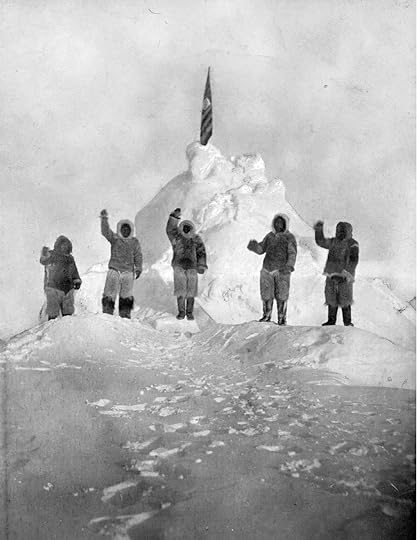
Peary at the North Pole April 6, 1909
The Polar Kerfluffle
On his return to civilization, Peary found that he'd been upstaged by Frederick Cook, who had returned to Europe months earlier to announce that he and two Inuit guides had reached the North Pole on April 21, 1905—a full year before Peary's claimed arrival. Cook also claimed that he had searched for Crocker Land after reaching the Pole, but had concluded that it didn't exist. The international furor was intense. Had Cook been to the Pole first? Or was it Peary? Or perhaps neither? Reputations and funding for future expeditions were at stake. The accumulated evidence over the years leads to one firm answer: we don't know, but probably neither found the North Pole. After all, the North Pole moves and there is no physical North Pole with a flashing neon sign: so discovery comes down to the discoverer's navigation skills. A respected explorer looking into the matter for the National Geographic Society in the 1980s concluded that Peary was probably within thirty miles of the Pole but that Peary's navigation skills were insufficient for a precise location. It's unlikely that he had reached the precise North Pole. In these ownership disputes, reputation plays a significant role. Cook's reputation was far from pure—some years earlier, he had claimed to summit Mount Denali, a claim rejected by experts when a photo of him standing on Denali's peak was determined to be taken at a rock outcropping 20 miles distant. Cook's evidence—his written records, sketches of maps, and navigational information—were questionable and a commission at the University of Copenhagen concluded his claim was unproven. To add to Cook's reputational problems, he was also later imprisoned for misdoings in oil field transactions. Peary's reputation was solid, but his evidence was weak. Like Cook, he had a photograph of his team standing on a tall pile of snow, a pile that could be anywhere. His diary turned out to be woefully silent on April 6, 1909, except to say "At Last!. . Mine at Last!" This was written on a page ripped from a steno pad and placed in the diary's April 6 slot—the original diary page for that date had been torn out and was never found. Hmmm! In the 1980s, at the request of the National Geographic Society, explorer Walter Herbert—the first to certifiably walk to the North Pole, in 1969—examined Perry's records. Herbert concluded that Peary did not reach the North Pole but probably came to within 30 miles, to about latitude 89.50 degrees North. Herbert felt that Perry had doctored his results, perhaps after writing a more truthful record on the torn-out diary page. But still, Peary was the victor in his clash with Cook: the U. S. Congress certified his claim; Cook was far less reputable and, perhaps, more likely to twist the truth; and Perry's mistakes were judged to be less damning. The Cook-Peary scuffle still exists in some quarters. We have no convincing record of an explorer reaching the North Pole until Walter Herbert's trek in 1969.
And Crocker Land?
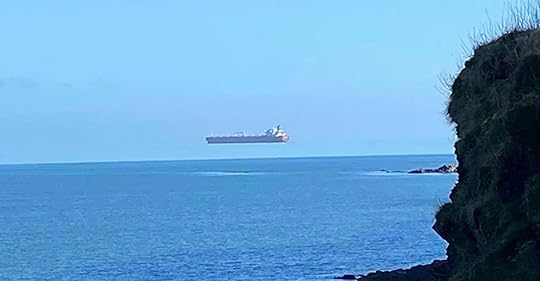
What about Crocker Land? In 1913, amid the ongoing Cook-Peary dispute, Donald Macmillan—a Peary loyalist who had accompanied Peary on his 1908-09 expedition—set out on an expedition to find Crocker Land; the American Museum of Natural History financed the expedition. MacMillan's expedition reached the Inuit village of Etah in northwestern Greenland, then it embarked on a 1,200-mile dog sled ride to the point where Peary had first seen the elusive Crocker Land. Early on an April morning in 1914 a shout was heard from the men: "We have it!" There, in the distance for all to see, was Crocker Land. But one of the Inuit guides poured water on the enthusiasm by announcing "It is a mist." It turned out that, though it stood before them for most of that day, Crocker Land was gone the next day. It was an optical illusion, a fata morgana created when an over-the-horizon image is reflected in the viewer's direction by a layer of dense colder air. It is seen by the over-the-horizon viewer as an object floating over the land or sea.
[Note: The optical illusion of "Crocker Land" replicates an eerily similar event in 1818, 95 years earlier, when Sir John Ross was commanding an exploration expedition north of Hudson Bay on HMS Isabella. Ross was searching for an entrance to the Northwest Passage when he found a channel (Lancaster Sound) that turned out later to be that entrance. But soon after entering the channel, Ross announced that he saw a mountain range in the distance ahead of his ship. Believing that he was going into a dead end, Franklin turned the ship around and left the area. He dubbed the mountain range "Coker's Hills." None of his men saw those Hills because, like Crocker Land, they were an illusion cast by a rare atmospheric condition, just like the photo above.]
Welky raises a disturbing thought. Peary never mentioned Crocker's Land in his diary or any other notes, and his diary entry for the date notes "No land observed." Nor was it mentioned in his speeches or in the drafts of his 1907 book Nearest the North Pole. Peary's first mention of Crocker Land was in the final draft of that book. Is it possible that Peary just made it up at the last minute? Or did see the illusion, but he knew it was an illusion and discounted it until, at a later point, he realized that it could be a device to raise funds for a future expedition? My bet was the latter: it is consistent with MacMillan's view of Crocker Land in 1914, and while saying "I saw Crocker Land" would be a sin of omission, it would not be an outright lie. But either way, it would be a deception.
When I was a child, the library branch my parents took me to was called the Richard Byrd Library, part of the Fairfax County (VA) library system. Many years later, my husband was stationed to Naval Station Newport, where the main road on base is called Peary St. Neither of those names meant anything to me until I began my fixation of what my friends and I call “sad boat” — polar exploration during the so-called Heroic Age that tends to go sideways at the worst possible moment.
This book gave me more insight on who Robert Peary was, and according to Weltky, he wasn’t quite a stand-up kind of guy. But supposedly on an expedition to reach the North Pole, Peary views from two different vantage points a new landmass he dubs Crocker Land. Unable to reach it himself, two of his acolytes, Donald MacMillan and George Borup, plan an expedition of their own to map this Crocker Land and possibly claim it for the United States.
Welky focuses a great deal on the personalities of the men that were part of this Crocker Land Expedition 1913-1915. MacMillan became so enamored of the Arctic that he tended to tune out the complaints and issues of his fellow expedition mates. Green tried to hold on to his sanity with both hands, occasionally letting his sanity slip during the long polar nights. Dr Hunt focused on healing whomever needed medical assistance, whether Westerner or indigenous. Stuck in the Arctic for two extra years, thanks to the onset of WWI and budgetary issues with the institution that was funding them, it was a surprise that all seven men managed to survive. Unlike many other expeditions, the Crocker Landers never got anywhere near starvation or even a touch of scurvy, a remarkable feat in the “sad boat” genre. But they were chasing a Fata Morgana, a mirage born of the bending of light and atmosphere at these high latitudes.
Surprisingly, the Crocker Landers weren’t the only men who were ignorant of the world’s descent into war. The men of the Karluk, captained by Bob Bartlett, who also rescued MacMillan and his men from a fifth winter in the Arctic, left civilization only to return to a world engulfed in war. It’s mind-boggling to think of being so isolated for several years.
This isn’t the most gripping of Arctic tales, but it’s an important and interesting one nonetheless. It’s made me want to visit Bowdoin College to see the Peary-MacMillan Arctic Museum and all its specimens.
“In Search of the Last Arctic Frontier,” a place called Crocker Land. Why have I never heard of this place? If for no other reason, I had to read this book to discover the history and legend of this lost land to the north.
In the beginning, I thought the story was about famed explorer, Robert E. Peary, who named Crocker Land in 1906 after claiming to have reached the North Pole. Soon, however, I found myself enjoying the tales of two friends who had worked under Peary, George Borup and Donald MacMillan, whose dreams of setting their feet on this new land sent the book off into a new direction. Then, new players emerge on the scene and we are finally taken on the actual journey of 1913. MacMillan is generally a very likable character, who seems to be quite organized, but takes things in stride. He is a man who knows what he wants and is able to discern the person who is best able to help carry out his plans. When something happens to disrupt his plans, he easily changes course and continues on in good spirits.
I really enjoyed the youthful enthusiasm of chums Borup and MacMillan, whose antics were laughable. They called their cabin the “Chamber of Horrors” and seemed to find a bright spot in even the worst situations of Arctic life. There was a scene in the beginning where Borup and MacMillan wanted to practice how to drive sled dogs, so they arranged empty biscuit tins in the shape of a sledge, laid out eight, frozen, dead dogs in front of it, and practiced using the 25-foot walrus-skin whip until they could hit their target. Not all was fun and games in the Arctic, however. At times, murder and secrets and failures amounted to “insufferable mental torture” and the delusional inner turmoil of chilling black winter days, which made one lose all sense of proportion. The high Arctic was “no place for unstable minds.” Perhaps “Mac” was not so good at choosing his men after all.
Unlike other Arctic expeditions I have read, this one had the men deposited safely on shore (though not the intended location) to set up a home base while the ship that carried them sailed away. The plan was for a second ship to come for them in two years, long enough for them to accomplish their mission. Another plan had been to set up a radio so they could report their findings at regular intervals; however, unbeknownst to them, the promised radio signal transmission tower was never built.
MacMillan’s discoveries about Crocker Land were quite interesting, but I’ll save the details for the readers! Mac and his expedition partner Fitzhugh Green found several caches that had been left by Peary some years earlier that seemed to disprove some of his claims.
Book Two sets us off in a new direction. Having been given hints about Green’s unstable character even before they set sail (though perhaps Mac had not seen any of this side of his trusted mate), we find him slipping further away from sanity. Conversely, Mac lived in ignorant bliss, enthralled with his Arctic wonderland. (Perhaps he is not turning out to be the good leader that I thought him to be.) It seems that without a goal but for awaiting their ship, boredom and complacency are setting in and mutinous ideas are beginning to unfold.
Meanwhile, the incompetent, self-indulgent, resentful museum curator, Edmund Hovey, was hiding information about the expedition from the public in order to scrape up enough funds to hire an ill-equipped, broken down vessel to try to rescue the men during a time of war. Due to the lateness of their arrival and the ineptitude of the ship’s greedy captain, three men would be left behind: one out of desire, one out of dedication, and one without his knowledge. Little did they know that they would need to assist in rescuing the newly ice-bound rescuers and the mutinous men who had been so eager to leave for home. After hundreds of miles of grueling sledging south, Peter Freuchen, a Dane trader who lived in the northern Arctic regions, deposited three of the “Crocker Landers” in Danish Greenland in March 1916 to fend for themselves the remainder of the journey and find a way home to New York. With assistance from explorer/businessman Knud Rasmussen, one of the men hitched a ride to Copenhagen where he sent telegrams to the museum for a second rescue ship and much needed supplies. A year later and another failed rescue attempt, only three men from the original Crocker Lander crew (Tanquary, Allen & Green) had returned to New York and the grumpy curator Hovey had taken up residence in their original northernmost home base post at Etah.
Could Ekblaw or Hunt be next? Attempts at reaching home and securing a better means for rescue by the scattered Crocker Lander crew resulted in a “daily existence” that “read like a list of Arctic woes”--hungry dogs, ear-piercing blizzards, snow blindness, starvation, depletion, exhaustion, and isolation. Captain Bob Bartlett, who had been denied the opportunity to command the original expedition was now their best hope. The Diana, Cluett and Danmark had each failed the party, but perhaps the Neptune would save them. (MacMillan, Comer, Small and Hovey are still in Etah, while Ekblaw waited in Godhavn.) Would one of the many Arctic death masks (stray bullets, starvation, scurvy, hypothermia, polar bears, walruses, slippery glaciers, tipping kayaks, frigid waters, disease, etc.) claim one of them still? Ever willing to trade for oil or bullets (as they had become more dependent upon the European luxuries) , even the natives’ food sources were diminishing. The Inughuit “deserved a large share of the credit” for the men's’ survival.
Four years into their two-year mission, the final five Crocker Landers were finally home to face matters of war, money, and the “dramatic changes” that were reshaping society. No more were the life and death concerns of the seasons, tides, thickness of ice, direction of wind, location of game, conservation of food and oil supplies, or the health of dogs. The 1911 proposition of an initial $10,000 venture would cost the museum more than $190,000 by the time the ordeal ended in 1917. And rather than new discoveries, scientific specimens, and the “life-defining moments” of seven men who had “forged tight bonds during their first days together,” most of the Crocker Landers preferred to forget the entire expedition. MacMillan, however, would return to the Arctic over two dozen times in the next 30 years.
In the final chapter, Endings, author Welky gives an update on the future lives of the players. The Epilogue sums up the dream, the reason, and the last remaining mystery--what was in that envelope? A tale well told. Photos and a map are included. Extraordinary relational insights! An amazing achievement by David Welky.
This entire review has been hidden because of spoilers.
Welky has a hell of story to tell and he does it well. He gives us the background of the main players and really sets the stage to understand how these people tick and what drives them. The story in and of itself is quite fascinating because it does have so many complex characters and tons of twists and turns. Very often, there are no heroes in this book, just humans trying to survive and make scientific discoveries.
If that were not enough, there is also a surprising death early in the book and a murder later on. If I didn’t know this was history, I would swear it was fiction. Welky’s biggest strength is keeping the story moving without rushing to the payoff. The book runs over 400 pages, but it never slows down too much to lag. Arctic and Antarctic survival stories need to make the point of crushing monotony when stuck in the extreme north or south. Welky makes his points but keeps the story moving.
And the final quarter, which covers the attempts to escape the Arctic, is truly a comedy of errors in a literal sense. You will find people who have been quite adept at making the right decisions for an entire book end up acting like complete idiots before it’s over. Welky never paints this survival story as anything but serious, but you will find yourself laughing at how ridiculous the escape becomes.
Following explorer Robert Peary's 1905-1906 Arctic expedition, he maintained that he had spotted a landmass unknown to science northwest of Canada's Ellesmere Island, which he dubbed "Crocker Land." His assertions inspired Donald MacMillan, a teacher and exploration enthusiast who had accompanied Peary on that journey, to secure funding and launch a followup trek with the goal of confirming the existence of this potentially new and exciting geographic discovery. Author David Welky has researched this second expedition and presented here the detailed story of adventure, accidents, discoveries, surprises, disappointments, murder, and lots of cold, cold weather.
Although not as gripping as I'd hoped – I was expecting decidedly more serious situations in which I'd be left wondering "Oh, no! Will they survive?!" – I'd never heard of MacMillan nor his Arctic journey prior, so it was rather fascinating to learn of the amount of sheer work, determination and supplies that went into an endeavor like this, and the number of things that have to go exactly right in order not to delay plans by days, if not months or years. Definitely recommended for fans of adventure and exploration.
I have read a lot of arctic expedition books and found this one difficult to finish. More so because I felt the book could have been shortened by 100 pages and the plot was bland and typical for this genre.
I’m a sucker for books about early Arctic exploration, although it is the last thing I would ever want to do myself. Usually these guys head North filled with the latest technology and white hubris, and end up freezing, and trying to eat their own belts.
This one gets its start in 1906 when famous Arctic explorer Robert Peary spots an enticing land mass far to the Northwest of Greenland. He named it Crocker Land, after a financial benefactor. Several years later, two of Peary’s young disciples mount an ambitious expedition to explore the mysterious Crocker Land. Things are dicey from the start. One of the two, George Borup, dies before the expedition even leaves the U.S. A drunken captain wrecks their first ship, a timid captain puts them in the wrong spot with a second ship. If it weren’t for the indigenous Polar Inuit, these guys wouldn’t get far. But the weirdest jolt occurs mid-book: Crocker Land doesn’t exist. It’s a mirage (Or, more romantically, a Fata Morgana) caused by the strange atmospheric distortions of the high Arctic. Whether Peary knew it was a mirage or not is an unanswered question.
The members of the expedition end up barely speaking to one another. One of them, Ensign Fitzhugh Green, goes at least temporarily mad and murders his Inuit guide. The book does get a bit tedious ( and confusing) as members of the expedition go their own ways and wait a long, long time for a ship that can carry them home. And when they do make it back, in 1917, the world was at war and no one cared much about an expedition that never found what it was looking for.
Again, I wish Goodreads allowed half stars, because I’d like to give this three-and-a-half. But I’m a charitable guy, so four it is.
This entire review has been hidden because of spoilers.
I love reading these kinds of stories in winter, when I'm at home all snug in my bed--tales of people braving the Arctic's bitter cold, sleeping in snow houses and living off hunted seals and musk oxen. The one thing I wasn't prepared for was all the suffering the poor DOGS went through. GOOD LORD. I'd avoid this book if animal suffering disturbs you much. I wouldn't say the explorers abused the dogs, since they were vital to the mission. But the animals certainly suffered.
Well-researched and written. As polar expeditions go, this was not the most significant, groundbreaking, or harrowing, but I appreciated the context of America's interest in the quest for the North Pole. Welky also conveyed how terribly white explorers treated the Inuit peoples their very lives depended on, and how complex their relationships could be. 3.5 stars.
It is an interesting tale, and it's very readable, although in the last quarter or so of the book it gets a bit confusing as to who is where on the trail. For a person like me with an interest in geography and maps, a shortcoming of the book is a real lack of more detailed maps - there is only one general map at the beginning of the book which does not reflect the paths taken on different journeys among the explorers.
I persevered and I'm glad I now know the story of Crocker Land and McMillan and all the artic cohorts. It seemed a bit disjointed and hard to follow at times (I resorted to skimming here and there), but it did get better toward the end. Apparently Peary was not the best individual; it was good to get that perspective from this book as well.
It was not all that long ago when explorers first penetrated the Arctic. A curious history professor's interest in that effort resulted in this fascinating book. David Welky's work, A Wretched and Precarious Situation: In Search of the Last Arctic Frontier, looks at the exploration of what was then a brand new frontier.
One of the early treks into the far north led to a belief that there was a continent called Crocker Land. The mistaken assumption was born because of an illusion that was conveyed as fact by famed explorer Robert Peary. When the American Museum of Natural History in New York decided to finance an expedition to probe the supposed continent, this became big news.
The continent that didn't exist was named in honor of George Crocker, a financial backer of the failed 1906 Peary attempt to reach the North Pole. The hubbub was heard loud and clear after Peary related what he thought he had seen on the trip. Prospects of finding Crocker Land sparked continued interest in Arctic exploration until the fascination waned because of the First World War.
Explorers of this time scarcely more than a hundred years ago were a hardy bunch. Peary himself lost eight toes, amputation necessitated by frostbite. Murder was committed by an explorer who later failed to come clean with what really happened. There were times of severe lack of ample food to keep the explorers properly nourished. After going months without bathing many became infested with lice.
The book is spellbinding, and very well written. It must have been hours of painstaking research to uncover the interesting details. Welky deserves high accolades. It's one of those works that is difficult to put down. If you are like me you probably will be looking for more online facts about the people and places mentioned. You will love this piece of excellent non-fiction if you have a passion for adventure.
This was a pretty light, breezy read (at least by the standards of the “olde timey men on boats having a miserable time” subgenre). A lot of these kind of books describe the desperation, terror, and suffering that explorers often experienced in excruciating detail. This book has a little bit of that but mostly glosses over it. That’s partly because there just wasn’t a lot of that sort of thing in the Crocker Land expedition, and partly because what little of it there was mostly occurred relatively early on.
That’s not a knock against the book though, as it’s an entertaining read regardless. The descriptions of the frozen polar sea are haunting, and make it sound like one of the most alien, otherworldly places on earth. I found this section of the book mesmerizing.
Likewise the section discussing why everyone was so convinced there even was a Crocker Land, and whether Robert Peary was mistaken about it, or just simply lying about the entire thing was an interesting read.
Then there’s the matter of the expedition’s members becoming stranded and the attempts to rescue them. This whole bit of the book is great fun. It’s almost a comedy of errors, with members of the expedition constantly getting stranded, rescuing each other, then wandering off and getting stranded again, all while multiple attempts are made by various ships to go north on rescue missions, only for those ships to get trapped themselves in polar ice. The whole thing reads almost like a farce, particularly the bits dealing with Hovey, one of the expedition’s financiers who tagged along on a rescue mission and got himself stuck alongside the people he was there to rescue, and spent the next couple years getting on everyone else’s nerves.
I read a lot of these kinds of books. I think this is one of the better examples of the genre, even if it often feels a little low stakes and lighter in tone compared to most of what you find in other stories like this one.
This story is really about a dozen or so men. At the outset of the story, one doesn't know what to expect, as is the case in any story. However, the author, David Welky, manages to keep the reader spellbound by the sheer enormity of the challenge that lay before George Borup and Donald MacMillan by avoiding trivial details and boring padding. In doing so, the months and years skip by, which is a little confusing at times, but eventually the events all fall into place. What is amazing is the courage and bravery, or ignorance, of these young men in the early twentieth century, and indeed all those that went to the nether parts of the world before them, in the eighteenth and nineteenth centuries. It would appear that the pioneers of the world in every pursuit did not fear getting lost or dying in an unpleasant way or alone. The world was a lot bigger place in those times, due to a lack of all the communications technology that we enjoy today, and so news and events took months to get through, if at all. The Crocker Land expedition was therefore a giant leap of faith into the relatively unknown wilderness, and it is amazing to read how they could cater for the time they would be away by taking and caching provisions to last them. Of course the hunting was an integeral part of their food supply, and this story offers a very interesting porthole into the life of the Inuits (Eskimos), without whose hospitality, bravery and survival skills, this expedition, and supposedly many others like it, would not have been possible, or would have ended badly at best. The whole story was rounded off very tidily with the historical journeys of the major expedition players to their conclusion.
More than other books I've read on the subject - even the ones where everyone died! - this one left me wondering why people worked so hard to get to the most inhospitable place on earth. There really ought to have been psych tests for the entire crew. Once you're out there, it's too late, and as this book makes plain, that wretched and precarious situation brings out your best or your worst, and reveals all the fracture lines in your personality.
It also makes pretty plain the ways in which history is so easily rewritten by the last man standing, or the first man to the finish line; murderers and liars transformed into heroes.
At the very end of the book, the author tracks down a letter which was given to the expedition leader at the very beginning of the journey, with 'to be opened when everything's gone dead wrong' written on the front. He never opened it. He carried it through the four years of his sojourn and brought it home unopened. The author finds it at the Peary-Macmillan Arctic Museum, preserved inside a block of Lucite, an eternal Schrodinger's Cat. What's in it? Who knows?
It's a nice touch. How many could have resisted opening that letter - ? But to open it, after a mystery so long deferred, is to destroy it really. Whatever is in it cannot be as interesting as the speculation. Funny that in a book dedicated to men who could not resist the call of that kind of mystery, we close with an unopened letter.
I've no desire to undertake this kind of adventure. But it makes for an irresistible read.
This is one of the best examples of history writing that I've read in quite a while.
In 1909, Robert Peary claimed to see a large landmass to the northwest of Ellesmere Island in the arctic. He named it Crocker Land after a financial backer of his expedition. An expedition was sent north to discover this supposed land mass - the 1913-1917 Crocker Land Expedition.
Seven men went north, a mix of explorers and scientists supported by the American Museum of Natural History. Things started out well, but the group faced setback after setback, including the location of their camp, the weather (of course), and the gradual tensions that can arise when a group spends dark winters in close quarters. Eventually a team was able to reach the supposed location of Crocker Land (which wasn't there, of course). This big disappointment marks the halfway point of the book.
The rest recounts the years of failed rescue attempts, a murder of an Inuit guide, and the general crumbling of discipline that followed. It's fortunate that so many diaries and letters were preserved in archives. Welky had a wealth of material to work with. The final chapter describing his visit to the archives at Bowdoin touched this librarian's heart -- as did his acknowledgements section.
Although this expedition didn't make any major discoveries, I think it's one of the best-told tales of arctic adventure I've ever read.
This book documents the Arctic journey of a team led by Donald MacMillan starting around 1915. They had a two year mission to explore the islands west of Greenland and attempt to reach the uncharted "Crocker Land" that explorer Robert Peary wrote about during a failed attempt to reach the North Pole. Not to give too much away (spoiler alert), but MacMillan's team accomplished very little in regard to exploration or scientific discovery. Bad weather and bad luck kept most of the team in the Arctic for two years longer than they planned. But the expedition did launch MacMillan's career in Arctic exploration and navigation, for which he was awarded rear admiral status in the United States Naval Reserve.
What I enjoyed about this book were the details of life in an extreme environment in the era when explorers like these were at the mercy of the elements; if your ship was trapped by the ice you were stuck where you were for at least another year, since rescue by air was not yet possible. The book was truly suspenseful; the members of the team narrowly averted disaster several times and their survival depended upon the help they received from the native Inuit population and a lone European outpost in northwestern Greenland. This book is not the best book I have read about polar exploration (that would be Endurance by Alfred Lansing) but A Wretched and Precarious Situation was still an engrossing and enlightening read.
“A Wretched and Precarious Situation: In Search of the Last Arctic Frontier” by David Welky traces the lives of the last great polar explorers as they journey to discover the last great Arctc landmass – Crocker Land. Along the way, it touches on the politics of scientific exploration, cultural conflicts, and how experiences of extreme survival shape personality and reveal character. The book provides remarkably rich detail and a uniquely objective character study of the explorers.
One of the greatest strengths of the book is the attention to the minutiae of survival in the arctic environment. Welky explains the logistics of expedition planning, building appropriately ventilated structures, and tribal relationships in a way that’s engaging and moves the story forward. This is particularly helpful as many of the ideas necessary for following the story – seasonal freezes, mirages, attitudes about sled dogs, etc. – aren’t really things readers can be expected to have a good knowledge of beforehand.
Although the book is ostensibly about the search for Crocker land, the core is the study of the explorers themselves. The character introductions are a bit clunky – to meet each explorer we must depart from the story to visit their lives beforehand – but this pays off as we see them changed by their time in the Arctic. As they wrestle with ideas of hope, rescue, discovery, and morality, we see how each man’s past experience defines who he becomes in the arctic. I particularly appreciated the explorations of Dr. Hunt and MacMillan, and their changing ideas about the best ways to use their time. I was somewhat disappointed in the handling of Green, whose reprehensible actions are addressed but not fully explored. While I realize this is in part due to limited information, I’d like to see more of how his actions influenced the rest of the expedition and the Inhuit guides.
Speaking of the Inhuit, upon whom the survival and success of the entire expedition depended, I appreciated Welky’s sensitivity and overt attention to colonialist perspectives. Rather than relegate these important expedition members to a background role as the explorers themselves did, Welky treats them as real people with names, families, needs, and values. As I read about the tragedy of Minik’s treatment, I found myself reflecting a lot on the story of Ishi, the last of the Yahi. Welky also doesn’t shy away from acknowledging the abuses carried out against the Inhuit by explorers who exploited women, promised payments that never came, and led men to their deaths under false pretenses. These stories of arctic exploration are often overlooked, but form an important part of the book.
Much like the expedition, the ending of the book feels like it drags on interminably. As the explorers await failed rescue attempt after failed rescue attempt, it begins to resemble a very cold version of Gilligan’s Island. The conflicts that characterize this phase of the expedition are important, but their circular nature and chronicity do wear some on the reader. I suppose this is inevitable in a truthful reporting of events, but it still makes this section difficult to read.
If you’ve ever been curious about the world of polar exploration, and want a departure from the romanticized accounts written by the explorers themselves, then you’ve found what you’re looking for.
This is a terrific yet sad book. Welky clearly did his research, and he's also a very good storyteller, leading the reader through the story of Peary's claim to have spied an undiscovered continent above the arctic circle, to how that claim inspired a whole generation of would-be explorers, to the eventual realization of a mission to go find and chart that continent. What an incredible story. One can only shake one's head in wonder at what people have somehow been able to survive and tell the tale of. Clearly, without the help of the Inughuit guides and the furs that the Inughuit people were able to provide the men on the expedition, the members of the Crocker Land mission would have died several times over. As it was, they had several harrowing escapes, dutifully chronicled by Welky. One can admire them too, because they showed amazing fortitude, especially given that only a few of them were previously trained in arctic exploration. After years in that environment, sled journeys of 1000 miles or more were apparently just to be expected. Amazing. Quite a tale, all around. Trying not to give any spoilers.
On Peary's supposed successful trip to the North Pole, he also happened to spot the mountains and valleys of another undiscovered land off the coast of Ellesmere Island. He named it Crocker Land, to appeal to a past and potential future donor. Later his proteges scared up an expedition to reach and explore Crocker Land.
Then just about everything proceeded to go wrong, and that's saying something, for a book about Arctic exploration, where you really do expect people to freeze and starve and lose toes and such. Unlike the team, stuck in northwestern Greenland as the years passed, everything went south after they returned from their scouting, and the team's eventual bitter parting of ways is pretty drawn-out and painful to read.
Nevertheless, the book is interesting and painstakingly researched. Very worthwhile for lovers of Ant/Arctic books.
As Arctic exploration books go, this one has a happy ending...sort of. I say sort of because the last book on Arctic exploration I read, "In the Kingdom of Ice: The Grand and Terrible Polar Voyage of the USS Jeannette" by Hampton Sides, a good many of the USS Jeannette's crew and its captain and expedition leader George De Jong died in the wilds of Siberia.
In "A Wretched and Precarious Situation" the seven members of the Crocker Land expedition return home safely if not completely sound. This book shows what can happen with five total strangers are thrown together in a forbidding and isolated environment. It also subtly delineates class divisions and academic snobbery inherent in the United States which most Americans wish to recognize.
Everybody knows the big names. Peary, Cook and Amundson. This book delves deep into an arctic journey mostly forgotten. The conflicting personalities make for absorbing reading. The kind of personality that would be attracted to the frozen north isn't the type that has learned to play well with others. The author also stressed the importance of the native peoples who saved the "explorers" over and over again. A journey that turned into Folly- best left for arm chair travel.
Overall a solid and enjoyable book. Gets a little lost in the weeds sometimes with repetitive details, but the narrative is generally engrossing and easy to follow. There’s an interesting twist part way through that affects how we read what comes after. The latter chapters are short and clear, which helps the book ease into its conclusion.
Could’ve done with at least one more map to help the reader see where things were happening.
You either hate them or marvel at the accomplishments that the group achieved. Being together for 3-4 years I am just surprised that someone didn't go postal. Ensign Green in today's military would not of survived.
Once I started I could not put the book down. It kept me turning every page all the way to the end.
A good book (if a bit long) but not what I was expecting. In all, there's doom written all over the book. A nice insight into how things are run academically rather than from experience.
The book captured my attention but not to the point that I could not put it down. If you like adventure, especially artic exploration, then you'll probably enjoy this book.
I enjoyed this book more than I expected. As I'd hoped, it reads like a good historical novel and exposed me to a new world. I wasn't familiar with the history of polar exploration so I was moved right along with the adventure. Highly recommended.