What do you think?
Rate this book


2 pages, Audiobook
First published January 1, 2016
"... we must adapt, shape and harness the potential of disruption by nurturing and applying four different types of intelligence:The author elaborates on these, but I found these discussions to be lacking specifics.— contextual (the mind) ...
— emotional (the hear) ...
— inspired (the soul) ...
— physical (the body) ...
1. Implantable Technologies—82%Each of the above anticipated technological advances are thoroughly described in the Appendix along with the above survey results.
2. Our Digital Presence—84%
3. Vision as the New Interface—86%
4. Wearable Internet—91%
5. Ubiquitous Computing—79%
6. A Supercomputer in Your Pocket—81%
7. Storage for All—91%
8. The Internet of & for Things—89%
9. The Connected Home—70%
10. Smart Cities—64%
11. Big Data for Decisions—83%
12. Driverless Cars—79%
13. A.I. & Decision Making—45%
14. A.I. & White-Collar Jobs—75%
15. Robotics and Services—86%
16. Bitcoin & the Blockchain—58%
17. The Sharing Economy—67%
18. Governments & the Blockchain—73%
19. 3D Printing & Manufacturing—84%
20. 3D Printing & Human Health—76%
21. 3D Printing & Consumer Products—81%
22. Designer Beings—vote result not shown
23. Neurotechnologies—vote result not shown
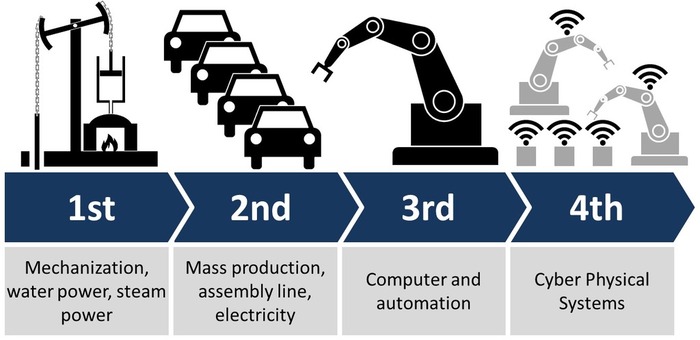
1. The Machine Age (1760-1840): The Steam Engine, RailroadsThe following is not from the book, but it provides a graphic that helps explain the various revolutions:
2. Mass Production (late 19th - early 20th c): Assembly Line Manufacturing, Electricity
3. The Digital Revolution (from mid 1960s-): Computers, Semiconductors, Internet
4. The Fourth IR: Ubiquitous Mobile Internet, Internet of Things (IoT) with Sensors, Artificial Intelligence (AI), Gene Sequencing, Nanotechnology