Offering a new interpretation of the hidden messages and symbols that have ornamented Beatles mythology for years, this examination of the Beatles' recordings and album artwork theorizes that John Lennon's murder was eerily foretold. Following a fascinating and unique trail of sorcery, mysticism, numerology, backwards masking, anagrams, and literary and theological writings, the book posits that John Lennon sold his soul in order to achieve international fame and fortune and subsequently paid the ultimate price for his success.
One of the more fun and fascinating bits of Beatles lore has always been the whole “Paul Is Dead” hoax. The story spun by that particular hoax is that Paul McCartney allegedly died in an automobile accident in 1966 – a “stupid bloody Tuesday” – and the heartbroken Beatles decided to soldier on without him, replacing McCartney with a lookalike, but planting clues of Paul’s demise in Beatles songs and on album covers.
Books could be written about the hoax – and, in fact, a few have – but now comes Joseph Niezgoda, in The Lennon Prophecy: A New Examination of the Death Clues of The Beatles to tell us that everyone’s got it wrong. The clues aren’t there to detail Paul’s demise, Niezgoda says, but rather to foreshadow John Lennon’s violent death in 1980, payment to the Devil for a 20-year pact Lennon made with Satan in 1960.
Yes, really.
According to Niezgoda, at some point in December 1960 — likely between the Beatles’ anticlimactic return from Germany on December 10, when the group seemed on the verge of breaking up, and their triumphant appearance at the Litherland Town Hall concert on December 27, the night it is generally accepted that Beatlemania was born – John Lennon traded his soul to the Devil in exchange for rock and roll fame and fortune. Twenty years later, in December 1980, the Devil called in the debt, using a demonically-possessed Mark David Chapman as his instrument of death.
On that wacky premise, Niezgoda devotes 186 pages to analyzing John Lennon’s behavior, scrutinizing album covers, scrubbing lyrics for hidden meanings, and generally working way too hard to come up with spooky numeric coincidences to support his theory. Like the Paul is Dead theory, I don’t buy one word of it; unlike the Paul is Dead theory, however, this one is neither fascinating nor even all that convincing. Niezgoda’s theories and his interpretations of events, lyrics, and images, are almost always eye-rollingly dopey, and ultimately require enormous leaps in logic or imagination to make lyrics, album covers, or anything else fit his theory.
Part of the problem is that Niezgoda is completely humorless. Sarcasm, satire, puns and plays on words are completely lost on him. Lennon’s wit—one of his most enduring traits—baffles Niezgoda, as does Lennon’s use of metaphor and delight in wordplay. And Niezgoda—who calls himself a “life-long Beatles fan, collector, and scholar”—doesn’t seem to be able to put Lennon or his quotes in context. He can’t tell when Lennon is joking, bragging, or being dismissive. He’s absolutely tone deaf.
Anyway, to spare you from ever having to read this thing, I’m going to give you a rundown of some of Niezgoda’s claims to give you an idea of just how loopy, and how spurious, Niezgoda and his claims can be.
Early on, in a chapter titled “Bewitchery of the Masses,” Niezgoda asks how to explain the enormous effect the Beatles had on their fans. How does one account for the swooning, the fainting, the screaming? Could it perhaps be their undeniable charisma or talent? Ridiculous, Niezgoda says; those are exactly the kinds of “intangible” and “indescribable” qualities that manager Brian Epstein and producer George Martin ascribed to the band—and they’re indescribable, Niezgoda says, because they were a gift from the Devil. So, Niezgoda’s first “evidence” of demonic influence is Beatlemania itself, in all its inexplicable, unexplainable wonder.
It’s not enough to sell one’s sell to the Devil, though—as Niezgoda explains earnestly, one must also do all he can to actively deride God and religion. Therefore, any time Lennon mentions God, religion, Christ, or his soul, Niezgoda pounces. While he naturally makes hay of the “bigger than Jesus” statement—though not as much as one might expect, giving it only eight pages—any other reference to God is dissected looking for hidden meaning. For example, when John Lennon, following the massive Shea Stadium concert in 1965, remarked that it was “louder than God,” Niezgoda arches an eyebrow curtly. “Why did he chose that analogy?” Niezgoda demands. And when an exhausted Lennon tells childhood friend Pete Shotton at the height of Beatlemania that he often feels he’s sold his soul, the nonplussed Niezgoda can only take the most literate Beatle literally.
Niezgoda is at his most bizarre, though, when analyzing music, lyrics and album covers. The intricate, interwoven images on the cover of Revolver don’t trouble him all that much—but he’s convinced that the album’s name has to be a foreshadowing of the kind of gun that would be used to kill Lennon fourteen years later. Certainly, the name Revolver has nothing to do with the fact that vinyl records were played by placing them on a turntable that revolved at a certain speed—thus making any record, in a sense, a “revolver,” right? Again, that sort of word play is lost on Niezgoda.
He’s more fascinated by the infamous “butcher cover” for the Yesterday … And Today album—with the Beatles in butcher smocks covered with dismembered dolls and raw meat—which Niezgoda is all but certain is Lennon’s nod to “the most reviling sacrifice to Satan . . . the killing of young innocent children—infanticide.” Niezgoda quotes Lennon’s enthusiasm for the project (“I would say I was a lot of the force behind it going out,” Lennon once said) as the final word on the impetus behind the photo—but either doesn’t seem to realize or completely ignores the fact that both Paul McCartney and photographer Robert Whitaker have claimed credit for the idea, too. Whitaker’s version, in fact, holds up to the most scrutiny, as the photo was actually part of a series of artsy photos Whitaker staged, including one in which George Harrison appears to be driving nails into Lennon’s head. Lord knows how Niezgoda would have interpreted THAT photo.
The real stretch, however, comes in his scouring of the cover of A Collection of Beatles Oldies—a relatively obscure album released in the UK and Australia in late 1966. While the Paul is Dead crowd point to the drawing of the car getting ready to crash into the lounging figure’s head as a “death clue” for Paul’s alleged death by automobile, Niezgoda’s got something much more clever in mind: “[The figure’s] right crossed leg, with only slight imagination, can be seen as the letter ‘J,’ and it rests aside the word ‘OLDIES’ . . . [t]ogether, they spell ‘JOLDIES’”—or, as Niezgoda explains, “JOL (John Ono Lennon) DIES.” Cue the thunderclap and opening notes of Toccata and Fugue. And don’t try to tell Niezgoda that Lennon was 16 months away from changing his middle name from Winston to Ono when the album was released—he’s already ahead of you: it’s a “craftily constructed prophecy,” don’t you know?
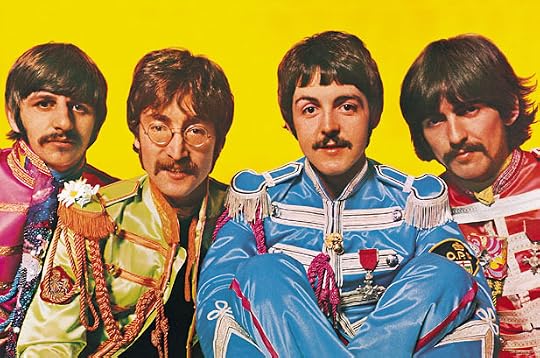
Sgt. Pepper also falls under a similar scrutiny—although, unlike the Paul Is Dead gang, Niezgoda isn’t as much interested in the front cover as he is the back, where the Beatles, with the album’s lyrics superimposed over them, appear against a blood red background (nothing is ever red in Niezgoda’s book; it’s always BLOOD RED!). McCartney famously stands with his back to the camera—“turning his back on John and what he knew of the fatal pact,” Niezgoda says solemnly—but the real clue lies in the layout of the lyrics from George’s “Within You, Without You”: the words “lose their soul” are perfectly centered on John’s waistline. Pretty sinister, huh?
Even sillier is Niezgoda’s discussion of the drumhead on the cover of Pepper, an image already overanalyzed by the Paul Is Dead aficionados. Niezgoda relies on the same parlor trick as the Paul Is Dead gang, using a mirror to bisect the words LONELY HEARTS (which, he points out sinisterly, are in a different font from the rest of the drum!) to reveal a messy I ONE IX HE DIE. For the Paul Is Dead people, this convoluted hidden message means that Paul died on November 9th (with “I ONE” meaning eleven, and IX meaning 9, for 11/9). Not for Niezgoda. Instead, he reads this as a taunt from Satan to John Lennon: “I won! Nine, he die!” Nine, Niezgoda explains, is the day Lennon died—because it was already December 9th in Liverpool, you see, when John died in New York on December 8th.
That kind of convoluted numerology, in fact, is where Niezgoda becomes wearying. Lennon himself made much of the number 9 in his life—he was born on the ninth and included the number in the title of several songs—but Niezgoda comes up with some truly inane readings and sleights-of-hand to arrive at his nines. For example, he points out that if you dial the name JOHNONOLENNON on a push button phone, you get 564666536666 – and wow, look at all those sixes, which are really just nines standing on their heads. And only Niezgoda could read “One After 909” as an omen—it’s waaay too confusing to explain how it predicts Lennon’s death down to the day—all the way down to a reference to Yoko as a his “bag.”
The punch my ticket moment, though—the moment I knew Niezgoda was in way over his head—arrives on page 122, as Niezgoda does some headscratching over the band’s name:
“’The Beatles’ was a curious choice of name for a band, especially because it’s spelled wrong. In 1961, John wistfully explained to Mersey Beat where he got the idea: ‘It came in a vision—a man appeared on a flaming pie and said unto them, ‘From this day on, you are Beatles with an A’”
With an absolutely straight face, Niezgoda explains that Lennon had to spell “beetles” incorrectly so he could use the letters to make an anagram of “seal bet,” hiding in plain sight his pact with the Devil. As for the man on a flaming pie, Niezgoda points out, his gears churning, that “man on a flaming pie” scrambles as “pagan flame minion.”
Apparently, the pun on “beat” in the word “Beatles” seems to never have occurred to the humorless Niezgoda—he’s too busy making scary sounds and tut-tut noises. (As for the “pagan flame minion,” you can also anagram “man on a flaming pie” to make “film an ape moaning,” but that hardly means Lennon had hidden aspirations of being a voyeuristic zookeeper). I can’t tell if Niezgoda is being intentionally ridiculous here, or if he’s really that clueless.
Niezgoda’s last chapter contains two incredibly odd bits of contrived thinking and backwards logic. The first is a way-out reading of James Joyce’s Finnegans Wake – a book published a year before Lennon’s birth, but which Niezgoda is nonetheless convinced contains prophecies of Lennon’s life and death. And that’s mostly because, at certain points over its 600 pages, Joyce uses words like “beetle,” “pepper” and “funeral.”
The second is a wacky bit of mathematics in which Niezgoda chooses three songs he believes “place the final moments of John Lennon’s life to music”: “I Am The Walrus,” “Revolution 9,” and “#9 Dream.” Niezgoda informs us that the total elapsed time from the moment Lennon was shot to the moment he died was 17 minutes—and I think we’re supposed to get chills when he informs us that the total time playing time for those three songs is 17 minutes, 42 seconds. Niezgoda provides us with absolutely no reason why there should or should not be a correlation between the playing time of these songs and Lennon’s last moments. It’s a completely nonsensical premise and farcical train of thought, and we’re supposed to somehow be spooked by it.
But that sort of spurious thinking is the norm for Niezgoda. His premise is a bizarre one to begin with, but The Lennon Prophecy is full of so many thin, lame, and eye-rollingly ridiculous theories that it’s impossible to take seriously. Yet, Niezgoda does. And “no one,” he writes in his wistful introduction, “is sorrier than I about what is written here.” Except maybe those of us who’ve read it.
This entire review has been hidden because of spoilers.
Deep Dive into the Occult Symbology of John Lennon Beatle Lore Leading to a Diabolically Disturbing Conclusion Who was the real John Lennon and what was behind the mystery of the words and symbols that made up the art of the world's most famous rock group, the Beatles? Author and die-hard Beatles fan Joseph Niezgoda has a few disturbing answers for you. The Lennon Prophecy will open your eyes to the unseen truth lurking behind the genius of John Lennon, and of one of the most distressing tragedies of pop culture, his 1980 murder at the hands of Mark David Chapman. Many who read this book will walk away unconvinced because of their presuppositions -- that John Lennon was not capable of selling his soul to the devil or that the supernatural does not exist. But I would tell such people to explain the phenomena of the Beatles in a more rational light if you can. The group's unparalleled rise, the meteoric end of their existence as touring entity, the rumors and symbols, and the bizarre end of John Lennon all provide substantial fodder for speculation. If the Beatles had not existed you could not have made this stuff up. This book is very well thought out and students of the occult will recognize that the author accurately evaluates how magick and ritual symbolism work out in the lives of those who dabble in Satanism. Read it and see for yourself.
Interesting postulations. A lot of circumstantial and coincidental evidence. Honestly, I thought the author read into the “evidence” A LOT. That being said, it’s hard to explain away all of those things all together. Historically, a couple things are clear, Lennon was hostile towards God and obsessed with fame and fortune. This alone is a recipe for tragedy. MDC was someone who was clearly spiritually conflicted. For those who believe in the Bible as the Word of God, then demon possession is not only possible, but very probable in this case. Does that prove that Lennon sold his soul and that MDC was demon possessed? No, but Lennon himself admitted on numerous occasions to making a pact with Satan and not being able to give any earthly explanation for the meteoric rise of the Beatles. And MDC claimed to be possessed by several demons. Only God knows, but the Unseen Realm is clearly real and not to be taken lightly in either regard.
The book certainly makes one think. It is hard to say whether Lennon was a “sell out”, but the author does an excellent job of researching and describing the clues.
This book started off strong and had so many interesting stories that really had me believing and kept me wanting to read more and more. By the last few chapters where the author “decodes” lyrics, anagrams, etc. it became really silly stuff that he is just stretching for and tries to justify with his own opinion rather than evidence. And if you’re going to use dozens of the Beatles’ lyrics to prove that John knew his fate by hiding clues in songs - where was Rocky Raccoon in this mix?
The chapters on Chapman were also interesting. Overall it was a fun and interesting read, but way too much stretching.
This has to be the most ridiculous thing I've ever read. The stretches made to try to prove Lennon sold his soul. The misuse of words the author obviously didn't know the meaning of (for instance describing Satan as maliciously benevolent. The crazy interpretations of lyrics. The only reason to read this book is for a good laugh at the author's expense. It was so bad that it prompted my first review on this site.
Funny, very funny book. I give him two stars for pure entertainment, otherwise it would be a zero. The clues are worse than the silly McCartney death rumours, and overall, for me, not convincing at all.
If nothing else, the fact that the author claims that Joyce's "Finnegan's Wake" foretells the life of John, and his shooting death at the hand of Chapman, should be another clue for you all. Dreck.
On one hand, it's fascinating. On the other hand, it's bunk. Or I should say, it devolves into gobbledygook. We go from very shocking stories about Lennon (urinating on nuns? idolizing Hitler and Crowley? Yeesh!) that are carefully tied to his obsession with the occult. Then, towards the end of the book, there is a mad dash for more and more "proof" that leads us to pretty silly anagrams, and a long section on numerology. I'm interested if Lennon used numerology, but dude, I don't hold with it myself, and if you think he sold his soul, ummmm, you shouldn't be so into numerology either.
So while I zoomed through, in the end I feel a little abashed about having gobbled this up. I did find it interesting, and bonus, well written. I didn't know what a bunch of weirdos the Beatles were, especially Lennon. Nazi salutes? And the parts about Chapman were sadly interesting too. So it's not like it's a trash book, just that the "ookie spookie" parts are really stretching. Interesting, but I wish he hadn't reached quite so far and desperately. Also fascinating but left out of the book was an apparent reaching out by Lennon to Billy Graham, trying to find redemption. Ono shut it down! That would have been better included than the numerology, imho.
Oh this is dross. I didn't get any further than the writer's conclusion that Lennon sold his soul to the devil. Because he said so. And because he got famous.
I am English. Lennon would have meant he sold his soul to the music business. That's all. People say, "I feel like I sold my soul to the devil" when they are overburdened by things they chose. That's all.
After the deranged start to the book, I didn't bother.
So dank and irrational. Sadly the result of the writer living in a theocracy.
Someone once claimed Morrisey had predicted the death of Princess Diana. What could "The Queen Is Dead" mean apart from that? And they insisted Frankly Mr Shankly was about Edward Longshanks - rather than, er, Bill Shankley, famous manager of Liverpool football club, just down the road from Manchester.
When UK people say, "Only in America!" we are referring to this level of absurd lunacy.
I don’t know what to make of this book. The research is excellent and far reaching and it is clearly expressed. However, as a lifelong Beatlemamiac and a practising Christian I find it a bit hard to take. Some of it seems far fetched, although the numbers connections seem more than coincidental. I tried my birthdate number - 6- and I couldn’t make it fit in most of the aspects in my life. I do have some questions:
How does a twenty year old in Liverpool sell his soul? How did a confirmed blasphemer in 1960 become an avid reader of the Bible by 1966? How did Paul McCartney never notice? More to the point, how did a spiritual person like George Harrison never notice. If all this did happen John Lennon was sold short after 1971. This was partly caused by Yoko Ono. Was she part of the pact?
I’ll applaud Joseph Niezgoda’s writing skills because the content was extremely captivating. I wanted to get an idea of the subject by reading a few lines before sleeping but it was so mesmerizing that I finished the entire book in that one sitting without any breaks. Song lyrics and album artwork are open to interpretation but the author is trying way too hard to correlate them with dealings with the devil. Whereas the overreliance on numerology seemed a bit ridiculous. Even though I do not agree with a few aspects of the book, I still found it very fascinating and a Beatles fan would definitely enjoy reading it.
Would recommend as a read for those Beatles fans as well as those interested in spiritual warfare. The pictures helped to explain the themes of the book
Though it was interesting and unique, this book wasn't quite what I expected; it reads more like short biography of the Beatles more than anything else.
This was the first time I encountered a biography on Lennon that didn't re-hash the same material that has been written by countless other biographers. While the reader definitely has to come to their own conclusion regarding the premise of this work, it is certainly well documented and very thought-provoking. It was a real page-turner that held my interest from beginning to the tragic end.
I read this book because I am interested in how occult forces have shaped modern history. From other books I was already aware that occult forces were behind the creation of the Nazi party in Germany and were also tied to the creation of and illegal activities of the CIA in the U.S. I was also aware that there is some evidence that occult forces have had their effect on serial killers and some very successful musicians.
Unfortunately, this book was not seriously researched and its author draws his conclusions more from sheer speculation rather than hard evidence.