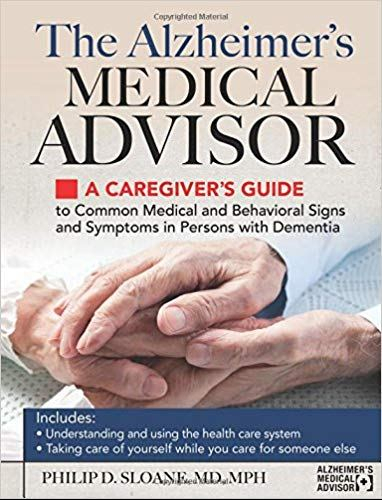
As we move through life many of us find ourselves needing to help a family member or friend with a medical condition. If the condition is temporary, our need to help is temporary. However, chronic conditions such as Alzheimer's and other dementias require longer-term, possibly ever-increasing assistance. Problems with thinking and memory lead to new, different, and often challenging behaviors. In addition, caring for someone with Alzheimer's often means helping them deal with other medical problems that are often difficult to recognize. This book is a resource for caregivers of people with Alzheimer's or dementia who are also beginning to experience non-memory-related medical conditions. It addresses 54 medical conditions that caregivers often must deal with when providing care. Each medical condition is addressed in an easy-to-follow, two-page guide that provides basic facts about the medical condition, signs that indicate a possible emergency, tips on providing relief in the home, other related issues to watch out for, and safety tips for the caregiver. Written by experts at the University of North Carolina at Chapel Hill and Duke University, this book is based on the latest clinical knowledge and scientific research on Alzheimer's and the care of Alzheimer's and dementia patients. It includes basic facts about Alzheimer's disease and other dementias and practical guidance when conferring with doctors and nurses, when visiting hospitals, nursing homes, and assisted-living residences, and during the dying process. Also, an entire chapter is devoted to what caregivers need to do to take care of themselves while helping someone with Alzheimer's and related dementia.
THE ALZLHEIMER’S MEDICAL ADVISOR: A CAREGIVER’S GUIDE by Philip D. Sloane, MD, MPH, is a user-friendly reference for people taking care of somebody who has Alzheimer’s or other dementias.. Much of the information is also valid for taking care of anyone… Or even if yourself if you have an illness. It starts talking about Alzheimer’s and other dementias. It continues with caring for and living with someone with dementia, taking care of yourself while helping someone with dementia and setting goals for life and care. The main part of the book is an alphabetical guide to 54 common care issues starting from abdominal pain continuing to wandering. It discusses physical and mental problems. Some, like heart attack or stroke, more serious than others like hoarding. It ends with keeping an eye on medical issues and general health, medication safety and management, healthcare systems, and useful information to have on hand. Each two-page common care issue includes basic facts, signs of a possible emergency, other important signs, tips on providing relief at home, what to watch for, while taking care of your own safety and stress. Quite often symptoms overlap. For example, the page on Confusion and Delirium refers to specific pages on agitation, anger, hallucinations/delusions, and wandering in the “What to Watch Out For” sidebars. It offer suggestions on how to recognize symptoms if the person cannot express them verbally, when to consider calling 911 for taking the person to the emergency department or healthcare provider’s office and when you can wait a day or more. For example, the “Chest Pain” page explains, “When deciding what to do about chest pain, think about the situation. Has the person had this type of pain before, and it ended up to be not serious? If so, you may know what to try at home first to bring relief.. Remember to consider the person’s care plan. If the person has [Do not resuscitate] orders, or bringing them to the ED in the past is cause a lot of problems, you may think twice before calling 911.” Many of the tips are things that the person with the illness can do while they still have the ability, such as choosing someone he or she trusts to make the decisions when or he or she cannot do so and have that person named in legal documents, such as a power of attorney. It also points out the need to let people know what medical decisions are preferred that would make for end-of-life issues, such as continuing medications, feeding tubes, and CPR. If the person has not done that, it includes tips about how you should make those decisions. “If the surrogate has no information about the person’s wishes, the best interest comes into play – decisions based on the benefits and burdens of treating and not treating, taking into account the harms and benefits of treatment that may result....That may not be easy, especially when family members disagree on the course of action. It’s helpful to know, though, that the law protects surrogates from errors in judgment, and the surrogate is not liable for the consequences of decision.” Some of the tips included are how to pay for respite care, asking for help and what to do to provide continuity, working with banks to help with financial management, and working with an attorney to be sure that plans can be carried out. It advises having a list of things that other people can do to help, such as shopping, preparing meals, home repair, taking the person to the doctor, visiting the person so you can have time to do other things, and providing financial help. Every community has some programs to help caregivers. The book suggests how to contact them. Among the warnings about self-protection, it notes that with stomach flu and other infections that cause vomiting and diarrhea, the viruses that cause the sickness can stay in the person’s bowel movements for up to two weeks after they feel better, so it’s very important to follow precautions to prevent unexpected spread of illness. One important section describes, with illustrations, how to help a disabled person to change position without injuring yourself. Another discusses “How to help someone brush their teeth.” THE ALZLHEIMER’S MEDICAL ADVISOR: A CAREGIVER’S GUIDE explains how to measure and understand vital signs and different types of medication. It warns that if “A person with early dementia is suspicious or paranoid and generally is aware of what’s going on, think twice about crushing pills – you may have more problems if they find out.” As the dementia progresses, it may be necessary to managing medications, sometimes stopping some for various reasons. “If the person has been on it for a long time” the caregiver “may worry that the person will suddenly get much worse; however, this rarely happens. This is a decision you want to make in consultation with a healthcare provider who knows a the person well.” The book ends with explanations of healthcare systems, different types of providers, e.g., primary care, emergency, hospital, surgery, paid in home care, residential long-term care, and end-of-life services, as well as providing a checklist of things to bring to the emergency department and what you can do if you can’t be at the ER with the person. Since 2011, I have been the volunteer legal guardian for a dozen adults who were determined to be incompetent and did not have family or friends available to serve as their guardian. I have had to make these types of decisions many times. It’s not easy, but by following the suggestions in THE ALZLHEIMER’S MEDICAL ADVISOR: A CAREGIVER’S GUIDE, the tasks could be simplified. I found the first part of the book to be somewhat patronizing, but once I got into the main body, the pages detailing “Common Care Issues,” I found it to be a valuable resource. All my wards were in nursing homes, so some of the situations did not apply personally, but book does provide information about what the nursing home should be doing, what to monitor, and what questions to ask. I received an advance copy of this book from LibraryThing Early Reviewers.
This beautiful 8.5 X 10 inch soft-covered book has high quality paper and is easy to read with color tabs for emergency topics.
My mother was a cut-up, an RN, an ambulance squad leader, a mother of four and the last living senior member of my family. When she died, I popped to the top of the old age squad. Before she died, she lost her marbles. All of them. But she never lost her humor or her love of ice cream and her hatred of bananas.
In spite of having 2 RNs and a certified EMT as children, my mother was able to hide her failing memory for a long time. She developed tricks of the trade so to speak. She was always sneaky with her memory so she knew the ropes.
We faced her fading memory and faltering physical health as best we could right up to the end. Alzheimer's and good old standard full-blown dementia never come with a manual.
The Alzheimer's Medical Advisor: a caregiver's guide comes about as close as a layman can get to a manual. I have had this book for a couple of years; negligent in my responsibility to Sunrise River Press and LibraryThing to provide a review in exchange for this advanced reader's copy.
Now that my brother faces a severe form of early onset fronto-temporal dementia, I find myself reaching for the book for answers to so many questions. And in doing so, I remembered I owed a review, so here it is.
This book is a gold mine of information. You won't be smothered in fifty-cent size medical lingo that makes you feel overwhelmed. The initial chapters cover dementia, general care information, setting goals and stresses the importance of taking care of yourself.
The heart of the book discusses 54 common issues encountered in the care of the patient. Each issue is covered in a two-page spread beginning with basic facts and highlights signs of a possible emergency, lists other important things to observe, identifies ways to handle the issue at home and when to contact medical health professionals.
One concluding chapter deals with general health issues and gives tips to accomplish the tasks, like taking the temperature or pulse of a confused and scared person, and when monitoring vitals can be helpful.
Another chapter tackles the tricky subject of medical safety and management and does so in great detail.
Quoting the book, "Throughout the course of illness, persons with dementia often require services from multiple types of health care providers in many different settings." Each level of care is covered from selecting a primary care provider through emergency and general hospitalization all the way to full-time residential care.
The hardest chapter deals with end of life decisions. Everyone and every family must explore their own feelings about the end of life wishes of a person no longer able to make their own decisions. These pages are more of an outline of topics helpful in developing a course of action working with the person while still capable of decisions and understanding the course of their disease or in the case that incapacity precludes that discussion.
The final pages are worksheets that can be reproduced and deal with gathering information necessary before consult with a health care professional. Filling out the personal information and preferences in advance makes a stressful time easier.
I hope this review is helpful. I encourage anyone with ANY long-term illness, not just dementia, to look at this invaluable resource.
Taking care of someone afflicted with Alzheimer’s Disease (A.D.) is a big job; some might even say it’s overwhelmingly so. This book is a big first step in making that job manageable. Written by a team of experts from the University of North Carolina at Chapel Hill and Duke University, all of whom hold advanced degrees, the pages of this volume contain informative yet compassionate guidance on how to get “stuff” done. The first four chapters, all concisely written, cover such introductory topics as “About Alzheimer’s Disease and Other Dementias,” “Caring for and Living with Someone with Dementia,” self-care and goal setting. Bulk of this work is an alphabetical listing of no fewer than 54 “Common Care Issues” in Chapter 5. Some of these are medical in nature, such as “Abdominal Pain” and “Fever.” Others concern behavioral problems, like “Anger and Aggression” and “Wandering.” Regardless of the specific topic, each follows a standard format: a full color two-page spread opens with a “Basic Facts” section, followed by “Signs of a Possible Emergency,” “Tips on Providing Relief at Home,” “What to Watch Out For,” and other practical advice. The typeface is large and very readable and liberal use is made of “bullet point” lists. Emphasis is on zeroing in on the problem and resolving same. Concluding chapters are “Keeping an Eye on Medical Issues and General Health,” “Medication Safety and Management” and an overview of navigating the health care system. Especially useful is a section of tear-out forms – designed to be photocopied – on which may be recorded health care and personal information about the individual in question. An Index containing a complete A-Z listing of topics discussed in this large format book concludes the volume. While no single resource can be considered exhaustive, this work is certainly comprehensive. Tables, charts, telephone numbers, useful resources and agencies and other solid information is presented clearly and informatively. The highest praise this reviewer can give is that I wish this book had been available to me when my own parents were suffering from this debilitating disease. Review by Michael F. Bemis
This book can be read either in its entirety or used as a reference to assist with symptoms that occur in those with Alzheimer's or other dementia. If you read through it in its entirety, there is a lot of overlap of information; however, that overap is necessary since if you need to use it as a reference, you need as much information as you can get on the two page summaries that this book uses as a quick reference guide format.
It does contain quite a bit of information and helpful advice.
Note: I received a copy of this book from LibraryThing's Early Reviewers Program in exchange for an honest review.