

What do you think?

Perdersi
Perdersi è un libro che ci regala qualcosa di prezioso: la libertà di esplorare, il piacere di abbandonare le idee precostituite e abbracciare l’incertezza. D’Ambrosio instaura infatti un dialogo intimo con il lettore e, attraverso una prosa armoniosa ed equilibrata e uno stile geniale e frizzante, lo coinvolge in una conversazione continua con se stesso. La raccolta – che si colloca nella tradizione del New Journalism di Joan Didion e Hunter Thompson – si apre con due saggi mozzafiato ambientati a Seattle, luogo natale dell’autore, dissertazioni ironiche e decisamente folli sulla città prima che diventasse di moda, passando poi a un brillante scritto su Il giovane Holden in cui si esplora la perdita di identità. Ma che parli di una città, un personaggio o la sua stessa storia familiare, è l’isolamento il grande soggetto di D’Ambrosio che in Perdersi, attraverso il linguaggio del saggio narrativo, sfida le convinzioni mettendosi in discussione in un modo che una storia o un racconto breve non avrebbero permesso. Un esempio lucido e spettacolare di moderno romanzo.
312 pages, Paperback
First published October 20, 2014
About the author
Charles D'Ambrosio
22 books136 followersCharles D'Ambrosio attended the Iowa Writers Workshop after getting his BA in English at Oberlin College in Ohio. He is the author of two collections of short stories, The Point and The Dead Fish Museum, and one collection of essays, Orphans. He has taught at several universities and workshops, including Reed College and The Tin House Summer Workshop, both in Portland, Oregon where he lives with his wife, Heather Larimer.
Ratings & Reviews
Friends & Following
Create a free account to discover what your friends think of this book!
Community Reviews
Displaying 1 - 30 of 205 reviews

May 28, 2017
PERDER TEMPO

Il capitolo su Salinger, su Holden e alcuni racconti, è decisamente il migliore, l’unico che mi sia davvero piaciuto.
La lettura che D’Ambrosio offre del grande autore è resa pulsante e vibrante dal dato biografico (che altrove è, invece, intralcio, gabbia, rallentamento): prendendo spunto dal suicidio del fratello minore, e da quello tentato dall’altro fratello (il primo si sparò in testa nella stanza da letto di Charles dopo avergli scritto una nota d’addio, il secondo saltò da un ponte, si sfracellò in più parti, ma sopravvisse), D’Ambrosio si immerge nel tema del suicidio e del silenzio che percorre e attraversa tutta la prosa di Salinger.

Il buen retiro di J.D.Salinger a Cornish, New Hampshire.
Fin dall’inizio la mia lettura dell’opera di Salinger è stata sbilenca, eccentrica, ossessionata dal leggendario silenzio dello scrittore recluso e dal tema del suicidio che sembra cucire insieme tutto ciò che ha scritto. Come succede sempre, forse inevitabilmente, il peso sbilanciato che la mia esperienza di vita caricava sul testo gli ha impresso un’orbita eccentrica, traballante, e ancora oggi mi sembra di non riuscire a leggere quel romanzo in maniera diversa. È un libro tutto sul Suicidio e sul Silenzio.
Tutto il resto, e cioè, la quasi totalità, è come un drink che dovrebbe essere alcolico ma risulta annacquato.
Come se d’Ambrosio fosse rimasto seduto tutto il tempo alla fermata del bus del primo capitolo.
Come se guardasse tutto attraverso occhiali sporchi, unti, che sfumano, scontornano, con occhi vecchi, uno sguardo grigio, malinconico, sfiancato.

La fermata dell’autobus di Fremont, a Seattle: A Seattle c’è una vecchia fermata d’autobus che è forse per me il luogo più desolante del mondo, ed è stato lì, leggendo nella luce fioca, che ho scoperto per la prima volta la forma letteraria del saggio.
Mi fa pensare a un David Foster Wallace che non ha digerito – e certo non mi riferisco all’aspetto alimentare – o anche un DFW che non ha desiderio di coinvolgere il suo lettore come invece faceva sempre nei suoi fantasiosi saggi e articoli di rivista: quelle di D’Ambrosio sono divagazioni rivolte invece quasi più a se stesso, divagazioni che si accendono solo a tratti.
L’elemento autobiografico è stranamente un inceppo, un irritante reiterarsi: viene voglia di dire, Charles fatti da parte, fammi vedere quello che stai guardando, smettila di raccontarmi di te, fai parlare le cose e la gente che incontri.
È come se ogni foto di gruppo avesse Charles in primo piano che copre gli altri. Un fastidioso Zelig che si ripropone in ogni pagina, più volte.
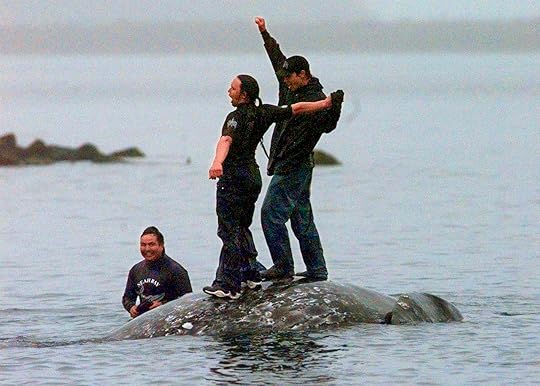
Indiani Makah hanno catturato una balena.
D’Ambrosio riesce perfino a diventare sgradevole nelle sue ossessioni: siccome il capitano Paul Watson, attivista ambientalista fondatore e presidente della Sea Shepherd Conservation Society afferma che per proteggere le balene anche gli indiani Makah dovrebbero smettere di cacciarle, D’Ambrosio si lancia in una difesa degli stessi indiani e dei loro diritti secolari (un po’ come dire che i cannibali avrebbero ragione di continuare a mangiare carne umana), in una prolungata descrizione fisica delle balene rendendole mostruose e inguardabili, per finire con un inno al salmone selvaggio, sempre meno selvaggio e più domestico (= allevato).
Oppure irritante e petulante nella sua ricerca d’eccentricità: spettatore al processo contro, un’insegnante poco più che trentenne accusata di corruzione di minorenne (tredicenne), rimasta incinta - la donna ha un’aria fragile, emaciata ed esangue per aver passato mesi in prigione, D’Ambrosio s’erge a suo paladino e si lancia in sua difesa, non appoggiandosi al fatto che il minorenne fosse consenziente, o al fatto che le leggi possono essere esageratamente restrittive o miopi, che l’amore non conosce età e differenza d’età, ma semplicemente per andare contro l’opinione più diffusa, quella della stampa e del pubblico, che voleva una condanna esemplare.

Mary Kay Letourneau e Vili Fualaau insieme alle due figlie nate dalla loro unione. Lei ha scontato una pena di sette anni per l’accusa di stupro di minorenne. In questa foto lui ne ha 31 e lei 52.
Perdersi sarebbe la traduzione di loitering che vuol piuttosto dire ciondolare, attardarsi, indugiare, bighellonare, gironzolare, vagabondare.
Sostanzialmente, perder tempo.
Come sia possibile che D’Ambrosio abbia anche scritto quel magnifico libro di racconti intitolato “Il museo dei pesci morti”, mi risulta incomprensibile.
Oppure, incomprensibile è che io sia lo stesso lettore che a quello ha tributato il voto massimo, e a questo invece quasi il minimo.

Loitering è un’attività (non attività) che in molti luoghi degli US è proibita e può essere sanzionata con una multa.
Il capitolo su Salinger, su Holden e alcuni racconti, è decisamente il migliore, l’unico che mi sia davvero piaciuto.
La lettura che D’Ambrosio offre del grande autore è resa pulsante e vibrante dal dato biografico (che altrove è, invece, intralcio, gabbia, rallentamento): prendendo spunto dal suicidio del fratello minore, e da quello tentato dall’altro fratello (il primo si sparò in testa nella stanza da letto di Charles dopo avergli scritto una nota d’addio, il secondo saltò da un ponte, si sfracellò in più parti, ma sopravvisse), D’Ambrosio si immerge nel tema del suicidio e del silenzio che percorre e attraversa tutta la prosa di Salinger.
Il buen retiro di J.D.Salinger a Cornish, New Hampshire.
Fin dall’inizio la mia lettura dell’opera di Salinger è stata sbilenca, eccentrica, ossessionata dal leggendario silenzio dello scrittore recluso e dal tema del suicidio che sembra cucire insieme tutto ciò che ha scritto. Come succede sempre, forse inevitabilmente, il peso sbilanciato che la mia esperienza di vita caricava sul testo gli ha impresso un’orbita eccentrica, traballante, e ancora oggi mi sembra di non riuscire a leggere quel romanzo in maniera diversa. È un libro tutto sul Suicidio e sul Silenzio.
Tutto il resto, e cioè, la quasi totalità, è come un drink che dovrebbe essere alcolico ma risulta annacquato.
Come se d’Ambrosio fosse rimasto seduto tutto il tempo alla fermata del bus del primo capitolo.
Come se guardasse tutto attraverso occhiali sporchi, unti, che sfumano, scontornano, con occhi vecchi, uno sguardo grigio, malinconico, sfiancato.
La fermata dell’autobus di Fremont, a Seattle: A Seattle c’è una vecchia fermata d’autobus che è forse per me il luogo più desolante del mondo, ed è stato lì, leggendo nella luce fioca, che ho scoperto per la prima volta la forma letteraria del saggio.
Mi fa pensare a un David Foster Wallace che non ha digerito – e certo non mi riferisco all’aspetto alimentare – o anche un DFW che non ha desiderio di coinvolgere il suo lettore come invece faceva sempre nei suoi fantasiosi saggi e articoli di rivista: quelle di D’Ambrosio sono divagazioni rivolte invece quasi più a se stesso, divagazioni che si accendono solo a tratti.
L’elemento autobiografico è stranamente un inceppo, un irritante reiterarsi: viene voglia di dire, Charles fatti da parte, fammi vedere quello che stai guardando, smettila di raccontarmi di te, fai parlare le cose e la gente che incontri.
È come se ogni foto di gruppo avesse Charles in primo piano che copre gli altri. Un fastidioso Zelig che si ripropone in ogni pagina, più volte.
Indiani Makah hanno catturato una balena.
D’Ambrosio riesce perfino a diventare sgradevole nelle sue ossessioni: siccome il capitano Paul Watson, attivista ambientalista fondatore e presidente della Sea Shepherd Conservation Society afferma che per proteggere le balene anche gli indiani Makah dovrebbero smettere di cacciarle, D’Ambrosio si lancia in una difesa degli stessi indiani e dei loro diritti secolari (un po’ come dire che i cannibali avrebbero ragione di continuare a mangiare carne umana), in una prolungata descrizione fisica delle balene rendendole mostruose e inguardabili, per finire con un inno al salmone selvaggio, sempre meno selvaggio e più domestico (= allevato).
Oppure irritante e petulante nella sua ricerca d’eccentricità: spettatore al processo contro, un’insegnante poco più che trentenne accusata di corruzione di minorenne (tredicenne), rimasta incinta - la donna ha un’aria fragile, emaciata ed esangue per aver passato mesi in prigione, D’Ambrosio s’erge a suo paladino e si lancia in sua difesa, non appoggiandosi al fatto che il minorenne fosse consenziente, o al fatto che le leggi possono essere esageratamente restrittive o miopi, che l’amore non conosce età e differenza d’età, ma semplicemente per andare contro l’opinione più diffusa, quella della stampa e del pubblico, che voleva una condanna esemplare.
Mary Kay Letourneau e Vili Fualaau insieme alle due figlie nate dalla loro unione. Lei ha scontato una pena di sette anni per l’accusa di stupro di minorenne. In questa foto lui ne ha 31 e lei 52.
Perdersi sarebbe la traduzione di loitering che vuol piuttosto dire ciondolare, attardarsi, indugiare, bighellonare, gironzolare, vagabondare.
Sostanzialmente, perder tempo.
Come sia possibile che D’Ambrosio abbia anche scritto quel magnifico libro di racconti intitolato “Il museo dei pesci morti”, mi risulta incomprensibile.
Oppure, incomprensibile è che io sia lo stesso lettore che a quello ha tributato il voto massimo, e a questo invece quasi il minimo.
Loitering è un’attività (non attività) che in molti luoghi degli US è proibita e può essere sanzionata con una multa.

December 11, 2014
My friends are sick and tired, I imagine, of hearing me go on and on about this book. Since I read the beginning of the Preface, I have been unable to stop trying to get everyone to read it, and that continued while I savored every word. This was my first time reading D'Ambrosio, and I regret that I've not known his work until now. Better late than never.
A caveat is that I feel an enormous kindredness to him: suicide in our families, severe discomfort with rigid categorical thinking and a greater comfort with ambiguity and complexity as a way to get anywhere near the 'truth', and a pretty deep sense of being an outsider. When I read the preface, it felt like I was reading the words of a long-lost sibling who had been there with me through it and understood in a way no one else could. Since these are themes that circle through the collected essays, it's hard for me to know how they would strike me if they weren't so perfectly true and personal for me.
I enjoyed every essay in the collection, every one, but found myself most drawn to the ones with greater personal material. One thing I especially enjoyed each time was the way he found an ending to the piece. It was never a neat circle-closing ending, but it did end. I always felt the ending, but it wasn't complete in a neat and tidy way. I loved that.
Off to buy everything he's ever written. I'll be reading this one again and again and again.
A caveat is that I feel an enormous kindredness to him: suicide in our families, severe discomfort with rigid categorical thinking and a greater comfort with ambiguity and complexity as a way to get anywhere near the 'truth', and a pretty deep sense of being an outsider. When I read the preface, it felt like I was reading the words of a long-lost sibling who had been there with me through it and understood in a way no one else could. Since these are themes that circle through the collected essays, it's hard for me to know how they would strike me if they weren't so perfectly true and personal for me.
I enjoyed every essay in the collection, every one, but found myself most drawn to the ones with greater personal material. One thing I especially enjoyed each time was the way he found an ending to the piece. It was never a neat circle-closing ending, but it did end. I always felt the ending, but it wasn't complete in a neat and tidy way. I loved that.
Off to buy everything he's ever written. I'll be reading this one again and again and again.

February 17, 2015
Initially I rated this 3 stars but after looking over the spots I marked it became obvious I couldn't rate this type of writing in the same way I rate fiction. I don't read a ton of essays, I'll catch one or two in a magazine or online but it is sporadic at best. I suppose I went in to this with the same mentality as I would when reading a collection of fictional short stories. I figured there would be a fairly even split between essays I enjoyed and those that didn't hit the right note. And while that was true in some sense what I found as I thought about this review was that there were great moments spread throughout this collection even in those essays that I wouldn't consider my favorites. Thus the change to 4 stars.
A couple of thoughts
A jab or two at television reporters;
Another TV guy is practicing a look of grave concern in his monitor, a look that, live at least, seems woefully constipated. It's weird to watch what amounts oxymoronically to a rehearsal of urgent news, especially without sound, emptied of content, because this pantomime of immediacy is patently fake, a charade, a fine-tuning, not of emotions, but the reenacted look of emotions. It's method acting or something. In a curious twist, I realize I always knew TV news seemed full of shit, but I never knew it was in fact, full of shit.
and this about a TV news woman covering the Mary Kat Letourneau trial
By the strident and aggressive tenor of the talk you couldn't tell if this Bonnie Hart entertained any doubt, then or ever, she was so careful not to cross herself, so careful to arrange her moral outrage along the lines of least resistance. In a sense the whole program was about Hart rendering the round world flat and endorsing lopsidedness, halfness. This seemed a crude and retrogressive project, since what really distinguishes us from apes is not the opposable thumb but the ability to hold in mind opposing ideas, a distinction we should probably try to preserve.
a relationship
Our whole time together she was less a girlfriend than a hypothesis, a vague guess at the truth, in constant need of testing and verification, further research.
I knew she was lying to me, but that doesn't mean I knew what was true. In this way, our relationship had the character of a rumor, something I'd heard about, something I knew only secondhand. Still we managed to resemble a couple for a while.
This description of a Moscow hotel
That particular exterior does the work of a facade, presenting a warren of windows so relentlessly uniform the eye is baffled and ultimately rejected; from a distance you can't quite locate the entrance. But if, from outside, you can't find a way in, from inside, especially walking the hallways, you can't imagine a way out. The interior space is made of incredibly long, horrid corridors lined on either side with black doors, like answers to questions you'd long ago forgotten.
at times so descriptive you can almost put your hands on the subject
Al tended the bar at night. He'd been in the merchant marine and ate with a fat clunky thumb holding down his plate, as if he were afraid the whole place might pitch and yaw and send his dinner flying. He was dwarfish and looked like an abandonded sculpture, a forgotten intention. His upper body was a slablike mass, a plinth upon which his head rested; he had a chiseled nose and jaw, a hack-job scar of a mouth; his hands were thick and stubby, more like paws than anything prehensile. Sitting back behind the bar, smoking Pall Malls, he seemed petrified, the current shape of his body achieved by erosion, his face cut by clumsy strokes and blows. His eyes, though, were soft and blue, always wet and weepy with rheum, and when you looked at Al, you had the disorienting sense of something trapped, something fluid and human caught inside the gray stone vessel of his gargoyle body, gazing out through those eyes.
He also spends quite a bit of time on suicide, his brother committed suicide in the authors bedroom
Most suicides go about the last phase of their business in silence and don't leave notes. Death itself is the summary satement, and they step into its embrace hours or days before the barrel is finally raised to the roof of the mouth or the fingertips last feel the rough metal of the bridge rail. They are dead and then they die.
If the aim of an essay is to shine a light on the seldom thought of, or forgotten, or taboo then this collection certainly hit its mark with me.
Every lie breaks the world in two, it divides the narrative, and eventually I fell through a crack into the subplot, becoming a minor character in my own life.
A couple of thoughts
A jab or two at television reporters;
Another TV guy is practicing a look of grave concern in his monitor, a look that, live at least, seems woefully constipated. It's weird to watch what amounts oxymoronically to a rehearsal of urgent news, especially without sound, emptied of content, because this pantomime of immediacy is patently fake, a charade, a fine-tuning, not of emotions, but the reenacted look of emotions. It's method acting or something. In a curious twist, I realize I always knew TV news seemed full of shit, but I never knew it was in fact, full of shit.
and this about a TV news woman covering the Mary Kat Letourneau trial
By the strident and aggressive tenor of the talk you couldn't tell if this Bonnie Hart entertained any doubt, then or ever, she was so careful not to cross herself, so careful to arrange her moral outrage along the lines of least resistance. In a sense the whole program was about Hart rendering the round world flat and endorsing lopsidedness, halfness. This seemed a crude and retrogressive project, since what really distinguishes us from apes is not the opposable thumb but the ability to hold in mind opposing ideas, a distinction we should probably try to preserve.
a relationship
Our whole time together she was less a girlfriend than a hypothesis, a vague guess at the truth, in constant need of testing and verification, further research.
I knew she was lying to me, but that doesn't mean I knew what was true. In this way, our relationship had the character of a rumor, something I'd heard about, something I knew only secondhand. Still we managed to resemble a couple for a while.
This description of a Moscow hotel
That particular exterior does the work of a facade, presenting a warren of windows so relentlessly uniform the eye is baffled and ultimately rejected; from a distance you can't quite locate the entrance. But if, from outside, you can't find a way in, from inside, especially walking the hallways, you can't imagine a way out. The interior space is made of incredibly long, horrid corridors lined on either side with black doors, like answers to questions you'd long ago forgotten.
at times so descriptive you can almost put your hands on the subject
Al tended the bar at night. He'd been in the merchant marine and ate with a fat clunky thumb holding down his plate, as if he were afraid the whole place might pitch and yaw and send his dinner flying. He was dwarfish and looked like an abandonded sculpture, a forgotten intention. His upper body was a slablike mass, a plinth upon which his head rested; he had a chiseled nose and jaw, a hack-job scar of a mouth; his hands were thick and stubby, more like paws than anything prehensile. Sitting back behind the bar, smoking Pall Malls, he seemed petrified, the current shape of his body achieved by erosion, his face cut by clumsy strokes and blows. His eyes, though, were soft and blue, always wet and weepy with rheum, and when you looked at Al, you had the disorienting sense of something trapped, something fluid and human caught inside the gray stone vessel of his gargoyle body, gazing out through those eyes.
He also spends quite a bit of time on suicide, his brother committed suicide in the authors bedroom
Most suicides go about the last phase of their business in silence and don't leave notes. Death itself is the summary satement, and they step into its embrace hours or days before the barrel is finally raised to the roof of the mouth or the fingertips last feel the rough metal of the bridge rail. They are dead and then they die.
If the aim of an essay is to shine a light on the seldom thought of, or forgotten, or taboo then this collection certainly hit its mark with me.
Every lie breaks the world in two, it divides the narrative, and eventually I fell through a crack into the subplot, becoming a minor character in my own life.

January 3, 2015
I'll bet Charles D'Ambrosio likes the song "My Way." He's no straight-outta-Iowa crooner, that's for sure, and I admire that. He identifies with the Pacific Northwest, but I'm not sure his circumlocutions are characteristic. He's at his best when exploring the fringes—whaling, dive bar gambling, religious hell houses, eco-uptopias—especially when he manages to convey more strangeness and empathy than cranky judgement (which is not always). His prose is lush, his approach slant. He takes to heart the etymology of "essay," and his pieces have the unfinish of attempt rather than the polish of foregone conclusion—another thing I appreciate. You get a healthy dose of his personal history, which is sad, though reading about it was a neutral experience for me. At his worst in this collection, D'Ambrosio is arrogant and self-indugent, which makes a handful of his essays tedious affairs. He seems semiconscious of how annoying he can be, though, and I suppose his fault-forward technique might have some abstract merit; at least he's not a phony. Speaking of phonies, I could have done without the pompous lit crit last third, which I guess is supposed to legitimize D'Ambrosio. In any case, I find his style for the most part refreshing, though ten-to-one he was hell to edit. Another shout out to the Tin House crew—you guys are doing amazing things!

March 10, 2018
Anche per un solo saggio, la raccolta vale altamente tutto il volume: Salinger e i singhiozzi è una lettura sapiente, dolorosa, coinvolgente del giovane Holden, attraverso l'esperienza di D'Ambrosio.
Scrive D'Ambrosio a cerchi concentrici, si allarga, sembra "perdersi" ma non manca mai il centro, il cuore oscuro del suo racconto.
Colpisce l'originalità: Se il giovane Holden è chiassoso nella sua ricerca dell'autenticità, il resto del'opera di Salinger cerca ciò che è reale arrestando il motore stesso che alimenta lo sterminato dubbio di Hoden: le parole.
Colpisce la vicinanza: Ma chi c'è lì vicino? Io lo so: suo fratello. (l'ossessione di D'Ambrosio verso il suicidio del fratello toglie il respiro, a lui, e poi, a noi, per empatia).
Colpisce la cultura: ci parlerà qui di Dickens (senza affetto), di Hugo (non quello francese...), di Bergson, del re Lear, di Fitzgeralfd, inanellando lettura su lettura.
Ogni racconto però, è intriso dalla vita di D'Ambrosio che conferma il dubbio che ho sempre avuto : non si legge forse mai veramente altro che non la proprio vita?
E il giovane Holden finisce per chiamarsi Charles.
p.s grazie a Orsodimondo per la foto imperdibile della fermata del bus a Seattle, anche se il libro non gli è piaciuto...
Scrive D'Ambrosio a cerchi concentrici, si allarga, sembra "perdersi" ma non manca mai il centro, il cuore oscuro del suo racconto.
Colpisce l'originalità: Se il giovane Holden è chiassoso nella sua ricerca dell'autenticità, il resto del'opera di Salinger cerca ciò che è reale arrestando il motore stesso che alimenta lo sterminato dubbio di Hoden: le parole.
Colpisce la vicinanza: Ma chi c'è lì vicino? Io lo so: suo fratello. (l'ossessione di D'Ambrosio verso il suicidio del fratello toglie il respiro, a lui, e poi, a noi, per empatia).
Colpisce la cultura: ci parlerà qui di Dickens (senza affetto), di Hugo (non quello francese...), di Bergson, del re Lear, di Fitzgeralfd, inanellando lettura su lettura.
Ogni racconto però, è intriso dalla vita di D'Ambrosio che conferma il dubbio che ho sempre avuto : non si legge forse mai veramente altro che non la proprio vita?
E il giovane Holden finisce per chiamarsi Charles.
p.s grazie a Orsodimondo per la foto imperdibile della fermata del bus a Seattle, anche se il libro non gli è piaciuto...

April 18, 2017
It took me about a year and a half to finish reading this book. Some of the essays in the collection were really tedious -- the worst kind of literary criticism: plodding and nitpicking. The only thing that carried me through to the final page was my curiosity. How did this book become a cult classic? When was I going to hit upon the truly great parts? I'm still wondering.

June 27, 2014
Fantastic stuff. Highly recommended to everyone, basically.

February 11, 2017
Seattle, 1974 ★★★
Ciondolare ★★★★
Caccia alle balene nel profondo Ovest ★★★★
In giro sui treni ★★
Questa è vita ★★★★★
Documenti ★★★★★
Novità americana ★★★★
Vincere ★★★★★
Hell House ★★
Un paradiso in più ★★★
Orfani ★★★
Salinger e singhiozzi ★★★★★
Lettura sbagliata ★★
Scagliare pietre ★★★
Col passar del tempo, un motivetto innocuo: Richard Brautigan ★★★
Qualunque somiglianza con persone viventi ★★★
Gradazioni di grigio a Philipsburg ★★★
Cit.
Ciondolare ★★★★
Caccia alle balene nel profondo Ovest ★★★★
In giro sui treni ★★
Questa è vita ★★★★★
Documenti ★★★★★
Novità americana ★★★★
Vincere ★★★★★
Hell House ★★
Un paradiso in più ★★★
Orfani ★★★
Salinger e singhiozzi ★★★★★
Lettura sbagliata ★★
Scagliare pietre ★★★
Col passar del tempo, un motivetto innocuo: Richard Brautigan ★★★
Qualunque somiglianza con persone viventi ★★★
Gradazioni di grigio a Philipsburg ★★★
Cit.

November 29, 2014
A real delight, contrary in argument, beautiful in construction. Essays collected over time and space, they address issues of his family, his mentally ill father and his two brothers, one successful and one unsuccessful in their suicide attempts, but are also about his work, his literary interests, and his quasi-journalistic explorations.
He quotes Patricia Hampl, quoting Augustine's Confessions in his introduction (having read and reread each recently, it felt he was hitting close to home early on). He says his essays are "seeking faith with doubt... or strike faith, if you must, and leave it seeking with doubt. And longing. And not-knowing. And the occult directives of desire." These are not religious essays (though the one on Hell House, the Pentecostal haunted house comes close), but they are tinged by a Catholic upbringing, by doubt and desire.
"Writing an essay is a form of loitering - a lingering, a skulking, a meandering - and I like the sinister undertone - loitering with intent - but in the end it brings me back full circle to that boy on the bus stop, reading in the dim light, and to all my brothers and sisters, whether by blood or by bond, who find themselves, now and then, without apparent purpose."
He quotes Patricia Hampl, quoting Augustine's Confessions in his introduction (having read and reread each recently, it felt he was hitting close to home early on). He says his essays are "seeking faith with doubt... or strike faith, if you must, and leave it seeking with doubt. And longing. And not-knowing. And the occult directives of desire." These are not religious essays (though the one on Hell House, the Pentecostal haunted house comes close), but they are tinged by a Catholic upbringing, by doubt and desire.
"Writing an essay is a form of loitering - a lingering, a skulking, a meandering - and I like the sinister undertone - loitering with intent - but in the end it brings me back full circle to that boy on the bus stop, reading in the dim light, and to all my brothers and sisters, whether by blood or by bond, who find themselves, now and then, without apparent purpose."

October 1, 2018
I was impressed with the lyricism of D'Ambrosio's writing. He really is a nimble stylist, really writes interesting sentences with energetic wordplay. But the more of these essays I read in Loitering, the less interested I became in what he has to say, until finally I began to think it was beautiful writing going nowhere. It's a beautiful emptiness. I walked its landscape from end to end and found few ideas in the fabulous prose. As a result, I returned home empty-handed, too.

February 26, 2017
Perdersi tra gli scaffali del dolore di quest'uomo
appunti, recensioni di case mobili, racconti personali, critica letteraria, lettere di addio e pezzi di vita di Charles D'Ambrosio la cui storia familiare trapela qua e là, fratelli pazzi e/o suicidi, padre e madre fuori di testa...insomma tutto il campionario per diventare scrittori di questi tempi
una lettura interessante se fai il terapeuta, educativa se hai illusioni sul genere umano, in ogni caso un'occhiatina la vale, ma astenersi persone già depresse per proprio conto
appunti, recensioni di case mobili, racconti personali, critica letteraria, lettere di addio e pezzi di vita di Charles D'Ambrosio la cui storia familiare trapela qua e là, fratelli pazzi e/o suicidi, padre e madre fuori di testa...insomma tutto il campionario per diventare scrittori di questi tempi
una lettura interessante se fai il terapeuta, educativa se hai illusioni sul genere umano, in ogni caso un'occhiatina la vale, ma astenersi persone già depresse per proprio conto

January 4, 2015
I don't like to rate a book I haven't finished, though not being able to get past 60 pages speaks for itself, as typically I am good at dragging myself through writing I find uninspiring, but my eyes are glazing over with effort, my mind is constantly wandering and I am completely un-engaged. I must acknowledge that I am in a very small minority of this book's reviewers, infact, I might just be the only one not to like it so far.

January 15, 2015
Classy essays about dambrosio’s brain, haunts in seattle, family, arts, books, brautigan, indian rights, holy rollers, Brodsky, books, geography, mental ism, suicides, books
Sad essays, but with a special d’ambrosio sauce that is all his own. and much of the pov is of the loitering class.
Sad essays, but with a special d’ambrosio sauce that is all his own. and much of the pov is of the loitering class.

March 3, 2017
Tra il saggio narrativo e il racconto autobiografico.
Per farla breve, D’Ambrosio lo reggo a fatica per 300 pagine.
A volte è l’argomento ad essere poco interessante, altre il modo di raccontarlo.
Una manciata di momenti limpidi, quelli più personali.
Poi un po’ di noia. [66/100]
Seattle, 1974 ✖✖
Ciondolare ✖✖✖✖
Caccia alle balene nel profondo Ovest ✖✖✖
In giro sui treni sv
Questa è vita ✖✖✖✖ / A tarda notte mio nonno sbriciolava dei cracker in una tazza e la riempiva di latte freddo. Era il suo spuntino preferito, e il ricordo più dolce che mio padre abbia mai condiviso con me. Ogni volta che lo immagino mi ritrovo lì con lui, a guardarlo da dietro le spalle in una cucina in penombra di tanti anni fa, a guardare un bambino che guarda un uomo a cui vuol bene infilarsi in bocca a cucchiaiate una pappa di latte e cracker mentre calcola gli interessi dei soldi prestati o legge i risultati delle corse sul Chicago Tribune, facendo il conto dei vincitori che dovrà pagare e dei perdenti di cui si intascherà i soldi. Ho un bisogno piuttosto disperato di assistere a quella scena e sapere che mio padre serbava quell’affetto, quella piccola riserva di tenerezza nel ricordo. ///// Ogni volta che andavo a trovare mio padre ero sicuro che sarebbe stata l’ultima. Passavano mesi, anche un anno, senza che sapessi se era vivo o morto, e poi vedevo un segno – una foglia che cadeva in un certo modo, una busta di plastica spazzata dal vento in mezzo a un incrocio deserto – e per quanto banali fossero quei presagi, la sensazione sinistra per me era vera, era sempre lì, si annidava sotto la superficie delle mie giornate, e mi pervadeva e mi assillava finché come unica cura non restava che telefonargli di nuovo.
Documenti ✖✖✖✖ / Quando è arrivato l’inverno e le montagne si sono coperte di neve, che ha sepolto le ossa, ho continuato a passare le mie giornate e spesso le mie notti nei boschi. Capivo, vagamente, che lo facevo perché non riuscivo più a pensare: trovavo sollievo nel camminare in salita. Quando le temperature notturne scendevano intorno ai venti sotto zero mi sentivo pervaso da un senso di necessità, da una risolutezza primitiva, e camminavo per chilometri, col solo obiettivo di rimanere in piedi, di continuare a muovermi, di conservare il calore. Quando mi perdevo mi raccontavo delle storie, storie sul modo in cui ero sopravvissuto, che presupponevano quindi che non fossi morto e potessi guardare il tutto a posteriori. A un certo punto mi sono reso conto che quelle storie le stavo raccontando a mio padre.
Novità Americana ✖✖
Vincere ✖✖✖
Hell House ✖✖
Un paradiso in più ✖✖
Orfani ✖✖✖✖ / In America, guardando al passato, non arriviamo tanto alla storia quanto piuttosto entriamo nel romanticismo, un luogo di eterne origini, mentre qui, anche nella bucolica campagna russa, le devastazioni della guerra sono indicate dai prigionieri morti, dai rifugi, dai defilamenti di pietra e, nel fitto dei boschi, da quelli che ho interpretato come crateri lasciati dalle bombe: avvallamenti insoliti in un paesaggio altrimenti piatto o dolcemente ondulato. Qui ci sono rovine, come anche cose salvate dalla rovina, cose che le sfuggono, e la differenza è decisamente viva e reale, anche se non si riesce a stabilirne il motivo usando i termini ingovernabili del destino storico.
Salinger e singhiozzi ✖✖✖✖
Lettura sbagliata ✖✖✖
Scagliare pietre ✖✖
Col passar del tempo, un motivetto innocuo: Richard Brautigan ✖✖✖
Qualunque somiglianza con persone viventi ✖✖✖
Gradazioni di grigio a Philipsburg ✖✖✖
Per farla breve, D’Ambrosio lo reggo a fatica per 300 pagine.
A volte è l’argomento ad essere poco interessante, altre il modo di raccontarlo.
Una manciata di momenti limpidi, quelli più personali.
Poi un po’ di noia. [66/100]
Seattle, 1974 ✖✖
Ciondolare ✖✖✖✖
Caccia alle balene nel profondo Ovest ✖✖✖
In giro sui treni sv
Questa è vita ✖✖✖✖ / A tarda notte mio nonno sbriciolava dei cracker in una tazza e la riempiva di latte freddo. Era il suo spuntino preferito, e il ricordo più dolce che mio padre abbia mai condiviso con me. Ogni volta che lo immagino mi ritrovo lì con lui, a guardarlo da dietro le spalle in una cucina in penombra di tanti anni fa, a guardare un bambino che guarda un uomo a cui vuol bene infilarsi in bocca a cucchiaiate una pappa di latte e cracker mentre calcola gli interessi dei soldi prestati o legge i risultati delle corse sul Chicago Tribune, facendo il conto dei vincitori che dovrà pagare e dei perdenti di cui si intascherà i soldi. Ho un bisogno piuttosto disperato di assistere a quella scena e sapere che mio padre serbava quell’affetto, quella piccola riserva di tenerezza nel ricordo. ///// Ogni volta che andavo a trovare mio padre ero sicuro che sarebbe stata l’ultima. Passavano mesi, anche un anno, senza che sapessi se era vivo o morto, e poi vedevo un segno – una foglia che cadeva in un certo modo, una busta di plastica spazzata dal vento in mezzo a un incrocio deserto – e per quanto banali fossero quei presagi, la sensazione sinistra per me era vera, era sempre lì, si annidava sotto la superficie delle mie giornate, e mi pervadeva e mi assillava finché come unica cura non restava che telefonargli di nuovo.
Documenti ✖✖✖✖ / Quando è arrivato l’inverno e le montagne si sono coperte di neve, che ha sepolto le ossa, ho continuato a passare le mie giornate e spesso le mie notti nei boschi. Capivo, vagamente, che lo facevo perché non riuscivo più a pensare: trovavo sollievo nel camminare in salita. Quando le temperature notturne scendevano intorno ai venti sotto zero mi sentivo pervaso da un senso di necessità, da una risolutezza primitiva, e camminavo per chilometri, col solo obiettivo di rimanere in piedi, di continuare a muovermi, di conservare il calore. Quando mi perdevo mi raccontavo delle storie, storie sul modo in cui ero sopravvissuto, che presupponevano quindi che non fossi morto e potessi guardare il tutto a posteriori. A un certo punto mi sono reso conto che quelle storie le stavo raccontando a mio padre.
Novità Americana ✖✖
Vincere ✖✖✖
Hell House ✖✖
Un paradiso in più ✖✖
Orfani ✖✖✖✖ / In America, guardando al passato, non arriviamo tanto alla storia quanto piuttosto entriamo nel romanticismo, un luogo di eterne origini, mentre qui, anche nella bucolica campagna russa, le devastazioni della guerra sono indicate dai prigionieri morti, dai rifugi, dai defilamenti di pietra e, nel fitto dei boschi, da quelli che ho interpretato come crateri lasciati dalle bombe: avvallamenti insoliti in un paesaggio altrimenti piatto o dolcemente ondulato. Qui ci sono rovine, come anche cose salvate dalla rovina, cose che le sfuggono, e la differenza è decisamente viva e reale, anche se non si riesce a stabilirne il motivo usando i termini ingovernabili del destino storico.
Salinger e singhiozzi ✖✖✖✖
Lettura sbagliata ✖✖✖
Scagliare pietre ✖✖
Col passar del tempo, un motivetto innocuo: Richard Brautigan ✖✖✖
Qualunque somiglianza con persone viventi ✖✖✖
Gradazioni di grigio a Philipsburg ✖✖✖

April 27, 2018
Bello, bellissimo, quasi fondamentale il saggio su Salinger.

March 14, 2015
These stories reflect D'Ambrosio's wandering through his own life, strolling, sprinting, loitering, probing, dissecting, demonstrating, in so many beautiful ways, a ferocious attention to the stuff of life. I read several rave reviews of this book that left me uninterested, and it took the urging of a good friend (thanks, Chris!) to compel me to read it. I see now why it's tough to explain this book. D'Ambrosio writes about his father and brothers (subjects of deep sadness), about tract homes and a fundamentalist haunted house, about a woman leaving him and a lurid court trial. The what of these essays is a grab-bag, but the how is relentlessly, insistently, courageously beautiful and probing.
"... it was at family meals that we learned indifference to our bodies, but it was in prose, particularly the kind I found in the personal essay, that a relationship to that body began to be restored, at least for me. One of my earliest ideas about writing was that the rhythms of prose came from the body, and although I still believe that, I still don’t know what I mean."
"... it was at family meals that we learned indifference to our bodies, but it was in prose, particularly the kind I found in the personal essay, that a relationship to that body began to be restored, at least for me. One of my earliest ideas about writing was that the rhythms of prose came from the body, and although I still believe that, I still don’t know what I mean."

February 11, 2017
In apparenza è un saggio, in realtà sono piccole dissertazioni narrative scritte in modo elegante, sia che si parli di Seattle, di letteratura o di cronaca. Il tema che accomuna tutti i capitoli è la solitudine e l’alienazione che quell’ambientazione della periferia tipica del nord ovest degli Stati Uniti incombono sull’individuo. Ci sono pezzi autobiografici dove si racconta della voglia di evadere, di andarsene e del legame profondo con la sua famiglia, o meglio, con la parte maschile della sua famiglia. C'è una parte più strettamente letteraria come il saggio su Salinger o quello su Brautighm, che mi ha fatto venir voglia di leggere "Pesca della trota in America". Mi hanno anche divertito e incuriosito i saggi sulle case "mobili," tipica ambientazione di certa periferia americana, o sull"'hell house", una specie di casa stregata per chi è ossessionato dall'inferno.

Read
October 2, 2017The man has a hell of a writing voice, the kind that can use words like "prolepsis" in his essays without sounding like a pompous ass. And even more than that, he has a hell of a sense of time and place. D'Ambrosio, it seems, seeks to place himself within that peculiarly Pacific-Northwest kind of miserabilism, the kind you associate with endless rainy days, suicidal tendencies, and the daily rhythms of a place predicated on the extraction of minerals, wood, and fish from the unforgiving natural world (q.v. Brautigan, Carver, and Richard Hugo, all of whom D'Ambrosio namechecks), a place that, until quite recently was a backwater located on the far edge of the Western world. Like all essay collections (or short-story collections), there is a certain unevenness, but the good far exceeds the bad.

July 1, 2015
Charles is remarkable. If you need a strong dose of masculinity and daily tidbits intertwined with potent independent thinking, read Loitering. God, his writing is just astounding. There is no dramatics and exaggeration, and his thoughts on small and meaningful life are so resilient. He pummels his thoughts but D'Ambrosio is clueless about what it means to escalate and catastrophize. Strong, quiet, persistent but crushing writing. A male book without any (self) destruction. You just want to eat these essays and digest the words and make them part of your long run energy. So rare to find. I understand cult following of this underdog. I will probably buy paperback which I haven’t done in years.

October 23, 2019
These are good essays. Charles D’Ambrosio writes erudite and often deeply empathetic prose, although it can become a bit pretentious in its lesser moments. I loved most of the essays in this collection—without mentioning any spoilers—but I could’ve done without the final piece, “Degrees of Gray in Philipsburg,” which was incredibly tedious and exhausted me.
The essay on the Christian-morality-themed haunted house was one that stood out, and another on Salinger and suicide was especially well written and thoughtful.
The essay on the Christian-morality-themed haunted house was one that stood out, and another on Salinger and suicide was especially well written and thoughtful.

July 8, 2014
*Received an advanced readers copy through Goodreads first reads
Charles D'Ambrosio's writing is fantastic. I'd give this collection 4.5 stars instead of five, only because there were one or two essays that I just wasn't in love with, but the writing... it was spot on, throughout. Thoughtful and fluid- a great addition to my shelf I'll be sure to visit again.
Charles D'Ambrosio's writing is fantastic. I'd give this collection 4.5 stars instead of five, only because there were one or two essays that I just wasn't in love with, but the writing... it was spot on, throughout. Thoughtful and fluid- a great addition to my shelf I'll be sure to visit again.

January 6, 2015
(3.5 stars) Full disclosure: I have never read anything by D'Ambrosio and I absolutely loved the first two sections, swinging back and forth while targeting a clear point and focus; blending personal empirical. The spell for me was broken, however, once I reached the final portion which focused on other writing and concluding with essays that felt labored and wandering.

December 23, 2014
The Michael Chabon of essayists, by which I mean that every sentence is finely crafted and a sensual pleasure to read. Deeply personal, these pieces are ring as true as crystal and skillfully use the intimate to cast a light on the human condition.

August 11, 2017
Nel candore spiazzante delle vicende letterarie e non di D'Ambrosio, c'è il segreto che regola l'Universo, c'è una linea immaginaria che unisce più mondi : sobborghi metropolitani e nature incontaminate, storia personale e Storia collettiva, incertezze morali e certezze illusorie.....
Un libro che inizia nel presente con una storia del passato : la vita vissuta che s'intreccia con quella che si sarebbe voluto vivere sullo sfondo di quella che si sta vivendo. Un'ingenuità che non diventa mai banalità, un intimismo che non diventa mai disgustoso e che sfugge alla retorica della speranza. Il Sogno Americano faccia a faccia con il suo tramonto. Sobrietà letteraria, eterodossia storica, radicalismo antiborghese. Questa di D'Ambrosio è, a mio avviso, la raccolta di saggi più ispirata dai tempi di David Foster Wallace. Più che paesaggi e frontiere, queste cronache on the road mappano e sondano la geografia interiore di una nazione che piange e combatte guerre tra praterie e grattacieli. Comuni scorci di un'umanità sull'orlo del precipizio esistenziale.
Un libro che inizia nel presente con una storia del passato : la vita vissuta che s'intreccia con quella che si sarebbe voluto vivere sullo sfondo di quella che si sta vivendo. Un'ingenuità che non diventa mai banalità, un intimismo che non diventa mai disgustoso e che sfugge alla retorica della speranza. Il Sogno Americano faccia a faccia con il suo tramonto. Sobrietà letteraria, eterodossia storica, radicalismo antiborghese. Questa di D'Ambrosio è, a mio avviso, la raccolta di saggi più ispirata dai tempi di David Foster Wallace. Più che paesaggi e frontiere, queste cronache on the road mappano e sondano la geografia interiore di una nazione che piange e combatte guerre tra praterie e grattacieli. Comuni scorci di un'umanità sull'orlo del precipizio esistenziale.

December 2, 2019
I felt really smug when I thought D'Ambrosio had misspelled "pixelated" but it turns out "pixilated" is right and he really is just that good at filling lexical gaps with the perfect nonce word. He's full of nuanced observation like any worthy essayist, but is very cruel in places and in ways that feel unnecessary, just, swinging at anyone he can reach with his wounded little fists. I don't know if providing an equation for the speed and drag of a falling man from a window the world trade center was necessary - not because 9/11 is sacrosanct, but because it didn't serve a purpose in his argument.
"Orphans", "Documents", "Winning", and "American Newness" were the standout stories. The first two sections in general were strong, the third section weaker/more abstracted literary criticism.
"Orphans", "Documents", "Winning", and "American Newness" were the standout stories. The first two sections in general were strong, the third section weaker/more abstracted literary criticism.

January 12, 2025
Loitering caught me off guard by describing ideas/experiences I’ve never seen put into words super casually and moving on like it was nbd. Each essay felt so carefully planned and written and yet so genuine and vulnerable. Slower read for me because the beautiful personal passages would sometimes pocket literary analysis that wandered away from the core of the essay and featured densely packed nitpicks I didn’t enjoy. I was still left feeling connected to DeAmbrosio, and there was some charm to the strange wandering quality of these essays. Next time I I read this need to leave bookmarks so I can find the special passages more easily.

March 2, 2017
D’ambrosio crea una subitanea empatia con il lettore, che è costretto a seguirlo come un Virgilio, fino nei recessi della sua anima travagliata, obbligato dalla sua estrema lucidità a una dolorosa sincerità.
http://www.piegodilibri.it/recensioni...
http://www.piegodilibri.it/recensioni...
April 18, 2022
This book almost put me in a reading slump.

April 21, 2025
loved this. writers are only as good as the standards we hold ourselves to, and these standards are HIGH

November 17, 2014
D’Ambrosio endeared himself to me with an Augustinian line about his purpose from the introduction: “Seeking faith with doubt, that’s definition enough for me.” Later he adds, “Friends would diagnose me with a really bad, likely terminal case of aporia.” His essays are full of questioning – with his research opposing natural, or even cultivated, ignorance. There are certain situations he’s searching to understand, like a brother’s suicide and his presence as the antagonist in an ex-lover’s novel.
I didn’t have time or inclination to read all of these in total, but a few favorites were “Whaling out West,” “Hell House” (about an Evangelical propaganda theme park), and “American Newness” (about Fleetwood Homes’ model houses). More than a few of the pieces reminded me of Pulphead by John Jeremiah Sullivan.
I didn’t have time or inclination to read all of these in total, but a few favorites were “Whaling out West,” “Hell House” (about an Evangelical propaganda theme park), and “American Newness” (about Fleetwood Homes’ model houses). More than a few of the pieces reminded me of Pulphead by John Jeremiah Sullivan.
Displaying 1 - 30 of 205 reviews