

What do you think?

Wilderness
Abel Truman vive sulla costa selvaggia del Pacifico, nello Stato di Washington. Si accontenta di poche cose: il riparo di una baracca di legno e la compagnia del suo cane. Lì, ai confini del mondo, ci è arrivato dopo il massacro del Wilderness, uno degli scontri più cruenti della Guerra civile americana. Per trent’anni è stato perseguitato da quel passato e per trent’anni ha sperato che il tempo e la solitudine rimarginassero le sue cicatrici.
Ora, vecchio e malato, ha deciso di lasciare quel luogo e partire per un ultimo viaggio, una missione che ha poche speranze di portare a termine, per affrontare ciò che alberga nel suo cuore sin da prima degli orrori della guerra.
Non appena si mette in cammino però il vecchio soldato è raggiunto dall’antica violenza: due uomini lo aggrediscono, gli rubano il cane e lo lasciano a terra quasi morto. Abel parte alla loro caccia, attraverso le Olympic Mountains minacciate dall’arrivo della neve; la sua ricerca lo porterà a tu per tu con i ricordi e gli mostrerà la strada verso una redenzione in cui aveva smesso di sperare.
Nel contrasto di luce e tenebra, ambientazioni selvagge e rifugi d’umanità, brutalità e tenerezza, nel tentativo di conciliare una guerra orribile con il grande buio della fine, Wilderness ci restituisce non solo la commovente storia di un personaggio indimenticabile, ma anche il racconto di ciò che siamo come esseri umani.
Un’eroica epopea, un libro sorprendente che ha inscritto di diritto Lance Weller tra i grandi narratori americani.
Ora, vecchio e malato, ha deciso di lasciare quel luogo e partire per un ultimo viaggio, una missione che ha poche speranze di portare a termine, per affrontare ciò che alberga nel suo cuore sin da prima degli orrori della guerra.
Non appena si mette in cammino però il vecchio soldato è raggiunto dall’antica violenza: due uomini lo aggrediscono, gli rubano il cane e lo lasciano a terra quasi morto. Abel parte alla loro caccia, attraverso le Olympic Mountains minacciate dall’arrivo della neve; la sua ricerca lo porterà a tu per tu con i ricordi e gli mostrerà la strada verso una redenzione in cui aveva smesso di sperare.
Nel contrasto di luce e tenebra, ambientazioni selvagge e rifugi d’umanità, brutalità e tenerezza, nel tentativo di conciliare una guerra orribile con il grande buio della fine, Wilderness ci restituisce non solo la commovente storia di un personaggio indimenticabile, ma anche il racconto di ciò che siamo come esseri umani.
Un’eroica epopea, un libro sorprendente che ha inscritto di diritto Lance Weller tra i grandi narratori americani.
352 pages, Paperback
First published September 4, 2012
Ratings & Reviews
Friends & Following
Create a free account to discover what your friends think of this book!
Community Reviews
Displaying 1 - 30 of 305 reviews

June 25, 2013
”The shack creaked softly with the wind while the tide hissed all along the dark and rocky shore. The moon glowed full from amidst the rain clouds, casting a hard light that slid like grease atop the water. The old man watched ivory curlers far to sea rise and subside noiselessly. Within the bounds of his little cove stood sea stacks weirdly canted from the wind and the waves. Tide-gnawed remnants of antediluvian islands and eroded coastal headlands, the tall stones stood monolithic and forbidding, hoarding the shadows and softly shining purple, ghostblue in the moon-and ocean-colored gloom. Grass and wind-twisted scrub pine stood from the stacks, and on the smaller, flatter, seaward stones lay seals like earthen daubs of paint upon the the night’s darker canvas. From that wet dark across the bay came the occasional slap of a flipper upon the water that echoed into the sound bowl of the cove, and the dog, as it always did, raised its scarred and shapeless ears.”
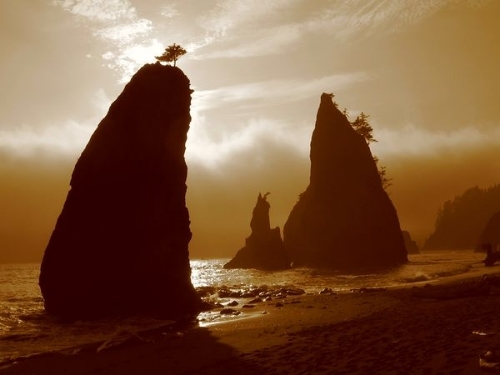
Sea Stacks off the Washington coast
Abel Truman is living in shack on the coast of Washington State with the Olympic Mountains looming up on one side and the Pacific Ocean forming a vast expanse on the other side. He was a Confederate soldier during the Civil War. He fought in most of the major battles including Gettysburg without receiving a single scratch. Everything changed for him at the Battle of the Wilderness. It turned out to be the end of the war for him and even though the Confederate commander Robert E. Lee may not have known it quite yet (or maybe he did he was an astute man) it was battle that ushered in the beginning of the end of the Confederacy as well.
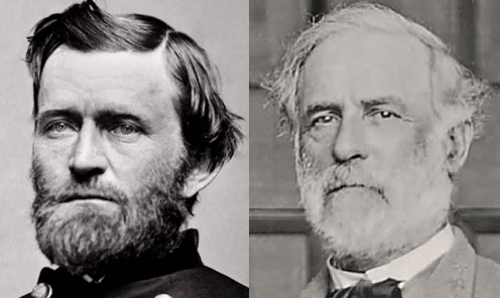
Ulysses S. Grant and Robert E. Lee
The Battle of the Wilderness was the debut of Ulysses S. Grant taking command of the Army of the Potomac. Now there are people that say that this battle was a draw, but with the lopsided casualty count there are those that insist it was a Confederate victory. Grant lost more than 17,000 men and Lee lost 11,000 men. As a percentage of the size of each army though Lee lost the higher percentage. Grant’s plan was to grind Lee’s army into powder. Every able bodied man in the South was either in uniform, wounded or dead. Grant knew he had at least 2.5 million men more that could be pressed into service if they proved to be necessary.
Grant could afford to be a butcher.
Unlike every Union commander in the past Grant did not retreat back across the closest river to lick his wounds after the battle. He moved his army to Lee’s right to try and seize the crossroads of Spotsylvania putting himself closer to the Confederate capital of Richmond than his opponent. The idea was to force Lee to retreat or fight.
Tactics.
Lee fought producing another bloodbath similar to the numbers lost by both sides during the Battle of the Wilderness. We are at the point of the war where Lee loses every time he wins.
So what was it like Abel being there at this turning point in history?
Anything can inspire memories of the war. A pile of stacked driftwood that he has to negotiate around snaps his mind from 1899 back in the thick of it in 1864.
”Climbing over and around them got the old man to thinking of battles despite himself. How they’d rush screaming and hollering through some field, some forest or farmer’s woodlot, where musket smoke hung from the branches in pale tatters like strange moss. How they’d go down on their knees in fallen leaves or dew-slick grass, firing blindly and fast. No skill to it. No time for aiming. Driving powder and shot down the barrel and pulling free the rammer and fitting the firing cap and raising the pieces to their cramped, bruising shoulders. Kneeling there, sobbing and loading and screaming and firing and loading again, hearing the shouts and cries and sobs of those everywhere around. The great, rolling, throaty percussion of cannon and the sharp crackle of rifle fire swelling up and up like an orchestra in the throes of some grand flourish. And that sound rolling together into a single noise a solitary booming wail of a sound that had no correlation to any other sound the world makes or that a man makes upon it.”
Now Abel Truman missed the follow up battle because he was lying in the woods along with a patchwork of dead men with blue and gray uniforms. He has two bullets in his leg and a shattered arm. His war is over, but then is something like this ever over? Every time he tries to use that arm for the rest of his life he can’t help but remember the circumstances and the pain. Every time he takes his clothes off the schematic of his injuries is etched into the scar tissue of his skin. The mental scars can’t be seen, but they are roadblocks that he continually has to negotiate again and again to live.
Hypatia, an escaped slave, nurses him back to health. Those that have the least always seem to have the most to give. You will have more than one moment in this book where you get teary eyed over the kindness of strangers to Abel. He must have that face, that right face that convinces everyone he is worthy of their aid and assistance.
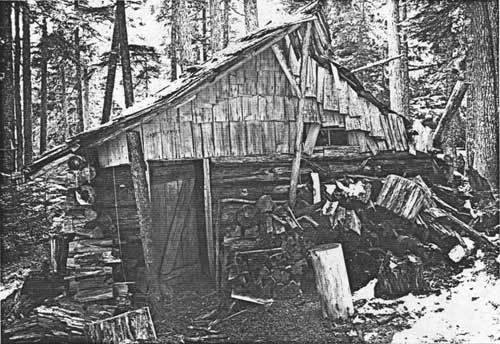
Driftwood shack similar to the one Abel and Dog lived in.
Now back in 1899 Abel and his faithful companion Dog are going on a quest over the Olympic Mountains. It is hardly a good idea with the chances for success somewhere between thin and none. He doesn’t see himself as the owner of the Dog, but he does consider this stray canine a friend. When Abel is beaten and Dog is taken from him to be used for fighting the story in a sense really begins because this is the point where the reader has to decide what kind of person they are as well. You’re old. You can barely use your left arm. You are beaten to within an inch of your life.
What do you do?
Well after some Indians patch him up (the kindness of strangers is still working for him) Abel goes after his friend.
Crazy.
Insane.
”I seen things I can’t forget. They won’t turn me loose, and if they did, I can’t imagine what I’d do with myself. Who I’d be. No. I can’t really tell any of it because they ain’t invented the words a man could use to do it justice.”
We are the composite of our triumphs and our disasters. Abel is the walking wounded, but he is still walking.
”The cool, stinging wind of a single bullet passed close to his cheek like the first quick kiss of a shy girl.”
Life is measured in centimeters.

Lance Weller with the 750 books that he signed for the First Edition Club Membership with Lemuria Books in Jackson, Mississippi.
I know the term lyrical is used a lot to describe literary writers and certainly lyrical applies to Lance Weller. In the early part of the book especially I thought to myself more than once I’m never going to finish this book because I was reading and reading again these beautiful composed sentences and paragraphs. I made notes and would read forward awhile only to return to read back through all the passages I’d marked. He left me with images.
”He passed trees swollen with bullets, broken by cannon fire, and singed black by flame. He saw fine-bred horses dead amidst the fallen leaves and dead soldiers lying beside them, weaponless and with their back shredded.” I’m so THERE I can smell it.
There is pain and redemption in this novel. You will feel the fear. It will jangle your nerves and have you ducking from bullets fired almost 150 years ago. The wicked are not punished as swiftly or as justly as we want. The righteous are not always protected or saved as often as we wish. As long as there are Abel Truman’s walking the earth we will always know that someone is coming for us. Highly recommended!!
I would also like to recommend The Black Flower by Howard Bahr both books are an excellent depiction of the Civil War on a personal level. Link to Black Flower review
I would also like to thank Diana Barnes for taking the time to write me and ask me to read this book called Wilderness. Her excitement was infectious...the absolute best kind of infection.
If you wish to see more of my most recent book and movie reviews, visit http://www.jeffreykeeten.com
I also have a Facebook blogger page at:https://www.facebook.com/JeffreyKeeten

Sea Stacks off the Washington coast
Abel Truman is living in shack on the coast of Washington State with the Olympic Mountains looming up on one side and the Pacific Ocean forming a vast expanse on the other side. He was a Confederate soldier during the Civil War. He fought in most of the major battles including Gettysburg without receiving a single scratch. Everything changed for him at the Battle of the Wilderness. It turned out to be the end of the war for him and even though the Confederate commander Robert E. Lee may not have known it quite yet (or maybe he did he was an astute man) it was battle that ushered in the beginning of the end of the Confederacy as well.

Ulysses S. Grant and Robert E. Lee
The Battle of the Wilderness was the debut of Ulysses S. Grant taking command of the Army of the Potomac. Now there are people that say that this battle was a draw, but with the lopsided casualty count there are those that insist it was a Confederate victory. Grant lost more than 17,000 men and Lee lost 11,000 men. As a percentage of the size of each army though Lee lost the higher percentage. Grant’s plan was to grind Lee’s army into powder. Every able bodied man in the South was either in uniform, wounded or dead. Grant knew he had at least 2.5 million men more that could be pressed into service if they proved to be necessary.
Grant could afford to be a butcher.
Unlike every Union commander in the past Grant did not retreat back across the closest river to lick his wounds after the battle. He moved his army to Lee’s right to try and seize the crossroads of Spotsylvania putting himself closer to the Confederate capital of Richmond than his opponent. The idea was to force Lee to retreat or fight.
Tactics.
Lee fought producing another bloodbath similar to the numbers lost by both sides during the Battle of the Wilderness. We are at the point of the war where Lee loses every time he wins.
So what was it like Abel being there at this turning point in history?
Anything can inspire memories of the war. A pile of stacked driftwood that he has to negotiate around snaps his mind from 1899 back in the thick of it in 1864.
”Climbing over and around them got the old man to thinking of battles despite himself. How they’d rush screaming and hollering through some field, some forest or farmer’s woodlot, where musket smoke hung from the branches in pale tatters like strange moss. How they’d go down on their knees in fallen leaves or dew-slick grass, firing blindly and fast. No skill to it. No time for aiming. Driving powder and shot down the barrel and pulling free the rammer and fitting the firing cap and raising the pieces to their cramped, bruising shoulders. Kneeling there, sobbing and loading and screaming and firing and loading again, hearing the shouts and cries and sobs of those everywhere around. The great, rolling, throaty percussion of cannon and the sharp crackle of rifle fire swelling up and up like an orchestra in the throes of some grand flourish. And that sound rolling together into a single noise a solitary booming wail of a sound that had no correlation to any other sound the world makes or that a man makes upon it.”
Now Abel Truman missed the follow up battle because he was lying in the woods along with a patchwork of dead men with blue and gray uniforms. He has two bullets in his leg and a shattered arm. His war is over, but then is something like this ever over? Every time he tries to use that arm for the rest of his life he can’t help but remember the circumstances and the pain. Every time he takes his clothes off the schematic of his injuries is etched into the scar tissue of his skin. The mental scars can’t be seen, but they are roadblocks that he continually has to negotiate again and again to live.
Hypatia, an escaped slave, nurses him back to health. Those that have the least always seem to have the most to give. You will have more than one moment in this book where you get teary eyed over the kindness of strangers to Abel. He must have that face, that right face that convinces everyone he is worthy of their aid and assistance.

Driftwood shack similar to the one Abel and Dog lived in.
Now back in 1899 Abel and his faithful companion Dog are going on a quest over the Olympic Mountains. It is hardly a good idea with the chances for success somewhere between thin and none. He doesn’t see himself as the owner of the Dog, but he does consider this stray canine a friend. When Abel is beaten and Dog is taken from him to be used for fighting the story in a sense really begins because this is the point where the reader has to decide what kind of person they are as well. You’re old. You can barely use your left arm. You are beaten to within an inch of your life.
What do you do?
Well after some Indians patch him up (the kindness of strangers is still working for him) Abel goes after his friend.
Crazy.
Insane.
”I seen things I can’t forget. They won’t turn me loose, and if they did, I can’t imagine what I’d do with myself. Who I’d be. No. I can’t really tell any of it because they ain’t invented the words a man could use to do it justice.”
We are the composite of our triumphs and our disasters. Abel is the walking wounded, but he is still walking.
”The cool, stinging wind of a single bullet passed close to his cheek like the first quick kiss of a shy girl.”
Life is measured in centimeters.

Lance Weller with the 750 books that he signed for the First Edition Club Membership with Lemuria Books in Jackson, Mississippi.
I know the term lyrical is used a lot to describe literary writers and certainly lyrical applies to Lance Weller. In the early part of the book especially I thought to myself more than once I’m never going to finish this book because I was reading and reading again these beautiful composed sentences and paragraphs. I made notes and would read forward awhile only to return to read back through all the passages I’d marked. He left me with images.
”He passed trees swollen with bullets, broken by cannon fire, and singed black by flame. He saw fine-bred horses dead amidst the fallen leaves and dead soldiers lying beside them, weaponless and with their back shredded.” I’m so THERE I can smell it.
There is pain and redemption in this novel. You will feel the fear. It will jangle your nerves and have you ducking from bullets fired almost 150 years ago. The wicked are not punished as swiftly or as justly as we want. The righteous are not always protected or saved as often as we wish. As long as there are Abel Truman’s walking the earth we will always know that someone is coming for us. Highly recommended!!
I would also like to recommend The Black Flower by Howard Bahr both books are an excellent depiction of the Civil War on a personal level. Link to Black Flower review
I would also like to thank Diana Barnes for taking the time to write me and ask me to read this book called Wilderness. Her excitement was infectious...the absolute best kind of infection.
If you wish to see more of my most recent book and movie reviews, visit http://www.jeffreykeeten.com
I also have a Facebook blogger page at:https://www.facebook.com/JeffreyKeeten

October 12, 2016
"For an Instant He Was a Child Again, Clutching Tightly His Father's Strong Hand in the Starlit Dark Night
"After nightfall, they sat up to watch the ocean dark under the nightblue sky. Abel and the dog. The rain clouds lay far to sea and they watched a single star fall arcing soundlessly across the heavens and then another and another while myriad others glistened and shined and moved slowly through the heavens like things alive, and who could say they were not? They were quiet and still together. The old man knew that in all the world's turning there had been but few moments such as this and so did not speak. And beside him, the dog's strong, inarticulate heart beat softly and together they sat under the bright, spirited stars until sleep overtook them."
Ever since reading "Cold Mountain" I have been trying to find a book like it, not especially the romance part of that book but the adventure that the main character had when he walked home from the Civil War. I finally found it in this book.
, Weller's writing makes me feel the pain and the sorrow of all involved. This has to be my favorite book after "The Road." I wish I could pick up another book by Weller, but this is one was his debut.
I don't think that I can say enough about his writing. It is so lyrical that every sentence is a poem and most of it could be written in free verse style. He writes in the way that I wish I could.
The pages are bound in one tragic story after another. This book got my mind off all other problems in our world by putting it on a story written about the past., America’s past, the Civil War, and what it had done to humanity, A past I hope we never repeat., but which, sadly, is repeated daily in our world.
It is a story about Abel, a man who survived the Civil War; his last battle at Wilderness wounded him deeply and ended his career as a confederate soldier. He now lives in a shack on a beach in Washington with his faithful dog. It seems idyllic to me, but it doesn't last.
This book, while taking place in the present moment, is also about remembering, remembering his wife and baby daughter and remembering the war.
"Abel lay back. He closed his eyes against the brightness of the night and listened to the constant sound of the ocean at its labors. Underbrush crackled softly as deer explored the slopes above the beach. Abel closed his eyes and tried hard not to see her, to keep seeing her. He tried not to see either of them, but it came back, like it always did, in the fall when the air grew crisp and the leaves began to turn, then die and fall."
There are other scenes in this book that will be forever engraved in my mind. I still see the image of a young boy named David, whose shirt was literally falling off his back and whose shoes were beyond repair. He finally received a package from home, a handmade shirt from his mother that was made from a tablecloth, but even this gift is not without tragedy, little is in this book.
Abel says, "I seen things I can't forget. They won't turn me loose, and if they did, I can't imagine what I'd do with myself. Who I'd be."
Abel found one of his friends wounded at a military hospital in the wilderness, his arms cut off. And he didn't even know that they were gone. He even tried to shoo a fly off one of his missing arms but was unsuccessful. It reminded me of a book I had to read in college, "All Quiet of the Western Front" where a man had his legs blown off and was running around on stumps. How much I had wished I had never had to read that book. But this book is written beautifully; it wasn't. Still, maybe I will someday wish that I had never read this one either.
Somehow I think that this last should have ended the book, but of course the story goes on with more and more tragedy than any one life can handle:
"After a moment, he (Abel) gathered his things and made to turn, but chanced to look starward, where he saw them falling out of the night.
It was no repetition of the Leonids of '33 or even the lesser shower after the war, but perhaps some celestial precursor of other, greater star showers yet to come. Long white trails etched flashing across the glassy night soundlessly in cold parabola. They glittered in the old man's eyes, and for an instant he was a child again, clutching tightly his father's strong hand in the starlit dark, and then he was a man and young..."
Updated and edited review:
I always knew that I wanted to read this book again, and for some reason I picked it up once more, I missed the way it was written. I missed reading a great book.
This time I got the audio narrated by Richard Poe. What a fantastic voice, a perfect reader for this book, a reader that even Cormac McCarthy has hired to read, some, if not all, of his books. Perfection.
When listening to this book you get an entire other view of it. The mind sees more, so to speak, much more, as it is loosened from its need to see words.
There may never be another book like this for me. I feel privileged to have read it.
"After nightfall, they sat up to watch the ocean dark under the nightblue sky. Abel and the dog. The rain clouds lay far to sea and they watched a single star fall arcing soundlessly across the heavens and then another and another while myriad others glistened and shined and moved slowly through the heavens like things alive, and who could say they were not? They were quiet and still together. The old man knew that in all the world's turning there had been but few moments such as this and so did not speak. And beside him, the dog's strong, inarticulate heart beat softly and together they sat under the bright, spirited stars until sleep overtook them."
Ever since reading "Cold Mountain" I have been trying to find a book like it, not especially the romance part of that book but the adventure that the main character had when he walked home from the Civil War. I finally found it in this book.
, Weller's writing makes me feel the pain and the sorrow of all involved. This has to be my favorite book after "The Road." I wish I could pick up another book by Weller, but this is one was his debut.
I don't think that I can say enough about his writing. It is so lyrical that every sentence is a poem and most of it could be written in free verse style. He writes in the way that I wish I could.
The pages are bound in one tragic story after another. This book got my mind off all other problems in our world by putting it on a story written about the past., America’s past, the Civil War, and what it had done to humanity, A past I hope we never repeat., but which, sadly, is repeated daily in our world.
It is a story about Abel, a man who survived the Civil War; his last battle at Wilderness wounded him deeply and ended his career as a confederate soldier. He now lives in a shack on a beach in Washington with his faithful dog. It seems idyllic to me, but it doesn't last.
This book, while taking place in the present moment, is also about remembering, remembering his wife and baby daughter and remembering the war.
"Abel lay back. He closed his eyes against the brightness of the night and listened to the constant sound of the ocean at its labors. Underbrush crackled softly as deer explored the slopes above the beach. Abel closed his eyes and tried hard not to see her, to keep seeing her. He tried not to see either of them, but it came back, like it always did, in the fall when the air grew crisp and the leaves began to turn, then die and fall."
There are other scenes in this book that will be forever engraved in my mind. I still see the image of a young boy named David, whose shirt was literally falling off his back and whose shoes were beyond repair. He finally received a package from home, a handmade shirt from his mother that was made from a tablecloth, but even this gift is not without tragedy, little is in this book.
Abel says, "I seen things I can't forget. They won't turn me loose, and if they did, I can't imagine what I'd do with myself. Who I'd be."
Abel found one of his friends wounded at a military hospital in the wilderness, his arms cut off. And he didn't even know that they were gone. He even tried to shoo a fly off one of his missing arms but was unsuccessful. It reminded me of a book I had to read in college, "All Quiet of the Western Front" where a man had his legs blown off and was running around on stumps. How much I had wished I had never had to read that book. But this book is written beautifully; it wasn't. Still, maybe I will someday wish that I had never read this one either.
Somehow I think that this last should have ended the book, but of course the story goes on with more and more tragedy than any one life can handle:
"After a moment, he (Abel) gathered his things and made to turn, but chanced to look starward, where he saw them falling out of the night.
It was no repetition of the Leonids of '33 or even the lesser shower after the war, but perhaps some celestial precursor of other, greater star showers yet to come. Long white trails etched flashing across the glassy night soundlessly in cold parabola. They glittered in the old man's eyes, and for an instant he was a child again, clutching tightly his father's strong hand in the starlit dark, and then he was a man and young..."
Updated and edited review:
I always knew that I wanted to read this book again, and for some reason I picked it up once more, I missed the way it was written. I missed reading a great book.
This time I got the audio narrated by Richard Poe. What a fantastic voice, a perfect reader for this book, a reader that even Cormac McCarthy has hired to read, some, if not all, of his books. Perfection.
When listening to this book you get an entire other view of it. The mind sees more, so to speak, much more, as it is loosened from its need to see words.
There may never be another book like this for me. I feel privileged to have read it.

August 2, 2012
In a word: Wow. Hard as it is to believe, Lance Weller's WILDERNESS, polished and accomplished, is listed as a debut novel. If you love literary fiction, enjoy reading a writer's writer, and have an affinity for Civil War literature, you can't do better than this.
This is the story of Abel Truman, a veteran of the Civil War, an odd sort of Everyman who hails from New York yet fights for the South because he is in North Carolina during the outbreak of hostilities. The chapters alternate between 1864 and 1899. In the former, we see Abel fighting with the Rebs in the Wilderness Campaign. Using realism and his keen gift for description, Weller provides a graphic narrative of the fighting and the deaths, balanced by the nobility of friendship among the soldiers and even acts of kindness between the enemies. History buffs will note Weller's careful research as well. Much of the action focuses on Saunder's Field here. As for the latter, we move to a different wilderness altogether. Thirty-five years later, the older Truman -- scarred physically and mentally by the past -- has escaped to the wilds of the Pacific Northwest. We see, however, how every Eden harbors its snakes as Abel is beset by two brigands who steal his dog for dog fighting purposes and terrorize the woods and mountains along the coast with atrocious abandon. When Abel vows to get his dog back, he is forced to reckon anew with mankind's blunt capacity for killing and maiming.
Back and forth, with compelling stories in both Abel's past and present, we meet various characters and follow a few sub-plots, each with Abel Truman playing his part. The Wilderness becomes a metaphor for life's journey, its sheer beauty and indifferent injustices -- for man himself, with his instinctive abilities to perpetrate good and evil with equal force. Here is a small sampling of Weller's writing style: "It was very cold now; his breath steamed and rose through the trees like moss vapor in the morning sun. Abel clutched the broken grip where the metal was jagged and tried to control his breath, to ignore the thin, high, icy itch at the back of his throat. He could smell himself, root-sour and fusty, speaking of fear and sickness and age and anger and hurt. He went slowly forward once more, and only stopped when he saw the dog's eyes glowing redly from across the burned-down fire."
Some might find the 1864 chapters reminiscent of Charles Frazier's COLD MOUNTAIN with its Civil War bent; others the 1899 chapters of Knut Hamsun's PAN with its ex-military hero hunting the coastal mountains for both day-by-day sustenance and elusive succor from the past, faithful dog by his side; but all should agree that, in the current literary landscape, Weller has emerged as a new force to be appreciated and welcomed by lovers of history, literature, and the sheer possibilities of language itself. Highly recommended.
This is the story of Abel Truman, a veteran of the Civil War, an odd sort of Everyman who hails from New York yet fights for the South because he is in North Carolina during the outbreak of hostilities. The chapters alternate between 1864 and 1899. In the former, we see Abel fighting with the Rebs in the Wilderness Campaign. Using realism and his keen gift for description, Weller provides a graphic narrative of the fighting and the deaths, balanced by the nobility of friendship among the soldiers and even acts of kindness between the enemies. History buffs will note Weller's careful research as well. Much of the action focuses on Saunder's Field here. As for the latter, we move to a different wilderness altogether. Thirty-five years later, the older Truman -- scarred physically and mentally by the past -- has escaped to the wilds of the Pacific Northwest. We see, however, how every Eden harbors its snakes as Abel is beset by two brigands who steal his dog for dog fighting purposes and terrorize the woods and mountains along the coast with atrocious abandon. When Abel vows to get his dog back, he is forced to reckon anew with mankind's blunt capacity for killing and maiming.
Back and forth, with compelling stories in both Abel's past and present, we meet various characters and follow a few sub-plots, each with Abel Truman playing his part. The Wilderness becomes a metaphor for life's journey, its sheer beauty and indifferent injustices -- for man himself, with his instinctive abilities to perpetrate good and evil with equal force. Here is a small sampling of Weller's writing style: "It was very cold now; his breath steamed and rose through the trees like moss vapor in the morning sun. Abel clutched the broken grip where the metal was jagged and tried to control his breath, to ignore the thin, high, icy itch at the back of his throat. He could smell himself, root-sour and fusty, speaking of fear and sickness and age and anger and hurt. He went slowly forward once more, and only stopped when he saw the dog's eyes glowing redly from across the burned-down fire."
Some might find the 1864 chapters reminiscent of Charles Frazier's COLD MOUNTAIN with its Civil War bent; others the 1899 chapters of Knut Hamsun's PAN with its ex-military hero hunting the coastal mountains for both day-by-day sustenance and elusive succor from the past, faithful dog by his side; but all should agree that, in the current literary landscape, Weller has emerged as a new force to be appreciated and welcomed by lovers of history, literature, and the sheer possibilities of language itself. Highly recommended.

June 22, 2013
This book gets 5 stars because I just finished reading it and I am still in awe of Lance Weller's talent. Wow! His first novel, Wow! His masterful descriptions of both nature and battle scenes, Wow! His characters, maimed and wounded both physically and emotionally, but still able function in the world and maintain their own goodness, drove me to tears more than once. And his decriptions of Gettysburg and the battle of the Wilderness drove home the reality and sadness of the Civil War like nothing else I have ever read. This is one of the best Civil War novels I have ever read, and most of it takes place in Washington state in 1899. I still can't believe this is a first novel, but I hope Mr. Weller is a young man, because I will read anything he ever writes, and his ability to paint pictures with words is awesome. Once again, Wow!

September 8, 2013
I've thinking lately about the term "literary fiction". It's a kind of an elusive term - but generally it is used to denote a certain quality to the way the book is written, to the care given to the sentences, as when they make you pause or suddenly see something new or something old in a new way. There's a presence you detect in literary fiction - the unhurried presence of an author who has taken as much time as he needs and given the book a chunk of his flesh. This book is literary fiction at its best (made even better by the careful research of history and places like the civil war battles where some of the story takes place). The true test of literary fiction is that it invites you, even urges you, to read it again. And I will. But despite the breathtaking descriptions, the perfect character-driven dialogue, the careful structure of a story that begins in 1965 and then travels back and forth between 1864 and 1899 (and not once did I not know where I was or who was speaking), despite the beauty of the words, what I liked the most about this book is that rare thing in literary fiction: characters who are noble and full of gritty courage and who ask you in a quiet way if you can be like them. I don't know if I have ever seen a book that treats the relationship between people of different races with the gentleness and power of this book. I am grateful when an author reaches beauty and doesn't stop there, but goes on to awaken.

September 3, 2013
A wonderful and sad story of an old soldier and his dog companion going on a quest. We get flashbacks to his soldiering days in the Civil War (the battle of the Wilderness 1864). The images from the front lines are very much "alive". The story itself is very well written. I didn't have a lot of time lately to read for long hours at a time so I had to put this book away (too) many times before finishing it. Yet every time I opened the book to read another few pages I was immediately drawn in. I was right there at Abel's side.
Although it took me a long time to finish this book but it was of no fault of the author or his book. This book even deserves a reread! it will be at a time when I have enough time on my hand to finish it in 1 or 2 reading sessions.
Before I started writing this short review I marked the book with 4 stars. I have quickly changed it to 5 stars!
Although it took me a long time to finish this book but it was of no fault of the author or his book. This book even deserves a reread! it will be at a time when I have enough time on my hand to finish it in 1 or 2 reading sessions.
Before I started writing this short review I marked the book with 4 stars. I have quickly changed it to 5 stars!

May 19, 2014
I’ll start with this: Wilderness is THE book I’ve been waiting for this year. In fact, if I could give it more than five stars, I would. Without a doubt, it is among my all-time favorite reads, so rich is it in sensory detail and drinkable prose.
The title of the book, alone, spoke to my natural sensitivities: Wilderness. You learn early on that the title has double meaning and a symbolic significance that influences the story of Abel Truman … an old man alone, reclusive, with no one in the world but his aging dog. A surviving soldier of the Confederacy in the Civil War, he fought in The Battle of the Wilderness and continues to fight that battle daily in his own mind. He simultaneously battles against the wilds of Washington state’s coastal lands, and with dubious thugs. But along the pathways of his life, he witnesses, time and again, the kindness of humanity, its promise of hope.
Perhaps all you need to know about this book is that it makes you feel; from your heart down to the marrow of your bones, you will feel as you read the story of Abel Truman, a name befitting an able man, a man true to his beliefs even if he doesn’t quite know it himself.
You will be awed, horrified and inspired by the realities of the Battle of the Wilderness, as seen through Abel’s flashbacks (Weller’s ability to paint lasting impressions of the war’s stories of loyalty and bedlam is beyond explanation and chill-inspiring).
I loved the complex, non-linear structure of this novel as well and am still awestruck that the author was able to thread so many stories and characters together, connecting them all to a pinnacle at the end. So impressive.
For readers who loved THE ORCHARDIST and BURIAL RITES, this book has equally evocative descriptions of a harsh but beautiful earth that interacts with its characters in ways heartbreaking and uplifting. I give this book my highest endorsement. If you love literary fiction with poetic sentences and setting-as-character, this is the book you must read this year. I honestly was reluctant to finish the book – and purposely stopped at the end a few times – because I just couldn’t bear to part with the natural setting and its sensory vibrancy. But most of all, I knew I would miss Abel, such a complex, wonderful, achingly sad character. And I do miss him. Still. He – and his dog – and the other characters will stay with me for a long, long while.
The title of the book, alone, spoke to my natural sensitivities: Wilderness. You learn early on that the title has double meaning and a symbolic significance that influences the story of Abel Truman … an old man alone, reclusive, with no one in the world but his aging dog. A surviving soldier of the Confederacy in the Civil War, he fought in The Battle of the Wilderness and continues to fight that battle daily in his own mind. He simultaneously battles against the wilds of Washington state’s coastal lands, and with dubious thugs. But along the pathways of his life, he witnesses, time and again, the kindness of humanity, its promise of hope.
Perhaps all you need to know about this book is that it makes you feel; from your heart down to the marrow of your bones, you will feel as you read the story of Abel Truman, a name befitting an able man, a man true to his beliefs even if he doesn’t quite know it himself.
You will be awed, horrified and inspired by the realities of the Battle of the Wilderness, as seen through Abel’s flashbacks (Weller’s ability to paint lasting impressions of the war’s stories of loyalty and bedlam is beyond explanation and chill-inspiring).
I loved the complex, non-linear structure of this novel as well and am still awestruck that the author was able to thread so many stories and characters together, connecting them all to a pinnacle at the end. So impressive.
For readers who loved THE ORCHARDIST and BURIAL RITES, this book has equally evocative descriptions of a harsh but beautiful earth that interacts with its characters in ways heartbreaking and uplifting. I give this book my highest endorsement. If you love literary fiction with poetic sentences and setting-as-character, this is the book you must read this year. I honestly was reluctant to finish the book – and purposely stopped at the end a few times – because I just couldn’t bear to part with the natural setting and its sensory vibrancy. But most of all, I knew I would miss Abel, such a complex, wonderful, achingly sad character. And I do miss him. Still. He – and his dog – and the other characters will stay with me for a long, long while.

August 15, 2012
My recent interview with Lance Weller can be read @http://more2read.com/review/interview-with-lance-weller/
This novel was storytelling rich in setting and characters amidst days of the civil war.
The author writes with some wonderful prose and eloquently words in the right places reminiscent of the writings of Hemingway and Cormac McCarthy in style of writing at times. You will read sentences that really describe well the setting, the terrible and the beauty of the world contained within these pages. There was possibly an overdoing of descriptions at times but that does not lower its quality by any degree in being a wonderful read. Blood Meriden by Cormac McCarthy comes to mind when reading this historical drama. The tale was tragic and unrelenting in its struggle for better days over very grim and unforgiving circumstances. There was a lasting mark left on me of the characters contained their sheer courage, bravery and heart long lasting. I found that one main protagonist had more than 9 lives of a cat, so to speak, as he manages to walk away from death many times.
Enjoy this fine example of storytelling with lyrical beauty.
http://more2read.com/review/wilderness-by-lance-weller/
This novel was storytelling rich in setting and characters amidst days of the civil war.
The author writes with some wonderful prose and eloquently words in the right places reminiscent of the writings of Hemingway and Cormac McCarthy in style of writing at times. You will read sentences that really describe well the setting, the terrible and the beauty of the world contained within these pages. There was possibly an overdoing of descriptions at times but that does not lower its quality by any degree in being a wonderful read. Blood Meriden by Cormac McCarthy comes to mind when reading this historical drama. The tale was tragic and unrelenting in its struggle for better days over very grim and unforgiving circumstances. There was a lasting mark left on me of the characters contained their sheer courage, bravery and heart long lasting. I found that one main protagonist had more than 9 lives of a cat, so to speak, as he manages to walk away from death many times.
Enjoy this fine example of storytelling with lyrical beauty.
“He lived beside the sea in the far northwest corner of these United States, and in the nights before he left he sat before his tiny shack watching the ocean under the night blue sky. Sea grass sawed and rustled in a cool, salty wind. A few drops of rain fell upon his face, wetting his beard and softly sizzling in the fire. This light rain but the after-rain of the lasts nights storm, or perhaps the harbinger of harder rains yet to come. The shack creaked softy with the wind while the tide hissed all along the dark and rocky shore. The moon glowed full form amidst the rain clouds, casting a hard light that slid like grease atop the water. The old man watched ivory curlers far to sea rise and subside noiselessly. Within the bounds of his little cove stood sea stacks weirdly canted from wind and waves. Tide gnawed remnants of antediluvian islands and eroded coastal headlands, the tall stones stood monolithic and forbidding, hoarding the shadows and softly shining purple, ghost blue in the moon and ocean colored gloom. Grass and wind-twisted scrub pine stood from the stacks, and on the smaller, flatter, seaward stones lay seals like earthen daubs of paint upon the night’s darker canvas. From that wet dark across the bay came the occasional slap of a flipper upon the water that echoed into the round bowl of the cove, and the dog, as it always did, raised its scarred and shapeless ears.”
“Far to the west, where the night was fast upon the ocean’s rim, the clouds had blown back and the old man could see stars where they dazzled the water. He breathed and rocked before the fire. His thought, beyond his control, went from painful recollections of women and family to worse remembrance of war because it had been his experience that one often led to the other- stoking its fires until there was not a man who could resist and, upon yielding, survive as a man still whole.”
“Abel stood beside the fire and watched the ocean move constantly, restlessly, in the outer dark. He looked at the stars that glistened hard and cold through gaps in the clouds and at the hazy moon behind. He looked at the dog where it lay sleeping by the snapping fire. Older now, it tired easily and slept hard, its long legs moving restlessly as it gave soft little puppy-barks from its dreams. Abel watched it for a time, then shed his clothes and stood naked, pale and ghostly in the shadows.
He started across the wrecked driftwood toward the sand, picking his way along carefully. The tide seethed and rattled along the shore. It sprayed and echoed on the stones in the deeper waters and slapped against itself still farther out, under the moon as it moved beyond the clouds, where men could not dwell nor prosper. Beds of kelp, like inky stains upon the general darkness, bobbed on the swells while mounds of it, beached days past, lay quietly afester with night-becalmed sand fleas near the driftwood bulwarks. Glancing to the little river that cut sharply and dark through the sand, Abel saw the largest wolf he’d ever seen, standing in the current watching him.”
“His own grief was nothing but suffering, then passing through sorrow, rage. A black gall. Nights steeped in drink. Days of hungry wandering. Begging, petty thievery, and a single wretched night of a full moon passed out facedown in some churchyard’s grass. And when war did come, Abel Truman found himself in North Carolina with a regiment of Tar Heels for no other reason than that was where he had happened to be. And then all the rest happened, and finally, ten and twenty years in a one-room shack on the shore of the cold, grey Pacific, and his life was blown. Passed him by like a slow, tannic river easing out to sea. He’d eked out a meagre life beside the waters and when he felt he’d finally had enough he’d walked into the ocean and the ocean had cast him back.”
“A stillness now, as if the world were waiting, breathless. The wind did not blow and the day grew warm. They slept that night on the banks of some nameless stream for the cool of the water in the close, hot dark, and when they rose they could hear a distant, tearing sound as of a sturdy piece of canvas ripped lengthwise. It came banging intermittently through the springtime air all morning and in the afternoon the tearing became a roar and the roar was constant. They could hear shouting. They stopped on arise on the outskirts of a four-building village that lay abandoned. The Wilderness was before them, studded with powder smoke that rose, slow, malignant, until the sun was darkened and the shadows grew long.”
http://more2read.com/review/wilderness-by-lance-weller/

February 17, 2013
First I loved the prose - so lyrical. Then I grew a little tired of that. Then I grew more tired of the relentless sorrow and suffering (and I love "The Road" so that tells you something) and violence that Abel encounters in his long life from being a husband/father/Civil War soldier and veteran. At every turn, he is abused by one or another of nasty characters or fate. I actually stopped reading half way through, then read through Goodreads reviews and picked it up again and was able to finish it. The Civil War battle descriptions are more realistically gory than any other war scenes I have read. The folding and unfolding timeline confused me some and I think the book lost much of its power from that fluctuation. Still, it was a good read if only for the descriptions alone - especially of the Northwest Coast beach and forest scenes. At the beginning a character is remembering her husband who died decades earlier ..."All that fades and fades away now like the diminishing ripples of a single raindrop fallen into a wide lake, like the silvery cavitation of bubbles flung through seawater by the blade of an oar."

February 23, 2013
This is an extravagant, thoughtful, graphic, and hugely entertaining book. The author describes it as a "literary" novel. Oh, lord, yet another genre - fiction is getting to be as bad a music - and I take it "literary" means language rich, as in prosody, or poetic, or musical, or "ruling itself alone." (My coinage.) Well, Wilderness is all those things, and as Lance Weller is suffering (and maybe reveling in) comparisons with Cormac McCarthy, and Wm. Faulkner, I suppose the book is "literary." Or as Cormac might say, "literary enough, until the real thing comes along." I'm being snarky to no good purpose, as I really liked this book - four stars in a five star system that I hate. And - I'd give it five stars but for one flaw, which I'll get to in a second.
In taking on the US Civil War, Mr. Weller has entered a field where giants walk, and I'd place those giants all the way back to Homer, that great cartographer of carnage, and emotional voyage, up to Michael Shaara's incredible "The Killer Angels," and Charles Frazier, whose Cold Mountain is near the top of the heap. But where I really get Wilderness is in how it elaborates on the idea that the Civil War is our very own Iliad, and his protagonist's journey enters the Odyssey's orbit.
Wilderness takes place at the battle of the Wilderness, a particularly ugly clash of men and material that was part of Grant's strategy of a war of attrition. Grant, that whiskey soaked son-of-a-bitch, seemed to have no compunctions about throwing as many bodies into the maw as could be devoured in the belief (true as it turns out) that the enemy would be devoured faster. It was total war, hand to hand, and resulted in piles of dead soldiers: 17,500 Union casualties, 7,000 Confederate in three days time, but considered a strategic victory because in percentages of the total the Reb's suffered the worst, and Grant pressed on. Abel Truman, our protagonist, was in the midst of it, and what he saw and felt marked him for life. Mr. Weller details the events through friendships taken by death, atrocities of shock and shell, and one short section that reads like the chronicle of deaths that Homer was so good at. Mr. Weller puts us squarely in the dream, and I was taken so far out of myself in the reading that, like all really good reads, time and space were suspended. The writing really is masterful.
Wilderness also takes place in the wilderness of the Pacific Northwest, and we move from the Iliad to an Odyssey as Abel, pretty much a beach-combing recluse goes on the hunt for a dog that was stolen from him by two really, really bad guys, and the adventures, and relationships that ensue.
So far, so good. Wilderness is a hell of a story, even with the 30 year gap between the battle and the dog. Abel is touching and deep, and a character I loved spending time with. Any dog lover is a friend of mine, anyway, and Abel has such a real relationship with Dog that it felt like me and my good dog Sam.
What's really important about all the above is that Wilderness is an empathetic read, and as a reader I was pulled so deeply into the dream I didn't want out.
Here's where things go wrong, and the book looses a star: Mr Weller's good men and women are, for the most part, rounded, which is to say we're witness to their flaws as well as their goodness, but his bad guys are nothing but bad. In fact, the bad guys are as bad as any from the McCarthy canon - monsters without humanity. That makes for entertainment, but not illumination, but , for the sake of entertainment, I'm able to let that go; what I'm not able to let go of is his treatment of slaves. Every slave is a saint. In the midst of battle, in relationship with women, on the road, homesteaders - saints, everyone, all, without exception.
Damn!
Here is a book so good I'd boost it up to classic, and this one thing that knocks it back a star. I'm not so vain as to think my opinion means much of anything to anyone but myself, but there you have it.
Last thing: the prologue didn't set me up all that well for the story, and the story got so deep I had to re-read the prologue in order to figure out why it was there. It might have served better as an epilogue - or been left out all together.
And, this is what a review sounds like after having rapidly downed two cups of Seattle strong coffee.
In taking on the US Civil War, Mr. Weller has entered a field where giants walk, and I'd place those giants all the way back to Homer, that great cartographer of carnage, and emotional voyage, up to Michael Shaara's incredible "The Killer Angels," and Charles Frazier, whose Cold Mountain is near the top of the heap. But where I really get Wilderness is in how it elaborates on the idea that the Civil War is our very own Iliad, and his protagonist's journey enters the Odyssey's orbit.
Wilderness takes place at the battle of the Wilderness, a particularly ugly clash of men and material that was part of Grant's strategy of a war of attrition. Grant, that whiskey soaked son-of-a-bitch, seemed to have no compunctions about throwing as many bodies into the maw as could be devoured in the belief (true as it turns out) that the enemy would be devoured faster. It was total war, hand to hand, and resulted in piles of dead soldiers: 17,500 Union casualties, 7,000 Confederate in three days time, but considered a strategic victory because in percentages of the total the Reb's suffered the worst, and Grant pressed on. Abel Truman, our protagonist, was in the midst of it, and what he saw and felt marked him for life. Mr. Weller details the events through friendships taken by death, atrocities of shock and shell, and one short section that reads like the chronicle of deaths that Homer was so good at. Mr. Weller puts us squarely in the dream, and I was taken so far out of myself in the reading that, like all really good reads, time and space were suspended. The writing really is masterful.
Wilderness also takes place in the wilderness of the Pacific Northwest, and we move from the Iliad to an Odyssey as Abel, pretty much a beach-combing recluse goes on the hunt for a dog that was stolen from him by two really, really bad guys, and the adventures, and relationships that ensue.
So far, so good. Wilderness is a hell of a story, even with the 30 year gap between the battle and the dog. Abel is touching and deep, and a character I loved spending time with. Any dog lover is a friend of mine, anyway, and Abel has such a real relationship with Dog that it felt like me and my good dog Sam.
What's really important about all the above is that Wilderness is an empathetic read, and as a reader I was pulled so deeply into the dream I didn't want out.
Here's where things go wrong, and the book looses a star: Mr Weller's good men and women are, for the most part, rounded, which is to say we're witness to their flaws as well as their goodness, but his bad guys are nothing but bad. In fact, the bad guys are as bad as any from the McCarthy canon - monsters without humanity. That makes for entertainment, but not illumination, but , for the sake of entertainment, I'm able to let that go; what I'm not able to let go of is his treatment of slaves. Every slave is a saint. In the midst of battle, in relationship with women, on the road, homesteaders - saints, everyone, all, without exception.
Damn!
Here is a book so good I'd boost it up to classic, and this one thing that knocks it back a star. I'm not so vain as to think my opinion means much of anything to anyone but myself, but there you have it.
Last thing: the prologue didn't set me up all that well for the story, and the story got so deep I had to re-read the prologue in order to figure out why it was there. It might have served better as an epilogue - or been left out all together.
And, this is what a review sounds like after having rapidly downed two cups of Seattle strong coffee.
July 27, 2019
An old man hermit and his old dog begin suddenly to meander to a final destination on the Pacific coast in the final year of the 19th century. This after a failed suicide attempt, which is taken as a sign that he has more to do, the rapidly declining one armed civil war veteran fights real villains intent on stealing his only remaining love, the dog, as well as imagined horrors and regrets from a horrific past. The story returns back and forth from his days as a confederate in the Civil war to the current time. The only deviation is the first chapter where the girl he saves in her own old (blind) age remembers the old man, Abel Truman. He is a superbly drawn character, full of actual visceral pain in old age (which I can begin to relate too, getting there myself); but mostly the trauma of the war between the states. I can't recall another story that captures so perfectly the boredom, the fear and the actual battlefield state of mind - it is antiwar in the best way (reminds me of Gautreux' coverage of the first world war in The Clearing). This book is rich with history and the characters are fully rounded and interesting, male and female. The un-named "Haida" accompanied by his spindly damage white sidekick, is a frighteningly clever predator reminiscent of a Cormac McCarthy figure in his unwavering commitment to a violent destiny. Mostly, though, the story is of the many regrets of our protagonist, Truman, who is lovable in his loyalty to his old dog as his travels lead him to a final act of greatness. The wonder of this story is my inclination to read it fast to get to the outcome - a sign of great writing - where I had to force myself to slow down and appreciate the stunningly beautiful descriptions of nature, nigh air, sea, and the animal world that is all around. Overall a thrilling read, that put in a class with Frazier's Cold Mountain. What I can't figure is why this talented author doesn't have more in the public domain.

June 12, 2014
Prepare yourself for a raving review. This is the best book I've read this year. This may be the best book I've read since Cormac Mccarthy's "The Road." It may even, “gasp”... be even better than “The Road.”
For me, literary fiction has been an acquired taste. Perhaps this is so because I had to work through the perceived trauma of being forced as a student to read beautiful works before I had eyes for them. I had to acclimate myself to the author’s style during the first 100 pages and was not initially as excited as I am now. Yet as the pages passed, words began flowing over me, and then through me. To borrow from another reviewer’s phrase, the sensory detail was just so rich and the author’s prose a delight.
As a reader, once I've read enough metaphors and similes I seem to reach a point where I began to grade them on a pass/fail basis. They either resonate or bounce awkwardly off. The richer the metaphor, the more spectacular the success/failure. It was in this regard that Weller’s prose was so delightful. His descriptions were so moving and filled with depth that he seemed to capture the essence of the way a thing really is. I found myself wondering why I had never thought of it that way. And he didn’t just illustrate nature, but also pain, violence, brokenness, hope, beauty, and human intimacy.
I feel exasperated in trying to explain the beauty of this book. I can’t even imagine having the mind to conceive and tell such a story consisting of saddened protagonist and littered with a splattering of broken secondary characters. The non-linear plot is neither exciting or boring though the book ends well.
The book is just beautiful. It makes me feel things that a book has never made me feel before. Feelings that were new but strangely familiar. The pages ache… of hope, beauty, and brokenness among mangled people who trod through the human experience. At its best the book gave me the aching longing feeling I’ve experienced when listening to Brahms’ Ballade No. 1 or Strauss’ Andante from Funf Klavierstucke, Op. 3.
Perhaps the aching these works produce is because they capture part of the human experience. That there is beauty, real and lasting beauty on earth to be had… Though it is horribly marred by pain and suffering it is real nonetheless. It is as if we were made for another world.
Lance Weller’s Wilderness has my highest recommendation to those who fancy themselves of having some literary sensibilities, 5/5 stars.
For me, literary fiction has been an acquired taste. Perhaps this is so because I had to work through the perceived trauma of being forced as a student to read beautiful works before I had eyes for them. I had to acclimate myself to the author’s style during the first 100 pages and was not initially as excited as I am now. Yet as the pages passed, words began flowing over me, and then through me. To borrow from another reviewer’s phrase, the sensory detail was just so rich and the author’s prose a delight.
As a reader, once I've read enough metaphors and similes I seem to reach a point where I began to grade them on a pass/fail basis. They either resonate or bounce awkwardly off. The richer the metaphor, the more spectacular the success/failure. It was in this regard that Weller’s prose was so delightful. His descriptions were so moving and filled with depth that he seemed to capture the essence of the way a thing really is. I found myself wondering why I had never thought of it that way. And he didn’t just illustrate nature, but also pain, violence, brokenness, hope, beauty, and human intimacy.
I feel exasperated in trying to explain the beauty of this book. I can’t even imagine having the mind to conceive and tell such a story consisting of saddened protagonist and littered with a splattering of broken secondary characters. The non-linear plot is neither exciting or boring though the book ends well.
The book is just beautiful. It makes me feel things that a book has never made me feel before. Feelings that were new but strangely familiar. The pages ache… of hope, beauty, and brokenness among mangled people who trod through the human experience. At its best the book gave me the aching longing feeling I’ve experienced when listening to Brahms’ Ballade No. 1 or Strauss’ Andante from Funf Klavierstucke, Op. 3.
Perhaps the aching these works produce is because they capture part of the human experience. That there is beauty, real and lasting beauty on earth to be had… Though it is horribly marred by pain and suffering it is real nonetheless. It is as if we were made for another world.
Lance Weller’s Wilderness has my highest recommendation to those who fancy themselves of having some literary sensibilities, 5/5 stars.
June 10, 2020
I feel compelled to tell people what happens to the dog, because I see a lot of people say they aren't going to read it because they are worried about violence and a bad end for the dog, and that would be a shame because it is a pretty good book. So here is a very small spoiler that in no way ruins the book: the dog makes it to the very end and dies of sickness. There. You can read it now. It may break your heart a dozen times over for all the other tragedy, but this well written civil war book isn't quite like anything else I've read and does deserve a read.

July 29, 2026
This novel follows the life of Abel Truman from his time as a Confederate soldier in the Civil War, fighting in the Battle of the Wilderness, to his journey at an older age with his dog into the wilderness of the Pacific Northwest. It alternates between the two timelines. The prose is beautiful in its descriptions of nature, but the characters are not particularly well developed. Be aware that it also contains a significant amount of graphic violence. This is a tragic story with a great deal of suffering and little in the way of warmth to offset it. It is a book I finished out of respect for the prose rather than any pull from the story. It is way too bleak for me.

June 23, 2014
I picked this up after reading a glowing review from a friend. The story starts a bit slow, and it is puzzling to try to piece it all together at the start. In fact, I didn't really "like" the book until about three-quarters of the way through it, and didn't love it until the end.
From the start, it is plain to see, that Weller is a great wordsmith. He crafts beautiful sentences that keep you reading, even if the story isn't really there yet. Even his characters, while interesting, are difficult to sympathize with at first--they grow on you with familiarity.
So far, it might be difficult to understand why this is an absolutely astounding book. It is all right there-even from the start. But Weller is so skilled that you can't really see it all until it is all but over.
The story, is similar to the style Dickens uses in driving everything in the story into one moment when it all becomes clear. But where Dickens doesn't conceal it well, Weller only gives you enough at a time for you to keep going, keep guessing, and then he wow's you at the end. The finish of this novel is truly wonderful. It certainly isn't wine and roses, but my goodness-it nearly had me in tears, and that's saying something.
The way that Weller has prepared each character, each actor, and each event for the finish is unlike any other finish I read--it has a biblical feel to it, as it is so profound, so meticulous that I simply stand amazed.
Again, I must emphasize, you've got to make it to the end to truly admire Weller, because this is a difficult read--especially for the squeamish. As my friend did in his review, I must compare Weller to Cormac McCarthy. Wilderness is what McCarthy should be. Where McCarthy only gives us existential despair, Weller gives us providential hope. McCarthy brings you to the void and nudges you in, but Weller takes you to the void, but then turns you to the holy.
For this reason, I can't recommend the book unreservedly. You've got to get through a lot of heart-break, wickedness, pain, and death before you see what makes it all worth it.
I've now read this twice, and my appreciation for the book has only grown. The entire experience was very different, of course, knowing the end from the beginning, which makes the book read far differently than the first time. There is a wonder in reading this the first time that is simply breathtaking. My second reading I found myself understanding and comprehending things more deeply. There are in fact many things I don't even remember from the first time around. But the effect is still incredible, as you ponder the way in which Abel is prepared for his final task in life.
What a book!
From the start, it is plain to see, that Weller is a great wordsmith. He crafts beautiful sentences that keep you reading, even if the story isn't really there yet. Even his characters, while interesting, are difficult to sympathize with at first--they grow on you with familiarity.
So far, it might be difficult to understand why this is an absolutely astounding book. It is all right there-even from the start. But Weller is so skilled that you can't really see it all until it is all but over.
The story, is similar to the style Dickens uses in driving everything in the story into one moment when it all becomes clear. But where Dickens doesn't conceal it well, Weller only gives you enough at a time for you to keep going, keep guessing, and then he wow's you at the end. The finish of this novel is truly wonderful. It certainly isn't wine and roses, but my goodness-it nearly had me in tears, and that's saying something.
The way that Weller has prepared each character, each actor, and each event for the finish is unlike any other finish I read--it has a biblical feel to it, as it is so profound, so meticulous that I simply stand amazed.
Again, I must emphasize, you've got to make it to the end to truly admire Weller, because this is a difficult read--especially for the squeamish. As my friend did in his review, I must compare Weller to Cormac McCarthy. Wilderness is what McCarthy should be. Where McCarthy only gives us existential despair, Weller gives us providential hope. McCarthy brings you to the void and nudges you in, but Weller takes you to the void, but then turns you to the holy.
For this reason, I can't recommend the book unreservedly. You've got to get through a lot of heart-break, wickedness, pain, and death before you see what makes it all worth it.
I've now read this twice, and my appreciation for the book has only grown. The entire experience was very different, of course, knowing the end from the beginning, which makes the book read far differently than the first time. There is a wonder in reading this the first time that is simply breathtaking. My second reading I found myself understanding and comprehending things more deeply. There are in fact many things I don't even remember from the first time around. But the effect is still incredible, as you ponder the way in which Abel is prepared for his final task in life.
What a book!

January 20, 2018
There's just too much in this book to do an easy or glib reaction. In review, I have to admit that at the end I finally remembered to exhale. It's that epic, dire, pivotal, core mired. Not only in the Civil War brutalities but in the roughest physical tooth and claw natural realities of those 1864 and 1899 time periods. And it flowed well, but at times it was a difficult read for whole piece context.
The Wilderness battle portions were some of the goriest and most horrific copy I've read in many years. So it's difficult to say that this is a book you can "enjoy" unless you change the connotation of that word's description.
Weller has a style that is extremely emotive and natural world descriptive heavy. In some manners it reminds me of Faulkner. Not just in the sentence length either. There is a mood placed in body condition, body's senses' all related, mind sense attention direction and a something else too that is like Faulkner. It's the slowness of the progression and movements. Everything is paced like a flower opening up. Not in a quick jutting but in a barely perceived stretching to a bit more, and a bit more, and then just a tiny bit more. It teases. And in the meantime, it describes. Rather like the hurry up and wait of military life. Or travel when there truly is no actual unique or focused destination.
After I finished the book, I was tempted to go back and read the first 30 or 50 pages again. Because the book is nearly backwards in that you get the "end stage" of the juxtapositions at the beginning. So I did. Because some aspects of the beginning I did not understand or connect for relationship until the end.
It's an epic tale, and not only the war aspects are brutal and unforgiving within every noxious detail. And that quality of depth for an "after think" to this book is a heavy one too; it made me ponder as few have before. Weller has an unusual emotive sense himself, I think. Maybe only "Oldest Living Confederate Widow Tells All" made me think about the NOW vs THEN as much as this book did.
There's much more I could post here about how America is judged for slavery and history in relationship to what is recorded both before, during and after the Civil War- and what relates highly to this expanded plot line in onus, but I won't. It's that kind of book. Complex. And not rote judgments as presently are handed out as "correct" ones.
Able was a character I will remember. But I'm not so sure some of the thoughts and aspects of "afterwards" that Weller gave him would have been apt to being conceivable to his world and experiences. Some of them say more about Weller than about Able. Able survived. He had a survivor mindset.
Absolutely this book had more dead bodies in it than any other I have read in at least 4 or 5 years. Burning surmounted burying. More than in some plague books. For odors in description it was up there in the top 5 too.
The Wilderness battle portions were some of the goriest and most horrific copy I've read in many years. So it's difficult to say that this is a book you can "enjoy" unless you change the connotation of that word's description.
Weller has a style that is extremely emotive and natural world descriptive heavy. In some manners it reminds me of Faulkner. Not just in the sentence length either. There is a mood placed in body condition, body's senses' all related, mind sense attention direction and a something else too that is like Faulkner. It's the slowness of the progression and movements. Everything is paced like a flower opening up. Not in a quick jutting but in a barely perceived stretching to a bit more, and a bit more, and then just a tiny bit more. It teases. And in the meantime, it describes. Rather like the hurry up and wait of military life. Or travel when there truly is no actual unique or focused destination.
After I finished the book, I was tempted to go back and read the first 30 or 50 pages again. Because the book is nearly backwards in that you get the "end stage" of the juxtapositions at the beginning. So I did. Because some aspects of the beginning I did not understand or connect for relationship until the end.
It's an epic tale, and not only the war aspects are brutal and unforgiving within every noxious detail. And that quality of depth for an "after think" to this book is a heavy one too; it made me ponder as few have before. Weller has an unusual emotive sense himself, I think. Maybe only "Oldest Living Confederate Widow Tells All" made me think about the NOW vs THEN as much as this book did.
There's much more I could post here about how America is judged for slavery and history in relationship to what is recorded both before, during and after the Civil War- and what relates highly to this expanded plot line in onus, but I won't. It's that kind of book. Complex. And not rote judgments as presently are handed out as "correct" ones.
Able was a character I will remember. But I'm not so sure some of the thoughts and aspects of "afterwards" that Weller gave him would have been apt to being conceivable to his world and experiences. Some of them say more about Weller than about Able. Able survived. He had a survivor mindset.
Absolutely this book had more dead bodies in it than any other I have read in at least 4 or 5 years. Burning surmounted burying. More than in some plague books. For odors in description it was up there in the top 5 too.

April 24, 2023
The first chapter was brilliantly written and I thought I was in for a treat. The rest of the novel was very much literary fiction and some of the descriptions were great, though phrases such as ’star strewn’ and the moon creating 'blue and silver' light were overused.
I really wanted to like it, but to me it was too tragic a story - rape, murder, horrific injury, violence - with an absence of moments of joy to relieve the misery. The author certainly brought home the suffering of those caught up in the Civil War. The chapters alternated between that time and three decades later.
A tale of unrelenting sadness and heartbreak.
I really wanted to like it, but to me it was too tragic a story - rape, murder, horrific injury, violence - with an absence of moments of joy to relieve the misery. The author certainly brought home the suffering of those caught up in the Civil War. The chapters alternated between that time and three decades later.
A tale of unrelenting sadness and heartbreak.

April 6, 2012
A marvelous debut by Lance Weller. Shades of Cormac McCarthy, Frazier's Cold Mountain, and McMurtry's Lonesome Dove. An adventure novel at heart but with a heavy literary (and literate) bent. Not a bad sentence in the book and it moves like a rocket. Like Hawthorne on speed.

January 20, 2013
Wow. I don't hardly know where to begin. I haven't been this impressed with a book in a long time. Lance Weller has created a beautiful work of art in this novel. Mixing a story of a man and his dog in the Northwest wilderness of 1899 with that same man in the Wilderness campaign of the Civil War in 1864, Weller takes us on a mystical exploration of a dark time as seen through the eyes of broken but good man. With tragedy worthy of Shakespeare, Weller cuts back and forth from the two time periods, slowly unfolding a story like the blooming of a rose.
Let me start right off with two warnings. First, this is not written like a story in the local newspaper. Weller is not aiming for a reader with a fifth-grade reading level. As other reviewers have said (the right word here is whined), this book is slow, full of rich description that requires an elevated knowledge of our language. There is a reason this is important to the story, and I'll get to that later. Secondly, the story itself is very rough, with a great deal of violence, profanity, and disturbing images. It is not for the faint at heart.
These two aspects of this book work together. What Weller does not create is just as important as what he does create. I've read similar books that elevated violence and depravity to some sort of glorious level of near virtue. As if that which is disturbing is really meant to titillate and excite. Nothing of the kind here. The story is gritty, and very realistic in its depiction of those extreme times. But Weller uses his poetic writing not to glorify the ugliness of that world, but to glorify the the goodness that shines through. If he had simply wallowed in the grime and blood, I would have been turned off by the story. I might never have made it through to the end. And how disappointing that would have been to miss out on this amazing ending.
The author's skill is something to admirable. Allow me to offer up a few examples:
His pale ribcage, the ribs themselves where they pressed against the underside of his flesh like tent braces under wearycanvas, seemed aglow. As though what he'd always and secretly feared these long years of war had actually come to pass and he had been killed sometime back without knowing or realizing it. As though he had become, suddenly and without warning in the way such things must always happen, the ghost of himself set to haunt forever this damp and lonely picket.
and this...
Abel bid the dog stay, then set out. The stars came out in their thousands around the risen moon. Brightly cold and glittering like points of ice. Abel sighed when he heard the dog stagger up and limp along behind him. The sound of them walking through the virgin snow swept past on the wind and faded against the trees where they stood dark and quiet.
There are so many more I could give. It is often hypnotic in its deliberate delivery. I don't agree with the reviewers who suggest that it seems he is just using a thesaurus just to impress people. I'd say he is using the language well, and some readers just don't have the vocabulary to appreciate it.
There moments in this book that will make you cringe. You will wonder, as I always do in such stories, 'could it really have been this awful back then'? And you might have trouble with the many uses of racial epithets throughout the dialog. But I never once had the feeling that Weller took delight in such things. He simply paints a picture. One of death, and sickness, and hatred, and violence, to be sure. But out of that, he allows beauty to shine through as he spotlights the indomitable will and honor and love that one man can have for not just his dog but for a fellow human in need.
Let me start right off with two warnings. First, this is not written like a story in the local newspaper. Weller is not aiming for a reader with a fifth-grade reading level. As other reviewers have said (the right word here is whined), this book is slow, full of rich description that requires an elevated knowledge of our language. There is a reason this is important to the story, and I'll get to that later. Secondly, the story itself is very rough, with a great deal of violence, profanity, and disturbing images. It is not for the faint at heart.
These two aspects of this book work together. What Weller does not create is just as important as what he does create. I've read similar books that elevated violence and depravity to some sort of glorious level of near virtue. As if that which is disturbing is really meant to titillate and excite. Nothing of the kind here. The story is gritty, and very realistic in its depiction of those extreme times. But Weller uses his poetic writing not to glorify the ugliness of that world, but to glorify the the goodness that shines through. If he had simply wallowed in the grime and blood, I would have been turned off by the story. I might never have made it through to the end. And how disappointing that would have been to miss out on this amazing ending.
The author's skill is something to admirable. Allow me to offer up a few examples:
His pale ribcage, the ribs themselves where they pressed against the underside of his flesh like tent braces under wearycanvas, seemed aglow. As though what he'd always and secretly feared these long years of war had actually come to pass and he had been killed sometime back without knowing or realizing it. As though he had become, suddenly and without warning in the way such things must always happen, the ghost of himself set to haunt forever this damp and lonely picket.
and this...
Abel bid the dog stay, then set out. The stars came out in their thousands around the risen moon. Brightly cold and glittering like points of ice. Abel sighed when he heard the dog stagger up and limp along behind him. The sound of them walking through the virgin snow swept past on the wind and faded against the trees where they stood dark and quiet.
There are so many more I could give. It is often hypnotic in its deliberate delivery. I don't agree with the reviewers who suggest that it seems he is just using a thesaurus just to impress people. I'd say he is using the language well, and some readers just don't have the vocabulary to appreciate it.
There moments in this book that will make you cringe. You will wonder, as I always do in such stories, 'could it really have been this awful back then'? And you might have trouble with the many uses of racial epithets throughout the dialog. But I never once had the feeling that Weller took delight in such things. He simply paints a picture. One of death, and sickness, and hatred, and violence, to be sure. But out of that, he allows beauty to shine through as he spotlights the indomitable will and honor and love that one man can have for not just his dog but for a fellow human in need.

January 5, 2022
Come fanno gli americani a scrivere come scrivono?
Quando inizi a leggere un grande romanzo americano sai che stai per leggere un libro impregnato di sofferenza e di sconfitta, di dolore e di violenza; sai che soffrirai tantissimo ma non vedi l’ora di farlo perché questo dolore riescono a scriverlo in una maniera quasi poetica. Riescono a tirare fuori dei passaggi pieni di lirismo anche dalla scena più truculenta. Credo che anche il loro modo di descrivere la natura, le grandi foreste, la neve, il freddo, le difficoltà che derivano dal vivere in luoghi poco ospitali della loro nazione, sia qualcosa che solo loro sono in grado di fare. Nel modo in cui lo fanno. Hanno una sensibilità, un tatto, una delicatezza nel parlarne che io non lo so davvero come facciano, però trasformano il dolore e le difficoltà in una potenza assolutamente piacevole per gli occhi di chi legge.
Wilderness è un libro crudo, duro e spietato e pieno di cose violente. Pieno di cose sporche. Ci sono delle pagine pesantissime da buttare giù soprattutto quelle in cui si parla della battaglia del Wilderness appunto, e Weller lo fa senza risparmiarsi nei dettagli: c’è morte, c’è viscidume, ci sono arti amputati, sangue, membra spappolate... e ci sono anche stupri, razzismo... c’è tutto il peggio della natura umana. Leggerlo è stato come affogare in mezzo al male e al torbido della cattiveria.
Leggiamo soprattutto di Abel Truman che ha combattuto la battaglia del Wilderness e che ha avuto una vita piena di sofferenza e di dolore, prima e dopo la guerra di secessione, e che ha cercato di espiare quelle che secondo lui erano le sue colpe più gravi, provando a rimediare al male e ai crimini commessi da uomini spietati. Vittime e carnefici che si mescolano in un tripudio di orrore e disperazione. A fare da sfondo, quella natura superba e crudele tipica americana. Foreste che trasudano sangue, montagne innevate e impervie che promettono morte per assideramento. È stata una lettura dura, in alcuni passaggi da togliere il fiato, ma non priva di bellezza e di passaggi commoventi.
Quando inizi a leggere un grande romanzo americano sai che stai per leggere un libro impregnato di sofferenza e di sconfitta, di dolore e di violenza; sai che soffrirai tantissimo ma non vedi l’ora di farlo perché questo dolore riescono a scriverlo in una maniera quasi poetica. Riescono a tirare fuori dei passaggi pieni di lirismo anche dalla scena più truculenta. Credo che anche il loro modo di descrivere la natura, le grandi foreste, la neve, il freddo, le difficoltà che derivano dal vivere in luoghi poco ospitali della loro nazione, sia qualcosa che solo loro sono in grado di fare. Nel modo in cui lo fanno. Hanno una sensibilità, un tatto, una delicatezza nel parlarne che io non lo so davvero come facciano, però trasformano il dolore e le difficoltà in una potenza assolutamente piacevole per gli occhi di chi legge.
Wilderness è un libro crudo, duro e spietato e pieno di cose violente. Pieno di cose sporche. Ci sono delle pagine pesantissime da buttare giù soprattutto quelle in cui si parla della battaglia del Wilderness appunto, e Weller lo fa senza risparmiarsi nei dettagli: c’è morte, c’è viscidume, ci sono arti amputati, sangue, membra spappolate... e ci sono anche stupri, razzismo... c’è tutto il peggio della natura umana. Leggerlo è stato come affogare in mezzo al male e al torbido della cattiveria.
Leggiamo soprattutto di Abel Truman che ha combattuto la battaglia del Wilderness e che ha avuto una vita piena di sofferenza e di dolore, prima e dopo la guerra di secessione, e che ha cercato di espiare quelle che secondo lui erano le sue colpe più gravi, provando a rimediare al male e ai crimini commessi da uomini spietati. Vittime e carnefici che si mescolano in un tripudio di orrore e disperazione. A fare da sfondo, quella natura superba e crudele tipica americana. Foreste che trasudano sangue, montagne innevate e impervie che promettono morte per assideramento. È stata una lettura dura, in alcuni passaggi da togliere il fiato, ma non priva di bellezza e di passaggi commoventi.

November 19, 2012
In between the two covers of this rather innocent looking book are some of the most evocative and emotional prose I have ever read. Be warned: this book is a journey that you certainly won’t forget in a hurry.
Wilderness packs a punch to the senses in more ways than one. It opens with a blind elderly lady, but this lady is not our main character. She’s thinking about Abel, a soldier she met many years during a horrific winter. We then move back in time to Abel, as an old man making one last journey. We then flash back to earlier times during the American Civil War. I don’t want to give too much more of the plot away, but there’s violence, prejudice, heroism, kindness and tragedy all combined.
Weller writes incredibly powerful scenes that stimulate every sense. The battle scenes of the Civil War in particular took me away from my train seat into the smells, screams and palpable fear. I was nearly brought to tears at one point. Weller counterbalances these scenes with ones of kindness that will restore your faith in humans, in particular the events involving Jane Dao-Ming Poole and Abel. One tip though – the narrative does move back and forth between time periods, so check the time of each chapter or you might get confused.
The prose is also incredibly lyrical, almost rhythmic at times. Setting is also described particularly well – I’ve never visited that part of America, but I feel that it is familiar through Weller’s writing. Weller also doesn’t shy away from the more cruel things that humans do to one another – some of the aspects of the battle scenes I found a bit sickening, but the respect I felt for Weller’s writing kept me reading.
If your only knowledge of the American Civil War is from movies or books like Gone With the Wind, read this book to see the true realities of war from a male perspective. Weller also includes race and class in this book and how they were viewed during this time. Wilderness really brings history alive, warts and all. I can’t wait to read Weller’s next book.
http://samstillreading.wordpress.com
Wilderness packs a punch to the senses in more ways than one. It opens with a blind elderly lady, but this lady is not our main character. She’s thinking about Abel, a soldier she met many years during a horrific winter. We then move back in time to Abel, as an old man making one last journey. We then flash back to earlier times during the American Civil War. I don’t want to give too much more of the plot away, but there’s violence, prejudice, heroism, kindness and tragedy all combined.
Weller writes incredibly powerful scenes that stimulate every sense. The battle scenes of the Civil War in particular took me away from my train seat into the smells, screams and palpable fear. I was nearly brought to tears at one point. Weller counterbalances these scenes with ones of kindness that will restore your faith in humans, in particular the events involving Jane Dao-Ming Poole and Abel. One tip though – the narrative does move back and forth between time periods, so check the time of each chapter or you might get confused.
The prose is also incredibly lyrical, almost rhythmic at times. Setting is also described particularly well – I’ve never visited that part of America, but I feel that it is familiar through Weller’s writing. Weller also doesn’t shy away from the more cruel things that humans do to one another – some of the aspects of the battle scenes I found a bit sickening, but the respect I felt for Weller’s writing kept me reading.
If your only knowledge of the American Civil War is from movies or books like Gone With the Wind, read this book to see the true realities of war from a male perspective. Weller also includes race and class in this book and how they were viewed during this time. Wilderness really brings history alive, warts and all. I can’t wait to read Weller’s next book.
http://samstillreading.wordpress.com

September 10, 2012
Wilderness
opens like a poem, demanding your attention, requesting your ear. The lyrical prose makes one slow to its cadence and learn to read all over again. Yet, the story itself, what I consider central to a novel, loses me in the end. If you are a fan of literary fiction it is well worth the read--the prose is polished and wondrous, and there were many moments when the turn of phrase took my breath away. Yet, the characters themselves I found wanting and one dimensional. Abel, as the central character, is the most robust and evokes the most empathy, but the other characters lacked depth and development; I only felt sorry for them. The brutality and violence of the Civil War, as well as the western territories during the 19th Century in which the novel is set, take center stage, and the author cannot seem to wrest a human individual from this time, except to define her/him by the violence done against them. I wish that Weller had turned his gifted writing to develop the characters in his novel; if the attention he paid to describe the landscapes should turn to evoke the intricacies of the human heart, the work would be outstanding.

Want to Read
May 25, 2013I am looking forward to reading this book. I must say that I am concerned that nothing happens to the dog...that will make difficult reading for me.
September 17, 2019
I loved reading about his life on the Washington coast with his dog, but barely made it thru the vivid descriptive battle scenes.
It’s a book I won’t soon forget.
It’s a book I won’t soon forget.

June 9, 2013
This is the 61st book I've read, this year, the pivot point for my goal of 121. I can't think of a finer book to have placed at the heart of my reading year, and I'll be running out to buy it in hardcover now.
Lance Weller takes his rightful place among a cohort of Northwest authors who are among the greatest living authors in the U.S. His debut novel is the story of an old Confederate veteran, Abel Truman whose journey east through the Olympic Peninsula wilderness while being pursued by brigands is seamlessly whorled together with the story of his fight in the Battle of the Wilderness, thirty years prior.
This books reads like the most engrossing 700 page book you've ever read and somehow manages a scope and scale way beyond its sub-300 page count. I can't think of another book I've read that so economically tackles a story of this magnitude with so much texture and complexity.
Plenty of comparisons have been made to Charles Frazier's "Cold Mountain." While that is one of my favorite books, the comparison is unfair. In my estimation, "Wilderness" is a far finer work.
While "Cold Mountain" splices the zig-zags of the character's memories and experiences into a chevron-shaped plot, "Wilderness" is a smooth spiral, with perfectly placed cues as the story gains depth and complexity with each remembrance and step on the journey. There is no question that Lance Weller's mighty treatment of the northwest landscape is some of the finest nature writing I've read. The Olympic Peninsula is a giant character in this book, and I think that even readers who skim when they see "beautiful sunset...blah blah blah" will be absorbed in Weller's prose. You can tell he's spent years walking among and keenly observing the Olympic wilderness and every shimmering star and bleached gnarl of driftwood adds to the story.
Another feature of this book that makes it stand out in the genre of Civil War writing is that Weller brings his full talent to bear in his descriptions...using all the senses...when writing about the Battle of the Wilderness. He's got a unique gift for zooming in on a smell or sound or snapshot and then fixing each terrifying pixel into a firmament of horrifying grandeur. Even if you've read all the Bruce Catton books, Lance Weller's writing will help you understand this battle in a new, visceral way. From the texture of a man's shirt to the sawbone's table, Weller takes you there.
Weller's characters have incredible dialogue. No word is wasted, and I think Weller took special care to craft the terse, flavored speech in the book.
Finally, I adored Weller's approach that there is no easy redemption. These characters struggle with their choices, histories and the shape of their world. Although a hermit, Abel Truman has the keenest sense of what it means to be a human, and to be an American. So many observations these characters make off-handedly, about race, about governance and about the world we try to make are absolute gems.
I can't recommend this book highly enough and hope that since the author is nearby that I catch him reading and presenting in Seattle soon.
Lance Weller takes his rightful place among a cohort of Northwest authors who are among the greatest living authors in the U.S. His debut novel is the story of an old Confederate veteran, Abel Truman whose journey east through the Olympic Peninsula wilderness while being pursued by brigands is seamlessly whorled together with the story of his fight in the Battle of the Wilderness, thirty years prior.
This books reads like the most engrossing 700 page book you've ever read and somehow manages a scope and scale way beyond its sub-300 page count. I can't think of another book I've read that so economically tackles a story of this magnitude with so much texture and complexity.
Plenty of comparisons have been made to Charles Frazier's "Cold Mountain." While that is one of my favorite books, the comparison is unfair. In my estimation, "Wilderness" is a far finer work.
While "Cold Mountain" splices the zig-zags of the character's memories and experiences into a chevron-shaped plot, "Wilderness" is a smooth spiral, with perfectly placed cues as the story gains depth and complexity with each remembrance and step on the journey. There is no question that Lance Weller's mighty treatment of the northwest landscape is some of the finest nature writing I've read. The Olympic Peninsula is a giant character in this book, and I think that even readers who skim when they see "beautiful sunset...blah blah blah" will be absorbed in Weller's prose. You can tell he's spent years walking among and keenly observing the Olympic wilderness and every shimmering star and bleached gnarl of driftwood adds to the story.
Another feature of this book that makes it stand out in the genre of Civil War writing is that Weller brings his full talent to bear in his descriptions...using all the senses...when writing about the Battle of the Wilderness. He's got a unique gift for zooming in on a smell or sound or snapshot and then fixing each terrifying pixel into a firmament of horrifying grandeur. Even if you've read all the Bruce Catton books, Lance Weller's writing will help you understand this battle in a new, visceral way. From the texture of a man's shirt to the sawbone's table, Weller takes you there.
Weller's characters have incredible dialogue. No word is wasted, and I think Weller took special care to craft the terse, flavored speech in the book.
Finally, I adored Weller's approach that there is no easy redemption. These characters struggle with their choices, histories and the shape of their world. Although a hermit, Abel Truman has the keenest sense of what it means to be a human, and to be an American. So many observations these characters make off-handedly, about race, about governance and about the world we try to make are absolute gems.
I can't recommend this book highly enough and hope that since the author is nearby that I catch him reading and presenting in Seattle soon.

June 7, 2012
Wilderness is the story of Abel Truman, and the events surrounding two traumatic periods that define his life: the Battle of the Wilderness in 1864, and his attempt in 1899 to leave the wilderness where he has isolated himself for 35 years and find a bit of redemption before he dies.
Abel's a northerner who went wandering after the tragic death of his wife and child and somehow ends up fighting for the Confederates. His real loyalties are to a couple of somewhat pathetic friends, survivors of the lengthening war. They're destroyed in the horrific Battle of the Wilderness, as his Abel's arm. Some coincidences save his life, but have tragic side effects that leave him wandering, all the way out to Washington State and the shore of the Pacific Ocean, where he spends the next 35 years as a hermit.
Together with his dog (this is a first rate dog story), he decides in 1899 to return to the world as an old man, but soon encounters some rough men who plunge him into another odyssey of violence.
This is an epic tale set against towering landscapes and told in poetic language, but only 300 pages long. It's the best Civil War fiction I've read since Cold Mountain, maybe even better than that. Unless you can't stomach violence, I recommend you get your hands on this. It's a truly moving story about the resilience of the human spirit, a cathartic masterpiece by this debut author.
Abel's a northerner who went wandering after the tragic death of his wife and child and somehow ends up fighting for the Confederates. His real loyalties are to a couple of somewhat pathetic friends, survivors of the lengthening war. They're destroyed in the horrific Battle of the Wilderness, as his Abel's arm. Some coincidences save his life, but have tragic side effects that leave him wandering, all the way out to Washington State and the shore of the Pacific Ocean, where he spends the next 35 years as a hermit.
Together with his dog (this is a first rate dog story), he decides in 1899 to return to the world as an old man, but soon encounters some rough men who plunge him into another odyssey of violence.
This is an epic tale set against towering landscapes and told in poetic language, but only 300 pages long. It's the best Civil War fiction I've read since Cold Mountain, maybe even better than that. Unless you can't stomach violence, I recommend you get your hands on this. It's a truly moving story about the resilience of the human spirit, a cathartic masterpiece by this debut author.

August 1, 2017
Weller ha una prosa decisamente rigogliosa, la natura selvaggia prende vita dalle sue righe. Per questo motivo gli risulta particolarmente efficace quella poesia brutale tipica di questo genere, il western di montagna dove il bianco abbacinante della neve si alterna al rosso vivace dei fuochi notturni e a quello scuro del sangue. La storia si dipana attraverso due piani temporali, la Guerra Civile americana e un presente collocato nel 1899; il protagonista Abel Truman dopo aver affrontato la più sanguinosa delle battaglie (quella appunto del Wilderness del 1864) si ritrova vecchio e malato a vivere come un eremita, unica compagnia il suo cane, su una fredda spiaggia dello Stato di Washington (costa del Pacifico), ma la comparsa di due briganti non gli consentirà di finire in pace la sua esistenza.
La prima parte è bellissima, con mirabolanti esercizi di stile dell'autore il quale non solo fotografa efficacemente la natura attorno ma riesce anche a trovare le parole giuste per descrivere gli stati d'animo. Dopo il "giro di boa" a mezzo libro, come spesso accade nella narrativa contemporanea, si registra una specie di stanchezza, le immagini si fanno più fiacche o ripetitive; chissà forse Lance Weller avrebbe padroneggiato meglio il racconto lungo. Ad ogni modo è una lettura avvincente, consigliata soprattutto agli amanti del western ad alta latitudine
La prima parte è bellissima, con mirabolanti esercizi di stile dell'autore il quale non solo fotografa efficacemente la natura attorno ma riesce anche a trovare le parole giuste per descrivere gli stati d'animo. Dopo il "giro di boa" a mezzo libro, come spesso accade nella narrativa contemporanea, si registra una specie di stanchezza, le immagini si fanno più fiacche o ripetitive; chissà forse Lance Weller avrebbe padroneggiato meglio il racconto lungo. Ad ogni modo è una lettura avvincente, consigliata soprattutto agli amanti del western ad alta latitudine

August 15, 2017
Quando ho visto questo libro in libreria, sono stata attratta subito. Era lì, in mezzo ad altri libri e non so perché io abbia preso in mano proprio questo. Sicuramente la copertina è bellissima sia alla vista che al tatto. Ho cercato di leggere un po' la trama, ma "siccome che so' cecata" ho chiesto al libraio (no, non ero alla Mondadori nè alla Feltrinelli, per fortuna) che mi ha assicurata sulla bellezza del libro. Nonostante io ormai legga solo ebook proprio per problemi di vista, l'ho comprato. Le prime frasi mi hanno un po' infastidita perché pensavo fosse il solito libro dove per descrivere qualunque cosa l'autore deve infiocchettare le parole poeticamente ma andando avanti mi sono resa conto che questo è un libro magico. È un libro in cui ti immergi completamente. Non puoi leggerlo velocemente perché è uno scrigno e ogni frase è una piccola pietra preziosa.

October 28, 2016
This is a beautifully written story about one mans terribly dark times before, during and after the Civil War. Throughout the book the author writes in flashback mode, jumping from 1864 to 1899. I had a hard time getting into this book throughout the first few chapters because of how it was jumping from one time frame to another. Once I became more familiar with the main characters and this writing style I found it very hard to put the book down. Abel has lost his wife & child and finds himself in the Civil War. We hear of Abel's experiences throughout the Battle of the Wilderness. Very dark book but beautifully written making it a very enjoyable novel. Would recommend to others that enjoy reading historical fiction circa Civil War era.

June 20, 2019
In 1899 an old man leaves his shack and heads to the mountains on his final journey, taking his beloved dog as well as his old Winchester, a walking stick, a blanket roll and his haversack. What is it that compels him to leave his his few comforts to travel into the wilderness? This is how it came about:
And so the old man sets off on his arduous journey along with his many memories: memories of his wife and daughter, memories of his friends who lost their lives in the American Civil War, memories of the battles… ”Abel thought that if he concentrated hard enough, he could call them all back to memory. Each man who died in his sight and whose face he knew. Recall them and let them live again, even if only for a moment and only in his mind.” When asked about the war he says: ”"“I don’t really know how to describe it,” he said. “Not at Gettysburg or Manassas or Malvern Hill. Not in the Wilderness or any other damn place I was at. I seen things I can’t forget. They won’t turn me loose, and if they did, I can’t imagine what I’d do with myself. Who I’d be. No. I can’t really tell any of it because they ain’t invented the words a man could use to do it justice.””
However, author Lance Weller knows very well indeed how to describe those battles. Here is one example: ”Kneeling there, sobbing and loading and screaming and firing and loading again, hearing the shouts and cries and sobs of those everywhere around. The great, rolling, throaty percussion of cannon and the sharp crackle of riflefire swelling up and up like an orchestra in the throes of some grand flourish. And that sound rolled together into a single noise, a solitary booming wail of a sound that had no correlation to any other sound the world makes or that a man makes upon it.’
As we travel along with Abel, he shares those memories with us. We learn that he happened to be in North Carolina when the war broke out, and the next thing he knew he was fighting on the Confederates’ side: ”And when war did come, Abel Truman found himself in North Carolina with a regiment of Tar Heels for no other reason than that was where he had happened to be.” We get to know his friend David Abernathy who receives a very special parcel from home, and the simple minded Ned. The author captures the horror of the war excruciatingly well with the description of the fly on Ned's face which he is unable to swat away. This is what nightmares are made of. But alongside the horror there is also kindness, such as that bestowed by Hypatia, a black slave who on her flight to freedom finds herself in the midst of a major battle.
Abel is once again the recipient of kindness on his journey in 1899, but again Abel also has to confront evil, this time in the form of two men who have no respect for human or any other life, and who have nothing to lose.
Wilderness is a very good debut novel. It has beautiful descriptions of nature, and I loved Abel’s friendship with his dog and the way they looked after each other. In addition to the characters already mentioned above, there are several others worthy of mention but I shall refrain from doing so. The novel is not overly sentimental, but I suggest that you keep some tissues handy.
Here are some additional quotes:
“Thick mist clung to the forest at his left, and a cool wind slowly tattered it. The tide lay far to sea and the sand was crossed and recrossed with the rolling, wheel-like tracks of hermit crabs and the precise, pencil-thin prints of oystercatchers. The smell of beached kelp and broken shells, of damp sand that had never been dry and rock pools astir with tiny fishes, was as heavy as the sound of crashing surf was constant. And wind never-ending.”
“Birdsong was everywhere that morning, and shafts of pale sunlight tilted through the branches so the light lay bright upon the leaves and the moss steamed softly from the forest floor. And the sun that morning made the dew to shine like tiny beads strung upon the precise, wiredrawn designs of spiderwebs. And the air that morning was redolent of sun and warmth and good, growing things—the thick, fecund odor of the forest where things grew, fell, rotted out, and grew again.”
“They were quiet and still together. The old man knew that in the all the world’s turning there had been but few moments such as this and so did not speak. And beside him, the dog’s strong, inarticulate heart beat softly and together they sat under the bright, spirited stars until sleep overtook them.”
“At the change of his breath, the dog rose and licked the side of his face. Abel grinned and swore softly and when he finally did fall back to sleep it was with his good arm outflung over the dog, fingers curling into the soft fur behind its ear.”
“And when he heard the dog racing up the trail toward him, Abel Truman turned and walked on through the night while an owl on the slope sang him mournfully on.”
““How you feeling this morning?” Abel swallowed and made a face, then said without thinking, “Like I been ate by a bear and shit out over a cliff.””
”“I was out front of my shack where I lived,” said Abel, choosing words carefully. “I like to sit and watch the ocean of an evening. The way the tide comes in and the different colors the sun puts on the water when it sets. At any rate, I remember standing up one day just as the last light was going out, and when I turned round it was shining back in the trees behind like there was fire in them. I seen fire in trees plenty of times, of course, but this was . . . But this was like how it was in the Wilderness, in the war. The light and the trees and I could suddenly . . . smell things I haven’t smelled in more’n thirty years. I had to up and practically pinch myself to be sure of where I really, truly was.” Abel sniffed and sighed. “It greatly disturbed me, as they say.”
“I was remembering how it had been when I realized how much I’d forgot. I don’t remember exactly what kind of trees there was back there. What kind of flowers there was. My wife, she planted us a little garden back behind our house when we was married, and I can’t, for the life of me, I can’t remember what it was she planted. Melons or corn or tomatoes or just a mess of flowers. A man ought to be able to remember something like that. And the color of her dress that day . . .” He faltered. “I can’t see it,” he said. “I can’t even see her face clear no more.”
“I just figured it was time for me to go on back home while I still can,””
And so the old man sets off on his arduous journey along with his many memories: memories of his wife and daughter, memories of his friends who lost their lives in the American Civil War, memories of the battles… ”Abel thought that if he concentrated hard enough, he could call them all back to memory. Each man who died in his sight and whose face he knew. Recall them and let them live again, even if only for a moment and only in his mind.” When asked about the war he says: ”"“I don’t really know how to describe it,” he said. “Not at Gettysburg or Manassas or Malvern Hill. Not in the Wilderness or any other damn place I was at. I seen things I can’t forget. They won’t turn me loose, and if they did, I can’t imagine what I’d do with myself. Who I’d be. No. I can’t really tell any of it because they ain’t invented the words a man could use to do it justice.””
However, author Lance Weller knows very well indeed how to describe those battles. Here is one example: ”Kneeling there, sobbing and loading and screaming and firing and loading again, hearing the shouts and cries and sobs of those everywhere around. The great, rolling, throaty percussion of cannon and the sharp crackle of riflefire swelling up and up like an orchestra in the throes of some grand flourish. And that sound rolled together into a single noise, a solitary booming wail of a sound that had no correlation to any other sound the world makes or that a man makes upon it.’
As we travel along with Abel, he shares those memories with us. We learn that he happened to be in North Carolina when the war broke out, and the next thing he knew he was fighting on the Confederates’ side: ”And when war did come, Abel Truman found himself in North Carolina with a regiment of Tar Heels for no other reason than that was where he had happened to be.” We get to know his friend David Abernathy who receives a very special parcel from home, and the simple minded Ned. The author captures the horror of the war excruciatingly well with the description of the fly on Ned's face which he is unable to swat away. This is what nightmares are made of. But alongside the horror there is also kindness, such as that bestowed by Hypatia, a black slave who on her flight to freedom finds herself in the midst of a major battle.
Abel is once again the recipient of kindness on his journey in 1899, but again Abel also has to confront evil, this time in the form of two men who have no respect for human or any other life, and who have nothing to lose.
Wilderness is a very good debut novel. It has beautiful descriptions of nature, and I loved Abel’s friendship with his dog and the way they looked after each other. In addition to the characters already mentioned above, there are several others worthy of mention but I shall refrain from doing so. The novel is not overly sentimental, but I suggest that you keep some tissues handy.
Here are some additional quotes:
“Thick mist clung to the forest at his left, and a cool wind slowly tattered it. The tide lay far to sea and the sand was crossed and recrossed with the rolling, wheel-like tracks of hermit crabs and the precise, pencil-thin prints of oystercatchers. The smell of beached kelp and broken shells, of damp sand that had never been dry and rock pools astir with tiny fishes, was as heavy as the sound of crashing surf was constant. And wind never-ending.”
“Birdsong was everywhere that morning, and shafts of pale sunlight tilted through the branches so the light lay bright upon the leaves and the moss steamed softly from the forest floor. And the sun that morning made the dew to shine like tiny beads strung upon the precise, wiredrawn designs of spiderwebs. And the air that morning was redolent of sun and warmth and good, growing things—the thick, fecund odor of the forest where things grew, fell, rotted out, and grew again.”
“They were quiet and still together. The old man knew that in the all the world’s turning there had been but few moments such as this and so did not speak. And beside him, the dog’s strong, inarticulate heart beat softly and together they sat under the bright, spirited stars until sleep overtook them.”
“At the change of his breath, the dog rose and licked the side of his face. Abel grinned and swore softly and when he finally did fall back to sleep it was with his good arm outflung over the dog, fingers curling into the soft fur behind its ear.”
“And when he heard the dog racing up the trail toward him, Abel Truman turned and walked on through the night while an owl on the slope sang him mournfully on.”
““How you feeling this morning?” Abel swallowed and made a face, then said without thinking, “Like I been ate by a bear and shit out over a cliff.””
Displaying 1 - 30 of 305 reviews