

What do you think?

Every Time a Friend Succeeds Something Inside Me Dies
An intimate, authorized yet frank biography of Gore Vidal (1925-2012), one of the most accomplished, visible and controversial American novelists and cultural figures of the past century.
The product of thirty years of friendship and conversation, Jay Parini’s EMPIRE OF SELF probes behind the glittering surface of Gore Vidal's colorful life to reveal the complex emotional and sexual truth underlying his celebrity-strewn life. But there is plenty of glittering surface as well—a virtual Who's Who of the American Century, from Eleanor Roosevelt and Amelia Earhart through the Kennedys, Princess Margaret and the crème de la crème of Hollywood.
The life of Gore Vidal was an amazingly full one, full of colorful incident, famous people, and lasting achievements that calls out for careful evocation and examination. Jay Parini crafts Vidal’s life into an accessible, entertaining story that puts the experience of one of the great American figures of the postwar era into context; introduces the author and his works to a generation who may not know him; and looks behind the scenes at the man and his work in ways never possible before his death. Provided with unique access to Vidal's life and his papers, he excavates many buried skeletons yet never loses sight of his deep respect for Vidal and his astounding gifts. This is the biography Gore Vidal has long needed.
The product of thirty years of friendship and conversation, Jay Parini’s EMPIRE OF SELF probes behind the glittering surface of Gore Vidal's colorful life to reveal the complex emotional and sexual truth underlying his celebrity-strewn life. But there is plenty of glittering surface as well—a virtual Who's Who of the American Century, from Eleanor Roosevelt and Amelia Earhart through the Kennedys, Princess Margaret and the crème de la crème of Hollywood.
The life of Gore Vidal was an amazingly full one, full of colorful incident, famous people, and lasting achievements that calls out for careful evocation and examination. Jay Parini crafts Vidal’s life into an accessible, entertaining story that puts the experience of one of the great American figures of the postwar era into context; introduces the author and his works to a generation who may not know him; and looks behind the scenes at the man and his work in ways never possible before his death. Provided with unique access to Vidal's life and his papers, he excavates many buried skeletons yet never loses sight of his deep respect for Vidal and his astounding gifts. This is the biography Gore Vidal has long needed.
528 pages, Paperback
First published October 13, 2015
About the author
Jay Parini
187 books160 followersJay Parini (born 1948) is an American writer and academic. He is known for novels and poetry, biography and criticism.
Ratings & Reviews
Friends & Following
Create a free account to discover what your friends think of this book!
Community Reviews
Displaying 1 - 30 of 98 reviews

November 6, 2015
Gore Vidal was hilarious. But he wouldn't have found this book so. His ego was transcendingly enormous and he liked public recognition too. When Parini who knew him very well went into Vidal's writing room for the first time he was surprised to see pictures of the author and peons of praise covering the walls. He asked Vidal what it was all about and was told, "I like to be reminded of just who I am."
Quite.
I read the abridged BBC version. It was genius. I've just ordered the hardback. Sadly the American one is entitled Empire of Self: A Life of Gore Vidal, I'd much rather my shelves had the UK one on them, it's such a great title.
____________
Notes on reading:I want to read this. Partly because I used to enjoy reading Gore Vidal's books and partly because of the title. The title, a quotation from Vidal himself, made me laugh. It is such British humour this self-deprecating making fun of oneself. In America the book is entitled,Empire of Self: A Life of Gore Vidal. Much more weighty and concerned less with personal imperfections and a great deal more with having a high self-esteem.
Those two titles sum up so much of the difference in attitude towards the self our two nations hold. They say why Americans think the British are stiff upper-lipped and have a dry sense of humour. And why the British think Americans are loud and full of themselves.
People aren't any different though. Once you get to know someone as a friend, all the outward cultural differences fall away and we are exactly the same. Except perhaps the French who are more stylish, sexier and cook better than anyone else.
Quite.
I read the abridged BBC version. It was genius. I've just ordered the hardback. Sadly the American one is entitled Empire of Self: A Life of Gore Vidal, I'd much rather my shelves had the UK one on them, it's such a great title.
____________
Notes on reading:I want to read this. Partly because I used to enjoy reading Gore Vidal's books and partly because of the title. The title, a quotation from Vidal himself, made me laugh. It is such British humour this self-deprecating making fun of oneself. In America the book is entitled,Empire of Self: A Life of Gore Vidal. Much more weighty and concerned less with personal imperfections and a great deal more with having a high self-esteem.
Those two titles sum up so much of the difference in attitude towards the self our two nations hold. They say why Americans think the British are stiff upper-lipped and have a dry sense of humour. And why the British think Americans are loud and full of themselves.
People aren't any different though. Once you get to know someone as a friend, all the outward cultural differences fall away and we are exactly the same. Except perhaps the French who are more stylish, sexier and cook better than anyone else.

June 5, 2016
A balanced, entertaining, and well researched biography written by a friend, writing peer, and neighbor of Vidal during the decades of his residence in Italy. Having loved Vidal’s “Burr” and “Lincoln”, I became curious about their origins from the man projected to us over the decades in the media as a witty public persona and outspoken political commentator. Many see these two works, along with “Julian” from his Roman Empire set, as his most significant accomplishments. Others appreciate more his fiction that explored homosexuality and gender issues, “The City and the Pillar” and “Myron Breckinridge” (unread by me). Still others say his essays are his biggest legacy, which I only occasionally intersected in newspaper or magazines over the years.
With this book you get the context of Vidal’s life for all these projects and some sense of the creative efforts he put into them. As always, I don’t see a clue as to the origins of his brilliance, just the interesting ingredients and the triumphs and tragedies along his life’s way. He grew up mostly in Washington DC, where his father worked in the fledgling airline industry and later in a precursor to the federal aviation bureaucracy. As a grandson of Thomas Gore, the Democrat Senator of Oklahoma, he spent a lot of time in his household, especially during his parents’ times of conflict preceding their divorce. Parini identifies a major influence of the Senator’s strange combination liberal populism and reactionary isolationism in the development of Gore’s political outlook. Because his grandfather was blind, Gore got a frequent chance to serve as an assistant to him and thereby gain an education on the workings of the legislature and imbibe his patrician, stentorial elocution as a model. He attended a local prep school, then one in New Mexico, and ended at Phillips Exeter in New Hampshire. He wasn’t a great student, preferring to read on his own agenda.
He was on a class trip to Europe just at the time World War 2 was about to begin. Upon enlisting, he served a combat-free tour with the Navy aboard small ships in the Aleutian Islands off Alaska and then an attack of rheumatoid arthritis put him on desk duty for the rest of the war. He skipped college in favor of making a living from writing. Living in New York, he struggled to write a major novel about the war, but the result was mediocre and publication was slow in coming. He took up journalism and essays to make money. In later years he could support his extravagant lifestyle by expanding his efforts to the more lucrative work of play production, movie script writing, and talk show performances. His peak in public fame came through his debate on live TV with conservative pundit William Buckley during the 1968 Democratic National Convention in Chicago. The vigorous and sardonic cat-and-mouse exchanges of views startled the nation when civility broke down and Vidal called Buckley a crypto-Nazi and his opponent countered with: Now listen, you queer! Stop calling me a crypto-Nazi or I’ll sock you in your goddamn face and you’ll stay plastered. …Go back to your pornography.
Though his sexuality was bisexual in scope, Parini finds that his propensity for the lifestyle of cruising for anonymous sex with men aligns better with the common categorization of being gay. Yet from early on, he refused to be pigeonholed, which I admire:
There is no such thing as a homosexual or a heterosexual person. There are only homo- or heterosexual acts. Most people are a mixture of impulses if not practices.
Vidal’s life-long promiscuity was balanced by a domestic non-sexual partnership with Howard Austen which lasted 53 years. In their travels in Europe, they soon fell in love with Rome and began mostly living there in the early 60s. In other periods they had an estate on the Hudson River and a couple of decades in an ancient villa on the Amalfi Coast. Vidal’s last ten years were spent in Los Angeles. All these sites were a cultural magnet for visits from a growing circle of prominent friends and acquaintances. Special friends included Tennessee Williams, Calvino, Moravia, the journalist George Armstrong, Princess Margaret, Jackie Kennedy, Paul Newman, Joanne Woodward, Claire Bloom, and Susan Sarandon.
A lot of his many novels and the few plays he wrote come in for criticism that their plot and characters are mainly vehicles for the ideas behind their stories and thereby lack human depth and heart. But at least for the two I mention above that doesn’t hold true for me. Regardless, it was healthy and refreshing for him to cast a bit of a jaundiced eye over the idealistic versions of our historical heroes and come to understand how much the founding principles in the Constitution have long been compromised by economic greed, class elitism, and power politics. A pervasive theme in his novels and essays is of the dangers of American imperialist leanings and rampant militarism, the insidious impact of all monotheistic religions, and the widespread hypocrisy and corruption associated with corporate entanglement with politics. All relevant for the long haul. He was brilliant in compressing his ideas into delicious and potent quotes:
--We should stop going around babbling about how we're the greatest democracy on earth, when we're not even a democracy. We are a sort of militarised republic.
--The United States was founded by the brightest people in the country — and we haven't seen them since.
--America has but one party, the Property Party, which has two wings, Democrat and Republican.
--Happily for the busy lunatics who rule over us, we are permanently the United States of Amnesia. We learn nothing because we remember nothing.
Parini’s love for Vidal as a friend makes for an effective insider perspective on his endearing personal strengths. Such as his loyalty and generosity with his many friends. For perpetually having the courage to speak in defense of his beliefs and principles in hope of inspiring us toward doing right for the world and the oppressed. Instead of focusing on the victims, his method overall is to write about and expose those who exercise power. But friendship doesn’t keep Parini from covering the more baffling and distasteful aspects of Vidal’s personality. Such as being perpetually vain and egocentric mixed in with a lot of insecurity and hypersensitivity to slight and insult. Being someone driven to win all arguments and keep face in conflicts against a competitor. And one quick to resort to sarcasm and character assassination, a veritable Jackson Pollock of invective. It’s not surprising that he could bait Mailer enough to get punched or pile on enough public criticism of Capote to garner lawsuits. Parini sums up his reaction to these tendencies:
I took his rampant egotism with a grain of salt. It was part of him, but only part. The narcissim was, at times an exhausting and debilitating thing for Gore, as it proved impossible to get enough satisfying responses. He required a hall of mirrors for adequate reflection, and there was never enough. The nature of the narcissistic hole is such that it can’t be filled.
The book made me grateful for the contributions Vidal made to literature and intellectual debate and made me regret the loss of his form of humor in public discourse. It inspires me to seek out more of his novels and essays and perhaps his 1995 autobiography, “The Palimpsest”. I close by sharing more example of revelatory truth wrapped in piquant irony:
-- I'm exactly as I appear. There is no warm loveable person inside. Beneath my cold exterior, once you break the ice, you find cold water.
--You hear all this whining going on, "Where are our great writers?" The thing I might feel doleful about is: Where are the readers?
--I never miss a chance to have sex or appear on television.
--It is not enough to succeed. Others must fail.
--A narcissist is someone better looking than you are.
--Every time a friend succeeds, I die a little.
--The four most beautiful words in our common language: I told you so.
With this book you get the context of Vidal’s life for all these projects and some sense of the creative efforts he put into them. As always, I don’t see a clue as to the origins of his brilliance, just the interesting ingredients and the triumphs and tragedies along his life’s way. He grew up mostly in Washington DC, where his father worked in the fledgling airline industry and later in a precursor to the federal aviation bureaucracy. As a grandson of Thomas Gore, the Democrat Senator of Oklahoma, he spent a lot of time in his household, especially during his parents’ times of conflict preceding their divorce. Parini identifies a major influence of the Senator’s strange combination liberal populism and reactionary isolationism in the development of Gore’s political outlook. Because his grandfather was blind, Gore got a frequent chance to serve as an assistant to him and thereby gain an education on the workings of the legislature and imbibe his patrician, stentorial elocution as a model. He attended a local prep school, then one in New Mexico, and ended at Phillips Exeter in New Hampshire. He wasn’t a great student, preferring to read on his own agenda.
He was on a class trip to Europe just at the time World War 2 was about to begin. Upon enlisting, he served a combat-free tour with the Navy aboard small ships in the Aleutian Islands off Alaska and then an attack of rheumatoid arthritis put him on desk duty for the rest of the war. He skipped college in favor of making a living from writing. Living in New York, he struggled to write a major novel about the war, but the result was mediocre and publication was slow in coming. He took up journalism and essays to make money. In later years he could support his extravagant lifestyle by expanding his efforts to the more lucrative work of play production, movie script writing, and talk show performances. His peak in public fame came through his debate on live TV with conservative pundit William Buckley during the 1968 Democratic National Convention in Chicago. The vigorous and sardonic cat-and-mouse exchanges of views startled the nation when civility broke down and Vidal called Buckley a crypto-Nazi and his opponent countered with: Now listen, you queer! Stop calling me a crypto-Nazi or I’ll sock you in your goddamn face and you’ll stay plastered. …Go back to your pornography.
Though his sexuality was bisexual in scope, Parini finds that his propensity for the lifestyle of cruising for anonymous sex with men aligns better with the common categorization of being gay. Yet from early on, he refused to be pigeonholed, which I admire:
There is no such thing as a homosexual or a heterosexual person. There are only homo- or heterosexual acts. Most people are a mixture of impulses if not practices.
Vidal’s life-long promiscuity was balanced by a domestic non-sexual partnership with Howard Austen which lasted 53 years. In their travels in Europe, they soon fell in love with Rome and began mostly living there in the early 60s. In other periods they had an estate on the Hudson River and a couple of decades in an ancient villa on the Amalfi Coast. Vidal’s last ten years were spent in Los Angeles. All these sites were a cultural magnet for visits from a growing circle of prominent friends and acquaintances. Special friends included Tennessee Williams, Calvino, Moravia, the journalist George Armstrong, Princess Margaret, Jackie Kennedy, Paul Newman, Joanne Woodward, Claire Bloom, and Susan Sarandon.
A lot of his many novels and the few plays he wrote come in for criticism that their plot and characters are mainly vehicles for the ideas behind their stories and thereby lack human depth and heart. But at least for the two I mention above that doesn’t hold true for me. Regardless, it was healthy and refreshing for him to cast a bit of a jaundiced eye over the idealistic versions of our historical heroes and come to understand how much the founding principles in the Constitution have long been compromised by economic greed, class elitism, and power politics. A pervasive theme in his novels and essays is of the dangers of American imperialist leanings and rampant militarism, the insidious impact of all monotheistic religions, and the widespread hypocrisy and corruption associated with corporate entanglement with politics. All relevant for the long haul. He was brilliant in compressing his ideas into delicious and potent quotes:
--We should stop going around babbling about how we're the greatest democracy on earth, when we're not even a democracy. We are a sort of militarised republic.
--The United States was founded by the brightest people in the country — and we haven't seen them since.
--America has but one party, the Property Party, which has two wings, Democrat and Republican.
--Happily for the busy lunatics who rule over us, we are permanently the United States of Amnesia. We learn nothing because we remember nothing.
Parini’s love for Vidal as a friend makes for an effective insider perspective on his endearing personal strengths. Such as his loyalty and generosity with his many friends. For perpetually having the courage to speak in defense of his beliefs and principles in hope of inspiring us toward doing right for the world and the oppressed. Instead of focusing on the victims, his method overall is to write about and expose those who exercise power. But friendship doesn’t keep Parini from covering the more baffling and distasteful aspects of Vidal’s personality. Such as being perpetually vain and egocentric mixed in with a lot of insecurity and hypersensitivity to slight and insult. Being someone driven to win all arguments and keep face in conflicts against a competitor. And one quick to resort to sarcasm and character assassination, a veritable Jackson Pollock of invective. It’s not surprising that he could bait Mailer enough to get punched or pile on enough public criticism of Capote to garner lawsuits. Parini sums up his reaction to these tendencies:
I took his rampant egotism with a grain of salt. It was part of him, but only part. The narcissim was, at times an exhausting and debilitating thing for Gore, as it proved impossible to get enough satisfying responses. He required a hall of mirrors for adequate reflection, and there was never enough. The nature of the narcissistic hole is such that it can’t be filled.
The book made me grateful for the contributions Vidal made to literature and intellectual debate and made me regret the loss of his form of humor in public discourse. It inspires me to seek out more of his novels and essays and perhaps his 1995 autobiography, “The Palimpsest”. I close by sharing more example of revelatory truth wrapped in piquant irony:
-- I'm exactly as I appear. There is no warm loveable person inside. Beneath my cold exterior, once you break the ice, you find cold water.
--You hear all this whining going on, "Where are our great writers?" The thing I might feel doleful about is: Where are the readers?
--I never miss a chance to have sex or appear on television.
--It is not enough to succeed. Others must fail.
--A narcissist is someone better looking than you are.
--Every time a friend succeeds, I die a little.
--The four most beautiful words in our common language: I told you so.

December 27, 2015
Jay Parini, a long term friend of Gore Vidal, was given full access to his papers and circle of friends for interview. Because this is a posthumous publication, it is more candid than most authorized biographies. It is personalized with chapters introduced with a short reminiscence.
You come to appreciate Vidal’s self-education that began at the side of his blind grandfather, Senator Thomas Pryor Gore. Vidal was with him on the Senate floor and in meetings at home and elsewhere. While he rubbed shoulders with senators, presidents (through his mother’s second marriage, Jackie Kennedy became his step sister), movie moguls and elite society you see how he was not, himself, elite. He went to “the right” boarding/day schools, but never attended college. He got his wide and deep foundation in literature and history from years of reading to and discussing the content with the blind senator.
Parini does not fully build the case for his title. Gore had tons of “friends” but no intimacy, not even with Howard, his loyal companion of many years. He sought media attention appearing on many late night shows, quiz shows and cameo film appearances, pouring over reviews and for his reflection in others. Upon his death, he left his $37 million to Harvard (where it is a drop in the bucket) with nothing for those who cared for and supported him or to causes where this sum could make a difference. Still, he was generous. He remembered people and asked about their lives. While Parini shows Vidal's self-involvement, he doesn't show the extreme which the title implies.
Perhaps because he lived to close to power he was quick to call out its abuse and the hypocrisy that went along with it. Late in life he damaged his reputation by observing that Timothy McVeigh was responding to abuse of power. He pointed out to his (many) critics that his peers, Capote (In Cold Blood ) and Mailer (The Executioner's Song ) both courted murderers and produced hundreds of sympathetic pages on them.
Parini credits Vidal for re-inventing the historical novel, his daring in writing the first American novel about homosexual relationships and for his essays which have insight into and prescience regarding politics and world affairs.
Throughout the book you enjoy the wit and vision of Vidal. Parini's forte is literary criticism and through his commentary you come to understand the (uneven) oeuvre Vidal produced.
The book needs a bibliography of works (particularly scripts, plays, essays) to be complete. The index was not at all helpful. The photos were very good, showing Vidal at different stages in his life with friends with acquaintances.
You come to appreciate Vidal’s self-education that began at the side of his blind grandfather, Senator Thomas Pryor Gore. Vidal was with him on the Senate floor and in meetings at home and elsewhere. While he rubbed shoulders with senators, presidents (through his mother’s second marriage, Jackie Kennedy became his step sister), movie moguls and elite society you see how he was not, himself, elite. He went to “the right” boarding/day schools, but never attended college. He got his wide and deep foundation in literature and history from years of reading to and discussing the content with the blind senator.
Parini does not fully build the case for his title. Gore had tons of “friends” but no intimacy, not even with Howard, his loyal companion of many years. He sought media attention appearing on many late night shows, quiz shows and cameo film appearances, pouring over reviews and for his reflection in others. Upon his death, he left his $37 million to Harvard (where it is a drop in the bucket) with nothing for those who cared for and supported him or to causes where this sum could make a difference. Still, he was generous. He remembered people and asked about their lives. While Parini shows Vidal's self-involvement, he doesn't show the extreme which the title implies.
Perhaps because he lived to close to power he was quick to call out its abuse and the hypocrisy that went along with it. Late in life he damaged his reputation by observing that Timothy McVeigh was responding to abuse of power. He pointed out to his (many) critics that his peers, Capote (In Cold Blood ) and Mailer (The Executioner's Song ) both courted murderers and produced hundreds of sympathetic pages on them.
Parini credits Vidal for re-inventing the historical novel, his daring in writing the first American novel about homosexual relationships and for his essays which have insight into and prescience regarding politics and world affairs.
Throughout the book you enjoy the wit and vision of Vidal. Parini's forte is literary criticism and through his commentary you come to understand the (uneven) oeuvre Vidal produced.
The book needs a bibliography of works (particularly scripts, plays, essays) to be complete. The index was not at all helpful. The photos were very good, showing Vidal at different stages in his life with friends with acquaintances.

January 6, 2016
“Style is knowing who you are, what you want to say, and not giving a damn.”
- Gore Vidal

Vidal's favourite photograph of himself, by Jane Brown
My first inkling of the existence of a writer going by the exotic sounding name of Gore Vidal (1925 - 2012) came about in a rather circuitous, some would say unorthodox, manner. An odd 8 years ago this tender youth – and budding film geek with a penchant for all things transgressive – got his paws on the fully uncut, 156 minute version of the infamous Caligula (1979), that gloriously lurid piece of erotica/exploitation that has maintained a loyal cult following to this day.
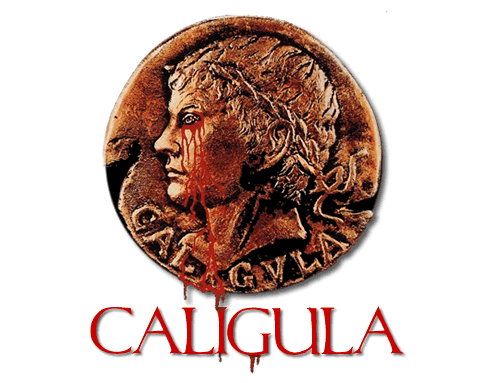
The iconic poster art for Caligula
Still reeling from that experience (even a veteran consumer of all things cult can only take so much gratuitous sex and violence before reaching the point of saturation), my attention was drawn to the supplementary material which was– most thoughtfully - enclosed. Some context was much needed, since the entire project left me flabbergasted, on account of some elements that did work in my eyes. It wasn't a complete failure by any means. With some judicious editing and/or reshoots this could have actually been a quality epic, not just the mere exploitation film hiding underneath a thin veneer of classiness that it was. But naturally this is not an article on the fascinating story of the troubled production of Caligula, just an entry point.
So I asked myself who the originator was. Who penned the screenplay? Surely his or her vision must have been meddled with? As it turned out, it had been. The unlucky figure as presented in the making off documentary however, seemed anything but a poor victim of the whims of big shot producers. Au contraire, he was the living embodiment of the urbane, confident, witty, perceptive, fiercely intelligent patrician. Thoroughly American (whatever that means) in many ways, yet in others wholly alien to a non-American’s perception of those who are. Needless to say, I found much merit (mustn't forget merriment) in what he had to say, and how he said it. A bonafide raconteur, that Gore. Yet I didn’t pursue further, at least not at that time.
Gore Vidal would occasionally crop up afterwards, and I would take note, still firmly entrenched in the world of cinema. The time wasn't right. When I finally did contract the reading virus a couple of years later, I decided to go the whole hog and acquired the gigantic, indispensable United States: Essays 1952-1992. That’s where it clicked. In more ways than one, It was a touchstone tome for me, further deepening my interest in the man. Ravenously, I would seek out documentaries and interviews with him, familiarising myself with many aspects of his life.
When I heard that Jay Parini, a decade-long friend of Gore's, was about to publish an unvarnished biography on him (easier to do when one's subject has passed), my reaction was one of both excitement and wariness. After all, being too close to one’s subject, does tend to distort how the biographer decides to treat his subject. Unpleasant facts might be left out (the threat of hagiography is a painfully real one in these cases) or, perhaps worse, in a fit of misplaced self-importance, the man might give himself a more prominent role than merited or, indeed, needed from his hypothetical audience.
Luckily, Parini has avoided these pitfalls, and has delivered a soberly frank, yet intimate portrayal of this complicated, difficult man he knew and admired. Wisely, personal anecdotes are kept limited to elegant one or two page prologues to each chapter. Having had full access to Vidal’s papers and decades worth of interviews with those who knew Vidal best at his disposal, Parini’s will probably be the definitive biography for some time to come. It hits all the marks it needed to hit admirably well. The good, the bad, the ugly and the beautiful, it’s all here, and the result is an about as honest and complete of an account we’re likely to get for the time being.
Giving concise shape to such a long, (often intentionally) tumultuous life populated with a vast array of celebrities, writers, politicians and even royalty is no mean feat. Arguably, the crafting of his multifaceted life by his own specifications was Vidal’s greatest accomplishment, which Parini realises all too well, and subsequently gives ample voice to.

Gore's villa in Ravello, where he lived with his partner Howard for decades
One element that especially delighted me and is important to note was Parini’s literary criticism of Vidal’s whole oeuvre both in fiction (novels, plays, screenplays) as non-fiction, which is interspersed with the biographical narrative. For example, he puts forth the to some controversial argument (even to Gore himself) that the essay was the form Vidal excelled at the most, which I (having only read the essays) am probably not going to disagree with when I do get to his fiction. They are absolutely brilliant gems of erudition and piercing wit.
Now the sole question which remains is this: who will take up the mantle, and fill the void Vidal left behind? Let’s hope the wait won’t be extended much longer.
- Gore Vidal
Vidal's favourite photograph of himself, by Jane Brown
My first inkling of the existence of a writer going by the exotic sounding name of Gore Vidal (1925 - 2012) came about in a rather circuitous, some would say unorthodox, manner. An odd 8 years ago this tender youth – and budding film geek with a penchant for all things transgressive – got his paws on the fully uncut, 156 minute version of the infamous Caligula (1979), that gloriously lurid piece of erotica/exploitation that has maintained a loyal cult following to this day.
The iconic poster art for Caligula
Still reeling from that experience (even a veteran consumer of all things cult can only take so much gratuitous sex and violence before reaching the point of saturation), my attention was drawn to the supplementary material which was– most thoughtfully - enclosed. Some context was much needed, since the entire project left me flabbergasted, on account of some elements that did work in my eyes. It wasn't a complete failure by any means. With some judicious editing and/or reshoots this could have actually been a quality epic, not just the mere exploitation film hiding underneath a thin veneer of classiness that it was. But naturally this is not an article on the fascinating story of the troubled production of Caligula, just an entry point.
So I asked myself who the originator was. Who penned the screenplay? Surely his or her vision must have been meddled with? As it turned out, it had been. The unlucky figure as presented in the making off documentary however, seemed anything but a poor victim of the whims of big shot producers. Au contraire, he was the living embodiment of the urbane, confident, witty, perceptive, fiercely intelligent patrician. Thoroughly American (whatever that means) in many ways, yet in others wholly alien to a non-American’s perception of those who are. Needless to say, I found much merit (mustn't forget merriment) in what he had to say, and how he said it. A bonafide raconteur, that Gore. Yet I didn’t pursue further, at least not at that time.
Gore Vidal would occasionally crop up afterwards, and I would take note, still firmly entrenched in the world of cinema. The time wasn't right. When I finally did contract the reading virus a couple of years later, I decided to go the whole hog and acquired the gigantic, indispensable United States: Essays 1952-1992. That’s where it clicked. In more ways than one, It was a touchstone tome for me, further deepening my interest in the man. Ravenously, I would seek out documentaries and interviews with him, familiarising myself with many aspects of his life.
When I heard that Jay Parini, a decade-long friend of Gore's, was about to publish an unvarnished biography on him (easier to do when one's subject has passed), my reaction was one of both excitement and wariness. After all, being too close to one’s subject, does tend to distort how the biographer decides to treat his subject. Unpleasant facts might be left out (the threat of hagiography is a painfully real one in these cases) or, perhaps worse, in a fit of misplaced self-importance, the man might give himself a more prominent role than merited or, indeed, needed from his hypothetical audience.
Luckily, Parini has avoided these pitfalls, and has delivered a soberly frank, yet intimate portrayal of this complicated, difficult man he knew and admired. Wisely, personal anecdotes are kept limited to elegant one or two page prologues to each chapter. Having had full access to Vidal’s papers and decades worth of interviews with those who knew Vidal best at his disposal, Parini’s will probably be the definitive biography for some time to come. It hits all the marks it needed to hit admirably well. The good, the bad, the ugly and the beautiful, it’s all here, and the result is an about as honest and complete of an account we’re likely to get for the time being.
Giving concise shape to such a long, (often intentionally) tumultuous life populated with a vast array of celebrities, writers, politicians and even royalty is no mean feat. Arguably, the crafting of his multifaceted life by his own specifications was Vidal’s greatest accomplishment, which Parini realises all too well, and subsequently gives ample voice to.
Gore's villa in Ravello, where he lived with his partner Howard for decades
One element that especially delighted me and is important to note was Parini’s literary criticism of Vidal’s whole oeuvre both in fiction (novels, plays, screenplays) as non-fiction, which is interspersed with the biographical narrative. For example, he puts forth the to some controversial argument (even to Gore himself) that the essay was the form Vidal excelled at the most, which I (having only read the essays) am probably not going to disagree with when I do get to his fiction. They are absolutely brilliant gems of erudition and piercing wit.
Now the sole question which remains is this: who will take up the mantle, and fill the void Vidal left behind? Let’s hope the wait won’t be extended much longer.

April 13, 2025
I've always been interested in Gore Vidal. I got to see him speak a few years before he passed, and I could have listened to him for hours. Of all the biographies written on him, I specifically chose this one because it was written by Jay Parini a close friend of his and it was published after Gore's death. The two only became friends in the 80s, and Gore had asked Parini to take over writing his biography from another author. Parini covers pretty much everything: the fueds, the Camelot and Hollywood years, lawsuits, political ambitions, relationships, and an examination of Gore's written work.
I like Parini's writing and I like the little personal vignettes he shares between the chapters. 'Empire of Self' is an appropriate title. It's intelligent, witty, catty, and touching. And I loved every bit of it.
I like Parini's writing and I like the little personal vignettes he shares between the chapters. 'Empire of Self' is an appropriate title. It's intelligent, witty, catty, and touching. And I loved every bit of it.

November 6, 2015
During his lifetime, Gore Vidal established a fine reputation as a very versatile, inventive writer. Novels, tele-scripts (in the early days of TV in the 1950s, Vidal made a name for himself as a scriptwriter for many of the live teledramas of the era), movie scripts, plays (one of them, "The Best Man" was a Broadway hit in 1960), and essays. Vidal was also a wit, polemicist, gadfly, and socio-political critic unlike any other. Whether you encountered him on any of the popular TV talk shows (e.g. The Dick Cavett Show or The Tonight Show with Johnny Carson), documentaries in which his considerable knowledge of politics, history & literature were given free rein, public lectures and interviews he gave, or his books, Gore Vidal was someone you would not soon forget.
Jay Parini, who had known Vidal over the last 30 years of his life, has crafted a first class, rich, comprehensive, and well-rounded biography. This is a work that was developed throughout Parini's relationship with Vidal. Indeed, Vidal had granted Parini full access to all his papers and access to many of Vidal's closest friends in the literary, political, and cinematic worlds. And for Gore Vidal --- whose writing career extended from the publication of his first novel ("Williwaw" based on his wartime experiences with the U.S. Army in the Aleutian Islands) in 1946 to the publication of his last novel, "The Golden Age", in 2000 ---- his circle of friends was amazingly extensive, from Amelia Earhart (who had a close relationship with his father, a West Point graduate and pilot who was a pioneer in the aviation industry and had worked for FDR in the early days of the New Deal), to Eleanore Roosevelt, John & Jacqueline Kennedy, Tennessee Williams, Paul Newman & Joanne Woodward, Anthony Quinn, Claire Bloom, Susan Sarandon & Tim Robbins, Anthony Burgess, Federico Fellini, Italo Calvino, Christopher Isherwood, Andre Gide, Thomas Mann, Norman Mailer, Princess Margaret, and Hillary Clinton. Just to mention a few.
As a Gore Vidal fan of many years standing, I confess to not having given much thought to his personal life while he was alive. His novels, essays, and his public persona are what drew me to this remarkable man. He was the type of person who was so amazingly erudite, funny, and astute that I'd find myself thinking about some of the issues he touched upon in public forums and interviews long after being exposed to them. This is not to suggest that I agreed or agree with all of Gore Vidal's positions on life, politics, history or literature. BUT he had a personality and a ferocious, far-reaching brilliance that never ceased to fascinate me. He was never dull. Indeed, I was fortunate enough to have once met Gore Vidal at an interview he gave at the Smithsonian Institution about his life and career at the time "The Golden Age" was published. After the interview, he autographed my copy of his novel and all I can remember about the experience was how awestruck I was by his presence.
The biography traces the arc of Vidal's life from his birth at the cadet hospital at West Point in 1925 (where his father was the U.S. Army's first instructor of aeronautics), through his formative years in Washington DC (where he spent considerable time with his maternal grandparents; his grandfather Thomas Gore, had been a Senator from Oklahoma, and played a considerable influence on the young Gore), prep school at Exeter, his wartime service, and his steady growth and development as a writer from the early postwar years to the early 21st century.
One of the best features of "EMPIRE OF SELF: A Life of Gore Vidal" are the asides that Parini includes after each chapter which contain "brief first-person vignettes" and "recollections of moments" in Parini's friendship with Vidal that are especially illuminating about Vidal on a deeply personal level. Anyone with even the slightest interest or curiosity about Gore Vidal will love this book. I highly recommend it.
Jay Parini, who had known Vidal over the last 30 years of his life, has crafted a first class, rich, comprehensive, and well-rounded biography. This is a work that was developed throughout Parini's relationship with Vidal. Indeed, Vidal had granted Parini full access to all his papers and access to many of Vidal's closest friends in the literary, political, and cinematic worlds. And for Gore Vidal --- whose writing career extended from the publication of his first novel ("Williwaw" based on his wartime experiences with the U.S. Army in the Aleutian Islands) in 1946 to the publication of his last novel, "The Golden Age", in 2000 ---- his circle of friends was amazingly extensive, from Amelia Earhart (who had a close relationship with his father, a West Point graduate and pilot who was a pioneer in the aviation industry and had worked for FDR in the early days of the New Deal), to Eleanore Roosevelt, John & Jacqueline Kennedy, Tennessee Williams, Paul Newman & Joanne Woodward, Anthony Quinn, Claire Bloom, Susan Sarandon & Tim Robbins, Anthony Burgess, Federico Fellini, Italo Calvino, Christopher Isherwood, Andre Gide, Thomas Mann, Norman Mailer, Princess Margaret, and Hillary Clinton. Just to mention a few.
As a Gore Vidal fan of many years standing, I confess to not having given much thought to his personal life while he was alive. His novels, essays, and his public persona are what drew me to this remarkable man. He was the type of person who was so amazingly erudite, funny, and astute that I'd find myself thinking about some of the issues he touched upon in public forums and interviews long after being exposed to them. This is not to suggest that I agreed or agree with all of Gore Vidal's positions on life, politics, history or literature. BUT he had a personality and a ferocious, far-reaching brilliance that never ceased to fascinate me. He was never dull. Indeed, I was fortunate enough to have once met Gore Vidal at an interview he gave at the Smithsonian Institution about his life and career at the time "The Golden Age" was published. After the interview, he autographed my copy of his novel and all I can remember about the experience was how awestruck I was by his presence.
The biography traces the arc of Vidal's life from his birth at the cadet hospital at West Point in 1925 (where his father was the U.S. Army's first instructor of aeronautics), through his formative years in Washington DC (where he spent considerable time with his maternal grandparents; his grandfather Thomas Gore, had been a Senator from Oklahoma, and played a considerable influence on the young Gore), prep school at Exeter, his wartime service, and his steady growth and development as a writer from the early postwar years to the early 21st century.
One of the best features of "EMPIRE OF SELF: A Life of Gore Vidal" are the asides that Parini includes after each chapter which contain "brief first-person vignettes" and "recollections of moments" in Parini's friendship with Vidal that are especially illuminating about Vidal on a deeply personal level. Anyone with even the slightest interest or curiosity about Gore Vidal will love this book. I highly recommend it.

November 6, 2015
 BOTW
BOTW http://www.bbc.co.uk/programmes/b06nn7cw
Description: The life of Gore Vidal was an amazingly full one; a life of colourful incident, famous people and lasting achievements that calls out for careful evocation and examination. Through Jay Parini's eyes and words comes an accessible, entertaining story that puts the life and times of one of the great American figures of the post-war era into context, that introduces the author to a generation who didn't know him before and looks behind-the-scenes at the man and his work in frank ways never possible before his death. Parini, provided with unique access to Vidal's life and his papers, excavates buried skeletons, but never loses sight of his deep respect for Vidal and his astounding gifts.
 Parini recalls his first encounter with Vidal, and relates a priviliged but lonely childhoodGore goes to war and emerges with a first novel.Lacklustre reviews of The City and The Pillar send Vidal into retreat in Europe. Vidal starts writing for the small screen and becomes a star at churning out TV drama Vidal finds fame at last with Myra Breckinridge
July 30, 2016
Senryu Review:
Bloated windbag or
raconteur and searing left
critic? You decide.
Bloated windbag or
raconteur and searing left
critic? You decide.

May 13, 2016
I have read a lot of literary biographies, in fact biographies of writers are the ones I read and like the most. And this book is one of the best I have ever read.
I dislike biographies of writers which spend most of their time revealing plots of the novels written and critically examining the books that have been written. I would rather read the books myself to find these matters out. Parini does a masterful job of sticking to the biographical facts. While he obviously mentions Vidal's books, he devotes the vast majority of the book to telling his life story. And what a life Vidal had. His many friends included Paul Newman, Johnny Carson, Princess Margaret, Tennessee Williams, Leonard Bernstein and many others. And then there were his famous feuds with Truman Capote, Norman Mailer and William F. Buckley.
For several decades, Vidal was ubiquitous. He was a very prolific writer, so there almost always seemed to be a book of his in the bookstores. And he was on television almost constantly, especially on Johnny Carson, Dick Cavett, and Merv Griffin's talk shows. He also wrote many film and TV screenplays.
Vidal was in many ways a nasty sort of guy, but his intelligence and wit have rarely ever been matched and this comes across wonderfully in this book. Highly recommended.
I dislike biographies of writers which spend most of their time revealing plots of the novels written and critically examining the books that have been written. I would rather read the books myself to find these matters out. Parini does a masterful job of sticking to the biographical facts. While he obviously mentions Vidal's books, he devotes the vast majority of the book to telling his life story. And what a life Vidal had. His many friends included Paul Newman, Johnny Carson, Princess Margaret, Tennessee Williams, Leonard Bernstein and many others. And then there were his famous feuds with Truman Capote, Norman Mailer and William F. Buckley.
For several decades, Vidal was ubiquitous. He was a very prolific writer, so there almost always seemed to be a book of his in the bookstores. And he was on television almost constantly, especially on Johnny Carson, Dick Cavett, and Merv Griffin's talk shows. He also wrote many film and TV screenplays.
Vidal was in many ways a nasty sort of guy, but his intelligence and wit have rarely ever been matched and this comes across wonderfully in this book. Highly recommended.

April 11, 2018
I wish a better, less self-conscious, writer had tackled this biography. Parini's lack of insight is just plain annoying.
Why describe Paul Newman's attractiveness as his "(vaguely feminine) beauty"? Cannot a person acknowledge the beauty of Paul Newman without adding an unnecessary heterosexual gloss?
I could go on, but there were many of these small moments, interspersed with slices of cruelty and a generous appreciation of Vidal's many books.
Why describe Paul Newman's attractiveness as his "(vaguely feminine) beauty"? Cannot a person acknowledge the beauty of Paul Newman without adding an unnecessary heterosexual gloss?
I could go on, but there were many of these small moments, interspersed with slices of cruelty and a generous appreciation of Vidal's many books.

May 8, 2015
Empire of Self is a stunner. Jay Parini has managed to collect and share all the most exciting highlights of Gore Vidal’s life, which is no easy feat as the highlights abound. The rich and interesting life of Vidal seems almost unreal—it’s as if from the day he was born each moment he lived was a story in and of itself. Gore Vidal knew everyone and everyone knew him, for better or worse. Parini’s personal experiences with Gore craft the book into a loving testament to Vidal’s character, and his skill as a biographer ensure that the portrayal is balanced and enticing. I left this book with a longing for the glamour of an era of publishing and writing that is long past, and a huge, and impossible to fulfill, desire to have a cocktail with Gore Vidal, if only to see him wind up and let loose. Empire of Self is a wonderful biography and will certainly please both fans of Gore Vidal and fans of the era that he was essential in shaping.
- Sarah E. Doubleday Marketing Department
- Sarah E. Doubleday Marketing Department

October 14, 2015
About as fair a biography as we are apt to receive on Gore Vidal--which isn't to say it is fair enough. Mr. Parini eschews the more formal, comprehensive approach taken by Fred Kaplan in his heftier, earlier Gore Vidal, preferring instead to give a series of brief surveys of the more notable incidents and acquaintances of Vidal's life. Unlike Kaplan, however Parini was a friend and common acquaintance of Vidal's over the last 3 decades (give or take) of his life, and that lends his anecdotes and recollected conversations a warm, compelling touch.
On the other hand, Parini's close social proximity to Vidal, especially during his waning years, colors his account at times with both pity (for a friend whose greatness has passed) and resentment (because that friend's greatness was suffocating). This leads to puzzling remarks such as, for example, his comments concerning Vidal's blistering 1967 takedown-cum-essay on the Kennedys, "The Holy Family". Remarking on a quote from JFK described therein, Parini writes "Did Kennedy really say that? Probably not. But I have no doubt Gore believed he heard it from the emperor's lips." Not to put too fine a point on it, but what on earth is Parini's basis for doubting the veracity of the quote? He wasn't there, and hadn't talked to anyone who was. But his friendship with Vidal, and his experience of many nights observing the old man drinking Scotch by the bottle and rambling drunkenly, saying outrageous things, allows him to casually dismiss assertions, even those predating his acquaintance with Vidal, that make him uncomfortable. Of course in 1967 Vidal wasn't yet a drunken old man, but a writer and bon vivant in his prime.
The other issue that bedevils Parini's assessment of Vidal is clearly sexual. Parini's attitudes toward sex, marriage, romance, and love, are (we can reasonably infer) clearly within the norms of bourgeois American acceptability. Gore Vidal's were not. And so it is not surprising when Parini remarks that "Unlike most others on this planet, Gore failed to connect sex and love," which is an accurate observation. But when he follows by describing this as "certainly a personality deformation", he goes a step too far. Logically, there is no connection between sex and love, and the cultural norms that link the two are only a few centuries old. For most of the history of homo sapiens, sex was about making babies, nothing more. Women were little better than cattle, and indeed, were the center of property transactions between families and tribes, the ratifications of which provided the origins of "marriage". The Romantic period of the last few centuries lingers yet, on life support, though the increasing ability of women to have sex for pleasure without the unpleasant side-effect (logistically, and from my perspective, ethically) of making a new human does not bode well for its long-term prospects.
Parini does the best that he can here, I suspect. Working through both unresolved difficulties in his friendship with Vidal, as well as the inconvenient reality that he is naturally unsympathetic to many of Vidal's views, underscores a fact that Vidal's patrician, haughty manner makes it easy to sometimes forget: he was a radical, he was ahead of his time, and, to paraphrase Heinlein, he was a super-genius who made his own rules about sex and everything else. We mortals who look upon his works need not do so in despair, but in gratitude. Vidal was right most of the time, and even on those rare occasions when he wasn't, he was funny. Would that the rest of us could do as well.
On the other hand, Parini's close social proximity to Vidal, especially during his waning years, colors his account at times with both pity (for a friend whose greatness has passed) and resentment (because that friend's greatness was suffocating). This leads to puzzling remarks such as, for example, his comments concerning Vidal's blistering 1967 takedown-cum-essay on the Kennedys, "The Holy Family". Remarking on a quote from JFK described therein, Parini writes "Did Kennedy really say that? Probably not. But I have no doubt Gore believed he heard it from the emperor's lips." Not to put too fine a point on it, but what on earth is Parini's basis for doubting the veracity of the quote? He wasn't there, and hadn't talked to anyone who was. But his friendship with Vidal, and his experience of many nights observing the old man drinking Scotch by the bottle and rambling drunkenly, saying outrageous things, allows him to casually dismiss assertions, even those predating his acquaintance with Vidal, that make him uncomfortable. Of course in 1967 Vidal wasn't yet a drunken old man, but a writer and bon vivant in his prime.
The other issue that bedevils Parini's assessment of Vidal is clearly sexual. Parini's attitudes toward sex, marriage, romance, and love, are (we can reasonably infer) clearly within the norms of bourgeois American acceptability. Gore Vidal's were not. And so it is not surprising when Parini remarks that "Unlike most others on this planet, Gore failed to connect sex and love," which is an accurate observation. But when he follows by describing this as "certainly a personality deformation", he goes a step too far. Logically, there is no connection between sex and love, and the cultural norms that link the two are only a few centuries old. For most of the history of homo sapiens, sex was about making babies, nothing more. Women were little better than cattle, and indeed, were the center of property transactions between families and tribes, the ratifications of which provided the origins of "marriage". The Romantic period of the last few centuries lingers yet, on life support, though the increasing ability of women to have sex for pleasure without the unpleasant side-effect (logistically, and from my perspective, ethically) of making a new human does not bode well for its long-term prospects.
Parini does the best that he can here, I suspect. Working through both unresolved difficulties in his friendship with Vidal, as well as the inconvenient reality that he is naturally unsympathetic to many of Vidal's views, underscores a fact that Vidal's patrician, haughty manner makes it easy to sometimes forget: he was a radical, he was ahead of his time, and, to paraphrase Heinlein, he was a super-genius who made his own rules about sex and everything else. We mortals who look upon his works need not do so in despair, but in gratitude. Vidal was right most of the time, and even on those rare occasions when he wasn't, he was funny. Would that the rest of us could do as well.

October 30, 2025
Well-organized, full of stories and inside material (the biographer and Vidal were friends), and containing may views of Nin, Mailer, T. Williams, Capote, the Kennedy clan, and others. It's not a book I'll likely need to read again, or want to, as you can only spend so much time in the company of a grandee, a narcissist (a word Parini uses often) and an alcoholic, someone who had a much-too-generous view of his contribution to the form of the novel. (Sometimes echoed by Parini, but you can feel the strain.) It also gives a good idea of struggles and battles in the 1960s and 1970s. Worth the time -- once.

November 6, 2015
From BBC radio 4 - Book of the Week:
The authorised behind-the-scenes biography of one of America's great and most under-rated man of letters, the cosmopolitan and wickedly satirical Vidal, from a devoted yet candid old friend.
In Episode 1, the author Jay Parini recalls his first encounter with Gore and describes a privileged, lonely childhood and the birth of the political, social and sexual interests that would last a lifetime.
In Episode 3, despite commercial success, lacklustre reviews of The City and The Pillar send Gore in retreat to Europe where he meets Tennessee Williams - soon to become his great friend.
In Episode 4, Gore turns to writing for the small screen and becomes a star turn at churning out TV drama. Meanwhile, his novels continue to flow but his political ambitions are thwarted.
In Episode 5, Gore finds his largest audience yet, with his ground-breaking novel Myra Breckinridge. He leaves the US and establishes a life in Italy in his dream home on the Amalfi Coast.
Written by Jay Parini
Read by Toby Jones
Abridged by Eileen Horne
Produced and directed by Clive Brill
A Brill production for BBC Radio 4.
http://www.bbc.co.uk/programmes/b06nn7cw
The authorised behind-the-scenes biography of one of America's great and most under-rated man of letters, the cosmopolitan and wickedly satirical Vidal, from a devoted yet candid old friend.
In Episode 1, the author Jay Parini recalls his first encounter with Gore and describes a privileged, lonely childhood and the birth of the political, social and sexual interests that would last a lifetime.
In Episode 3, despite commercial success, lacklustre reviews of The City and The Pillar send Gore in retreat to Europe where he meets Tennessee Williams - soon to become his great friend.
In Episode 4, Gore turns to writing for the small screen and becomes a star turn at churning out TV drama. Meanwhile, his novels continue to flow but his political ambitions are thwarted.
In Episode 5, Gore finds his largest audience yet, with his ground-breaking novel Myra Breckinridge. He leaves the US and establishes a life in Italy in his dream home on the Amalfi Coast.
Written by Jay Parini
Read by Toby Jones
Abridged by Eileen Horne
Produced and directed by Clive Brill
A Brill production for BBC Radio 4.
http://www.bbc.co.uk/programmes/b06nn7cw

November 22, 2020
Gore Vidal was one of the most interesting people in the 20th Century. It seemed he knew everybody, slept with every homosexual author you've ever read, traveled the globe, took on the military industrial complex, had larger than life feuds with other luminaries, may or may not have been ejected from the Kennedy White House, was famously punched by Norman Mailer, had a fabulous villa in Italy overlooking the sea, appeared in movies, and Television talk shows, ran for Senator in California and oh yeah . . . wrote prolifically; novels, movie scripts, Television shows, plays and essays - all the while drinking whiskey in quantities that would kill a lesser man. Openly bi-sexual in an era where Gays were deeply closeted, Vidal was a genius at self-promotion, never missing an opportunity to be on T.V., in a movie, on the pages of journals, on the stage as either author or actor, and on the best seller list. He hob knobed with Amelia Erhart, JFK, Jackie Onassis, Jack Kerouac, Tennessee Williams and myriad other famous authors, politicians, ballet dancers, poets, and even just plain admirers. He cut through society with a devastating wit, eg: When his arch-enemy Truman Capote died he called it "a good career move". A complex man he was famously thin-skinned. His life was a riot of friends, enemies, travel, anonymous sex and disciplined research and writing. The demise of such a man had to be positively Shakespearean, of course. This was a man who sucked the marrow out of life.
January 3, 2016
this book was the third biography I read in Dec 2015. It is decently written but lacks drive largely due to the insipidity (in there such a word?) of the topic. Mr. Parini knew Vidal, and admired him, which comes across clearly, but the tome lacked "oomph"-- I mean, how many times can you say Vidal was bright, witty, handsome, etc etc, but fail to provide any examples, much less insight? Nevertheless, I am interested in following up with some of Vidal's later works (e.g., Burr) having read "Julian" previously. The other biographies I read in December were the first volume of James Kaplan's biography of Frank Sinatra (Frank: The Voice) which introduced me to the apparent current vogue of biography-- lacking much research and quoting huge sections of other biographies. I think I will pass on Frank: The Chairman, which sounds like more of the same. The other biography I read (The Life and Times of Mickey Rooney) used a similar style. Think I am done with biographies for now!

August 4, 2021
3.5* rounded up

September 3, 2016
Gore Vidal’s greatest work of art was his own life. He certainly created many great fictional characters — the pagan emperor Julian and bisexual Myra Breckinridge, among others — but none matched the expanse and variety of his own. Biographer Jay Parini, a close friend for decades (no mean achievement in itself) is perfectly equipped to capture both Vidal’s massive egoism and substantial achievement.
Early in his career, Vidal had an uncanny, Zelig-like ability to show up at just the right place and time to advance his literary career and feed his voracious need for attention. His play The Best Man coincided with the Kennedy presidency, while the best of his historical novels, Burr, caught the zeitgeist of Watergate.
But his novels — and they are many and lengthy — have not aged well and remain little read. The reason, Parini makes clear, is the same that so many of his essays live on: a literary gift that rarely escaped the gravity of his own narcissism. Vidal could hurl down brilliant apercus from Olympian heights but not invest fully in fictional characters that weren’t disguised versions of himself. Many of his essays, on the other hand, are deeply insightful, exquisitely phrased, and often genuinely witty. (Vidal, in my view, never matched John Updike as a writer of fiction, but I loved his cutting comment: “Might Updike not have allowed one blind noun to slip free of its seeing-eye adjective?”)
Vidal wrote large and lived larger: novels, essays, political commentary, satire, Broadway plays and Hollywood screenplays. (His involvement with the alleged homoerotic subtext of Ben Hur is the stuff of legend). Only the short story escaped his attention. He presided over Edgewater, an estate in the Hudson River valley, with his lifelong companion Howard Austen, and later in one of literature’s most celebrated abodes, a villa hanging over a cliff on the Amalfi coast in Ravello, Italy. If you were anybody of note who traveled to Europe in the 1980s and 1990s, odds were good that you would receive an invitation to dine with Vidal in Rome or Ravello.
Vidal traveled incessantly, pursued sex with anonymous young men everywhere, ate and drank prodigiously, happily appeared on television talk shows, and managed to meet just about everyone who had celebrity, recognition, royalty, or a literary reputation. The book is a namedropper’s delight. Parini makes clear how Vidal parlayed a tenuous connection to the Kennedys into publicity, essays, and malicious gossip — long after he had become persona non grata for bad behavior at a White House party and a nasty feud with Robert Kennedy.
Yet no matter how exhausted or hungover from his socializing, Vidal usually managed to sit down each morning and write for two to four hours each day, whether at home or a hotel suite. The result was an immense body of work, with his masterful essays rising to the heights of critical attention; his collection United States: Essays 1952-1992 runs to 1,300 pages. By contrast, his satiric novels — Duluth, Live from Golgotha are only readable for their witticisms. Even the best of the historical novels— Julian, Burr, and Lincoln — contain too many windy polemical speeches alongside more powerful narrative passages.
In his later years, alcohol and ill-health inevitably took their toll, and after 9/11, Vidal’s acerbic criticism on the failures of American democracy became increasingly cranky and conspiracy-driven. But he never stopped talking, drinking, and writing.
Like his contemporary, Norman Mailer, with whom Vidal feuded and reconciled, it’s unclear how much the legend of the life will continue to obscure the body of his work.
Early in his career, Vidal had an uncanny, Zelig-like ability to show up at just the right place and time to advance his literary career and feed his voracious need for attention. His play The Best Man coincided with the Kennedy presidency, while the best of his historical novels, Burr, caught the zeitgeist of Watergate.
But his novels — and they are many and lengthy — have not aged well and remain little read. The reason, Parini makes clear, is the same that so many of his essays live on: a literary gift that rarely escaped the gravity of his own narcissism. Vidal could hurl down brilliant apercus from Olympian heights but not invest fully in fictional characters that weren’t disguised versions of himself. Many of his essays, on the other hand, are deeply insightful, exquisitely phrased, and often genuinely witty. (Vidal, in my view, never matched John Updike as a writer of fiction, but I loved his cutting comment: “Might Updike not have allowed one blind noun to slip free of its seeing-eye adjective?”)
Vidal wrote large and lived larger: novels, essays, political commentary, satire, Broadway plays and Hollywood screenplays. (His involvement with the alleged homoerotic subtext of Ben Hur is the stuff of legend). Only the short story escaped his attention. He presided over Edgewater, an estate in the Hudson River valley, with his lifelong companion Howard Austen, and later in one of literature’s most celebrated abodes, a villa hanging over a cliff on the Amalfi coast in Ravello, Italy. If you were anybody of note who traveled to Europe in the 1980s and 1990s, odds were good that you would receive an invitation to dine with Vidal in Rome or Ravello.
Vidal traveled incessantly, pursued sex with anonymous young men everywhere, ate and drank prodigiously, happily appeared on television talk shows, and managed to meet just about everyone who had celebrity, recognition, royalty, or a literary reputation. The book is a namedropper’s delight. Parini makes clear how Vidal parlayed a tenuous connection to the Kennedys into publicity, essays, and malicious gossip — long after he had become persona non grata for bad behavior at a White House party and a nasty feud with Robert Kennedy.
Yet no matter how exhausted or hungover from his socializing, Vidal usually managed to sit down each morning and write for two to four hours each day, whether at home or a hotel suite. The result was an immense body of work, with his masterful essays rising to the heights of critical attention; his collection United States: Essays 1952-1992 runs to 1,300 pages. By contrast, his satiric novels — Duluth, Live from Golgotha are only readable for their witticisms. Even the best of the historical novels— Julian, Burr, and Lincoln — contain too many windy polemical speeches alongside more powerful narrative passages.
In his later years, alcohol and ill-health inevitably took their toll, and after 9/11, Vidal’s acerbic criticism on the failures of American democracy became increasingly cranky and conspiracy-driven. But he never stopped talking, drinking, and writing.
Like his contemporary, Norman Mailer, with whom Vidal feuded and reconciled, it’s unclear how much the legend of the life will continue to obscure the body of his work.
February 5, 2016
Read it only for LGBT references. I guess it was all about semantics for Gore.

April 27, 2023
It can be exhausting reading about one of the most narcissistic people to ever walk the Earth...but unlike Donald Trump, this man had a powerful intellect and an ability to write...so I'll forgive him. Exhaustive but intense biography, and it doesn't steer from his complicated self-image. Well done.

July 9, 2018
A very good biography. It's written by a friend of his, meaning the author knows his subject well. Apparently Vidal was a bit of a handful, and his pal has no problem acknowledging that. He lived through some eventful times and usually managed to be in the center of it all. He had thin skin and a good taste in enemies (like that steaming pile of shit Mailer), so obviously had the best feuds. I don't think I've ever actually read any of his novels, and probably won't, but that didn't lessen my enjoyment of this at all.

November 16, 2015
The best parts of “Empire of Self” are the brief interludes between chapters, when we are in the moment with Gore Vidal and his friend Jay Parini. There we can see, by turns, the imperious Gore and the charming and friendly Gore — amusing and provocative, and also a kind of emperor, lording it over others. This novelist, essayist, playwright and screenwriter, who saw himself in the days of live television as the king of hacks — as well as a scintillating guest on the David Susskind, Jack Paar and Johnny Carson talk shows — can easily be depicted as a narcissist. After all, he did say that the world would be a much better place if only it would listen to him. Perhaps he was joking, but he acted as if he meant it.
And why not? He had the credentials: He grew up reading Roman history to his blind grandfather, a senator from Oklahoma. Vidal was kin to the American ruling class via the Kennedys. He wrote grand historical novels about the American republic turned empire. He made a credible run as a Democrat for Congress in an overwhelmingly Republican district in upstate New York. Always a nonconformist, Vidal had no time for college. While his Exeter classmates took their cues from Harvard professors, Vidal enlisted in the Army. Before the age of 21, he had made a novel, “Williwaw,” out of his time in the Aleutians. He was slim, handsome and powerfully attractive to women and men.
What a subject! The biographer has all the elements of a great story and a bang-up title, and yet, as Rebecca West said of her gifted husband, with everything in place to become a man of genius, Henry Andrews just did not tick over. The same can be said of Parini’s biography. When he is not writing those energetic passages about Vidal’s badinage, the biographer is too often dutiful and dull. I regret to say I’m reminded of what a reviewer said about my Norman Mailer biography, calling it “too fair to be really interesting.” So it is that we get the conventional wisdom: “Burr,” “Lincoln” and “Julian” constitute Vidal’s claim to greatness in the novel form, and though much else is worthy, it wouldn’t appear on “Masterpiece Theatre.”
Perhaps if this were the first biography of Vidal, Parini’s balancing act would be commendable. But Fred Kaplan has already published that book, which Parini calls “sturdy and intelligent.” I don’t know what to think about those words. Are they a compliment, or Parini’s pat on the head for his understudy? Kaplan took the job while Vidal was alive after Parini decided not to accept Vidal’s invitation to step in for the ailing first choice, Walter Clemons.
Kaplan’s biography did not fare so well with reviewers — or with Vidal himself, for that matter. Too much detail was the complaint, and that is certainly the case. But Parini’s antidote is to give Kaplan’s account a trim job, so that we learn rather less about Vidal’s sexuality, his meetings with John Kennedy and many other matters that Kaplan details. Parini gets no closer than Kaplan to Vidal’s character and accomplishments.
How many times do we have to hear that Vidal disliked the preening Truman Capote, or that feisty Mailer and Vidal were feuding? Characters are introduced several times in the narrative, as if Parini is certain his readers have short attention spans. Too often subjects are mentioned but never pursued. What Vidal thought is never revealed, and if the biographer does not know, then that, too, has to factor into the prose. Otherwise, narrative becomes simply a report of one damn thing after another.
The elegant Vidal would have winced at the cliches and awkward phrasing: “Now Capote’s malicious lies poured kerosene on the flames of Gore’s continuing hurt feelings about his relationship to the Kennedys.” How could you mention the Kennedys in such an ungainly sentence, I can imagine Vidal saying. We also have “the baton” passed to editor Gerald Howard, and other inane phrasings.
A check-in with Kaplan even casts doubt on “Empire of Self.” I was struck by how many women Vidal genuinely loved — even though he was gay and had the worst mother in the Western world. Of course Vidal had an enormous ego, but he had friends galore like Paul Newman and Joanne Woodward, and less famous people who weren’t his sycophants either.
Gore Vidal is a tough subject, and rare is the biographer who could match his cunning wit, but we need one who can distill Kaplan and Parini and write with at least some of the panache that Vidal was willing to expend not merely on his writing, but on so many of his public appearances. He did not hold back, and neither should his biographer.

September 10, 2026
Man, this was great but Vidal's life bums me out so much. He was never that great at anything but stuck his nose into it all so as to SEEM profound and important. When he just comes off as an angry, insecure loser. He never seemed to come to terms with his own sexuality or any of his own wants or needs besides satiating his ego. I generally vibed with his politics, rolled my eyes at his cultural opinions, and found his novels flat and ephemeral. Now I don't know if he's really known for much of anything except being a guy who was always around.
I did laugh at the part where he tried writing Kalki with a trans masc protagonist to mirror Myra Breckinridge but he couldn't wrap his head around the concept.
I did laugh at the part where he tried writing Kalki with a trans masc protagonist to mirror Myra Breckinridge but he couldn't wrap his head around the concept.

October 28, 2015
Poet, novelist and biographer Jay Parini (One Matchless Time: A Life of William Faulkner) has written an intimate, clear-eyed and authoritative biography of Gore Vidal (1925--2012). Parini's nearly 30-year friendship doesn't blind him to his friend's faults. "He could be cantankerous, testy, ill-mannered, a terrible snob, a drunken bore," writes Parini. But he was also "a man I admired and valued as a friend."
Vidal wrote two memoirs (Palimpsest in 1995, and Point to Point Navigation in 2006) but he wanted Parini to write his full biography. Parini agreed on the condition it would not be published in Vidal's lifetime. This freedom from interference allows Parini a more critical eye toward Vidal's novels, screenplays and essays. He's also unencumbered to sift out fiction from what Vidal presented as fact. (Parini believes Vidal wasn't blacklisted by reviewers after the publication of his groundbreaking 1948 gay novel The City and the Pillar; he just followed it up with a number of underwhelming novels.)
A charming narcissist ("He required a hall of mirrors for adequate reflection, and there was never enough," writes Parini), Vidal's colorful and volatile life was filled with fetes and feuds with celebrities, politicians and writers. His poised, witty and acerbic personality (catnip for TV talk shows that helped sell his more than 30 novels) hid his social insecurity. His life partner of 53 years, Howard Austen, was his diplomatic buffer with most people.
Empire of Self offers a fascinating and compelling portrait of Gore Vidal's many contradictions: an anti-Roosevelt Democrat, a gay man who believed "There were no homosexuals, only homosexual acts" and an enormously successful author with the thinnest of skins.
Jay Parini, a friend of three decades, provides insight into the real Gore Vidal in a compelling and richly detailed, warts-and-all biography.
Vidal wrote two memoirs (Palimpsest in 1995, and Point to Point Navigation in 2006) but he wanted Parini to write his full biography. Parini agreed on the condition it would not be published in Vidal's lifetime. This freedom from interference allows Parini a more critical eye toward Vidal's novels, screenplays and essays. He's also unencumbered to sift out fiction from what Vidal presented as fact. (Parini believes Vidal wasn't blacklisted by reviewers after the publication of his groundbreaking 1948 gay novel The City and the Pillar; he just followed it up with a number of underwhelming novels.)
A charming narcissist ("He required a hall of mirrors for adequate reflection, and there was never enough," writes Parini), Vidal's colorful and volatile life was filled with fetes and feuds with celebrities, politicians and writers. His poised, witty and acerbic personality (catnip for TV talk shows that helped sell his more than 30 novels) hid his social insecurity. His life partner of 53 years, Howard Austen, was his diplomatic buffer with most people.
Empire of Self offers a fascinating and compelling portrait of Gore Vidal's many contradictions: an anti-Roosevelt Democrat, a gay man who believed "There were no homosexuals, only homosexual acts" and an enormously successful author with the thinnest of skins.
Jay Parini, a friend of three decades, provides insight into the real Gore Vidal in a compelling and richly detailed, warts-and-all biography.

November 3, 2015
Some interesting people sometimes do not live interesting lives. I've been through some of these biographies from time to time, but that is definitely not the case of Gore Vidal. He has been around, traveled the world, met really fascinating people and was a great writer during his time. His books were quite influential to my generation, especially the historical novels and the essays, which I still read with pleasure nowadays. His great fear, of being a writer that would endure, looks very real today. He was a good writer, smart and cultivated, but his books lack emotion, the inner angst at a great writer. Looking in retrospect, his great and hated rival, Truman Capote, was a whole different story. Maybe not that smart, but he wasn't afraid of throwing himself fully in his books. But this biography is definitely worth reading. Parini was a good friend who shared many moments (some quite amusing) with Gore. He treats him with respect and the admiration he deserves. A good introduction to newcomers to Gore's work as well as an interesting book also for the fans.

November 6, 2015
The title of this new biography is somewhat off-putting in my opinion. I was unsettled enough to reconsider reading it at all. Obviously, it is a quote Mr Vidal used quite often. Nevertheless, it left a bad after-taste.
Short review to follow.
Need to read Gore Vidal books in 2016:
*Burr
*Myra Breckinridge
*The Golden Age
*The City and the Pillar
*Palimpsest
Short review to follow.
Need to read Gore Vidal books in 2016:
*Burr
*Myra Breckinridge
*The Golden Age
*The City and the Pillar
*Palimpsest

October 2, 2015
Boring, boring, boring!

December 24, 2015
The life of one of America's greatest--and most controversial--novelists, essayists and commentators, with detailed and gossipy vignettes from his long life.

November 13, 2022
This is a strange moment where I find myself admiring the biographer more than the subject.
I think Jay Parini is terrific. I’ve met him a handful of times in his visits back to his hometown of Scranton, and he’s always been generous and attentive. He’s a very good writer in his own right, and I think his recent Borges and Me is a great and intriguing book.
I have mixed feelings about Gore Vidal.
I picked this up out of equal parts admiration of Parini and curiosity about Vidal. (And it’s worth noting that by far the most compelling parts of this are the beginning – where Parini talks about the origins of his eventually close friendship with Gore – and the end, where he reflects on how it felt to be friends with the man.)
The in-between of this is a competent, life-chapter after life-chapter biography. I admire Parini for his research and for the skill of his prose, but I can’t help feeling I’m still missing what supposedly made Vidal great.
Or, better said, hearing all the evidence, I don’t think Gore is all that great.
I should add that I have read 6-7 of Gore’s novels, including most of his Narratives of Empire series. I enjoy those, but I find them distinctly middle-brow. They're works that depend on Vidal’s implicit sense of ‘knowing’ a history that others have forgotten. As such, they aren’t great history as much as provocations. And, while Vidal is a gifted aphorist – some of his sentences are worth taking out and framing – he’s only a middling novelist. His characters serve his opinions rather than having anything like a life of their own.
What’s more, when Parini calls Julian one of Vidal’s best books, I start to feel I don’t need to read anymore – although, maybe, maybe, Myra Breckenridge still beckons. To be blunt, Julian is a clumsy affair. While it has moment of interest and Vidal’s prose carries it in places, it’s a mess of a narrative strategy. If it’s truly Vidal at his best, I don’t want to see him at his worst or even at his ordinary.
What strikes me as much as anything with this biography, though, is the extent to which Vidal was outside my personal radar even as the final quarter of his career came during my adult literary awareness.
As I read Parini’s take, I see Vidal as someone who parlayed his fame in one form to fame and success in others. He started (and finished) as a novelist. He used that early attention to get opportunities on Broadway (and eventually Hollywood). He used that platform to write essays – which Parini praises highly and which I may want to look at quickly sometime – and then jumped from there to a highly successful series of television punditry appearances.
He spread himself very thin – which isn’t a problem in itself – but I get the impression he was always performing as Gore Vidal more than creating art that’s got much chance of outliving him.
To push it to an extreme that Parini suggests in places here, Vidal seems as if he is less a successor to Sinclair Lewis (as he may have wanted to be in the sense of writing a realistic American novel that reflected and named social types back to a reading public) and more a precursor to some of the “influencers” we know today. That is, the man could certainly write a sentence, but his real skill seemed a sustained capacity to provoke. He had ideas, and he was obviously a tireless worker, but he seems someone who was largely famous for being famous rather than someone whose art carried him forward.
I missed the final years of his high-profile time because, too young to have seen him in his television ubiquity, he wasn’t famous to me. His final novels and collections of essays didn’t mean anything to me – other than causing me to remember his striking-sounding name – because I wasn’t aware of the primary mirror that reflected him onto all the others. To be a little cruel about it, he drew attention in the 1990s and early 2000s as an echo of his earlier self. But, on closer examination, the work of that earlier self isn’t all that interesting.
As a result, the most compelling parts here remain Parini’s reflections. He was close to Vidal, but he is also a gifted reader and literary analyst. At least as I read what he’s saying, he suspects there’s a good chance that Vidal the writer/critic/performer was grander in his own imagination – in the empire of self that he created – than he was in actual American letters. He cares for his friend and even for his friend’s vast and fragile ego; he also can’t entirely hide his sense that Vidal’s work probably won’t endure.
That’s a striking place for a dedicated writer to be. And it confirms my sense that it’s the biographer who inspires the best parts of this book .
I think Jay Parini is terrific. I’ve met him a handful of times in his visits back to his hometown of Scranton, and he’s always been generous and attentive. He’s a very good writer in his own right, and I think his recent Borges and Me is a great and intriguing book.
I have mixed feelings about Gore Vidal.
I picked this up out of equal parts admiration of Parini and curiosity about Vidal. (And it’s worth noting that by far the most compelling parts of this are the beginning – where Parini talks about the origins of his eventually close friendship with Gore – and the end, where he reflects on how it felt to be friends with the man.)
The in-between of this is a competent, life-chapter after life-chapter biography. I admire Parini for his research and for the skill of his prose, but I can’t help feeling I’m still missing what supposedly made Vidal great.
Or, better said, hearing all the evidence, I don’t think Gore is all that great.
I should add that I have read 6-7 of Gore’s novels, including most of his Narratives of Empire series. I enjoy those, but I find them distinctly middle-brow. They're works that depend on Vidal’s implicit sense of ‘knowing’ a history that others have forgotten. As such, they aren’t great history as much as provocations. And, while Vidal is a gifted aphorist – some of his sentences are worth taking out and framing – he’s only a middling novelist. His characters serve his opinions rather than having anything like a life of their own.
What’s more, when Parini calls Julian one of Vidal’s best books, I start to feel I don’t need to read anymore – although, maybe, maybe, Myra Breckenridge still beckons. To be blunt, Julian is a clumsy affair. While it has moment of interest and Vidal’s prose carries it in places, it’s a mess of a narrative strategy. If it’s truly Vidal at his best, I don’t want to see him at his worst or even at his ordinary.
What strikes me as much as anything with this biography, though, is the extent to which Vidal was outside my personal radar even as the final quarter of his career came during my adult literary awareness.
As I read Parini’s take, I see Vidal as someone who parlayed his fame in one form to fame and success in others. He started (and finished) as a novelist. He used that early attention to get opportunities on Broadway (and eventually Hollywood). He used that platform to write essays – which Parini praises highly and which I may want to look at quickly sometime – and then jumped from there to a highly successful series of television punditry appearances.
He spread himself very thin – which isn’t a problem in itself – but I get the impression he was always performing as Gore Vidal more than creating art that’s got much chance of outliving him.
To push it to an extreme that Parini suggests in places here, Vidal seems as if he is less a successor to Sinclair Lewis (as he may have wanted to be in the sense of writing a realistic American novel that reflected and named social types back to a reading public) and more a precursor to some of the “influencers” we know today. That is, the man could certainly write a sentence, but his real skill seemed a sustained capacity to provoke. He had ideas, and he was obviously a tireless worker, but he seems someone who was largely famous for being famous rather than someone whose art carried him forward.
I missed the final years of his high-profile time because, too young to have seen him in his television ubiquity, he wasn’t famous to me. His final novels and collections of essays didn’t mean anything to me – other than causing me to remember his striking-sounding name – because I wasn’t aware of the primary mirror that reflected him onto all the others. To be a little cruel about it, he drew attention in the 1990s and early 2000s as an echo of his earlier self. But, on closer examination, the work of that earlier self isn’t all that interesting.
As a result, the most compelling parts here remain Parini’s reflections. He was close to Vidal, but he is also a gifted reader and literary analyst. At least as I read what he’s saying, he suspects there’s a good chance that Vidal the writer/critic/performer was grander in his own imagination – in the empire of self that he created – than he was in actual American letters. He cares for his friend and even for his friend’s vast and fragile ego; he also can’t entirely hide his sense that Vidal’s work probably won’t endure.
That’s a striking place for a dedicated writer to be. And it confirms my sense that it’s the biographer who inspires the best parts of this book .
February 3, 2026
**BOOK REVIEW: "Empire of Self" by Jay Parini**
"Empire of Self" by Jay Parini is a compelling exploration of the life and legacy of one of America's most enigmatic literary figures, the poet and essayist, William Carlos Williams. Parini, a seasoned author and scholar, delves into the complexities of Williams’ character, his relationships, and the broader cultural context in which he created his work. This biography is not only a tribute to Williams’ contributions to modernist poetry but also a profound reflection on the nature of creativity and selfhood.
From the outset, Parini captures the essence of Williams’ dual identity as both a physician and a poet. This duality is central to understanding Williams’ work, as he often drew inspiration from his experiences in the medical field, using the everyday lives of his patients as a canvas for his poetry. Parini skillfully weaves together anecdotes and critical analysis, providing readers with a rich tapestry that illustrates how Williams’ personal experiences informed his artistic vision.
One of the most striking aspects of "Empire of Self" is Parini’s ability to humanize Williams. The poet is portrayed not just as a literary giant but as a flawed individual grappling with the complexities of life, love, and ambition. Parini does not shy away from discussing Williams’ struggles, including his tumultuous relationships with family and friends, which adds depth to the narrative. This intimate portrayal allows readers to connect with Williams on a personal level, making his triumphs and failures resonate more profoundly.
Parini also contextualizes Williams within the broader landscape of American literature, examining his interactions with contemporaries such as Ezra Pound and T.S. Eliot. By situating Williams among his peers, Parini highlights the unique contributions he made to modernism, particularly his emphasis on the American experience and the use of everyday language in poetry. This contextual analysis enriches the reader’s understanding of Williams’ significance and the impact of his work on future generations of poets.
The prose in "Empire of Self" is both elegant and accessible, making it suitable for a wide range of readers, from literary scholars to casual enthusiasts. Parini’s passion for his subject is evident throughout the book, and his insightful commentary encourages readers to reflect on the nature of artistic identity and the role of the self in creative expression.
However, some readers may find that the book occasionally meanders, as Parini delves into various aspects of Williams’ life and the literary world. While this approach adds richness to the narrative, it may also lead to moments where the focus on Williams’ personal life overshadows his literary achievements. Nonetheless, these moments are often balanced by Parini’s keen insights into Williams’ poetry, making the book a well-rounded exploration of the poet’s life.
In conclusion, "Empire of Self" is a thought-provoking and engaging biography that sheds light on the life of William Carlos Williams, offering readers a deeper understanding of his work and the complexities of his character. Jay Parini has crafted a narrative that is both informative and reflective, making it a valuable addition to the canon of literary biographies. For anyone interested in the intersections of art, identity, and the human experience, this book is a must-read.
REVIEWER: Tapan Kumar Banik
Country -Bangladesh
Gmail: ratankis02@gmail.com
Whatsapp number:+8801326985809
"Empire of Self" by Jay Parini is a compelling exploration of the life and legacy of one of America's most enigmatic literary figures, the poet and essayist, William Carlos Williams. Parini, a seasoned author and scholar, delves into the complexities of Williams’ character, his relationships, and the broader cultural context in which he created his work. This biography is not only a tribute to Williams’ contributions to modernist poetry but also a profound reflection on the nature of creativity and selfhood.
From the outset, Parini captures the essence of Williams’ dual identity as both a physician and a poet. This duality is central to understanding Williams’ work, as he often drew inspiration from his experiences in the medical field, using the everyday lives of his patients as a canvas for his poetry. Parini skillfully weaves together anecdotes and critical analysis, providing readers with a rich tapestry that illustrates how Williams’ personal experiences informed his artistic vision.
One of the most striking aspects of "Empire of Self" is Parini’s ability to humanize Williams. The poet is portrayed not just as a literary giant but as a flawed individual grappling with the complexities of life, love, and ambition. Parini does not shy away from discussing Williams’ struggles, including his tumultuous relationships with family and friends, which adds depth to the narrative. This intimate portrayal allows readers to connect with Williams on a personal level, making his triumphs and failures resonate more profoundly.
Parini also contextualizes Williams within the broader landscape of American literature, examining his interactions with contemporaries such as Ezra Pound and T.S. Eliot. By situating Williams among his peers, Parini highlights the unique contributions he made to modernism, particularly his emphasis on the American experience and the use of everyday language in poetry. This contextual analysis enriches the reader’s understanding of Williams’ significance and the impact of his work on future generations of poets.
The prose in "Empire of Self" is both elegant and accessible, making it suitable for a wide range of readers, from literary scholars to casual enthusiasts. Parini’s passion for his subject is evident throughout the book, and his insightful commentary encourages readers to reflect on the nature of artistic identity and the role of the self in creative expression.
However, some readers may find that the book occasionally meanders, as Parini delves into various aspects of Williams’ life and the literary world. While this approach adds richness to the narrative, it may also lead to moments where the focus on Williams’ personal life overshadows his literary achievements. Nonetheless, these moments are often balanced by Parini’s keen insights into Williams’ poetry, making the book a well-rounded exploration of the poet’s life.
In conclusion, "Empire of Self" is a thought-provoking and engaging biography that sheds light on the life of William Carlos Williams, offering readers a deeper understanding of his work and the complexities of his character. Jay Parini has crafted a narrative that is both informative and reflective, making it a valuable addition to the canon of literary biographies. For anyone interested in the intersections of art, identity, and the human experience, this book is a must-read.
REVIEWER: Tapan Kumar Banik
Country -Bangladesh
Gmail: ratankis02@gmail.com
Whatsapp number:+8801326985809
Displaying 1 - 30 of 98 reviews