
What do you think?
Rate this book


184 pages, Kindle Edition
First published January 1, 1905


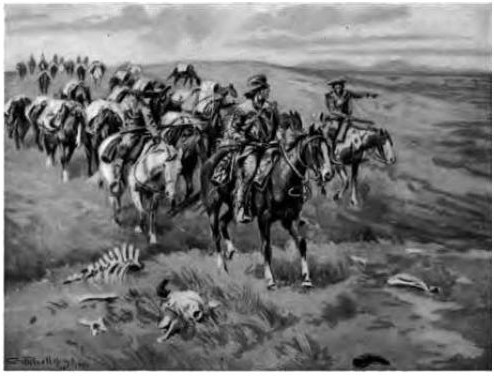
"...We had a fairly well-fortified position, and it stood us well in hand to have it so. The Indians, knowing our number, would attack us seven or eight to one, and perhaps more.
Trappers in those days were obliged always to contend against overwhelming numbers; but they never hesitated, and it was always a fight to win, for defeat meant death.
The first wolf howls were soon followed by others, coming from points nearer and in a semicircle. Indians are expert in imitating the cries of wolves or coyotes, and it is very hard to distinguish them from the cries of the real animals. On the other hand, even after years of practice, few whites can successfully imitate these animals. The hooting of the owl is frequently used as an Indian signal in attacking camps. All these signals are carefully studied by trappers and scouts, who are rarely deceived.
The Indians must have located our camp from the mountains, which were at no great distance, as our one lodge was set up in a Cottonwood grove, which concealed it.
We had not long to wait before the attack commenced. Just at break of day the signals ceased, and the trappers knew that the crisis was at hand.
The Indians crept to within one hundred yards of camp before they gave the war-whoop. Then they came madly charging, fully one hundred in number.
The trappers had their rifles in hand and their pistols out of their scabbards ready for instant use after the rifles were discharged. We let them get within fifty yards before delivering a shot, and at the discharge of the rifles many fell. Three of our men were armed with double-barrelled shotguns, loaded with a half-ounce ball and five buckshot, deadly weapons at close quarters. These were now discharged and the Indians halted. Immediately the trappers began with their six-shooters, one in each hand, for as a result of long and constant practice they could shoot equally well with either. Every condition of his life obliged the trapper to be expert in the use of firearms..."
"Pemmican is manufactured in the following manner. The choicest cuts of meat are selected and cut into flakes and dried. Then all the marrow is collected and the best of the tallow, which are dissolved together over a slow fire to prevent burning. Many tribes use berries in their pemmican. Mountaineers always do unless they have sugar. The meat is now pulverized to the consistency of mince meat; the squaws generally doing this on a flat rock, using a pestle, many specimens of which may be seen on exhibition in museums. A layer of meat is spread, about two inches thick, the squaws using a wooden dipper, a buffalo horn, or a claw for this work. On this meat is spread a certain amount of the ingredients made from the marrow and tallow, the proportion depending on the taste. This same process is repeated until the required amount is secured.
One pound of pemmican is equal to five pounds of meat.
Buffalo tongues are split the long way and dried for future use, and thus prepared are a delicacy fit for a prince.
Another important article of food, the equal of which is not to be had except from the buffalo, is *'depuyer'' (d^pouille). It is a fat substance that lies along the backbone, next to the hide, running from the shoulder-blade to the last rib, and is about as thick as one's hand or finger. It is from seven to eleven inches broad, tapering to a feather edge on the lower side. It will weigh from five to eleven pounds, according to the size and condition of the animal. This substance is taken off and dipped in hot grease for half a minute, then is hung up inside of a lodge to dry and smoke for twelve hours. It will keep indefinitely, and is used as a substitute for bread, but is superior to any bread that was ever made. It is eaten with the lean and dried meat, and is tender and sweet and very nourishing, for it seems to satisfy the appetite.
When going on the war-path the Indians would take some dried meat and some depuyer to live on, and nothing else, not even if they were to be gone for months..."


