Una ragazza, nota solo come A, vive in un’anonima città americana insieme alla coinquilina, B, e al ragazzo, C. A si nutre quasi esclusivamente di ghiaccioli e arance, trascorre un assurdo quantitativo di tempo davanti alla televisione, spesso ipnotizzata dalla pubblicità – in particolar modo dagli spot di Kandy Kat, la mascotte di una merendina ultrachimica – o dal reality show che C ama tanto, e plasma il proprio corpo su un modello di bellezza che esiste esclusivamente sullo schermo. Col passare del tempo A sviluppa un’ossessione per Michael, figura televisiva diventata celebre per aver prosciugato l’intera fornitura di carne di vitello di una filiale del Wally’s Supermarket. Nel frattempo B tenta disperatamente di fare di sé una copia di A, appropriandosi delle sue cose e delle sue abitudini, mentre A, a sua volta insoddisfatta, cerca un senso alla propria vita al di là della dipendenza dal ragazzo. Si rilassa soltanto spiando la famiglia dall’altra parte della strada che tuttavia un giorno scompare misteriosamente. L’ultima cosa che A vede è padre, madre e figlia camuffati da fantasmi uscire di casa, montare in macchina e andarsene lasciando sulla porta del garage una sinistra scritta. Romanzo d’esordio sagace, divertente e a tratti inquietante, che richiama alla mente L’incanto del lotto 49, Rumore bianco e i racconti di George Saunders, Il corpo che vuoi è una sorta di giallo raccontato dal punto di vista della persona scomparsa, una storia dell’orrore tutta americana che intreccia sesso e amicizia, fame e appetito, fede e alimentazione, vita vera e reality show, ma soprattutto uno sguardo originale sul moderno concetto di femminilità.
Abandoned at page 46. My patience for these self-fellating, aggressively pointless, over-workshopped, look-I-have-an-MFA exercises in pretentious tedium was always pretty low, but I don't know man. I just can't stomach these books anymore. Ever since I choked down that Valeria Luiselli horrorshow and learned that it's not just Brooklyn white bros who pinch these things off, I think that was it for me. I mean while reading this I literally had the thought for a second that I would rather be reading the new Jonathan Franzen, that's how bad it was.
You too can save yourself from wasting your time on this book.
I downloaded this book because I read a review that said the book was so good the reviewer "wanted to hit herself in the head with it," and that she "clung to it like a spider monkey." Well, it turns out, I wanted to hit myself in the head with it, too, but for the opposite reason.
I give the book points for trying to be original in format and idea, but it was so damn boring. "A" lives in an unnamed American city, has a roommate, "B"who wants to look like/be her, and dates "C," who is--spoiler alert--disengaged and boring. There is a product called "Kandy Kakes" that isn't real food, but is perpetually on TV advertising its fake food-ness, and featuring a character called Kandy Kat who is obsessed with trying to eat a Kandy Kake, but is always foiled. No one eats real food in this book. Oh, yeah, there is also some mystery about people disappearing and whether that is or is not connected to people walking around in white bedsheets with eye holes.
Everything I just wrote is, unfortunately, more interesting than the story. The writing is passive, the characters are passive, and the story unfolds so slowly that, even though I tried to read this on an airplane with no competing reading material available, I was too bored to continue. I made it through a third of the book and not a damn thing had happened. What is supposed to be a commentary on today's superficial society was too superficial to engage this reader.
You Too Can Have a Body Like Mine begins as a chronicle of the smallness and aimlessness of everyday life, something that might seem very recognisable to many of us. Remaining unnamed for the entire story, our narrator worries about her creepy roommate, B, and the empty relationship she has with her boyfriend, C. She watches TV advertisements. She goes to work, part-time, at a local office, where she sits in a cubicle designated for freelancers and proofreads copy for obscure magazines with titles like New Age Plastics and Fantastic Pets. She observes the neighbours across the street - an ordinary lot, until the day the whole family abandons their house and troops off clad in white sheets, leaving the words 'HE WHO SITS NEXT TO ME, MAY WE EAT AS ONE' daubed on the garage. Along with B's bizarre behaviour, this is an early indicator that the story may be something a bit more twisted and inventive than it initially appears.
Images of consumer culture are significant in You Too..., particularly a series of adverts for Kandy Kakes, an entirely synthetic sweet snack. The TV commercials all feature the brand's mascot, Kandy Kat, who chases the animated Kakes ever-more-desperately through a series of different scenes and situations. Kandy Kat's endlessly fruitless pursuit is an idea familiar from old cartoons - Tom and Jerry, or Wile E. Coyote and Road Runner - but his physical appearance takes on disturbing aspects more suited to a 'lost episode' creepypasta ('the bones and tendons of the arm show starkly... the stomach distended and throbbing through the thin cover of skin... he was biting so hard that his teeth cracked'), while the accompanying slogans are ripped straight from a nightmare ('KANDY KAKES: WE KNOW WHO YOU REALLY ARE').
The narrator is initially afraid that B is emulating her, trying to take her place, but it slowly starts to seem as though the opposite might be the case; the narrator destroys B's makeup and vandalises her room, then begins to stalk C in the same way she'd earlier described B harassing an ex-boyfriend. The narrator's quest to track down Kandy Kakes mirrors the antics of Kandy Kat; her physical deterioration, too.
Other important elements of the plot include: Wally's, a supermarket chain where every member of staff wears a giant foam head, the aisles are frequently shifted in nonsensical ways to keep customers confused, and a chandelier made of food spins in the lobby; a phenomenon nicknamed Disappearing Dad Disorder, which involves men vanishing from their families' lives only to resurface months later in a different, but similar, place, often living with a replacement wife and children; Michael, a man who develops an obsession with stealing veal from food stores, and becomes a celebrity - and has his image used to advertise the meat - after he is caught; and a reality show named That's My Partner!, in which couples compete in bizarre tasks to determine how easily they can recognise their partner in disorientating situations (example: groping a roomful of naked strangers), and the losers are forced to split up. Finally, and ultimately most significantly, there's a sinister organisation known as the Church of the Conjoined Eater, which brings all the other elements together towards the end in a really rather ingenious manner.
I thought at first that You Too... would be an American counterpart to Alice Furse's Everybody Knows This Is Nowhere, something about the sort of directionless life many of us find ourselves in during our twenties and thirties, still trying to figure out some sort of identity, doing a bearable job but not yet having a career, etc. And there are times when the narrator's cynical comments fit perfectly with that expectation - that's part of what balances the story so effectively. But the quiet horror and creeping surrealism of its details, eventually, reminded me more of the stories of Robert Aickman, or what I was hoping for when I had a go at reading the Welcome to Night Vale book.
This is a strange and surreal novel. I don't think I can overemphasise that - I'd read reviews of it before I started, and an excerpt, and I was still surprised at exactly how weird (and I mean that in the sense of the phrase 'weird fiction') it was. I've been scanning back through some of those reviews, and I think maybe I was surprised because so many of them focus on aspects like the relationships between the narrator and B and C, or whatever the whole Kandy Kakes/Church of the Conjoined Eater arc has to say about body image, and when I was in the thick of the story, I didn't (or couldn't) read those elements that literally, or even see them as analogous to real life. I liked You Too... better the further it divorced itself from reality. It's entirely possible that I was reading it wrong, but either way - this is a brilliant story, and more subtle than it has any right to be given the often outlandish images it throws up. 2016 is only just beginning, but I've already found a favourite.
This book feels very late '90s/early '00s in its style and its targets. Consumerism, body image, TV and TV commercials, reality shows, cults, corporate mascots, processed food...
It feels less like Thomas Pynchon and more like Donnie Darko or Being John Malkovich: that very particular brand of turn-of-the-millennium anxiety about the discrepancy between media images and our actual selves, and trying to figure out what exactly comprises our actual selves / actual bodies.
The characters have no spark to them -- which is necessary for Kleeman's satire to work -- but it makes it a real slog to get through. Again with the style of ~'97-'03, each character feels like that Gen X apathetic protagonist who has no drive, no dreams, no future, but lots of thoughts about commercials and discount department stores.
This seems like a polarizing book; either you're into this kind of style or you're not. I am really not into this style at all, and found so much of the book a complete turn-off that reading each chapter felt more and more like being forced to complete some kind of terrible assignment.
That being said, it's evident that Kleeman has incredible talent. Some of her phrasing and metaphors are wonderful, and I loved some of the monologues about oranges and white sheets. This book is "NOT FOR ME" in just about every way, but I look forward to reading more from Kleeman. Her characters may not have a special spark to them, but she does.
Think of Alexandra Kleeman as an heir to Dave Eggers and Douglas Coupland, with a hefty dollop of Margaret Atwood thrown in. Her first novel is a full-on postmodern satire bursting with biting commentary on consumerism and conformity. Television and shopping are the twin symbolic pillars of a book about the commodification of the body. In a culture of self-alienation where we buy things we don’t need, have no idea where food comes from and desperately keep up the façade of normalcy, Kleeman’s is a fresh voice advocating the true sanity of individuality. Don’t miss her incredible debut.
Oh, this book. I think it will forever render me tongue-tied, but I'm unlikely to forget it anytime soon. I'm in awe of Alexandra Kleeman's brain for conceiving something so bat-shit insane as You Too Can Have a Body Like Mine. I'm also irritated that she fished me in twice to read it, with my gleaning no particular insight the second time around. I loved and despised her nameless narrator (presumably named A. only because the other two principal characters are B. and C.) with equal fervor (probably because I could identify with her OCD and neurotic behavior). Even though the interactions seemed a bit cartoony, I loved (and cringed over) A's relationship with her chompy, chain-smoking Doppelgänger roommate, B. Ditto A's WTF?-obsession with her Shark Week-loving, mansplaining, porn-during-sex-needing freak boyfriend C. The societal issues of lock-step consumerism, perceived body image (dysmorphic) disorder, and other neuroses (as evinced by A. with her world around her: at work as a proofreader, at home with her claustrohobia-evoking roommate and at her boyfriend's condo channel-surfing commercials for beauty products and Kandy Kake snack cakes, at Wally's Supermarket navigating the ever-changing aisles) was fascinating, if a bit anachronistic. (For instance, all of Kleeman's riffing on television-watching here, for a 2015 "dystopian" novel, felt curiously 1990s-ish.) A lot of Ms. Kleeman's ideas here begged elucidation: Disappearing Dad Disorder; the reality show "That's My Partner!"; the entire sheet-wearing cult movement "Church of the Conjoined Eaters" (and their dietary imperative of eating mass quantities of Kandy Kakes and eschewing individuality); Michael-the-Veal-Vigilante-turned-veal spokesman; etcetera. I realize this review makes little sense, and I apologize. This book was just confounding to me, yet I kind of savored the feeling. Your results will certainly vary. (Though if you're a Heidi Julavits fan, I guarantee you'll appreciate Kleeman's unique brand of "dystopian neurotica", perhaps even love it.)
getting in a cult and feeling like i'm doing a bad job at the cult and all the other cult members are making fun of me for sucking so bad at culting is both very specific and very relatable
This book still has me in a bit of a tailspin. For nearly two thirds of it, all I could think was that this is the definitive novel of 21st century U.S., hyperconsumerist, overmediated body dysmorphia that we've been needing, or at least that I've been needing.
For those of you who recall The Day After, the Nuclear War Threat Made Real telemovie that greatly traumatized surely many youths aside from myself - this novel was like that, only instead of fallout and mushroom clouds and cancer and bunkers, the dangers are television and television commercials and cosmetics advertisements and processed foods and diets and game shows and reality shows and big box superstores. We know all these things are bad, but this novel really creatively explores, to an extreme The Day After-th degree, the extent to which we are all on the fast track to ruin.
The young author of this book is so scarily, creepily genius, in her precocious talent, writing, and thinking, to bring to life this unique take on the post-apocalyptic vision.
This book is hard to describe and absolutely not for everyone. It's...a book where someone eats an entire long braid of human hair, just for one instance. It is pretty much a troubled young woman's interior monologue that may try some folks' patience and should probably gross you out. But it was very unique and a worthy read - in fact, a solid five star, year's-best candidate for me until that final third or quarter, where the book's slight change in focus and setting, to life in a sort of dietary cult, detracted from the sum total a bit in my opinion. It was still interesting, but for me the book didn't quite need it, or maybe it was just all too much.
For me, this book has a solid footing with other creative and horrifying takes on the "well, the societal shit has really hit the fan now, hasn't it?" genre, including works with some subtle or overt elements of sci/fi or fantasy. Some other examples might be: American Psycho, Less Than Zero, The Stepford Wives, The Handmaid's Tale, and especially that one book made into the harrowing, drug-themed film with Ellen Burstyn, Jared Leto, and Jennifer Connelly - what the hell was that called again? - anyone? But in the author's focus on issues of the body and consumption explored through innovative and experimental narration, I was also reminded of French feminist writers (especially Monique Wittig). And another reviewer cited Pynchon's The Crying of Lot 49 (a favorite of mine); I think this is a useful comparison to the culture-skewering scavenger hunt experience of reading this book.
These comparisons are just meant to help convey some idea of whether this book might be at all in your wheelhouse, but really, Kleeman is an exciting new voice and her own thing. Very much looking forward to her future endeavors!
Having read two books in a row that were surrealist by female authors, I’ve decided to write a combined review comparing my reactions to them. You Too Can Have a Body Like Mine by Alexandra Kleeman and The Beautiful Bureaucrat by Helen Phillips. I will refer to them henceforth as YTCHABLM and TBB.
When I began YTCHABLM, I thought it was going to be a contemporary version of Generation X by Douglas Coupland, and it initially threw me off as it evolved unexpectedly from real to surreal, but once I got past that shift, I thoroughly enjoyed it. On the other hand, TBB was a short, tight book with a consistent style, but in total, I disliked it. It struck me as gimmicky and artificial in plot. A game for the author with little true purpose and no meaningful themes. If I was to try to capture these books in a nutshell, I would describe YTCHABLM as The Stranger for Millennials, while TBB was the movie Angel Heart starring Mickey Rourke rehashed from a female perspective.
YTCHABLM has something else going for it: humor. It was strung throughout with amusing commentary and dialogue about relationships, television and commercialism, food, religion, and our physical bodies. The title of the book threw me off quite a bit. I expected some kind of satire of the modeling industry, but rather, Kleeman’s take on the body is more about how we are alienated from our physical bodies by culture. Especially women but men too. Through the agricultural/advertising/grocery chains of the world, through the cosmetics industry, through porn and mediated by the contemporary struggle to achieve intimacy in relationships. I did not expect the surreal turn of YTCHABLM…the first quarter of the book is a relatively realistic view of two female slacker roommates and the main character’s relationship with her arrogant slacker boyfriend. Clues begin to pop up in the story that this is going to take a turn away from realism, such as a repeated series of highly elaborate TV commercials that are much too long and intricate to be actual commercials. And too many of them in a series as well. They are almost more morality tales of the artificial food industry, metaphors expressing the means by which media manufactures desire for utterly worthless crap. At the same time, the main character begins to lose touch with her body, with communication and even with common sense. Her character evolves to become after a time, an empty vessel carrying forth only certain behaviors wrought in her by habit. This is where it dovetails for me with The Stranger. And as a side note, she calls her boyfriend C and her roommate B, which reminds me of The Trial by Kafka whose main character is Joseph K. YTCHABLM becomes a modern Existentialist drama/comedy with our character surrendering her identity and personal agency to live in a state of emptiness where nothing really seems to matter.
TBB, on the other hand, seems to lack meaningful or profound themes. Which is unexpected, because YTCHABLM comes from a very contemporary moment, while TBB is vaguely more universal in setting (not placed so particularly in our time). Although a few sour notes like repeated mention of the brand “Coca-Cola” marred that. The title of TBB irritated me quite a bit. The plot was a gimmick, and so was the title. The main character gets hired into a job that one would assume is a corporate job in a faceless building in the city. It’s certainly never stated as being a “government” job. The main character is in a data entry/filing capacity but amazingly with her own office. Rather than being labeled a corporate drone, she suddenly calls herself a “bureaucrat,” which as I understand it is a term for a government employee with an implied conservative critique of government, the claim that “all that red tape” is a waste of money for the taxpayer. Also, too many laws get in the way of shit getting done. Yes, our taxes are somewhat complicated, but this is an exaggerated claim simply asserted by an ideology that wants to gut government for private enterprise. So the use of the term “bureaucrat” set up a very particular implication that didn’t sit well with me from the beginning. Then the “Beautiful” reference in the title seems to be about a secondary character? Who is like a slightly overweight Barbie doll? But…why name the book after this secondary character? There was really no reason. A title chosen for greatest draw at the bookstore, I suppose. The wordplay in TBB also was thrown in arbitrarily. Oh the husband and wife like to play on words together? I guess…unfortunately her husband had zero personality so that premise was ungrounded. Another gimmick technique to beef up the literary creds for this empty novel.
The surreal aspects of YTCHABLM crept in gradually. I could perhaps quibble with that, but in the end, her approach worked for me. They grew out of the psychology of our culture. By contrast the surreal aspects of TBB hit early on. And they felt utterly contrived. They struck me as the author setting out to “write a surrealist novel” and coming up with a “clever twist” the readers “won’t see coming.” In the end, I saw no point to TBB. It was smoke and mirrors with no substance. On the other hand, YTCHABLM was, in a way, about smoke and mirrors. About the illusions our culture creates distorting our feelings and views about our bodies and our relationships. Kleeman won me over.
"Everywhere I go I’m asked if I think the universities stifle writers. My opinion is that they don’t stifle enough of them. . . . The idea of being a writer attracts a good many shiftless people, those who are merely burdened with poetic feelings or afflicted with sensibility."
A difficult book to rate as although I think the themes and messages within this book are incredibly interesting (body and self-image mainly, but also commentary on contemporary consumerism), I just didn't enjoy reading this dystopian and oh so very peculiar book. I read a LOT on these subject areas with my degree, and wrote my dissertation on body image...but still this just didn't do it for me. Not a bad book, at all - in fact very clever, very observational - but too slow, too repetitive (but without this the book probably wouldn't work so...).
I hated this book with the fiery passion of 10,000 suns. I seriously considered putting it down after 200 pages, but got bored and slugged through to the end. I just want to throw this book across the room and scream, "stand up for yourself!" And "everyone you know is the worst person in the world!" And take an eraser to my brain to get this "clever little work of satire" out of there.
Horrid little book. Read it on the Tube each morning to depress me further. I finished it only because I started it, and I started it only because I didn't know what "hysterical realism" was and wanted to find out. I have learned now. I shall not attempt to learn more.
2.25: I respected this book. I also wanted to shake it by the shoulders and shout, "You're already clever. You don't need to keep proving it."
I had a complicated relationship with this book. Much like A and B's friendship.
It's weird. Proper weird. The kind of weird where everything feels completely recognisable and also a little wrong. There's something uncanny about it. Like someone recreated reality from memory after someone else described it for 3 seconds. The details are technically correct, but the atmosphere's off.
And I loved that.
The author's got a lot to say about consumer culture, identity, capitalism, and the ways we package ourselves for other people. It's a novel about consuming things, but also consuming each other. How we copy others and perform for them, how we reshape ourselves until we're no longer sure what's authentic.
The relationship between A and B's probably the strongest part. The two women already look almost identical, but B starts pushing that similarity into increasingly disturbing territory.
Is B trying to become A?
Is B trying to erase A?
Is B trying to make A become her?
Is B actually harmless and just really bad at social interactions?
Who knows!
What I do know is that I hated B (complimentary).
She made me feel everything a good unsettling character should make you feel: discomfort, suspicion, disgust, irritation, and the overwhelming urge to scream, "Respect personal boundaries!"
She's the kind of roommate who'd make me permanently retreat into my room. I'd become a mysterious cryptid who only emerges at 2 am and startles at the faintest noise. Communication would be reduced to passive-aggressive Post-it notes like, "Please stop using my things" and "No, we do not need to stare into each other's eyes again."
The scene where she cuts off her hair and gives it to A had me like absolutely fucking not. I'd be moving out immediately. No explanation or goodbye. Just me, whatever belongings I could carry, and a new identity 3,000 miles away.
But while I found this book fascinating, I was also very aware that I admired it a lot more than I enjoyed it.
Which brings me to a recurring problem: MFA fiction.
I didn't know the author had an MFA before picking this up, but by page 4 I was like, "ah, there you are."
Before anyone comes for me: obviously an MFA doesn't automatically produce a novel blueprint. But a lot of MFA-influenced fiction I've read feels too polished and overly invested in literary technique, often at the expense of narrative momentum. It can feel less like someone telling a story they actually wanted to tell and more like someone demonstrating how well they can write.
That was my biggest struggle here.
Because the author can write. The prose is clever and the imagery's memorable. The concepts are very original. On a technical level, it's excellent. But there were too many moments where I felt like the book was standing in front of me holding a giant sign saying: DID YOU GET THE METAPHOR?
Yes. I got it. You can put the sign down now.
There's a slight smugness to it all. Not arrogance exactly, but a constant awareness of its own cleverness. Ironically, for a book critiquing superficiality and consumer culture, parts of the reading experience felt a bit superficial too.
Maybe that's intentional. Maybe the emptiness is the point?
I also think it needed an editor willing to ask, "great idea... but do we need 5 pages of it?"
Because it's overwritten.
And I say that as someone whose "quick thoughts" regularly become a 30 page notes app manifesto.
Editing is where you go back and ask: Does this actually add anything? Didn't I already make this point three paragraphs ago? Am I saying something meaningful, or do I just enjoy the sound of my own thoughts?
Sometimes less is more. Beautiful writing doesn't require maximum density.
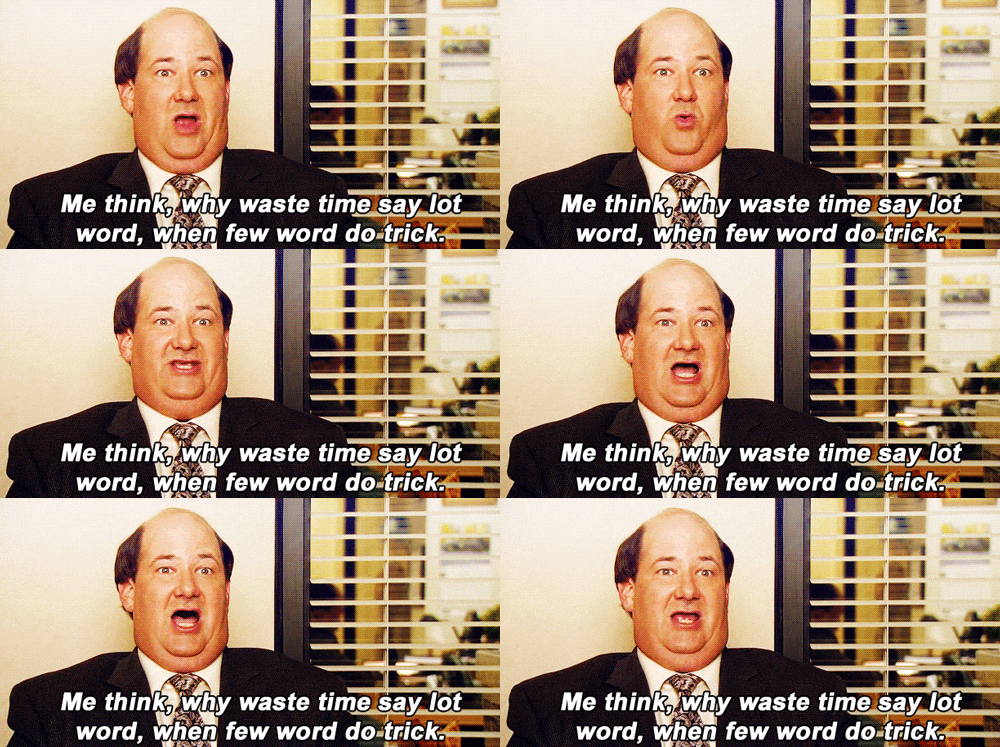
Kevin's philosophy should be taught in every creative writing programme.
The characters suffer from the same problem. Everyone's observing, analysing, thinking, absorbong. There's a lot of staring into the abyss and not enough actually doing something. I don't mind introspection, but eventually I need the book to leave its own head.
There's also a lot I did love. The unnamed city and unnamed characters really worked for me. There's something very effective about stripping away those identifying details, and it reminded me of Hard Copy, another book where anonymity becomes part of the atmosphere. I loved the lack of a specific place, the '90s atmosphere, the TV, the advertising, and the weird nostalgia of a world that feels equal parts familiar and completely alien.
Alexandra Kleeman porta nella contemporaneità una grazia claustrofobica e l'estraneità nei confronti del mondo che potrei saper ritrovare solo in Philip Dick. Laddove lui riconosceva che tutto ciò che vediamo è un riflesso in uno specchio (ed è lo specchio la realtà), A. un giorno non riesce più a riconoscere sé stessa. Non riesce più a percepire il proprio corpo, se non attraverso il confronto con quello degli altri. L'alienazione passa attraverso le pubblicità, i cibi confezionati, la mancata empatia e non ci sono volti, veri esseri umani, solo costumi, lenzuoli con i buchi per gli occhi, eroi televisivi.
Ennui. Consumption. Dystopian present. Late Capitalism. Duplication. A sense of dissolving identity.
Like a Ballard protagonist, the narrator here is telling her story out of the depths of the malaise being assessed. She's already entirely compromised by it. This adds to the affective, subjective feel of it, but simultaneously blocks the kind of identification with the character that might make it possible to get truly caught up in her story. Still, there's a scene-by-scene clarity of word and image that makes this all highly memorable.
The main character is simply known as A. She has a roommate, B, who seems determined to become A's double, even cutting off her long braid and then handing it to A to keep. A tells us B has food issues, yet we rarely see A eat a bite. A is dating C. She likes him because he feels simple.
The world they live in is similar to ours but also more extreme. Consumerism is even more rampant in their land than ours. In their world, one of the most popular tv shows tests a couple's relationship including a round that involves trying to pick the other out of a crowd of naked people in the dark. The couple agree to a complete dissolution of the relationship if they don't succeed in all the tests. A man becomes famous for buying veal. And there's a phenomenon involving disappearing fathers who pop back up utterly befuddled, sometimes having managed to construct a new family. Wally's World is a store that sort of resembles our megastores but they rearrange the contents constantly so you can't find things without a hunt (workers wear crazy masks and don't really help). Oh, and there's a strange snack cake known mostly for its ads that resemble an old-school Roadrunner cartoon.
And then it gets weird....or, more accurately, weirder...One day, A watches as the family across the street disappears, all three dressed in white sheets (think ghost costume, not KKK). There's only so much one can say here without saying too much, but much of the book revolves around a cult-like group that attempts to live in opposition to most of the world around them. Food is a big issue, as are bodies, but the cult also helps raise much more general questions of identity, culture, and alienation.
There's not a ton I can say in the "review" part of this review. I feel like I probably missed a lot, although the lack of clear ideas/ideals is probably part of the point. I simply didn't enjoy this book. I kept hoping it would turn a corner but it never did. I managed to finish, but I feel like it took more out of me than it gave back. I felt like I should be thinking and feeling and reflecting and more, but I was just waiting to be done.
Two stars....there are some amazing sentences and some impressive word-craft. Someday, it'll be taught in a class that mixes sociology, philosophy, and literature. And a few will love it, but I suspect most will be hunting for Cliff Notes. I got my copy from the publisher (and appreciate it even if it wasn't a win!)....it is probably quite apparent that they put no constraints on my review and that this is an honest and unbiased review.
Per essere puntigliosi le stelle sono 2 e 1/2 , ne metto 3 per la casa editrice. Questo è uno dei libri più assurdi che abbia mai letto, sembra che la scrittrice sia stata vittima di allucinogeni potenti perché spesso non riuscivo a credere a quello che leggevo, di sicuro ha il pregio di avere un forte impatto emotivo sul lettore. La storia ruota tutta attorno al concetto di corpo, esplorandone ogni valenza; A B e C sono immersi in una società commerciale, patinata e alienante che porterà la protagonista (A) a sentire il suo corpo e la sua identità come qualcosa di estraneo fino a farle perdere qualunque senso di umanità. Il problema qual'è? Gli stessi concetti sono ripetuti troppe volte, leggere un terzo del libro è come averlo letto tutto...questo unito a interminabili descrizioni di spot pubblicitari e scene francamente inutili rende il libro veramente pesante da finire. L'idea e i temi sono molto interessanti ma il loro sviluppo è gestito male; lo si può perdonare sapendo che il libro è il debutto di un autrice per giunta molto giovane, in definitiva ho "apprezzato lo sforzo" ecco.
A campy text exploring how the non-transformative mundane can become the basis of a cruel optimism a la Berlant: how notions are humored that we (a very gendered we) can be satisfied with so little. I've seen some reviews that reductively claim that this book is about body image or diet culture, as if satisfaction is only a matter of the most literal definition of appetite. This fails to acknowledge the vaster interpersonal, performative, or desire-producing implications made by the concept of metabolism. Or annihilative consumption. Well, maybe these reviews just fail to acknowledge that body image or diet culture are falsely-discrete mechanisms in a complicated social machine. And c'mon, Kleeman makes this larger focus evident in her epigraphs citing A Thousand Plateaus and the gospel. Zoom out, loosen up associations.
"'A store is about something greater than selling,' he said. 'If you looked only at the surface of the word, you could say its primary purpose is storage. That surface is its core.'" (p.179) I noticed a pivot away from the conversation of ~interstitial~ and ~liminal~ spaces that's been popular over the past decade in theory-land; instead, Kleeman prizes the surface. Whether the production of new surfaces in a disemboweled animal, the deceitful power of skin, or the dominant relationship between characters of host-and-leech, this text points to surfaces as the locus of action and power. I'm not sure what to do with this relocation of interest, but something feels comforting about it--like I'm coming home, back to my body, or back to haptic potentials.
Oh my God. This novel so pleasantly intrudes on everything I've ever hoped to write and puts the narrative flesh on the skins of the vignettes I have written. If you enjoy the alternate universe of Atwood's Maddadam trilogy (religious cult re: food and fake food and beauty products) and/or just want to see a novel tackle body dysmorphia in a way that's not grossly chick lit -- in a way that's expressly and uniquely literary -- just read this book.
Kleeman paints a here-and-now that's only slightly more hyperbolic than our own. Think couple's reality shows with more grim-dark rules and consequences, pastry ads that take the Trix Rabbit to the next level, grocery stores that use "consumer insights" to rearrange themselves systematically to prolong the shopping experience. Common denominators: food and relationships. And these things just happen to intersect too. You think it would be boring to watch a narrator worry about how she looks in profile while she and her boyfriend watch TV together, but really, it just hits home. The whole thing is like an exestentailist slumber party. And a slumber party does happen, which is even better.
If you're like me you've also been hoping Miranda July and Amelia gray would get together and collaborate on a remake of single white female. Except this version has Don DeLillo editing the script into the story of a woman having an existential crisis in a "Wally" an invasive species of chain megastore clearly designed by Ayn Rand. Shoppers are warned "weakness thrives on help". Her roommate has gradually become more her than her, absorbing her boyfriend in the process. She ventures to Wally to find a product, not unlike a crowbar, to make her feel more like herself, and is directed to the veal. Then it gets weird.
Nel momento in cui ho capito che Alexandra Kleeman era in potenza la mia donna ideale mica lo sapevo che scriveva di faccende così strane (assurde?) che al confronto i racconti di Saunders e Barthelme sembrano carezze.
Che fatica! C’ho messo 6 mesi a leggerti, Alexandra, ma non ho mai pensato di abbandonarti. Pensaci a ‘ste cose, che la costanza nelle difficoltà è importante.
Magari non siamo fatti l’uno per l’altra ma sappi che il mio affetto rimane inalterato. Ah, quando leggi chiamami che ne parliamo. [55/100]
A self-fellating piece of drivel so proud of itself that it forgets to introduce a plot until the last third of the novel Some very interesting ideas, but poor execution. This is a miserable, soulless book.
If this is what counts as "literary fiction", I'll stick with my cheap YA.
It wasn't funny and I didn't get it. What is wrong with book reviewers these days, that they think the stupidest dreck is funny and/or satirical? I couldn't wait for this book to be a ghost.
This is a book all about body image. Even where it's not -- where it is about consumerism, cults, bad tv, twins -- it all boils down to body image. How do we percieve ourselves, how do others see us, how do we think others see us. And, through that, it's terrifying, essentially a psychological thriller... about body image.
I'm lucky to have never had anything beyond typical body concerns -- I don't love my body, but I'm pretty sure I'll still have that Dr. Pepper tomorrow -- but the book is written so intensely that I feel like Kleeman knows the world of body-image disorders far too well. She's sharing some pieces of that in this novel, and her terrific writing has such an intense focus on bodies and food that I felt a distressed connection with the protagonist. What are you doing. Why aren't you eating. Where are you going.
This focus on bodies and the self is heightened by hyper-selective worldbuilding. This, further, emphasizes a recent trend I've seen in other works: the extremely passive protagonist. Like in Gold, Fame, Citrus and Mr. Robot, the protagonist, often as not, just lets things happen; that is, they refuse to apply critical reasoning or let us understand the avenues taken to result in a given (non-)decision. It's both engaging and incredibly frustrating, and I wish I knew enough to pinpoint if this is a trend, or just selective sampling. I mean, Gregor Samsa did the same when he became a bug, a hundred years ago.
I think there will be a lot of people turned off from the book, so I can't make broad recommendations. Beyond the intensity, the book features beautiful, thematic writing (check out the eating-related metaphors!) and some shocking turns. Digest with caution.
I might have to settle for wanting Kleeman's body because I sure as hell don't want her mind. I struggled through this until my eyes were just looking at the words and not really converting them into anything meaningful and this is essentially what I think is wrong with the book. I don't have a problem with the characters not being named – C is just as valid as Bob – but I do think that it is indicative of the author's desire to be deliberately obfuscating, to write something that shows just how clever and arcane she can be. Sure there are some interesting questions that are posed; do we spend so long presenting an image of ourselves that we are shocked by the reality when we drop the act, do we even recognise our authentic selves if in fact we do have one. The insidiousness of advertising and the zombification of us as consumers – blindly buying what is bad for us, what we don't need, what we don't even like – is a running theme but loses its impact through the overlong and over used description of the Kandy Kake commercials that were comparable to the Itchy and Scratchy interludes in The Simpsons. There is the show That's My Partner that our protagonist hates because it has the power to destroy the contestants' happiness, again a comment on our current favoured genre of television but Kleeman offers no greater insight than the mere observation, which any person can make. Throw in a family who take to wearing sheets with eye holes which turns out to be the garb of a cult that encourages its members to rid themselves of identity and memory and you get a mosaic of ideas that never really align to a coherent image. Like the society depicted this book is all style and no substance - which may indeed be the point.
Ser, no ser y dejar de ser. La identidad como producto que se publicita, se adquiere, se consume y se desecha. Me ha costado seguir adelante con la lectura porque me producía una ansiedad terrible. Por alguna razón me recuerda a una especie de Black Mirror versión millennial (salvando las distancias y bastante menos casposa que la serie) y solo quería gritarle a la protagonista huye, huye, huye! Hace una crítica mordaz al sistema capitalista y la hace de forma inteligente y original. Toda la novela está aderezada con pequeñas notas de humor ácido, elementos muy «pop», pero el plato principal es esa desazón lacerante que atraviesa todo el contexto social de la historia, los personajes y la relación entre ellos.
is this what being severed feels like? my outie could not tell u a single thing that went on in this book. my innie (who was forced to read it) also couldn’t really tell u anything other than that the story is mysterious and important (or so it thinks it is)
Ho terminato questa mattina "Il corpo che vuoi" di A. Kleeman, che è senza dubbio un libro molto particolare. La storia, di per sé piuttosto semplice, tocca punti davvero interessanti, primo tra tutti l'alienazione come conseguenza estrema delle criticità della società contemporanea (l'eccessiva pubblicità, la strumentalizzazione delle emozioni, il cibo confezionato, il culto del supermarket...). La protagonista, A, non riesce più a percepire il proprio corpo, anche (ma non solo) a causa di un'attenzione morbosa che la sua coinquilina ha nei suoi confronti. Il libro racconta questa sua difficoltà, trasmessa al lettore non solo attraverso ciò che viene narrato ma anche (e soprattutto) attraverso la scrittura profondamente perturbante dell'autrice, che destabilizza il lettore. In conclusione la Kleeman ha creato un libro ricco di spunti di riflessione interessanti attraverso una realtà surreale, inquietante e claustrofobica.