Jump to ratings and reviews
Rate this book

Ashworth

Rate this book
Nel 1839 Charlotte Brontë dà il suo addio ad Angria, il lunghissimo ciclo di racconti scritto durante tutta l’infanzia e parte dell’adolescenza.
Dopo anni trascorsi a scrivere per il puro gusto di farlo, è ora di fare sul serio, è tempo di scrivere un romanzo da pubblicare. Quel romanzo è Ashworth. La storia della famiglia Ashworth costituisce un lungo antefatto a quella che sarebbe diventata la travagliata storia d’amore tra Mary Ashworth e Arthur Ripley West, passando per un gioco di corteggiamenti a scapito di Marian Fairburne.
Frutto di una preziosa ricostruzione di fogli sparsi per il mondo, il testo ci consegna, ancora una volta, una storia di uomini dannati e donne frivole, di amori controversi e drammi economici che, alla fine, sono ancora figli di Angria.

116 pages, Kindle Edition

Published January 22, 2017

21 people want to read

About the author

Charlotte Brontë

2,175 books19.1k followers
Charlotte Brontë was an English novelist, the eldest out of the three famous Brontë sisters whose novels have become standards of English literature. See also Emily Brontë and Anne Brontë.

Charlotte Brontë was born in Thornton, Yorkshire, England, the third of six children, to Patrick Brontë (formerly "Patrick Brunty"), an Irish Anglican clergyman, and his wife, Maria Branwell. In April 1820 the family moved a few miles to Haworth, a remote town on the Yorkshire moors, where Patrick had been appointed Perpetual Curate. This is where the Brontë children would spend most of their lives. Maria Branwell Brontë died from what was thought to be cancer on 15 September 1821, leaving five daughters and a son to the care of her spinster sister Elizabeth Branwell, who moved to Yorkshire to help the family.

In August 1824 Charlotte, along with her sisters Emily, Maria, and Elizabeth, was sent to the Clergy Daughters' School at Cowan Bridge in Lancashire, a new school for the daughters of poor clergyman (which she would describe as Lowood School in Jane Eyre). The school was a horrific experience for the girls and conditions were appalling. They were regularly deprived of food, beaten by teachers and humiliated for the slightest error. The school was unheated and the pupils slept two to a bed for warmth. Seven pupils died in a typhus epidemic that swept the school and all four of the Brontë girls became very ill - Maria and Elizabeth dying of tuberculosis in 1825. Her experiences at the school deeply affected Brontë - her health never recovered and she immortalised the cruel and brutal treatment in her novel, Jane Eyre. Following the tragedy, their father withdrew his daughters from the school.

At home in Haworth Parsonage, Charlotte and the other surviving children — Branwell, Emily, and Anne — continued their ad-hoc education. In 1826 her father returned home with a box of toy soldiers for Branwell. They would prove the catalyst for the sisters' extraordinary creative development as they immediately set to creating lives and characters for the soldiers, inventing a world for them which the siblings called 'Angria'. The siblings became addicted to writing, creating stories, poetry and plays. Brontë later said that the reason for this burst of creativity was that:

'We were wholly dependent on ourselves and each other, on books and study, for the enjoyments and occupations of life. The highest stimulus, as well as the liveliest pleasure we had known from childhood upwards, lay in attempts at literary composition.'

After her father began to suffer from a lung disorder, Charlotte was again sent to school to complete her education at Roe Head school in Mirfield from 1831 to 1832, where she met her lifelong friends and correspondents, Ellen Nussey and Mary Taylor. During this period (1833), she wrote her novella The Green Dwarf under the name of Wellesley. The school was extremely small with only ten pupils meaning the top floor was completely unused and believed to be supposedly haunted by the ghost of a young lady dressed in silk. This story fascinated Brontë and inspired the figure of Mrs Rochester in Jane Eyre.

Brontë left the school after a few years, however she swiftly returned in 1835 to take up a position as a teacher, and used her wages to pay for Emily and Anne to be taught at the school. Teaching did not appeal to Brontë and in 1838 she left Roe Head to become a governess to the Sidgewick family -- partly from a sense of adventure and a desire to see the world, and partly from financial necessity.

Charlotte became pregnant soon after her wedding, but her health declined rapidly and, according to biographer Elizabeth Gaskell, she was attacked by "sensations of perpetual nausea and ever-recurring faintness." She died, with her unborn child, on 31 March 1855.

Ratings & Reviews

What do you think?
Rate this book

Friends & Following

Create a free account to discover what your friends think of this book!

Community Reviews

5 stars
1 (12%)
4 stars
3 (37%)
3 stars
3 (37%)
2 stars
0 (0%)
1 star
1 (12%)
Displaying 1 - 2 of 2 reviews
Profile Image for Chris.
953 reviews115 followers
October 10, 2020
"When Edward and I were in penury, kept chained together by want, and abhorring each other for the very compulsion of our union, I used to endure worse torments than those of hell. Edward overwhelmed by his strength and bulk. He used his power coarsely, for he had a coarse mind, and scenes have taken place between us [of] which remembrance to this day, when it rushes upon my mind, pierces every nerve with a thrill of bitter pain no words can express."
-- Sir William Percy, in Charlotte Brontë's 'The Duke of Zamorna' (1838)
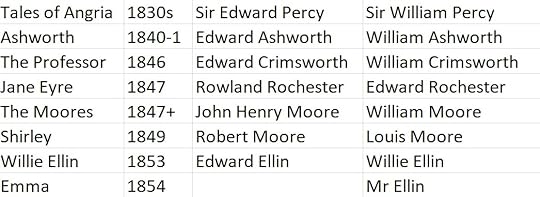
In discussing Ashworth, one of the four items in Tom Winnifrith's collection of Charlotte Brontë's uncompleted tales, I want to focus on a motif that she kept returning to in her novels, that of two brothers in conflict, a motif which only disappeared with Villette, her last finished work (published in 1853, a couple of years before her death).

One brother, who may be called Edward, was often (as with Sir Edward Percy) described as having a "savage, hard, calculating barbarity" while his younger sibling, frequently named William, was altogether more gentle and sensitive. In varying degrees of intensity that fraternal rivalry was pursued in narratives for roughly two decades until her writing tailed off before her tragic death.

I've already discussed this aspect in a review of The Story of Willie Ellin (1854) but in outlining Ashworth I want to consider how the unfinished fragment forms a link between Charlotte's juvenilia and her later work and speculate about why her Two Brothers theme seems to be a continuing obsession.

The Two Brothers strand in Charlotte Bronte's writings

Ashworth is the longest fragment in Winnifrith's collection, over forty pages and four chapters long. By the time she got to Emma Charlotte had virtually got over her idée fixe, for the male character who briefly appears is only a faint echo of the pleasanter brother of earlier works, with no brutalistic sibling in evidence. Fourteen years before she'd decided to say farewell to Angria and set her stories in the "real" world, or rather her version of Yorkshire and particularly the West Riding:
Mr Ashworth was a man much known about the country some years ago. But in the West Riding of Yorkshire where most of his public exploits were performed, his private history remains to this day in a great measure a mystery.

What's confirmed by Brontë scholars is that the Ashworth brothers are essentially the Percy siblings of her Angrian chronicles transposed to a more realistic and geographically precise setting. But I'm getting ahead of myself. Let me say something about this unfinished novel as a whole.

Apparently what we have is part of the sample Charlotte sent to the son of Samuel Taylor Coleridge for his consideration, and of which he was dismissive. Dispersed after Charlotte's husband Arthur's death, the four extant chapters were first published in the 1980s and republished in Tom Winnifrith's collection. The first chapter gives a summary of the first part of Alexander Ashworth's life: an Eton-educated young man, by degrees he went from talented pianist to magistrate via radicalism, Unitarianism, hell-raising and cattle droving (he's later characterised as "demagogue, cow-jobber, horse jockey"). Brought up at Ashworth Hall in Hampshire he eventually lands up a widower at the antique pile of Gillward in Yorkshire, father to Edward, William and Mary.

The next chapter focuses on the siblings -- Edward, who severely bullies his younger brother William, even at Harrow School, and Mary whom we see behaving well towards the less advantaged Ellen Hall at her boarding school. Chapter III shifts us from Gillwood to the neighbouring properties of Ripley Towers and De Capell Hall: at the former we have General West and the bluff Mr De Capell chewing the fat about the disreputable Mr Ashworth, and about their own varied offspring -- the dashing Arthur Ripley West, and tearaway John De Capell, his brother Thornton* (!) and sister Amelia.

In the final available chapter we have Mary Ashworth visiting former schoolfellow Amelia at De Capell Hall, where she meets Marian Fairburne and attracts the roving eye of Arthur Ripley. These four chapters have introduced us to a multiplicity of characters -- a cast we're often hard pressed to keep track of -- and shifted our focus from Hampshire to London and then to Yorkshire, from mansions to schools and shady dens of iniquity.

In addition to all that, Charlotte constantly changes narrative viewpoint: first from that of a mature writer retailing anecdotes she's tried to collate, then to the proverbial fly on the wall eavesdropping on private conversations. She shifts also to the omniscient novelist employing her familiar tic of addressing the reader directly whilst disclaiming any skill: "Biography is not my forte," she tells the reader at the start of Chapter II before continuing with her biography. It's not till after the middle of Chapter IV that, after many digressions, she tells us who her male protagonist is going to be:
... Mr Arthur Ripley West. We may as well introduce him at once without further parade and also announce that he is going to be our hero, for if we did not reveal this secret, the reader would soon find out.

It is intriguing to wonder in which direction Ashworth would have gone if it hadn't been nipped in the bud. But here I now want to pick up on the warring Ashworth brothers whom Charlotte references in the second chapter. I'm sure I'm not the only reader who's wondered why this theme appears again and again.

As a clergyman's daughter she will have been familiar with Biblical brothers at loggerheads -- the likes of Cain and Abel, Esau and Jacob -- and her wide early reading will have furnished contrasting male siblings from various mythologies. But we mustn't neglect her own personal experience.

After the premature death of their older sisters, Maria and Elizabeth, Branwell became the eldest Brontë sibling ahead of Charlotte, Emily and Anne. We also know that when the four Brontë children began their collective journey to the imaginary worlds of Glass Town, it was Emily and Anne who split off to found the Pacific island of Gondal while Branwell and Charlotte remained in West Africa to build on Angrian life.

Much has been written about Branwell, of course, of his early promise, his talent for art and poetry, his poor decisions, and his addictions to alcohol and drugs which ultimately led to his own death. Charlotte dearly wanted to look up to her brother but must have been continually disappointed.

So here are two possibly inspirations for the Two Brothers theme which permeated Charlotte's writings. Branwell's mood swings from charm personified to intemperate episodes prefigured Stevenson's story of Dr Jekyll and Mr Hyde, the tale of the rational and talented doctor who transformed into a violent monster after imbibing substances. Secondly, is it not also possible to see in the headstrong and domineering Branwell the template for the many Edwards who popped up, even under a different name, from the Angrian stories all the way to The Tale of Willie Ellin? And in the sensitive but determined brothers William (or Louis, or even Edward Rochester, despite his forename) should we not see the persona of Charlotte herself? She had of course already authored sensitive Angrian male characters, often named Charles, who were in essence herself in masculine guise.

I come now to some final words on Ashworth as we now have it. It's a curious hybrid in terms of writing styles, jumping from memoir to biography, from epistolary to omniscient, with flashes of humour and archness amongst more serious, judgemental passages. Above all, it's far too busy, trying to cram in too much in too little space, too many changes of scene peopled with too many characters; as readers we have to assess each individual on often sparse evidence, deciding whether we should invest in this or that person or whether they are incidental, extras for a crowd scene. It may be this inconsistency that irked Hartley Coleridge when he replied negatively to the anonymous writer CT, and to whom Charlotte then sent a pointed and cutting response using some insider knowledge gleaned from Branwell (as Claire Harmon notes in chapter six of her recent biography).

The previous criticism notwithstanding, there is enough in this incomplete piece to wonder where Charlotte would have intended taking her chronicle of the Ashworth family, and to speculate on what she might have done with it in her more mature years. In the meantime we may picture her putting the manuscript away in a drawer or box till, as she put it, "I get sense to produce something which at least aim at an object of some kind..."

* Thornton in West Yorkshire is of course where Charlotte was born, and which even might have inspired the name Thornfield where Jane Eyre met Rochester


Ashworth by Charlotte Brontë, Unfinished Novels. Introduction by Dr Tom Winnifrith, Alan Sutton Publishing 1993
Charlotte Brontë, Tales of Angria. Edited with an introduction and notes by Heather Glen. Penguin Classics, 2006

Claire Harmon, Charlotte Brontë. A Life. Penguin Books 2015: 127-8

Nicola Friar, "Charlotte Brontë’s Unfinished Novels: Ashworth." 2019 at https://brontebabeblog.wordpress.com/.... Accessed 09/10/2020
Profile Image for Elisa.
112 reviews41 followers
February 27, 2017
→ Recensione completa su THE BOOKISH TEAPOT: http://thebookishteapot.blogspot.de/2...

Dopo aver lasciato il ciclo di racconti di Angria, che ha tenuto impegnata la scrittrice nell'età giovanile, Charlotte Bronte da il via, attorno al 1840, alla stesura di quello che - purtroppo - rimarrà un romanzo incompiuto.
Di Ashworth, infatti, scrive soltanto alcuni capitoli su fogli sparsi nei quali abbozza in linea di massima il filo di una trama, soffermandosi per lo più a tracciare e definire le caratteristiche dei personaggi che intende mettere a parte della sua storia.

Leggendo il titolo penseremo subito che il protagonista di questa storia sia infatti il primo dei personaggi che la scrittrice inglese delinea e ci presenta, ma in realtà tutto l'intreccio narrativo seguente si focalizzerà poi sulla figlia di costui, ossia Mary Ashworth, per la quale la Bronte aveva in serbo una storia d'amore un po' travagliata. [...]
Displaying 1 - 2 of 2 reviews

Can't find what you're looking for?

Get help and learn more about the design.