

What do you think?
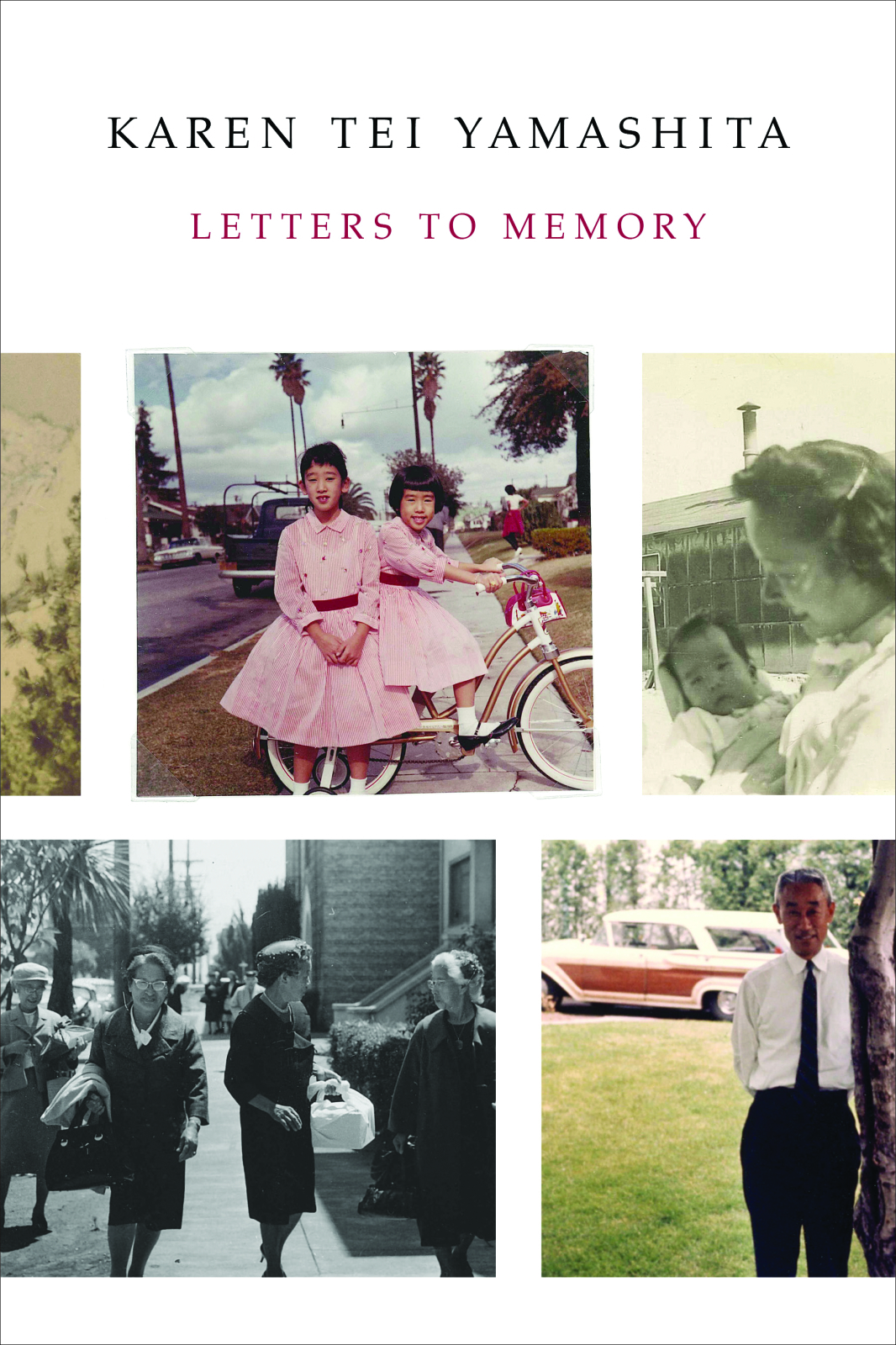
Letters to Memory
Praise for Karen Tei Yamashita:
"It's a stylistically wild ride, but it's smart, funny and entrancing." —NPR
"Fluid and poetic as well as terrifying." —New York Times Book Review
With delightful plays of voice and structure, this is literary fiction at an adventurous, experimental high point." —Kirkus
"Magnificent. . . . Intriguing." —Library Journal
"This powerful, deeply felt, and impeccably researched fiction is irresistibly evocative." —Publishers Weekly (starred review)
Scintillations is an excursion through the Japanese internment using archival materials from the Yamashita family as well as a series of epistolary conversations with composite characters representing a range of academic specialties. Historians, anthropologists, classicists—their disciplines, and Yamashita's engagement with them, are a way for her explore various aspects of the internment and to expand its meaning beyond her family, and our borders, to ideas of debt, forgiveness, civil rights, Orientalism, and community.
Karen Tei Yamashita is the author of Through the Arc of the Rain Forest, Brazil-Maru, Tropic of Orange, Circle K Cycles, I Hotel, and Anime Wong, all published by Coffee House Press. I Hotel was selected as a finalist for the National Book Award and awarded the California Book Award, the American Book Award, the Asian/Pacific American Librarians Association Award, and the Association for Asian American Studies Book Award.
"It's a stylistically wild ride, but it's smart, funny and entrancing." —NPR
"Fluid and poetic as well as terrifying." —New York Times Book Review
With delightful plays of voice and structure, this is literary fiction at an adventurous, experimental high point." —Kirkus
"Magnificent. . . . Intriguing." —Library Journal
"This powerful, deeply felt, and impeccably researched fiction is irresistibly evocative." —Publishers Weekly (starred review)
Scintillations is an excursion through the Japanese internment using archival materials from the Yamashita family as well as a series of epistolary conversations with composite characters representing a range of academic specialties. Historians, anthropologists, classicists—their disciplines, and Yamashita's engagement with them, are a way for her explore various aspects of the internment and to expand its meaning beyond her family, and our borders, to ideas of debt, forgiveness, civil rights, Orientalism, and community.
Karen Tei Yamashita is the author of Through the Arc of the Rain Forest, Brazil-Maru, Tropic of Orange, Circle K Cycles, I Hotel, and Anime Wong, all published by Coffee House Press. I Hotel was selected as a finalist for the National Book Award and awarded the California Book Award, the American Book Award, the Asian/Pacific American Librarians Association Award, and the Association for Asian American Studies Book Award.
184 pages, Paperback
First published January 1, 2017
About the author
Karen Tei Yamashita
26 books232 followersBorn January 8, 1951 in Oakland, California, Karen Tei Yamashita is a Japanese American writer and Associate Professor of Literature at University of California, Santa Cruz, where she teaches creative writing and Asian American literature. Her works, several of which contain elements of magic realism, include novels I Hotel (2010), Circle K Cycles (2001), Tropic of Orange (1997), Brazil-Maru (1992), and Through the Arc of the Rain Forest (1990). Tei Yamashita's novels emphasize the absolute necessity of polyglot, multicultural communities in an increasingly globalized age, even as they destabilize orthodox notions of borders and national/ethnic identity.
She has also written a number of plays, including Hannah Kusoh, Noh Bozos and O-Men which was produced by the Asian American theatre group, East West Players.
Yamashita is a finalist for the 2010 National Book Award for I Hotel.
She has also written a number of plays, including Hannah Kusoh, Noh Bozos and O-Men which was produced by the Asian American theatre group, East West Players.
Yamashita is a finalist for the 2010 National Book Award for I Hotel.
Ratings & Reviews
Friends & Following
Create a free account to discover what your friends think of this book!
Community Reviews
Displaying 1 - 27 of 27 reviews

December 28, 2017
I picked up Letters to Memory thinking it would be a family memoir of internment. I was wrong--it's much more interesting than that. Yamashita plays with form and literary tradition in order to tell a complex story. It doesn't come to a traditional climax and denouement because, like many stories, it isn't really over.

September 25, 2019
Stars are for my level of enjoyment, not for the success of this ambitious work or the writer's skill. This book was tough for me. The long philosophical jaunts, the meandering thinking and abstraction, mythology. I appreciated how she tackled what sounds like a mountain of family artifacts.

January 30, 2018
Karen Tei Yamashita's epistolary memoir is detailed, intellectual, and haunting. Letters to Memory tells the story of Yamashita's family through their letters, journals, and personal documents as well as Yamashita's letters to famous poets. In these letters Yamashita engages with them on their own work, describing Homer's Iliad to Homer as sometimes boring or the asking Vyasa about the violence in the Mahabharata. The root of this book is the experience of Japanese internment during WWII and it is undeniably honest in its exploration of that history. The book sometimes feels disjointed but in a way that encouraged me to dig deeper into the work. It is unlike anything I have read before.

July 20, 2020
LETTERS TO MEMORY by Karen Tei Yamashita is one outcome of the compilation of the Yamashita family archives. She sifts through letters, photos, documents, journals and art relating to her Japanese-American family. The central event of this archive is the second world war, with Japanese-Americans rounded up in detention camps as the two countries went to war, a war that finally ended with the dawn of the atomic age. Yamashita makes sense of this record and the people in it through her own letters to imagined correspondents - muses, as she calls them in an afterword. There is much here about identity, loyalty, memory, family, faith and philosophy. For a book centered on Japan and America, there is a surprising amount of recourse to Indian myth and folklore. But there's also the Iliad, the Bible, and Yamashita's own more agnostic worldview. Finally, this is, in the best sense, a book about everything. Everything that matters.
September 8, 2018
I really wanted to like this book and hoped to learn something about Japanese American history. I consider myself open-minded to unusual writing styles and story construction, but in this case the author's creative stylings just took up space rather than enhance the story. It wasn't all-foam-no-beer, but if you're looking for a book with stories of Japanese-American families during WWII, Stubborn Twig is far superior: https://amzn.to/2QkDCAW

July 16, 2018
Don’t know why I read this book. Hated the style from the first page on.

October 18, 2021
"…the idea of God made the modern world possible. The authority of a universal God creates the possibilities or perhaps the arrogance of discovery and investigation."
January 12, 2018
Not what I was expecting. Not a historical tale of days in the camps but instead mostly the before and after. Emphasis definitely on a family trying not to let such a horrible 'evacuation' define them but at the same time unable to escape the legacy of what an America at war did to its own citizens. Beautiful prose demonstrating the difficulty of reconciling whole neighborhoods, families, and livelihoods disrupted and then the difficulty of reintegration afterward. Though the author was not in the camps she is also touched by the legacy. It is kind of the author to end in contemplation of laughter and the role of suffering; the great equalizing of all in death, but she does well to maintain the stain of bitterness that this dark history has left.
January 27, 2022
Sorry. Just don't get it. Intentionally obtuse with references to all sorts of disconnected things. Japanese-American internment camps during the 1940s and slavery of black Americans and ancient Indian myths and Buddhist theologies - letters written to characters with no explanation who they are supposed to be or represent. Philosophical mumbo-jumbo and esoteric navel gazing. Even with the family tree schematic in the back of the book I couldn't keep track of who was doing the action, were we in the recent past or biblical past or some imaginary past...This is supposed to be one of Yamashita's more "approachable" books - if that's the case I won't be reading any of her other books. Just finishing this mess was a real slog and an effort of will.

June 15, 2018
My professor gifted me a copy of this book since my master's thesis relates to the subject of Japanese-Americans interned during World War II. I appreciated the words that Yamashita used to describe a story using her own family tree. It makes the reader feel awash in feelings of the past, even though you're not connected to it in any way. As a reader I was amazed at the level of study and collections of past family letters, papers, photos, etc, that were sorted and catalogued in order to write Letters To memory. It makes you think about which family member will be the memory keeper for your own family.
June 18, 2024
A beautiful work that weaves together traditions, cultures, art, and history into a beautiful story. I’ve never read anything like this book. Yamashita pens letters to her family that survived Japanese internment and to philosophers/significant figures across religious traditions. It beautifully witnesses to the Asian American experience and is an artistic protest against racialization.
Interestingly, the book is theological in nature. Yamashita is daughter of a pastor, John Yamashita, who studied with Howard Thurman. I found this fascinating.
Interestingly, the book is theological in nature. Yamashita is daughter of a pastor, John Yamashita, who studied with Howard Thurman. I found this fascinating.

September 21, 2020
Karen Yamashita Is helping clean up her aunt's apartment after her death. She finds letters and pictures of her family's life which starts her project of collecting all of the family papers which chronicles their life in America through incarceration, resettlement and building new lives. This is also combined with the author's reflections. This is a complex read and thus betrayal by the American government affected the family throughout the generations.

January 10, 2021
Exhilarating. What a beautiful exploration into family, memory, remembering, retelling, forgiving, all the things. What do you do with all the things that are left behind? What is your responsibility to tell them? How should one tell them?
Also I can't stop thinking about this: "It's hard to theorize my birth, especially since I rather enjoy being here."
Also I can't stop thinking about this: "It's hard to theorize my birth, especially since I rather enjoy being here."

Did Not Finish
July 27, 2022My second failed Karen Tei Yamashita read attempt. Sorry, I really liked "Through the Arc of the Rainforest" but I'm just too dumb to get the other stuff. I would have loved to read this in undergrad alongside a history lesson or two and a professor I admired. By myself, I'm only left grasping at what I could imagine gaining.
August 28, 2019
I actually very much enjoyed this book. Reading it for school definitely brought down my attitude starting it but Yamashita really brings up topics that you need to stop and think about due to the rawness of them. Hope to learn more about her.
July 18, 2020
I feel like I probably missed some layers because the style wasn’t really my thing, but I’m glad this exists and that small personal stories beyond the main overarching narrative of internment (which I’ve read a lot about at various museum exhibits etc) are being told.
October 20, 2021
I really wanted to like this book and I enjoyed the parts when Yamashita considers her family. I don’t think the epistolary style enhanced it and I didn’t get enough out of the people to whom Yamashita was writing.

January 21, 2026
really a special book . I want to look at it again slower and on my own time (read in like a week for a class) because it is structurally so remarkable and the prose is wonderful and images really become part of the prose!! sad in a way that is so unique

April 17, 2018
I heard so much about this book and thought I'd like it, but the writing style just wasn't my thing, even though as a historian, I enjoyed learning new facts.

October 17, 2018
I really wanted to like this but it was too idiosyncratic and stylized for me. I could see how this book, if you're the right person, would be an amazing gem. Pay your money, take your chances...
May 24, 2019
Beautifully written with compassion, humor, and honesty. Yamashita writes with a blend of storytelling, philosophy, and poetry. I really liked her style!

May 21, 2020
I can’t wait to reread this at some point, it moved me deeply.
January 7, 2023
very cool & unique narrative? reflection writing style on facets of the japanese american experience during internment and her ancestors lives

March 14, 2023
It was alright
February 23, 2024
This little book is definitely more of an experience than any sort of narrative. A lot packed into it. Left me bewildered at times and fascinated at others.

June 7, 2026
A creative mix of letters, musings, photos (from her family), about the Japanese American experience during WWII.
Read
January 29, 2018Fiction Y197L 2017
Displaying 1 - 27 of 27 reviews