Jump to ratings and reviews
Rate this book

Climate Leviathan: A Political Theory of Our Planetary Future

Rate this book
How climate change will affect our political theory—for better and worse

Despite the science and the summits, leading capitalist states have not achieved anything close to an adequate level of carbon mitigation. There is now simply no way to prevent the planet breaching the threshold of two degrees Celsius set by the Intergovernmental Panel on Climate Change. What are the likely political and economic outcomes of this? Where is the overheating world heading?

To further the struggle for climate justice, we need to have some idea how the existing global order is likely to adjust to a rapidly changing environment. Climate Leviathan provides a radical way of thinking about the intensifying challenges to the global order. Drawing on a wide range of political thought, Joel Wainwright and Geoff Mann argue that rapid climate change will transform the world’s political economy and the fundamental political arrangements most people take for granted. The result will be a capitalist planetary sovereignty, a terrifying eventuality that makes the construction of viable, radical alternatives truly imperative.

224 pages, Hardcover

First published January 1, 2018

129 people are currently reading
2443 people want to read

About the author

Joel Wainwright

9 books9 followers

Ratings & Reviews

What do you think?
Rate this book

Friends & Following

Create a free account to discover what your friends think of this book!

Community Reviews

5 stars
111 (21%)
4 stars
202 (38%)
3 stars
155 (29%)
2 stars
43 (8%)
1 star
11 (2%)
Displaying 1 - 30 of 87 reviews
Profile Image for Bruno.
50 reviews13 followers
Read
June 27, 2018
I don't know how to rate this. It's very smart, but infuriatingly vague toward the end. Also it's stodgily academic at times. It takes the left reading of Carl Schmitt-- that he's right about the incompatibility of democracy and sovereignty, but wrong to jettison democracy. But that's just background; that's not their new contribution. It's a speculation about how the political will change in the face of a planet-wide crisis. They speculate on the emergence of a new Leviathan, a sovereign who can decide for the planet, and they speculate on what alternatives there might be to Leviathan. But their favored alternative, what they call Climate X, often sounds feeble and vague; when they gesture toward Negri and desertion, I get even more depressed than I am by the climate news. I was airily gesturing toward Negri and desertion while these guys were in high school. It did not get me far.
Profile Image for Murtaza.
713 reviews3,386 followers
August 6, 2021
The upheavals wrought by climate change are likely to generate serious transformations in how politics are conducted and conceived around the world. This book theorizes four possible political configurations in a climate ravaged world, the first being a Climate Leviathan (planetary governance, capitalist), Climate Mao (planetary governance, authoritarian), Climate Behemoth (nationalist governance) and Climate X (emancipatory governance with unclear contours). As per the title, most of the time is spent theorizing about the Leviathan, which the authors consider the most likely outcome. This Leviathan might look something like the United States today, or a superpower G2 conglomerate of the U.S. and China. It would be armed with an array of controlled international organizations and would arrogate itself global authority to intervene in the affairs of others on the grounds of defending the wellbeing of earth itself.

The authors spend a lot of time unpacking many theoretical underpinnings of the idea of sovereignty and states of exception and emergency. This is a book of political science with strong anti-capitalist leanings, with the authors clearly favoring some sort of global popular socialist resistance to Leviathan although they are not quite capable of articulating what this would plausibly look like. They do seem to potentially support a Climate Mao option in which some power on earth with global authority intervenes with force to determine who can and cannot emit CO2. Meanwhile they are dismissive of the Green Keynesianism/Green New Deal politics that liberalism is presently offering as an inadequate solution to our problems. They make a good point that these proposals are not quite as radical as their aesthetics suggest.

With fires raging across the planet, its difficult to deny that climate change is here and that it is going to have terrible consequences in the years to come. This is a bleak conclusion and this book is suitably bleak in its argument that we have already missed the window of opportunity to prevent these consequences from occurring. There is a lot of theory in here, some of it quite thought-provoking, but I would've enjoyed more practical discussion of what the Leviathan might look like as it emerges during our lifetime. I'm not fully convinced that our present elites are competent enough to enact global government, as this book seems to take for granted.
102 reviews13 followers
May 19, 2019
The climate crisis is here. What political forms will the world’s response take? According to Mann and Wainwright, the most likely answer is Climate Leviathan, a kind of global sovereign with the power to declare emergencies, decide who should be spared and who must be sacrificed. They argue that the implications of how the climate crisis is and will produce new forms of sovereignty are just as important for the left to consider and respond to as capitalism.

The authors’ case is strong, and they are right to critique the left for often neglecting issues around sovereignty and constitutional forms. We need to take seriously the risk of eco-fascism and/or that the global poor will be deemed collateral damage by the great powers.

The issue is that this is pretty much set out sufficiently by the second chapter, and the rest of the book is almost embarrassingly unreadable. Chapter 4 is basically gibberish, Chapter 5 tries to explain the history of capitalism in a single chapter, Chapter 6 is an interesting but slightly out of place deviation into interstellar weapons, and the closing chapters are very vague. The writers exhibit the very worst traits of left academic writing: a lack of editing, the use of more complex words than are needed to signal their leftism (don’t say ‘the present conjuncture’ when you just mean ‘the present’), etc. But probably the oddest thing about this book is their use of references. Adorno features throughout, without a single mention of his disillusionment with socialism and transition into a full-on liberal by the end of his career. There’s also little reflection on whether Adorno, and others quoted, mean when they speak of ‘nature’ - I’m not so sure it’s intended in the way Mann and Wainwright want it to mean. Keynes is bad, but Schmitt is used approvingly throughout. The most successful parts of the book come when it focuses in on the theory of the state and the literature on totalitarianism/states of exception, and this is where it probably should have focused.
Profile Image for Geoffrey Gordon.
34 reviews6 followers
January 9, 2019
Climate Leviathan is an ambitious book. The authors begin by pointing out the limits of Green New Deal-style economic solutions, arguing that the limited conception of adaptation adopted by climate scientists and political leaders doesn't go far enough because it doesn't strike at the root of the problem of climate change, which is capitalism itself. The Green New Deal (or, as they call it, "green Keynesianism") aims to bring about changes in consumption patterns through tax and industrial policies, but the authors argue that this amounts to rearranging the deck chairs on the Titanic. The authors then speculate about how the consequences of climate change will affect global politics, arguing that emergencies brought about by climate change (migration, famine, disease, etc) will result in the exercise of planetary sovereignty by the US, China, or some coalition of powers, who will dictate how the world adapts to climate change, ensuring that adaptation doesn't harm their interests (or the interests of their ruling class). This is the 'climate leviathan' that gives the book its name. To counter that, the authors argue for a "Climate X" strategy, in which social movements push for a climate justice agenda that includes redistribution of wealth, liberal migration policies, and far-reaching changes to the economic system.

I gave this book four stars (really 3.5, but I rounded up) because I think that their critique of Green New Deal policies is persuasive, and their analysis of the emergence of a 'climate leviathan' is plausible. However, if they aimed to write a book that will actually be read by climate activists, they could have done without the digressions into political philosophy. They could have gotten their main points across without going down the Gramsci/Schmitt and Hegel/Kant rabbit holes. I'm generally comfortable with dense scholarly writing, but they get too abstract for their own good, limiting the reach of their ideas. A stronger sense of who their intended audience is would have made this a better book.
Profile Image for Toni.
53 reviews16 followers
June 15, 2018
I hate to give this book a bad rating, because the subject is so important. But I would really not recommend anyone read this book, unless you're a total fanatic, or think everyday about the mass extinction period we live through, global warming or climate change or whatever you want to call it.

I'm also not quite sure why it was so dulling to read. The last chapters in academic books like these are often boring at best, sometimes stupid, as soon as they start asking themselves "What Should We Do About This?". They start mentioning all kinds of activism, you get the feeling they're never part of themselves. (Andreas Malm is one exception to this rule).

The task of the book is basically to join political theory plus climate science. Or: To join Agamben and Schmitt's theory of sovereignty as the power to decide the state of exception plus what we know about likely scenarios for our dying planet.

The elites who can call the states of exception these days, will do everything they can to consolidate their status, as climate changes increasingly unsettles what we took for granted as the stable background to politics. Their likely attempt will be to create a planetary sovereign, to decide on the exception to other political norms - in the name of "saving life on Earth". The COP-conferences are such an attempt - failed so far, but it's an embryo for a world state, to trump all other concerns.

I might return later to give a better summary of the book. It has good points. It's not written by poets and it's not written with passion. You get the feeling that they re-used many dry academic papers in the book's chapters. There is something to learn from it, but I wish someone would do the work of synthesizing or pilfering the book for it's points, so people don't have to go through this stuff all the way ...
Profile Image for Gustav Osberg.
21 reviews19 followers
June 25, 2022
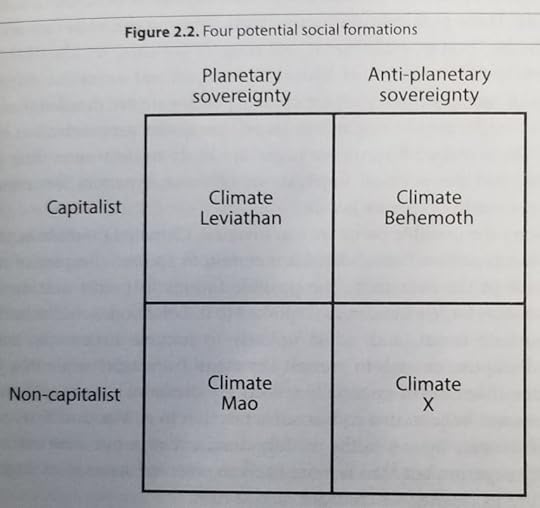
What actor will facilitate the great transition to a fossil-free society and how world politics will be changed by climate change are grand questions that this book bravely seeks to tackle. It does so by outlining four potential social formations: climate leviathan, climate behemoth, climate Mao and climate X. Each scenario represents extremes on a spectrum with two axes: degree of capitalist and planetary sovereignty.

Climate leviathan is the book’s central concept. It is capitalist and is defined by its dream of planetary sovereignty. Its central thesis is that the drive to defend capitalist social relations will pull the world towards the climate leviathan, partly through adaptation projects that can allow capitalist elites to stabilise their position amidst planetary crises. The rhetoric justifying its emergence and stabilisation is one revolving around a state of emergency and exception, which will slowly be replaced by an unprecedented paradigm of security as a new normal technique of government. Built on a democratic legitimacy (although a thin but sufficient), climate leviathan binds technical authority and scientific issues together with a global monitoring machinery (of both natural and social processes).

We can see the tendencies of the climate leviathan already. Capitalism is not understood as a problem, but as the solution to climate change, which is merely another obstacle to humanity’s great quest for progress. This is where the ideology of liberalism comes in as the climate leviathans defining doctrine since the freedom it produces (and has produced historically) is dependent on the unfreedom it creates for others excluded.

Climate Mao is also planetary sovereign but anti-capitalist. It’s most applicable for large parts of Asia since these are the territories where climate change will have its most fatal impacts and thus generate crises which can be exploited for the sake of political mobilisation. The vanguard party is here a key player to represent the wills of the masses. Today, China is (unsurprisingly) the country showing the most inclination towards this model.

Climate behemoth is the extreme result of reactionary populism or anti-state democracy. It is thus most applicable to the capitalist core as seen in the contemporary examples of Trump, Brexit and Modi which have successfully recruited the proletariat to its causes (through materialist arguments) while managing to empower elite experts.

Finally, Climate X is the just and truly democratic alternative; what the left must become to stand a chance against the other models. As I will mention below, the model is vague in its formulation, perhaps to accommodate the space necessary for it to emerge creatively and organically. All I can say is that the model is clearly inspired by Gramsci.

Apart from the above four models, the book contributes to a discussion of what is to be considered ‘the political.’ The authors argue for a deepened notion of the political. They initiate the discussion around Aristotle’s ontology of man as ‘zoon politikon’, i.e., man as a being whose very animality is social and hence political.

However, we are seemingly stuck in an ‘episteme’ (dominant model of reasoning) of a post-political understanding of climate change. Matters are decided and concluded by expert regimes that assume a type of continued stability of our current political order (the IPCC is certainly guilty of this fallacy). Even the growing discussion around adaptation mostly assumes that we will learn to live in a hotter climate in a manner as similar as possible to how we currently live. It is here we must find the agency to adapt the system to our needs, rather than the opposite.

Conclusively, the authors do away with the post-political discourse by instead outlining an understanding of the political as the grounds upon which conditions (such as the ‘post-political’), institutions and struggles are formulated. Thus, the political defines a relationship between the dominating and dominated. This is different from seeing the political as the arena of struggle as what the authors propose is rather the grounds upon which the arena (and its conditions) rests.

Although not explicitly stated, I believe this is the insight Climate X must embrace to transcend the capitalist paradigm. However, the chapter on this last, but most important, formation is (perhaps consciously) vague.
Profile Image for Bryan Alexander.
Author 4 books316 followers
January 26, 2020
How might humanity respond to climate change?

Climate Leviathan explores one angle, the transformation of global politics. Unlike other accounts which address climate refugees or escalating conflicts, Mann and Wainwright focus on how governments could change.

Their major contribution is this breakdown of four possible futures:

Climate Leviathan is a world state or strongly bound alliance of states, committed to preserving capitalism while adapting to (not so much resisting) climate change. Mann and Wainwright see seeds of this in the Paris Accord (pre-Trump). A combination of ecological and financial crises may speed the Leviathan’s way as authorities can declare emergencies which require extraordinary powers (151).

Climate Behemoth: this is a world of nationalistic nation-states, each refusing to do anything to mitigate or adapt to climate change. The authors see Trump and Bolsonaro as examples of this attitude.

(NB: the name of this one turns on a neat bit of linguistics, arguing that the word is actually plural, rather than singular, so it fits well with a plurality of states. “behemoth is the plural of the Aramaic behema, ordinary cattle or beast”, 44 )

Climate Mao imagines, as you might expect, a Chinese government a bit more Maoist than it is at present, and able to influence much of the world. Here we see a combination of anti-capitalist politics with a strong, unitary or alliance-dominating government. It “reflects the demand for rapid, revolutionary, state-led transformation today.” (39) Signs of Climate Mao can be seen in China’s rapid, state-led development of solar power. However, contemporary China seems equally committed to participating in Leviathan.

Climate X: ah, this is where the book gets controversial (for example). The authors refuse to outline what such a future would look like. Instead, they see a non-centralized, anti-climate change world order as a space of possibility that we need to create. They do draw on some sources for suggestions, notably the tradition of left-wing insurgencies and of indigenous people’s movements (189).
…Climate X is a world that has defeated the emergent Climate Leviathan and its compulsion toward planetary sovereignty, while also transcending capitalism. This is obviously a tall order… (173)
(X here is the unknown in math, as well as a kind of lexical refusal of order.)

Mann and Wainwright develop these models by engaging with a wide range of political thinkers, from Schmitt to Gramsci. Their approach is deeply Marxist, but also one that resists state power (so no Leninism here). It's not a simple book. The later chapters in particular work carefully through pretty detailed readings and arguments.

I confess to disagreeing with aspects of nearly every chapter, either for readings I didn't like or for blindspots. I'm always glad to see anyone cite Adorno, but the optimistic interpretation didn't work for me. Absences were stronger. While the authors resist state power they refuse to acknowledge anarchist or libertarian work. Seeing Like a State's Scott, for example, would have fit in nicely with their appreciation of indigenous peoples' opposition to state power. The authors also have a bleak, nearly Malthusian approach to technology and innovation, setting the former aside without serious discussion.

That said, Climate Leviathan is a major work in the politics of climate change. It's a welcome left perspective.

My blog review goes into more detail.
Profile Image for Anna.
2,131 reviews1,034 followers
March 20, 2024
I had to take a break in the middle of reading Climate Leviathan: A Political Theory of Our Planetary Future, as it was making me too anxious in combination with news of February 2024 being the hottest on record in England, Wales, and the world. The rampant shifting baseline syndrome among family and friends in England, who complained about February weather being too cold when it was above 10°C, made me feel like my head was going to explode.

Anyway, the authors of Climate Leviathan: A Political Theory of Our Planetary Future attempt to condense the political possibilities of climate change into a neat two by two grid. This structure is similar to Four Futures: Life After Capitalism, except it draws predominantly on philosophy and political theory rather than science fiction. The two variables forming Wainwright and Mann's grid are planetary/anti-planetary sovereignty and capitalist/non-capitalist. Of the four possibilities, the one the book is named after combines planetary sovereignty (i.e. world government in some form) with capitalism. The name is inspired by Hobbes. Its non-capitalist counterpart is termed Climate Mao and seems to be a 'what if China takes over' scenario. The capitalist anti-planetary sovereignty scenario, which we're currently in, is termed Climate Behemoth and obviously isn't good. The fourth and final scenario is unfortunately named Climate X, which made me realise that Elon Musk has made an entire letter of the alphabet absolutely cringe. What a way to waste billions. In any case, the book argues that this non-capitalist and anti-planetary sovereignty scenario would be preferable to the other three but is also the least likely.

While reading Climate Leviathan: A Political Theory of Our Planetary Future I did find myself wondering: does this genuinely add anything to what I've already read? The authors critique, synthesise, and reference material from many authors old (including Marx, Gramsci, Einstein, Kant, & Adorno) and new (including Andreas Malm, Naomi Klein, Joseph Stiglitz, & Thomas Piketty). Of course building on previous research and placing your own contributions in a wider context is essential to academic writing. Yet I found little that seemed new to me and was merely reminded of the weakness of the Paris Agreement, the incompatibility of radical emissions cuts with capitalism, and the failures of adaptation to extreme weather. All very depressing, even when leavened with philosophical references. I did like how this point was phrased, though:

Leviathan's sovereignity is posited as nothing less than the functional social adaptation to the state of nature. This thread ties the entire Western European tradition of political theory together. Historically, appeals to nature and biology are always used to justify and secure the position of the prevailing elite. Nature sides with the powerful.

None of this is to deny the value of scientific study of nature, the legitimacy of evolutionary theory, or valid uses of the concept 'adaptation' in social and political analysis. We are all subjects of ideology. No one can wholly rejects ones conceptual inheritance any more than one can wholly refuse the knowledge it affirms. But grave problems arise when we forget the irrevocably metaphorical quality of all natural and biological concepts that circulate in political life.


This, on the other hand, was merely a huge downer:

To address its contradictions - including the ecological contradiction that capital's growth is destroying the planet - capitalism needs a planetary manager, a Keynesian world state. But elites have proven reluctant to build it, and it appears unlikely to miraculously realise itself. So, the only apparent capitalist solution to climate change is presently impossible; the only even marginally possible green Keynesianism that could save us is still predicated upon the territorial nation-state.

Climate Leviathan: A Political Theory of Our Planetary Future's tone and conclusions essentially presuppose that hope is lost. Climate Behemoth, the path we're currently on, is the worst of the four options on offer. Climate Leviathan looks impossible and would be oppressive; Climate Mao likewise. The latter sounded to me somewhat the the Climate Change War Communism briefly outlined by Andreas Malm in Corona, Climate, Chronic Emergency: War Communism in the Twenty-First Century. Climate X, on the other hand, appears impossible to articulate, let alone build a path to. Including proposals from Osama Bin Laden among the examples was audacious but probably unwise, as theocratic sovereignty doesn't fit neatly into any of the four grid squares.

I think Climate Leviathan: A Political Theory of Our Planetary Future seeks to combine philosophy in an academic mode with political writing on climate change policies in a popular non-fiction mode. I found it perfectly readable and clearly phrased, just didn't get a lot out of it myself as it forced much that I'd already read into a reductive grid format. The depressing tone is par for the course for any climate change book published since 2019, as things really are going to hell. Nonetheless, I would recommend the alarming insights of Naomi Klein in Doppelganger: A Trip into the Mirror World and Andreas Malm in White Skin, Black Fuel: On the Danger of Fossil Fascism instead. Both books are explanatory rather than theoretical; Climate Leviathan: A Political Theory of Our Planetary Future certainly reminded me that political theory based on 17th to 19th century philosophy isn't helpful or comforting in the face of climate catastrophe. For something hopeful, on the other hand, I suggest looking further back in time to The Dawn of Everything: A New History of Humanity by Davids Graeber and Wengrow.
Profile Image for Daniel Mitchell.
219 reviews2 followers
January 25, 2025
Hard to rate this bc I did not understand it bc I am dumb! I don't know Marxism, I studied biology more than 10 years ago! My eyeballs did move over every word and footnote, so maybe I got the gist, but do not ask me for even a one sentence summary. Capitalism bad. Sovereignty bad. I'd take a 10- or 16-week intro class on this topic though with a good teacher.
42 reviews1 follower
November 26, 2020
When i saw this quoted in Uninhabitable Earth I was intrigued by the premise - political theory of the world of tomorrow as climate change creates needs to change and adapt. I was unfortunately largely disappointed.

What i had envisoned (or hoped) for was a book grounded in geopolitics, a la prisoners of geography for tomorrows world. With Tetlock in the back of my mind i thought a lot may end up never coming to pass and being a waste of time but i was curious anyway. If like me you want pragmatic and grounded, go elsewhere. It had some - but it was very light. Their focus was mainly political theory of yesterday - Kant, Hobbes, Marx, among others. The writers only very abstractly incorporate it into the world of tomorrow. Some of it ok, but large chunks could have been cut, bits about science being social.... what an unnecessary tangent. Islam by 2050 will likely be the worlds largest religion - it got a page. Climate refugees got a brief mention and eco-facism didnt turn up - more time was spent fawning over Schmitt and Marx than factors that will impact.

My main issue with the book though is the academic writing - its been a while since I have a read a book this unreadable. The last time i did the book "Democracy: A life" had the decency to be worth plodding through. A personal thing for sure but I prefer accessible to academic writing.

Also just going in the writers are fairly big marxists - if you hate marxists for (insert your reason here) perhaps dont pick it up - many seem to be infuriated by their marxist appraisal of the world. I personally am fairly left wing with a marxist streak so i did not gasp at this, but maybe they could have been forgiven by others if they had compelling, understandable, evidence based points to make (they do not).

Though the theory itself is interesting, and make some good geopolitical points about the US and its capacity to reach planetary soverignity, thoughts on climate justice and a good case for Green Keynesianism. But its outweighed by throwing that case under the bus without evidence or fucking reason, a 24 page chapter on climate X where they didnt seem to make a single point, debunkable and tedious "capitalism is to blame" babble and seeming to think Indigenous people and vague Marxist theorists will be more relevant than gee i dunno. Water stress, rising sea levels, climate refugees and 70% of the world diet from 14 crops. A world where China is stretching its super power muscles, Islam will be the most populous religion, and countries like Russia will win from global warming despite causing it, as countries like Mali that didnt cause it lose out massively due to it. Meanwhile eco-fascists flip "We are the virus" to "They are the virus". Why? Birth rates? Refugees? Carbon produced? Perhaps they're just not from round here? THAT is what this book should have seen as its focus - theory grounded in the consequences of climate change, and those they are unleashed on, and how the asymmetric power structures will impact the relationships of those affected.

The question remains - how will this play out for us all? Can we possibly stand united? Can we save ourselves? Will I in 50 years time look across other continents and still see "we" and not "them?" I dont know, and I did not entirely expect full answers from this, afterall, its complicated. But I had hoped for a couple of good questions to be constructed from evidence and tried to be answered. I was left wanting.
Profile Image for Yngve Skogstad.
94 reviews22 followers
January 5, 2019
When I started studying political science a little more than three years back, it was in the hopes of coming to grips with the question of “can measures be taken to avoid catastrophic climate change while maintaining (what is commonly perceived as) a democracy?” The topic of this ambitious, and quite possibly prescient book is very closely related. Geoff Mann and Joel Wainwright see in climate change a challenge not only to the way we’ve structured our society in a material sense (at least in the industrialized world), but also to our conception of the political.

The authors’ main theoretic contribution is constructing a typology of four trajectories in a world where climate change is the main force configuring politics. The first question is whether the world will be governed through capitalist accumulation, market logic and the incessant expansion and exploitation which it entails. The second question is whether there will emerge a planetary sovereign which “can invoke the exception, declare an emergency, and decide who may emit carbon and who cannot. … [C]apable of acting both at the planetary scale … and in the name of planetary management—for the sake of life on Earth.” The four ideal types emerging from this taxonomy are Climate Leviathan (capitalist & planetary sovereignty); Climate Mao (non-capitalist & planetary sovereignty); Climate Behemoth (capitalist & anti-planetary sovereignty); and Climate X (non-capitalist & anti-planetary sovereignty).

I have so many thoughts after reading this book, and this is precisely the great strength of such a work of political theory. It helps us conceive of the current world in new ways that can inform our understanding of where we’re at, what we’re up against, and the internal contradictions facing us now and in the future. Hopefully, this understanding could indirectly spur change. But this isn’t a blueprint for what an egalitarian, post-carbon future looks like, or how we get there. Climate X, which the authors favour, lacks any semblance of tangibility and doesn’t address the problem of the insane power asymmetry between the powers that be and any climate justice movement. I mean, all other alternatives seem genocidal and ecocidal, so it’s sort of the only moral option, but… yeah.

As a final note, a weakness to this book that I think should be noted is that it deals exclusively with one ecological overshoot that capitalism perpetuates, namely that of atmospheric sinks of carbon-gases, and the climate change resulting from this. A lot could be said about the other ecological ceilings that we’re currently transgressing, like biodiversity loss, land conversion, and nitrogen & phosphorous loading. So even if this book makes you so depressed you want to kill yourself, just keep in mind it’s actually even worse.
Profile Image for Johan.
1,234 reviews2 followers
July 31, 2019
The subject is important, but the book is very hard to understand, bordering on unreadable.

The authors constantly refer to persons (philosophers, economists, political theorists?) I do not know, refer to ideas and theories I have never heard of and refer to books I haven't read, but they assume you do. The texts are very verbose, academic, and contain lots of jargon.

I am a geek, science buff, biochemistry engineer, eco-modernist and I assume that my knowledge of English is C1-C2 level, but reading this book gave me a headache. I think I somewhat understand what it is about and it sounds fascinating, but don't ask me any questions about it. Maybe I do not belong to the intended audience. Maybe you need to be a philosopher, economist and/or political theorist to understand this book. I can't recommend it.

I still gave it two stars because I feel it is an important book and I hope one day someone will make a 20-page summary for dummies.
Profile Image for Zack.
327 reviews5 followers
December 1, 2020
This book is an interesting read, with much to criticise, but some interesting and important questions raised. As the title suggests, it attempts to theorise and sketch possible or likely political developments, globally, in the light of climate crises’ impacts and attempts (failed or otherwise) at adaptation and mitigation. This is arguably a gap in much left-wing environmental discourse, and even though the authors don’t fill the gap well, they at least attempt to.

See my review here: https://workersliberty.org/story/2020... (as well as on this page)

The authors are influenced by, on the one hand, the climate justice movement, and, on the other, Eurocommunism, a 1970s-80s social-democratic or liberal strain of post-Stalinism; and their book is shaped by a dry academic lens.

Their relation to the climate justice movement makes them, I think, soft on its severe limitations. More fatally, they seem to see it as the starting point, and that, combined with their other political influences, paints the organised working class as a key environmental agent out of the picture. Their perspective has a large dose of what used to be called "Third-Worldism" (seeing progress as coming from a battle of poorer countries, all or most classes combined, against richer countries, all classes combined): indeed, one of their two non-capitalist futures is named after Mao Zedong.

Their preferred future, “Climate X”, may seem libertarian, but they celebrate many aspects of Maoism, a "Third-Worldist" Stalinism, and see a “red thread running from Robespierre to Lenin to Mao”. They distance themselves from Bolshevism by conflating it with authoritarianism and Maoism, so they jettison the valuable lessons from Bolshevism, but simultaneously they are influenced by some of their warped perception of a Lenin-Mao "red thread".

The poor record of Stalinism on the environment is ascribed to Leninism: “The Leninist tradition has much to offer, certainly, but there is a reason that so few Marxists prioritised the question of nature during the twentieth century.” They make a strange argument as to why Gramsci was not a Leninist, based in large part on debates over idealism vs. materialism. Beyond brief and positive mentions, they don’t engage with existing ecological Marxist literature.

Their vaguely-aspired-to “Climate X” seems to reflect a critique of “governmentality” derived from Michel Foucault and post-modernist authors; inspirations from predominantly indigenous groups and tendencies such as the Zapatistas; and the limited focus and strategy of the “blockadier” movements that the authors have participated with.

"Climate X" is one of four futures, or elements of futures, that they sketch. "Climate Leviathan" is where capitalism still exists but with a global “sovereign” or world-government which takes responsibility for climate mitigation and adaptation. “Climate Behemoth” is a reactionary capitalist opposition to this, based on nationalism or an assertion of national sovereignty against “planetary sovereignty”, and with support “from the fraction of the capitalist class with ties to fossil fuels.” The other two are “an anticapitalist, state-centred Climate Mao… and an anticapitalist, antisovereign Climate X”.

Some of the interesting and important questions which I took from the book can, I think, can be straightforwardly answered from a third-camp Trotskyist perspective, while others require further consideration. A mix of both:

• What are the likely political and economic developments over the coming century, in response to climate change and pushes for adaptation and mitigation, particularly while capitalism survives? What are the roles of ideology and of economics in this? How can we intervene?

• How should we think about and critique pushes for “Green capitalism” which are often “Green Keynesianism”, for example “Green New Deal” initiatives? Does supporting them legitimate the idea that climate change is solvable within capitalism, or that moving beyond capitalism is not on the cards?

• How far can international treaties between competing capitalist nation states get in mitigating and adapting for environmental crises? Would a unified capitalist world state, with more centralised direct control, get further? Will there be a push towards a world capitalist state? How far will it succeed and what will the backlash resemble, and what ideologies will these dynamics generate? What role will crises, climate migration, climate wars, play in such dynamics?

• On what basis, from what origin, and with what identity would such a “global sovereign” exist and come into being? Might part of the identity be — as they suggest — (cynical) claims to global stewardship, global environmental stewardship?

• What role will developments in space weaponry have in global politics? How will it relate to the establishment (or otherwise) of a planetary sovereign?

• And geoengineering? How far will current widespread opposition to it influence the future? How can we intervene? Given that most proposals harm some parts of the world significantly in order, theoretically, to help others, what will the political implications be? How will international agreements fare? Will these considerations push towards a planetary sovereign?

• How important a role does global spatial economic unevenness play for global capital (in terms of production and consumption)? Does this cut against a global state? Does it strengthen nationalism? Does opposing inequality and nationalism make a global state more likely?

• Would a global capitalist state be more or less likely to be authoritarian than a competing capitalist nation state? Or is this primarily down to class struggle? Does the possibility of no societies being free from a potentially authoritarian state pose particular threats to the socialist project?

• What would global inequality look like under a planetary sovereign? What would climate adaptation look like, and how would that relate to global inequality?

• In the face of climate crises, how should we think about nation states, sovereignty, nationalism, rights to national self-determination, and internationalism?

• Why is it — or is it? — more widely accepted that there is a failure, perhaps an insurmountable one, of capitalism in dealing with climate crises, than that there is a failure of “sovereignty”, or of competing nation states?

• Should we oppose moves towards a capitalist planetary state? Or, more aptly, under what conditions should we oppose or not oppose such moves?

• Do international integration and co-operation, lowering of borders, etc., that we favour, point towards an international state while capitalism exists? How can we further bring them about?

• Would UNFCCC (United Nations Framework Convention on Climate Change) and the COPs (Conferences of the Parties) form the basis of a global state?

• How should we think about UNFCCC and the COPs? What kind of protests should we direct at them? Do we want to strengthen them and beef them up, or destroy them? Does demanding that they do their job better strengthen an ideological hegemony in which capitalism and the nation state is assumed? How applicable in this situation are the perspectives of third camp Trotskyism about demands we make of bourgeois states, about united fronts, transitional demands, workers’ governments, etc.?

• Would a global state or sovereign be necessary in the first stages of socialism?

• Is there a problem with — beyond capitalism — a single “sovereign” planetary democratic and federated order? What are the limits of “sovereignty”, or “rights” to national self-determination — conceptually and politically?

• What role should people, and movements of people, currently living outside of direct capitalist social relations — e.g. some “indigenous people” — play in stopping climate change and capitalism, and building socialism? Do we need to be more imaginative about our envisioned post-capitalist societies?
Profile Image for Christina Dongowski.
258 reviews71 followers
August 25, 2025
I wondered how this book would hold up, almost 7 years after it was first published and big climate activist groups like Fridays for Future or Last Generation have functionally ceased to exist as a political factor, at least here in Germany and as far as I can see, in Europe. In a way, the book contains the explanation for their demise: Wainwright and Mann give a in-depth historically informed analysis of the paradoxes and dead ends climate activism runs into that does not address and acknowledge Capitalist state formation and social reproduction as the central force of the climate crisis. But to be clear: The authors themselves are not prophesying the eclipse of the (Western?) climate movement of the pre-pandemic era with its big protest marches because of its lack of a realistic concept of the powers they’re up against. This is something the reader today may learn from the book, but it is not what the authors seem to have been expecting while writing it almost ten years ago. What they’re setting out to do is to formulate the most probable scenarios where the international state-system is heading while and by confronting climate catastrophe: climate leviathan, a sort of neo-Keynesian liberal super state (basically the trajectory of the US and EU before Trump & the pandemic), climate behemoth, an authoritarian or neo-fascist national state, climate Mao, an authoritarian socialist super state (China, basically) and climate x, the post-capitalist post-sovereignty / post-state social form(s) that should be the goal of any climate movement. The vast bulk of their analysis concerns Climate Leviathan, Climate Mao is profiled against the Leviathan, Climate X is described in the last chapter of the book (which is really good and provides the outlines of a political theory that I would like to read more of).
In 2018, focusing heavily on Climate Leviathan was something that made eminent sense, but even than giving so little room to Climate Behemoth is an interesting choice: This is the period of the first Trump presidency. Wainwright and Mann give some thoughts on the transmutability from Leviathan and Behemoth, but there’s no systematical reflection, although Adorno, Benjamin and Gramsci play a major role in the book, all of them major analysts of the way liberal democracies of capitalist states have a strong tendency to become fascist. Now, that the US is on its way to become the fascist climate behemoth, this omission in the book may seem like a major flaw, but I don’t think so: It only shows how very true the main hypothesis of the book is: that climate activism, at least the Western left liberal variety, is much much to beholden to an image of liberal democracies that has scant basis in material realities.
36 reviews
May 5, 2020
This was one of my first ventures into "socialist" literature, which does take some getting used to. The book promises to look at different paths of (properly) responding to (rapid) climate change. As they state in the preface: "Rapid climate change will transform the global political economy and alter our world's basic political arrangements" ... "We argue that under pressure from climate change, the intensification of existing challenges to the extant global order will push existing forms of sovereignty toward one we call `planetary'."

To this end, they construct four potential social formations, each given biblical or historical names. Climate Leviathan denotes capitalist, planetary sovereignty. Climate Mao an anticapitalist, state-centered formation. Climate Behemoth is anti-planetary sovereignty but is a reactionary capitalist formation. Finally, Climate X is an anticapitalist, anti-sovereign "worlds within worlds".

They do not necessarily say one of these paths is taken. One might rise to predominance but our future will be shaped by the interaction and the conflict between these formations.

Climate Leviathan, the center of the book, is a planetary sovereign, a regulatory authority that has democratic legitimacy and technical authority and the data to use it. It is also a capitalist dream; this authority would impose regulations on current "free" market systems, primarily to save the planet. However, it will come to be out of the current hegemony, the global elites, which are able to save their own hides.

Climate X is its antithesis. It comes to be not out of the hegemony, but out of fringe-groups. The example given is indigenous people, mostly referring to native Americans. It is concerned both with dealing with rapid climate change but doing so while serving climate justice. Climate Justice is a concept that might be new to many people not already familiar with climate movements but is important. In a normal setup, the elite are able to buffer against detrimental change. The non-elite aren't able to, so they take the brunt of it. This is apparent whenever conflict arises, whenever the market fails. When, during the current COVID19 crisis, airlines fail, it is not their leadership that takes the brunt of the force. No, their income is safe, but they discontinue many temporary positions and apply for government funding. Also mentioned in this context is "Privatising the profit, socializing the losses".

Climate Mao is the non-capitalist alternative of a planetary sovereign. It "expresses the necessity of a just terror in the interests of the future of the collective, which is to say that it represents the necessity of a planetary sovereign but wields this power against capital". It determines who is allowed to emit carbon. It is the climate response equivalent of the Chinese state putting a highway through your front yard to the benefit of the collective.

And then, the "specter haunting the world's core capitalist states today is that of reactionary conservatism." Climate Behemoth, opposing the drive for planetary sovereignty. The leadership is a fraction of capitalists with ties to fossil fuels. Their most willing allies (and voter base) are "segments of the proletariat that perceive climate change not only as a threat to their jobs and cheap energy but also as a sophisticated means to empower elite experts and hinder the exercise of national(ist) sovereignty." Their summation of the movement is interesting: "mobilized around ethnoreligious nationalist (and often hyper-masculinist) ideologies." They "dismiss the threat of climate change and international regulation in the name of an unfettered capitalist market".

It is clear from the writing, the focus, and of course the title of the book that the authors regard "Climate Leviathan" as the likely outcome. They take care to express that this is not necessarily the "best" outcome, but merely the "most likely".

However. One major shortcoming throughout the book is the focus on the USA, the movements within the USA, and of course the USA. While China does get some attention, in formulating why it should be regarded as a capitalist state that is authoritarian, and that is starting to assert its political-economic power. Russia is mentioned in passing, Africa is mentioned in the context of a book and the EU is disregarded altogether.

When one takes a look at the future, one should consider many different paths. The USA is a known power, but one whose dominance is lessening rapidly. China is quickly ascending towards a (more) dominant position, which is only strengthened by the decision of the USA and EU to outsource most of the tech industry to them. India is running the backbone of the world's software, in the same way, that China does for hardware. The EU is still divided, but the current stirring of "behemoth" movements can also possibly just forebode the rise of movements that oppose it. I would guess that Africa is not going to be a dominant power at the same level in time to prevent disaster (but would like to see that explained clearly, rather than disregarded).

This became apparent only near the end of my reading when I realized that the Climate X discussion mostly referred to the culture of Native American tribes. Climate X is a very complex scenario, in that it would overhaul the political-economic landscape of the world. It is mostly explained why it is just, why these movements would try to argue for it and that a sound framework for the changes of this splintered movement is missing. All these smaller movements, of different groups within the world's population expressing that their stakes in climate responses are different than that of other groups, would somehow come together to form a conglomerate that does justice to all. This is beautiful, utopian, and probably unrealizable. By pointing out the lack of a sound framework for doing this, nothing much is gained.

I think religion was mentioned in the context of climate X, mostly then digressing into whether or not religion could lead to a sovereign of the kind that would be helpful. Most emphatically, it is said, "No", because the basis would be wrong. It's not clear whether or not that would serve the ends; the means are wrong, and therefore "No". It is also a discussion primarily centered on the actions of Pope Francis, an 84-year-old man who caused a rapid shift in church politics. I'm guessing that is not a shift that will survive him. It is also a bit weird to once again only digress into the familiar; Christianity is the majority religion (29%), about half of which are Catholics, but the Islam (24%) is the religion that is still gaining followers. Hinduism (14%), Buddism (6%) and non-religious of all kinds (14%) are the largest after that.

With that in mind, it seems that the book has an audience: most Americans back home. To describe the image mockingly: The EU is mostly a market for selling commodities, Russia is a scary opponent vanquished in the past and the Chinese are a scary opponent for the future. Africa is sand and India is full of elephants.

Disregarding that audience, the book does an excellent job of making its points. First, that capitalist market failures are an issue. That rapid climate change is the largest example of that and needs to give rise to a planetary sovereign that represents the common good. In a nation-state focussed solution, it would be to the benefit of every nation-state to lag behind slightly on taking measures on carbon emissions. In fact, this is one of the most-heard arguments against reducing carbon emissions: "Why would *we* be the one?". Why "Not someone else?". Indeed, "Not in my backyard."

In fact, the book mostly outlines three transnational formations that attempt to tackle rapid climate change. And one, the behemoth, that doesn't tackle it at all. Effectively, the three effective paths are a "Democratic Capitalist path" (Climate Leviathan), an "Authoritarian Capitalist path" (Climate Mao), and "Something new that is neither" (Climate X).

There is nothing wrong with that. Writing to the audience back home, the authors are trying to get across the point that a transnational authority is required. One that, contrary to the Paris Accords, has some real backbone. One that transcends current elections and focusses on technically sound responses. The way the book is set up, they finish with how sad it is that this response won't be great on climate Justice (as Climate X would be).

What I would have wanted to see while keeping the spirit (and audience) of the book is a larger exploration of climate behemoth movements. These are extremely current and seem to be on the rise throughout the USA (Trump) and Europe (e.g. Johnson). Depending on the political game of the nation-state in question, right-wing authoritarian leaders (such as Trump) are taking the field while the centrist and leftist movements seem to be bankrupt for clear leaders. As a result, it seems the political landscape is not only ripe for Climate Leviathan and Behemoth, but also for a counter-movement of Climate Maoist - Leftish Authoritarian Leaders! Of course, this trend has become more pronounced in 2019 when the book had already been out for a year.

Overall I enjoyed the writing style of the book, its clear exposure of concepts and ideas, and the way it got its points across. It does love its hegemonies, but I've been told that leftish literature does this in general. I'm subtracting one star not for its audience, but for not trying to take that audience a bit outside of its normal scope and telling it about the other 90% of the world population.
This entire review has been hidden because of spoilers.
Profile Image for Ali.
124 reviews1 follower
Read
March 15, 2025
would've liked more sustained analysis on climate x, and the writing didn't revolve around their typology enough so was a bit lame

also the words conjecture and conjuncture are my ops now
Profile Image for Finn Haberkost.
13 reviews2 followers
November 14, 2023
"One of the most profound paradoxes of climate justice is that our work is oriented toward an open, just future for those to come, particularly the descendants of the world's less powerful, but this future is so undeniably bleak that any informed, rational response is likely to pull us toward Climate Leviathan, because the further consolidation and expansion of extant power structures would seem to be the only structure of scale, scope and authority even close to adequate to the challenge of climate change."
Profile Image for Jorgon.
402 reviews5 followers
May 31, 2019
Five stars for the development of a useful framework for treating future global political developments in light of climate change. One star off for each A.universal and sometimes silly applications of historicism; B.attempts to undermine modern liberalism by pointing out its contradictions while at the same time attempts to promote a more democratic politics for the future while...pointing out its contradictions; and C.language that on occasion evoked for me old meetings and speeches in the 1970s USSR, where I grew up, to which I am extremely allergic, and which is both overwrought and vague to distraction.
Profile Image for Josh McBee.
3 reviews
December 5, 2020
Tedious and often borderline incomprehensible. This is a book that presents itself as offering some deep thinking about climate change, but in the end, the authors don’t do not even attempt to describe their alternative vision for the future in enough detail for it to even come close to having any clear practical implications. To somewhat garble an old remark of Jerry Fodor’s, this is not a way for grown-ups to spend their time. Climate change is far too serious problem for this sort of nonsense.
Profile Image for Dena.
76 reviews
January 18, 2023
This book was a struggle to get through, and I’ll admit I was tempted to give up multiple times and read something I’d enjoy more. I’m glad I have a background in environmental studies, which made it a bit easier to understand everything. It almost felt like I was reading a textbook. I’m being generous with the three star rating, I’d give it more a 2.5. If you’re looking for a political/economic analysis of our climate, and have a background in a related field, then give this a read. But, I’d read other environmental books over this one.
Profile Image for Dan.
Author 16 books156 followers
March 4, 2019
Absolutely superb intervention that sketches out four ways in which inevitable climate catastrophe will reorganize the global political economy.
Profile Image for Andrew.
140 reviews48 followers
October 18, 2023
The middle section of this book says everything you need to know about the absolutely degenerate state of the academic left. Gramsci worshipped as the central Buddha like figure of all leftist thought, stripped of any historical context of his thought, divorced from any the class politics he was engaged in in his time, stripped totally of the deeply sophisticated historical class dialectics he was analysising, raped, mutilated beyond recognition and subsequently dumped into a layby as he is transformed into some kind of folksy, idealist, worthless pseduo postmodernist with their selective quoting and wretched ideological debasement (especially in their understanding of Lenin, which falsely presumes a divide between the 2 long since discredited beyond dispute by Perry Anderson). Endless whining and cunty fucking complaining about historical materialism, trotting out the old, sad, tired, pitiful, decaying circus animals of high critical theory to perform their tortured, exhausted tricks (class reductionist, vulgar empiricist, wut abut my thoughts and feelingz duh) the revolting stain of the cultural theorists who elevated their own nauseating narcissistic proffessions (that of forming ever so profound Didcourse, chatting, talking, writing, debating- essentially anything that does not involve supporting a fucking picket line) into the singular ur-model of political struggle.

Filled to the brim with absolute postmodernist horseshit. Science bad. Science evil. Science is a social construct. Science is full of evil White Straight Men embodying 'Enlightenment discourses of fouculian power control in a biopilitical eurocentric/westonocebtric blah fucking blah' why won't someone waterboard these two cretins. In shitting on science, they already display their irrelevency in discussing any single facet of the climate crisis. These worthless chimpanzees masquerading as intellectuals wallow in the same pit as holocaust deniers and COVID denialists in their absolute contempt for the truth, their veneration of ideology over material reality, their fetish for discourse over class, their obssession with abstractions over concrete politics. Marx bad. Lenin good. Postmodern Gramsci good. Schmidtt, an Actual Nazi, is more valuable to these crypto-anarchist mayo brains that Lenin. There is not enough vomit in the world that could be produced upon reading this feculent, left-Nietzsche sympathising, postmodernist crap.

It's worthless, endemic, rancid cow shit. Makes one wish for a new Pol Pot to send all the academics to the countryside and destroy their shitty work. Judging from the attempts seen here, almost nothing of worth would be lost.
Profile Image for Andrew.
663 reviews164 followers
September 25, 2023
I may have to stop reading books with "theory" in the title, just don't have the attention span for it anymore. Or the political patience.

I think I would have really enjoyed this as a long-form article, because the argument is thought-provoking and I appreciate the relatively novel Punnett Square model with Leviathan/Behemoth/Mao/X. Ultimately though the authors did not explain clearly enough for me a) what Climate X would actually look like and b) why Climate Mao is unworkable. Coming at this as mostly a Marxist-Leninist I am very skeptical that anything as drastic as needs to happen can be done without a state.

This is a similar critique to the one I had about a very good recent book by Peter Gelderloos, The Solutions Are Already Here. I highly recommend it even though I'm also skeptical Gelderloos's ground-up approach is scalable and physically defensible when capital comes knocking (see my review). What I enjoyed much more about Solutions than this one is that it is heavily focused on praxis rather than theory. It is a good counterpart to this one, and in hindsight it feels unfortunate that Gelderloos appears to have written his book before he could read and include comment on Climate Leviathan.

If you like political theory I would highly recommend this book in addition to Solutions, but if you're like me and get impatient with theory then I'd suggest skipping it and just going with Gelderloos.

Not Bad Reviews
Profile Image for ben.
47 reviews
April 23, 2020
Leviatán climático es un Estado-Planetario con el que la organización social del mundo pasará por una reformulación drástica, por el hecho de la necesidad de adaptarnos a un mundo caliente.
Si te has preguntado sobre las posibilidades de orden político que el mundo podría devenir, sobre la situación actual de las políticas liberales tratando el medioambiente (con una suerte de esperanza por un sistema que progrese de manera Sustentable), sobre las decisiones y la relevancia que el continente asiático (China en particular) podría tener sobre una nueva soberanía estatal alternativa al capitalismo neoliberal, sobre el movimiento actual por la justicia climática en el mundo...
Un libro que te argumenta posibilidades sin caer en la certeza de nada, porque sencillamente no sabemos qué chucha va a pasar.
Profile Image for Matt Knox.
90 reviews6 followers
Read
February 9, 2021
A stimulating exploration of sovereignty in the era of climate change. However, I found myself wishing there was more discussion of the concrete steps we are already taking towards a possible "Climate Leviathan" (or other possible scenarios), such as policies enacted by the IMF, World Bank, etc. to confront climate change.
Profile Image for Lisa.
110 reviews4 followers
October 30, 2023
Sometimes to feel more in control of the uncontrollable I look for as much information as I can. This checks that box and explains how we got to the point where we need to think about living with the world we are in rather than changing it, because it can be a depressing world out there when you want things to change but the timer has run out.
Profile Image for Horza.
125 reviews
Read
January 21, 2022
Has its idiosyncratic moments but won me over at the end.
Profile Image for Stephan.
7 reviews
August 20, 2022
I liked the book although it was a slow reading. The last chapter on Climate X brings it all together.
I really like one of the last sentences of the book the my son marked in his copy.
"The planetary crisis is, among other things, a crisis of the imagination, a crisis of ideology, the result of an inability to conceive any alternative to walls, guns and finance as tools to address the problems that loom on the horizon."
Displaying 1 - 30 of 87 reviews

Can't find what you're looking for?

Get help and learn more about the design.